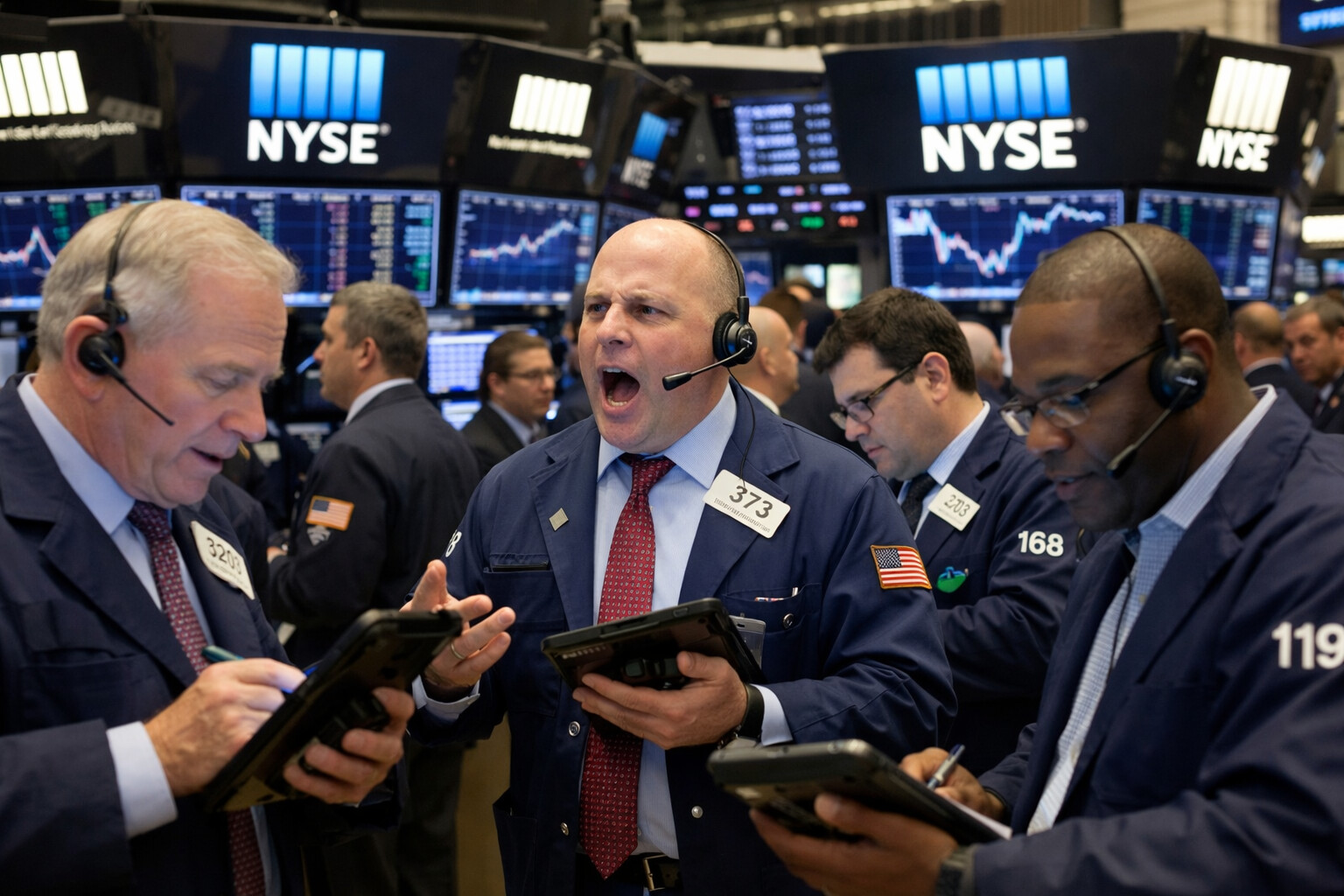
Stock Market Today: S&P 500 Holds 6,939 as Nasdaq and Dow Jones Fade
Wall Street stalls at record levels with S&P 500, Nasdaq and Dow Jones easing, Bitcoin under $78,000 and crude oil supported by rising Iran–Middle East tensions | That's TradingNEWS
U.S. stocks stall at altitude as S&P 500 flirts with 7,000 and breadth rotates
Index landscape: S&P 500, Nasdaq, Dow and Russell 2000 send mixed signals
The U.S. equity complex is sitting at extreme price levels with clear signs of fatigue, but not outright breakdown. The S&P 500 index (^GSPC) briefly pushed through the psychological 7,000 mark to a record around 7,002.28 before slipping back to roughly 6,939.03, down about 0.4% (-29.98) on the day. The Dow Jones Industrial Average (^DJI) traded near 48,892.47, also lower by roughly 0.4% (-179.09), while the Nasdaq Composite (^IXIC) dropped about 0.9% to around 23,461.82, underperforming and confirming that the tech-heavy side of the market has started to lag after leading the rebound from last April’s lows.
The Nasdaq 100 (NDX) has not printed a new all-time high since late October, when the Fed delivered its second rate cut of last year. Since then the index has diverged from the S&P 500 and Russell 2000, which both recently hit fresh records. Futures buyers stepped back in near the 25,000 area in Nasdaq 100 contracts, defending that level aggressively, but the inability to reclaim new highs while the S&P 500 touches 7k is a warning sign that concentration in mega-cap tech has reached the point where incremental buyers are harder to find.
By contrast, the Russell 2000 (RUT) pushed to a new all-time high earlier in January before a controlled retreat. The index is now testing potential support zones around 2,560 and lower down near 2,460, a level that capped price for roughly four years before finally breaking in late 2025. That structure suggests small caps are still in a primary uptrend, with pullbacks looking more like consolidation in a broader reflation narrative driven by fiscal expansion and domestic stimulus. On relative terms, the Russell is the outperformer among the major U.S. indices year-to-date, and that shift in breadth toward smaller names is one of the few genuinely healthy signals in an otherwise stretched market.
Overall stance: short-term momentum remains positive for ^GSPC and RUT, but the Nasdaq is clearly weaker and looks more vulnerable to an earnings-driven air pocket. Directionally the tape is still bullish, but risk-reward at the index level is no longer attractive for new long-term exposure; this sits in “Hold with upside grind” rather than clean upside.
Valuation pressure: CAPE 40.9 on the S&P 500 and the historical message
The valuation picture on the S&P 500 is blunt. The Shiller CAPE ratio – price divided by the inflation-adjusted average of ten years of earnings – is sitting around 40.9, essentially matching the megabubble conditions of 1999–2000. The long-run average is near 15. Historically, periods where CAPE holds above 30–35 have almost always been followed by 10–15 years of much lower real returns, often in the 0–4% annual range and sometimes negative, once you adjust for inflation.
The last decade delivered about +196% cumulative gain for the S&P 500, with annualized returns around 16% and six out of the last seven years posting double-digit advances. That performance is what has driven valuations to current extremes, and it mathematically limits what the next decade can deliver unless earnings explode in a way that even the AI optimists would struggle to justify. Put simply, the market has already pulled forward a lot of future performance.
From a structural standpoint this places the broad S&P 500 (^GSPC) in a “valuation-stretched Hold” zone. Over a short horizon, with supportive policy and still-benign credit conditions, the index can levitate at these levels and even overshoot. Over a 5–10-year horizon, buying the index here implies accepting a high probability of sub-par returns and at least one serious drawdown. The risk profile is skewed; it is no longer an obvious long-term bargain.
Macro drivers: U.S. shutdown noise, hot PPI and the Trump–Warsh Fed axis
A formal U.S. government shutdown started over the weekend, but the market is treating it as a negotiable, short-duration event rather than a structural shock. The real macro catalysts this week have been the Fed, inflation data, and personnel decisions at the top of the central-bank hierarchy.
The latest Federal Reserve meeting left rates unchanged, exactly in line with expectations. The statement did not introduce a new hawkish bias, and futures still price rate cuts later in 2026. The apparent policy path remains “higher for now, lower later”, which is inherently equity-friendly. However, that narrative was hit by a major surprise in U.S. Producer Price Index (PPI) data: headline PPI climbed 0.5% month-on-month and core PPI rose 0.7%, against expectations of 0.2% for both. That is not a small miss; it is more than double consensus, and it matters.
Those numbers forced the market to push back the expected timing of the second 2026 rate cut out toward October, firmed up the U.S. Dollar Index (DXY) after a multi-year slide, and triggered violent unwind moves in crowded trades such as long Silver (XAG/USD) and Gold (XAU/USD). The weekly DXY candle formed a sizeable bullish pin bar off a fresh four-year low: that combination of long-term downtrend and short-term rejection gives a conflicted, choppy setup for the dollar and everything priced against it.
Overlaying the data, President Trump has nominated Kevin Warsh as the next Fed Chair. Markets remember Warsh as a hawk from his earlier tenure, but the expectation now is more nuanced: rhetorically tough on inflation while politically aligned with Trump’s desire for easier financial conditions and rising asset prices. That mix – a Fed leadership that talks discipline but is incentivized to keep markets happy – is exactly the sort of regime that can extend equity and credit bubbles well beyond what fundamentals alone would justify.
Net takeaway: macro policy remains structurally supportive for risk assets, but the inflation surprise and Warsh’s appointment increase the probability of abrupt volatility bursts when data or politics disappoint, rather than a smooth, linear path higher.
Geopolitics and energy: WTI crude prices track Iran war risk and Trump pressure
The energy complex is trading geopolitics almost tick-for-tick. WTI Crude Oil (CL=F) has climbed sharply to a new four-month high, with spot moving toward the mid-$60s. A sustained daily close above roughly $66.25 would mark a fresh six-month high and typically trigger systematic buying from trend-following funds, given the breakout from prior consolidation.
The driver is not classic supply-demand rebalancing; it is war risk. U.S. military buildup around Iran continues, and prediction markets like Polymarket are pricing a meaningful probability of U.S. strikes in March. Any disruption to Gulf shipping or Iranian exports would mechanically tighten crude balances and justify a higher risk premium. That is exactly what the curve is starting to reflect.
Two caveats limit the upside. First, moving averages and longer-term trend metrics do not yet fully confirm a sustained bullish regime; technically, this could still be a sharp spike that fades quickly if diplomacy stabilizes the region. Second, the current U.S. administration has every political incentive to lean on lower gasoline and energy prices. Historically, Trump has been vocal in pressing for cheaper oil and has shown willingness to deploy strategic reserves and diplomatic pressure to achieve it.
From a trading stance, WTI sits in tactically bullish but headline-dependent territory. A clean break and hold above $66.25 favors trend-followers on the long side with tight risk control; fundamentally, however, this is a geopolitical premium, not a durable supply shock, and any fast resolution of tensions could trigger a quick round-trip lower.
Precious metals reset: Silver bubble bursts as Gold tries to base
The most dramatic price action of the week came in Silver (XAG/USD). After an explosive blow-off rally that drove prices up by more than 15% in a matter of days and briefly to an options target near $120, Silver collapsed. Thursday and Friday saw an “air pocket” crash, with Friday alone delivering a decline of roughly 28%. That kind of two-day reversal is textbook bubble behavior: crowded momentum, forced liquidation, and risk systems shutting down exposure all at once.
Prior long recommendations above the breakout level delivered gains on the way up but this week’s trade was a clear -18%+ hit from the latest entry if executed per the referenced strategy. With that pattern now printed, the probability of a sustained move to new highs in the short term has dropped sharply. The more likely path from here is a volatile, sideways range with gradually declining realized volatility and no clear edge for trend-following strategies.
Gold (XAU/USD) followed a similar but less extreme pattern. Earlier, a long setup triggered after a daily close above the $5,000 threshold ended the week with a loss of roughly 2.26%, as the metal slid alongside Silver in response to the hotter PPI print and firmer dollar. The downside volatility in Gold was milder, and support at lower levels showed stronger resilience than in Silver, but the broad message is the same: the easy phase of the precious-metals trade is over for now.
Positioning view: Silver has flipped from high-conviction long to “avoid / speculative short” territory; the asymmetry now favors downside or at best choppy mean-reversion, not trend continuation. Gold is closer to a “neutral to mildly bullish Hold”; its role as a hedge against geopolitical risk and long-term monetary debasement is intact, but after the vertical move and shake-out, the probability skews toward consolidation rather than another immediate leg higher.
Crypto pain: Bitcoin (BTC/USD) breaks $81,000 support and extends its bear trend
While U.S. equities and precious metals were pushing to records, Bitcoin (BTC/USD) was quietly rolling over. Price has now broken decisively below the long-term support band just above $81,000 and is trading closer to the high-$70,000s, with recent quotes around $77,747, down roughly 4.1% (-$3,313) on the day and sitting at a new nine-month low.
Technically, that loss of the $81k shelf is critical. It confirms a lower-highs, lower-lows sequence and places Bitcoin firmly in a bearish long-term trend despite the broader risk-on environment. That divergence matters: in a world where the S&P 500, Gold and even cyclical assets have been setting records, the failure of Bitcoin to participate signals genuine rotation out of the narrative that crypto is a universal hedge or core macro asset.
Fundamentally, adoption outside specific regions like Africa remains limited, transaction usage is still dominated by speculation, and alternative yield-bearing assets have become more attractive with higher real interest rates. As long as real yields remain positive and regulatory pressure hangs over the sector, Bitcoin’s ability to reclaim leadership is constrained.
Directional view: BTC/USD sits squarely in “bearish / underweight” territory. For sophisticated traders, high-volatility short setups exist, but structurally this asset does not currently justify a core overweight relative to less speculative risk assets.
Currencies and rates: EUR/USD, Dollar Index and high-volatility crosses
The U.S. Dollar Index (DXY) spent months grinding lower as markets priced an aggressive Fed easing cycle, printing a new four-year low before this week’s bullish pin-bar reversal. The hotter 0.5% / 0.7% PPI print and ongoing repricing of rate-cut timing have allowed the dollar to stabilize, but the longer-term trend is still down, creating a messy, range-bound environment.
The EUR/USD pair illustrates that conflict. A few days ago, the cross broke strongly higher, confirming a long-term bullish breakout as the dollar accelerated to a new 3.5-year low. That move quickly failed; the euro slipped back into its prior range and found little support at higher levels. This kind of spike-and-fade price action signals that the market is not yet ready to commit to a clean, multi-month uptrend.
The working level to watch is a daily close above roughly $1.2039. Only a sustained break beyond that area would justify a high-conviction long bias again. Until then, EUR/USD remains a candidate for tactical trades rather than a structural core position.
Cross-asset volatility has been elevated in smaller pairs as well. Previous weekly forecasts highlighted shorts in NZD/JPY, AUD/JPY and NZD/CAD, all of which delivered modest losses of around 0.3–0.6%. The Swiss franc (CHF) and New Zealand dollar (NZD) emerged as the strongest majors, while the U.S. dollar (USD) was the weakest across the board. Directional volatility across G10 FX fell compared with prior weeks, with only about 11% of major pairs moving more than 1%, but forward-looking indicators point to a pick-up next week.
The coming calendar is dense: U.S. Non-Farm Payrolls and Average Hourly Earnings, UoM inflation expectations, ECB, Bank of England, and RBA decisions, plus jobless data from New Zealand and Canada. That cluster of central-bank and labor-market events is enough to reprice curves and FX trends if any one of them materially surprises.
Strategy stance: DXY remains range-bound with a slight downside skew, EUR/USD is cautiously bullish above 1.2039, neutral below, and high-beta crosses are better treated as short-term trades around event risk rather than longer-term carries until the macro picture clarifies.
Tech earnings as volatility hubs: GOOGL, AMZN, AMD, LLY, PLTR on deck
Against this macro backdrop, the next immediate catalysts for the equity market are earnings from the biggest secular winners. Alphabet (GOOGL), Amazon.com (AMZN), Advanced Micro Devices (AMD), Eli Lilly (LLY) and Palantir Technologies (PLTR) anchor the coming week’s reporting calendar and will heavily influence Nasdaq sentiment.
GOOGL is trading in what technicians would call a “buy zone” ahead of results, grinding higher within an established uptrend as investors price continued strength in search, cloud and AI infrastructure. The market’s key questions are the scale of incremental AI-related capex and the margin impact of that spending. If Alphabet can show that AI monetization offsets higher costs – for example, through better ad targeting and cloud AI services – the stock retains upside and justifies a bullish bias even at elevated index valuations.
AMZN, last seen around $239.26 and down about 1.0% (-$2.47) on the day, remains a central beneficiary of both e-commerce normalization and AWS cloud scale. The group has already re-rated significantly, but upside surprises in operating income, AWS growth or advertising revenue can still drive further expansion. Into earnings, the stock sits in “growth Buy” territory for those comfortable with volatility; the risk is that any slowdown in AWS or guidance cuts could hit a richly valued tape.
AMD is a purer play on AI compute and data-center acceleration. The market is pricing aggressive growth in its server GPU line to close some of the gap with NVIDIA (NVDA). This is an extremely high-beta name: good numbers and bullish commentary on AI demand can trigger outsized upside, but any sign of delayed ramp or share-loss keeps it vulnerable to double-digit downside moves in a single session. Directionally the bias is bullish but high risk, making position sizing critical.
LLY has become the flagship of the GLP-1 obesity and diabetes theme. The market will dissect prescription growth rates, capacity expansion, and any new data on cardiovascular or metabolic benefits. With the stock already priced for perfection, Lilly sits in “fundamental Buy but valuation-rich Hold” territory: the story is extremely strong, but expectations are also extreme.
PLTR is a smaller but heavily watched AI-and-defense data play. Its multiple embeds a large premium for long-term government and commercial analytics growth. Earnings will be judged not just on revenue and margins but on evidence that Palantir can convert pipeline into recurring commercial contracts outside its traditional defense/intelligence base. That makes PLTR a speculative upside name – attractive if growth accelerates, fragile if it doesn’t.
Collectively, this earnings cluster is critical for the Nasdaq 100. If these names deliver and guide confidently, they can arrest the index’s underperformance and justify another leg higher for U.S. tech. If they disappoint, Nasdaq becomes the weakest link in a market priced for perfection.
Read More
-
Yen Stalls at 160 Despite a 3% JGB and Tokyo Core CPI at 2.0% — Intervention Sits at 164, Friday's Payrolls Decide
02.09.2026 · TradingNEWS ArchiveEnergy
-
AMD ($560.68) Rebounds 10% From Its October Low on the Meta Helios Win — November 3 Report Holds the Key to $649
27.10.2026 · TradingNEWS ArchiveStocks
-
Ethereum ($2,312) Lags Bitcoin and AI Stocks as BitMine Nears Its 5% Cap — Break of $2,295 Opens $2,200
27.10.2026 · TradingNEWS ArchiveCrypto
-
Brent ($113.88) Trades a $2.35 Range as Houthi Strikes Meet Saudi-Iran Diplomacy — Break of $117 Unlocks $120
27.10.2026 · TradingNEWS ArchiveCommodities
-
Nasdaq Rips 1.3%, S&P 500 Hits 7,728, Dow Stalls as BA Drops to $171
27.10.2026 · TradingNEWS ArchiveMarkets
-
GBP/USD (1.3310) Can’t Cash In on 5.43% Gilt Yields as Budget Risk Meets a Firm Dollar — Break of 1.3274 Opens 1.3200
27.10.2026 · TradingNEWS ArchiveForex
Barclays and the rate cycle: Barclays (BARC) after a 265% five-year surge
Outside the U.S., the FTSE 100 has staged its own comeback, jumping roughly 20% last year on top of dividend yield, after years where many investors had effectively written it off. A key contributor is Barclays (LSE: BARC), which has delivered about +265% over five years and +65% over the last twelve months as higher interest rates fattened net interest margins and the bank stepped up capital returns.
Valuation is no longer cheap in absolute terms but is not yet at bubble levels. Barclays trades on a price-to-earnings multiple around 13.3, with a plan to return roughly £10 billion to shareholders via dividends and buybacks between 2024 and 2026. That combination of moderate multiple and heavy capital return is attractive if rate cuts are shallow and credit quality holds.
The risk is straightforward: if base rates are cut faster or deeper than expected, the net interest margin tailwind fades. In a slowdown, loan losses can also rise, compressing profitability from the other side of the P&L. After a +65% one-year run, the asymmetric part of the move is behind it.
At current levels, the name looks like a “Hold with Buy-on-dip” profile. A meaningful pullback driven by global risk-off or a steeper-than-expected rate-cut path would likely create a better entry; chasing after a 5-year 265% rally is a different risk profile than buying when it was left for dead earlier in the cycle.
Sentiment and crash risk: historic setup for the S&P 500 in 2026
The S&P 500’s behavior over the last decade has created a statistical outlier. With annualized total returns around 16% over ten years versus the long-term average near 10%, and a CAPE of 40.9, the market has entered territory it has only visited once before since 1871: the late-1990s dot-com extremity. Back then, subsequent ten-year real returns were poor; valuations mean-reverted via a combination of a sharp crash and years of sideways grinding.
That historical rhyme is why there is so much focus on whether 2026 could see a third “historic” crash under President Trump. Elevated CAPE, extreme money-supply swings, political polarization, and AI-driven speculative flows all fit the classic ingredients list for a major drawdown. At the same time, the market has repeatedly refused to break despite multiple potential catalysts, and investors who stayed in cash over the past decade were badly punished in relative terms.
The rational interpretation is not binary crash/no-crash thinking. It is a recognition that the distribution of outcomes has fattened tails: the probability of a severe drawdown is meaningfully higher than in a normal year, and the probability of another decade of 15–20% annualized returns is meaningfully lower. That argues for tighter risk management, less leverage, more selectivity in equities, and a greater focus on quality balance sheets and cash-generation, not for abandoning the market entirely.
Trading stance across assets: momentum vs fundamentals and Buy/Sell/Hold map
Across the landscape, the picture is consistent: price action still supports equities and certain cyclicals, while fundamentals and valuations are flashing amber.
For U.S. indices, the S&P 500 (^GSPC) and Dow (^DJI) remain in firm uptrends but are priced for perfection. From a market-wide perspective, they sit in “tactically bullish but structurally cautious Hold” territory: trend followers can stay long with disciplined stops, but long-horizon investors should temper expectations and consider how much of their portfolio is exposed to a single, expensive market. The Nasdaq 100 is weaker and more dependent on the upcoming results from GOOGL, AMZN, AMD, LLY and PLTR; until those numbers clear, the index is “neutral with downside risk”. The Russell 2000 (RUT), supported by reflation and domestic fiscal measures, looks more attractive on a 3–5-year view and sits closer to a measured “Buy” among the major U.S. benchmarks.
In commodities, WTI crude (CL=F) is in a headline-driven tactical Buy zone above $66.25, with the understanding that this is a geopolitical risk premium that can evaporate quickly. Gold (XAU/USD) is a Hold after its surge and pullback: the strategic case remains, but the easy momentum phase is finished. Silver (XAG/USD) has clearly transitioned from high-conviction long to “avoid / speculative Sell” after the bubble-style blow-off and crash.
In crypto, Bitcoin (BTC/USD) has broken its key support near $81,000 and is trading below that at around $77,747. The trend, structure and relative performance all justify a bearish / underweight stance; the market has voted against the idea of Bitcoin as a core macro hedge, at least for now.
In FX, the U.S. Dollar Index (DXY) is stuck between a long-term downtrend and short-term support; EUR/USD remains a potential Buy only if it can close and hold above $1.2039, otherwise it is a neutral, range-bound cross. High-beta pairs like NZD/JPY, AUD/JPY and NZD/CAD remain suitable for short-term, event-driven trades around the heavy central-bank and labor-market calendar, not for multi-month positions.
On single stocks, GOOGL and AMZN retain bullish bias into earnings as core beneficiaries of AI, cloud and consumer normalization. AMD offers high-risk upside tied to AI server adoption. LLY is fundamentally strong but priced for perfection, effectively a quality Hold with a growth tilt. PLTR is a speculative AI/data play where contract wins and commercial traction will decide whether it remains a story stock or matures into a durable compounder. Barclays (BARC), after a 265% five-year move and 65% in twelve months, shifts into Hold / Buy on pullback territory as the rate and credit cycle matures.
The common denominator is simple: price trends in risk assets are still intact, but almost nowhere are you being paid with obvious value. The market is rewarding momentum and policy support; the cost is compressed forward returns and an elevated probability that when something finally breaks, it breaks fast.