Stock Market Today: Mixed Jobs, Policy Shocks And A Broader U.S. Rally
Index Performance And Market Tone
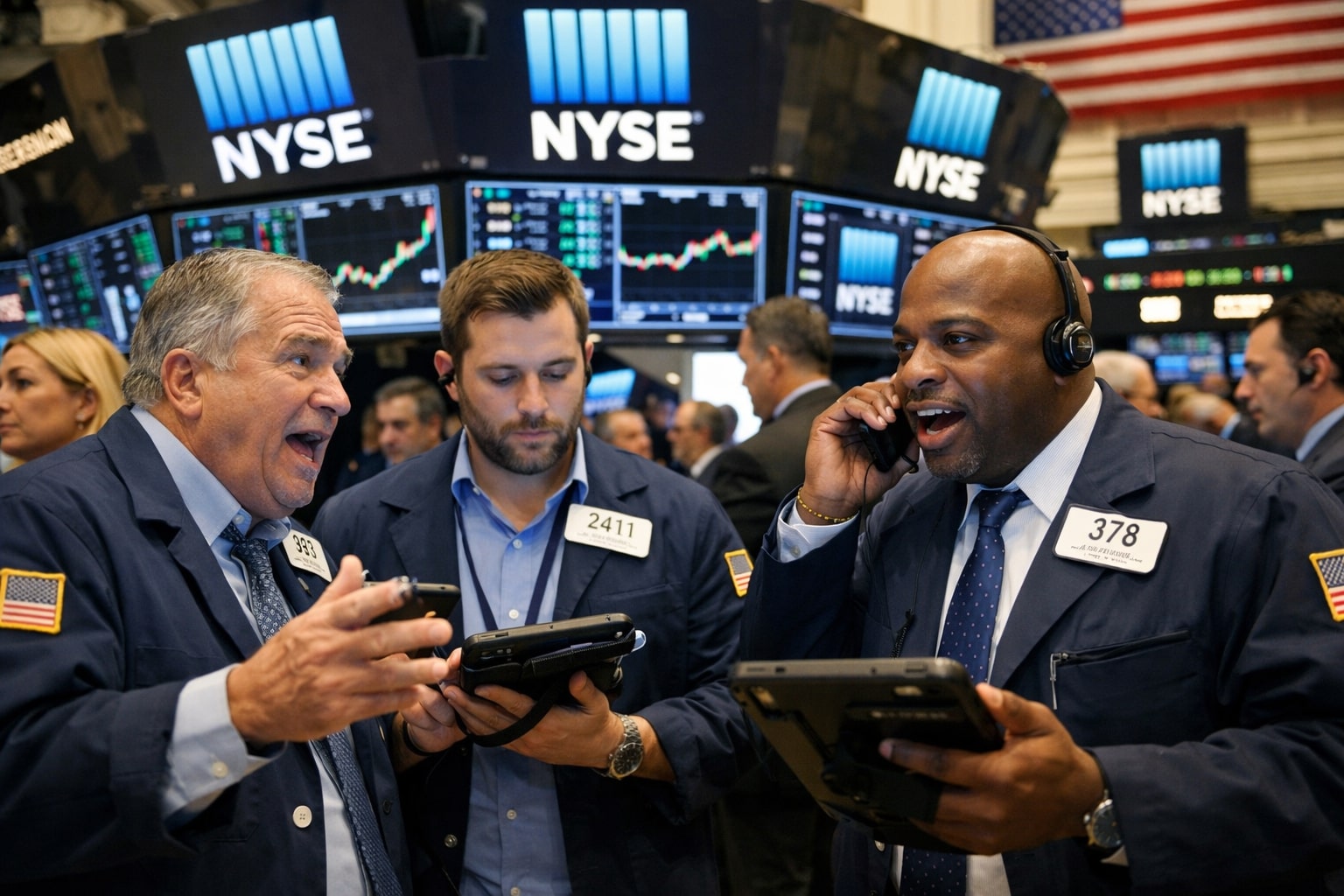
U.S. equities are advancing in controlled fashion, not a melt-up. Around mid-morning, the Dow Jones Industrial Average (DJIA) trades near 49,290 (about +0.05%), the S&P 500 is around 6,939 (roughly +0.25%), and the Nasdaq Composite sits near 23,540 (about +0.27%). The Russell 2000 is the clear relative winner at roughly 2,624, up about 0.75%–0.80%, signaling rotation into smaller, domestic cyclicals. The KBW Nasdaq Bank Index is slightly weaker at about 170.9 (around -0.2%), reflecting the rate backdrop and slower credit-sensitive growth. The VIX holds near 15.6, confirming a low-vol, grind-higher environment rather than panic or euphoria.
Earlier in the week the Dow was ahead about 1.8%, the Nasdaq roughly 1.1%, and the S&P 500 about 0.9%, as indices swung between fresh highs and modest pullbacks. Today’s price action extends that winning week with better breadth: more sectors participating, less dependence on a handful of mega-cap tech names.
Labor Market: Sluggish Hiring, Lower Jobless Rate And A Shrinking Federal Workforce
The December jobs report is weak on headline hiring but constructive on unemployment. Nonfarm payrolls rose only 50,000 versus expectations of 73,000, and below a revised 56,000 for November. For 2025, payrolls increased by just 584,000, an average of 49,000 per month, compared with roughly 2 million jobs and 168,000 per month in 2024.
The unemployment rate fell to 4.4%, better than the 4.5% consensus and down from a revised 4.5% in November (originally 4.6%). October and November payrolls were revised down by a combined 76,000 jobs, underlining how much momentum has cooled since Trump’s broad “Liberation Day” tariff package in April 2025.
The most dramatic structural move is in government employment. The federal workforce ended the year at around 2.738 million, down about 274,000 from a year earlier – the largest annual drop since 1953. That decline is directly linked to the record-long government shutdown and subsequent policy restructuring. This government contraction is depressing headline payrolls even as private employers remain “slow to hire, slow to fire.”
Fed, Treasury Yields And Rate-Cut Expectations
Rate markets shifted quickly after the jobs release. The 10-year Treasury yield dipped toward 4.18%, then traded back around 4.18%–4.19% as investors reassessed growth versus inflation. The data effectively erased any serious pricing of a January rate cut. Probabilities of a 25 bps cut at the Jan. 27–28 FOMC meeting have dropped to roughly 2.8%, from about 11% the day before and more than 16% a week ago.
The message is straightforward: the Fed has enough cover to hold rates steady, given weak job growth, easing wage pressure and a modest drop in unemployment. It does not need to accelerate easing, but it also has no reason to re-start hikes. For equities, a 10-year anchored near 4.2% with stable policy expectations supports valuation multiples without triggering a growth scare. For banks, this yield level keeps net interest margins viable, but the soft hiring and tariff risk explain why the KBW Bank Index is slightly in the red.
Tariffs, Supreme Court Risk And Trade Policy Uncertainty
Trade policy remains a material overhang. The U.S. Supreme Court did not issue a decision today on Trump’s use of emergency powers under the International Emergency Economic Powers Act to impose his “Liberation Day” tariffs. The ruling, when it comes, will define whether the White House can maintain this structure or must roll it back and possibly reimburse importers for duties already paid.
If the Court upholds the emergency framework, markets will price Trump’s tariff architecture as more durable, supporting certain domestic-oriented names but weighing on global cyclicals, exporters and parts of the supply chain. If the Court rules against the administration and the White House delays a backup plan, you get a period of heightened volatility even if the long-term outcome (lower trade barriers) is positive for risk assets.
For now, the absence of a ruling keeps equities in a holding pattern on trade: no relief rally, no shock, just a live binary event hanging over multinationals, industrials and exporters.
Trump’s Housing Gambit, Mortgage Bonds And Policy Footprint
Trump injected another policy driver into markets by announcing he is instructing his “representatives” to purchase $200 billion in mortgage bonds, arguing that Fannie Mae and Freddie Mac are flush with cash and can drive mortgage rates and monthly payments lower.
If even partially implemented, a $200 billion MBS bid would compress mortgage spreads, pull primary mortgage rates down and further intertwine political decisions with housing finance. That would likely support homebuilders, mortgage REITs and rate-sensitive equities, but investors will treat this as a policy option, not a fully priced baseline, until the operational details become clear.
Taken together with tariffs, nuclear deals, Venezuela and the Intel stake, Trump’s approach is now a core macro factor for equities: policy decisions are being aimed directly at specific asset classes, not just at headline growth.
Breadth, Style Rotation And The Russell 2000 Signal
Today’s leadership tilt is important. The Russell 2000 is up around 0.75%–0.80%, outperforming the S&P 500 and Nasdaq at roughly +0.25%–0.30%. That move, plus earlier weekly gains (Dow about +1.8%, Nasdaq +1.1%, S&P 500 +0.9% heading into Friday), points to a broadening rally. Investors are not just hiding in mega-cap AI; they are adding exposure to domestic, economically sensitive small caps that benefit if growth in 2026 accelerates from today’s slow baseline.
This rotation matters for risk assessment. A rally driven solely by a few stocks like Nvidia (NVDA), Alphabet (GOOGL) and Apple (AAPL) is fragile. When small caps, cyclicals and financials participate, the market is effectively betting that the combination of stable rates, lower inflation and moderate growth will hold.
AI Power Demand: Oklo, Vistra, Meta And Nuclear Capacity
One of the most explosive moves sits at the intersection of AI infrastructure and nuclear energy. Meta Platforms (META) has announced “landmark agreements” with Oklo (OKLO), Vistra (VST) and privately held TerraPower to secure up to 6.6 gigawatts of nuclear-driven clean power by 2035 for its data centers.
The equity market reaction is aggressive and very specific. OKLO is up roughly 15%–17% in today’s trade and has surged nearly 275% over the past year. VST is up around 11%–15% on the session, reversing about a 6% twelve-month slide. META is roughly flat on the day but is still up about 6% over the last year even after prior volatility. Meta already locked in a 20-year power deal with Constellation Energy (CEG) in June 2025; today’s expansion confirms that mega-cap AI platforms now see long-dated nuclear capacity as critical infrastructure.
For markets, the implication is clear: nuclear-exposed equities are becoming core AI infrastructure plays, not peripheral ESG stories. The AI theme is spreading from chips and cloud software into power, grid stability and long-horizon generation assets.
Semiconductors, Intel’s Government Stake And AI Hardware Dynamics
The semiconductor complex is another clear outperformer. Intel (INTC) jumped about 1.7% in after-hours trading and is up roughly 9% this morning after Trump posted that he had a “great meeting” with CEO Lip-Bu Tan and highlighted that the U.S. government is “proud to be a shareholder.” Washington has effectively converted around $9 billion in grants into an equity position of roughly 10%, making the U.S. government Intel’s largest shareholder.
That equity stake is not just symbolism. It embeds Intel at the center of U.S. industrial policy for advanced nodes, AI accelerators and domestic manufacturing, and it increases the probability of sustained subsidies, favorable export rules and regulatory support.
The wider AI-chip group is firm: Broadcom (AVGO) is up about 0.5% pre-market, Micron (MU) around 0.9%, and Advanced Micro Devices (AMD) about 0.3%–0.4%. Earlier, U.S. AI-adjacent stocks strengthened after Taiwan Semiconductor Manufacturing (TSM) reported a 32% revenue increase, beating expectations and reinforcing the AI-driven capex cycle.
On the mega-cap side, GOOGL has overtaken AAPL as the second-largest U.S. company by market cap at just under $4 trillion, behind NVDA, underscoring how investors are assigning the highest valuation multiples to AI platform and infrastructure leaders.
Single-Stock Stories: Generac, Southwest And Other Outperformers
Beyond the AI and nuclear narrative, several idiosyncratic stories are driving meaningful moves. Generac Holdings (GNRC) is trading about 3% higher after Baird upgraded the stock to outperform, one day after Citi shifted it to buy. The thesis centers on GNRC’s push into large diesel generator sets in the 2.25–3.25 MW band, targeting both data centers and traditional commercial & industrial (C&I) customers. Orders and backlog have climbed from roughly $125 million in the second quarter to about $300 million in the third quarter. Baird projects $400–$800 million in incremental revenue by 2027–2028, while consensus sits at the low end, leaving room for positive estimate revisions if execution is solid.
Southwest Airlines (LUV) is up more than 3% after JPMorgan upgraded the stock from underweight to overweight and raised its price target from $36 to $60. In a context of slower hiring but still-resilient consumer spending, that call implies confidence in Southwest’s capacity discipline, balance sheet and margin recovery.
Other early movers mentioned across live coverage include Oklo (OKLO) and Vistra (VST) on the Meta deals, Tilray Brands (TLRY) jumping nearly 8% after reporting record net revenue of about $218 million versus $211 million expected, and smaller movers such as Rocket Companies (RKT), Opendoor Technologies (OPEN) and Revolution Medicines (RVMD) being flagged as “stocks to watch” on company-specific catalysts.
Autos, Metals And Strategic Re-Rating: GM, Rio Tinto And Glencore
In autos, General Motors (GM) is firmly on the back foot. The stock is down about 3%–3.5% after the company disclosed special charges of roughly $6–7.1 billion for the fourth quarter of 2025, tied primarily to its EV reset and a China restructuring. The numbers confirm that GM’s earlier EV strategy was too aggressive relative to realized demand and cost dynamics. Investors are forcing management to acknowledge those missteps via the P&L before assigning any higher multiple to the stock.
In metals and mining, Rio Tinto (RIO) and Glencore (GLEN) are repricing on renewed merger talks. U.S.-listed RIO shares are roughly 3% lower, while GLEN gains about 10% in London. A potential combination would create one of the most powerful players in copper, coal and broader bulk commodities at a moment when the market is debating long-term demand from energy transition, EVs and infrastructure. The spread between RIO and GLEN tells you investors believe Glencore is on the advantaged side of negotiations at current indicative terms.
Venezuela, Oil And Geopolitical Energy Risk
The capture of Venezuelan President Nicolás Maduro by U.S. special forces on Jan. 3, 2026, continues to reshape the energy and credit narrative. Venezuelan sovereign bonds initially spiked on expectations that the world’s largest proven oil reserves could be reopened to investment, and oil majors such as Chevron (CVX), ExxonMobil (XOM) and ConocoPhillips (COP) moved higher on Trump’s statement that U.S. companies would “spend billions” rebuilding the country’s industry.
Reality is more complex. Venezuela carries roughly $150 billion in sovereign debt, its oil infrastructure requires at least a decade of heavy capex to normalize, and U.S. sanctions still limit direct capital flows. A committee of large bondholders is positioning for lengthy restructuring negotiations, not a rapid windfall.
For now, there are no Venezuelan ADRs trading in the U.S., no Venezuela-specific ETFs, and any attempt to access local equities on the Caracas Stock Exchange is constrained by sanctions and currency risk. Teucrium has filed for a Venezuela-themed fund, but it is not yet trading. The result is a market where headline risk is huge, but practical investability is still close to zero.
In parallel, West Texas Intermediate (WTI) crude futures trade around $59–59.1 a barrel, up more than 2% on the day, while broader commodities via the S&P GSCI Spot Index sit near 560.5, up close to 0.9%. Geopolitical risk in Venezuela is now one factor among many (OPEC+, Russia, Middle East) feeding into the oil complex.
Cross-Asset Moves: Gold, Dollar, Bitcoin And Banks
Cross-asset price action reinforces the “soft but not broken” macro story. Gold futures trade just below $4,500 an ounce, up roughly 0.7%–1.0% on the day, as investors hedge policy risk (tariffs, Supreme Court, Venezuela) without fleeing equities.
The U.S. dollar is firmer: the generic Dollar Index sits in the 96.5–99.2 band depending on the basket measured, with one widely watched gauge around 96.57 and another dollar index print near 99.15–99.21, both up about 0.3%–0.4%. A stronger dollar reflects the mix of relatively tight U.S. policy, slower global growth and tariff overhang.
Bitcoin (BTC-USD) trades around $90,000, down roughly 0.9% from an overnight high near $91,500. That is a modest giveback after a huge multi-month run, and the pullback looks more like position adjustment than a regime break.
In commodities, crude oil at about $59 aligns with the Venezuela and geopolitical discussion, while the KBW Nasdaq Bank Index near 170.9 and slightly negative for the day shows that financials are processing weaker job creation, modestly higher yields and tariff uncertainty without systemic stress.
Strategic View On U.S. Equities: Cautious Buy, Modestly Bullish Bias
Putting all of this together – indices, jobs, Fed, tariffs, Trump policy, AI power, semis, idiosyncratic winners and losers, Venezuela, and cross-asset moves – the signal is a market betting on moderate economic acceleration in 2026, not a rate-cut fantasy or a melt-up driven by liquidity alone.
The S&P 500, Nasdaq and Dow are supported by:
– A 4.4% unemployment rate that is higher than early-2025 but not recessionary
– Slowing but still positive job growth of 50,000 in December and 584,000 over 2025
– A 10-year yield near 4.18%–4.19% with January cut odds collapsing to about 2.8%, giving the Fed room to hold rather than tighten
– Expanding structural themes in AI infrastructure, nuclear power, semiconductors, and data-center energy that are driving outsized earnings potential for META, OKLO, VST, INTC, NVDA, AVGO, AMD, MU, GOOGL and peers
Against that, risks are real: a still-unresolved Supreme Court tariff case, volatile Trump policy interventions in tariffs, housing and specific corporates, a shrinking federal workforce cutting into public-sector demand, and large one-off corporate charges in areas like EVs (GM’s $6–7.1 billion hit) and potential concentration risk in mega-cap tech.
Netting the data, the stance on broad U.S. equities (S&P 500, Nasdaq, Dow, Russell 2000) is a cautious Buy with a moderately bullish bias. The breadth improvement — especially the Russell 2000 up around 0.8% and cyclicals participating — supports an overweight to U.S. stocks over cash and short-duration bonds, with an emphasis on:
– Structural AI and power winners (META, INTC, NVDA, OKLO, VST, AVGO, AMD, MU)
– Select cyclicals and small caps benefiting from any 2026 acceleration
– Balanced exposure to financials and industrials, recognizing tariff risk
Given the unresolved Supreme Court decision and ongoing tariff and Venezuela uncertainty, this is not an environment for maximum leverage, but the data on jobs, rates, earnings and rotation argues that staying underweight equities is more dangerous than running a measured, risk-aware long.
That's TradingNEWS