Stock Market Today - US Futures Tumble on Tariff Shock as Gold Blasts to $4,689
With NYSE and Nasdaq shut for MLK Day, S&P 500, Nasdaq 100 and Dow futures slide on Trump’s 10% Greenland-linked EU tariffs, driving a rush into record-high gold | That's TradingNEWS
US Stock Market Today – Holiday Session Pressure, Futures Signal Risk-Off
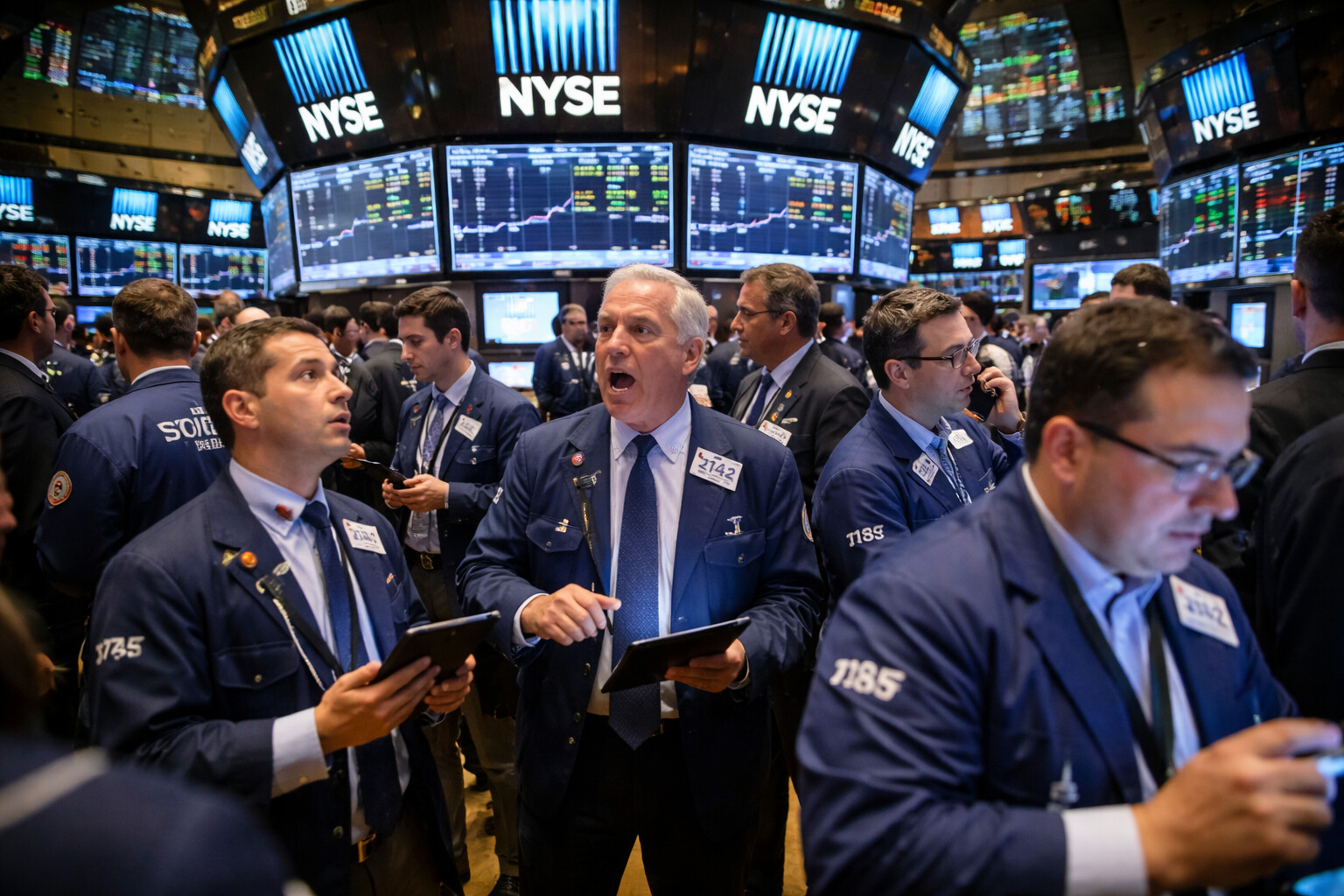
NYSE And Nasdaq Closed, Futures Drive Price Discovery
Martin Luther King Jr. Day keeps the cash session closed across the NYSE and Nasdaq, shifting all directional signals to derivatives. Despite the holiday, volatility is elevated. S&P 500 futures are trading roughly -1.2%, Nasdaq 100 futures around -1.4%, and Dow Jones futures near -1.0% as macro risk is repriced under thin liquidity.
The decline is not technical noise. It reflects immediate re-rating of geopolitical risk following renewed U.S.–EU trade confrontation tied to Greenland. The tariff proposal is explicit: an additional 10% levy on imports from eight European countries, directly impacting transatlantic trade expectations and corporate margin assumptions.
Tariff Escalation And Macro Transmission To US Equities
The market reaction is proportional to the policy risk. Tariffs at this magnitude compress operating margins for multinational manufacturers, technology exporters, and industrial suppliers with European revenue exposure.
The sensitivity is visible in futures because institutional models discount earnings streams in real time. A 10% tariff on intermediate goods typically translates into a 150–300 bps margin drag for capital goods and hardware exporters if costs cannot be passed through.
This explains the immediate pressure on Nasdaq 100 beta relative to Dow Jones, as growth multiples remain more sensitive to forward earnings uncertainty.
S&P 500 Technical Context And Key Levels
The S&P 500 is trading below recent highs in electronic hours, with futures stabilizing near the 6,800 zone, where the 50-day moving average provides the first structural support.
The upper psychological barrier remains 7,000, a level repeatedly rejected over the past sessions. Failure to reclaim this zone keeps short-term trend momentum capped. Despite the overnight drawdown, the index remains in a medium-term uptrend, but volatility is expanding.
From a positioning standpoint, systematic strategies reduce exposure when headline-driven variance rises, reinforcing intraday swings.
Dow Jones Price Behavior Under Elevated Index Risk
The Dow Jones Industrial Average is hovering near the 49,000 region in futures. Point movement appears limited, yet embedded risk is high. A 0.3% index shift under leveraged structures translates into materially amplified P&L outcomes.
Financials and industrials dominate Dow weighting, making the index particularly sensitive to rate-path expectations and trade policy. The current environment supports defensive rotation rather than cyclical accumulation.
Liquidity conditions around the 09:30 ET reopening tomorrow are critical. Historically, the first hour captures the bulk of repositioning after holiday sessions.
Nasdaq 100 Volatility And Growth Stock Sensitivity
The Nasdaq 100 is the most reactive index in this tape, sliding approximately 1.4% in early electronic trade. Growth duration risk is being repriced as tariff escalation intersects with valuation compression.
High-multiple technology and IP-dependent exporters face asymmetric downside under a scenario where the EU applies countermeasures under the Anti-Coercion Instrument, including potential constraints on intellectual property protections and licensing revenues.
That structural risk explains the relative underperformance of growth benchmarks versus value-heavy indices.
Read More
-
Yen Stalls at 160 Despite a 3% JGB and Tokyo Core CPI at 2.0% — Intervention Sits at 164, Friday's Payrolls Decide
02.09.2026 · TradingNEWS ArchiveEnergy
-
QQQI ($53.80) Turns Nasdaq Volatility Into a 14.2% Monthly Yield as Assets Top $15B — Big Tech Earnings Set November
27.10.2026 · TradingNEWS ArchiveStocks
-
IBIT ETF Captures 100% of $110.3M as Spot Funds Snap Outflow Streak, but October Stays $202M Negative Ahead of the Fed
27.10.2026 · TradingNEWS ArchiveCrypto
-
NG($3.002) Takes the Front Month Near a Multi-Month Low as Record Production Meets Mild Weather — Break of $2.945 Opens $2.80
27.10.2026 · TradingNEWS ArchiveCommodities
-
USD/JPY (157.86) Squeezed Between a 2.8-Point Carry Edge and Tokyo’s 160 Line — BoJ Hawkish Hold Friday Sets the Break
27.10.2026 · TradingNEWS ArchiveForex
Cross-Asset Confirmation: Gold As Risk Barometer
Gold provides confirmation of the equity risk-off regime. Spot prices printed a fresh record near $4,689 per ounce, reflecting capital rotation into hard-asset protection. Historically, gold strength of this magnitude alongside falling equity futures signals institutional de-risking rather than retail noise.
This matters for equities because sustained gold outperformance typically coincides with multiple contraction in cyclical sectors and higher equity risk premia.
Earnings Noise Versus Macro Dominance
Corporate fundamentals are not the current driver. Earnings revisions are being temporarily overshadowed by policy risk. Even solid company-level results are insufficient to offset macro uncertainty when tariff probability rises.
This is visible in index behavior: no single sector catalyst is driving the move. The pressure is broad-based, systematic, and volatility-led.
Market Structure And Liquidity Dynamics
Algorithmic and high-frequency flows dominate today’s tape. Order-book depth is thin, and price gaps are more likely. A flat headline index masks violent intraday ranges on lower timeframes.
The absence of cash-market participation increases the probability of false breakouts and air pockets. This environment punishes leverage and rewards capital preservation.
Forward Bias And Tactical Stance
The current configuration is cautiously bearish for U.S. equities in the short term. S&P 500, Nasdaq 100, and Dow Jones remain structurally supported, but headline risk and tariff uncertainty justify reduced exposure until clarity emerges.
Momentum favors defensive positioning over aggressive dip-buying until the S&P 500 can reclaim the 7,000 zone with volume confirmation.
Bias:
S&P 500 – Hold / Short-Term Bearish
Nasdaq 100 – Sell on Rallies
Dow Jones – Hold with Defensive Tilt
Volatility remains the dominant factor, and macro policy, not earnings, is setting the price.