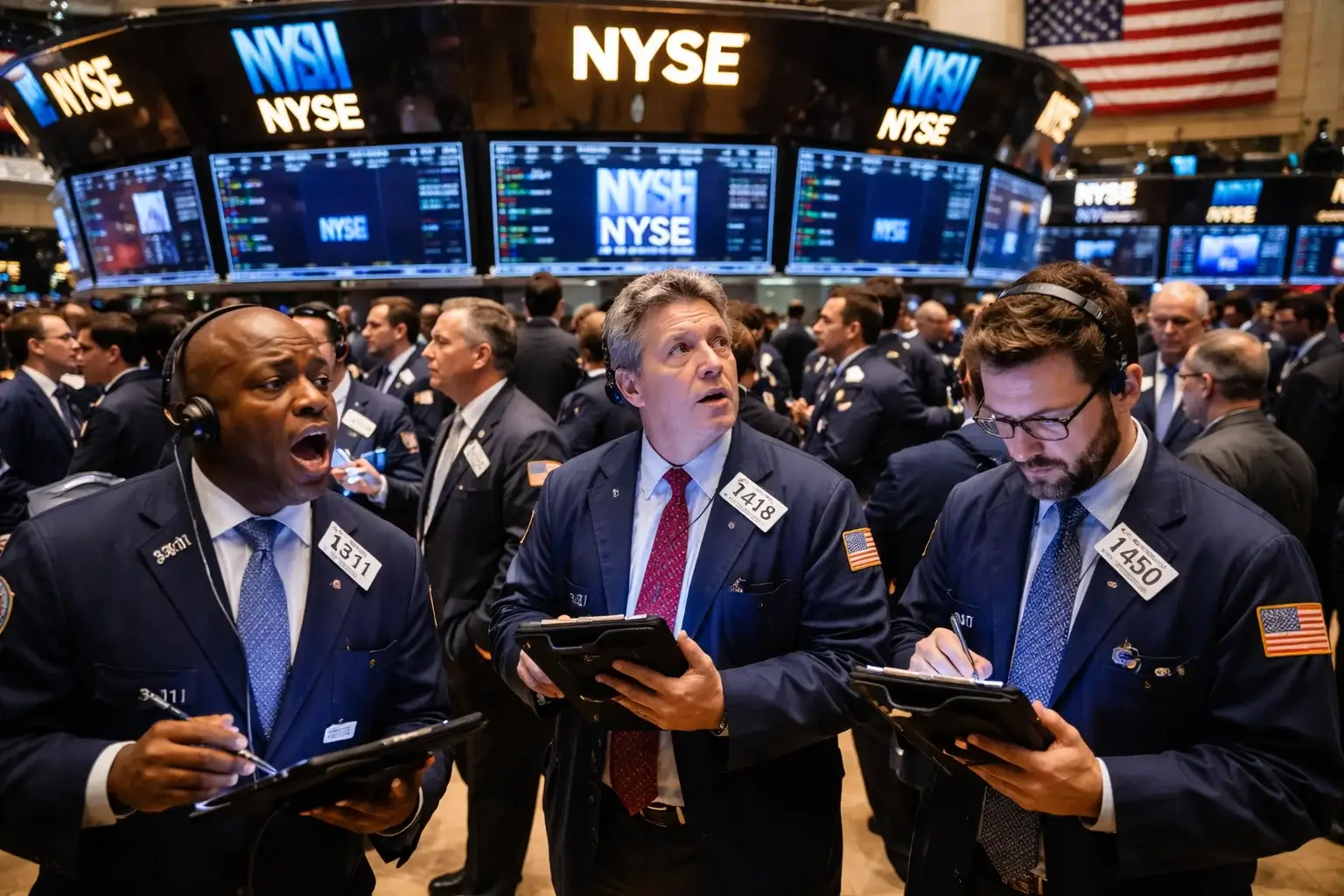
Stock Market Today — S&P 500 Clings to Gains, Dow Bleeds 220 Points and Nasdaq Defies the War Premium, GS Stock Drops 3%
Tech carries Nasdaq to a nine-session win streak at 22,966, GS Stock collapse to $879 | That's TradingNEWs
Key Points
- Trump's Hormuz blockade erased the 12-day ceasefire rally, sending WTI crude 5.7% higher to $102 and Brent back above $100, reigniting inflation fears across global markets.
- Goldman Sachs slid 3% to $879 despite beating EPS at $17.55 as FICC trading revenue crashed $900M below consensus, single-handedly dragging the Dow down 200 points.
- Revolution Medicines exploded 35% to $130 after its pancreatic cancer pill daraxonrasib doubled patient survival to 13.2 months versus chemotherapy in a landmark Phase 3 trial.
By mid-morning, the S&P 500 ($SPX) sat at 6,822, up roughly 5-7 points or 0.08% — functionally unchanged and having recovered from an opening loss of 0.3%. The Nasdaq Composite ($COMP) held at 22,966, up 63-69 points or 0.28%, driven almost entirely by software and AI infrastructure names that continue to operate as a relatively insulated pocket of the market. The Dow Jones Industrial Average ($DJIA) told a different story entirely, sitting at 47,690, down 220-226 points or 0.47%, weighed down primarily by a Goldman Sachs earnings reaction that alone subtracted roughly 200 points from the index. The Russell 2000 ($RUT) quietly outperformed all three major benchmarks at 2,639, up 8.5 points or 0.32%, a subtle rotation signal into smaller domestic names seeking shelter from the macro cross-currents hitting large-cap industrials and financials.
The CBOE Volatility Index ($VIX) climbed back above the psychologically significant 20 threshold to a session high of 21.58, having closed Friday at 19.23 — its lowest print since before the Iran war began in late February. Context is important here. The VIX had collapsed 18.4% on Wednesday when the ceasefire was announced, fell another 7.4% to 19.49 Thursday, and slipped a further 1.3% to 19.23 Friday. That entire three-session, 38% compression rebuilt in a single overnight session once the Islamabad talks fell apart. The war-era closing peak was 31.05 on March 27, with an intraday high of 31.65 the same day — the market is not yet pricing catastrophic escalation, but the speed of Monday's VIX rebound from 19.23 to 21.58 illustrates exactly how thin the foundation beneath the ceasefire rally actually was.
Oil Roars Back Above $100 — and Some Are Already Pricing $140
West Texas Intermediate crude ($CL=F) hit an overnight peak near $104-$105 per barrel before trimming to $102.13-$102.18 by mid-morning, still up 5.66-5.76% on the session. International Brent crude ($BZ=F) pushed to $100.49-$100.56, up 5.56-5.63%. This is not a technical bounce — it is a direct fundamental repricing of restricted supply risk at one of the world's most operationally irreplaceable maritime chokepoints. At the Sunday night extreme, WTI had jumped as much as 8.54% to $104.82 per barrel and Brent surged as much as 9.1% to near $104 before trimming as markets assessed the precise operational scope of the blockade restrictions.
The U.S. Central Command's clarification that the blockade applies specifically to vessels entering and exiting Iranian ports — while explicitly leaving other traffic transiting the strait unrestricted — removed some of the overnight panic premium. But the structural threat has not changed. The Strait of Hormuz handles roughly 20% of global seaborne oil flows. Any Iranian countermeasure — targeting non-Iranian tankers, deploying fast attack craft against U.S. naval assets, or mining approaches to the strait — could transform this into a supply shock of a magnitude not seen since the 1970s. Onyx Capital Group Managing Director Jorge Montepeque argued on Bloomberg TV that current futures prices fail to fully reflect the real risk, stating plainly that oil "should be $140, $150." That view sits at the extreme end of the range, but it is not analytically indefensible given the scenario tree.
Iran had strategically been running elevated export volumes in anticipation of exactly this kind of escalation — shipping 1.84 million barrels per day in March and 2.15 million bpd in February, roughly 26% above 2025 average levels, with much of that volume pre-positioned in storage outside the strait for Chinese buyers. That stockpile provides Tehran and Beijing a buffer of potentially weeks to months under blockade conditions. The oil market is therefore not staring at an immediate 2-million-barrel-per-day hole in global supply — but it is pricing elevated probability that this situation does not resolve on a short timeline.
Energy equities were among the session's clearest winners. APA Corp ($APA) climbed 2.45% to $39.58. Occidental Petroleum ($OXY) added approximately 3% in premarket trading. CF Industries ($CF), the fertilizer producer with direct natural gas and energy input cost exposure, rose 3.13% to $125.11. The S&P GSCI Commodity Index ($SPGSCI) advanced 2.09% to 719.38, confirming broad commodity repricing across energy and agricultural markets simultaneously. Oil producers with direct Brent exposure remain tactical buys as long as the blockade holds.
Trump escalated the rhetoric further on Monday morning, posting that any Iranian fast attack vessels approaching the blockade perimeter would be "immediately eliminated." He cited the destruction of 158 Iranian naval vessels as evidence of U.S. military resolve. Iran's government called the blockade "an act of piracy" and vowed to target all Persian Gulf port infrastructure if its own energy export hubs face direct attack. The Wall Street Journal reported that Trump is simultaneously weighing a resumption of limited targeted military strikes inside Iran, with officials noting that a full-scale bombing campaign escalation was considered less probable given the risk of broader regional destabilization. Mediators from Pakistan, Egypt, and Turkey are continuing parallel backchannel talks with both parties. UK Prime Minister Keir Starmer explicitly said London is "not supporting" the blockade and will not be dragged into the conflict militarily. French President Macron announced that France and the UK will co-host a multinational conference aimed at restoring freedom of navigation through the strait on a "peaceful" and "strictly defensive" basis, separate from either belligerent.
Iran's stated demands at Islamabad — operational control over the Strait of Hormuz, formal war reparations, and release of frozen sovereign assets — are nowhere near any position Washington has signaled willingness to accept. The nuclear enrichment question was where the U.S. side formally broke off talks. The gap between the two positions is wide on every dimension simultaneously. There is no deal this week, and probably not next week either.
Goldman Sachs Beats on Every Line Except the One That Mattered
Goldman Sachs ($GS) fell to $879.21-$879.81, down $27.99-$28.59 or 3.08%-3.15%, contributing approximately 200 points of downward pressure to the Dow Jones Industrial Average in a single session. The irony is that Goldman's headline numbers were genuinely exceptional. Net earnings rose 19% year-over-year to $5.6 billion. EPS landed at $17.55, comfortably clearing the $16.34-$16.49 consensus by more than $1 per share. Revenue hit $17.23 billion against $16.97 billion expected. The markets division reported $9.3 billion in total revenue, up 8.6% from a year ago. The equity trading desk posted the best quarterly revenue in Goldman's history. Investment banking fees surged 48% year-over-year to $2.84 billion. M&A advisory alone jumped 48% to $1.5 billion, the strongest evidence yet that corporate deal activity is genuinely recovering after years of suppressed volumes. By virtually every conventional measure, Goldman delivered an outstanding quarter.
The single number that dismantled the entire reaction: fixed income, currencies, and commodities intermediation revenue came in at $4.01 billion — down 10%-13% from Q1 2025 and $810-$900 million below the $4.82-$4.92 billion consensus range. The market had built Goldman's Q1 expectations on the premise that war-driven volatility in interest rates, credit spreads, oil-linked derivatives, and currency markets would generate exceptional FICC trading revenue. That thesis was entirely reasonable — a Middle East war affecting inflation expectations, sovereign bond markets, and global currency flows should produce exactly the kind of dislocated pricing that large fixed income desks monetize. The problem was timing. The ceasefire window that covered a meaningful portion of the quarter compressed rate and credit volatility at the exact moment Goldman's FICC desk needed it most. Record equity trading and collapsing fixed income trading in the same quarter captures the essential Goldman story: the bank was positioned for the wrong type of market turbulence. Goldman is a hold at best until management clarifies the FICC trajectory and whether Q1 was a timing anomaly or a structural shift in the business.
The broader bank earnings calendar amplifies the importance of this week's remaining reports. JPMorgan Chase ($JPM), Citigroup ($C), and Wells Fargo ($WFC) report Tuesday. Bank of America ($BAC) and Morgan Stanley (MS)followWednesday.CollectiveQ1profitsforthesixmajorU.S.banksareforecasttoriseroughly5MS) follow Wednesday. Collective Q1 profits for the six major U.S. banks are forecast to rise roughly 5% year-over-year, and analysts had broadly expected sturdy fundamentals following a significant reset in bank stock prices from January record highs. The Nasdaq KBW Bank Index ( MS)followWednesday.CollectiveQ1profitsforthesixmajorU.S.banksareforecasttoriseroughly5BKX) is up just 1% year-to-date after its worst first-quarter performance since the 2023 mini-banking crisis — an index that was supposed to benefit from the Trump deregulation and deal-making revival narrative. Goldman's FICC miss on the opening day of earnings season sets a cautious tone heading into Tuesday's trio of reports.
Revolution Medicines Rewrites Pancreatic Cancer Treatment
The most consequential individual stock move of Monday's session had nothing to do with oil or geopolitics. Revolution Medicines ($RVMD) traded at $130.77, up $34.34 or 35.61%, after touching 71% higher in premarket following a Phase 3 clinical trial result that genuinely deserves the word "landmark." The company's oral daily pill daraxonrasib was tested against pancreatic cancer — statistically one of the most lethal malignancies in oncology, a disease where median survival has barely improved in 30 years despite dozens of failed therapeutic attempts. Patients on daraxonrasib lived a median of 13.2 months — more than double the survival observed in the chemotherapy control arm. The trial met every primary endpoint. CEO Mark Goldsmith described the outcomes as "dramatic" and "practice-changing," and for once that kind of language is justified by the underlying data. Doubling survival in pancreatic cancer is not incremental. It is a category-defining clinical result. RVMD is a buy on any post-gap consolidation. The addressable market across RAS-mutant solid tumors extends well beyond pancreatic cancer, and the Phase 3 data provides a clear and accelerated regulatory pathway.
Oracle Surges 9% While Palantir Fights for Credibility at $133
Oracle ($ORCL) surged 9% Monday, one of the session's cleanest and most sustained moves. Enterprise cloud infrastructure and AI database demand continues to generate the kind of durable revenue acceleration that justifies premium multiple expansion. Oracle has increasingly positioned itself as a critical layer in enterprise AI deployment — not just a legacy database vendor — and Monday's 9% move reflects institutional conviction in that repositioning. Oracle is a buy.
Palantir Technologies ($PLTR) traded at $133.25, up $5.19 or 4.05%, attempting to recover from a brutal prior week that saw the stock fall more than 12%. The catalyst for that selloff was a post from investor Michael Burry on X directly claiming that Anthropic "is eating Palantir's lunch" in enterprise AI — a post he subsequently deleted. The deletion softened the immediate pressure but did nothing to answer the underlying competitive question. Palantir is down nearly 30% year-to-date through Friday's close, a brutal drawdown for a stock that was treated as a primary AI beneficiary entering 2026. Monday's 4.05% rebound looks technically driven — short covering off an oversold setup — rather than fundamentally motivated. The AI competition narrative surrounding Palantir will not disappear without a concrete product or contract response from management. Hold, with significant skepticism.
Amazon Tests $240 — The Most Important Technical Level in Mega-Cap Tech
Amazon ($AMZN) leads the Magnificent Seven recovery off the March 30 lows, pressing into a technically critical resistance zone at $238-$240. That zone has capped every meaningful rally attempt since early 2025, aligning with a downtrend line drawn from the November 2025 high and the January 2026 peak. The stock traded slightly lower Monday — precisely the behavior expected at a resistance test. This is a genuine decision point. If Amazon breaks and holds above $240 with volume confirmation, the technical pathway reopens toward all-time highs in the $255-$260 range. If the level holds as resistance and the stock pulls back, the bull case requires holding the $220-$225 zone, where the 200-day moving average and recent structural support converge. Long-term holders stay positioned. Traders wait for the $240 break before adding.
Taiwan Semiconductor Manufacturing ($TSM) held at $369.84, down a negligible 0.21%, trading near multi-month highs ahead of a Thursday earnings call that functions as one of the most important data points in global technology. Analysts expect Q1 net profit of T$542.6 billion — approximately $17.1 billion — representing a 50% year-over-year surge. Demand for TSMC's 3-nanometre AI chip production technology continues to structurally outstrip current manufacturing capacity. The company's market capitalization sits near $1.6 trillion, approximately double Samsung Electronics. Thursday's call will include second-quarter guidance and an updated full-year outlook that the entire semiconductor and AI infrastructure investment community will treat as a primary read on the durability of global AI capital expenditure. TSMC is a buy ahead of the print.
Goldman Cuts Best Buy, Lifts Williams-Sonoma — Retail Gets Bifurcated
Williams-Sonoma ($WSM) rose 1.66% to $192.28 after Goldman Sachs upgraded the kitchen and home goods retailer to buy, arguing the stock is trading at attractive valuation levels relative to what Goldman described as one of the strongest proprietary brand portfolios in all of U.S. retail. Williams-Sonoma's owned brands — Pottery Barn, West Elm, Williams-Sonoma proper — give it pricing power that commodity retailers simply do not have. In an inflationary environment with elevated input costs, that distinction is material. Buy.
Best Buy ($BBY) dropped 3.35% to $60.28 on a Goldman downgrade to sell. The thesis is surgical: Best Buy likely benefits in Q1 from consumers pulling forward PC purchases ahead of expected price increases, combined with elevated tax refund flows. But as higher memory costs work through the semiconductor supply chain into laptop and desktop pricing, same-store sales face a compressing headwind in Q2 and beyond. Best Buy is fundamentally a hardware distributor with minimal pricing power in a rising-component-cost environment — it passes through cost increases rather than absorbing them, which makes it a poor inflation hedge. Sell.
Fastenal ($FAST) fell more than 4% despite reporting first-quarter EPS of exactly $0.30 and revenue of exactly $2.2 billion — both meeting the FactSet consensus with no deviation. In a market that entered earnings season with elevated expectations for any industrial name with construction and manufacturing channel exposure, meeting estimates precisely reads as a soft result. The underlying business environment for industrial supply distributors is not accelerating fast enough to justify current valuations amid ongoing macro uncertainty. Underweight.
Carnival Sinks 3.65% as the Oil-Cost Math Turns Brutal
Carnival Corp ($CCL) slid 3.65% to $26.96, and the logic is straightforward enough to state simply. Oil at $102 per barrel directly inflates fuel costs for one of the world's largest commercial vessel fleets. Sustained geopolitical conflict in and around the Persian Gulf suppresses consumer confidence in international travel itineraries. Forward booking windows for cruise lines are long enough that uncertainty compounds — a customer making a booking decision today about a cruise six months from now has no visibility into what the Middle East looks like at departure. Carnival is a tactical sell into the current oil spike. The stock is structurally cheap on long-duration metrics, but it has no near-term positive catalyst and two direct operational headwinds simultaneously. Wait for oil to pull back meaningfully before revisiting.
Read More
-
Yen Stalls at 160 Despite a 3% JGB and Tokyo Core CPI at 2.0% — Intervention Sits at 164, Friday's Payrolls Decide
02.09.2026 · TradingNEWS ArchiveEnergy
-
CHAT Fund Holds $96.37 as Korean Memory and Chip Exposure Drive a 109.73% Year — Break of $98.02 Opens $105.20
18.09.2026 · TradingNEWS ArchiveStocks
-
First-Generation XRPR and XRPI Ride XRP's Rebound to $1.386 as Spot Funds Post First Outflow — Break of $1.40 Opens $1.54
18.09.2026 · TradingNEWS ArchiveCrypto
-
NG Holds $2.9255 as Storage Surplus Narrows From 5.5% to 3.7% in 3 Weeks — Break of $3.00 Opens $3.15
18.09.2026 · TradingNEWS ArchiveCommodities
-
Dollar Surges to 157.90 as BoJ's Divided Hike Fails to Lift the Yen — Break of 158.87 Opens 159
18.09.2026 · TradingNEWS ArchiveForex
Bitcoin Retreats From $73,000 But Structural ETF Demand Holds
Bitcoin ($BTC-USD) traded at $72,121-$72,260, up a modest 1.37%-2.07% on the session but well off Friday's close above $73,000, which had capped Bitcoin's best single week since October 3 — a 9% gain in seven sessions. The ceasefire had driven Bitcoin alongside equities in a broad risk-on move that lifted all liquid assets simultaneously. The weekend's geopolitical breakdown reversed that impulse. Spot Bitcoin ETFs saw net inflows of $786.31 million last week — the strongest single-week haul for that cohort since February 27 — demonstrating that institutional allocation demand for Bitcoin exposure is structurally intact regardless of short-term price volatility. The immediate technical picture shows a failure to hold above $73,000 on the ceasefire catalyst, with the next meaningful resistance at the all-time highs near $75,000-$76,000. Support at $70,000 is the level that matters on the downside. Hold existing positions. No aggressive new longs until the geopolitical picture provides cleaner risk visibility.
Gold Dips Despite Oil Surge — the Dollar Explains Everything
Gold ($GC=F) traded at $4,738-$4,740 per ounce, down 0.99%-1.03% — a counterintuitive move on a day when oil-driven inflation fears are explicitly front and center. The explanation runs entirely through the dollar. The ICE U.S. Dollar Index ($DXY) firmed to 98.72-99, up 0.07%-0.26%, as rising oil prices and the re-anchoring of higher-for-longer Fed expectations attracted dollar demand from global capital flows. When the dollar strengthens, gold faces mechanical headwinds even in explicitly inflationary environments — because gold is priced in dollars, a stronger dollar means gold costs more in every other currency, compressing demand at the margin. The gold pullback on Monday is not a fundamental reversal. It is a dollar-driven technical correction within an otherwise constructive long-term setup. Gold at $4,700+ remains well-supported by the same inflationary and geopolitical forces driving oil higher. Hold.
Treasuries Sell Off Hard as Inflation Math Flips Negative for Fixed Income
The 10-year Treasury yield ($TNX) rose 3 basis points to 4.325%-4.334%. The 30-year yield ($TYX) added 2 basis points to 4.924%. The 2-year yield settled at 3.814%, up marginally. Bond prices trade inversely to yields — meaning the Treasury market sold off across the entire curve Monday as oil-driven inflation expectations re-accelerated. The U.S. Dollar Index climbing toward 99 simultaneously reinforced the notion that the Federal Reserve is firmly on hold and that rate cut expectations built into the front end of the curve are likely to be pushed out further. Any sustained period of WTI crude above $100 makes a 2026 Fed rate cut politically and analytically untenable. The Fed's only clean path is to hold until inflation data convincingly shows energy price increases are not feeding through to core. That is a several-months-minimum process at best.
The Treasury sell-off has direct consequences for equity valuation. Higher discount rates compress the present value of future earnings, most acutely for long-duration growth stocks. The Nasdaq's resilience Monday — holding green and extending its winning streak to nine sessions — reflects the market's conviction that AI-driven earnings growth is durable enough to absorb tighter financial conditions. That conviction will be stress-tested if WTI sustains above $100 through Q2 earnings season.
Housing Market Cracks Under Rate Pressure
Existing home sales dropped 3.6% in March to a seasonally adjusted annual rate of 3.98 million — the lowest reading since last June and dramatically worse than the 1% monthly decline economists polled by the Wall Street Journal had forecast. The National Association of Realtors responded immediately by slashing its 2026 existing-home sales growth forecast from 14% to 4%. Higher mortgage rates are the primary structural headwind, and with the 10-year Treasury yield pushing back toward 4.33% on renewed oil-driven inflation expectations, that headwind is not softening in the near term. Real estate-exposed equities and mortgage-sensitive financials face continued underperformance as long as the rate environment stays elevated.
Meta Passes Google in Global Advertising for the First Time
A structural shift in digital advertising that will define the medium-term competitive landscape became official Monday. Per Emarketer projections, Meta Platforms ($META) will surpass Alphabet/Google ($GOOGL) in global net advertising revenue in 2026 for the first time — Meta reaching $243.46 billion versus Alphabet's $239.54 billion. Meta's advantage comes from two simultaneous sources: the commercial performance of Reels in short-form video advertising, which has captured incremental brand and direct-response budget at scale, and broad AI-driven ad targeting efficiency improvements across Facebook and Instagram that are measurably improving advertiser return on investment. For advertisers, this is a signal to recalibrate budget allocation toward Meta's platforms. For investors, it validates Meta's AI infrastructure spending and suggests the multiple expansion in META shares over the past 18 months has fundamental underpinning. Meta is a buy.
Hungary's Political Earthquake Delivers Its Own Market Signal
In the session's most unexpected international development, Hungarian Prime Minister Viktor Orbán suffered a landslide electoral defeat over the weekend, ending his 16-year grip on power and sending Hungarian stocks to all-time record highs Monday. The Hungarian forint surged more than 2% against the U.S. dollar — the strongest single-currency gain globally on Monday — and rose approximately 2.3% against the euro. The investment case is clear: Orbán's removal clears the path to unfreezing nearly $20 billion in European Union funds that had been withheld over rule-of-law concerns, representing an immediate and material fiscal injection into the Hungarian economy. The result also signals a meaningful shift in EU-Hungary relations that could eventually restore Budapest's full access to EU structural and cohesion funds. For European equity investors, the forint and Hungarian equity moves are a leading indicator of the broader rerating potential as the country normalizes its relationship with Brussels.
Morgan Stanley Warns of Retest Risk, Yardeni Sees Learned Tolerance
Morgan Stanley strategist Michael Wilson issued a pointed note Monday framing the near-term risk clearly: the S&P 500 could retest last week's lows — approximately the 6,700 level on the index — if the Iran conflict re-escalation continues to drive oil higher and compress corporate earnings expectations. His recommended posture was to be ready to add risk on that retest rather than selling into it, framing any move back to 6,700 as a buying opportunity rather than a breakdown. The logic is that the market has already partially absorbed the war premium once — and rebuilding that buffer after a second wave of selling would represent genuine long-term value creation.
Ed Yardeni offered a contrasting interpretation. Markets may be learning to live with the Iran conflict the way they eventually learned to live with the Russia-Ukraine war — pricing in a persistent but bounded risk premium rather than treating each escalation as a fresh systemic shock. The analogy has merit in structure if not in oil market dynamics. The Ukraine war never threatened to cut off 20% of global oil supply. The Hormuz scenario does. That difference is meaningful enough to treat the two situations as categorically distinct in terms of commodity and inflation spillover.
The base case that emerges from Monday's session is this: technology names — Oracle up 9%, Nasdaq holding green for nine straight sessions, TSMC near record highs, Amazon pressing all-time resistance — provide genuine structural cushion for the broader market. The AI earnings growth thesis remains intact and continues to attract institutional capital regardless of geopolitical turbulence. But Goldman's 3% drop on a FICC miss, Carnival down 3.65% on fuel costs, Best Buy cut to sell on component inflation, Fastenal falling 4% on an exactly inline print, and housing sales hitting their weakest level since last June — these moves collectively confirm that anything exposed to inflation, consumer cost sensitivity, or rate duration without a compelling AI growth anchor will face sustained selling pressure as long as crude oil trades above $100 and the Hormuz blockade holds.
The ceasefire dividend lasted twelve days. The market built a 3.6% S&P 500 rally on it. That entire rally has now been returned to the starting point, and the next directional catalyst is not a technical level or an earnings print — it is a phone call between Washington and Tehran that does not appear imminent.