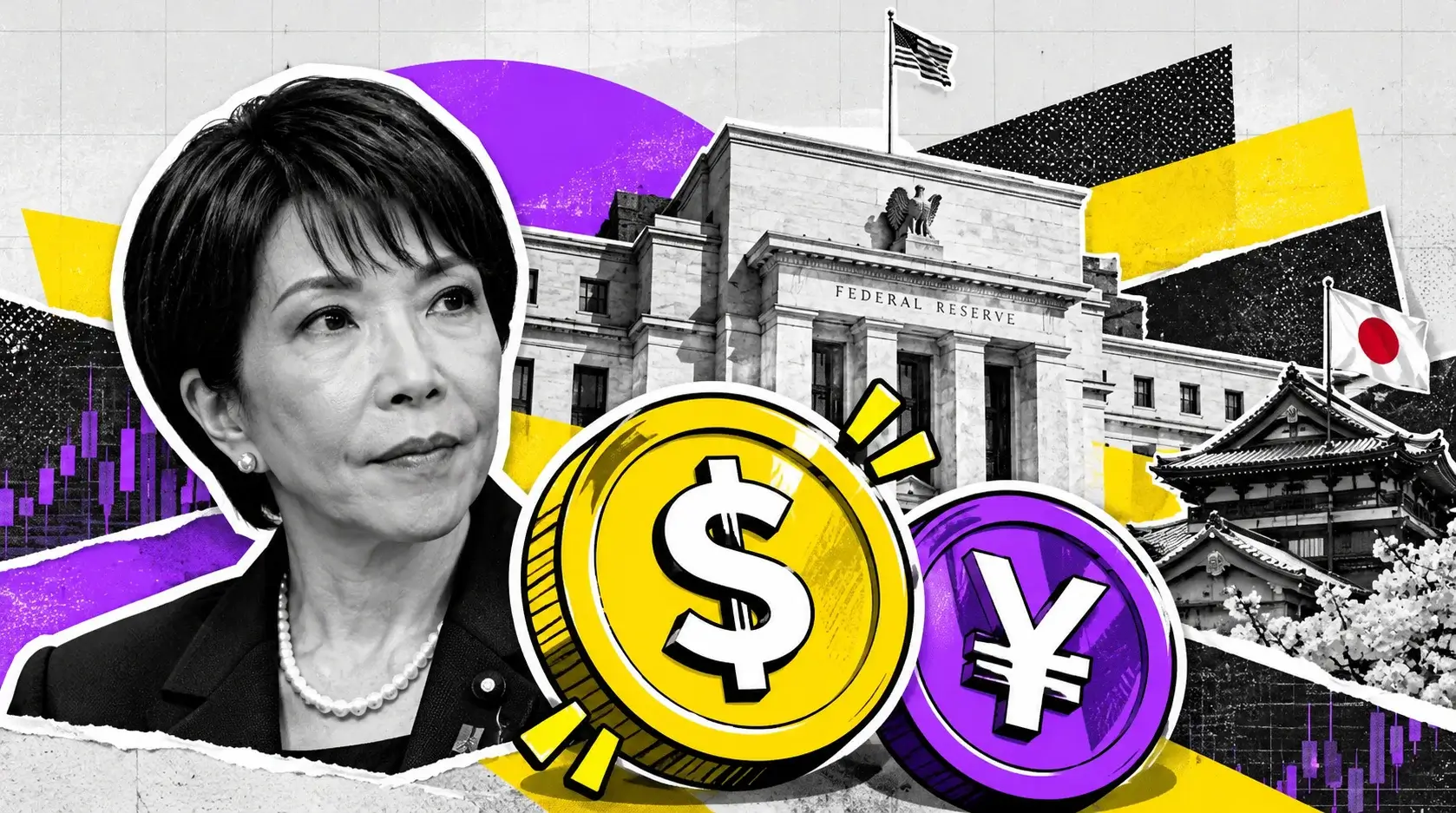
USD/JPY Price Forecast: Pair Stalls at 159.20 as 160 Intervention Zone and Fed Rate Hold
USD/JPY Holds Below the 1990 Historical High With 78,000 Net Long Contracts at Risk | That's TradingNEWS
USD/JPY Price Forecast: 159.20 and the 160.00 Battlefield — Why Japan's Oil Import Crisis, a 3% Rate Differential, and the Most Dangerous Intervention Zone in FX History Define the Next 500 Pips
USD/JPY at 159.20 — A 4% Rally From February Lows Running Straight Into History's Most Defended Level
USD/JPY is trading at approximately 159.20 on Tuesday — a consolidation zone that has formed after one of the most aggressive multi-week uptrends the pair has produced in the current cycle. The move from February lows represents a 4% appreciation of the dollar against the yen in a compressed timeframe, driven by a combination of forces that are simultaneously structural, geopolitical, and monetary policy-driven. The pair touched 159.75 — the highest level since July 2024 — on Monday before pulling back modestly during the Asian session, with buyers stepping back in to defend the 159.00 handle as the European session commenced.
The consolidation at 159.20 is not indecision about the direction of the trade. It is indecision about timing — specifically, whether the forces driving USD/JPY higher are powerful enough to push through 160.00, a level that Japan's Ministry of Finance has historically treated as a red line requiring direct intervention. The September and October 2022 interventions — when Japan spent approximately $65 billion buying yen and selling dollars — were triggered at 146.00. The pair is now 13 full yen above that previous intervention trigger. Every pip above 159.00 increases the probability that the Bank of Japan and Ministry of Finance deploy the same mechanism at a materially higher cost and with a much larger speculative short yen position to unwind.
The technical architecture around 159.20 is precise. Immediate resistance at 159.60 — the recent intraday high — must be cleared before 160.00 comes into play. Below, initial support at 159.00 is the psychological floor. Below that, the 200-period Simple Moving Average on the 4-hour chart sits at approximately 158.40, and a sustained break below 158.40 would weaken the bullish structure and open the door to 158.00. On the weekly timeframe, a close below 158.80 exposes 157.40 and then 156.00, below which the 50-period SMA at 156.506 becomes the critical support separating the current bullish trend from a structural reversal.
USD/JPY Above 159.80 — The 1990 Historical High That Changed Everything
The monthly chart context for USD/JPY is where the most consequential technical reference point lives. The 159.80 level aligns with the 1990 historical high — a price point that marked the apex of Japan's asset bubble economy before the collapse that produced 30 years of stagnation and deflation. A decisive monthly close above 159.80 and then 160.00 would not just break a psychological resistance level — it would push USD/JPY into price territory last seen during a period when Japan's economy was fundamentally different and the conditions for that valuation no longer exist.
The monthly chart using log scale shows that if 160.00 breaks and 163.00 is cleared, the next area of meaningful resistance doesn't materialize until the 180 zone — a level corresponding to the 1978 trough on the long-term chart. That 180 target is not a near-term price objective. It is a scenario description for what happens if the Bank of Japan loses control of the yen depreciation narrative and the Ministry of Finance fails to execute effective intervention. Getting from 160 to 180 requires a complete policy failure — not the base case, but the extreme tail risk that market participants watching the monthly chart are actively modeling.
On the downside, the monthly timeframe shows that a close below 159.00 support opens weekly supports at 158.80, 157.40, 156.00, and then the 154 and 152 zones before the pair could target a return to 147. The 147 level represents the extended bearish forecast and would require either a dramatic BoJ rate hike or a genuinely dovish Fed pivot to generate that magnitude of reversal. Neither is the base case for Wednesday or Thursday.
The DXY monthly chart adds the global currency context. The US Dollar Index has been consolidating since June 2025, potentially forming a double bottom below the 100.50 neckline. A monthly close above 100.50 on the DXY would confirm a bullish reversal pattern that historically produces extended gains across all major dollar pairs — including USD/JPY, USD/CAD, and USD/CHF — while simultaneously inflicting steeper losses on metals and currencies. The DXY's current position just below 100.50 means the breakout confirmation is not yet in place, which explains why USD/JPY is consolidating rather than running directly to 163.
The 3% Rate Chasm Driving USD/JPY — Fed at 3.75% vs. BoJ at 0.75% and the Carry Trade That Has Everyone Positioned the Same Direction
The fundamental engine driving USD/JPY to the 159.00–160.00 zone is as mathematically straightforward as carry trade arithmetic gets. The Federal Reserve holds rates at 3.50%–3.75%. The Bank of Japan holds at 0.75%. The spread is 300 basis points — three full percentage points of annual yield advantage for dollar-denominated assets over yen-denominated assets. When you borrow yen at 0.75% and invest proceeds in U.S. Treasuries at 4.2% — the current 10-year yield — the carry return is approximately 345 basis points per year before currency movement. That carry return attracts institutional capital with a consistency and scale that dwarfs retail FX positioning.
The Commitment of Traders data confirms the institutional expression of this carry: net long USD/JPY positions held by non-commercial traders — hedge funds and large speculators — stand at approximately 78,000 contracts, near the upper end of the historical range. This positioning figure is simultaneously the strongest argument for continued USD/JPY upside and the most acute vulnerability. When 78,000 net long contracts all try to exit simultaneously on an intervention announcement or a surprise BoJ rate hike signal, the liquidation cascade is measured in hundreds of pips per hour, not per day.
The U.S.-Japan 10-year yield differential reinforces the carry dynamic at every level. U.S. 10-year Treasuries yield approximately 4.2%. Japan's 10-year JGB yields approximately 0.9%. The spread is 330 basis points. Historically, USD/JPY has tracked this differential closely, and the current differential justifies significantly higher USD/JPY than where the pair traded when yields were closer to parity in 2021–2022. The structural argument for 160.00+ is valid. The tactical argument for buying at 159.20 is not — because the intervention risk at 160.00 creates asymmetric downside that negates the carry return for a considerable holding period.
The June rate cut probability in the United States has collapsed from above 50% just weeks ago to below 25% currently, with the CME FedWatch tool now pricing rates unchanged at the June meeting at over 75% probability. That shift in rate cut expectations — from three cuts expected in 2026 before the Iran war began to at most one cut in Q4 2026 — is what drove the most recent leg of USD/JPY appreciation. Every basis point of U.S. rate cut expectation that gets priced out is a dollar-positive event that manifests directly in USD/JPY as a push higher.
Read More
-
Yen Stalls at 160 Despite a 3% JGB and Tokyo Core CPI at 2.0% — Intervention Sits at 164, Friday's Payrolls Decide
02.09.2026 · TradingNEWS ArchiveEnergy
-
QQQ ETF ($706.22) Slides 7.4% Below Its High as the Market Reprices the AI Capex Bill — $686.57 Target if $700 Breaks
22.10.2026 · TradingNEWS ArchiveStocks
-
XRPI ($7.00) and XRPR ($10.74) Slide Toward 52-Week Lows as Spot XRP ETF Flows Stall at $708,510
22.10.2026 · TradingNEWS ArchiveCrypto
-
NG ($2.775) Decoupled From Europe’s €88 Gas Crisis as LNG Feedgas Hits 18.9 Bcf/d — $3.30 Upside on Cold Weather
22.10.2026 · TradingNEWS ArchiveCommodities
-
Dollar-Yen (157.35) Loses 157.65 as the Yen Rallies on Haven Demand — 155 Target if 156 Breaks
22.10.2026 · TradingNEWS ArchiveForex
Japan's Oil Import Bill Explodes at $103 Brent — Why the Yen Has Lost Its Safe-Haven Status in This Specific Crisis
Japan is the world's third-largest economy and one of its largest net importers of energy. The country has virtually no domestic oil or gas production — it imports approximately 90% of its energy from international markets. With Brent crude at $103 per barrel — up 50% from pre-war levels of $68.81 just three weeks ago — Japan's trade deficit is deteriorating at a speed and scale that has direct implications for USD/JPY through the current account channel.
Japan's current account surplus, which has historically provided structural support for the yen through repatriation flows, is being compressed by the oil import cost surge. When a country's oil import bill increases by 50% in 18 days, the trade deficit widens, net yen demand from repatriation flows declines, and the structural bid for yen weakens. This is not theoretical — it is the mechanical consequence of Japan needing to purchase significantly more dollars to pay for the same volume of oil at a dramatically higher price. The dollar purchases required to fund these imports add direct selling pressure on yen in the spot market every single trading session.
The broader implication — and the one that differentiates the current USD/JPY rally from prior geopolitical episodes — is that Japan has lost the safe-haven benefit it typically derives from global crises. In a normal geopolitical shock, yen risk-off flows would partially offset the deteriorating trade balance. In this specific conflict, yen has been displaced as a safe-haven currency by gold and Bitcoin. A conflict that sends Brent to $103 is not a generic geopolitical shock where yen benefits from flight-to-quality flows — it is a Japan-specific economic deterioration event. The $65 billion that Japan's Ministry of Finance deployed defending yen at 146.00 in 2022 was effective partly because oil prices had not fully translated into trade balance deterioration at the scale being seen in 2026. At 159.00 with oil at $103 and no sign of Hormuz reopening, the structural selling pressure on yen from import bill payments is running continuously — meaning intervention at 160.00 is less effective and more expensive in 2026 than it was in 2022.
Bank of Japan Thursday Decision — Hold at 0.75%, Hawkish Hints, and the 160.00 Line That Has Been Defended for Decades
The Bank of Japan meets Thursday and is universally expected to hold rates at 0.75%. The rate decision itself is fully priced. Japan's inflation at approximately 1.5% is running below the BoJ's 2% target — providing limited justification for additional rate hikes in the immediate term. The Shunto spring wage negotiations have shown only gradual passthrough from the record wage increases of 2024 into broader price stability, meaning the BoJ's condition of "sustainable achievement of 2% inflation driven by wage growth" remains technically unmet.
What Thursday's meeting will deliver — and what markets are actually positioned around — is the forward guidance. Any language from Governor Ueda suggesting that the April meeting is a live possibility for a rate hike would produce an immediate and significant USD/JPY decline. The pair's RSI near 49 on the daily chart means it is operating at exact neutral momentum, which implies that a surprise BoJ hawkish signal would encounter a market that is not overbought and therefore capable of a substantial move lower rather than just a brief correction. A move to 157.40 on hawkish BoJ language is not an extreme scenario — it is the natural technical support below the 159.00 floor if the intervention risk materializes through policy action rather than direct market operation.
The Ministry of Finance's verbal intervention has already been escalating. Japan warns it is "ready to take decisive action on FX" — language specifically calibrated to deter carry trade additions at current levels. Historically, verbal intervention shifts to actual market operations when the pair reaches a specific level with specific velocity — rapid, one-sided moves rather than gradual appreciation. The 4% rally from February lows in a few weeks constitutes precisely the kind of "rapid, one-sided move" that the Ministry of Finance has cited as its intervention trigger. The 160.00 level, where direct dollar selling was executed in 2022 at a cost of $65 billion, now sits just 80 pips above Tuesday's trading price. Every 10-pip advance toward 160.00 increases the probability of intervention.
The asymmetry of the trade at 159.20 is therefore unusually clear. Above 160.00, the upside toward 163.00 is the bull scenario — a 300-pip move with limited technical resistance. Below 158.80 on intervention, the move toward 156.00 and 154.00 is the bear scenario — a 300–500 pip move executed rapidly. The probability-weighted risk-reward from buying at 159.20 targeting 163.00 versus the risk of an intervention-driven drop to 156.00 does not favor initiating new long positions at this level.
MACD, RSI, and the 4-Hour Technical Structure — Bullish Momentum Without the Conviction to Chase It
The 4-hour chart for USD/JPY shows the pair holding well above the rising 200-period SMA at approximately 158.40 — the first technical confirmation that buyers retain structural control despite hesitancy at the 159.00–159.80 range. The MACD has turned slightly positive after recovering from negative territory — a recovering momentum signal, not a strong breakout signal. The RSI on the 4-hour chart near 49 sits exactly at the neutral midline. On the daily chart, the RSI at approximately 58 indicates bullish momentum present without overbought conditions — there is technical room to move to 160.00 without the RSI flashing extreme readings.
The MACD histogram above the zero line on both the 4-hour and daily timeframes confirms that short-term moving averages are above long-term moving averages — the technical definition of uptrend conditions. If the current selling pressure from intervention fears and pre-central bank positioning fails to push USD/JPY below 158.80, the MACD setup becomes the launchpad for a renewed bullish impulse. The 50-period daily SMA at 156.506 is the line that separates the current bullish structure from a structural reversal — as long as USD/JPY trades above that level, the multi-month uptrend remains technically intact.
Key resistance levels in ascending order: 159.60 is the immediate test, 160.00 is the psychological ceiling and intervention trigger, 160.80 is the next resistance after a decisive 160.00 breach, and 163.00 is the weekly breakout target if 160.80 falls. Key support levels in descending order: 159.00 is the immediate floor, 158.80 is the critical weekly support, 158.40 is the 200-period 4-hour SMA, 157.40 is the next weekly level, 156.506 is the 50-day SMA structural bull/bear dividing line, 154.00 is the next major floor, 152.00 is the extended bear target, and 147 is the full bearish forecast requiring a BoJ policy reversal coinciding with a dovish Fed pivot.
The one-week implied volatility for USD/JPY options is at its highest level in three months — a direct reflection of the central bank decision risk concentrating into a 48-hour window starting Wednesday. Algorithmic trading systems account for approximately 70% of USD/JPY spot volume currently, which means that when 159.75 or 160.00 is tested, the move will happen in seconds, not minutes. Any position established above 159.50 without a defined stop below 158.80 is a position that may not be exitable at the intended price if a rapid move occurs.
Five Central Banks in 48 Hours — The RBA at 4.10% and What the Global Policy Divergence Means for Yen
The Reserve Bank of Australia raised rates from 3.85% to 4.10% on Tuesday — the second consecutive hike bringing its policy rate to the highest level since April 2025. This move matters for USD/JPY context because it confirms the global central bank divergence theme is not simply a U.S.-Japan binary. The RBA hiking into an energy shock environment — choosing inflation control over growth support — is the template that the Fed's Wednesday decision and the BoJ's Thursday decision are being measured against.
The global central bank meeting calendar this week is unprecedented in concentration. Wednesday brings the Fed hold at 3.75% and the Bank of Canada hold at 2.25%. Thursday brings the BoJ at 0.75%, the SNB, the BOE at 3.75%, and the ECB at 2%. Five major central banks in two days, all expected to hold, all facing the same oil-shock inflation dilemma with different economic starting points and different policy room. For USD/JPY, the critical verdict is the combined messaging: if the Fed is hawkish-on-hold and the BoJ is dovish-on-hold with no hawkish hints, the 300+ basis point differential widens in perception terms even if nominal rates don't change, and USD/JPY presses toward 160.00. If the BoJ signals April hawkishness and the Fed signals rate cut optionality for June, the pair could reverse to 157.40 within 24 hours.
Japan's inflation currently running at approximately 1.5% versus the United States at 2.4% in February establishes the asymmetric policy dilemma: the U.S. has more reason to maintain elevated rates, Japan has less justification for hiking, and the differential between them — already 300 basis points — is unlikely to compress meaningfully before Q4 2026 at the earliest. This duration of differential maintenance is what sustains the structural carry trade and explains why 78,000 net long contracts persist in the futures market despite the intervention risk just 80 pips above current trading levels.
Daily spot volume in USD/JPY over the past week has averaged approximately $120 billion — roughly 15% above the yearly average. This elevated volume reflects institutional engagement, not retail noise. Hedge funds are actively managing carry positions, central bank reserve managers are monitoring levels for potential action, and algorithmic systems are loading orders on both sides of the 160.00 level. The market microstructure is set for a breakout. The only question is direction and catalyst.
The USD/JPY Trade Decision — Buy the Dip to 157.40–158.40, Not the Current 159.20 Level
USD/JPY at 159.20 is not a buy. The risk-reward at current levels is asymmetric against the position: 80 pips of upside to the 160.00 intervention threshold versus 150–250 pips of downside if intervention materializes or the BoJ signals April hawkishness. The structural bull case for USD/JPY remains intact — 300 basis points of rate differential, Japan's deteriorating trade balance from $103 Brent, yen's lost safe-haven status in this specific conflict, record speculative short yen positioning that hasn't unwound — but entry price matters enormously at these levels.
The optimal strategy is patience. If USD/JPY pulls back to the 157.40–158.40 zone — either from BoJ verbal intervention Thursday, a post-FOMC dovish surprise from Powell, or pre-announcement positioning squaring — that range offers entry into the structural long with a defined risk below 156.506 and a target sequence of 159.00, 159.75, 160.80, and the extended 163.00 scenario. The risk-reward from 157.80 long to 160.80 target with a stop at 156.30 is approximately 3.7-to-1 — genuinely favorable and worth waiting for.
Conversely, if USD/JPY breaks decisively above 160.00 on Wednesday's FOMC outcome — Powell hawkish-on-hold removing 2026 cuts from the dot plot — the intervention argument temporarily weakens because the move is fundamentally driven rather than speculative. In that scenario, 160.80 and 163.00 become live targets and following the breakout makes tactical sense with a stop below the newly confirmed 160.00 support. That breakout scenario requires a specific catalyst and is not the base case. The base case is consolidation between 158.40 and 160.00 through the end of this week while both central banks confirm their holds and the market absorbs the guidance. Do not buy 159.20. The 80 pips to the intervention trigger is not worth the 150+ pips of potential drawdown if the Ministry of Finance decides this week is the week they defend the 160.00 line.