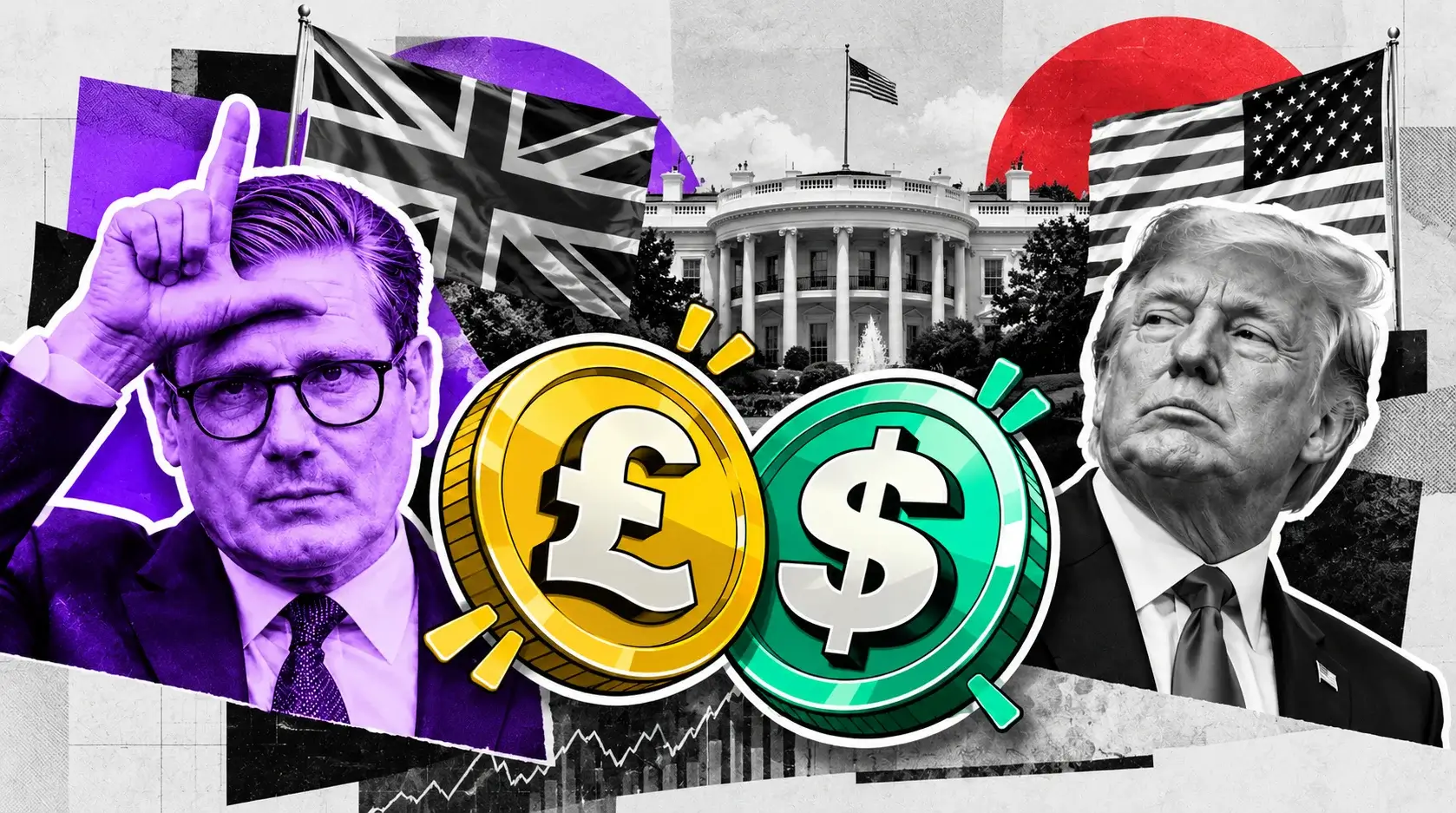
GBP/USD Price Forecast: Cable Breaks 10-Day Lows at 1.3500 as Hot US CPI and Starmer Leadership Crisis Crush Sterling
US CPI accelerates to 3.8% YoY, pushing Fed hike odds to 35.6% from 23.5% | That's TradingNEWS
Key Points
- GBP/USD breaks to 1.3500 lows, down 0.25% as US CPI hits 3.8% YoY and dollar surges.
- UK gilt yields punch 26-year highs as Wes Streeting prepares Thursday resignation against Starmer.
- Cable targets 1.3434 first, then 1.3331 and 1.3163 if 1.3500 floor breaks decisively.
GBP/USD is changing hands at 1.3500 on Wednesday, May 13, 2026, fresh off a 10-day low after extending a third consecutive day of losses against a firming U.S. dollar. The session has produced a 0.25% to 0.57% decline on the day depending on the data feed, with intraday prints clustering between 1.3500 on the FXStreet quote, 1.35062 on the Forex Factory feed, 1.3513 on the FXEmpire chart, and 1.3550 on the TMGM read from earlier in the European session before the breakdown accelerated. The cross-currency map confirms the breadth of the dollar move — USD has gained 0.25% against GBP, 0.19% against EUR, 0.11% against JPY, 0.16% against AUD, 0.12% against CHF, and 0.37% against NZD on the session, while losing 0.02% against CAD. Sterling has been the second-weakest G10 currency against the dollar after the New Zealand dollar, and the relative weakness reflects two simultaneous catalysts hitting Cable from both sides — a hotter-than-expected U.S. CPI print that has fundamentally repriced Federal Reserve policy expectations toward rate hikes rather than cuts, and a deepening political crisis in Westminster that has pushed UK gilt yields to levels not seen since the late 1990s. The U.S. Dollar Index has firmed 0.2% to 98.50, with the white descending channel ceiling at 98.59 acting as the next directional pivot. The pair is now testing the white ascending trendline support from the early-May low at 1.3510, having sold off from the red moving average at 1.3535, with the technical structure increasingly threatening a clean break of the 1.3500 psychological floor.
The Hot CPI Print That Rewrote The Rate Path
The April Consumer Price Index print released Tuesday accelerated to 3.8% year-on-year from 3.3% in March, beating consensus estimates of 3.7% and producing the cleanest hawkish surprise of the year. The core CPI reading climbed to 2.8% from 2.6%. The combined headline and core acceleration was driven by persistent shelter inflation and rising energy prices from earlier in the year, with the U.S.-Iran ceasefire allowing some oil to flow again but not enough to break the underlying pricing trend. The market reaction was immediate and material — CME FedWatch probabilities for at least one Federal Reserve interest rate hike in 2026 have surged to 35.6% from 23.5% before the CPI release, a 12 percentage point jump in a single session that fundamentally changes the rate-differential math behind every dollar pair. The April Producer Price Index released Wednesday morning added another leg to the move, with consensus expectations for headline PPI at 4.9% year-on-year against 4.0% in March and core PPI at 4.3% year-on-year against 3.8% prior — figures that would further entrench the inflation-stickiness narrative if they print as expected. The 10-year U.S. Treasury yield sits at 4.48%, a 10-month high that mechanically raises the opportunity cost of holding non-dollar currencies and removes the structural floor that had been supporting Cable through the late-April recovery. The combination of a hotter CPI than expected, a hotter PPI on deck, and a Fed transition arriving Friday creates the cleanest sustained dollar bull case across the G10 complex in months.
The Starmer Leadership Crisis That Is Crushing Sterling
Prime Minister Keir Starmer is facing the most serious leadership challenge of his tenure, with Health Secretary Wes Streeting reportedly preparing to resign as soon as Thursday to trigger a formal leadership contest. Streeting confronted Starmer on Wednesday morning during a 16-minute meeting ahead of the King's Speech, and Labour Party insiders are now openly discussing the timeline for Starmer's exit rather than whether he can survive the current pressure. The trigger for the crisis was Labour's disastrous local election performance — councillor changes show Labour down 202 seats, the Conservatives down 61, Reform UK adding 270 councillors, the Liberal Democrats gaining 29 seats, and the Greens adding 23. The 202-seat collapse on the Labour side represents the worst council-level performance for a sitting government in decades and has effectively shattered the political cover Starmer had been operating under since the general election less than two years ago. Starmer has publicly insisted he will remain Prime Minister, but markets have moved past the question of whether he stays and are now pricing the probability that he leaves on his own terms versus being forced out. Kathleen Brooks, research director at XTB, has framed the situation precisely — if this becomes a drawn-out leadership battle or Starmer lays out a departure timetable, both Starmer and Chancellor Rachel Reeves will be seen as lame ducks with no control over the public purse, which would be a bad position for the UK given the last general election was less than two years ago. The bond market has begun pricing in that scenario decisively.
UK Gilts At 26-Year Highs Are The Real Catalyst
The bond market move underneath Sterling is the single most important macro signal driving the GBP/USD breakdown. The 10-year UK gilt yield has climbed above 5.10%, while the 20-year and 30-year UK yields have struck 26-year highs — readings not seen since the late 1990s. Higher yields would normally be supportive of a currency through the rate-differential channel, but the current move is being driven by fiscal sustainability concerns rather than monetary policy tightening expectations, which is the precise opposite signal. SocGen's Kit Juckes has captured the dynamic — increased spending under a new Labour leadership is a given, higher taxes are almost certain including wealth and housing taxes, and that fiscal backdrop layered on top of geopolitical uncertainty, rising energy costs, and UK 2026 consensus GDP growth forecasts that have fallen from 1.1% at Christmas to 0.8% currently leaves very little to drive Sterling higher. Bank of England commentary has reinforced the cautious outlook — the BoE is expected to maintain a restrictive stance as inflation remains above target per the latest Reuters poll. BoE Monetary Policy Committee member Catherine Mann has explicitly stated that monetary policy cannot offset cost-push shocks from energy prices, signaling that the central bank has no intention of cutting rates aggressively to support the economy even as growth deteriorates. The combination of fiscal blow-out risk, political instability, BoE restrictive policy, and a worsening growth outlook creates a perfect storm for Sterling that has nothing to do with what the dollar is doing on the other side of the pair.
The Technical Read Beneath The 1.3500 Wall
The chart structure for GBP/USD has rotated decisively bearish over the past three sessions. The pair currently sits below the 20-day Exponential Moving Average at 1.3530 after failing to break above the 61.8% Fibonacci retracement of the latest swing at 1.3602. The Relative Strength Index reads 49.6, hovering around the neutral line and indicating waning upside momentum, which suggests rallies will remain capped while price holds beneath the immediate confluence of dynamic and Fibonacci resistance. On the topside, the immediate resistance ladder runs through the 50.0% retracement at 1.3518, the 20-day EMA at 1.3530, the 61.8% retracement at 1.3602, the 78.6% retracement at 1.3721, and the 100% retracement at 1.3873. On the downside, the first support sits at the 38.2% Fibonacci retracement around 1.3434, with a deeper floor at the 23.6% level near 1.3331 and the structural anchor at 1.3163 if the breakdown extends. The intraday 2-hour chart shows price testing the white ascending trendline from the early-May low at 1.3510, with the red moving average at 1.3535 acting as immediate resistance. The Volume Profile reads the 1.351 zone as the fair value gap where buyers are stepping in, but the structural pressure points to continued downside if the 1.3500 floor breaks decisively. The Daily Bollinger configuration shows price below the 20-day SMA at 1.3540 and above the 100-day SMA at 1.3483, with the lower Bollinger band at 1.3458 representing the next stronger floor on a deeper pullback.
The Q1 GDP Release That Will Define Thursday
The single most important UK data point on the calendar is the Q1 2026 Gross Domestic Product preliminary release scheduled for Thursday, May 14 at 06:00 GMT. The consensus expectation sits at 0.6% quarter-on-quarter expansion against the 0.1% growth seen in the final quarter of 2025, with employment data also expected to show modest growth. A print at or above consensus would provide a temporary lift for Sterling by countering the recessionary narrative that has been building under the political turmoil, while a miss would accelerate the breakdown and likely push GBP/USD decisively beneath 1.3500. The structural setup is genuinely binary — the consensus is unusually high relative to recent UK data trends, which means the risk of a downside miss is materially elevated. The EU data released this morning showed eurozone Q1 GDP expanded 0.1% quarter-on-quarter, with industrial production rising 0.2% in the euro area and 0.8% in the EU in March 2026 — a soft set of readings that confirms the broader European growth slowdown but did not produce significant euro weakness because the ECB's restrictive stance has held up against the data. The UK number will be measured against that backdrop and against the prior 0.1% UK print, which sets a low bar that could either be cleared decisively or missed badly depending on how the political uncertainty has fed through into Q1 activity.
Iran War Risk And The Oil Price Pass-Through
The geopolitical backdrop is reinforcing the dollar bid through the safe-haven channel and the oil-driven terms-of-trade channel simultaneously. President Trump has rejected the latest Iranian proposals and explicitly warned that the U.S.-Iran ceasefire is on "massive life support" — language that has unsettled markets and pushed crude prices back toward $107 Brent and $102 WTI. The Strait of Hormuz remains effectively closed for the first time in recorded history, with cumulative supply losses exceeding 1 billion barrels and the IEA forecasting a 1.78 million barrels per day deficit for 2026. Iran's Aladdin Boroujerdi, a member of Parliament's National Security and Foreign Policy Commission, has stated that Iran "will by no means relinquish the achievement of the Strait of Hormuz" and will not enter into negotiations regarding nuclear enrichment — language that signals the diplomatic track has fundamentally stalled. MUFG has captured the implication — ending the conflict and reopening the Strait could take longer than expected and result in a more disruptive outcome for the global economy and financial markets. ING has flagged the risk of complacency — markets have been reluctant to price renewed escalation despite Trump's claim that the ceasefire is on life support and further reports of military activity in the Strait, and the longer this stalemate persists, the greater the upside risks for the dollar both in the near term and the medium run. The oil-driven inflation pass-through is also feeding directly into the UK economic outlook — UK consensus GDP growth for 2026 has fallen from 1.1% at Christmas to 0.8% currently specifically because of energy cost pressures.
The Cross-Currency Map And Cable's Position In The Hierarchy
The relative-performance ranking across the G10 complex tells a precise story about where Sterling sits. The dollar's gain of 0.25% against the pound on the session is roughly in the middle of the dollar's broader G10 advance — meaning the GBP/USD move is not specifically about Sterling weakness but about broad-based dollar strength that Sterling is participating in. The dollar's largest single-day gain has been against the New Zealand dollar at 0.37%, with USD/NZD strength reflecting risk-off rotation into the safe-haven complex. The dollar's weakest performance has been against the Canadian dollar at -0.02%, with CAD outperforming because the Canadian dollar is benefiting from the oil-driven terms-of-trade improvement. EUR/USD sits at 1.1711 per Scotiabank's read, extending its downward drift on the same hot inflation backdrop that is pressuring Cable. The euro is trading mildly softer against the dollar as markets weigh the same Fed rate-cut repricing dynamic that is hitting Sterling, but the Eurozone political backdrop is meaningfully more stable than the UK situation, which means EUR/USD is holding above its near-term support while GBP/USD is breaking through. USD/JPY is testing 158 with Japanese 20-year yields climbing to 1997 highs as JGBs track U.S. moves. The Australian dollar is muted near 0.7250 following the PPI print. USD/CAD is steady around 1.3695 with the Canadian dollar seen as cheap versus fair value per Scotiabank strategists Shaun Osborne and Eric Theoret. AUD/JPY and GBP/JPY are in focus as the yen-cross dynamics extend the broader risk-asset rotation. The pattern across the entire G10 complex confirms that the dollar is the dominant force, and Sterling is being penalized further because of the layered political and fiscal concerns specific to the UK.
BoE And Fed Policy Divergence
The monetary policy divergence between the Federal Reserve and the Bank of England is the cleanest fundamental driver of the GBP/USD trajectory over the next three to six months. The Fed transition arrives Friday, May 15, when Jerome Powell hands the gavel to Kevin Warsh after the Senate confirmed him in a 51 to 45 vote. Warsh is presumed to be more dovish than Powell, but MUFG and other major banks have argued he is unlikely to change the status quo because most Fed officials will remain unreceptive to easing calls given the current inflation backdrop. Four Fed policymakers dissented at the most recent meeting, highlighting a growing policy divide that the Fed must navigate under Warsh's leadership. The BoE side of the equation is structurally different — Catherine Mann's comment that monetary policy cannot offset cost-push shocks from energy prices is effectively a statement that the BoE will hold restrictive policy regardless of growth deterioration. The Reuters poll of economists expects the BoE to maintain its current stance because inflation remains elevated. The divergence is producing a unique outcome — both central banks are holding restrictive policy, but the Fed has the structural backing of accelerating inflation prints while the BoE is holding into a deteriorating growth backdrop with fiscal concerns layered underneath. That asymmetry mechanically favors the dollar through both the rate-differential channel and the credibility channel over the next several months.
The Daniel Forecast And The Range Trade Argument
DailyForex's Daniel framework has argued that the GBP/USD pair is trading within a notably flat and directionless range that is challenging to read for trend purposes, with price consolidating or moving in choppy swings without clear logic. The argument is that when a range looks this strong and directionless, it is more likely to hold, which creates range-trading opportunities at the extremes through reversals off the support and resistance bands. The implication is that traders should look for fades of the 1.3434 to 1.3500 lower band and fades of the 1.3600 to 1.3700 upper band rather than chasing directional breakouts. That view has merit, but the current setup is genuinely different from a pure range environment because the political and fiscal pressure on the UK side is accelerating rather than stabilizing, and the technical structure has rotated through several support levels in the past three sessions. The risk to the range-trading thesis is precisely the kind of catalyst-driven breakdown that materializes when political instability combines with a hawkish central bank backdrop on the opposing currency side. Independent technical analyst Anton Kharitonov's framework has framed the broader pattern as one where bulls failed to clear key resistance, with the inability to break higher increasing the likelihood of continued correction — a view that aligns with the current price action rather than the range-trading thesis.
The Cross-Asset Read Across Risk Markets
The broader risk-asset complex is reinforcing the GBP/USD breakdown rather than offering Sterling any relief. The S&P 500 is on the defensive as hot PPI fuels Fed angst — the Nasdaq is being supported by AI momentum but the broader equity market is rotating defensively. Gold is trimming losses and revisiting $4,700 amid continuous U.S. dollar strength. Silver is advancing on Asian demand and geopolitical tensions despite firm dollar pricing. Bitcoin is holding above $80,000 but downside risks are increasing. The U.S. Dollar Index is rejecting the 98.59 resistance at the white descending channel ceiling, with the next directional move depending on whether DXY breaks above 98.59 or fades back toward 98.09 support. The technical resistance on DXY is genuinely the most important pivot in the entire FX complex — a clean break above 98.59 opens the path toward 99.07 and accelerates the dollar bid against every G10 counterpart, while a rejection at the channel ceiling produces a near-term retracement that could provide temporary relief to Sterling. The Volume Profile on DXY at 98.54 indicates price consolidation with sellers defending the top of the trendline. The next 48 hours of dollar price action will determine whether GBP/USD breaks 1.3500 decisively or holds the support and bounces to 1.3530 to 1.3540.
Iran-Specific Bond Market Risk And The Carry Trade Implications
Former Bank of Japan Governor Kuroda has flagged that if the Iran war is prolonged, the BoJ may be forced to speed up policy normalization or even tighten monetary policy to deal with inflation — language that has structural implications for the entire yen-cross complex and indirectly for GBP/USD through the broader risk-rotation channel. If the BoJ accelerates tightening, the yen-funded carry trade unwinds, which would pressure all high-yielding pairs including GBP/USD through volatility expansion. ECB's Madis Muller has separately stated that he sees no reason to talk about recession now, which provides a marginal support floor for the euro but also confirms that the ECB is unlikely to cut rates in the near term — limiting the relative attractiveness of Sterling against the euro and capping any GBP/EUR recovery that might otherwise provide indirect support for Cable. The Fed Collins comment that the prolonged Middle East war creates challenging policy choices captures the fundamental tension — the Fed cannot cut rates into an inflation-driven supply shock without losing credibility, and Cable is being penalized through both the inflation channel and the safe-haven channel simultaneously.
The Bull Case For GBP/USD That Still Exists
The structural argument for a Sterling recovery later in 2026 retains genuine merit despite the near-term breakdown. The consensus 0.6% Q1 GDP print expected Thursday would mark a sixfold acceleration from the 0.1% Q4 2025 print, signaling that the UK economy has more underlying resilience than the political narrative suggests. The BoE's restrictive stance means UK rates remain genuinely competitive against the dollar on a real-rate basis once the inflation differential is factored in. The pure-technical argument is that 1.3500 has held as support multiple times over the past month, and a decisive bounce from the level would provide a cleaner long entry than the current breakdown environment offers. The political turmoil could resolve quickly if Starmer either consolidates power through a cabinet reshuffle or if a clean leadership transition produces a credible replacement, in which case the political risk premium currently embedded in Sterling would unwind quickly. The Iran war scenario could also reverse — if a credible Strait reopening announcement materializes from the Trump-Xi summit or from direct U.S.-Iran negotiations, the safe-haven dollar bid would compress and Cable would have room to recover toward 1.3700 or higher. The longer-horizon view from most institutional banks remains that Sterling can recover into H2 2026 if the Fed begins cutting rates before the BoE shifts policy, which would invert the current rate-differential pressure.
Read More
-
Yen Stalls at 160 Despite a 3% JGB and Tokyo Core CPI at 2.0% — Intervention Sits at 164, Friday's Payrolls Decide
02.09.2026 · TradingNEWS ArchiveEnergy
-
QQQ ETF ($706.22) Slides 7.4% Below Its High as the Market Reprices the AI Capex Bill — $686.57 Target if $700 Breaks
22.10.2026 · TradingNEWS ArchiveStocks
-
XRPI ($7.00) and XRPR ($10.74) Slide Toward 52-Week Lows as Spot XRP ETF Flows Stall at $708,510
22.10.2026 · TradingNEWS ArchiveCrypto
-
NG ($2.775) Decoupled From Europe’s €88 Gas Crisis as LNG Feedgas Hits 18.9 Bcf/d — $3.30 Upside on Cold Weather
22.10.2026 · TradingNEWS ArchiveCommodities
-
Dollar-Yen (157.35) Loses 157.65 as the Yen Rallies on Haven Demand — 155 Target if 156 Breaks
22.10.2026 · TradingNEWS ArchiveForex
The Bear Case That Is Currently Dominant
The near-term case against GBP/USD is structurally specific and demands meaningful respect. The 10-year U.S. Treasury yield at 4.48% raises the opportunity cost of holding Sterling to a 10-month high. The 35.6% probability of a Fed rate hike in 2026 is pricing dollar strength that the market simply was not entertaining 48 hours ago. UK gilt yields at 26-year highs are signaling fiscal sustainability concerns rather than monetary tightening, which is structurally bearish for the currency. The Streeting resignation timeline and the broader Starmer leadership crisis create a multi-week political risk premium that will not resolve quickly even if the immediate situation stabilizes. Reform UK's 270-seat council gain signals that the next general election could produce an even more uncertain political outcome. UK 2026 GDP consensus has dropped from 1.1% to 0.8% on the back of the energy shock. The Iran war remains active with no credible resolution timeline. The technical structure has broken multiple support levels in the past three sessions. The MACD and RSI indicators are both leaning bearish despite the recent attempt to stabilize above 1.3500. The combination of weak UK fundamentals, hot U.S. inflation, restrictive BoE policy, and structural dollar strength creates a sustained bearish backdrop that is mechanically self-reinforcing.
The Strategic Read On A Compressed Setup
The decision framework for GBP/USD at 1.3500 sits squarely between two specific price triggers. A daily close below 1.3434 confirms the bearish breakdown and exposes 1.3331 as the next downside target, with 1.3163 as the structural anchor on a deeper move. A reclaim of 1.3530 with volume confirmation would invalidate the breakdown thesis and reopen the path toward 1.3602 channel resistance and 1.3721 as the prior monthly highs. The stop-loss reference for short positions sits at 1.3540 on the topside. The stop-loss reference for any contrarian long positioning sits at 1.3450 on the downside. The position-sizing implication is that the next decisive move is likely to be 1.5% to 3% in either direction given the volatility regime, combined with the dual catalysts of the UK Q1 GDP print Thursday, the Friday Fed chair transition, and the ongoing Streeting resignation timeline that could materialize as soon as tomorrow. The compressed FX implied volatility means option premiums are pricing limited movement, which creates favorable risk-reward for directional positioning if the catalysts deliver a decisive break.
The Trade
The honest read on GBP/USD at 1.3500 is that the path of least resistance is to the downside over the next one to three weeks. The current asymmetry favors the bearish side because the rate backdrop, the dollar strength, the political uncertainty in Westminster, the fiscal blow-out fears feeding into UK gilt yields at 26-year highs, the technical breakdown beneath the 20-day EMA, and the Iran war risk-off impulse all point to continued Sterling weakness. The medium-term thesis remains constructively biased toward moderate Sterling recovery in H2 2026 if and when the Fed begins cutting rates before the BoE shifts policy, but that scenario is contingent on the inflation prints peaking inside the next two months and the UK political situation stabilizing — neither of which is the current base case. The recommendation reads sell with a target of 1.3434 as the first downside objective, 1.3331 as the secondary target, and 1.3163 as the deeper-pullback target if the breakdown sustains, with the stop-loss reference at 1.3540 on the topside to manage the contrarian risk of a Streeting non-resignation or a dovish Warsh comment that triggers a short-squeeze. The recommendation for participants with existing long Cable exposure reads reduce ahead of the UK Q1 GDP print Thursday and the Friday Fed transition, on the basis that the asymmetric risk-reward over the next 48 hours is meaningfully tilted toward further Sterling weakness. The mid-term bias on GBP/USD reads bearish in the near term with a price target of 1.3331 to 1.3163, neutral on the medium-term horizon contingent on the BoE-Fed rate-differential trajectory and the resolution of the Starmer leadership question, and constructively bullish on the longer-term outlook contingent on the H2 2026 rate-cut sequence playing out as the institutional consensus currently projects. The current bias reads short GBP/USD targeting 1.3434 with strict risk management above 1.3540.