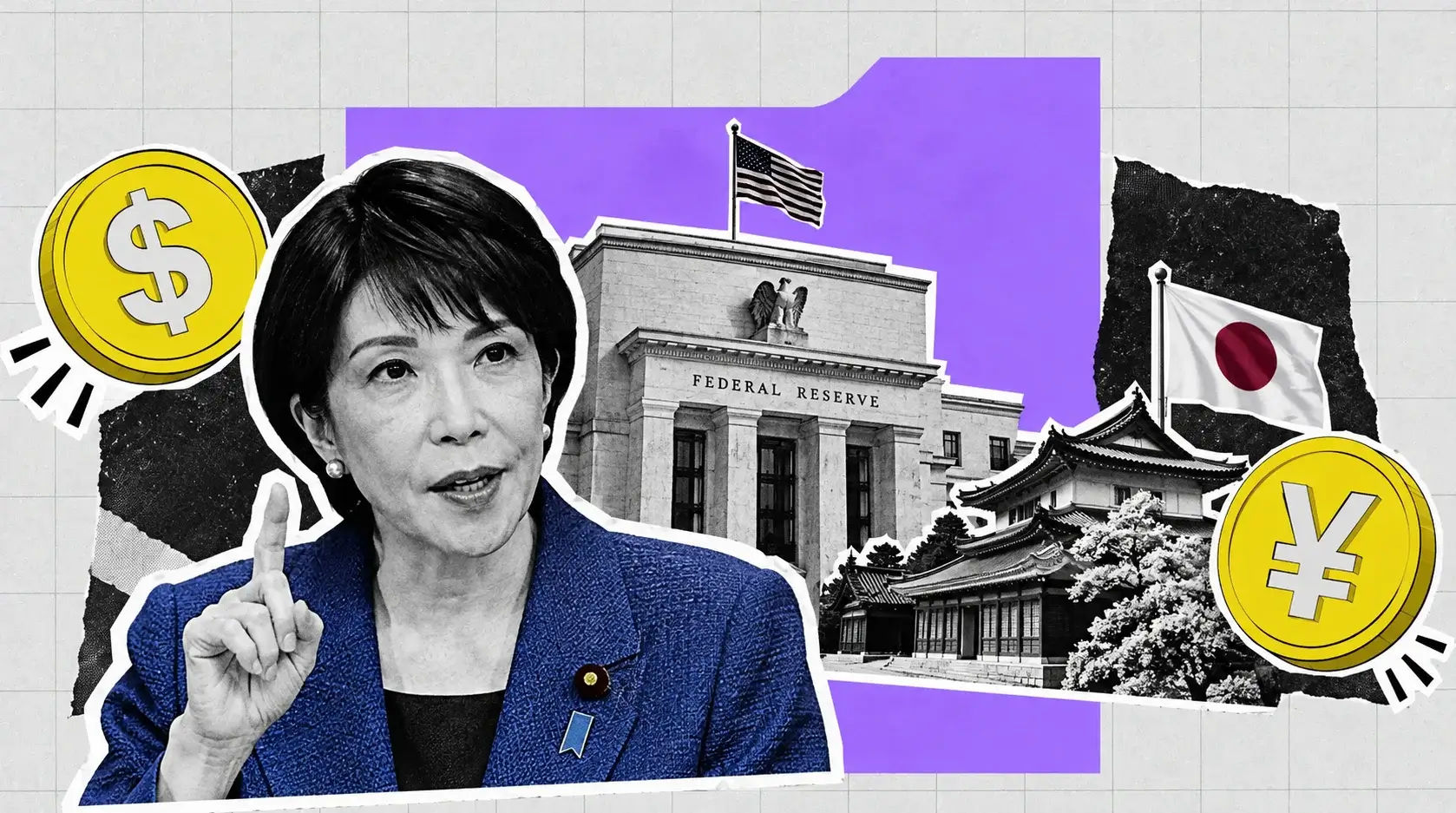
USD/JPY Forecast: Dollar-Yen Pinned at 159 Below 160 Ceiling as BoJ and Fed Loom
Pair holds above 157.53 Elliott Wave pivot with 160.21-160.74 resistance capping upside | That's TradingNEWS
Key Points
- USD/JPY at 159.422 below 160.00 ceiling as retail sentiment hits 77.2% bullish and 52-week high stands at 160.48
- Elliott Wave targets 162.00-165.00 with 157.53 as pivot, while US-Japan 10-year yield gap at 190 bps backs carry trade
- BoJ April 28 and Fed decisions next week set the move, with Tokyo's ¥15T 2024 intervention memory capping upside at 160.50
USD/JPY is pressing against one of the most politically charged price levels in global foreign exchange, with the pair currently trading at ¥159.422 after pulling back 0.285% on the session — a move that tells you everything about why this setup has become the single most contested trade in the G10 complex heading into next week's dual central bank decisions. The pair has spent most of the past six weeks coiling in a tight consolidation just beneath the 160.00 psychological barrier, with the 52-week high of 160.48 sitting directly overhead as a combination of hard technical resistance and an unofficial line in the sand for the Japanese Ministry of Finance. Market sentiment on retail positioning is running at 77.2% bullish, which reflects the strong underlying momentum of the trend but also signals a crowded long book that carries meaningful squeeze risk if the intervention card gets played. The daily range has compressed to roughly 159.40-159.80, and the weekly chart shows price holding firmly above the April opening range while repeatedly failing to close cleanly above 160.21/74. The setup is genuinely binary — a clean break above 160.74 on weekly close unlocks the next leg toward 161.95 and potentially 163.33, while a rejection off the intervention zone and a close below 157.53 opens structural downside toward the 154.79-155.29 invalidation cluster where the broader bullish count finally breaks. Both central banks meeting in the same week, combined with U.S. and Japanese CPI prints Thursday, makes this the single biggest event-risk cluster for the pair of the entire quarter.
Why the 160.00 Zone Is Not Ordinary Technical Resistance
The 160.00 level on USD/JPY has a specific meaning that ordinary resistance zones do not carry, and anyone positioning around this trade needs to internalize the full picture. This is not a simple Fibonacci level or round-number psychological barrier. It is a memorialized intervention threshold where the Japanese Ministry of Finance has already deployed massive real money to defend the yen in recent history. Japan spent ¥9.7885 trillion on dollar-selling, yen-buying operations during April-June 2024, followed by another ¥5.5348 trillion across July-September 2024. Those are operational realities, not theoretical possibilities — Tokyo has already demonstrated both the willingness and the capacity to intervene at and just above this zone when price action becomes disorderly.
The mechanics of how Tokyo approaches intervention are worth understanding because they directly affect trade structure. Japan does not mechanically defend a fixed FX line. The Ministry of Finance reacts to speed, to disorder, to speculative excess, and to political pressure — not to a specific numerical threshold. A slow grind above 160.00 that takes several weeks may not trigger intervention at all. A violent spike from 158 to 162 over two sessions on speculative positioning almost certainly would. That distinction matters because it tells you what kind of upside price action is actually sustainable and what kind will get slammed back down by direct MOF action.
The Finance Minister has reiterated publicly that "decisive action will be taken if necessary" and hinted at maintaining coordination with U.S. Treasury counterparts. That rhetoric is important because it elevates the 160.00 zone from a purely technical level into a highly policy-sensitive threshold where the tug-of-war between speculative flow and official action becomes existential. For dollar bulls, 160.00 represents an attractive breakout target because clearing it could trigger stop-driven momentum buying. For Japanese officials, that same break looks disorderly and demands response. That is precisely why the upside from current levels becomes increasingly asymmetric — price can still rise, but each additional 50-pip push carries a larger intervention premium that skews the risk-reward against fresh long entries.
The Technical Architecture — 157.53 Is the Elliott Wave Pivot That Defines the Cycle
The Elliott Wave structural count on the pair provides a clean trading framework that connects the short-term consolidation to the longer-term directional bias. On the weekly timeframe, an ascending fifth wave of larger degree labeled 5 is actively developing, with wave (1) of 5 forming as its primary component. The third wave of smaller degree 3 of (1) has already printed on the daily chart, and a correction has completed as the fourth wave 4 of (1). On the H4 timeframe, the fifth wave 5 of (1) is presumably now forming, within which wave i of 5 has printed, the local correction ii of 5 has completed, and wave iii of 5 has started developing. If the wave structure holds, USD/JPY should continue rising toward the 162.00-165.00 target zone as the primary forecast.
The critical level that defines the entire bullish count is 157.53. A confirmed break and consolidation below that pivot would invalidate the current wave structure and open the door to a deeper decline toward the 156.07-155.10 zone. The trade framework that flows directly from this structure is clean: long positions on corrections above 157.53 with stops below 157.00 and targets at 162.00-165.00, versus short positions on confirmed breaks below 157.53 with stops above 158.00 targeting 156.07-155.10. Current price at 159.422 means the pair is sitting deep inside the bullish zone with roughly 200 pips of risk budget to the pivot level and 250-550 pips of upside potential to the target range.
The Weekly Chart Battle Lines — Resistance at 160.21/74 and Support at 154.79-155.29
The weekly technical structure maps out the specific levels that will determine whether this consolidation resolves higher or lower. Immediate confluent resistance sits at 160.21-160.74, a region defined by both the April 2024 swing high and the 2024 high-week reversal close. That zone has rejected USD/JPY multiple times over the past month, creating a defined ceiling that needs weekly closing strength above to unlock the next directional leg. If the breakout materializes, the first target above sits at the 2024 swing high of 161.95, followed by the 1.618% extension of the 2025 advance near 163.33 — a level that should produce a larger reaction given its mathematical significance in the wave count.
On the downside, weekly support architecture is layered. The 2025 high-week close (HWC) at 157.70 is the first meaningful level below current price. The yearly open sits at 154.67. The broader bullish invalidation has now been raised to the 154.79-155.29 zone, which aligns with both the 2026 low-week close (LWC) and the 61.8% retracement of the yearly range. Channel support on the weekly converges on this zone into the monthly cross, meaning a loss of 154.79 would be the cleanest signal that a significant top is in place and a larger trend reversal is underway.
For USD/JPY to be heading higher on a continuation basis, losses on any pullback need to stay limited to 157.70. Below that, the technical structure begins to deteriorate meaningfully, and the bullish case becomes harder to defend with conviction. Above 160.74 on a weekly closing basis, the upside trade becomes genuinely clean with a defined path to 161.95 and 163.33.
The Short-Term Technical Reading — 157.60 and 158.30 Are the Critical Pullback Levels
The short-term daily chart fills in the tactical picture between the weekly structure markers. USD/JPY has been oscillating in a familiar range since mid-March, with the recent rebound from the technically significant 200-day Exponential Moving Average establishing a bullish consolidation phase. The Relative Strength Index at 56.79 to 58.34 sits comfortably in positive territory without signaling overbought conditions, suggesting underlying demand persists without the kind of stretched positioning that precedes sharp reversals. The Moving Average Convergence Divergence indicator at 0.080 is marginally positive, hinting that upside momentum remains constructive but not aggressive enough to overwhelm the intervention-sensitive resistance zone.
The moving average cluster is providing important structural support. The 20-day EMA sits at 159.69, the 50-day EMA at 159.54, and the 200-day EMA at 159.26 — all clustered just below spot price and providing layered dynamic support on any near-term pullback. The 14-day Average True Range at 0.861 means normal daily ranges can absorb typical event risk without breaking the technical structure, but BoJ or Fed surprise headlines could easily push price through multiple moving average layers in a single session.
Further weakness below the daily low around 159.60 could attract fresh buyers near the 159.00 mark. Below that, the lower boundary of the multi-week-old range around 158.30 becomes critical — a decisive break there would prompt technical selling and open a move toward the 200-day EMA strong dynamic support at 155.03, which underpins the broader bullish structure on the daily chart. As long as pullbacks remain cushioned at these layered support zones, dips should prove short-lived unless daily closes start developing below the long-term average. Dollar bulls, however, need to see sustained strength and acceptance above 160.00 before placing fresh positions for continuation of the prevailing uptrend.
The BoJ Guidance Problem — What the April 28 Outlook Report Actually Matters For
The Bank of Japan meets April 27-28 with the Outlook Report's "Bank's View" scheduled for release on April 28. The rate decision itself is probably secondary to the forecast language, and that distinction is critical. Most sell-side desks expect the BoJ to hold the overnight call rate around 0.75% — the level set in March by an 8-1 vote with Hajime Takata dissenting in favor of 1.0%. The key variable is not whether the rate moves but whether Governor Kazuo Ueda keeps the risk of June or July tightening alive in the language surrounding the decision.
A hawkish hold — the current base case — would preserve the BoJ's policy optionality while acknowledging that energy prices, geopolitical risk, and global uncertainty justify patience. The March statement kept rates at 0.75% but explicitly noted that real interest rates remain significantly low and that the BoJ would continue raising the policy rate if the January Outlook Report's projections are realized. That formulation leaves the door open for June or July action without committing to it, which is exactly the kind of language that would keep USD/JPY capped below 160.50 without triggering a sharp yen rally.
The dovish hold scenario is where intervention risk becomes acute. If Ueda treats currency weakness as secondary and fails to link yen depreciation to inflation expectations, the market would likely interpret the message as green-lighting another leg higher in USD/JPY, forcing the Ministry of Finance to step in as Japan's next defensive layer. That is why next Tuesday's BoJ decision is effectively a choice between preserving monetary policy credibility or shifting the yen defense to direct FX intervention — and the market reaction will be driven almost entirely by that choice rather than by the headline rate number.
Japan's Inflation Mix That Is Uncomfortable Rather Than Cleanly Hawkish
The inflation picture sitting underneath the BoJ decision is genuinely complicated and deserves careful walkthrough because it explains why the bank has flexibility to hold rather than being forced to hike. Japan's March core CPI rose 1.8% year-on-year, accelerating from February's 1.6% but staying below the BoJ's 2% target for the second consecutive month. Higher crude oil prices made energy disinflation less powerful in the March print, but the number still fell short of the level that would force immediate tightening.
The underlying picture is meaningfully firmer. CPI excluding fresh food and energy — the BoJ's preferred core-core metric — rose 2.4% in March. That reading shows demand-side and wage momentum continuing to transmit into consumer prices, and it suggests that underlying inflation has not cooled significantly. The apparent softness in headline CPI is partially being masked by fuel subsidies and slower food price growth rather than reflecting genuine disinflation.
The wage signal is unambiguously strong. Rengo's third 2026 Shunto tally showed average wage increases of 5.09%, marking the third consecutive year above 5%. That data supports the BoJ's argument that inflation is becoming domestically anchored through the wage-price cycle rather than simply imported through energy channels. Under normal circumstances, a 5.09% wage print combined with 2.4% core-core inflation would be sufficient justification for continued policy tightening. The complication is that elevated energy prices from the Middle East conflict are squeezing real incomes and corporate margins simultaneously, creating stagflationary pressure that makes aggressive rate hikes potentially counterproductive for domestic demand.
This is the BoJ's hardest problem — wage-led inflation argues for higher rates while oil-led inflation argues for caution. Yen weakness sits between the two, amplifying imported costs while making policy gradualism look increasingly expensive. The April decision will reveal which of these competing pressures the BoJ weights more heavily.
The Fed Decision and the U.S.-Japan Yield Spread That Drives Everything
The Federal Reserve meets in the same week as the BoJ, with the federal funds target range at 3.50%-3.75% following the March decision. The U.S. 10-year Treasury yield recently stood at 4.34% while Japan's 10-year yield sits at 2.43%, leaving a roughly 190-basis-point 10-year spread in favor of the dollar. That yield differential is the structural core of the USD/JPY trade and explains why the pair keeps grinding higher despite repeated verbal intervention threats from Tokyo.
As long as U.S. rates remain significantly above Japanese rates, capital flows into dollar assets on a carry basis, which is the fundamental logic behind the yen's long-term weakness. The dollar has remained firm recently partly because of recurring tensions in the Middle East that drive safe-haven buying — and while the yen also carries safe-haven attributes historically, it tends to lose that competition with the dollar in an environment where interest rate spreads dominate market psychology.
Fed rhetoric at next week's decision will be scrutinized for any signs of dovish pivot language. Fading expectations for near-term rate cuts have been supporting the dollar broadly, and the DOJ probe of Fed Chair Powell has been closed — clearing procedural risk around the forward Fed leadership transition but introducing new uncertainty about Kevin Warsh's likely policy stance once confirmed. A hawkish Fed that emphasizes sticky inflation from the Iran-driven energy shock would keep the 190-basis-point spread intact and give USD/JPY the fundamental support needed to test 160.00 again. A dovish pivot that hints at earlier cuts would compress the spread and give the yen room to strengthen toward 157.70 and potentially deeper.
The CFTC Positioning Data That Makes the 160.00 Level More Dangerous
One of the critical variables that makes the intervention risk at 160.00 genuinely acute is speculative positioning data from the CFTC. Non-commercial yen net shorts stood at 83,200 contracts as of April 14, improved from the 93,700-contract print the prior week but still heavily skewed short. Leveraged funds held 77,737 long yen futures contracts against 132,182 short contracts, leaving the market vulnerable to a violent short-covering scramble if intervention headlines or BoJ guidance trigger a sudden yen rally.
That positioning structure matters because short-covering cascades typically move USD/JPY far further and faster than fundamental flows alone can explain. A 200-pip yen rally triggered by direct MOF intervention would force leveraged fund shorts to cover at adverse levels, creating a feedback loop that can take the pair from 160.00 back toward 157.00 in a matter of days or even hours. The intervention ops in 2024 produced exactly this pattern — initial 300-500 pip drops on the operation itself followed by continued short-covering weakness for several sessions as the positioning imbalance unwound.
For dollar bulls approaching this trade, the positioning overhang creates asymmetric downside risk that is not fully priced at current levels. The market is long, the level is intervention-sensitive, and the event calendar is packed — that combination skews risk-reward against fresh long entries above 159.50 even if the fundamental case for continued dollar strength remains intact.
The BoJ Reaction Function Map — Four Scenarios and Their USD/JPY Implications
The April BoJ decision distills into four distinct reaction scenarios, each with clear implications for pair direction. Scenario One — Surprise Rate Hike: The BoJ delivers a 25-basis-point increase to 1.0%, taking markets off guard and signaling that inflation credibility now outranks growth concerns. Probability is low — perhaps 10-15% — but the reaction would be sharp with USD/JPY dropping toward 158.00 or below. This outcome resolves the intervention overhang by making it unnecessary. Scenario Two — Hawkish Hold: The BoJ holds at 0.75% but uses language acknowledging energy and geopolitical uncertainty while signaling that further tightening remains likely if wages and inflation stay firm. Probability approximately 45-55% — this is the base case and would cap USD/JPY near 160.00-160.50 while preserving June or July hike optionality. Scenario Three — Neutral Hold: The BoJ holds with bland language that fails to actively address yen weakness, which the market interprets as dollar-positive. Probability around 20-25% — this outcome would trigger stop-driven tests of 160.50 and potentially pull in MOF verbal intervention within hours. Scenario Four — Dovish Hold: The BoJ holds with language that treats currency pressure as secondary and downplays inflation concerns. Probability around 10-15% but this is where intervention risk becomes acute — the breakout attempt above 160.50 would force the Ministry of Finance to center stage and create the exact conditions for direct FX intervention.
The market reaction will depend less on the first policy line and more on the reaction function Ueda demonstrates during the press conference. If he links yen weakness to inflation expectations explicitly, the yen can stabilize without an actual hike. If he treats currency pressure as peripheral, USD/JPY may force the MOF into the center of the trade within days rather than weeks.
Read More
-
Yen Stalls at 160 Despite a 3% JGB and Tokyo Core CPI at 2.0% — Intervention Sits at 164, Friday's Payrolls Decide
02.09.2026 · TradingNEWS ArchiveEnergy
-
QQQ ETF ($739) Fades From an Early Tech Rally as a 77.9 ISM Prices Index Meets Micron's $61.5B Guide — $760 Record Test Ahead
01.10.2026 · TradingNEWS ArchiveStocks
-
XRPR and XRPI Follow XRP's $1.49 Test as Spot Funds Hold 1.16B XRP and a 1 Billion Token Escrow Release Lands — $1.70 in Play
01.10.2026 · TradingNEWS ArchiveCrypto
-
November NG Slips Below $3 as Decade-High Storage Meets Capped LNG Exports — $2.75 in Sight
01.10.2026 · TradingNEWS ArchiveCommodities
-
Dollar-Yen at 158 Presses Toward 160 as a 363 bp Carry Gap Meets Katayama-Bessent Intervention Risk — 159 in Sight
01.10.2026 · TradingNEWS ArchiveForex
The Yen Performance Against the Major Currency Complex
The relative performance of the yen this week tells you something about where the structural pressure points sit. Against the U.S. dollar, the yen is down 0.54% on the week. Against the euro, flat. Against the British pound, flat. Against the Canadian dollar, -0.40%. Against the Australian dollar, -0.54%. Against the New Zealand dollar, -0.41%. Against the Swiss franc, +0.22% — making the yen actually stronger against the franc despite weakness elsewhere. The interesting pattern is that the yen's relative weakness is concentrated against the dollar and commodity-linked currencies, not against European peers, which suggests the move is being driven by carry flows and commodity-linked risk appetite rather than pure yen-specific weakness.
That distinction matters because it implies any unwinding of the USD/JPY move would probably be accompanied by softness in commodity currencies as well — meaning correlated positions across AUD/JPY, NZD/JPY, and CAD/JPY would unwind simultaneously if intervention or a hawkish BoJ surprise triggered a risk-off move. The cross-pair positioning ecosystem amplifies any move on the primary USD/JPY pair and creates the kind of liquidity squeeze that makes breakout plays above 160.00 more expensive than headline pricing suggests.
The Macro Overlay — Middle East Tensions and the Energy Shock Amplifier
The overlay that sits on top of every USD/JPY forecast right now is the Middle East conflict and its transmission through energy prices into Japanese inflation and real incomes. The Strait of Hormuz disruption has removed close to 20% of global LNG supply from the market. Brent crude is trading near $104-105 and WTI near $93-94 with persistent upside pressure from the JPMorgan-flagged 13.7 million barrels per day supply deficit. For Japan specifically, elevated energy import costs translate directly into deteriorating terms of trade and additional pressure on the current account, both of which work against the yen structurally.
The transmission from energy prices to USD/JPY operates through three distinct channels. First, the current account deterioration creates baseline yen selling pressure as Japan pays more for imported fuel. Second, the inflation impact complicates BoJ policy — higher energy prices push CPI higher but also squeeze real incomes and corporate margins, making aggressive tightening counterproductive. Third, the safe-haven flow dynamics get distorted because when risk-off shocks hit, the dollar typically strengthens faster than the yen, driving USD/JPY higher rather than lower during genuine stress episodes. All three channels favor continued yen weakness until the Middle East situation resolves or until the BoJ finds a way to compensate through rate differentials.
A clean diplomatic breakthrough from the Araghchi-Islamabad talks would provide the single most important catalyst for yen strength over the coming weeks — not because it would directly impact BoJ policy but because it would remove the energy shock component that has been reinforcing the yen-bearish macro thesis. Conversely, escalation into active military operations at Hormuz would push USD/JPY decisively through 160.00 and likely trigger either Japanese intervention or a forced BoJ rate hike as defensive responses.
The Cross-Asset Correlations — How USD/JPY Sits Relative to Everything Else
The position of USD/JPY relative to other major asset classes provides additional context for directional positioning. The U.S. Dollar Index at 98.70 is off 0.1% on the session, with the three-day rally showing signs of exhaustion. EUR/USD is holding near 1.17, GBP/USD recovering toward 1.35 after UK retail sales beat, USD/CAD choppy with softer bias developing. Gold trades above $4,700 with the week positioned for modest losses as inflation expectations and Middle East risk compete. The S&P 500 is holding near 7,159 with Intel and the semiconductor complex leading the tape higher. Bitcoin sits near $77,600-$78,000 with the crypto complex showing resilience despite broader market chop.
The correlation that matters most for USD/JPY is the U.S. Treasury yield picture. The 10-year yield climbing through 4.34% provides direct support for the pair through the yield differential channel. If yields compress as the market prices in eventual Fed cuts, the USD/JPY support weakens mechanically. If yields continue grinding higher on sticky inflation, the pair retains its fundamental bid regardless of intervention threats. That makes next week's Fed language and the Thursday CPI prints the specific data points that matter most for medium-term positioning — more so than the immediate technical levels everyone is watching.
Directional Call on USD/JPY — Neutral-to-Bullish With Hard Cap at 160.50 Pending BoJ Clarity
Rating: Hold with tactical buy on pullbacks toward 157.70-158.30 and aggressive take-profit near 160.50. The technical structure favors continued bullish bias with the Elliott Wave count targeting 162.00-165.00, the moving average cluster supporting dips, and the fundamental yield differential at 190 basis points in favor of the dollar. The RSI at 58 and MACD at 0.080 confirm constructive momentum without overextension. UK retail sales strength, U.S. yield resilience, and the ongoing Middle East energy shock all underpin the dollar's structural bid against the yen.
The downside risk is specific and named — intervention by the Ministry of Finance at or near the 160.50 zone. Tokyo has spent ¥15 trillion combined defending the yen in 2024, demonstrating both capacity and willingness to act when conditions warrant. The CFTC positioning data showing leveraged fund shorts at 132,182 contracts creates the kind of positioning overhang that amplifies any intervention-driven reversal. The binary nature of the BoJ decision next Tuesday and the Fed decision next week means the pair could plausibly see a 200-300 pip move in either direction depending on the specific policy language rather than the headline actions themselves.
The tactical playbook is clean. Long positions accumulated between 157.70 and 158.30 with stops below 157.00 offer favorable risk-reward targeting 160.00-160.50 in the near term and the 161.95-163.33 extended zone on a confirmed breakout. Do not chase strength above 159.80 without a confirmed weekly close above 160.74 because the intervention risk at current levels skews reward-to-risk unfavorably. Sell any explosive move above 160.50 aggressively if it occurs within a single session, because that kind of price action is exactly what Japanese officials are watching for as a trigger for direct FX operations.
For longer-duration positioning, the 162.00-165.00 Elliott Wave target remains achievable but requires either a confirmed BoJ dovish hold that fails to address yen weakness, further deterioration in the Middle East situation that drives oil and energy costs higher, or a hawkish Fed outcome that widens the U.S.-Japan yield spread further. None of those three catalysts is currently priced in, meaning the upside path to the target zone depends on genuinely new information arriving over the coming weeks rather than extension of current trends.
Trade the defined range, respect the intervention ceiling at 160.50, and let the BoJ decision on April 28 determine whether this resolves as the next leg of the structural yen-weakness trade toward 163.33 or as a major topping pattern that reverses toward 155.03 over the following quarter. The positioning data at 77.2% bullish retail sentiment combined with the crowded leveraged fund short book creates the exact conditions where either a clean breakout or a violent reversal becomes possible — and the specific outcome depends almost entirely on how Governor Ueda frames Japan's tolerance for continued yen weakness during next Tuesday's press conference. The binary setup here is genuine, the asymmetric upside from current levels is limited by intervention risk, and the downside from 160.50 if triggered could be violent enough to wipe out weeks of patient accumulation in a single session. Size positions accordingly, respect the structural levels absolutely, keep close attention on the intervention playbook, and remember that 160.00 is not just a price — it is where the Japanese state has already demonstrated willingness to deploy tens of trillions of yen to defend its currency. That reality should anchor every position decision from here until the BoJ and Fed decisions resolve the current standoff one way or the other. The edge in this trade sits with disciplined capital that waits for the breakout confirmation rather than chasing the consolidation, and with patience that respects the Ministry of Finance's proven capacity to reset the pair by hundreds of pips in a matter of hours when the conditions align.