USD/JPY Price Forecast: 155.60 Tested as BoJ Hawkish Turn Meets Cautious Fed
USD/JPY hovers around 155.60 while BoJ hike bets, Tokyo inflation slowdown, Warsh nomination and 150.00–156.00 trading range drive volatility and raise odds of a medium-term yen rebound | That's TradingNEWS
USD/JPY Price – Hawkish BoJ Meets Cautious Fed at 155
BoJ shift and rate expectations reset the USD/JPY narrative
The latest move in USD/JPY is being driven by a clean repricing of interest-rate expectations on both sides of the Pacific. On the Japanese side, the recent Summary of Opinions from the Bank of Japan signaled a more hawkish tilt, with several policymakers pointing explicitly to the need for another rate hike as inflation pressures and yen weakness remain on the radar. That rhetoric, combined with upward revisions to GDP and inflation forecasts in the January outlook report, has moved the market toward expecting a hike in H1 2026 rather than pushing normalization further out. At the same time, real rates in Japan are still negative, so the BoJ is talking about more action without delivering an aggressive schedule yet, which explains why USD/JPY is still trading in the mid-150s rather than collapsing toward 140 immediately.
Hawkish BoJ rhetoric versus softer Tokyo data keeps USD/JPY volatile
The data backdrop is unstable. Tokyo inflation has rolled over just as the BoJ has turned more vocal about further tightening, creating conflicting signals. Tokyo CPI eased sharply, with core inflation slipping toward the 2.1% area, which reduces the immediate urgency for the BoJ to hike again and explains why markets have shifted the probability of the next move closer to the spring rather than the next meeting. Earlier in the week, weaker Tokyo inflation and soft retail sales briefly pushed USD/JPY back up toward 155 after it had traded as low as roughly 152.09, the weakest level for the pair since October, as yen buyers took profits and macro funds faded the hawkish reaction. The pair’s intraday reaction to the Summary of Opinions – spiking up to around 155.24 before reversing toward 154.82 – shows a market that is positioning for tightening but not willing to fully price a rapid BoJ hiking cycle when the latest inflation print is cooling instead of accelerating.
Japanese politics and fiscal risk add another layer to USD/JPY pricing
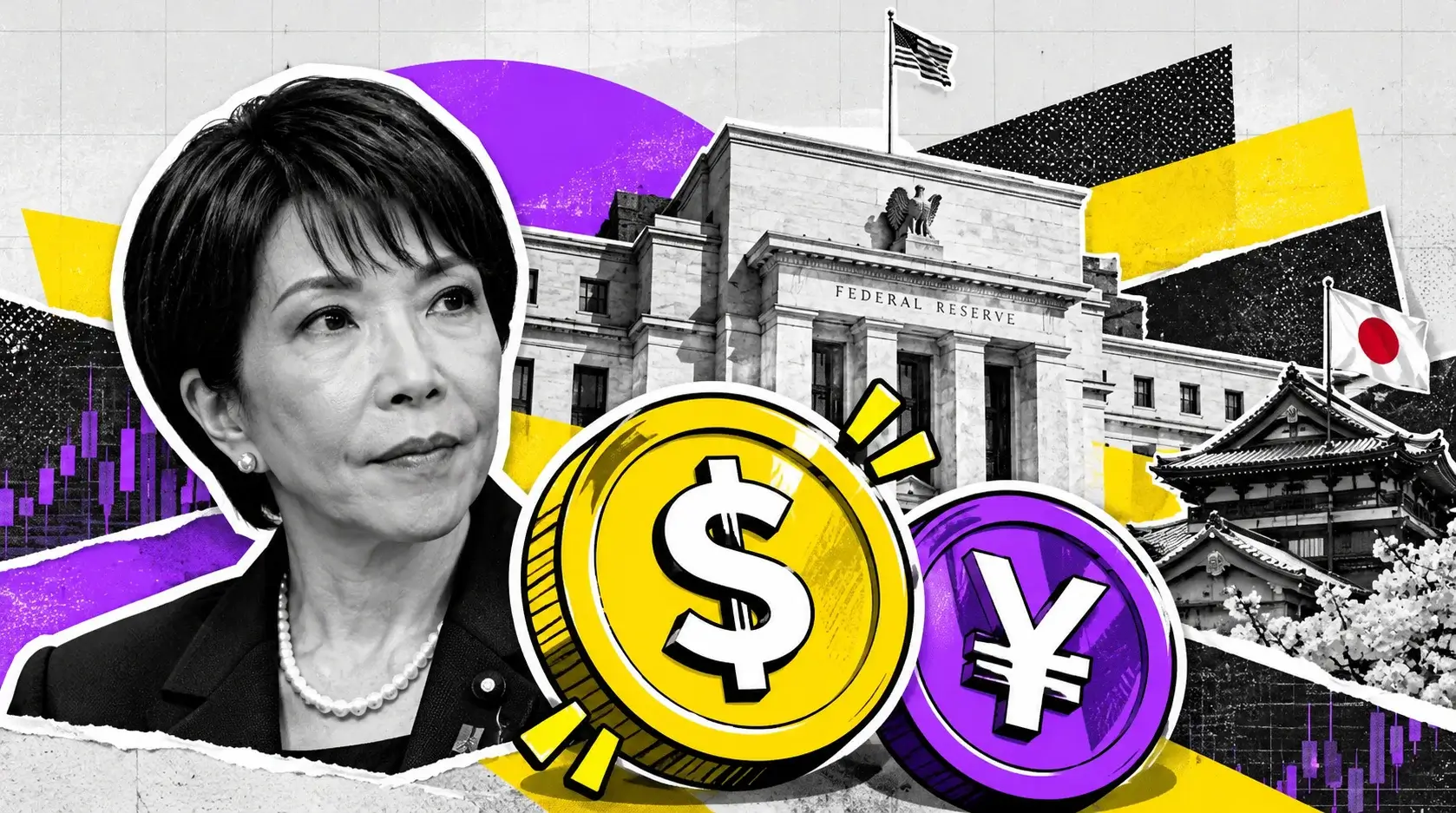
Domestic politics are now a direct driver of USD/JPY. Prime Minister Sanae Takaichi is leaning into expansionary fiscal proposals and pre-election promises, including potential tax cuts and fresh stimulus. That combination revives long-standing concerns about Japan’s fiscal path just as the BoJ is trying to move away from ultra-easy money. Markets understand that a looser fiscal stance with only gradual monetary tightening is structurally yen-negative, so the policy mix is pushing investors to keep funding trades in yen despite talk of higher rates. At the same time, officials have a long history of drawing a line in the sand when USD/JPY trades too far above where domestic politics can tolerate it. Traders remember the 2024 interventions when the rate ran through 155 and then 160; the current zone around 155 is again “politically sensitive,” which limits how aggressively the market wants to chase upside in the pair before testing the Ministry of Finance’s patience.
Intervention risk and carry-trade positioning cap USD/JPY upside
Intervention risk is now a structural cap on USD/JPY even as fundamentals still support a strong pair in the short run. Repeated verbal warnings, reports of unusual rate checks, and the historical pattern of direct FX operations whenever the yen sells off too quickly all sit in the background of every move above 155. The carry trade remains heavily skewed toward being short yen and long higher-yielding currencies, which means any hint of actual intervention or a more aggressive BoJ path can trigger an abrupt unwind. A large carry reversal similar to mid-2024 would likely send USD/JPY sharply lower, with 150 and then the 146.58 area from the prior major low acting as magnets for forced deleveraging. That asymmetry – limited upside due to intervention risk and significant downside if the BoJ or the Ministry of Finance force a reset – is one of the key reasons the medium-term skew for the pair is shifting bearish even while price is still hovering in the mid-150s.
US macro data and Fed path keep USD/JPY supported near 155
On the US side, the dollar is no longer in pure “peak hawkishness” mode, but it is still strong enough to keep USD/JPY elevated. The rebound in the ISM Manufacturing PMI from 47.9 in December to a forecast and print around the 48.3 area signals that the US industrial sector is still contracting but less severely than feared, which keeps recession risks contained and underpins the greenback. Producer inflation remains sticky, with headline PPI running near 3.0% year-on-year and core PPI around 3.3%, while the latest CPI print came in slightly hot at roughly 3.2%. Those numbers justify the cautious stance from the Federal Reserve and explain why Fed officials like Alberto Musalem and Raphael Bostic are still talking about policy needing to stay “slightly restrictive,” with an effective neutral rate band around 3.50%–3.75%. Fed funds futures are only pricing about a 13% chance of a cut in March, with the probability of a June cut near 62%, which implies a gradual, not aggressive, easing cycle. That backdrop keeps US yields high enough that funding longs in USD/JPY is still attractive on a carry basis while the Fed is not yet fully pivoting to dovishness.
Read More
-
Yen Stalls at 160 Despite a 3% JGB and Tokyo Core CPI at 2.0% — Intervention Sits at 164, Friday's Payrolls Decide
02.09.2026 · TradingNEWS ArchiveEnergy
-
AMD ($560.68) Rebounds 10% From Its October Low on the Meta Helios Win — November 3 Report Holds the Key to $649
27.10.2026 · TradingNEWS ArchiveStocks
-
Ethereum ($2,312) Lags Bitcoin and AI Stocks as BitMine Nears Its 5% Cap — Break of $2,295 Opens $2,200
27.10.2026 · TradingNEWS ArchiveCrypto
-
Brent ($113.88) Trades a $2.35 Range as Houthi Strikes Meet Saudi-Iran Diplomacy — Break of $117 Unlocks $120
27.10.2026 · TradingNEWS ArchiveCommodities
-
Nasdaq Rips 1.3%, S&P 500 Hits 7,728, Dow Stalls as BA Drops to $171
27.10.2026 · TradingNEWS ArchiveMarkets
-
GBP/USD (1.3310) Can’t Cash In on 5.43% Gilt Yields as Budget Risk Meets a Firm Dollar — Break of 1.3274 Opens 1.3200
27.10.2026 · TradingNEWS ArchiveForex
DXY firming and Warsh nomination reinforce the USD/JPY ceiling, not a new bull leg
The nomination of Kevin Warsh as the next Fed Chair adds another layer of hawkish bias to the US side of the equation. Warsh is seen as someone who will resist premature cuts, which is consistent with the stronger dollar seen across the G-10 board, with the greenback up more than half a percent versus the yen and over 1% against the Swiss franc in the latest daily heat maps. That has helped USD/JPY stabilize and even grind higher, with prints around 155.20–155.60 after three days of gains. However, the market is already discounting a cautious Fed, and the upside in the dollar is now doing more to hold the pair near current levels than to launch a new sustained bull leg beyond 160. As the year progresses and the conversation shifts from “if” to “how many” Fed cuts in 2026, the US side of the differential should start working against USD/JPY, especially if the BoJ proceeds with even a slow sequence of hikes and signals a higher long-run neutral rate in the 1.5%–2.5% area instead of the 1%–1.25% band some investors still assume.
Technical structure for USD/JPY: channel resistance, EMAs, and key levels
Technically, USD/JPY is trading at a crowded inflection zone. On the daily chart, the pair is oscillating around the nine-day exponential moving average near 154.85 and remains capped by the 50-day EMA around 155.63. The 50-day has started to roll over, which historically is an early warning that momentum is fading even if spot is still close to recent highs. At the same time, the pair is testing the upper boundary of a descending channel, with immediate resistance around 156.00. A clean daily close above 156.00 and sustained trade above the 50-day EMA would open a path toward the six-month high near 161.00 and then the long-term peak around 162.00 from July 2024, but that scenario would almost certainly invite louder intervention threats. On the downside, a decisive break below the nine-day EMA at 154.85 would confirm that the short-term corrective phase is reasserting itself and expose the three-month low at 150.02 from January 27, followed by the lower channel boundary near 149.20. Below there, the 200-day EMA becomes critical support; a sustained move under that longer-term average would signal a genuine trend reversal and bring 146.58 and then the 140 handle into view over a 6–12 month horizon.
Momentum, RSI and cross-JPY behavior confirm a fragile USD/JPY trend
Momentum indicators are consistent with a market that is topping rather than starting a fresh impulsive rally. The 14-day Relative Strength Index has recovered from deeply oversold territory around 23 back into the mid-40s, currently hovering near 46. That level is neutral, not bullish; it shows that the extreme yen buying has cooled, but buying pressure in USD/JPY is not strong enough to push RSI above 50 and into a sustained up-trend. On the cross side, the Japanese yen is not uniformly weak: it has been underperforming the US dollar, euro and pound, but has been more resilient versus commodity FX like the Australian dollar and the Canadian dollar, where small positive percentage changes indicate that yen sellers are being more selective. That pattern is typical of a late-stage USD/JPY up-cycle, where the core dollar-yen pair stays elevated thanks to rate differentials, but broader JPY weakness across the board starts to fade as value and intervention risks accumulate.
Election risk, neutral rate debate and carry unwind potential around USD/JPY
The upcoming Japanese election is a critical volatility event for USD/JPY. Markets are trying to price whether a stronger mandate for Prime Minister Takaichi will lock in more aggressive fiscal stimulus and tax cuts, which would push up JGB supply and keep the BoJ cautious about hiking too quickly. At the same time, if the BoJ communicates a higher estimate of the neutral rate – for example 1.5%–2.5% rather than 1%–1.25% – carry traders will have to re-run their models and may decide that long-term short-yen positions are no longer a one-way bet. That shift, combined with any real or threatened intervention, could trigger a classic carry unwind similar to mid-2024, when crowded positions were forced out and USD/JPY dropped sharply over a short window. The risk-reward now tilts toward that kind of event over the next year: US-Japan rate differentials are likely to narrow as the Fed cuts and the BoJ nudges rates higher, while positioning is still leaning heavily against the yen.
Short-term trading zone for USD/JPY: levels that matter for active positioning
For active traders, the current structure in USD/JPY argues for treating 155–156 as a distribution zone rather than a place to initiate fresh long exposure. Above 155.60, price is leaning against channel resistance with intervention risk rising. A sustained daily close above 156.00 would be a signal that the market is testing official tolerance and might squeeze toward 161.00–162.00, but that scenario would be driven as much by short-term momentum and options gamma as by fundamentals. On the downside, 154.85 is the immediate trigger level: a daily close below that nine-day EMA would confirm a loss of upside momentum and open a move toward 152.00–150.00, where prior lows and the three-month trough at 150.02 sit. Below 150.00, the structure turns decisively bearish, with 149.20, 146.58, and eventually the 140 region lining up as progressively more ambitious medium-term downside targets if carry trades begin to unwind.
Strategic view on USD/JPY – sell rallies, medium-term bearish bias (Sell)
Putting the macro, technical and positioning picture together, the balance of evidence points to USD/JPY being closer to the top of its cycle than the beginning of a new bull leg. A more hawkish BoJ stance, upward revisions to growth and inflation, and the likelihood of a higher Japanese neutral rate argue for multiple hikes over time. On the US side, sticky but easing inflation and Fed expectations of cuts beginning around mid-2026 mean the wide rate gap that powered the move above 150 is likely to compress rather than widen. Politically, Takaichi’s fiscal expansion and export-driven preference for a weaker yen may delay but not cancel the need for a stronger currency once intervention risk bites. Technically, the failure so far to clear the 50-day EMA at roughly 155.63 and the channel resistance near 156.00, combined with a neutral RSI around 46 and heavy positioning in carry trades, suggests limited upside and meaningful downside if sentiment turns. On that basis, the strategic stance is bearish: USD/JPY is a Sell on strength in the 155–156 zone, with an initial medium-term target cluster around 150–149, a secondary objective near 146.50, and a longer-run risk scenario pointing toward 140 if rate differentials narrow more sharply and yen carry trades unwind over the next 6–12 months.