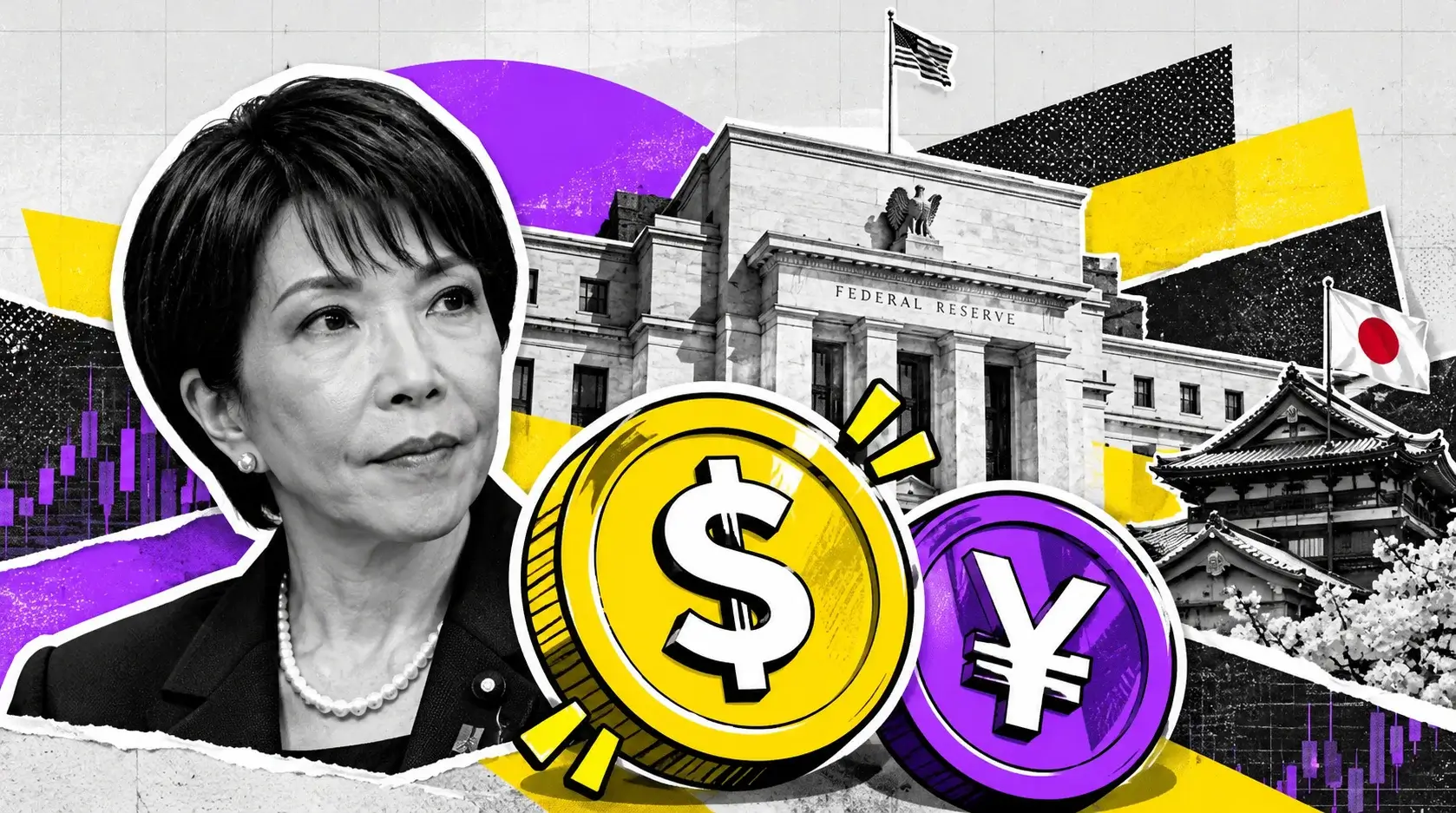
USD/JPY Price Forecast - USDJPY=X Near 158 As Tariff Shock And BoJ Shift Put 160 Ceiling In Focus
After touching 159.45 and slipping to about 157.85, USD/JPY faces intervention risk near 160.00 while 10-yr JGB yields hit 2.198% and Fed cut bets grow, tilting the medium-term bias toward a move back toward 150 | That's TradingNEWS
USD/JPY Price Snapshot and Market Context
USD/JPY Slips to 157.85 as Dollar Sells Off on Tariff Shock
USD/JPY is trading around 157.8–158.0 after losing the 158.00 handle, with the move driven more by broad USD weakness than by a sudden surge in yen demand. The Dollar Index sits near 99.18, down roughly 0.2%, as markets digest a fresh 10% US tariff package against several European economies and the UK, tied to the Greenland dispute, with a threat to lift those tariffs to 25% from June if no deal emerges. That combination of trade-war risk and a US market holiday has flattened liquidity and pushed investors into defensive positioning, leaving USD under pressure even as global risk sentiment deteriorates.
The cross has already travelled a long way in a short time. From April, USD/JPY has climbed roughly 12.5%, briefly trading just under 160.00 and printing a mid-week high near 159.45 before fading. Today’s dip to about 157.85 shows that buyers are no longer willing to chase at any price, especially with intervention risk building near the 160.00 area and the policy narrative in Japan starting to shift.
Futures Positioning in USD/JPY: Late Yen Capitulation Signals Turning Risk
The latest FX futures data shows that speculative positioning in the yen has finally flipped to net-short for the first time in about a year. Large speculators are now short JPY at an extreme, with position percent ranks sitting at 0% on both the three-month and one-year lookback. In other words, traders have spent months abandoning yen longs and only now reached a crowded short at the exact time when USD/JPY is pressing historically stretched levels.
On the dollar side, asset managers have moved back to a net-long stance in the broad USD index for the first time in several weeks, adding roughly 2.6k gross long contracts while trimming only a few hundred shorts. Yet large specs remain net short USD, about –3.2k contracts, so the speculative community is split: institutional asset managers leaning cautiously long USD, while leveraged players are still structurally against it. That split introduces the risk of sharp position adjustment if tariff-driven growth worries or Fed-cut expectations intensify.
Across other currencies, there are several sentiment extremes that matter indirectly for USD/JPY. The Swiss franc is heavily net-short among asset managers at record levels, while CAD and AUD show stretched positioning metrics, with AUD percent ranks at 100% on shorter horizons. Taken together, this is a market that has already bet aggressively on carry and on continued USD outperformance, leaving little margin for error if the policy and macro narrative shifts toward lower US yields and a more active Bank of Japan.
Japanese Politics: Snap Election, Fiscal Easing and JGB Yields Above 2.19%
Domestic Japanese politics have become a key part of the USD/JPY story. Prime Minister Sanae Takaichi has announced that the lower house will be dissolved on January 23, setting up snap elections and signalling an explicit end to what she calls “excessively tight fiscal policy.” That message is unambiguously pro-spending and has raised concerns about an even larger fiscal footprint in an economy already running one of the highest debt-to-GDP ratios in the developed world.
The bond market has reacted brutally. Ten-year Japanese Government Bond yields have pushed to around 2.198%, the highest level seen in decades. That move is not happening because growth is booming; it reflects rising risk premia and investor discomfort with Japan’s debt trajectory and potential spending commitments under the new political leadership. Higher JGB yields should, in theory, support the yen by tightening financial conditions, but the backdrop is more complex: investors are still unsure how much of this move the Bank of Japan will tolerate and how quickly it is willing to let yields re-price without stepping in.
For USD/JPY, this creates a two-way risk. On one side, a disorderly rise in JGB yields could force the BOJ into a more hawkish stance or a cutback in bond purchases, reinforcing yen strength. On the other side, if markets conclude that the central bank will ultimately cap yields to protect fiscal sustainability, then the message becomes one of persistent financial repression and a structurally weak yen. Right now, the price action suggests the market is still leaning toward the second interpretation, but the levels on JGBs indicate that patience is being tested.
Read More
-
Yen Stalls at 160 Despite a 3% JGB and Tokyo Core CPI at 2.0% — Intervention Sits at 164, Friday's Payrolls Decide
02.09.2026 · TradingNEWS ArchiveEnergy
-
SOFI ($16.71) Posts Its Best Day of the Quarter as Profit Guidance Finally Rises — Holding $15.70 Unlocks $20
27.10.2026 · TradingNEWS ArchiveStocks
-
XRP-USD ($1.30) Defends a $1.27 Double Bottom as Whales Hold 68.5% of Supply — Break of $1.31 Opens $1.35 and $1.40
27.10.2026 · TradingNEWS ArchiveCrypto
-
NG($3.002) Takes the Front Month Near a Multi-Month Low as Record Production Meets Mild Weather — Break of $2.945 Opens $2.80
27.10.2026 · TradingNEWS ArchiveCommodities
-
Nasdaq Rips 1.3%, S&P 500 Hits 7,728, Dow Stalls as BA Drops to $171
27.10.2026 · TradingNEWS ArchiveMarkets
-
GBP/USD (1.3310) Can’t Cash In on 5.43% Gilt Yields as Budget Risk Meets a Firm Dollar — Break of 1.3274 Opens 1.3200
27.10.2026 · TradingNEWS ArchiveForex
Bank of Japan Policy Path: From 0.75% to a Hawkish Neutral Rate Debate
The BOJ has already exited the zero-rate era, lifting its policy rate to 0.75%, the highest in thirty years. Yet real rates remain deeply negative because inflation has printed above the 2% target for roughly four consecutive years. That combination of entrenched inflation and still-ultra-loose real policy is the main reason why USD/JPY has been able to trade toward 160.00 despite growing political and market discomfort.
The forward path, however, is shifting. Survey data of economists shows a clear bias toward further tightening in 2026, with about 43% expecting the next rate hike in July, 27% looking for June, and a small minority seeing an earlier move in April. The near-term consensus is still for no change at the January and March meetings, but rate-hike expectations build noticeably into the second half of the year. The market is currently pricing around 46 basis points of BoJ tightening by year-end, implying at least one, and possibly two, additional moves.
The neutral rate discussion is where the medium-term story for USD/JPY becomes critical. If the BOJ signals a neutral rate in the 1.5%–2.5% zone, markets will quickly infer a path of multiple hikes beyond July, compressing the US–Japan rate differential and undermining the carry that has supported the pair for years. A more cautious neutral range around 1.0%–1.25% would still represent further tightening from today but imply a shorter cycle and a less aggressive convergence with US yields. In both cases, the direction is toward a narrower differential; the difference is the speed and magnitude.
The central bank also has to weigh the impact of the weaker yen on imported inflation. A currency that has hovered near 160.00 against the dollar for months pushes up import prices, squeezes household purchasing power and complicates any narrative that inflation is purely demand-driven. That alone argues for less tolerance of additional yen weakness and supports the case for clearer hawkish signaling once the January meeting is out of the way.
US Policy and Tariffs: Fed Cut Expectations vs Trade-War Volatility
On the US side, the interest-rate story is moving in the opposite direction. Market pricing now reflects roughly 48 basis points of Fed easing by year-end as investors respond to labor-market data and a decelerating inflation profile. Fed officials have been pushing a patient, data-dependent line, but the direction of travel is away from restrictive policy and toward gradual normalization. That matters for USD/JPY, because the pair has been built on a wide US–Japan rate gap; as that gap shrinks, the core structural support starts to erode.
At the same time, the tariff shock linked to Greenland has injected a new layer of risk. A 10% tariff on multiple European economies, with the threat of 25% later in the year, hits global growth expectations, encourages a bid for safe assets and weighs on US equity sentiment. Historically, tariff-related risk-off moves have pulled US yields lower as investors seek Treasuries, a dynamic that typically undermines the dollar in favour of currencies backed by improving policy trajectories or current-account resilience.
For USD/JPY, the combination is uncomfortable for dollar bulls. On one side, tariffs and trade conflict normally generate defensive flows into the yen as a regional safe haven. On the other, the Fed is moving, slowly but clearly, toward a lower-rate regime, while the BoJ is being pushed toward further hikes by persistent inflation and a structurally weak currency. The only argument still favouring sustained dollar strength is the absolute level of US yields and the entrenched role of the yen as a funding currency, but both pillars look weaker than they did a year ago.
Intervention Risk and Carry Unwind Potential Around USD/JPY 160.00
Authorities in Tokyo have repeatedly signalled discomfort with excessive yen depreciation, and the 160.00 area in USD/JPY is now widely seen as a line where verbal warnings could switch to action. The pair is trading below that threshold, but the memory of past interventions and recent official rhetoric remains fresh. Verbal pushback from Japanese officials after breaks above the prior 2025 high was enough to halt the move and trigger a pullback, underscoring how sensitive the market has become to the policy tone.
At the same time, the yen carry trade is now heavily populated. For much of the past year, investors have borrowed in yen at ultra-low rates to fund long positions in higher-yielding assets, including US and European credit, equities and EM carry. The combination of crowded yen shorts in the futures data and stretched spot levels near 158.00–160.00 means that any credible shift in BOJ guidance or an upside surprise in the neutral-rate signal could trigger an abrupt unwind. That kind of unwind tends to be violent: USD/JPY can drop ten to fifteen big figures in weeks as speculators cut leverage and real-money investors hedge.
The medium-term narrative laid out by several macro forecasters points toward such a scenario. A path of one or two BoJ hikes, a higher neutral rate, and Fed cuts spread through 2026 naturally drives US–Japan differentials narrower and reduces the reward for holding dollar longs against the yen. In that environment, a move from current levels toward 150.00 and potentially down to 140.00 over a 6–12 month horizon is a realistic, data-consistent path rather than an outlier.
USD/JPY Technical Structure: 160.00 Ceiling, 157.00 and 154.50 as Pivots
On the daily chart, USD/JPY still trades above its 50-day and 200-day exponential moving averages, so the longer-term trend remains technically bullish. The rally from last year’s lows drove the pair to a mid-week high near 159.45, just under the psychological 160.00 level, before sellers stepped in. The failure to sustain trades above the previous 2025 high and the subsequent slide back below 158.00 marks an important momentum shift: buyers are less willing to add at increasingly stretched levels, and every approach to 160.00 now runs into a wall of intervention risk and profit-taking.
Immediate support sits around 157.00. A decisive break below that level would turn attention toward the 50-day EMA and the 155.00–154.50 band, which has acted as a key support area on prior pullbacks. A daily close under 154.50 opens the way to a deeper correction toward 150.00 and would formally break the current medium-term uptrend. Under that, the 200-day EMA becomes the key structural line; once price trades below that average, the market will treat rallies as selling opportunities rather than dips to buy.
On intraday timeframes, a clear structure has formed. The four-hour chart shows USD/JPY pulling back to a rising trendline that has defined the bullish momentum. Buyers have been defending that line with tight risk below, targeting another attempt at 160.00, while short-term sellers lean into a secondary downward trendline that caps each rebound. The one-hour chart highlights this push-and-pull dynamic: the minor descending trendline frames the corrective leg, and a break above it would invite a retest of 158.87 and then 160.00, while a rejection keeps pressure on the primary trendline and, ultimately, on the 157.00 and 154.50 supports.
The broader technical picture is therefore asymmetric. Upside above 160.00 is likely capped by intervention risk and an increasingly stretched macro story, while downside breaks through 157.00 and 154.50 could accelerate as carry trades unwind and futures shorts are forced to cover.
Fundamental Verdict on USD/JPY: Bearish Medium-Term, Sell Rallies Above 158.50
Putting the pieces together, the medium-term balance of risk points to a weaker USD/JPY, not a stronger one. BOJ policy is moving, slowly but firmly, toward normalization after lifting rates to 0.75%, with inflation staying above target for four years and political pressure mounting to address yen weakness and import-price pass-through. Ten-year JGB yields have already surged to roughly 2.2%, reflecting a higher risk premium and a market that no longer believes in permanently free money. Economists are clustered around a July hike, with a full tightening path of roughly 46 basis points priced through year-end.
On the US side, the story goes the opposite way. Markets expect around 48 basis points of Fed cuts this year, and trade-war shocks like the Greenland-linked tariffs push growth expectations and yields lower, undermining the dollar’s carry advantage. Positioning in futures markets is crowded against the yen at the same time that USD/JPY trades near historically rich levels, creating the conditions for a disorderly reversal once the catalyst arrives in the form of a hawkish neutral-rate signal, a stronger BoJ statement, or a deeper risk-off episode that forces investors out of carry.
Technically, the pair is rich near 158.00 with limited sustainable upside beyond 160.00 and multiple clear downside levels at 157.00, 154.50, 150.00 and eventually the 140.00 area if a full carry unwind takes shape over the next 6–12 months. In this configuration, the rational stance is bearish on USD/JPY on a medium-term horizon.
The strategic call based on the data is straightforward: USD/JPY is a Sell on strength, not a Buy. Rallies into the 158.50–160.00 zone are more attractive for initiating or adding to short positions than dips are for fresh longs, with a medium-term target path skewed toward 150.00 and, in a full yen-strength cycle, toward 140.00 as policy convergence and position clearing run their course.