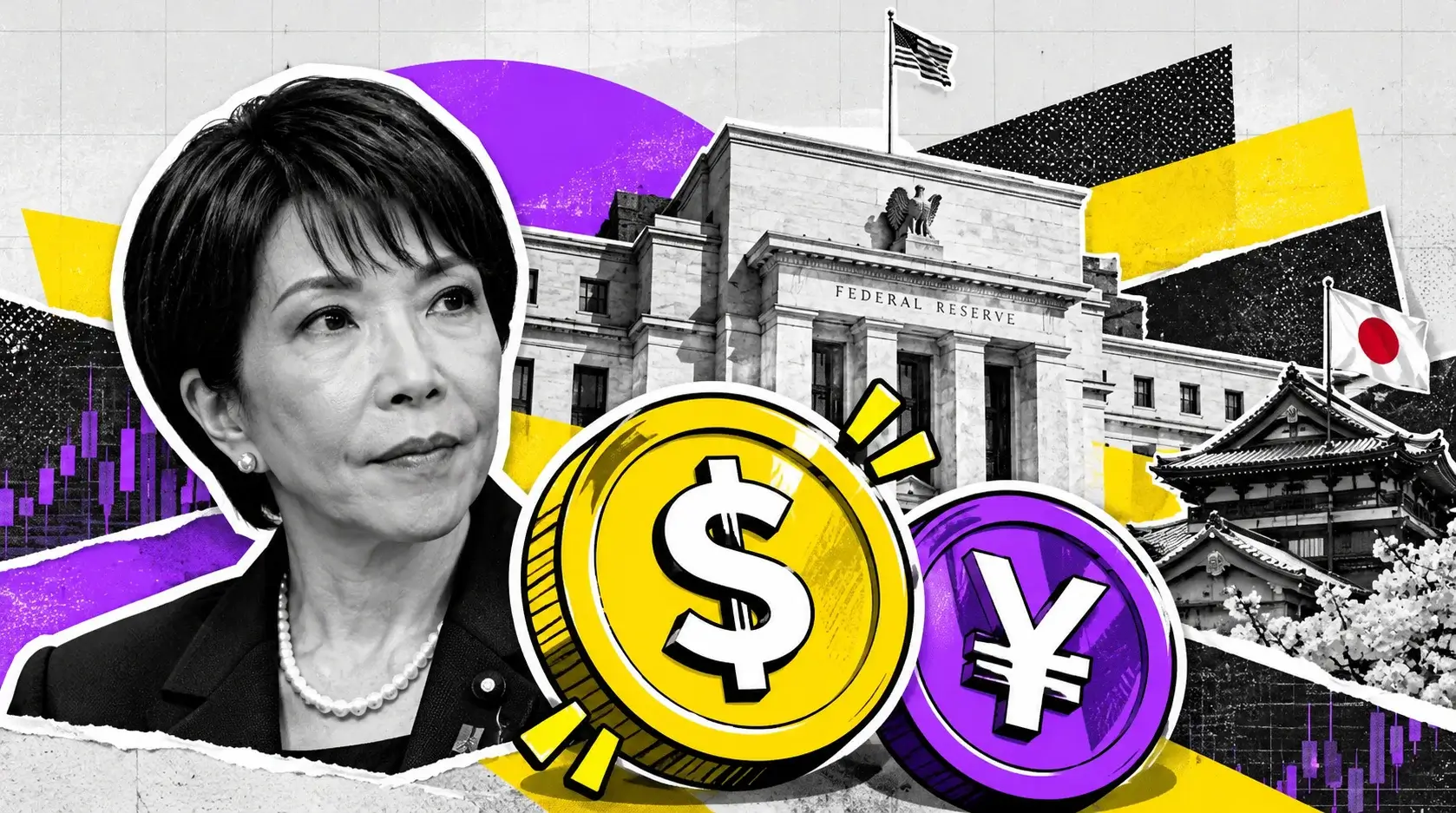
USD/JPY Price Forecast - USDJPY=X Price Dips Toward 155.7 As Rate Checks And BoJ Hawkish Turn Put 160 Ceiling At Risk
Yen surges after USD/JPY reverses from 159.2 to the 155s on NY Fed rate checks, BoJ’s 2026 tightening outlook, and narrowing Fed–BoJ rate differentials, leaving 160 as an intervention line and 150 as the next key downside zone | That's TradingNEWS
USD/JPY Price Snapshot And Weekly Damage Assessment
The USD/JPY pair has flipped from grinding higher to flashing stress. The pair just closed the week around 155.75, down roughly 1.47% on the week after swinging violently between a high near 159.23 and a low around 155.60. That is the second weekly decline in eight weeks and leaves USD/JPY lower by about 0.7% year-to-date, wiping out December’s modest 0.46% gain. At the same time, the US Dollar Index slid 1.97% to 97.096, its lowest level since September 2025, as confidence in the dollar cracked even after Trump walked back his latest tariff threat. You now have a currency pair that is still historically elevated but losing altitude, with volatility driven by three overlapping forces: narrowing rate differentials, escalating Japanese intervention risk, and a US policy backdrop that is slowly shifting toward cuts, not hikes.
How Trump’s Trade Pivot And Fed Expectations Hit USD/JPY
The first blow to USD/JPY this week came from Washington, not Tokyo. Trump’s attempt to push tariffs and his Greenland-related posturing hit the dollar hard enough that, even after he reversed course on tariffs, the Dollar Index still finished the week almost 2% lower at 97.096. That matters because USD/JPY had been leaning on the dollar side of the equation for months. The interest-rate story is now working against the pair as well. Fed funds futures put the probability of a March 2026 rate cut at just 15.4% as of January 23, down sharply from 48.7% in late December, and the odds of a June cut at 60.7%, down from 82.1%. The direction, however, is still toward cuts in 2026, while Japan moves the other way. As the market prices out the fantasy of an aggressive Fed hiking cycle and accepts a flat 3.75% policy rate with cuts later this year, the yield advantage that powered USD/JPY higher is clearly past its peak. Any further wobble in US growth or any dovish nuance from the Fed press conference will feed dollar selling and keep pressure on this pair.
BoJ’s Hawkish Turn, 2026 Outlook And Implications For USD/JPY
On the other side, the Bank of Japan is no longer the passive anchor that allowed USD/JPY to float higher unchecked. The BoJ’s latest quarterly outlook explicitly projects stronger growth and higher inflation in 2026, and that is exactly the combination that justifies a more hawkish policy path. Markets are already talking about an April hike as the first real step away from ultra-loose policy, and the tone out of Governor Ueda has supported that narrative. A credible path toward multiple hikes in 2026 forces investors to rethink the carry-trade logic that underpinned long USD/JPY positions. If Yen cash starts offering more than zero and Japanese yields grind higher, funding everything in yen is no longer a free lunch. That’s why this week’s move matters: the yen is no longer just a growth or risk-off hedge; it is slowly turning into a yield-adjusting currency again, and that shifts the structural bias in USD/JPY from persistent grind higher to a genuine two-way – and increasingly downside – story.
Japanese Macro Data Triggers: Confidence, Inflation And Real Demand
The next set of Japanese data points directly into that hawkish BoJ narrative and therefore into USD/JPY pricing. Consumer confidence has been inching higher, and another uptick would confirm that households are starting to look through past yen weakness and inflation spikes and are ready to spend. When rising confidence meets a labor market that stays solid, the result is demand-driven inflation instead of just cost-push noise from imports. Tokyo CPI and national retail sales will be watched for exactly that dynamic. If Tokyo inflation holds firm and retail sales avoid rolling over, markets will treat an April hike as more likely and will start assigning probability to more than one move in 2026. That is explicitly yen-positive. Under that scenario, every rally in USD/JPY toward the high 150s or 160 becomes more attractive for macro funds to sell, because the Japanese side of the rate differential is no longer static.
Elections, Debt Fears, JGB Yields And Political Risk Inside USD/JPY
The political layer in Japan complicates the picture but ultimately reinforces medium-term yen strength. In Q4 2025, USD/JPY rallied roughly 6.12% as markets digested Sanae Takaichi’s rise to the prime minister’s office and her aggressive fiscal stance. With Japan’s debt already around 240% of GDP, her push for further spending raised legitimate concerns about long-term debt sustainability and helped drive 10-year JGB yields higher. That combination initially weakened the yen on debt fear, even as yields rose. The snap election she called in January 2026 has amplified those concerns because a landslide win would give her a freer hand to ramp spending. However, that same debt pressure is precisely what is forcing the BoJ to normalize policy, and rising JGB yields are making yen assets more attractive in relative terms. The net effect for USD/JPY is asymmetry: political noise can still spike the pair higher in the short run, but any sustained move toward or above 160 immediately invites both market pushback and tangible intervention risk.
Fed Decision, US Data And The Dollar Side Of USD/JPY
The US data slate in the coming week is narrow but critical for USD/JPY. Conference Board consumer confidence is expected to edge up from 89.1 to 90.1, initial jobless claims are seen rising slightly from 200k to 205k, and producer prices are forecast to stay at 0.2% month-on-month. None of these numbers are blockbuster by themselves, but they feed directly into the Fed narrative. If confidence beats and producer prices surprise to the upside, the market will dial back June-cut expectations and give the dollar a short-term reprieve. USD/JPY could then bounce from the mid-155s toward the 158–159 area. If instead the data confirm a slow grind lower in inflation and a softening labor market, the Fed press conference will likely lean on patience and data dependency, and the path of least resistance for the dollar remains lower. In that environment, the bias is for USD/JPY to trade heavy below the 50-day EMA and test deeper supports later in Q1.
Intervention Watch: Rate Checks, PM Warnings And The 160 Line For USD/JPY
The clearest new input for USD/JPY is the intervention drumbeat. Reports that the New York Fed ran USD/JPY rate checks on behalf of the US Treasury pushed the pair sharply lower, with spot dropping to around 155.66 – the strongest the yen has been in about four weeks – after trading above 159.20 earlier in the day. Rate checks are not cosmetic; they are the step between verbal jawboning and actual FX intervention. They tell you authorities are mapping liquidity and depth before they even consider pulling the trigger. Prime Minister Sanae Takaichi then went on national television and warned that officials are prepared to respond to “speculative and highly abnormal movements.” Coming from the PM, not just the Ministry of Finance, that is a deliberate escalation. On top of that, weekend commentary highlighted that the Friday move from roughly 159.22 to the mid-155s happened in thinning liquidity, a classic environment where coordinated action can deliver maximum impact per dollar spent. The message to markets is simple: push USD/JPY toward 160 again and intervention becomes more a question of “when” than “if.”
Market Microstructure: Thin Liquidity, Holidays And Stop Clusters In USD/JPY
Microstructure is now a core part of the USD/JPY trade. Thin early-Asia liquidity on Monday, amplified by an Australian holiday, makes every headline more dangerous. The same is true around the Tokyo fix and the New York handover, when liquidity gaps can turn routine flows into outsized moves. Traders are laser-focused on round numbers: 155 as the first defense, 156 as a pivot for short-term positioning, 158 as the lower bound of the resistance band, and 160 as the intervention trigger line. Rate checks and PM warnings mean stop clusters above 159–160 are now a risk, not a target. A quick squeeze higher in thin conditions could be followed by an even faster air pocket lower if authorities step in or even hint at joint action with Washington. For anyone trading USD/JPY, the lesson is straightforward: position size has to be smaller, and stop levels have to be hard, because intraday gaps are no longer hypothetical.
Read More
-
Yen Stalls at 160 Despite a 3% JGB and Tokyo Core CPI at 2.0% — Intervention Sits at 164, Friday's Payrolls Decide
02.09.2026 · TradingNEWS ArchiveEnergy
-
SOFI ($16.71) Posts Its Best Day of the Quarter as Profit Guidance Finally Rises — Holding $15.70 Unlocks $20
27.10.2026 · TradingNEWS ArchiveStocks
-
XRP-USD ($1.30) Defends a $1.27 Double Bottom as Whales Hold 68.5% of Supply — Break of $1.31 Opens $1.35 and $1.40
27.10.2026 · TradingNEWS ArchiveCrypto
-
Brent ($113.88) Trades a $2.35 Range as Houthi Strikes Meet Saudi-Iran Diplomacy — Break of $117 Unlocks $120
27.10.2026 · TradingNEWS ArchiveCommodities
-
Nasdaq Rips 1.3%, S&P 500 Hits 7,728, Dow Stalls as BA Drops to $171
27.10.2026 · TradingNEWS ArchiveMarkets
-
GBP/USD (1.3310) Can’t Cash In on 5.43% Gilt Yields as Budget Risk Meets a Firm Dollar — Break of 1.3274 Opens 1.3200
27.10.2026 · TradingNEWS ArchiveForex
Technical Structure: EMAs, Trendlines And Carry-Trade Unwind Risk For USD/JPY
Technically, the structure has shifted from one-way uptrend to vulnerable topping pattern. On the daily chart, USD/JPY now sits below the 50-day exponential moving average while still holding above the 200-day EMA. That combination – price under the shorter EMA but above the longer one – is a textbook signal of a near-term bearish reversal inside a still-intact long-term uptrend. Last week’s decisive push below the 50-day EMA confirms that sellers finally gained control of the short-term tape. The key support levels are clear: 155 as immediate horizontal support, then the 200-day EMA, and then the 150 area as the major psychological and technical floor. A clean break below 155 would invite a test of the 200-day EMA; if that goes, the door opens toward 150 and, on a 4–8 week horizon, even 145–140. On the upside, the 159.45 January high, the broader 158–160 resistance band, and the 160 intervention line all converge to form a very heavy ceiling. At the same time, the entire carry trade structure built on borrowing yen at near zero to buy higher-yielding assets is now exposed. If USD/JPY slices through the 200-day EMA and heads toward 150 while intervention risk caps rallies, carry positions can suddenly face both FX losses and forced liquidations, accelerating downside.
Cross-Asset Impact: Exporters, Importers And Japanese Financials Under USD/JPY Stress
The equity side confirms the FX signal. A stronger yen at 155 instead of 159–160 immediately pressures exporters that report large chunks of revenue in dollars: autos, machinery, and tech hardware see earnings translated back into fewer yen. At the same time, importers and fuel-intensive sectors such as airlines, retailers dependent on imported goods, and utilities enjoy some relief as dollar-denominated input costs fall in yen terms. Financials are caught in the middle: FX volatility boosts hedging demand and trading revenue but can also slow cross-border deal flow and raise risk-weighted assets. Corporate treasurers are re-examining hedge ratios as the cost of dollar hedging rises and bid-ask spreads widen during spikes. Laddered forwards, options overlays and staggered execution across Tokyo, London and New York sessions become the norm. For households and SMEs with USD liabilities or purchases, the shift from 159-plus to mid-155s in USD/JPY is large enough to change hedging decisions and cash-flow planning in the near term.
Tactical Trading Approach: Ranges, Triggers And Positioning In USD/JPY
Given the current backdrop, USD/JPY is a trade you manage like a live grenade, not a sleepy carry position. Headline risk is extreme because a single comment from the BoJ, the Ministry of Finance, the PM, or the Fed can move the pair multiple yen in minutes. Short-term, the most realistic base case is a choppy range with a bearish bias: 155–160 on the wide frame, with 155–158 doing most of the actual trading. Buying the dollar on dips only makes sense for very short-term traders who are disciplined enough to cut positions quickly and who respect the 160 line as a hard stop, not a target. For macro and swing traders, rallies into 158–160 are more attractive as short entries than dips are as long entries, because the structural drivers – BoJ normalization, narrowing rate differentials, and explicit intervention risk – all point toward lower USD/JPY over a 4–16 week horizon. Risk management has to reflect the new regime: smaller sizes, clearly defined maximum loss per trade, staggered entries instead of all-in orders, and a willingness to stop trading USD/JPY entirely during known thin-liquidity windows if price action becomes disorderly.
USD/JPY Verdict: Short On Rallies, Targeting A Move Toward 150 As Medium-Term Bearish Structure Builds
After pulling all of the data together – the slide in the Dollar Index to 97.096, the second straight weekly drop in USD/JPY to around 155.75, the BoJ’s more hawkish 2026 outlook, the rising probability of at least one Japanese rate hike, the fading odds of early Fed cuts but the clear direction toward easing, the 6.12% Q4 2025 rally fueled by Japanese fiscal worries, the explicit rate checks by the New York Fed, PM Takaichi’s intervention warning, and the break below the 50-day EMA with 150–140 sitting below as realistic downside – the bias is clear. The medium-term structure for USD/JPY is bearish, with risk skewed toward yen strength, not further dollar gains. On that basis, the stance is Sell: treat USD/JPY as a short on strength, with rallies toward 158–160 viewed as opportunities to build bearish exposure for a 4–8 week move targeting first the 155 floor, then the 200-day EMA, and then the 150 zone if the BoJ delivers and the Fed stays on track for 2026 cuts. Bulls are not dead, but they are trading against the central-bank drift, against a rising intervention threat, and against a chart that has clearly shifted from effortless uptrend to fragile top.