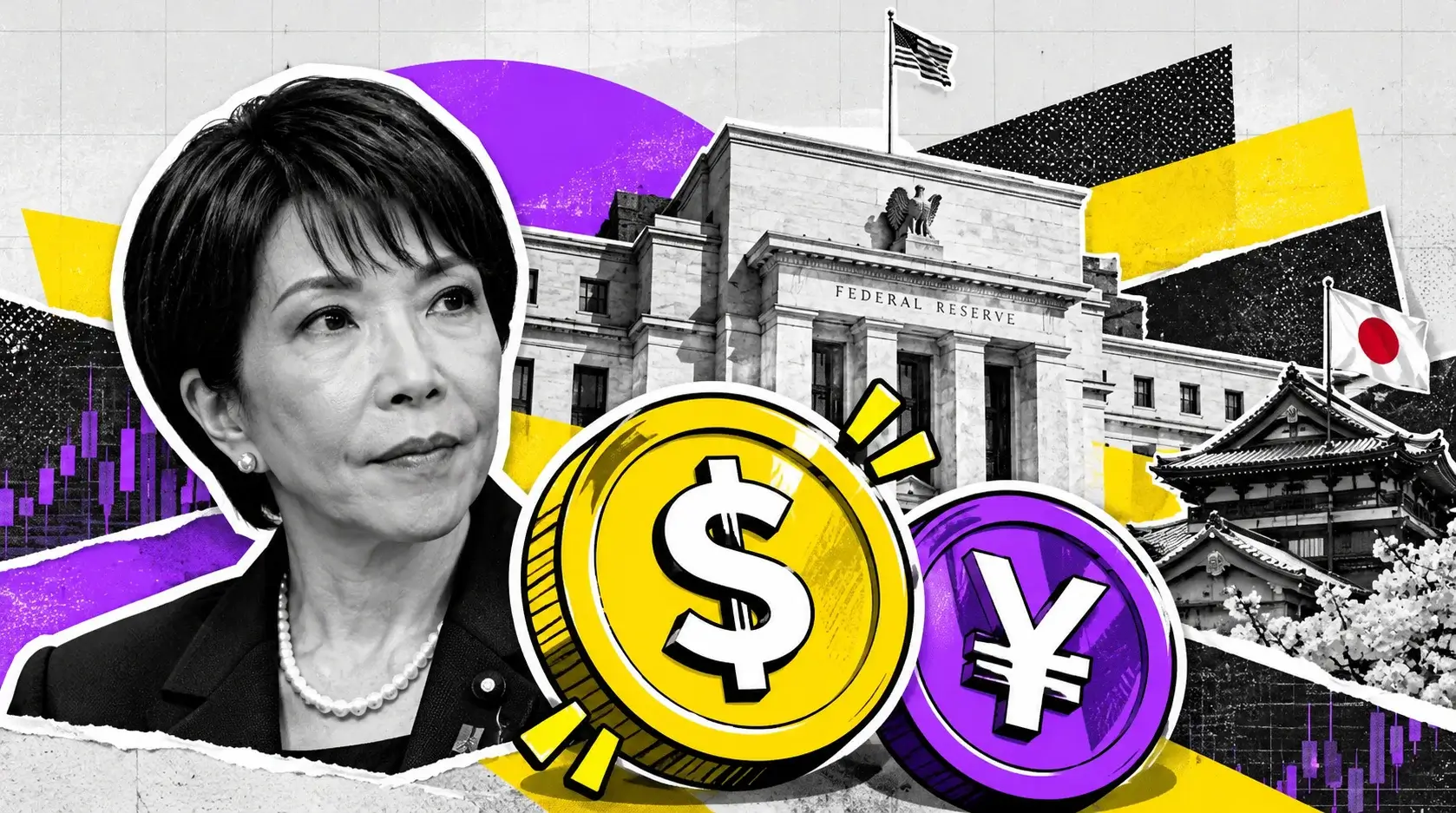
USD/JPY Price Forecast - USDJPY=X Slides to 154: Intervention Chatter Replaces Dip-Buying Before Fed
Dollar-yen dumps nearly 600 pips toward 153–154 as NY Fed “rate checks,” BoJ’s 0.75% stance and Japan’s snap election fuel intervention risk while markets brace for this week’s Fed decision | That's TradingNEWS
USD/JPY Slides To 153–154 As Intervention Talk Replaces Dip-Buying
USD/JPY has flipped from a clean uptrend to a hard reversal. The pair has dropped roughly 600 pips in a straight line from the recent highs, opening the week with a bearish gap and trading around 154.00 after printing an intraday low near 153.31. That puts spot back at levels last seen in November and close to the mid-153s area that previously acted as a launchpad higher. The move on Friday alone was about −1.65%, triggered right after price flirted with levels that historically drew direct Japanese intervention. The market is no longer treating dips as easy entries; every rally now runs into sellers who are pricing both official action and a changing macro backdrop
Policy Mix: BoJ At 0.75% And Hawkish, While The Fed Hesitates
Under the surface, the rate story has shifted just enough to matter. The Bank of Japan has already moved away from the zero line, holding its policy rate at 0.75% on an 8–1 vote and clearly signaling it can tighten further. That is a major break from the era when BoJ policy was locked at negative or zero. At the same time, the Federal Reserve heads into this week’s meeting with markets pricing no change in rates and more uncertainty than conviction about the path forward. The US Dollar Index trades near four-month lows around 96.98, reflecting reduced appetite for long-dollar positions as investors question how aggressive the Fed can be with Trump’s trade rhetoric and Fed-independence concerns in the background. The nominal rate differential still favors the dollar, but the narrative is no longer one-way. A cautious Fed plus a BoJ that openly keeps the door to more tightening ajar makes chasing USD/JPY higher far less attractive than it was when carry was the only story
Verbal Signals, NY Fed ‘Rate Checks’ And The 160 Barrier In Traders’ Heads
The catalyst that flipped positioning was not a formal intervention announcement, it was signaling. Reports that the New York Fed checked USD/JPY levels with dealers on behalf of the US Treasury were read immediately as a warning shot. Historically, those “rate checks” precede or accompany coordinated action, so macro funds treated it as a clear message: upside beyond the prior extremes would not be tolerated. The yen then strengthened roughly 3% from Friday’s lows, forcing short covering and driving USD/JPY down into the mid-153s. Tokyo doubled down rhetorically. The Prime Minister promised “necessary steps” against speculative moves. The top currency diplomat stressed coordination with Washington and called the recent actions “appropriate.” The Finance Minister refused to deny the rate-check story. That combination tells the market there is a soft ceiling not far above the prior highs. The working assumption is simple: any sustained push back toward 160 will meet heavier, possibly coordinated, selling
Japan’s Politics, Fiscal Risk And Why Yen Strength Still Lacks Follow-Through
Yen bulls are not getting a clean runway because Japan’s domestic backdrop adds another layer of risk. Prime Minister Sanae Takaichi’s decision to dissolve the lower house and call a snap election re-opens the debate about how aggressive fiscal policy will be. A more expansionary stance with already heavy public debt raises questions around JGB supply, term premia, and how far the BoJ can really go in tightening without destabilizing funding costs. That keeps some investors cautious about loading up on JPY even when USD/JPY dumps on intervention headlines. The result: strong down days driven by short covering and policy fear, followed by hesitations as political and fiscal uncertainty caps how far discretionary money wants to push the currency
Read More
-
Yen Stalls at 160 Despite a 3% JGB and Tokyo Core CPI at 2.0% — Intervention Sits at 164, Friday's Payrolls Decide
02.09.2026 · TradingNEWS ArchiveEnergy
-
SOFI ($16.71) Posts Its Best Day of the Quarter as Profit Guidance Finally Rises — Holding $15.70 Unlocks $20
27.10.2026 · TradingNEWS ArchiveStocks
-
XRP-USD ($1.30) Defends a $1.27 Double Bottom as Whales Hold 68.5% of Supply — Break of $1.31 Opens $1.35 and $1.40
27.10.2026 · TradingNEWS ArchiveCrypto
-
Brent ($113.88) Trades a $2.35 Range as Houthi Strikes Meet Saudi-Iran Diplomacy — Break of $117 Unlocks $120
27.10.2026 · TradingNEWS ArchiveCommodities
-
Nasdaq Rips 1.3%, S&P 500 Hits 7,728, Dow Stalls as BA Drops to $171
27.10.2026 · TradingNEWS ArchiveMarkets
-
GBP/USD (1.3310) Can’t Cash In on 5.43% Gilt Yields as Budget Risk Meets a Firm Dollar — Break of 1.3274 Opens 1.3200
27.10.2026 · TradingNEWS ArchiveForex
USD/JPY Technical Structure: Broken 154.50 Demand, Focus On 153.00 And 150.90
Technically, USD/JPY has shifted from a buy-the-dip trend to a damaged structure. On the 4-hour chart, price gapped lower and sliced straight through the key demand zone around 154.50 that had supported multiple bounces earlier in the month. That zone is now flipped into resistance. The drop of roughly 600 pips has pushed momentum indicators into oversold territory, which argues for consolidation or a corrective bounce, not a straight-line collapse every session. A logical retracement zone sits back at 154.50 and then the psychological 155.00 handle, where trapped longs from the breakdown will likely look to exit. If sellers defend that region, the next downside levels are clear: 153.00 as near-term support, followed by the deeper pivot around 150.90. The moving averages on the 4-hour and daily timeframes have rolled over, pointing to a higher probability of another down-leg once any oversold relief is exhausted. Earlier in January, USD/JPY was described as “steady near 158” while the market argued about Fed turmoil and a snap election in Japan; the break from that regime to today’s 153–154 trade shows how quickly the pair loses altitude when policy risk and stretched positioning collide
Cross-Market Signals: JPY/VND Spreads, Soft DXY And What They Say About Yen Demand
The stress around the yen is not visible only in USD/JPY. In Vietnam, banks and remittance desks quote JPY around 169 VND, with very wide bid–ask bands roughly between 168 and 175, while the free market trades closer to 167.4. That 6–7 VND spread is significant and tells you dealers are defensive: they widen JPY/VND quotes when liquidity thins and when intervention chatter raises the risk of sharp moves. The dong is managed against the dollar, so swings in USD/JPY transmit directly into JPY/VND. Wider spreads and cautious quoting confirm that FX desks are preparing for more volatility, not less. On the dollar side, the DXY under 97 reinforces that the move in USD/JPY is not purely a Japan story. The greenback is under pressure across the board. Pairs like AUD/USD and NZD/USD have pushed higher, with the Aussie testing near 0.6950 and the kiwi stretching above 0.60 even though both now look ripe for pullbacks. US traders are selling dollars into the Fed meeting rather than adding exposure, which removes an important pillar that previously supported USD/JPY on every dip
Event Risk Ahead: Fed Decision, Tokyo CPI And Japan Data As Triggers
The next 48–72 hours are loaded with catalysts that can extend or interrupt the USD/JPY selloff. The Federal Reserve decision on Wednesday is center stage. Markets are pricing no change in the policy rate, so the text and Powell’s tone during the press conference will do most of the work. Any hint that the Fed is closer to cuts, or more sensitive to political pressure, will reinforce the current dollar downtrend and keep USD/JPY pinned or lower. A pushback against easing expectations, or a stronger commitment to independence, could spark a short-term rebound in the pair, especially given how oversold it is intraday. On the Japanese side, Tokyo CPI, labor market data, industrial production, and retail sales will all feed into the story of how credible a more hawkish BoJ path really is. Firm inflation or resilient activity would justify keeping policy at 0.75% or even nudging it higher, which supports the yen. Soft numbers, combined with fiscal uncertainty around the snap election, would soften the case for aggressive BoJ tightening and could limit further yen gains. Meanwhile, any fresh comments from the Ministry of Finance or the US Treasury about FX moves will be watched tick by tick. Traders know that if authorities implicitly defend a line near 160 again, speculative appetite to push USD/JPY back toward those extremes will stay muted
USD/JPY Trading Stance: Sell Rallies, Bearish Bias With Intervention Overhang
Taking the macro, policy, and technical signals together, USD/JPY now looks like a pair where strength should be sold rather than weakness bought. The intervention overhang near 160, the BoJ holding rates at 0.75% with a hawkish lean, the DXY trading around 96.98, and the break of the 154.50 demand zone all point in the same direction. The most efficient risk–reward is not chasing shorts at 153.30 after a 600-pip flush, but using any corrective bounce toward 154.50–155.00 to re-establish downside exposure, with 153.00 and 150.90 as realistic downside waypoints if volatility stays elevated. Political and fiscal noise in Japan can slow the yen’s advance, yet they do not change the fact that authorities have clearly signaled discomfort with a weak currency and are willing to back words with action. Until the Fed reasserts a much more hawkish stance or Japanese officials step away from intervention rhetoric, the balance of evidence favors a bearish view on USD/JPY and a Sell rating on the pair, focused on fading rebounds rather than betting on a sustained trend recovery higher