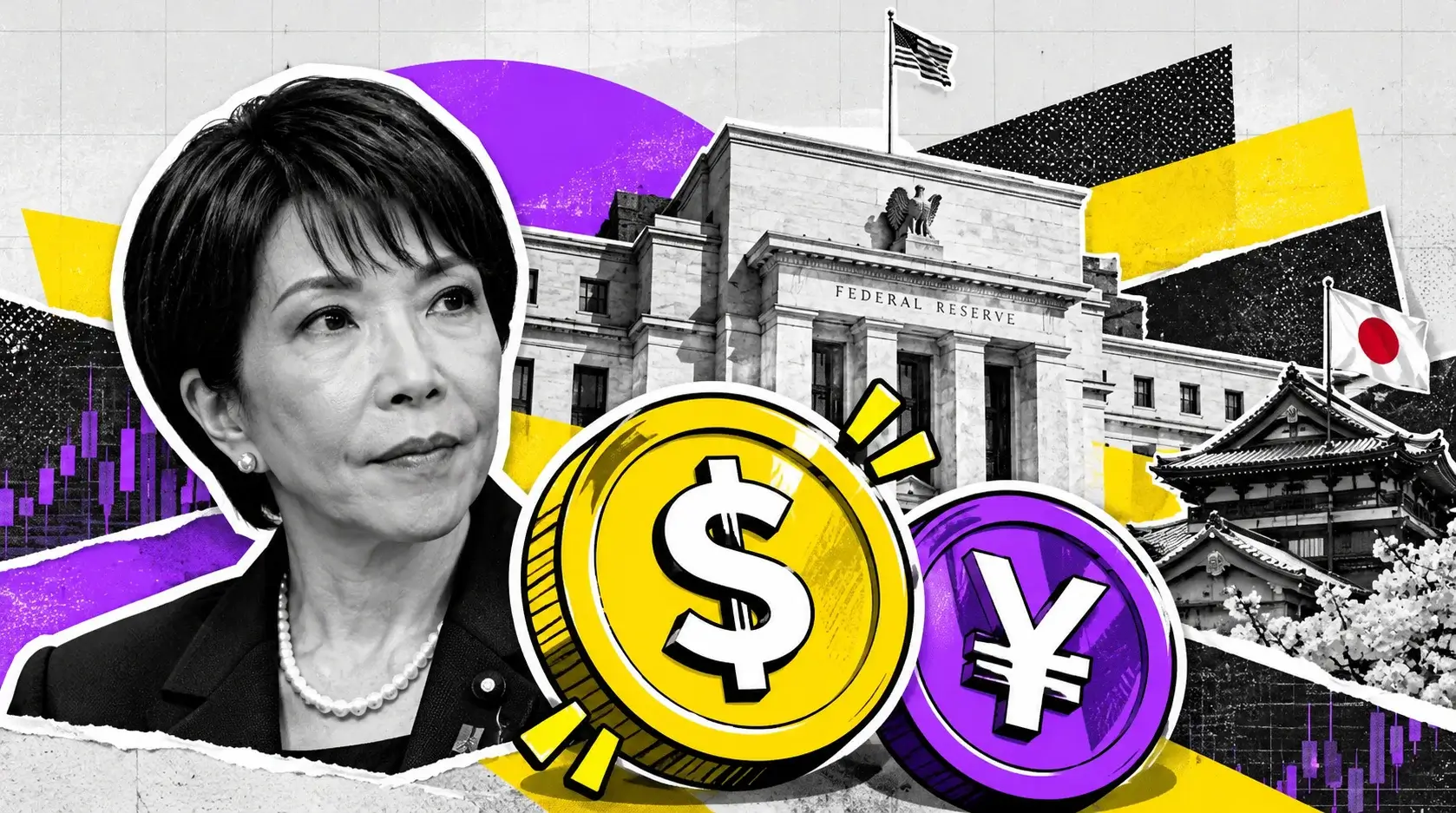
USD/JPY Price Forecast - Pairs Charges Toward ¥159.45 as BoJ Risk and US Data Fuel Bullish Momentum
Yen stays weak near ¥158.7 as markets price higher-for-longer US rates, watch BoJ guidance and PCE/GDP for a potential push through the ¥159.45–¥160 zone | That's TradingNEWS
USD/JPY Reclaims 158–159 Zone As Risk Appetite Snaps Back
USD/JPY has pushed back above the 158.50–158.70 band, unwinding the brief pullback from this week’s ¥157.43 low and re-establishing its bullish structure. Global risk sentiment flipped sharply after the latest tariff scare faded and a framework deal on Greenland removed the immediate threat of new levies on key US allies. US indices responded with a broad rally: the Dow Jones added about 1.2%, the S&P 500 climbed roughly 1.2% in its strongest daily gain in two months, and the Nasdaq 100 advanced a similar magnitude. Volatility compressed as the fear gauge retreated and gold gave back around $100 from record territory near $4,900, signalling a clear reduction in safe-haven demand. In that backdrop, USD/JPY naturally tracked higher, with the pair now eyeing the mid-January swing high near ¥159.45 and the psychologically important ¥160.00 region.
Japanese Yen Weakens As Safe-Haven Bid Evaporates
The Japanese Yen is trading on the back foot as classic safe-haven flows unwind. A few days ago, markets were braced for a renewed trade confrontation and higher geopolitical risk premia; since then, the tone has shifted to de-escalation, with talk of shelving threatened tariffs on several European economies. Equities in the US, Europe and Asia have followed through, while credit spreads stabilised. In such an environment, there is little incentive to hold JPY purely as insurance. Instead, investors are rotating back into higher-yielding and pro-growth currencies, leaving USD/JPY supported on dips. The pair’s ability to rebound decisively from ¥157.43 early in the week, and to hold above that level on a closing basis, confirms that safe-haven demand is no longer dictating intraday price action.
Fiscal Stress And JGB Turmoil Erode Confidence In The Yen
Yen weakness is not only about global risk appetite; domestic fixed-income dynamics are working against the currency. Japan’s bond market suffered a sharp selloff around the latest 20-year auction, where tepid demand pushed long-dated yields to fresh highs. These moves reflect growing concern about fiscal discipline under Prime Minister Sanae Takaichi, who is leaning toward expansionary spending and lower taxes. Rising long-term JGB yields might appear Yen-supportive at first glance, but in this context they are being read as a risk premium on Japan’s balance sheet rather than a genuine tightening of financial conditions. That distinction matters: foreign investors are less inclined to treat JGBs as a safe anchor, while the policy rate remains locked at just 0.75% after the first hike in three decades, keeping front-end yield differentials overwhelmingly in favour of the US Dollar.
BoJ At 0.75%: Event Risk High, Structural Dovishness Intact For Now
The upcoming two-day Bank of Japan meeting is the key event on the calendar for USD/JPY. The market base case is straightforward: the policy rate is expected to be left unchanged at 0.75%, the highest in roughly 30 years after December’s move. Under the surface, however, expectations are far less settled. Recent commentary from policymakers has hinted that a further hike as early as April is on the table, supported by data showing headline inflation averaging above the 2% target for four consecutive calendar years and surveys indicating that households expect prices to keep rising in the coming years. That profile argues for a gradual normalisation path. At the same time, the BoJ is acutely aware of how sensitive the Yen is around these meetings, especially with USD/JPY trading not far from its multi-year highs. Governor Ueda’s press conference will therefore be watched more for the balance of risks he signals – how much weight he puts on stubborn inflation versus growth and financial-stability risks – than for the rate decision itself.
Intervention Risk Caps USD/JPY Blow-Off Above 160
Even as the macro and technical backdrop favours Dollar strength versus the Yen, there is a clear policy ceiling that traders cannot ignore. Japan’s Finance Minister Satsuki Katayama has already floated the possibility of joint action with the US to counter excessive currency weakness. With USD/JPY now pressing back toward the ¥159.45 peak from mid-January and the round ¥160.00 level looming above, the probability of verbal or even direct intervention increases non-linearly. Authorities do not need an explicit line in the sand to influence positioning; the memory of past operations is enough to keep speculative longs disciplined. That is one reason why option markets are pricing elevated overnight volatility around the BoJ outcome despite a consensus “no change” call on rates. The higher USD/JPY trades into the meeting, the greater the likelihood that even a mildly hawkish BoJ tone or a hint of coordinated action triggers an outsized reaction.
US Growth And Inflation Profile Still Tilts The Scales Toward The Dollar
On the US side of the cross, the macro narrative remains straightforward: growth is resilient and underlying inflation is still running above target. The final Q3 GDP figures and the upcoming Personal Consumption Expenditure price data are expected to confirm an economy expanding solidly with core inflation stuck above the Federal Reserve’s 2% objective. That combination justifies policy rates staying “higher for longer,” even if markets continue to price some easing later in the year. For USD/JPY, what matters is not the exact timing of the first Fed cut, but the persistence of a wide front-end yield gap versus Japan, where the policy rate is anchored at 0.75% and any future hikes will be incremental. As long as investors believe the Fed will keep the upper bound of its target corridor multiple percentage points above BoJ settings, the Dollar retains a structural carry advantage that supports buying USD/JPY on dips rather than fading rallies.
USD/JPY Technical Structure: Rising Channel From Late December
Technically, USD/JPY is not flashing exhaustion; it is tracking a well-defined rising channel that has been intact since late December. The pair’s pullback earlier this week stalled at ¥157.43, which now marks the key short-term pivot. That low sits above the early January trough around ¥156.45 and the prior mid-December floor near ¥156.12, confirming a consistent pattern of higher lows. On the topside, spot has reclaimed the 158 handle and is now trading around ¥158.60–¥158.70, keeping it within striking distance of the mid-January high near ¥159.45. The confluence of the 100-hour moving average and a 38.2% retracement level around ¥158.15 was taken out decisively, signalling that dip buyers are still in control. A 50% retracement of the latest downswing lies close to ¥158.39, and the 61.8% retracement sits in the ¥158.60–¥158.65 area where price is currently consolidating. Clearing this cluster on a closing basis would reopen the path toward ¥159.45 and then ¥160.00.
Read More
-
Yen Stalls at 160 Despite a 3% JGB and Tokyo Core CPI at 2.0% — Intervention Sits at 164, Friday's Payrolls Decide
02.09.2026 · TradingNEWS ArchiveEnergy
-
SOFI ($16.71) Posts Its Best Day of the Quarter as Profit Guidance Finally Rises — Holding $15.70 Unlocks $20
27.10.2026 · TradingNEWS ArchiveStocks
-
XRP-USD ($1.30) Defends a $1.27 Double Bottom as Whales Hold 68.5% of Supply — Break of $1.31 Opens $1.35 and $1.40
27.10.2026 · TradingNEWS ArchiveCrypto
-
Brent ($113.88) Trades a $2.35 Range as Houthi Strikes Meet Saudi-Iran Diplomacy — Break of $117 Unlocks $120
27.10.2026 · TradingNEWS ArchiveCommodities
-
Nasdaq Rips 1.3%, S&P 500 Hits 7,728, Dow Stalls as BA Drops to $171
27.10.2026 · TradingNEWS ArchiveMarkets
-
GBP/USD (1.3310) Can’t Cash In on 5.43% Gilt Yields as Budget Risk Meets a Firm Dollar — Break of 1.3274 Opens 1.3200
27.10.2026 · TradingNEWS ArchiveForex
Momentum, Trend And Key USD/JPY Levels Into The BoJ Decision
Momentum indicators corroborate the bullish bias without yet flashing extreme conditions. The MACD line is positioned above its signal line just above the zero axis, indicating positive but not overstretched impulse. The relative strength index is hovering around 58–60, comfortably above the midline but below the classic overbought threshold, which suggests that the uptrend still has room to run before momentum becomes unstable. From a level perspective, the immediate resistance zone sits around ¥158.90, just ahead of the prior ¥159.45 swing high that marks an 18-month peak. A sustained break through that region would expose the ¥160.00 psychological barrier, where both technical and intervention risk are likely to intensify. On the downside, near-term support is concentrated around ¥158.30; below that, the 50-day exponential moving average near ¥158.10 and the rising channel’s lower boundary around ¥157.65 provide successive layers of defence. Only a decisive close below ¥157.43 would seriously challenge the current bullish structure and bring the ¥156.45 and ¥156.12 lows back into play.
Options Market Signals Elevated, But Not Extreme, USD/JPY Event Risk
The volatility market is putting a clear price on the upcoming BoJ decision. Overnight implied volatility on USD/JPY, which serves as the tradable proxy for expected turbulence over that window, has jumped from roughly 9% to around 14.75% now that the meeting falls inside the expiry horizon. That translates into a breakeven range of roughly 59 pips in Yen terms and close to 1 big figure in Dollar terms for a simple at-the-money straddle. In other words, option traders are positioning for a sizeable move during the event, but current pricing remains below the peaks seen ahead of the most contentious BoJ meetings over the past six months. The message is nuanced: markets are braced for a meaningful adjustment in USD/JPY if the BoJ surprises on guidance or tone, yet they are not expecting a complete regime shift. For spot traders, this backdrop argues against complacency – sharp intraday swings are likely – but it also implies that any volatility spike which fails to break key technical levels may be faded by macro-driven players who continue to see value in the carry.
Cross-Asset Signals: Equities, Metals And The Yen’s Role In The Risk Complex
Cross-asset price action reinforces the idea that USD/JPY is being pulled higher by a broad risk-on impulse rather than idiosyncratic Yen weakness alone. US equities have staged a forceful rebound from their recent tariff-driven wobble, with bank stocks in particular ripping higher as regional lenders rallied nearly 5% and pushed sector indices to their best levels since late 2024. Energy and airlines have joined the move, signalling confidence in both demand and the policy backdrop. Precious metals have responded in a way that confirms the risk narrative: silver has printed a record high near $95.88 per ounce before consolidating just below that level, while gold has swung from record territory above $4,900 to a modest pullback as immediate hedging needs diminish. Against that mosaic, the Yen has reverted to its usual position as the funding leg of choice when investors want to re-engage in carry and pro-growth trades. Unless this cross-asset alignment breaks – for example, through a sudden resurgence of trade tension or geopolitical risk – it remains a supportive backdrop for higher USD/JPY.
USD/JPY Trading Stance: Buy On Dips While Above 157.40, With Respect For BoJ Risk
Pulling the macro, policy, positioning and technical signals together, USD/JPY screens as a Buy rather than a Sell or a neutral Hold at current levels, provided risk is managed aggressively around the BoJ event. The pair is trading within a rising channel, momentum is positive but not overextended, and the fundamental drivers – a 0.75% BoJ against a still-restrictive Federal Reserve, strong US data, compressed safe-haven demand for the Yen and ongoing cross-asset risk appetite – all point in the same direction. The most coherent tactical approach is to treat pullbacks toward the ¥158.30–¥158.10 support band as opportunities to re-enter the uptrend, with a clear invalidation line just below ¥157.40, which would break the current sequence of higher lows and warn that BoJ guidance or intervention threats are shifting the narrative. On the topside, the first objective sits near ¥159.45, followed by the round ¥160.00 level where both technical resistance and policymaker sensitivity are likely to be acute. Until the BoJ either signals a materially faster tightening path or coordinates a credible intervention line, the balance of evidence keeps USD/JPY in a bullish, buy-the-dip regime rather than in a topping or reversal phase.