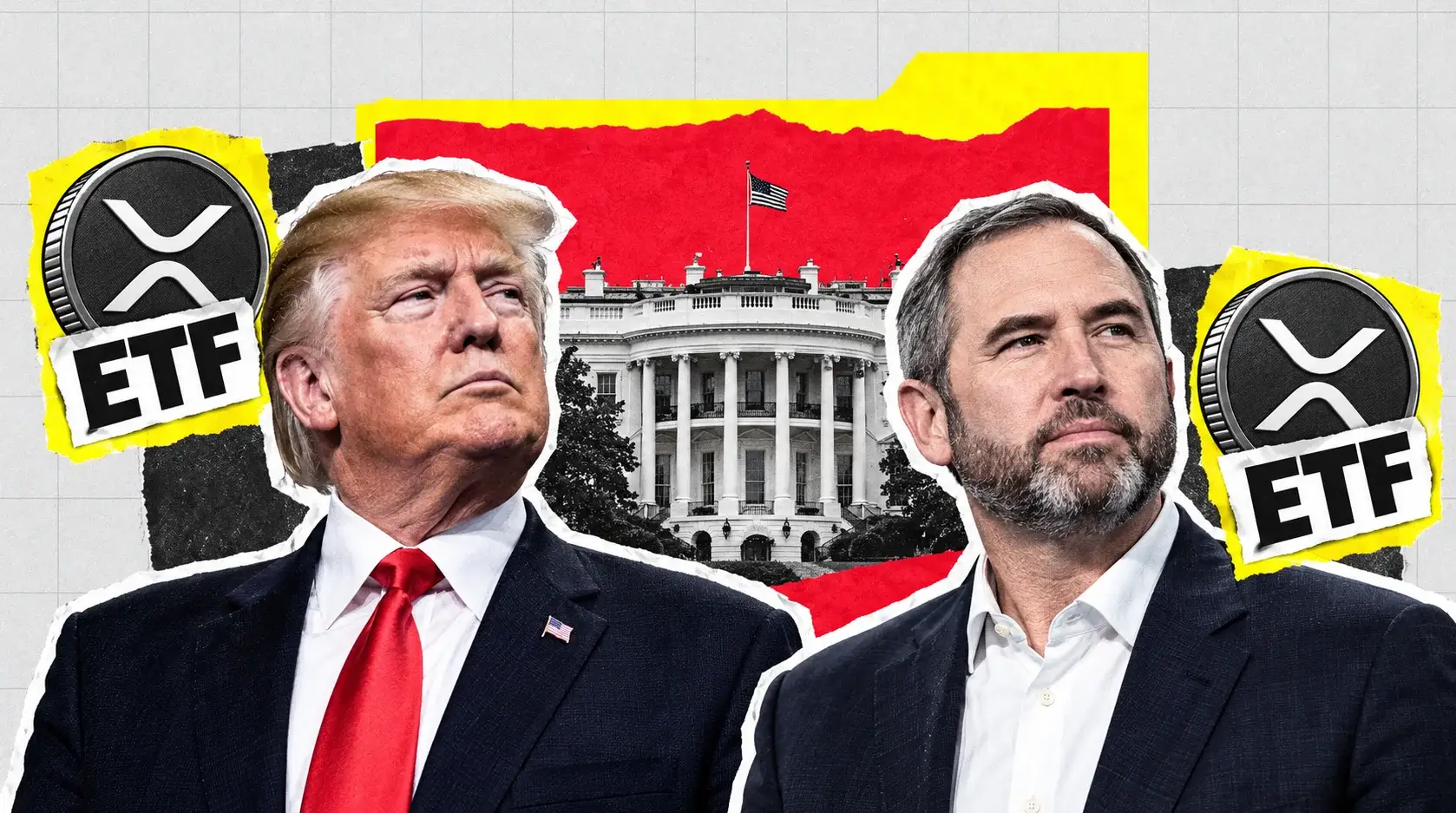
XRP ETF Forecast: XRPI at $7.58, XRPR at $11.07, and Bitwise XRP (NYSEARCA:XRP) at $15.18 All Retreat 2%+
XRPI ETF trades at $7.58 down 2.38% from prior close $7.76 with intraday range $7.57-$7.70 and 52-week range $6.50-$23.53 | That's TradingNEWS
The institutional wrapper architecture that was supposed to launder XRP exposure into the regulated brokerage channel is producing a genuinely interesting structural divergence this week. The spot XRP token is grinding lower, the technical chart is flashing one of the most bearish continuation patterns in the cycle, and yet the XRP ETF complex continues to absorb fresh institutional capital at a pace that has now extended into a nine-consecutive-day inflow streak totaling $95.5 million with cumulative net inflows since the November 2025 launch crossing $1.4 billion and aggregate assets under management at approximately $1.14 billion to $1.25 billion across the issuer roster. XRPI ETF is trading at $7.58 on the NASDAQ session, down 2.38% or $0.18 from the prior close of $7.76, with the intraday range running $7.57 to $7.70 against a 52-week range of $6.50 to $23.53 and average daily volume of 201,700 shares. XRPR ETF is trading at $11.07 on the BATS exchange, down 2.21% or $0.25 from the prior close of $11.32, intraday range $11.07 to $11.22 against a year range of $9.50 to $25.99, average daily volume of just 20,460 shares. The broader XRP ETF issuer roster shows Bitwise XRP ETF (NYSEARCA:XRP) at $15.18 down 2.13% with prior close at $15.51 and average volume of 597,670 shares, Franklin XRP ETF (XRPZ) at $14.72 down 2.32%, Canary XRP ETF (XRPC) at $14.41 down 2.17%, 21Shares XRP ETF (TOXR) at $13.24 down 2.14%, and Grayscale XRP Trust ETF (GXRP) at $26.31 down 2.05%. The leveraged complex is bleeding harder: 2x XRP ETF (XRPT) at $39.26 down 4.31%, ProShares Ultra XRP ETF (UXRP) at $3.57 down 4.29%, and Teucrium 2x Long Daily XRP ETF (XXRP) at $3.71 down 4.63%, which is the textbook signature of leveraged wrappers amplifying the 2.2-2.4% decline in the spot-tracking products.
The underlying spot XRP token is trading at $1.36-$1.388 during the Tuesday session, down approximately 5% over the past week, 12% over the past five days, and 26.46% year-to-date from the cycle high of $3.65 printed in July 2025. The technical picture is exactly the kind of breakdown pattern that historically precedes deeper corrections — XRP has fallen below its 20-day EMA at $1.4150, its 50-day EMA at $1.3939, and remains well below the 200-day EMA at $1.7149. The descending triangle structure has confirmed a breakdown, the three-day bear pennant pattern has triggered, and the measured downside target derived from the pennant's post height pointed at $0.65 — a roughly 52.5% decline from current levels. The weekly Stochastic RSI has confirmed a death cross for the third time since the July 2025 all-time high, with the previous two crosses producing corrections of approximately 50% each. The daily RSI has dropped to 42 from 63 over the past seven days, signaling accelerating bearish momentum but not yet reaching the 30 capitulation threshold.
Structural Decomposition: XRPI ETF and XRPR ETF Are Different Vehicles Solving Different Problems
The first analytical point that capital allocators need to internalize is that XRPI ETF and XRPR ETF are not interchangeable products despite both providing XRP exposure inside the regulated U.S. brokerage channel. XRPI ETF trades on NASDAQ at $7.58 with average daily volume of approximately 201,700 shares — translating to roughly $1.53 million in average daily dollar volume turnover. XRPR ETF (the REX Osprey XRP ETF) trades on BATS at $11.07 with average daily volume of just 20,460 shares — producing approximately $226,500 in average daily dollar volume turnover. The roughly 9-to-1 ratio in dollar-volume liquidity between the two products is the single most important practical distinction for execution purposes. XRPI ETF offers meaningfully tighter bid-ask spreads, lower slippage on size, and substantially better fill quality for institutional capital deploying meaningful position sizes. XRPR ETF offers exposure through the REX Osprey structure but at a substantially lower liquidity profile that makes it tactically inferior for capital allocators needing to enter or exit positions at scale.
The price difference between the two products — XRPI at $7.58 versus XRPR at $11.07 — has no economic significance whatsoever. Share price for an ETF is purely a function of the fund's initial seed allocation and ongoing creation/redemption mechanics. A $10,000 allocation produces 1,319 shares of XRPI at the current price or 903 shares of XRPR, but the underlying XRP exposure is roughly equivalent on a notional dollar basis. The persistent retail confusion that lower-priced ETFs offer "more upside" or are "cheaper" is mathematically wrong — share price reflects fund mechanics, not relative value. What does matter is the structural exposure profile: spot-tracking products like XRPI and XRPR offer direct beta to the underlying XRP price action, while futures-linked or actively managed products may produce roll yield drag, basis risk, and tracking error that compounds over time.
The Bitwise XRP ETF (NYSEARCA:XRP) Is the Liquidity King of the Complex
The structural liquidity leader inside the XRP ETF complex is Bitwise XRP ETF (NYSEARCA:XRP) at $15.18 with average daily volume of 597,670 shares — translating to approximately $9.07 million in daily dollar turnover. That level of liquidity is roughly 6x the dollar volume of XRPI ETF and 40x the dollar volume of XRPR ETF, which is the cleanest possible signal that institutional capital deployment is concentrating in the Bitwise vehicle. The intraday range of $15.16 to $15.41 with current spot at $15.18 sitting near the session low confirms the broader complex-wide selling pressure, while the 52-week range of $12.77 to $26.90 shows the structural compression from the July 2025 ATH cycle. The Bitwise product was the disclosed largest holding inside Goldman Sachs's now-liquidated $154 million XRP ETF basket — meaning the smart-money institutional flow architecture has explicitly favored the Bitwise wrapper over alternative issuers within the complex.
The Franklin XRP ETF (XRPZ) at $14.72 carries the lowest expense ratio in the U.S. spot XRP ETF universe at 0.19%, which is the cleanest cost structure for long-term holding capital. The Canary XRP ETF (XRPC) at $14.41 captures a smaller share of institutional flow but offers a competing wrapper for capital seeking issuer diversification. The 21Shares XRP ETF (TOXR) at $13.24 carries approximately $156 million in assets under management as of recent disclosures, with the most recent flow data showing $1.12 million in net inflows on May 13 — representing 0.72% of AUM in a single session and signaling steady accumulation rather than speculative chasing. The Grayscale XRP Trust ETF (GXRP) at $26.31 is the legacy trust converted into an ETF wrapper that captures the longer-tenured Grayscale brand recognition but trades at a higher share price purely as a function of historical fund mechanics rather than any structural valuation premium.
The Goldman Sachs Exit and What It Actually Means
The single most distorted institutional narrative of the past week has been the Goldman Sachs Q1 2026 13F filing showing a complete liquidation of the bank's approximately $154 million XRP ETF basket. The exit covered positions across Bitwise, Franklin Templeton, Grayscale, and 21Shares — the four major issuers — and at one point Goldman accounted for roughly 73% of all top-disclosed institutional XRP ETF holdings. The bank also fully exited Solana ETF positions (over $100 million combined across BSOL, Fidelity, Grayscale, VanEck, Franklin, and 21Shares Solana products), cut Ethereum ETF exposure by approximately 70% to roughly $114-$177 million, and maintained Bitcoin ETF exposure at approximately $700-$720 million (down from 20.685 million shares to 17.985 million shares of IBIT, representing roughly a 10% reduction).
The structural read on the Goldman move requires honest framing. Bloomberg analysts had flagged the Goldman Q4 2025 XRP ETF accumulation as trading-desk facilitation rather than directional conviction — meaning the bank was acting as market-maker rather than expressing a long-term thesis. The Q1 exit confirms exactly that interpretation. Goldman was never making a directional bet on XRP; the bank was providing liquidity and facilitating client flow, and the position got cleared out as part of normal trading-desk inventory management rather than as a strategic capital allocation decision. The same filing shows Goldman building new positions in Circle (+249%), Galaxy Digital (+205%), Coinbase, and Hyperliquid Strategies (PURR) at approximately $3.3 million — confirming the rotation is away from direct altcoin ETF exposure and toward crypto infrastructure and operating-company plays.
The replacement institutional flow is genuinely happening. UBS disclosed 197,369 shares of the Volatility Shares XRP ETF plus 317 shares of the Grayscale XRP Trust — small initial positions but meaningful because UBS manages $5.7 trillion in assets and tends to scale entry positions methodically. Bank of America and RBC each disclosed small first-time XRP ETF stakes in Q1 2026 filings. The structural takeaway is that the institutional ownership of XRP ETFs is rotating from trading-desk facilitation (Goldman) toward wealth-management-driven allocation (UBS, BofA, RBC) — a meaningful shift in the quality of the institutional sponsor base even if the headline names produce dramatic optics.
ETF Flow Architecture: Nine Consecutive Days of Net Inflows Diverge From Spot Price Action
The cleanest structural argument for the XRP ETF complex right now is the persistent inflow data that has diverged sharply from the spot price action. XRP ETFs added $750,000 on Monday, marking the ninth consecutive day of net inflows totaling $95.5 million over the streak. Cumulative inflows since the November 2025 launch have crossed $1.4 billion. Aggregate assets under management across the XRP-focused funds stand at approximately $1.14-$1.25 billion — surpassing the Solana-linked ETF complex at roughly $1.05 billion, which is genuinely interesting given that Solana's market cap is meaningfully larger than XRP's institutional-ETF capital base would suggest.
Weekly inflows for the week ending May 15 came in at approximately $60.495 million to $67.6 million depending on which tracker is used. That weekly inflow figure compares favorably against the $981.5 million in net outflows from Bitcoin ETFs and the $250 million in Ethereum ETF outflows over the same period — meaning XRP was the single major-cap crypto asset that attracted positive institutional ETF flows during a week when Bitcoin and Ethereum products were systematically distributing. The CoinShares Head of Research has explicitly flagged this divergence, noting that institutional capital is "looking past Bitcoin and Ethereum for selective exposure" — with XRP, Solana, TON, Dogecoin, and Chainlink all attracting fresh capital during the broader major-cap outflow wave.
The structural implication is that the institutional flow architecture for XRP ETFs is functioning as a steady accumulation channel rather than a speculative chasing vehicle. The roughly $750K Monday print may look small in absolute terms, but the consistency of the inflow streak combined with the asymmetric outperformance versus Bitcoin and Ethereum flow data signals that allocators with longer time horizons are using the spot weakness in XRP as an opportunity to build positions through the regulated wrapper channel rather than panicking out of exposure. That kind of disciplined institutional accumulation during periods of negative spot price action is historically the structural signature that precedes meaningful trend reversals — though it does not guarantee one.
The Macro Backdrop Is Brutal for Crypto Beta Exposure
The broader macroeconomic environment is actively hostile to leveraged risk-asset exposure. The 30-year U.S. Treasury yield has climbed to 5.17% — the highest level since April 2007 — while the 10-year yield jumped 4.2 basis points to a 16-month high of 4.66%. The CME FedWatch tool now shows the odds of even a single rate cut by the end of 2026 has dropped to just 0.6%, meaning the rate-cut catalyst that supported the entire 2026 crypto cycle through April has been effectively erased. A Bank of America fund manager survey shows 66% of respondents expect the 30-year yield to exceed 6% over the next year — which would represent a brutal further compression of risk-asset multiples across the complex. Kevin Warsh is set to be sworn in as Fed Chair on Friday with President Trump explicitly giving him latitude to "do what he wants to do" on rates, which adds policy uncertainty to the inflation overhang.
The yield environment is doing real damage to XRP ETF flows even as the underlying nine-day inflow streak persists. Higher yields mechanically pull capital out of zero-yielding speculative exposure and into duration-anchored Treasury allocation, which is the structural reason Bitcoin ETF outflows hit $648 million on a single day this week and the entire crypto complex is grinding lower. The geopolitical layer adds further stress — Iran tensions and the Strait of Hormuz closure have pushed Brent crude to $111+, fueling the kind of inflation persistence that locks the Fed in a hawkish posture indefinitely. The Crypto Fear & Greed Index has compressed to 25 in Extreme Fear territory.
The CLARITY Act Is the Single Most Important Catalyst on the Horizon
The defining institutional catalyst for the entire XRP ETF thesis is the CLARITY Act, which already cleared the Senate Banking Committee on May 14 in a 15-9 bipartisan vote. The legislation would formally classify XRP as a digital commodity under CFTC oversight, removing the regulatory barrier that has kept major pension funds, sovereign wealth funds, and large asset managers from committing capital at scale. Standard Chartered has projected that XRP ETFs could attract $4 billion to $8 billion in total inflows if the CLARITY Act passes — roughly 3x to 6x the current cumulative total. The full Senate vote is pending, with Congress heading into Memorial Day recess on May 21. Whether the floor vote happens before the recess window closes will define the institutional story for the remainder of 2026.
The implication is that the XRP ETF complex is functioning as a binary option on the CLARITY Act passage. If the legislation clears the Senate floor in the current window, the institutional allocation channel opens substantially and the $4-$8 billion projected inflow wave produces structural price discovery toward higher levels. If the legislation stalls into the second half of 2026, the existing institutional flow at the current ~$95.5 million over nine days pace is the realistic continuation case — meaningful but not transformational. The asymmetry is real: capital deployed into XRPI, XRPR, Bitwise XRP, Franklin XRPZ, or any of the spot-tracking wrappers at current depressed levels offers genuinely meaningful upside optionality if the CLARITY Act passes, with the downside contained by the persistent institutional flow architecture and the existing $1.4 billion cumulative capital base.
Read More
-
Yen Stalls at 160 Despite a 3% JGB and Tokyo Core CPI at 2.0% — Intervention Sits at 164, Friday's Payrolls Decide
02.09.2026 · TradingNEWS ArchiveEnergy
-
QQQ ETF ($739) Fades From an Early Tech Rally as a 77.9 ISM Prices Index Meets Micron's $61.5B Guide — $760 Record Test Ahead
01.10.2026 · TradingNEWS ArchiveStocks
-
XRPR and XRPI Follow XRP's $1.49 Test as Spot Funds Hold 1.16B XRP and a 1 Billion Token Escrow Release Lands — $1.70 in Play
01.10.2026 · TradingNEWS ArchiveCrypto
-
November NG Slips Below $3 as Decade-High Storage Meets Capped LNG Exports — $2.75 in Sight
01.10.2026 · TradingNEWS ArchiveCommodities
-
Dollar-Yen at 158 Presses Toward 160 as a 363 bp Carry Gap Meets Katayama-Bessent Intervention Risk — 159 in Sight
01.10.2026 · TradingNEWS ArchiveForex
The Japan Vector: SBI's $32 Billion XRP ETF Plan
The longer-term structural catalyst that most capital allocators are underweighting is the SBI Holdings ETF application filed with Japan's Financial Services Agency in August 2025, targeting $32 billion in assets under management within three years of launch. SBI has been Ripple's biggest external shareholder since 2016 with a roughly 9% equity stake and runs Japan's only live XRP-powered remittance corridor processing more than half of Ripple's global On-Demand Liquidity volume. Japan's cabinet approved the FIEA amendment on April 10, 2026, reclassifying 105 cryptoassets including XRP as financial instruments — with implementation targeted for fiscal 2027 and the first crypto ETF approvals expected by fiscal 2028.
The structural math is genuinely transformational. Between July 2024 and June 2025, $21.7 billion in Japanese yen moved into XRP through centralized exchanges — more than 4x the inflows to Bitcoin and roughly 10x the inflows to Cardano. That happened under one of the world's harshest crypto tax regimes with rates up to 55%. Japan's tax reform replaces that progressive rate with a flat 20% matching equities, with a three-year loss carryforward provision. Combined with the FIEA reclassification that allows pension funds, insurance companies, and asset managers to hold crypto-backed ETFs through the same compliance rails they use for Japanese equities, the SBI ETF specifically targets pent-up demand that has had no regulated path to XRP exposure for the past decade. The $32 billion target is approximately 23x the current cumulative U.S. spot XRP ETF inflow base — and even if SBI captures a fraction of that target, the implications for global XRP price discovery are structurally significant.
The catch is timing. The SBI ETF cannot list before fiscal 2028, meaning capital allocators positioning for the Japan vector are taking an 18-24 month forward view. The U.S. CLARITY Act catalyst is the near-term binary event; the Japan SBI launch is the structural long-term tailwind. Both work in the same direction. The combined institutional setup is the most supportive backdrop XRP has produced in its entire history, but both catalysts require regulatory execution that introduces real timing risk.
Technical Setup for XRPI ETF and XRPR ETF
The chart structure for XRPI ETF at $7.58 has broken below the prior consolidation range. The immediate support cluster sits at $7.50 (psychological round number), $7.20-$7.30 (recent volatility floor), and $6.50 (the 52-week structural low) — meaning a sustained move below $7.50 opens the path toward the $6.50 flush zone if the underlying XRP spot breaks below $1.27 and tests $1.11. Resistance is layered through $7.76 (prior close), $8.00-$8.20 (the recent recovery zone), and $9.00-$9.50 (the early-May peak). The intraday range of $7.57-$7.70 confirms the price discovery is happening at the lower end of the daily band.
XRPR ETF at $11.07 carries a similar but less liquid technical profile. Support sits at $11.00 (the psychological floor), $10.50 (recent consolidation), and $9.50 (52-week low). Resistance runs through $11.32 (prior close), $11.80-$12.00 (the recent recovery zone), and $13.50-$14.00 (the early-May high). The intraday range of $11.07-$11.22 confirms that the price action is testing the lower band on light volume — and the structural concern with XRPR is that the 20,460-share average daily volume means individual block trades can produce outsized intraday moves that are not present in the more liquid XRPI.
The Bitwise XRP ETF (NYSEARCA:XRP) at $15.18 technical structure mirrors the broader complex. Support clusters at $15.00, $14.50 (the recent consolidation floor), and $12.77 (the 52-week low). Resistance sits at $15.51 (prior close), $16.00-$16.50 (the early-May high), and $18.00 (the structural breakdown level). The intraday range of $15.16-$15.41 combined with 597,670 average daily shares confirms that institutional capital is genuinely engaging at these levels rather than allowing the price to drift on light flow.
Volume Quality and What It Signals About the Institutional Setup
The volume profile across the XRP ETF complex is revealing. The user-cited intraday volume of 300,858 shares for XRPI ETF versus average of 201,700 represents roughly 1.5x normal turnover — a meaningful pickup that signals genuine institutional engagement rather than passive drift. The cited 24,036 shares for XRPR ETF versus 20,460 average is closer to normal turnover, signaling that the redemption wave hitting the broader complex is being absorbed primarily through the more liquid XRPI wrapper rather than the smaller XRPR vehicle. Bitwise XRP ETF (XRP) at 597,670 average shares is the only product in the complex with genuinely institutional-grade liquidity, and the order flow there is the cleanest signal of where the smart-money positioning is concentrated.
The leveraged product moves provide structural context for risk appetite. 2x XRP ETF (XRPT) down 4.31% at $39.26, ProShares Ultra XRP ETF (UXRP) down 4.29% at $3.57, and Teucrium 2x Long Daily XRP ETF (XXRP) down 4.63% at $3.71 all confirm that leveraged positioning is being unwound aggressively. The compounded daily-rebalanced 2x structure of these products produces meaningful path-dependent decay during periods of elevated volatility — meaning the 4.3-4.6% decline in the leveraged wrappers reflects both the underlying spot move and the embedded rebalancing drag. Capital deployed in XRPT, UXRP, or XXRP is fundamentally tactical short-duration positioning, not buy-and-hold exposure.
Which Wrapper Fits Which Capital Profile
The structural decision tree across the XRP ETF complex breaks down cleanly by capital objective. For institutional capital deploying meaningful size with focus on execution quality, tight spreads, and reliable fill mechanics, Bitwise XRP ETF (NYSEARCA:XRP) at $15.18 with 597,670 average daily shares is the unambiguous best vehicle — the $9.07 million daily dollar turnover supports meaningful position sizing without spread degradation. For retail capital prioritizing low expense ratio and long-term holding mathematics, Franklin XRP ETF (XRPZ) at $14.72 with the 0.19% fee structure offers the cleanest long-term cost profile. For capital wanting issuer diversification across the complex, splitting allocation across Bitwise, Franklin XRPZ, and 21Shares TOXR ($13.24) provides exposure to three distinct fund operators with different operational track records.
XRPI ETF at $7.58 fits capital wanting NASDAQ-listed exposure with reasonable liquidity at 201,700 average daily shares — adequate for retail and mid-sized institutional positioning but not for size-deploying institutional capital that would degrade pricing. XRPR ETF at $11.07 with 20,460 average daily shares is a meaningfully more niche product where the REX Osprey wrapper structure may matter to specific allocators but the broader liquidity profile is structurally inferior to the alternatives. Grayscale XRP Trust ETF (GXRP) at $26.31 captures the legacy Grayscale brand recognition but the higher share price has no economic significance — exposure-equivalent allocation is what matters, not nominal share price. The leveraged products (XRPT, UXRP, XXRP) should be treated exclusively as short-duration tactical instruments with explicit understanding of the daily rebalancing decay mechanics.
What Confirms the Bearish Setup
The bear case across the XRP ETF complex strengthens decisively if (a) spot XRP breaks below $1.27 on a daily close, triggering the next leg toward $1.11 and the psychological $1.00 floor, (b) the nine-day inflow streak reverses into net outflows for three consecutive sessions, signaling the institutional accumulation channel has fractured, (c) the CLARITY Act fails to reach a Senate floor vote before the Memorial Day recess on May 21, removing the binary catalyst from the near-term institutional bid, or (d) the broader crypto complex enters capitulation mode with Bitcoin breaking below $72,000 and dragging the entire altcoin complex into forced selling.
What Invalidates the Bearish Setup
The bull case re-asserts if (a) XRP reclaims $1.41-$1.42 on the EMA cluster within five sessions, neutralizing the descending triangle breakdown, (b) the CLARITY Act clears the Senate floor with 60+ votes, triggering the projected $4-$8 billion ETF inflow wave from Standard Chartered's framework, (c) weekly XRP ETF inflows accelerate above $150 million for two consecutive weeks signaling institutional flow expansion, or (d) Bitcoin reclaims $82,000 and re-opens the broader risk-on rotation across the altcoin complex.
The Verdict: Sell Rallies Tactically Across XRPI ETF, XRPR ETF, and Bitwise XRP ETF; Structural Re-Entry Zone Lower on Spot XRP Capitulation
The setup across the XRP ETF complex at the current prints is tactically bearish on the technical structure but constructively positioned on the institutional flow data and the binary CLARITY Act catalyst. XRPI ETF at $7.58 down 2.38%, XRPR ETF at $11.07 down 2.21%, and Bitwise XRP ETF (NYSEARCA:XRP) at $15.18 down 2.13% all confirm the broader 2.0-2.4% complex-wide selling pressure driven by the underlying XRP spot weakness below $1.40. The descending triangle breakdown is intact, the bear pennant continuation pattern points to $0.65 measured downside, the weekly Stochastic RSI death cross has confirmed for the third time since the July 2025 ATH, the spot XRP price is below the 20-day, 50-day, and 200-day EMAs simultaneously, and the macro backdrop with the 30-year Treasury yield at 5.17% is actively hostile to leveraged risk-asset exposure.
The actionable call is Sell rallies for tactical short-duration positioning across the spot-tracking wrappers. Rallies in XRPI ETF into the $7.80-$8.20 zone should be faded with stops above $8.50 for risk management, with a tactical downside target of $7.00-$7.20 corresponding to spot XRP at $1.27 and an extension target of $6.50 if the spot breaks below $1.11. Rallies in XRPR ETF into the $11.32-$11.80 band should be similarly faded with stops above $12.00, targeting $10.00-$10.50 initially and $9.50 on the structural flush scenario. Rallies in Bitwise XRP ETF (NYSEARCA:XRP) into the $15.51-$16.00 zone should be faded with stops above $16.50, targeting $14.00-$14.50 initially and $12.77 on the structural flush.
The structural re-entry zone for accumulation positioning aligns with spot XRP reaching the $1.11-$1.27 flush band, which would correspond to XRPI ETF at the $6.50-$7.00 zone, XRPR ETF at the $9.50-$10.00 zone, and Bitwise XRP ETF at the $12.77-$13.50 zone. Capital with patient horizons should add aggressively into those re-entry bands because the CLARITY Act binary catalyst combined with the SBI Japan ETF longer-term structural tailwind produces meaningful asymmetric upside if both vectors execute on schedule. The Standard Chartered $4-$8 billion inflow projection following CLARITY Act passage represents approximately 3x to 6x the current cumulative $1.4 billion ETF capital base — and if even half that projection materializes, the spot price discovery moves XRP back toward $2.00-$2.50 with the ETF complex re-rating correspondingly.
For multi-year accumulators with explicit conviction in the regulatory path and the Japan institutional vector, the Hold/Accumulate rating is defensible at current levels but tactical patience produces better entry pricing. For short-duration tactical capital, the Sell call on rallies remains active until either the CLARITY Act passes the Senate floor or the spot XRP price reclaims $1.42 on a daily close. The honest read is that the XRP ETF complex offers genuinely meaningful asymmetric optionality at current depressed levels — but the timing is uncertain and the technical structure points lower in the immediate near-term. The patient capital positioning into the $6.50-$7.20 zone for XRPI, the $9.50-$10.50 zone for XRPR, and the $12.77-$14.00 zone for Bitwise XRP captures the asymmetric setup with explicit risk management. The smart money is fading rallies, accumulating into capitulation flushes, and waiting for the CLARITY Act floor vote to confirm the directional bias. The wrapper architecture is real, the institutional flow data is genuinely supportive despite headline noise, and the Japan SBI vector adds structural longer-term tailwind. Until then, Sell rallies, accumulate flushes, and treat the leveraged complex (XRPT, UXRP, XXRP) as short-duration tactical instruments only.