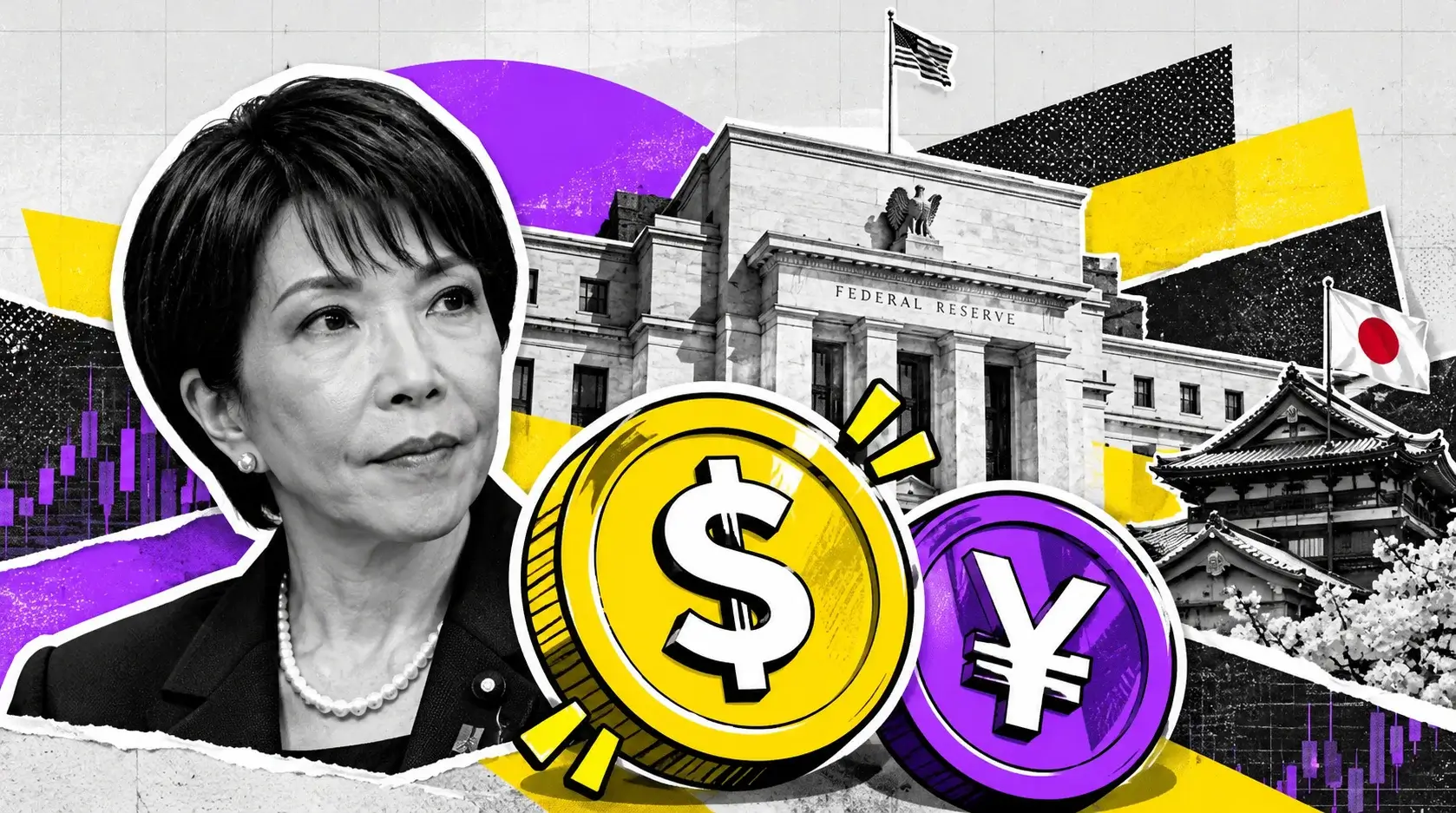
USD/JPY Price Forecast: Dollar-Yen at 159 Targets 160 Intervention Zone and 162 Extension as 30-Year U.S. Yield Hits 5.19%
USD/JPY extends its rally to a seven-day winning streak as the carry-trade math overwhelms every yen-friendly catalyst | That's TradingNEWS
Key Points
- USD/JPY at 159.18 up 7 straight days; targets 159.49, 160.00 intervention zone, then 162.00 extension on break.
- Fed at 3.5-3.75% vs BoJ at 0.75% = 300bp gap; U.S. 30-year yield at 5.19% — highest since 2008 crisis.
- Brent at $109.84 crushes Japan's import bill; 30-year JGB at record, 10-year highest since 1996.
The carry-trade poster child is back in the danger zone, and the tape is forcing every G10 currency desk to confront the same uncomfortable arithmetic: USD/JPY is grinding back toward the 160.00 psychological line where the Bank of Japan went to war in the spring, and nothing about the macro setup suggests the bulls are tired yet. USD/JPY is trading at 159.18 during the Tuesday New York session, extending the bullish run to seven consecutive days and pressing against the highest level in nearly three weeks. The pair has now recovered virtually all of the ground lost to the late-April Japanese Ministry of Finance intervention that sent the cross down sharply from above 160.00, and the 158.55 confluence — where the 200-period SMA on the 4-hour chart aligns with the 61.8% Fibonacci retracement of the April-to-May decline — has been decisively reclaimed as support. The structural backdrop is unambiguously dollar-bullish: U.S. policy rates remain anchored at 3.5% to 3.75% with the effective federal funds rate at 3.63%, while the Bank of Japan policy rate sits at just 0.75%. That 300+ basis point rate differential, combined with elevated Brent crude prices near $109.84, the U.S. 30-year Treasury yield at 5.19% (the highest since before the 2008 financial crisis), and the 10-year benchmark at roughly 4.60%, has produced the most asymmetric long-USD/JPY setup since the 2024 intervention cycle began. Treasury Secretary Scott Bessent's verbal warning about "excessive FX volatility" Tuesday triggered a brief pullback to daily lows near 158.65 before the carry-trade bid reasserted itself and pulled spot back to 159.18. The market is now firmly betting that intervention is a temporary brake rather than a structural reversal mechanism — and that conviction is the single most important driver of the current rally.
The Rate Differential Is the Entire Story
The mathematical foundation of the USD/JPY bull case is the carry trade. With the Federal Reserve holding policy rates at 3.5%-3.75% and the Bank of Japan sitting at 0.75%, the overnight rate spread of roughly 280-300 basis points generates a powerful structural bid for any holder of dollars funded in yen. That spread alone would be enough to support sustained Dollar-Yen appreciation. But the marginal positioning shift over the past three weeks has made the setup even more asymmetric. The market that spent most of 2026 quietly pricing two Federal Reserve rate cuts before year-end has been forced to reverse course after the 6% Producer Price Index print — the hottest reading in nearly four years — landed alongside persistent shelter inflation and Brent crude refusing to back off from the $110 zone. CME FedWatch now shows 53% probability of a Fed hold and 47% pricing a potential hike. That repricing has flipped the rate differential trajectory from "narrowing" to "potentially expanding," which is the single most bullish structural development for USD/JPY in 2026.
The April Federal Reserve meeting confirmed the wait-and-see stance with the policy rate kept inside the 3.5%-3.75% band. The latest effective rate at 3.63% signals that funding conditions remain meaningfully restrictive on a real basis once inflation expectations are stripped out. That keeps the carry-trade attractive even after position-sizing adjusts for intervention risk. As long as the U.S. two-year yield holds above 4.50% and the ten-year above 4.50%, the funding-currency premium that supports long-dollar/short-yen positioning remains structurally intact.
Japanese Economic Data Cannot Save the Yen
The Tuesday morning Japanese GDP release should have provided the yen with a fundamental anchor. Real GDP grew 0.5% quarter-over-quarter and 2.1% year-over-year in Q1 2026, well above consensus expectations and confirming that the Japanese economy is meaningfully outperforming the deflationary trap that defined the last decade. The probability of an overnight rate hike at the June Bank of Japan meeting now sits at 77%, and institutional surveys suggest the BoJ could lift the policy rate to 1.00% in June and 1.25% by the fourth quarter. Those numbers would, in any normal cycle, force a meaningful yen rally. But the yen barely budged on the data — USD/JPY continued grinding higher, confirming that the carry-trade math is dominating the rate-convergence narrative.
The structural issue for the yen is the pace mismatch. Even at the most aggressive BoJ tightening path, the policy rate remains hundreds of basis points below the Fed, and the gap will not close before late 2027 at the earliest. Japanese inflation rebounded to 1.5% in March from 1.3% — still below the 2.0% sustained target the BoJ requires to materially accelerate tightening. Tokyo CPI prints have shown similar steady gains but no acceleration into the 2.5%-3.0% zone that would force a hawkish surprise. The result is that every modestly hawkish BoJ signal gets absorbed into yen weakness because the market is pricing the absolute level of yields, not the direction of change.
The Takaichi Supplementary Budget Has Quietly Become a Yen Killer
The single most underappreciated bearish catalyst for the Dollar-Yen pair is Prime Minister Sanae Takaichi's decision to deploy a supplementary budget to fund expenses tied to the Middle East conflict. The PM emphasized the move should not be viewed as fiscal stimulus, but the market has read it differently. Increased government bond issuance combined with imported energy inflation creates the textbook stagflationary cocktail that historically destroys currency credibility. Japanese government bonds have responded predictably: 30-year JGB yields have climbed to record highs, while 10-year JGB yields have reached the highest level since 1996. That is a generational shift in Japanese fiscal pricing, and it is happening at exactly the moment the yen needs every macro tailwind it can find.
The contradiction between stimulative fiscal policy and the BoJ's restrictive monetary stance is the precise setup that destroyed UK Sterling in the fall of 2022 — the Liz Truss moment that sent the pound to historic lows and forced the government's resignation. The yen is now exhibiting similar warning signals. Japanese institutional investors have positioned for years offshore, chasing yield in U.S. Treasuries and global credit. If rising domestic JGB yields trigger capital repatriation, the yen would mechanically strengthen — but the same flow would generate parallel sell pressure in U.S. Treasuries, which Washington would find deeply problematic. That dynamic is what Bessent's comments are designed to manage. Verbal intervention is the cheapest tool the U.S. has to discourage Japanese FX action that would simultaneously force U.S. yields higher.
Oil Prices Are the Single Largest Yen Headwind
Japan imports approximately 94% of its energy needs, with crude oil and LNG dominating the import basket. The current Brent crude print near $109.84 per barrel — down slightly from the wartime peak of $126 but still up roughly 54% since the Iran conflict began on February 28 — translates directly into a deteriorating Japanese terms-of-trade picture. Every $10 sustained increase in oil prices adds approximately ¥1.5-2.0 trillion to Japan's annual import bill, which mechanically pressures the yen as Japanese importers convert yen into dollars to settle crude invoices. The Strait of Hormuz remains effectively closed, with shipping traffic running well below the 138 vessels per day baseline. JP Morgan expects oil to remain above $100 through the rest of 2026 even if strait restrictions are lifted in the near term — meaning the structural import-cost headwind for the yen is unlikely to compress materially before 2027.
The oil-yen relationship is the second-derivative bullish channel for USD/JPY. Higher crude prices feed U.S. inflation expectations, which delay Fed cuts, which support U.S. yields, which support the dollar — and simultaneously punish the yen through the import-cost channel. Both effects pull Dollar-Yen higher in tandem, which is why the pair has rallied seven sessions in a row despite multiple BoJ-friendly catalysts.
The 160.00 Line Is the Intervention Trip Wire
The 160.00 psychological barrier is no longer just a round number — it is the explicit defense line for the Japanese Ministry of Finance. The April 30 intervention came after USD/JPY punched through 160.00 during the Golden Week holiday period, triggering Tokyo's first yen-buying operation since July 2024. The cycle high near 160.72 marks the level where the BoJ went to work, and the 161.00-162.00 zone represents the next major battleground where the central bank conducted its July 2024 intervention. The current spot at 159.18 sits roughly 80-90 pips below the trip wire, and every grinding session higher tightens the coiled spring.
Goldman Sachs estimates that Japan could conduct up to 30 more interventions similar to the spring operations before depleting reserves — but the practical capacity is materially lower. Japan holds $1.17 trillion in total foreign exchange reserves, but a significant share is parked in U.S. Treasuries that Tokyo would be politically reluctant to sell. Selling Treasuries to fund yen-buying interventions would push U.S. yields higher, which the U.S. Treasury has explicitly identified as a policy priority area. Bessent's confirmation that 10-year yields remain a Treasury focus is the de facto warning that Japan cannot use its Treasury holdings without triggering Washington's pushback. That structural constraint on Japan's intervention capacity is precisely why the market is increasingly willing to test the 160.00 line.
The diminishing returns from each successive intervention round are now visible in the price action. The April 30 intervention generated a sharp pullback from above 160.00 to below 156.00, but the rebound has been relentless and one-directional. Within three weeks, the pair has recovered virtually the entire move. Each intervention cycle teaches the market the same lesson: the macro setup is too aligned for any temporary spot disruption to change the trend. That conditioning is now embedded in the price-action behavior, and it makes the next intervention attempt structurally less effective.
The Technical Setup: Bullish Continuation With Overbought Tension
The USD/JPY chart is in confirmed bullish continuation mode. The 4-hour structure shows the pair trading above the 200-period SMA at 158.55, above the 21-day EMA, and above the 158.00 psychological level that previously acted as resistance before flipping to support after the late-April intervention. The middle Bollinger Band on the daily timeframe sits near 158.37, the upper band near 160.63, and the lower band near 156.12. The current price above the middle band but below the upper band suggests the rally has room to extend toward 160.00 without yet entering full overbought territory on the volatility envelope.
Momentum indicators show the tension between trend strength and stretched conditions. The 14-period RSI on the 4-hour chart sits at 73.34, deep inside overbought territory and signaling that the up-leg is mature. The MACD has slipped marginally into negative territory on shorter timeframes but the histogram has turned positive on the daily, indicating that previous downward momentum from the intervention sell-off has fully reversed. The combination of overbought RSI with bullish momentum confirmation typically precedes one of two scenarios: a sharp but short-lived pullback to the 50-period moving average before continuation, or a sideways consolidation pattern that allows the RSI to reset before the next leg higher.
The immediate resistance ladder is clear. 159.49 marks the 78.6% Fibonacci retracement of the April-to-May decline — the first technical hurdle above current spot. 160.00 is the psychological round number and the immediate intervention trip wire. 160.72 is the cycle high. Above that, 161.00-162.00 represents the prior intervention zone from July 2024. The downside structure is equally well-defined. 158.55 is the immediate support at the 61.8% Fibonacci confluence. 157.86 is the 50% retracement level. 157.18 and 156.35 are the deeper Fibonacci levels, and 154.99 marks the structural floor that defined the entire post-intervention base.
The DXY Context Reinforces the Bullish Setup
The broader U.S. dollar picture confirms the USD/JPY thesis. The Dollar Index broke above the 99.13 pivot Tuesday with green engulfing candles confirming the new ascending channel, targeting the 99.40-99.66 Fibonacci extension zone. Above that, 100.60 opens as the next major magnet. That DXY breakout is structurally bullish for every dollar pair, and Dollar-Yen is the cleanest expression because it carries the largest rate differential of any G10 cross. The fact that USD/JPY is leading the DXY rally rather than lagging it confirms that the carry-trade math is the dominant driver — when fundamental macro alignment is this clean, the highest-carry pairs typically outperform.
The cross-currency picture tells the same story. EUR/USD has cracked below 1.1600 to six-week lows. GBP/USD has lost the 1.3400 psychological floor. USD/CHF is testing breakout resistance. Every major G10 currency is losing ground to the dollar simultaneously, which means the USD/JPY rally is not a yen-specific story — it is a broad dollar-strength regime where the yen is simply the weakest counterpart because of the rate-differential math.
Speculative Positioning and Options Pricing
The CFTC Commitment of Traders data has shown speculative managed money positioning in yen futures sitting deeply net short, with the carry-trade bid being the primary structural buyer of Dollar-Yen on every dip. That positioning is concentrated enough to create real squeeze risk if Japan delivers a coordinated intervention that catches speculators offside — which is exactly what happened in late April. But the post-intervention rebuild of net-short yen positioning has been swift and unrelenting, suggesting the market is unwilling to abandon the trade until a fundamental shift in the macro setup forces the issue. Options pricing on USD/JPY has shown elevated implied volatility around the 160.00 strike, reflecting both intervention risk and the asymmetric payoff structure if the pair breaks decisively higher. Risk reversals have moved toward put-side premium as traders pay up for downside protection against potential intervention, but the spot-vol correlation suggests that protection is increasingly being treated as portfolio insurance rather than a directional bet on yen strength.
Sentiment and Cross-Asset Confirmation
The 10-year U.S. Treasury yield at approximately 4.60% has pulled back marginally from the cycle high near 4.79%, but the broader yield curve remains structurally elevated. The 30-year at 5.19% is the highest since before the financial crisis. The U.S. two-year yield, which historically tracks Fed expectations most directly, has stabilized in the 4.40%-4.50% zone after the PPI shock. That entire yield complex provides structural support for the dollar against every low-yielding funding currency, and the yen sits at the top of the funding-currency list given its 0.75% policy rate. As long as the U.S. real-yield premium versus Japan holds at current levels, every dip in USD/JPY finds buyers from carry-driven systematic strategies and macro funds.
The cross-asset risk picture is more mixed but generally yen-bearish. Equity markets are slipping on inflation concerns, which would normally trigger safe-haven flows to the yen — but the yield-differential pull is overwhelming the historical risk-off response. The VIX at 18.05 signals heightened but not panic-level volatility. Gold has dropped to two-month lows below $4,500 as the dollar strengthens and rate-cut expectations evaporate. The cross-asset environment is rewarding U.S. dollar exposure and punishing zero-yielding hedges — exactly the regime where USD/JPY typically delivers the cleanest carry-trade returns.
Read More
-
Yen Stalls at 160 Despite a 3% JGB and Tokyo Core CPI at 2.0% — Intervention Sits at 164, Friday's Payrolls Decide
02.09.2026 · TradingNEWS ArchiveEnergy
-
QQQ ETF ($706.22) Slides 7.4% Below Its High as the Market Reprices the AI Capex Bill — $686.57 Target if $700 Breaks
22.10.2026 · TradingNEWS ArchiveStocks
-
XRPI ($7.00) and XRPR ($10.74) Slide Toward 52-Week Lows as Spot XRP ETF Flows Stall at $708,510
22.10.2026 · TradingNEWS ArchiveCrypto
-
NG ($2.775) Decoupled From Europe’s €88 Gas Crisis as LNG Feedgas Hits 18.9 Bcf/d — $3.30 Upside on Cold Weather
22.10.2026 · TradingNEWS ArchiveCommodities
-
Dollar-Yen (157.35) Loses 157.65 as the Yen Rallies on Haven Demand — 155 Target if 156 Breaks
22.10.2026 · TradingNEWS ArchiveForex
What Would Invalidate the Bullish Case
Three scenarios would materially shift the USD/JPY trajectory. First, a coordinated U.S.-Japan intervention — particularly if Washington provides explicit verbal support or actual operational coordination — would carry substantially more credibility than unilateral Japanese action and could trigger a deeper pullback toward 154.99 or below. Treasury Secretary Bessent's "excessive FX volatility is undesirable" framing is the diplomatic groundwork, but actual coordinated action remains unlikely given the U.S. focus on Treasury yields. Second, a Bank of Japan surprise rate hike that materially exceeded the consensus 25 bps path — say a 50 bps move in June combined with explicit guidance toward a 2.0% terminal rate — would force a meaningful repricing of the rate differential and trigger short-covering across the entire yen complex. Third, a major decline in oil prices below $80 Brent, combined with a verified Iran ceasefire that fully reopened Strait of Hormuz transit, would compress the imported-inflation channel and reduce the dollar-bid that has been building since February.
What Confirms the Bullish Continuation
The bear case strengthens (i.e., the bull case is invalidated) only under specific conditions. The bull case for USD/JPY strengthens further if (a) U.S. yields continue grinding higher, with the 10-year crossing 4.80% and the 30-year breaking above 5.30%, (b) the BoJ delivers a modestly hawkish but not surprising June meeting that confirms gradualism rather than acceleration, or (c) the Iran conflict produces a new escalation that pushes Brent back above $120 and reactivates the imported-inflation channel into Japan. Any two of those three would force USD/JPY through 160.00 decisively and open the path toward 162.00.
The Verdict: Buy USD/JPY on Pullbacks Toward 158.55 Targeting 160.00 Then 162.00
The setup across USD/JPY at the current 159.18 print is decisively bullish across every timeframe that matters for capital deployment. The carry-trade math is intact with the Fed-BoJ rate differential at roughly 300 basis points. The U.S. yield complex is sitting near multi-year highs with the 30-year at 5.19% and the 10-year at 4.60%. The PPI shock has flipped Fed expectations from cuts to potential hikes, with CME FedWatch showing 47% probability of a hike by year-end. Oil prices near $110 Brent are mechanically pressuring Japan's import bill and feeding U.S. inflation simultaneously. The Takaichi supplementary budget has triggered the worst JGB sell-off in nearly three decades, with 30-year yields hitting record highs. The chart structure has confirmed the bullish continuation above 158.55 confluence support, and the 160.00 intervention trip wire is now the next major magnet.
The actionable call on USD/JPY is Buy at current levels and on any pullback toward 158.55 or 158.00 with stops below 156.35 for protection. The immediate upside target is 159.49 (78.6% Fib retracement), the medium-term target is 160.00-160.72 (the prior cycle high and intervention zone), and the extension target is 161.00-162.00 (the July 2024 intervention battleground) if the 160.00 ceiling is decisively cleared. Intervention risk is real — Bessent's comments and the BoJ's demonstrated willingness to act mean any approach to 160.00 could trigger short-term volatility — but the post-April pattern strongly suggests that intervention-driven pullbacks are buying opportunities rather than trend reversals.
For accounts seeking to position for the longer-term Dollar-Yen trajectory, sizing should account for the asymmetric intervention risk by maintaining stops at meaningful distances and using options structures (call spreads, knockout calls) to limit downside if a coordinated intervention materializes. The bear case requires either coordinated U.S.-Japan action, an outsized BoJ hawkish surprise, or a major oil-price collapse — none of which are imminent. Until at least two of those three catalysts materialize, the path of least resistance for USD/JPY is higher, and the structural setup favors maintaining long carry-trade exposure with disciplined risk management around the 160.00 trip wire. The yen has lost the rate-differential argument, lost the imported-inflation defense, and lost the fiscal-credibility narrative simultaneously — and the dollar is now collecting the premium across every channel. Long USD/JPY remains the cleanest single-name expression of the broader dollar-strength regime, and the buy signal stays active until the macro alignment fractures.