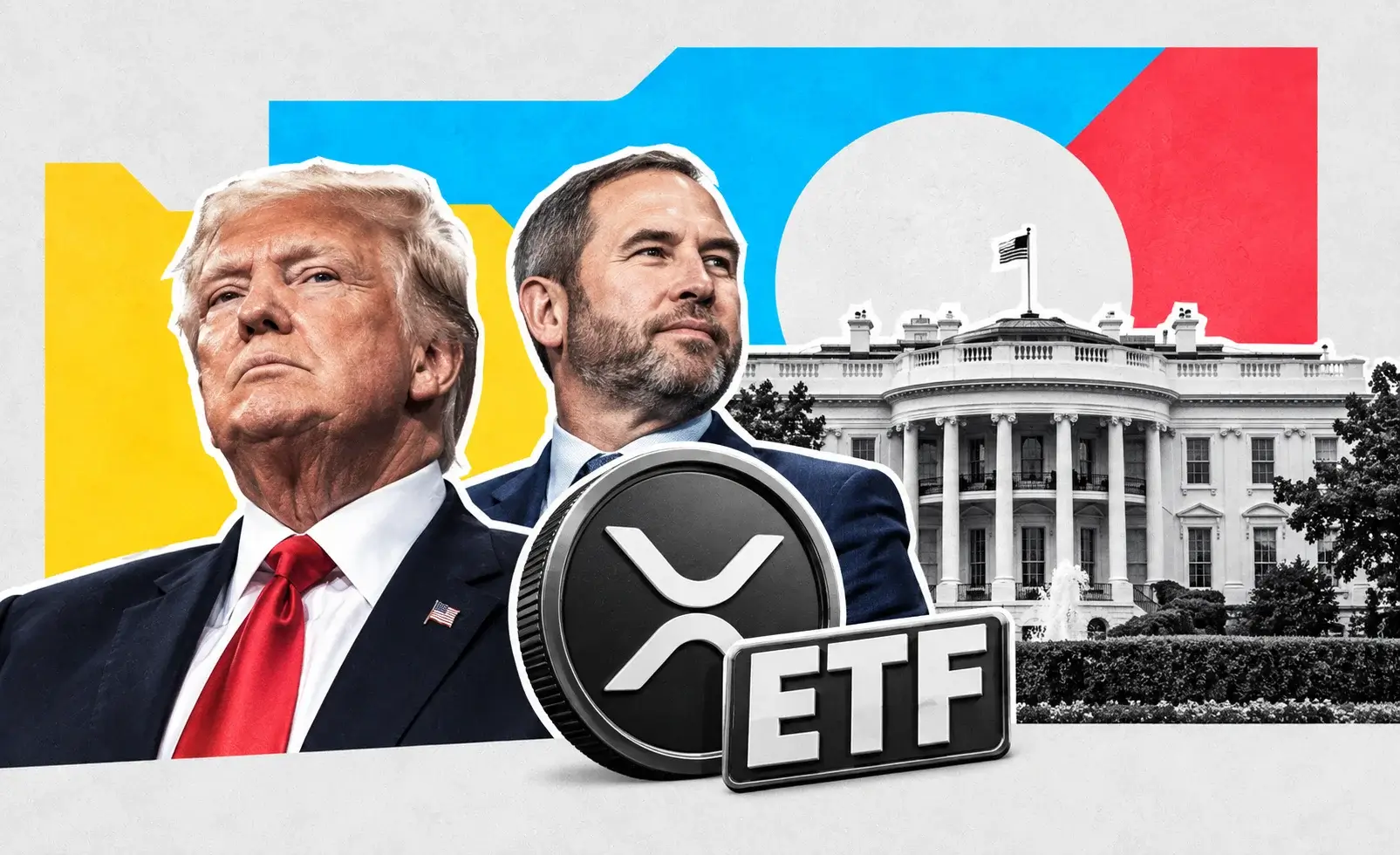
XRP ETF Price Forecast: XRPI at $8.13 and XRPR at $11.78 After $1.44B in Inflows — Goldman Sachs at $153.8M
Seven spot XRP ETFs hold $1 billion in AUM as combined assets fell from $1.65B peak on XRP's 43% decline | That's TradingNEWS
XRP ETF (NASDAQ: XRPI) at $8.13, XRPR at $11.78 — $1.44 Billion in Cumulative Inflows, Goldman Sachs at $153.8 Million, and the CLARITY Act Clock That Decides Whether XRP-USD Reaches $2.00 or Collapses to $1.12
XRP ETF (NASDAQ: XRPI) closed Monday, March 23, 2026 at $8.13 — unchanged on the session after an intraday range of $8.07 to $8.30, with after-hours trading ticking up to $8.18, representing a 0.62% gain that reflected the broader crypto market's relief rally on Trump's five-day Iran strike pause announcement. The 52-week range of $6.50 to $23.53 tells the complete story of an ETF that has been demolished by the underlying asset's price collapse — sitting 65.5% below its 52-week high of $23.53 and 25% above its 52-week low of $6.50 — reflecting the full damage of XRP-USD's 43% decline in 2026 and the 61% drawdown from the July 2025 all-time high of $3.66. The REX Osprey XRP ETF (BATS: XRPR) closed at $11.78, up 0.26% on the session, with an intraday range of $11.69 to $11.90 and a 52-week range of $9.50 to $25.99, trading on average daily volume of 40,050 shares. Seven U.S. spot XRP ETFs have collectively attracted $1.44 billion in cumulative net inflows since their September through December 2025 launches, yet combined AUM has contracted from a January 2026 peak of $1.65 billion to approximately $1 billion — not because institutions are leaving, but because the underlying token's price decline eroded the dollar value of holdings that were never sold. Goldman Sachs committed $153.8 million across four XRP ETFs in its Q4 2025 13F filing — larger than the next 29 institutional holders combined. Franklin Templeton's XRPZ offers the lowest fee structure of any XRP ETF at 0.19%, currently waived entirely through May 31, 2026. The SEC and CFTC jointly classified XRP as a digital commodity on March 17, 2026 — removing the legal overhang that suppressed institutional adoption for years. The CLARITY Act, which would make that commodity status permanent statutory law rather than administrative guidance, carries approximately 90% passage probability by late April 2026 according to market consensus. Every structural prerequisite for a sustained XRP-USD recovery and an XRP ETF re-rating is assembling simultaneously. What is missing is price confirmation — and the inverse head-and-shoulders pattern forming on the daily chart, with the $1.26 head as the invalidation floor and the $1.70 neckline as the breakout target, is the technical structure that will determine whether the fundamental thesis gets expressed in the ETF prices before or after the next major macro catalyst.
$1.44 Billion in Cumulative Inflows Since Launch, $164 Million on Day One, 35 Consecutive Days Without a Net Outflow — The Fastest Institutional Adoption of Any Crypto ETF Launch
The formation of the U.S. spot XRP ETF market between September and December 2025 was one of the most consequential structural developments in crypto market history, and its speed exceeded every comparable precedent. REX Osprey (XRPR) launched first in September 2025 at a 0.75% expense ratio — the highest fee among the group but commanding first-mover premium as the only U.S.-regulated XRP exposure vehicle available at that moment. By December 2025, six additional spot XRP ETFs had gone live: Canary Capital's XRPC — which holds the largest AUM among the seven — the Bitwise XRP ETF which trades the highest daily volume, Franklin Templeton's XRPZ at 0.19% fee making it the cost leader, Grayscale's fund, 21Shares, and Amplify. The combined Day 1 net inflow of $164 million exceeded every realistic pre-launch estimate and on a proportional basis relative to the underlying asset's market cap surpassed Bitcoin ETF Day 1 performance — a statistic that the market significantly underweighted when processing the launch because Bitcoin's absolute dollar figures were larger. The subsequent 35 consecutive trading days without a single net outflow from any of the seven funds was the most striking early-adoption signal, representing a streak that neither Bitcoin nor Ethereum ETFs achieved in their equivalent post-launch periods. Bitcoin ETFs experienced net outflow days within the first two weeks of trading as institutional arbitrage traders rotated out of GBTC into new products. XRP ETFs had no comparable distribution pressure — every single trading day for 35 consecutive sessions ended in net positive territory, reflecting the pent-up institutional demand that had been building through years of SEC litigation and regulatory uncertainty. By year-end 2025, cumulative inflows crossed $1.18 billion. January 2026 pushed the total to $1.44 billion as the post-launch momentum combined with XRP's price action and the anticipation of additional regulatory clarity. March has been dramatically slower — only four positive inflow days through March 20 — reflecting the Iran war risk-off environment that has suppressed risk appetite broadly. The weekly inflow average through Friday March 20 was $635,000 per day, compared to the $43 million weekly pace in early January and the $483 million monthly pace in December 2025. The deceleration from $483 million monthly to approximately $19 million monthly is the most important near-term challenge for the XRP ETF thesis — it reflects not institutional conviction weakening but macro environment suppressing the weekly inflow cadence that would otherwise be accelerating as regulatory clarity improves.
XRPI at $8.13, XRPR at $11.78 — What the Price Divergence Between the Two Funds Reflects and Why Fee Structure Is the Critical Variable
The two most actively traded XRP ETFs in the U.S. market represent different positioning strategies within the same underlying asset, and the divergence in their absolute price levels — XRPI at $8.13 versus XRPR at $11.78 — reflects the different inception dates, NAV calculation methodologies, and share price structures rather than any meaningful difference in investment performance relative to XRP-USD. Both funds track the spot price of XRP held in physical cold storage custody, meaning their performance before fees should be essentially identical. The fee differential — XRPR at 0.75% annually versus Franklin Templeton's XRPZ at 0.19% — is the primary competitive dimension separating these products over multi-year holding periods. On a $100,000 position, the annual fee difference between XRPR at 0.75% and XRPZ at 0.19% is $560 per year — or $675 per year at the maximum differential across the seven-fund competitive field. Over a five-year holding period, that $560-$675 annual cost differential compounds into $2,800-$3,375 in additional expense on a $100,000 position, before any consideration of the compounding effect on growth. For institutional allocators managing positions in the hundreds of millions — like Goldman Sachs at $153.8 million — the fee differential generates millions of dollars in additional annual cost on the higher-fee products. Franklin Templeton's decision to waive the 0.19% fee entirely through May 31, 2026 makes XRPZ the zero-cost XRP ETF for the remainder of Q1 and most of Q2 2026 — a competitive positioning that is aggressively targeting institutional assets away from higher-cost competitors during the critical period when the CLARITY Act will either pass or stall. The fee waiver creates an explicit incentive for institutional allocators entering the XRP ETF space before May 31 to route capital through XRPZ rather than XRPR — a competitive dynamic that will show up in relative AUM flows over the next 60 days. XRPR's 0.75% expense ratio may be sustainable because of its first-mover advantage and brand recognition among retail participants who entered early and have not optimized their fee exposure, but it faces meaningful pressure as the market matures and fee consciousness increases among larger allocators.
Goldman Sachs at $153.8 Million Across Four XRP ETFs — Larger Than the Next 29 Institutional Holders Combined
The Goldman Sachs Q4 2025 13F filing disclosure of a $153.8 million combined position across four XRP ETFs — Bitwise, Franklin Templeton's XRPZ, Grayscale, and 21Shares — is the single most powerful institutional validation signal in the entire XRP ETF story, and its analytical significance extends far beyond the dollar amount. The $153.8 million Goldman position being larger than the next 29 institutional holders combined is the data point that should anchor every conversation about where institutional XRP ETF adoption stands. It means that despite the 35-day streak without outflows, the $1.44 billion in cumulative inflows, and the commodity regulatory designation, Goldman Sachs dominates the institutional XRP ETF landscape in a way that has no precedent in Bitcoin or Ethereum ETF institutional adoption curves. Millennium Management — the next largest institutional holder at $23.1 million — holds less than 15% of Goldman's position. This concentration creates both a strength and a vulnerability in the XRP ETF market structure. The strength is the signal quality: when a firm of Goldman's analytical capability and institutional fiduciary responsibility commits $153.8 million to a new crypto ETF product, it is making a deliberate, researched, conviction-based asset allocation decision that will influence other institutional allocators who follow Goldman's positioning disclosures. The vulnerability is position concentration risk — if Goldman reduces its XRP ETF exposure in a future 13F filing, the headline will be interpreted as institutional abandonment regardless of the fundamental reasons, creating temporary selling pressure in the ETF shares. The 84% retail ownership of XRP ETF assets — against only 16% institutional — reflects the early-stage nature of the institutional adoption cycle. Goldman's $153.8 million is the leading edge of what will be a much broader institutional ownership wave if the CLARITY Act passes, BlackRock files, and the major custodians finalize their XRP ETF operational infrastructure. The transition from 84% retail to 60% retail over the next 12-18 months would require approximately $600-$800 million in additional institutional net inflows — a figure that is achievable given the addressable institutional capital pool, but only if the regulatory and price environment cooperates.
XRP-USD at $1.42 — The Inverse Head-and-Shoulders Pattern With a $1.26 Floor and a $1.70 Neckline That Determines the Next 20% Move
XRP-USD closed Monday at $1.42, up approximately 3% on the session after recovering from a daily low of $1.36 following Trump's Iran ceasefire announcement. The intraday range from $1.36 to $1.45 frames the precise technical boundaries that are defining the entire near-term price structure. The 50-day MA sits at $1.4220, the 100-day MA at $1.4122, and the 200-day MA at $2.1057 — a triple-moving-average configuration that places XRP-USD below its short and medium-term moving average resistance while sitting 32.5% below the long-term trend anchor. The inverse head-and-shoulders pattern forming on the daily chart since late February is the most analytically significant technical formation in the XRP complex and deserves the precise numerical treatment it requires. The left shoulder formed in mid-February at approximately $1.45-$1.50 before the first decline toward the $1.30s. The head — the deepest point of the entire correction — printed at $1.26 during the February 2026 low, representing the maximum pessimism point and the critical invalidation level for the entire bullish pattern. The right shoulder is currently forming near the $1.37 level — the zone where XRP-USD has been finding support during the current decline, creating the asymmetric three-peak structure that defines a valid inverse head-and-shoulders. The neckline — the resistance that needs to be broken on a daily closing basis to confirm the pattern — sits near $1.70 based on the Fibonacci confluence of multiple recovery attempts. The measured move target from a confirmed $1.70 neckline breakout — adding the head-to-neckline distance of approximately $0.44 to the breakout point — implies a target of approximately $1.91 on the initial measured move, representing a 35% gain from Monday's $1.42 close if the pattern confirms. The $1.45 immediate resistance, the $1.54 most recent swing high that failed beneath the descending trendline from the $3.66 all-time high, and the $1.57 (0.618 Fibonacci), $1.63 (0.786 Fibonacci), and $1.70 (1.0 Fibonacci/neckline) levels form the sequential resistance ladder that XRP-USD must climb through before the pattern delivers its measured target. Every level in that sequence needs to be overcome on a daily closing basis to maintain pattern integrity.
700 Million XRP in Cost-Basis Support Clusters Between $1.28 and $1.37 — The On-Chain Architecture That Gives the H&S Pattern Its Numerical Foundation
The Glassnode cost-basis distribution heatmap for XRP-USD is providing one of the most precise on-chain validations of a technical chart pattern available in the entire crypto market. Two distinct and quantified cost-basis clusters sit at the precise price levels that correspond to the inverse head-and-shoulders structure. The first cluster — approximately 203 million XRP — represents tokens whose holders have an average cost basis of $1.35-$1.37. These are the participants who bought during the most recent phase of the correction and are currently sitting at or near breakeven, creating a specific behavioral dynamic: they are not forced sellers because their positions are near cost, and they have incentive to hold or accumulate additional XRP below their cost basis rather than realize a loss. This 203 million XRP cluster is why the $1.37 right shoulder level has repeatedly absorbed selling pressure — there is genuine holder demand at exactly that price zone from real capital at real cost. The second and substantially larger cluster holds approximately 497 million XRP in the $1.28-$1.29 cost-basis range — more than double the size of the $1.37 cluster and representing the buyers who entered during the deepest part of the correction, below the right shoulder level. This 497 million XRP cluster sitting just above the pattern's $1.26 head is the on-chain expression of why $1.26 is such a critical invalidation level. A sustained daily close below $1.26 would push both clusters — 700 million XRP combined, or approximately 1.1% of total circulating supply — into loss territory simultaneously. When 700 million tokens across two distinct cost-basis clusters move from profitable or breakeven to underwater in a single price event, the behavioral shift toward selling accelerates nonlinearly — the holders who were comfortable near their cost basis suddenly have a loss to manage, the stop-loss levels below $1.26 that many set when entering get triggered, and the support zone that was protecting the pattern's floor dissolves. The 700 million XRP cost-basis clusters are not theoretical support levels derived from chart analysis — they are the numerical expression of real money paid by real participants at prices that will influence their future selling behavior. This is the most important on-chain confirmation that the inverse head-and-shoulders is not just a chart pattern but a reflection of actual market microstructure.
Hodler Net Position Grew From 233.6 Million to 240.3 Million XRP During a 15% Price Decline — The Accumulation Signal That Trumps Every Bearish Indicator
The Glassnode hodler net position change metric — tracking addresses holding XRP for 155 days or more — delivered one of the most constructive on-chain signals in the entire dataset during the most recent XRP correction. On March 17, when the most recent selloff phase began, long-term holders carried a net positive position of 233.6 million XRP. By March 22 — five days later, during which XRP-USD declined approximately 15% — that net position had grown to 240.3 million XRP, a 3% increase in accumulation during active price deterioration. The consecutive green bars on the hodler net position chart throughout early March confirm that this accumulation during weakness is not a one-session anomaly — it is a sustained behavioral pattern from the 155+ day holder cohort, the addresses that by definition survived prior cycle drawdowns, understood XRP's historical volatility, and decided to add exposure rather than reduce it as prices fell. This behavioral pattern from experienced long-term holders is categorically different from short-term buyers averaging down — it represents the informed conviction of participants who have managed through multiple market cycles and are reading the combination of regulatory clarity, ETF adoption progress, and price weakness as an opportunity rather than a warning. When the cohort with the deepest historical knowledge of an asset is buying as it falls, the information content of that signal is substantially higher than when new participants buy the dip simply because prices are lower than they were. The significance of 240.3 million XRP in hodler net accumulation relative to the total circulating supply of 61 billion tokens is modest in percentage terms — approximately 0.39% — but the directional behavior during price decline is what matters analytically. The question the hodler accumulation data is answering is not "how much XRP are long-term holders buying?" but "what are the most informed, most experienced XRP market participants doing when the price falls?" The answer — buying more — is the single most bullish data point in the entire XRP complex regardless of what the shorter-term technical and momentum indicators suggest.
Open Interest Collapsed From $2.6 Billion to $722 Million — The Leverage Flush That Creates the Cleanest Possible Setup for the Next Move
The trajectory of XRP-USD derivatives open interest over the past several months represents one of the most complete leveraged position unwinds in the current crypto market cycle, and its analytical implications for the forward price outlook are consistently underappreciated by market participants focused on the headline price decline. Open interest peaked near $2.6 billion — a concentration of leveraged directional bets that is inherently unstable because it creates the cascade mechanics for violent price moves whenever positions get forced to close. From that $2.6 billion peak to the current level of approximately $722 million-$900 million, XRP derivatives open interest has contracted by 65-72% — a deleveraging of exceptional magnitude that has systematically removed the forced-seller pressure that amplified every downward price move during the correction. The significance of this leverage flush for the forward price structure is direct and quantifiable. When open interest is elevated at $2.6 billion and price begins moving against the dominant positioning, each adverse price increment triggers liquidation of overleveraged positions, which generates forced selling at market prices, which moves price further against remaining positions, which triggers additional liquidations in a cascade. That cascade dynamic — which is responsible for the sharp, velocity-driven moves that take XRP from $2.00 to $1.26 in compressed timeframes — has been substantially defused by the 72% open interest reduction. When the next directional catalyst arrives — whether that is CLARITY Act passage, a BlackRock filing, the Iran ceasefire holding and risk appetite returning broadly, or simply the XRP ETF inflow pace recovering toward December 2025 levels — the move higher will face dramatically less liquidation headwind from overcrowded leverage than any of the prior recovery attempts. The funding rate shift from 0.0015% on March 17 to 0.009% on March 23 — rising funding accompanying falling open interest — signals that new long positions entering the market are cautious and well-capitalized rather than the leveraged momentum chasing that characterized the late-2025 bull run. Markets that have completed thorough leverage flushes and re-enter a rising price environment with moderate open interest and reasonable funding rates tend to produce more sustained and less volatile appreciation than markets that recover from oversold conditions with excessive leverage still embedded in the derivatives structure.
Read More
-
Yen Stalls at 160 Despite a 3% JGB and Tokyo Core CPI at 2.0% — Intervention Sits at 164, Friday's Payrolls Decide
02.09.2026 · TradingNEWS ArchiveEnergy
-
T-Rex 2X Inverse MSTR ($4.39) Rips 10.44% as Strategy Pauses Bitcoin Buys for a 2nd Week — $4.63 Close Opens $5.27
15.09.2026 · TradingNEWS ArchiveStocks
-
XRPR ($10.59) and XRPI ($7.04) Open at Highs and Close at Lows After Senate Kills CLARITY Act
15.09.2026 · TradingNEWS ArchiveCrypto
-
NG ($2.908) Holds Above $2.80 Low as LNG Feedgas Hits 18.8 Bcf and TTF Trades 9.2x Henry Hub
15.09.2026 · TradingNEWS ArchiveCommodities
-
USD/JPY (155.09) Faces 275bp Policy Gap as BOJ Prepares 31-Year-High Rate — Close Below 154 Opens 153.40
15.09.2026 · TradingNEWS ArchiveForex
The March 27 SEC Deadline, 91 Outstanding Crypto ETF Applications, and Why XRP's Commodity Classification Makes Denial Legally Untenable
March 27, 2026 is the 240-day maximum deadline for the SEC to approve or deny the latest batch of cryptocurrency ETF applications, and XRP-related filings are among the most consequential items in that queue. The broader context: 91 outstanding crypto ETF applications across 24 tokens were pending as of late 2025, reflecting the explosion of product development activity that followed the Bitcoin and Ethereum spot ETF approvals. The March 27 deadline applies across the crypto ETF universe, but the XRP filings carry heightened significance because seven spot XRP funds are already live, absorbing capital, and demonstrating that the operational infrastructure for physically-backed XRP custody and ETF administration works. The joint SEC/CFTC commodity classification released on March 17 — which explicitly named XRP alongside Bitcoin, Ethereum, XRP, Dogecoin, and Cardano as examples of digital commodities — removes what was previously the SEC's primary statutory justification for XRP ETF denial: uncertainty about the asset's regulatory classification. With XRP now carrying a joint agency commodity designation, the SEC has been stripped of the legal ambiguity that allowed it to deny or delay prior applications on the grounds that XRP's status as a security remained unresolved. The new administrative guidance places the SEC in the position of having to deny an XRP ETF application for a commodity-classified asset while simultaneously approving Bitcoin and Ethereum ETFs for commodity-classified assets — a legally inconsistent position that would face immediate judicial challenge. WisdomTree's withdrawal of its spot XRP ETF application on January 6, 2026 and CoinShares pulling its XRP, Solana, and Litecoin filings around late 2025 reflect market positioning rather than lost conviction — both firms still operate XRP products in Europe, and their U.S. withdrawal was driven by the crowded competitive landscape where Canary, Bitwise, and Franklin Templeton had already captured the majority of early institutional inflows. Their exits from the queue make the competitive field slightly less crowded for the remaining applicants, which is marginally constructive for the fee and AUM capture dynamics of the seven existing products.
BlackRock Needs $3 Billion in XRP ETF AUM Before Filing — The Missing $2 Billion That Would Transform the Market
The most consequential actor absent from the U.S. spot XRP ETF market is BlackRock — and the specific threshold that Canary Capital CEO Steven McClurg identified as the commercial trigger for BlackRock's entry is $3 billion in combined XRP ETF AUM. The current combined AUM sits at approximately $1 billion — meaning the market is $2 billion short of the level that the most informed observer of BlackRock's decision-making process believes would prompt a filing. BlackRock's head of digital assets Robbie Mitchnick has publicly stated that client demand from pensions, endowments, and sovereign wealth funds has not crossed the firm's internal threshold for XRP ETF product development. This is a specific, quantifiable, and potentially achievable barrier rather than a vague statement of disinterest. BlackRock entered Bitcoin ETF with IBIT after institutional demand signals were unambiguous — and IBIT now holds $54.82 billion in AUM, establishing it as the dominant spot Bitcoin ETF globally by a factor of more than 4-to-1 over Fidelity's FBTC. The same playbook applied to XRP means that BlackRock waits until the market has demonstrated sufficient institutional depth, then files with the brand, distribution network, and fee-competitive structure to rapidly capture AUM leadership. The connection between BlackRock and Ripple's ecosystem already exists: Mitchnick worked at Ripple before joining BlackRock, and BlackRock's tokenized treasury fund BUIDL uses Ripple's RLUSD stablecoin as collateral. The organizational familiarity with Ripple's technology and team reduces the due diligence timeline that BlackRock would require before filing. If inflows recover toward December 2025 paces following CLARITY Act passage and the Iran macro environment normalizes, the $1 billion AUM could approach $3 billion within 6-9 months — and a BlackRock XRP ETF filing announcement would likely move XRP-USD by 15-25% on the announcement day alone, before the fund even launched. Fidelity and Invesco, who have both not filed for XRP despite Invesco already submitting a Solana ETF application, would face similar competitive pressure to file quickly after BlackRock moves, creating the multi-major-issuer announcement dynamic that drove Bitcoin ETF inflows to extraordinary levels in early 2024.
The CLARITY Act at 90% Passage Probability — The Statutory Designation That Transforms XRP From Administrative Guidance to Federal Law
The CLARITY Act is the single most important forward-looking variable in the entire XRP ETF investment thesis, and understanding the precise difference between the current SEC/CFTC administrative commodity classification and a statutory designation under the CLARITY Act is critical for assessing what the legislation would actually do to institutional XRP ETF demand. The current March 17 joint agency classification is an interpretive release — an administrative guidance document that carries regulatory weight and removes the immediate compliance barrier but can be reversed by a future administration through re-issuance of contradictory guidance, without requiring Congressional action. The CLARITY Act would encode XRP's commodity status in federal statute, making it permanent law that can only be changed through a new Congressional act. For the most conservative institutional capital — pension funds operating under ERISA, insurance companies with state-level investment guidelines, sovereign wealth funds with statutory mandates — the difference between administrative guidance and statutory law is the difference between "legally tolerable exposure" and "clearly permitted investment." Approximately 90% passage probability by late April 2026 based on current Congressional dynamics reflects the stablecoin yield compromise reached between Senators Tillis and Alsobrooks on March 20 — the specific dispute that had been blocking the bill's committee progress — and Senator Lummis confirming the Banking Committee is targeting a markup in the second half of April. Senator Moreno's explicit warning that if the bill doesn't pass by May, midterm election dynamics will push it off the table for the rest of 2026 creates an actionable timeline: the window for CLARITY Act passage is approximately 30-60 days from March 23, and the probability of passage within that window is approximately 90%. The investment implication is direct: XRP ETF (XRPI), XRPR, and XRP-USD all trade at prices that assume the CLARITY Act has not yet passed. When it does pass — and the 90% probability suggests it will — the institutional demand that has been waiting for statutory clarity will begin flowing through the ETF channel at a materially higher rate than the current $635,000 daily average.
Standard Chartered's $8 Target Revised to $2.80 Near-Term, $28 by 2030 — The ETF Inflow Mathematics That Determines Which Scenario Plays Out
Standard Chartered's XRP-USD price forecast evolution captures the precise impact of ETF inflow trajectory on price targeting better than any other analytical framework available. The bank's original $8 end-of-2026 target — which implied 315% upside from then-current prices — was premised on $4 to $8 billion in total XRP ETF inflows reaching the market during 2026. The subsequent revision to a $2.80 near-term target reflects the deceleration of inflows from the December 2025 pace of $483 million monthly to the March 2026 pace of approximately $19 million monthly — an 96% reduction in inflow velocity driven primarily by the Iran war macro environment and the FOMC's hawkish pause suppressing risk appetite. The $28 by 2030 target was maintained — confirming that Standard Chartered's long-term conviction on ETF-driven XRP demand is intact even as the near-term pace has slowed. The mathematical bridge between the current $1 billion AUM and a price that would push XRP-USD toward $2.80, then $3.65, and eventually $8 runs through the supply physics of XRP's relatively thin exchange float. Each $1 billion in XRP ETF inflows locks approximately 500 million tokens in cold storage custody, representing about 0.8% of the 61 billion circulating supply. At the current $1 billion AUM level, ETFs hold approximately 772 million XRP. At $5 billion in AUM — the midpoint of Standard Chartered's $4-$8 billion scenario — ETFs would hold approximately 2.5 billion tokens, exceeding the combined XRP held on every major cryptocurrency exchange globally given that exchange balances have already dropped from approximately 4 billion to 2.6 billion during 2025 — the lowest level since 2018. When ETF custody holdings approach or exceed total exchange balances, the available float for spot market trading compresses dramatically, creating the supply squeeze conditions that mechanically force prices higher as any incremental demand has fewer tokens available to purchase. The path from $635,000 in daily inflows to the $14+ million daily pace required to hit $5 billion by year-end requires either a macro catalyst — Iran ceasefire that restores risk appetite broadly — or a regulatory catalyst — CLARITY Act passage that opens institutional floodgates — or both operating simultaneously. Both are plausible within 30-60 days based on current trajectory.
XRP/BTC at 2,020 Satoshis, Below Both the 100-Day at 2,100 and 200-Day at 2,200 — The Cross-Rate That Reveals How Much XRP Is Really Underperforming
The XRP/BTC cross-rate deserves analytical attention that it rarely receives in the context of XRP ETF coverage because it strips out Bitcoin's own price movements and isolates XRP's performance against its most directly comparable large-cap crypto asset. The current XRP/BTC rate of approximately 2,020 satoshis — sitting below the 100-day moving average at 2,100 sats and the 200-day moving average at approximately 2,200 sats — confirms that XRP has been underperforming Bitcoin not just in dollar terms but in crypto-relative terms since October 2025. The descending channel in XRP/BTC has capped every recovery attempt at 2,500 satoshis — a resistance level that aligns with the broader trend structure's upper trendline and has rejected the pair multiple times without exception. The RSI for XRP/BTC is recovering from its most oversold reading of the entire correction cycle — creating a modest positive divergence that could precede relative outperformance if a CLARITY Act catalyst triggers XRP-specific institutional demand rather than simply following the broader market. The critical implication for XRP ETF holders is this: even a scenario where XRP-USD recovers toward $1.70 on the back of broader crypto market appreciation and risk-on environment restoration might leave XRP ETF prices near current levels if Bitcoin simultaneously rallies more aggressively — because the dollar price gains in XRP are offset by Bitcoin's larger percentage move. XRPI at $8.13 and XRPR at $11.78 generating meaningful ETF price appreciation requires either XRP outperforming Bitcoin in ratio terms — which demands the XRP/BTC cross-rate to break above 2,500 sats — or Bitcoin remaining stable while XRP-specific catalysts drive USD price appreciation. The CLARITY Act passage scenario is the most compelling candidate for genuine XRP-specific outperformance because it addresses a regulatory constraint that Bitcoin does not share and opens institutional access channels that remain partially restricted for XRP in ways they are not for BTC.
The $1.98 Million Friday Inflow, $635,000 Daily Average, and the Six-Day Streak That the FOMC Killed — What the ETF Flow Data Actually Predicts for the Next 30 Days
The granular XRP ETF inflow data from the week of March 16-20 contains more analytical content than the headline weekly number of $640,000 total inflows suggests. The six-day consecutive inflow streak from March 10-17 — which was generating approximately $3.5-$4 million per day in cumulative net flows across the seven ETFs — was broken abruptly following the Federal Reserve's Wednesday March 18 meeting when Powell's hawkish press conference triggered a risk-off cascade across all crypto ETF products. The $1.98 million in inflows on Friday March 21 — the first positive day after two days of zero net activity following the FOMC — suggests that the institutional buyers who paused during the Fed uncertainty did not abandon their positions permanently but simply waited for directional clarity before resuming accumulation. The current $635,000 daily average through Friday represents the baseline institutional XRP ETF demand under maximum macro stress — an environment combining active military conflict, oil above $100, Fed hawkishness, and the most risk-off sentiment since COVID. If the five-day Iran ceasefire holds, oil normalizes toward $80-85, and the CLARITY Act advances through committee, the daily inflow pace should recover toward the $3-$5 million daily range that characterized the most constructive periods of early 2026. A recovery to $4 million daily for the remainder of Q2 2026 would add approximately $240 million to combined XRP ETF AUM — bringing the total toward $1.24 billion. A recovery to the December 2025 pace of $16 million daily would add approximately $960 million over the same period — pushing combined AUM past $2 billion and covering half the distance toward the $3 billion threshold that Canary Capital's McClurg identified as the BlackRock filing trigger. The inflow pace over the next 30-60 days is therefore the most directly observable indicator of whether the XRP ETF thesis is accelerating toward its transformative phase or consolidating at current levels pending the next catalyst.
The Trading Verdict: Accumulate XRPI and XRPR Between $7.50-$8.00, Stop Below $6.75, Full Position Add on CLARITY Act Passage
XRP ETF (NASDAQ: XRPI) at $8.13 and REX Osprey XRP ETF (BATS: XRPR) at $11.78 represent accumulation opportunities for positions sized appropriately for the binary nature of the near-term catalysts — not aggressive full-position entries at current prices, but measured initial positioning that can be scaled aggressively if the CLARITY Act passes and XRP-specific ETF inflows accelerate. The bull case is constructed on five specific, numerically validated pillars. The SEC/CFTC joint commodity classification on March 17 removed the primary legal barrier to institutional adoption. The CLARITY Act carries 90% passage probability by late April, and statutory commodity designation would open the full institutional capital pool — pension funds, endowments, sovereign wealth funds — to XRP ETF allocation. The 700 million XRP in cost-basis support clusters between $1.28 and $1.37 provides quantified on-chain backing for the inverse head-and-shoulders pattern's floor. The hodler accumulation of 6.7 million additional XRP during a 15% price decline signals informed long-term holder conviction. The 72% open interest reduction from $2.6 billion to $722 million has flushed the leverage excess that was amplifying downside moves. The risk case is equally clear: a daily close below $1.26 in XRP-USD invalidates the inverse head-and-shoulders entirely and removes the technical basis for the near-term bullish thesis, with the next meaningful support at $1.12 and a deeper flush scenario toward $0.80-$0.70. The tactical approach for XRPI is: initiate or add to positions at $7.50-$8.00 where the ETF reflects XRP-USD in the $1.35-$1.40 zone matching the cost-basis cluster support, set a hard stop at $6.75 which corresponds to an XRP-USD break below $1.26, and double position size immediately upon confirmed CLARITY Act passage through Senate committee — that event will likely move XRP-USD 15-25% on the announcement day, making entry at post-news prices substantially less favorable than the current $8.13 ETF price. For XRPR at $11.78 with the 0.75% fee structure, the same directional thesis applies but fee-conscious positions should evaluate whether XRPZ (Franklin Templeton, 0.19% fee, currently free through May 31) offers better cost-adjusted exposure for the same underlying directional bet.