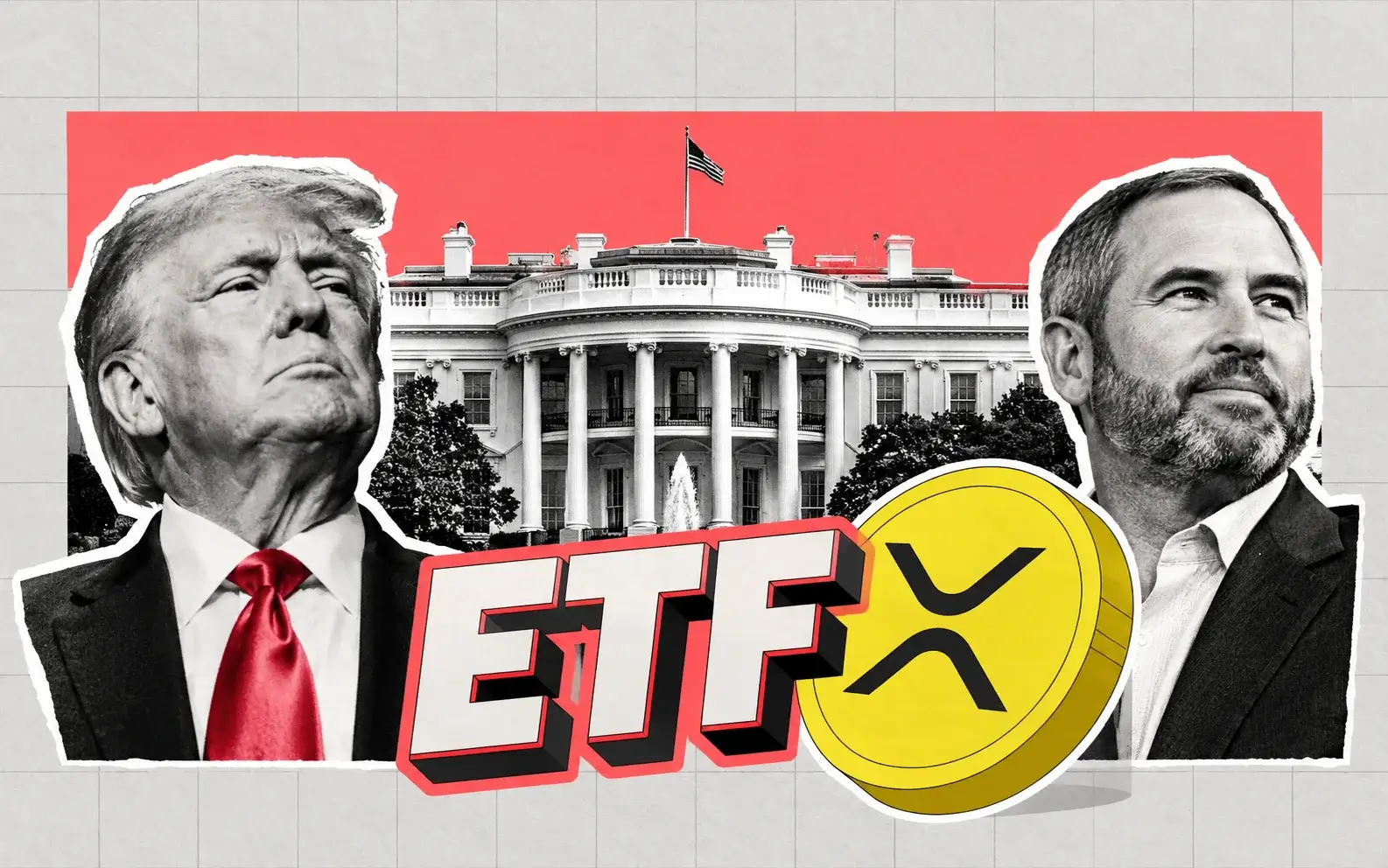
XRP ETF: Complex Hits $1B in Assets and $1.49B Cumulative Inflows While July Delivers 6 Zero-Flow Days
Seven US spot XRP ETFs held combined assets of $1 billion and 977.4 million XRP as of July 26 | That's TradingNEWS
Key Points
- XRP traded $1.09 to $1.11 Monday, down 0.80% over 24 hours and 71% below its $3.84 record.
- Seven US spot XRP ETFs held $1 billion in combined assets and 977.4 million XRP as of July 26.
- Cumulative net inflows reached $1.49 billion against net assets of $997.18 million.
XRP traded at $1.11 at 12:22 a.m. Eastern Monday on $384.27 million of 24-hour volume, held near $1.11 through the Asian and European sessions with a 1% gain against the prior day's $1.10, and eased to $1.09 by the New York morning — down 0.80% over 24 hours and 1.90% over seven days. A separate read had it at $1.0922. Call it a 2-cent band that resolved lower.
Market capitalisation sits between $68.32 billion and $69.38 billion depending on the supply measure used, on 62.53 billion circulating tokens against a 100 billion genesis cap. Fully diluted valuation is $110.95 billion. Twenty-four-hour volume ran between $717 million and $1.02 billion across venues, against a seven-day average of $1.34 billion and a thirty-day average of $1.148 billion — volume is decaying, not building.
The fade matched everything else Monday. Bitcoin touched $65,359 and slipped toward $64,580. Ether led the majors at $1,958.91, up 3.94%. Solana rose 2.25% to $76.59. The broad twenty-asset index printed 1,780.09, up 1.63%. Every one of those gapped up on the US-Iran strike pause and Brent's 7% collapse, and every one gave most of it back.
The reason this session matters for XRP specifically is what happened on the fund side. As of July 26, seven US spot XRP ETFs trade with combined assets under management of $1 billion and 977.4 million XRP tokens locked in custody. Cumulative net inflows have reached $1.49 billion against total net assets of $997.18 million — roughly 1.45% of XRP's market capitalisation.
Crossing a billion dollars in a product category launched nine months ago is a genuine milestone. It arrived in the same month that daily inflows collapsed to zero on six separate sessions.
That is the tension this article is about. The wrapper infrastructure has been built, Wall Street's largest bank has taken a disclosed position, and the ledger is shipping product. Meanwhile the marginal institutional dollar has stopped arriving, the token trades 71% below its nominal record, and the price sits in a descending channel it has not escaped since January.
XRP's all-time high is $3.84, set January 4, 2018. The recent cycle high was $3.657 in July 2025. Today's price is 71% below the former and 70% below the latter.
Six Zero-Flow Days and the First Outflow Week in Two Months
The July flow record is the single most important dataset for anyone holding these products, and it reads as a deceleration to a standstill rather than a rout.
Six separate trading days this month recorded flat zero net activity across the entire seven-fund complex. July 1 posted $1.86 million in net outflows. July 8 logged $7.29 million out — one of the largest single-day losses since March 2026. The week of July 6 to 10 registered net outflows of $7.18 million, ending a roughly two-month streak of consecutive inflow weeks.
The best day of the month delivered $6.78 million in net inflows, which was described as the largest July print. For context on how modest that is: a $6.78 million day into a category with $997 million in net assets moves 0.68% of the asset base.
A zero-flow day in an ETF is not neutrality. It means no authorised participant found it worthwhile to assemble either a creation or a redemption basket across seven competing products covering the same asset. Six of those in a single month, in a category that had been taking money in weekly for two months, describes primary-market machinery that has gone quiet.
The contrast with the immediately preceding period sharpens it. Spot XRP ETFs logged an eighth consecutive positive week at the start of July with roughly $1.47 billion cumulative. May saw the complex take in well over $100 million across the month with money arriving week after week. June added $59.4 million — a third straight monthly inflow, though already at a visibly slower pace than the two months before it.
May at over $100 million. June at $59.4 million. July at approximately zero. That is the sequence, and it took six weeks to run from a structural bid to a near-standstill.
The forward view depends on whether this is exhaustion or pause. Two months of consecutive weekly inflows established that a genuine allocator base exists for regulated XRP exposure. Six zero-flow days establish that the base has stopped adding. Distinguishing between a completed allocation and an abandoned one requires the next several weeks of data, and Wednesday's Fed decision is the variable most likely to resolve it.
One Issuer Is Driving the Entire Category, in Both Directions
The concentration inside these flow numbers matters more than the headline totals, and it substantially qualifies every signal drawn from them.
The July 6 to 10 outflow week of $7.18 million was driven almost entirely by a single issuer. Canary Capital's XRPC, Franklin Templeton's XRPZ and Grayscale's GXRP each saw barely any net movement. Only 21Shares' TOXR posted an inflow, at $107,400 — an amount too small to offset the Bitwise redemption. The weekly balance across all seven products stayed clearly negative on the strength of one fund's book.
The best inflow day of the month showed the identical structure in reverse. Of the $6.78 million net intake, the Bitwise XRP fund contributed $4.41 million and Franklin's XRPZ added $2.38 million. Canary's XRPC, 21Shares' TOXR and Grayscale's GXRP recorded nothing at all.
Two funds are the category. Five are effectively dormant in the primary market.
That concentration cuts against the interpretation most commonly drawn from these prints. A broad category-wide flight from XRP would look different — it would show simultaneous outflows across several providers rather than a redemption at one. What the July data actually reflects is a reallocation at one fund rather than a fundamental institutional retreat from the asset. That is a materially less bearish reading than the headline number suggests.
It also makes the aggregate number unreliable as a sentiment gauge. When five of seven products contribute zero, the complex's daily figure is one issuer's client-flow decision with a Franklin adjustment. Anyone describing "institutional sentiment toward XRP" from that total is describing something considerably narrower.
The pattern mirrors what has happened in bitcoin, where IBIT accounted for more than 88% of the $240.08 million outflow on July 24 while eleven of thirteen funds printed exactly zero. Concentration is becoming the defining feature of crypto ETF flow data across every asset, and it degrades the signal quality of the aggregate everywhere.
For traders the practical implication is specific: track the Bitwise fund's line rather than the category total. It is the only one with consistent primary-market throughput, and it is the one that determines the category's sign on any given day.
Goldman Sachs Holds $153.8 Million and Is the Largest Institutional Owner
The institutional ownership disclosure is the most concrete evidence that these products have found a genuine allocator base, and it is more significant than any weekly flow figure.
Goldman Sachs disclosed a $153.8 million position spread across four spot XRP ETFs in a recent filing, making Wall Street's largest bank the biggest institutional XRP holder on record. That is roughly 15.4% of the entire category's $997 million in net assets held by one institution, and it arrived through regulated wrappers rather than direct custody.
The significance is structural rather than directional. A disclosed nine-figure position at a major bank changes what the product category is — it converts XRP from an asset institutions discuss into one that appears on a bulge-bracket balance sheet with regulatory reporting attached. That threshold, once crossed, is difficult to reverse and typically precedes broader adoption rather than following it.
Separately, a social-media disclosure indicated that Brookstone Capital Management holds $71 million in exposure to an XRP ETF. That figure has not been confirmed by the firm and should be treated as unverified.
The futures-based side of the market shows similar tactical engagement. The Volatility Shares Trust XRP ETF, ticker XRPI, logged inflows of $2,112,624 on July 14, lifting its assets under management to approximately $90.7 million. That single flow equalled roughly 2.33% of the fund's capital base — a meaningful positioning swing in one session, and a considerably larger percentage move than anything the spot complex produced in July.
That distinction between spot and futures products is worth holding onto. The spot funds hold physical XRP in custody with institutional custodians including Coinbase and BitGo, and their flows reflect allocation decisions. Futures-based products carry roll costs and attract tactical rather than strategic capital, and a 2.33% single-day AUM swing is characteristic of the latter.
So the ownership picture splits three ways: a large disclosed strategic position at one bank, near-zero incremental flow across the spot complex, and active tactical positioning in the futures wrapper. Those three facts are consistent with each other. They describe a market where the strategic buyers have finished buying and the tactical buyers are trading the range.
How These Products Exist at All: The September Rule Change and the Ripple Settlement
The regulatory sequence that produced this category is worth understanding because it determines what happens next for the rest of the altcoin ETF pipeline.
Seven spot XRP ETFs currently trade in the United States, with offerings from Bitwise, Franklin Templeton, Canary Capital, Grayscale and 21Shares among them. The first fund began trading in November 2025, following generic SEC listing standards for crypto spot exchange-traded products issued in September 2025.
That generic-standards framework was the unlock. Before it, each product required bespoke approval on a case-by-case basis, which is why bitcoin waited a decade and ether waited years. A generic listing standard converted the process from a negotiation into a filing exercise, and the XRP funds were among the first beneficiaries.
The precondition was the resolution of the legal dispute between the SEC and Ripple. In August 2025, the Commission agreed to drop its appeals, ending a long-running battle over whether XRP constituted a security. XRP surged more than 23% on that news, climbing to $3.38 within days.
Further clarity has since arrived. The SEC and CFTC issued joint interpretive guidance clarifying how federal securities laws apply to major crypto assets, offering a practical taxonomy and reducing the regulatory ambiguity that had kept institutional allocators out.
What remains unresolved is legislation. The CLARITY Act is stalled after Senate Democrats stated they will not advance it unless the ethics provision is rewritten to place enforcement with state attorneys general rather than the Department of Justice. The calculus is now calendar-driven: if the bill does not clear before Congress recesses in August, midterm politics make 2026 passage unlikely. Ripple's leadership has been publicly advocating for the Act, and falling odds have been pressuring crypto-linked equities.
That is the honest regulatory scorecard. Litigation resolved, listing standards in place, interpretive guidance issued, and the comprehensive market-structure legislation that would settle the remaining questions running out of time. The products exist and trade normally. The framework underneath them is still provisional.
Mechanically, each ETF share represents ownership of real XRP held by institutional custodians, and the funds trade on NYSE and Nasdaq like any other listed security.
The Price Path Since the Legal Win Has Been Almost Uninterrupted Decline
Understanding why flows stopped requires the price chart, because the two are causally linked.
XRP surged to $3.38 in August 2025 on the SEC settlement. By the end of December it had retreated to $1.87. The first week of January 2026 delivered a 31% rally from $1.84 to $2.41 before a pullback to $2.14, accompanied by the largest liquidation event in 30 days at $22 million in long liquidations and whale transfers hitting a three-month high of 2,802 transactions above $100,000 each.
Then the decline set in and did not stop. By early February the price had fallen to $1.11. From mid-February to mid-May it consolidated in a narrow $1.27 to $1.67 band. At the end of May the decline resumed and reached $1.05 amid the broader crypto downtrend. It has traded within a descending channel since, and it entered July near $1.04.
Over the three months to mid-July, XRP fell approximately 22.07%.
That trajectory explains the flow curve precisely. The allocators who bought these products in the first months after launch were buying a post-settlement regulatory-clarity thesis at prices between $1.87 and $2.41. Every one of them is underwater. The category has attracted $1.49 billion in cumulative net inflows and holds $997 million in net assets — a roughly $493 million mark-to-market loss at the category level, or about 33% of the money contributed.
That is the mechanism that turns weekly inflows into zero-flow days. Existing holders are not selling in size, which is why outflows have been modest rather than severe. New holders are not arriving, because the trailing return is deeply negative and the chart shows a descending channel rather than a base.
Against the $3.84 nominal high from January 2018 the drawdown is 71%. Against the $3.657 cycle high from July 2025 it is 70%. The all-time low is $0.1055, set in March 2020.
The comparison set puts it in context. Bitcoin trades 48% below its October 2025 peak, Ether 61% below its own, and Solana 74% below its January 2025 high. XRP sits between Ether and Solana on drawdown depth.
RLUSD Just Overtook Ethereum on Its Own Ledger
The fundamental development that most deserves attention has nothing to do with the token price and is arguably the most consequential thing to happen in this ecosystem this year.
For the first time, more of Ripple's RLUSD stablecoin lives on the XRP Ledger than on Ethereum — $810 million, or 51.7%, against $756 million, or 48.3%. A month ago Ethereum led by more than $300 million. That crossover has been verified on-chain.
RLUSD's total market capitalisation has reached $1.6 billion with new exchange partnerships and a launch in Japan, and it settles roughly $2.5 billion in volume on the XRP Ledger. Approximately $4 billion in tokenised real-world assets are now live on the ledger.
The distribution infrastructure expanded materially in the past week. Ripple launched Ripple Mint on July 23, giving institutional customers a single point to mint, redeem, bridge and manage RLUSD either through a standard interface or by connecting internal systems via APIs and webhook notifications. Separately, Ripple invested in Notabene, with both firms planning to integrate RLUSD into Notabene Flow — a business-to-business stablecoin payments platform whose network connects over 2,300 institutions across more than 100 jurisdictions and processes roughly $2 trillion in annualised transaction volume.
That $2 trillion figure is the number worth remembering. If a meaningful fraction of it routes through RLUSD on the XRP Ledger, the transactional volume creates demand for XRP as a bridge asset and as the fee-burning unit on every transaction.
The caveat is that the link between stablecoin volume and token price is indirect and weak in the short run. XRP's role is as a bridge asset between low-liquidity pairs and as the burned base fee on transactions — the burn is deliberately tiny to keep the network cheap, and bridging is only required where direct liquidity is absent. A dollar of RLUSD settlement does not generate a dollar of XRP demand or anything close to it.
So the honest framing: the ecosystem is winning share in a business that is genuinely large, through infrastructure that is genuinely institutional, in a way that produces modest and indirect token demand. That is a better position than it was six months ago and it has not moved the price.
Read More
-
Yen Stalls at 160 Despite a 3% JGB and Tokyo Core CPI at 2.0% — Intervention Sits at 164, Friday's Payrolls Decide
02.09.2026 · TradingNEWS ArchiveEnergy
-
GLD ETF Sheds Value With Bullion as North American Funds Stay $7.7B in the Red
10.09.2026 · TradingNEWS ArchiveStocks
-
XRP ETF Flows: 7 Funds Split $1.682B With the Complex at Just 1.68% of Market Cap
10.09.2026 · TradingNEWS ArchiveCrypto
-
NG Breaks $2.90 With Production at 113 Bcf/d and LNG Feedgas Capped at 18.3 Bcf/d
10.09.2026 · TradingNEWS ArchiveCommodities
-
USD/JPY Holds Below the 157.23 Average as 2 Central Banks Tighten in 48 Hours
10.09.2026 · TradingNEWS ArchiveForex
AI Agents, Ledger Upgrades and Ripple's European Licence
Three further developments round out the fundamental picture, and each is more advanced than the price implies.
The XRP Ledger surpassed 1.4 million transactions initiated by AI agents on July 22, with 129 participating merchants at the time of the report. That milestone followed Ripple's launch of an AI starter kit in June designed to help developers build agent-driven payment flows. Agentic commerce is the use case with the clearest fit for a low-fee, fast-settling ledger — machine-to-machine payments are high-frequency and low-value, which is precisely the transaction profile that makes card networks uneconomic.
On the protocol side, XRPL version 3.2.0 is nearing completion with two-thirds of validators upgraded. Development proposals including AMM Swappable Curves aim to improve capital efficiency on the ledger's decentralised exchange. Version 3.1.3 introduced the fixCleanup3_1_3 amendment, which activated on May 27, 2026 — infrastructure hardening rather than a user-facing feature, which strengthens the foundation without creating immediate demand.
Governance requires at least 80% validator approval sustained over two weeks for any amendment, which makes the ledger slow to change and difficult to capture. That is a feature for institutional users and a constraint on rapid iteration.
Regulatory positioning outside the US has advanced further than inside it. Ripple has received full EU MiCA approval covering 30 countries, which permits regulated operation across the entire European single market under a single licence. The company also holds a US bank charter. In Asia, SBI Ripple Asia is launching prepaid tokens on the XRP Ledger targeting Japan's $200 billion market, and a DeFi bridge has absorbed 100 million XRP.
Supply dynamics are supportive at the margin. Ripple placed 55 billion XRP into monthly time-release escrows, with 1 billion unlocked each month and unused tokens automatically returning to escrow — the January 5 transfer of 300 million XRP, worth roughly $652 million, fit that routine process. XRP held on exchanges has fallen by more than 50% in recent months to around 1.6 billion tokens, which reduces immediately available sell-side liquidity.
Circulating supply stands at 62.53 billion of a 100 billion cap, or 63%.
Standard Chartered Cut Its Target From $8 to $2.80 Because Flows Slowed
The clearest evidence that ETF flows have become the primary valuation input for XRP is what happened to the most prominent bullish price target on the street.
Standard Chartered slashed its XRP call from $8 to $2.80, explicitly citing slowing ETF inflows. That is a 65% reduction in a published target, and the stated reason was not a change in Ripple's business, the ledger's technology, or the regulatory position — all of which improved over the same period. It was the flow data.
That revision tells you how the institutional framework for valuing this asset now works. Ripple's bank charter, the DeFi bridge absorbing 100 million XRP, RLUSD overtaking Ethereum on its own ledger and full MiCA approval across 30 countries all landed while the target was being cut. The analytical judgement was that none of it matters as much as whether the ETF complex is taking money in.
Independent forecast dispersion reflects the same uncertainty. One consensus view has XRP ranging between $1.05 and $1.72 across 2026, with some expecting growth by autumn and others a decline by year-end, and $1.01 to $2.63 in 2027 with most anticipating gradual advance accelerating by December. A separate model is far tighter and far less ambitious: a 2026 high of $1.23, a low of $1.15 and an average of $1.19.
When one published target sits at $2.80 and another model caps the year at $1.23, the honest reading is that this asset's valuation is entirely path-dependent on flows nobody can forecast.
The current trading structure is narrow. XRP has been ranging between $1.05 and $1.20, consolidating near $1.11 with mixed technical signals. One widely followed analyst framed the setup as indecisive: above $1.18 resistance offers a long, and a short-term move down to $1.10 support followed by a bullish turn would also offer a long — a genuinely two-sided read placing the current price between support at $1.10 and resistance at $1.18.
Below $1.05 the descending channel extends. Above $1.20, the $1.23 area and then $1.27 — the floor of the February-to-May consolidation — become the first meaningful objectives.
Forecast: Range-Bound $1.05 to $1.20 Until the Flow Print Changes
The base case into month-end is continued compression between $1.05 and $1.20, with the $1.09 to $1.11 area as the pivot. Assign roughly 55% weight, targeting a close between $1.07 and $1.15. The structure supports it: six zero-flow days establish there is no incremental bid, modest outflows establish there is no panic, volume is decaying from $1.34 billion weekly average toward the $717 million printed Monday, and the descending channel has held every test since January.
The bullish path requires the flow data to turn, not the fundamentals — those have already turned and produced nothing. A Wednesday Fed statement reading as a genuine pause, followed by soft core PCE Thursday, would lift the whole complex; XRP participates if the seven-fund category resumes consecutive positive sessions rather than alternating with zeros. That takes out $1.18 and opens $1.20, then $1.23 and the $1.27 consolidation floor. Assign 25%, targeting $1.20 — roughly 9% above spot. A CLARITY Act breakthrough before the August recess would be the larger catalyst, and Ripple is actively lobbying for it.
The bearish path is a hawkish hold or the Bitwise fund resuming redemptions at the July 8 scale. That breaks $1.05 and extends the descending channel toward $1.00, with the psychological round number the only visible support beneath it. Assign 20%, targeting $1.02 — 6% lower. Note the asymmetry created by the underwater cohort: with the category holding $997 million against $1.49 billion contributed, a rally toward $1.20 walks into holders looking to exit closer to breakeven.
The trigger checklist, in order: the daily category flow print and specifically whether zero-activity days continue; the Bitwise fund's line, since it determines the category's sign; whether $1.10 holds as support on a closing basis; RLUSD's share of its own ledger, currently 51.7%, as the fundamental leading indicator; and the CLARITY Act's status before Congress recesses.
Calendar: FOMC Wednesday at 2 p.m. Eastern with the press conference at 2:30. US second-quarter GDP, PCE inflation and jobless claims Thursday, alongside Coinbase earnings. Strategy reports July 30. Chinese PMIs Friday. The August recess deadline runs through this week.