

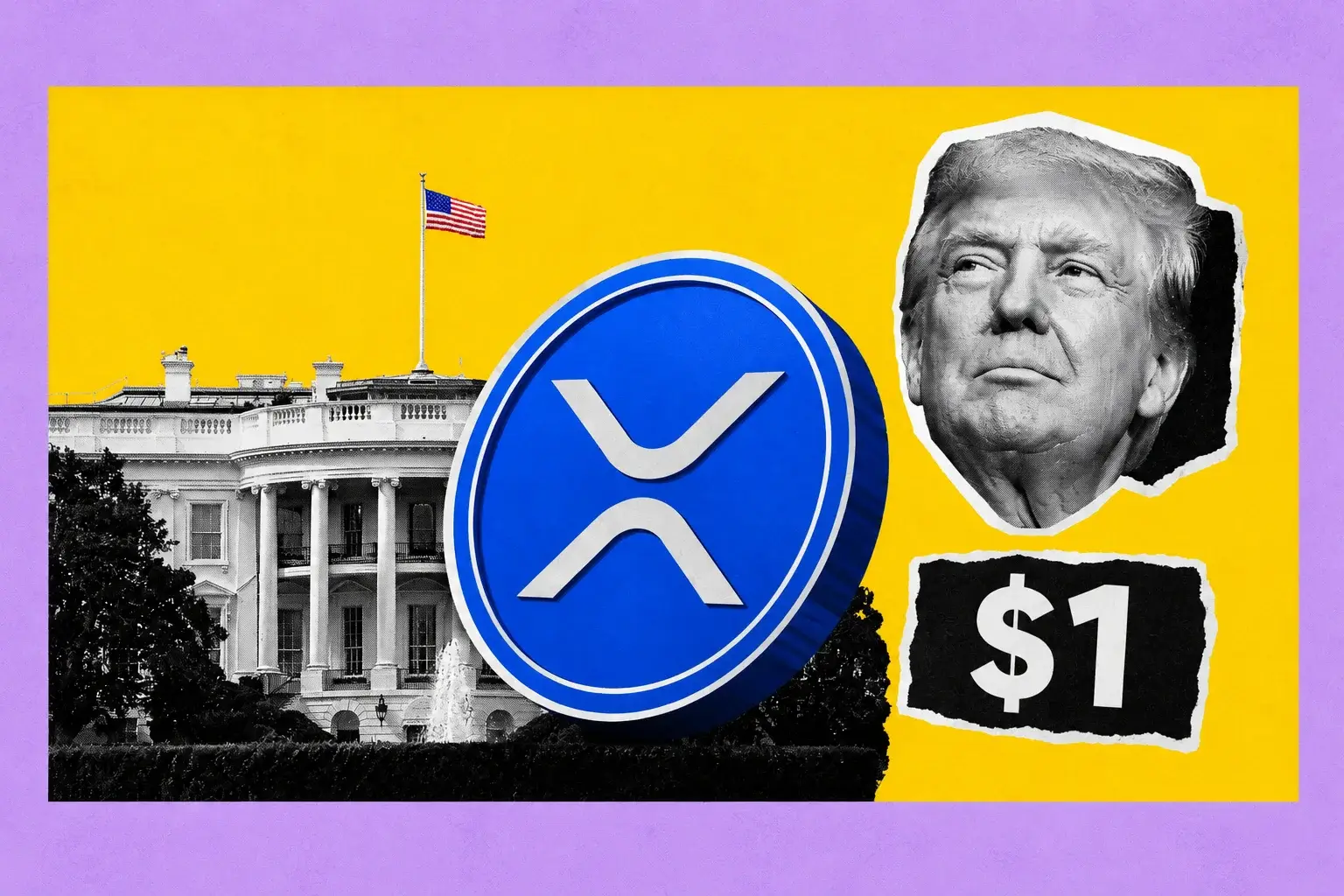


XRP Holds $0.967 After $0.894 Two-Year Low; Reclaiming $1.00 Opens a $1.105 Target
XRP holds $0.967; a close above $0.979 opens $1.105 | That’s TradingNEWS
Key Points
- XRP fell to $0.894 on Nov. 15, its lowest since mid-November 2024, and has not reclaimed $1.00.
- US spot XRP ETFs lost $19.13M in the week to Nov. 13, the weakest week in eight months.
- Ripple’s next escrow release of up to 1B XRP lands Dec. 1 after 300M stayed free in November.
XRP is trading at $0.967 on Tuesday, up 0.57% over 24 hours, inside a daily range of $0.9416 to $0.976. Market capitalization sits at $60.5 billion on 63.5 billion tokens in circulation, which keeps XRP sixth among digital assets. Twenty-four-hour trading volume across venues runs at $1.92 billion.
Monday closed at $0.95446, down 1.99%, after a session range of $0.94005 to $0.97648. Over seven days XRP is down 12.4%, and the week that ended on Sunday was worse, with losses of 13% to 17% depending on the measure. A month ago, one XRP was worth $1.31. Today it is down 26.5% from that level. XRP started November near $1.30.
The breakdown has a clear sequence. XRP closed at $1.11 on November 8, a 30-day low. On November 9 buyers stepped in at $1.07, its lowest since August. XRP closed November 12 at $1.04 and printed $1.04 again at 13:00 UTC on November 13 before sliding through $1 for the first time since August, to an intraday low of $0.9963. On November 14, it broke $1 on a closing basis and traded at $0.9869. Over the weekend, the overnight low reached $0.894 on November 15, a two-year low and the weakest level since mid-November 2024. XRP has not reclaimed $1.00 since.
The scale of the drawdown is severe. XRP’s record high of $3.65 came in July 2025. At $0.967, the token sits 74% below that peak. Over the first year of US spot XRP ETFs, which launched on November 13, 2025, XRP fell 60%.
The thesis for this forecast is narrow. XRP lost the $1 floor that held for six weeks because the ETF bid disappeared and leveraged longs were forced out, not because of anything specific to Ripple. Every factor documented in the breakdown is market-wide. That leaves XRP extremely oversold, with the daily relative strength index at levels as low as 16, sitting on the lower Bollinger Band, while on-chain activity is rising and the largest holders are not sending tokens to exchanges. The obstacle is the December 1 escrow release and a second straight week of ETF outflows. XRP is stuck between an oversold floor and an overhead supply problem.
The levels define the trade. Support sits at $0.94005, Monday’s low, then $0.89943, the lower Bollinger Band, $0.894, the weekend low, and $0.89112, below which a fresh 90-session low would be confirmed. Resistance sits at $0.97914, Sunday’s high, then $0.984, $1.00 and $1.00316. The upside target is $1.105, which requires a daily close above $0.97914 and then a reclaim of $1.00 to come into play. From $0.967, that is a 14.3% move.
Spot XRP ETFs: $19.13 Million Out in the Weakest Week in Eight Months
The ETF channel is the clearest reason XRP lost the $1 floor. US spot XRP exchange-traded funds recorded $19.13 million in net outflows during the November 9 to 13 trading week, the second straight weekly outflow and the weakest week for the products in eight months. The week before had zero inflow days, with the funds reporting zero net flows on November 3, 4, 5 and 6.
The daily breakdown shows where the selling came from. On November 9, the funds lost $10.42 million, with $9.4 million coming from Bitwise. On November 10, they lost $7.62 million. November 11 and 12 saw no net change. On November 13, the funds lost $1.09 million.
The fund-level picture is concentrated. Grayscale’s XRP Trust, GXRP, posted the largest weekly outflow at $12.71 million, two-thirds of the total. Bitwise’s XRP ETF lost $9.40 million. Franklin Templeton’s XRPZ was the lone bright spot, taking in $4.45 million. Franklin’s fund held 293.1 million XRP worth $439.7 million at the end of September.
The cumulative numbers remain positive. Since launch, US spot XRP ETFs have taken in $1.79 billion in net inflows. Combined net assets stand at $1.15 billion, with a net-asset ratio of 1.77% of XRP’s market capitalization. In their first year, the funds bought 1.16 billion XRP tokens, equal to less than 1.6% of circulating supply.
That first-year anniversary carries an uncomfortable message. The first US spot product holding only XRP, Canary Capital’s XRPC, opened for trading on November 13, 2025. The funds have bought steadily since then, but XRP fell 60% over the same period. November 2026 has produced net outflows of $19.66 million in its first two weeks, the first negative month for the category.
Bitwise’s fund illustrates the price impact. At September 30, it held 413.14 million XRP with a market value of $616.06 million, based on a reference price of $1.4912. At $0.967, the same holding is worth $399.5 million, a 35% decline in seven weeks.
For the forecast, the ETF tape is the most important demand signal for XRP. A return to daily inflows of $5 million or more for three sessions would show that institutional allocators are buying the dip below $1, and would give XRP a reason to push through $0.97914 and reclaim $1.00. Continued outflows would keep the $0.894 low in play. With ETF holdings at just 1.6% of supply, the funds are not large enough to move XRP on their own, but they are the clearest read on institutional appetite.
The December 1 Escrow Release: 1 Billion XRP and the 300 Million Already Free
XRP carries a supply overhang that Bitcoin and Ether do not. Ripple holds a large share of the XRP supply in escrow, and it releases up to 1 billion XRP from escrow at the start of each month. The next release comes on December 1, 2026, when up to 1 billion XRP from four escrow objects becomes releasable.
The November release shows how the mechanism works. On November 1, 1 billion XRP was released. Ripple relocked 700 million XRP in a new escrow, leaving 300 million XRP free. That 300 million represents potential supply that Ripple can sell into the market, use for operations or hold.
The pattern of relocking most of each monthly release has been in place for years. Ripple typically returns the bulk of each billion to escrow and uses the remainder for operations and strategic purposes. But the market treats each release date as an event risk, especially when price is weak and buyers are scarce.
The December 1 date matters more than usual this month. With XRP below $1, the ETFs posting outflows and leveraged longs flushed, the market has limited capacity to absorb new supply. If Ripple keeps more than 300 million XRP free in December, it would add to the supply pressure at exactly the wrong time.
Ripple’s business model adds context. The company has built a dollar-backed stablecoin, RLUSD, which allows Ripple to expand its payments business while XRP buying stays thin. That decoupling means Ripple’s corporate success does not automatically translate into demand for the XRP token. Investors who bought XRP as a proxy for Ripple’s growth have had to adjust to that reality.
The escrow overhang is also a known quantity. Every holder of XRP knows the release schedule, and the market prices it in advance. The risk is not the release itself but the share that stays free. A December relock of 700 million or more, matching November, would be a neutral outcome. A relock of less would be read as bearish.
For the forecast, the December 1 escrow release is the main scheduled supply event over the next two weeks. It caps the upside of any relief rally, because traders will be reluctant to chase XRP higher ahead of a known supply date. A move to the $1.105 target would most likely come before the release, with the risk of a pullback afterward if Ripple keeps more tokens free than in November.
The Leverage Flush: $27 Million Liquidated, 97% of It Longs
The break below $1 was driven by forced selling. XRP fell below $1 on November 13 for the first time since August because leveraged long positions were force-closed. A $20.75 million liquidation wave hit XRP that day, with long traders absorbing most of it. After Bitcoin fell below $67,000, $27 million in XRP futures were liquidated within 24 hours, and 97% of those were long positions. Across the move, 94% of liquidations hit longs.
The open interest data shows how the leverage unwound. On November 13, dollar-denominated XRP futures open interest declined 2.19% to $2.25 billion over 24 hours. Adjusting that figure for the price decline suggests a relatively small reduction in actual positioning. In other words, part of the drop in open interest came from lower prices rather than from traders closing positions.
That distinction matters for the forecast. If positioning did not fall much, there are still leveraged longs in the market that could be forced out if XRP breaks lower. That is the bear risk: a second leg down triggered by the remaining long exposure.
The weekend added to the forced selling. Some cbXRP-backed loans on the Morpho lending protocol were forcibly unwound over the weekend. That shows how XRP’s decline spread into decentralized finance, where loans collateralized by wrapped XRP were liquidated as the collateral value fell.
The broader crypto market saw a much larger flush. Across all digital assets, weekend liquidations topped $2 billion, mostly long positions in Bitcoin and Ether, as Bitcoin fell to $62,029 and Ether to $1,711. XRP’s $27 million in liquidations was small by comparison, which reflects its smaller derivatives market relative to Bitcoin and Ether.
The rebound from $0.894 to the $0.95 to $0.97 area came after the forced selling ended. As with Bitcoin and Ether, the bounce appears to be driven by shorts closing and dip buyers stepping in rather than by new institutional demand.
The speed of the break shows how much leverage sat around the $1 level. Over the previous month, $1 had acted as a strong support level, with the lowest daily close at $1.01. When that floor gave way, stops below $1 triggered in clusters, and the August low at $0.99, the first support below the round number, broke almost immediately.
For the forecast, the leverage data cuts both ways. The 97% long share of liquidations shows that the weekend flush cleared out the most vulnerable positions. But the relatively small reduction in real positioning means some leverage remains. A break below $0.89112 would likely trigger a second wave of long liquidations and accelerate the move toward $0.85 and $0.77.
Whales and On-Chain Activity: 240 Million XRP Moved, None to an Exchange
The on-chain data offers the most constructive signals in the XRP market right now. During the hour of the weekend low on November 15, 240 million XRP moved in two transfers of 120 million each, seven minutes apart. At the low, the transfer was worth $214 million.
The route matters more than the size. The tokens moved from an unlabelled address to an intermediate address and then to a third address. Ledger explorers say none of the three addresses belongs to an exchange or to Ripple’s escrow, and whale trackers classified the move as a reshuffle rather than a sale. The 240 million XRP represents just under 0.4% of the 63.5 billion XRP in circulation.
That is important because large transfers at the bottom of a sell-off often go to exchanges for sale. This one did not. A whale moving $214 million of XRP between private wallets during the low is the opposite of capitulation.
The broader exchange-flow picture is less clear. The 50-day average of large-holder transfers to exchanges rose 93% between August 16 and November 12, from 12,315 to 23,816. That is a meaningful increase in whale deposits to exchanges over the past three months, which helps explain the sustained selling pressure. The annual average sits at 23,834, so the current rate matches the long-term norm rather than signaling an extreme.
Network activity has surged. Active accounts on the XRP Ledger rose 154.5% to 42,300. Payment volume rose 140% to 1.1 billion XRP. Neither figure is a record, but both show a sharp increase in usage during the sell-off. Rising activity during a price decline can reflect panic transfers, but it can also reflect accumulation and repositioning.
The combination is mixed but leaning constructive. Whales were depositing more XRP to exchanges through the autumn, which fed the decline from $1.30 to $1. But at the low, the largest single movement did not go to an exchange, and network activity rose sharply. That pattern is consistent with a market where weak hands have sold and stronger hands are repositioning.
For the forecast, the on-chain data supports the view that the $0.894 low could hold. If large holders continue moving XRP into private wallets rather than exchanges, the supply available for sale shrinks, and a relief rally toward $1.00 becomes more likely. A spike in large-holder exchange deposits would be the clearest warning that another leg lower is coming.
Technical Map: Lower Bollinger Band at $0.89943, Midpoint at $1.14466
The XRP daily chart shows a token pinned to the bottom of its volatility envelope. On the daily chart, using a 20-day simple moving average with two standard deviations, the upper Bollinger Band sits at $1.38988, the midpoint at $1.14466 and falling, and the lower band at $0.89943. XRP closed Monday above the lower band but well below the midpoint.
The 20-day average sits around $1.16, 20% above the current price. That gap shows how far XRP has fallen from its short-term trend in just three weeks.
Momentum is deeply oversold. The daily relative strength index has fallen to readings as low as 16, with other measures putting it at 20 and 26. Any reading below 30 is considered oversold, and readings below 20 are rare.
The four-hour chart shows the first sign of stabilization. On the four-hour timeframe, the upper Bollinger Band sits at $1.00316 and the midpoint at $0.96450. The latest four-hour candle closed at $0.96658, just above that midpoint. That puts XRP back in the upper half of its short-term range for the first time since the break below $1.
Support is layered tightly. The first support is $0.94005, Monday’s low. A close below it would expose the lower-band area. The daily lower Bollinger Band at $0.89943 is next, followed by the $0.894 weekend low. A loss of $0.89112 would invalidate the rebound and confirm a fresh 90-session low. Below that, analysts point to $0.85, $0.77 and $0.70. The closest historical support below those is 63 cents from late 2023.
Resistance is equally clear. A daily close above $0.97914 would clear Sunday’s high. Above that, $0.984 was the 24-hour high after the weekend low. The $1.00 level, broken on November 14, is the key psychological barrier. The four-hour upper band sits at $1.00316. If the $0.97914 breakout holds, the target is $1.10473. Above that, the daily midpoint at $1.14466, the 20-day average near $1.16 and the $1.20 recovery level come next.
The longer-term reference points matter too. XRP closed at $1.04 on June 25 and again on November 12, which makes $1.04 the top of a range that held for five months. The August low at $0.99 was the first support below $1, and it has now flipped to resistance along with the round number. A reclaim of $1.04 would put XRP back inside that five-month range.
For the forecast, $0.97914 is the trigger and $1.105 is the target. A daily close above $0.97914, followed by a reclaim of $1.00, would confirm that the break below $1 was a capitulation flush and open the path to $1.105. A daily close below $0.89112 would confirm a new leg lower toward $0.85.
Macro Backdrop: 97.4% Fed Hike Odds, a Strong Dollar and Nvidia Tonight
XRP trades as a high-beta risk asset, and the macro backdrop has turned against it. The Federal Reserve raised its target range to 3.75% to 4.00% in September, and fed funds futures now price a 97.4% probability of another 25 basis point hike in December. The 10-year Treasury yield sits at 5.12%. The dollar index touched 103.70, a 19-month high, before pausing on Tuesday.
This morning’s US retail sales report added to the pressure. Headline October sales rose 0.2%, in line with expectations, but the control group rose 0.6% against a 0.4% forecast. That keeps the Fed on track to hike and supports higher yields, which weigh on non-yielding digital assets.
The broader crypto market sets the tone for XRP. Bitcoin trades near $64,853 after falling to $62,029 over the weekend, its weakest level since July, and has closed six straight weeks in the red. Ether trades near $1,830 after a $1,711 low. Total crypto market capitalization stands at $2.19 trillion. The Crypto Fear and Greed Index reads 12, deep in extreme fear.
XRP is not alone among payment-focused tokens. Stellar’s XLM hovers around $0.137 after slipping to a two-year low at $0.130 on Saturday. Both tokens are being sold as part of a broad risk-off move rather than on project-specific news.
The equity market adds pressure. On Monday, the Nasdaq Composite fell 2.49% into correction territory and the S&P 500 dropped 1.92%. Nvidia fell 4.12% ahead of its earnings report after today’s bell. AI stocks and crypto draw on the same pool of risk capital, and when that pool shrinks, both get sold.
Tonight’s Nvidia report is the biggest event risk of the week for XRP. Consensus calls for $109.15 billion in revenue and $2.47 in earnings per share, with options pricing an 8% move. A strong report would ease pressure across risk assets and give XRP room to push through $0.97914. A weak report would trigger another wave of risk-off selling, and XRP would take that hit in the overnight session.
Wednesday brings the Fed minutes at 2:00 p.m. Eastern. Hawkish minutes would strengthen the dollar and push XRP back toward $0.94005. Minutes that show debate about a pause after December would ease rate pressure and support a relief rally.
For the forecast, the macro backdrop caps XRP’s upside until rates or risk sentiment turn. XRP will not reclaim $1.105 on its own fundamentals while Bitcoin is falling and the Fed is hiking. It needs the broader crypto market to stabilize first.
Read More
-
Yen Stalls at 160 Despite a 3% JGB and Tokyo Core CPI at 2.0% — Intervention Sits at 164, Friday's Payrolls Decide
02.09.2026 · TradingNEWS ArchiveEnergy
-
Nike Jumps 4% as Investor Day Targets $3.00-$3.50 EPS by 2031; $40.80 Target in Sight
17.11.2026 · TradingNEWS ArchiveStocks
-
Ethereum Holds $1,830 After $1,711 Flush; Reclaiming $1,933 Opens $1,982 Target
17.11.2026 · TradingNEWS ArchiveCrypto
-
Brent Holds $92.61, WTI $85.73 on IEA Surplus; Reclaiming Friday Opens $95.84 and $88.56
17.11.2026 · TradingNEWS ArchiveCommodities
-
Stock Market Today: Nasdaq IXIC in Correction, S&P 500 SPX Eyes 7,560 as Dow DJI Waits on NVDA
17.11.2026 · TradingNEWS ArchiveMarkets
-
GBP/USD Holds 1.3190 Above 2026 Low as UK Jobless Rate Hits 4.6%; 1.3252 Break Opens 1.3300
17.11.2026 · TradingNEWS ArchiveForex
XRP Against Bitcoin and Ether: Underperforming Into the Low, Leading Off It
XRP’s relative performance tells a two-part story. Into the low, XRP underperformed. Off the low, it has started to lead.
The underperformance is clear on longer timeframes. XRP is down 26.5% over 30 days, compared with 21.02% for Bitcoin and 25.8% for Ether. It is 74% below its July 2025 record of $3.65, compared with 63% for Ether below its all-time high. XRP has lost more ground than either of the two largest digital assets over the past month.
The divergence came from the ETF channel and the loss of the $1 level. Bitcoin and Ether had their own ETF outflows, but XRP’s ETF base is much smaller relative to its market capitalization, which means each dollar of outflow matters more. And the $1 level carried psychological weight that has no equivalent for Bitcoin or Ether.
The recovery has been more even. On Tuesday, XRP is up 0.57% over 24 hours, compared with 0.54% for Bitcoin and 0.89% for Ether. Over the past session, XRP has moved in line with the rest of the large-cap complex.
The ETF comparison is instructive. Bitcoin ETFs lost $1.065 billion in the week of November 9 to 13, and Ether ETFs lost $398.9 million. XRP ETFs lost $19.13 million. In absolute terms, XRP’s outflows were tiny. But relative to the size of the funds, $19.13 million is 1.7% of XRP ETF assets, a meaningful share for a single week.
XRP’s role in the crypto market is different from Bitcoin’s or Ether’s. It is primarily held by retail investors and payment-focused institutions rather than by macro funds and DeFi users. That makes XRP more sensitive to retail sentiment, which is why fading retail participation has been cited as a factor in its decline below $1.
The ETF retreat is market-wide. Across five crypto ETF groups, weekly outflows totaled $1.53 billion in the November 9 to 13 week, with Bitcoin funds alone losing $1.065 billion. Bitcoin ETFs posted a $7.9 million inflow on Monday, their first in eight sessions, while Ether funds lost another $8.4 million. XRP’s own Monday flows will be the first test of whether the category has stopped bleeding.
For the forecast, XRP’s relative performance is a confirming indicator. If XRP starts outperforming Bitcoin and Ether on the bounce, it would signal that the selling specific to XRP has been exhausted and that the token is ready to recover the $1 level. If it continues to lag, the decline is likely to extend.
Ripple’s Business and the XRP Disconnect
Investors often treat XRP as a proxy for Ripple, the company that created it. The 2026 sell-off has exposed how loose that link has become.
Ripple has continued to expand its business. Its RLUSD stablecoin is backed by dollars, which allows Ripple to grow its payments and settlement business without requiring XRP purchases. A bank using RLUSD for cross-border settlement does not need to buy XRP. That model is good for Ripple’s revenue but neutral for XRP demand.
The drop below $1 had nothing to do with Ripple. Every factor documented in the sell-off is market-wide, and there was no direct Ripple news behind the decline. The token fell because Bitcoin fell, ETFs saw outflows and leveraged longs were liquidated.
The escrow mechanism is the main direct link between Ripple and XRP supply. Ripple’s monthly release of up to 1 billion XRP, and its decision on how much to relock, directly affects how much XRP can enter the market. In November, Ripple kept 300 million XRP free.
Regulatory clarity has improved. US spot XRP ETFs have been trading for a full year, which reflects a much clearer regulatory status than XRP had during its long legal dispute with the SEC. In Europe, the MiCA regulation has applied since the end of 2024. That clarity removed a major overhang from the token, but it has not translated into sustained price gains.
The market capitalization tells the story of shifting valuation. XRP closed at $1.04 on June 25 with a market cap of $64.9 billion, and at the same price on November 12 with a market cap of $66.1 billion. That means the circulating supply grew between June and November, so buyers needed to invest more to hold the same price. Supply growth from escrow releases is a structural headwind.
The supply math is worth spelling out. A $64.9 billion market cap at $1.04 on June 25 implies 62.4 billion tokens in circulation. A $66.1 billion market cap at the same $1.04 price on November 12 implies 63.6 billion tokens. That is 1.2 billion additional XRP in circulation in under five months, which at $0.967 represents $1.16 billion of new supply. US spot ETFs bought 1.16 billion XRP in their entire first year. In other words, the ETFs have absorbed as much XRP in a year as escrow releases added to circulation in five months.
For the forecast, the disconnect between Ripple and XRP limits the upside from company-specific news. Ripple can announce partnerships and product launches, but unless those require XRP purchases, they will not move the token. The XRP price will continue to trade on crypto market sentiment, ETF flows and escrow decisions rather than on Ripple’s business success.
Bear Case: A Close Below $0.89112 Opens $0.85, $0.77 and $0.70
The bear case for XRP requires the current pressures to continue for a few more days. ETF outflows keep running, Bitcoin breaks below its $62,029 low, the Fed minutes lean hawkish and the December 1 escrow release adds supply.
The trigger sequence would likely start tonight. A weak Nvidia report would hit risk assets after the bell, and XRP would take the hit in the overnight session. A break below Monday’s $0.94005 low would put the lower Bollinger Band at $0.89943 in play.
From there, the $0.894 weekend low becomes the battleground. A daily close below $0.89112 would invalidate the rebound and confirm a fresh 90-session low. The remaining leveraged longs, which the open interest data suggests were not fully cleared, would be forced out.
That break would open the path to $0.85, a level flagged by several analysts. Below $0.85, the next support sits at $0.77, the lower bound from weekend analysis. Below that, $0.70 is the next key support. A move to $0.70 would represent a 27.6% decline from the current price. The closest historical support below that is 63 cents from late 2023.
The flow data would confirm the bear case. ETF outflows above $5 million a day for several sessions would show institutional selling accelerating. A spike in large-holder exchange deposits would show whales preparing to sell. A December escrow decision that keeps more than 300 million XRP free would add supply.
The bear case also has a structural element. XRP’s circulating supply grows with each escrow release, which means buyers need to invest more each month just to hold the same price. With ETF demand fading and retail participation weakening, that supply growth becomes a steady headwind.
The probability of a retest of $0.894 this week is meaningful. The probability of a sustained break below $0.89112 is lower, because the RSI is already at extreme oversold levels and the whale data shows large holders moving tokens away from exchanges. The most likely bearish outcome is a retest of $0.94005 to $0.89943 that holds.
For the forecast, the bear case target is $0.85 on a daily close below $0.89112, with $0.77 and $0.70 the extensions. The interim target on a weak Nvidia print is $0.94005 to $0.89943.
Bull Case: Close Above $0.97914, Reclaim $1.00, Then $1.105
The bull case for XRP rests on extreme oversold conditions and a stabilizing crypto market. With the daily RSI at readings as low as 16, XRP closing above its lower Bollinger Band and the four-hour chart back above its midpoint, the setup for a relief rally is in place.
The first step is immediate. XRP needs a daily close above $0.97914, which would clear Sunday’s high and the $0.97648 Monday high. That would confirm that the $0.894 weekend low held as a capitulation bottom.
The second step is the $1.00 level. XRP broke through $1.00 to the downside on November 14 and has not reclaimed it since. A daily close back above $1.00 and the four-hour upper band at $1.00316 would show that the break below $1 was a temporary flush rather than a lasting change in trend. Traders who sold below $1 would be forced to buy back.
The third step is the $1.105 target. If the $0.97914 breakout holds, the target is $1.10473. That level sits just above the $1.09 resistance flagged in weekend analysis and below the $1.12 level. A move from $0.967 to $1.105 would be a 14.3% gain.
The catalysts are lined up this week. A strong Nvidia report tonight would lift risk assets and reduce the rotation out of crypto. Fed minutes on Wednesday that show debate about a pause after December would ease rate pressure. A return to XRP ETF inflows would provide the institutional bid that has been missing for two weeks. A stabilization in Bitcoin above $65,000 would remove the main source of correlated selling.
The on-chain data adds support. Active accounts on the XRP Ledger rose 154.5% and payment volume rose 140%. The 240 million XRP whale transfer at the low went to private wallets, not exchanges. Franklin Templeton’s XRPZ took in $4.45 million in a week when the category lost $19.13 million, which shows that some institutional buyers are using the dip.
The timing favors a move before December 1. Traders will want to position ahead of the escrow release, and a relief rally to $1.105 is most likely in the window between now and the end of November.
Beyond $1.105, the next resistance levels sit at $1.12, the daily Bollinger midpoint at $1.14466, the 20-day average near $1.16 and $1.20. A move above $1.20 would require a broader recovery in crypto and a return to sustained ETF inflows.
For the forecast, the bull case is the less likely path this week but the one with the sharper move. XRP is as oversold as it has been in years. A single positive catalyst could trigger a fast move through $1.00 toward $1.105.
XRP Price Forecast Verdict: Range $0.894 to $1.00, Upside Target $1.105
XRP enters the Nvidia print at $0.967, up 0.57% on the day, after a week that took it from $1.11 on November 8 through the $1 floor to a $0.894 low on November 15, its weakest level since mid-November 2024. The token is down 12.4% over seven days, 26.5% over 30 days and 74% below its July 2025 record of $3.65. Monday closed at $0.95446, inside a $0.94005 to $0.97648 range.
The demand picture is weak. US spot XRP ETFs lost $19.13 million in the week of November 9 to 13, their second straight weekly outflow and the weakest week in eight months. Grayscale’s GXRP lost $12.71 million and Bitwise lost $9.40 million, while Franklin’s XRPZ added $4.45 million. Cumulative inflows stand at $1.79 billion, with $1.15 billion in assets. Ripple’s December 1 escrow release of up to 1 billion XRP adds a known supply overhang, after Ripple kept 300 million XRP free from the November release.
The supply and momentum picture is more constructive. The daily RSI has fallen to readings as low as 16, deep in oversold territory. XRP is holding above its lower Bollinger Band at $0.89943. The four-hour chart has moved back above its $0.96450 midpoint. A 240 million XRP whale transfer at the low went to private wallets rather than exchanges. Active ledger accounts rose 154.5% to 42,300, and payment volume rose 140% to 1.1 billion XRP. Leveraged longs took 97% of the $27 million in recent liquidations.
The verdict is neutral with a constructive near-term bias. Expect XRP to range between $0.894 and $1.00 through the Fed minutes on Wednesday, with tonight’s Nvidia report setting the first direction. A strong Nvidia print, a return to ETF inflows and a daily close above $0.97914 would open a reclaim of $1.00 and the $1.105 upside target before the December 1 escrow release. A weak Nvidia reaction, continued ETF outflows and a daily close below $0.89112 would confirm a fresh 90-session low and open $0.85 and $0.77. With the RSI at extreme oversold levels, leveraged longs flushed and whales moving tokens away from exchanges, the risk-reward favors buyers on dips into $0.94005 to $0.89943, with a stop below $0.89112 and $1.105 as the target.