Alibaba at $129 Is a J-Curve Bet — AI Spending Is Crushing Earnings Today While Cloud Rips 40% Toward a $100 Billion Prize
BABA trades at 14.4x forward with $41 billion in net cash as a $56 billion AI capex program tanks near-term profit | That's TradingNEWS
Key Points
- BABA trades near $129 at 14.4x forward earnings; FY2026 net income fell 18% and Q4 group EBITA dropped 84% on the $56B AI/cloud capex.
- Cloud revenue grew 40% with triple-digit AI growth for an 11th straight quarter; management targets $100B+ annual cloud/AI revenue in 5 years.
- The Strong Buy consensus targets $191 (~48% upside) with $41B net cash; the recent-lows base and August earnings define the J-curve bet.
Alibaba shares sit near $129, trading close to recent lows with a weak technical picture, down roughly 15% over the past 90 days and about 20% below the October 2025 high of $193. The Chinese e-commerce and cloud giant carries a market cap above $200 billion and a Strong Buy consensus from 41 analysts with an average price target of $191.48 — implying roughly 48% upside from current levels. That gap between a depressed price and a bullish Street is the entire story.
The disconnect is rooted in a single number: BABA trades at just 14.4 times forward earnings. For a company growing its cloud business at 40%, posting triple-digit AI revenue growth for the eleventh consecutive quarter, sitting on $41 billion in net cash, and being named a top China pick by Goldman Sachs and a fresh buy by Michael Burry, that is a remarkably cheap multiple. The market is pricing Alibaba like a struggling legacy retailer while the company transforms into China's leading AI-infrastructure provider.
The thesis here is that the market is selling Alibaba's investment phase and ignoring its cloud inflection. The reason the stock sits near lows despite 40% cloud growth is that the heavy AI and cloud capex is crushing current earnings and free cash flow — net income fell 18% in fiscal 2026, group adjusted EBITA collapsed 84% in the latest quarter, and free cash flow swung to a multibillion-renminbi outflow. BABA is paying for the future with the present, and the market hates the present.
This is a J-curve bet. Alibaba is committing RMB380 billion — roughly $56 billion — over three years to build the AI and cloud infrastructure layer for China's economy, targeting more than $100 billion in annual external cloud and AI revenue within five years. The spend depresses earnings now in exchange for a much larger revenue base later. The bulls are betting the spend pays off; the bears are pointing at the collapsing margins and the China macro. The stock at 14.4x forward is the market's skepticism about whether the J-curve bends back up.
The catalysts are layered. The cloud-margin inflection that management has guided for, the August fiscal first-quarter earnings that will show whether the AI revenue ramp is on track, and the broader China stimulus picture all feed the debate. With smart money like Burry accumulating near lows and the Street targeting $191, BABA is a contrarian AI play trading at a fraction of its US peers' multiples — if the cloud inflection is real, the gap closes; if the spend is a black hole, the value-trap bears win.
The J-Curve: Why Earnings Fell as Cloud Soared
The defining feature of Alibaba's current financials is a paradox: the business is investing aggressively into its fastest-growing, highest-potential segment, and the result has been collapsing near-term profitability. Fiscal 2026 revenue rose to CN¥1.02 trillion, up just 2.7%, but net income fell 18% to CN¥105.9 billion, EPS dropped to CN¥45.63 from CN¥55.12, and the profit margin compressed to 10% from 13%. On the headline numbers, this looks like a company in decline.
The quarterly detail is even starker, and it is the heart of the J-curve. In the quarter ended March 31, group adjusted EBITA fell 84% year over year to RMB5,102 million, and free cash flow swung to an outflow of RMB17,300 million — a dramatic reversal for a company that historically generated enormous cash. That is not the profile of a failing business; it is the profile of a business deliberately sacrificing current profit to fund a massive build-out. The spending hit the income statement hard, and the market punished the stock.
The drivers of the margin collapse are all forward investments. Alibaba funneled spending into cloud infrastructure, quick commerce, and Qwen app user acquisition — three areas that cost money today in pursuit of revenue tomorrow. Building data centers, subsidizing quick-commerce delivery to gain share, and acquiring users for its consumer AI app are all classic J-curve investments: they depress current earnings and cash flow while building the foundation for future growth. The 84% EBITA decline is the cost of the bet, not evidence the bet is failing.
The market's reaction reflects its skepticism about the J-curve. Investors looking at an 18% net-income decline, an 84% EBITA collapse, and a free-cash-flow outflow see a company spending heavily with uncertain returns, and they have marked the stock down to near recent lows. The bear reads this as value destruction — money pouring into capex with no guarantee of payoff. The bull reads it as a temporary trough that precedes a much larger earnings base once the investments mature. The 14.4x forward multiple sits right in the middle of that debate.
For the forecast, the J-curve is the central question. If Alibaba's AI and cloud investments convert into the revenue and margin expansion management has guided for, the current earnings trough is the bottom of the J, and the stock re-rates higher as profitability recovers. If the spend fails to generate adequate returns — if the cloud growth slows or the AI monetization disappoints — the earnings stay depressed and the stock stays cheap. The entire investment case rests on whether the J-curve bends back up, and the proof points come with each quarterly report showing whether the cloud engine is scaling profitably.
The Cloud Engine: 40% Growth and the AI Flywheel
The reason to look past the depressed earnings is the cloud engine, which is accelerating in exactly the way the bull case requires. Alibaba's Cloud Intelligence Group posted revenue of RMB41,626 million — about US$6 billion — in the quarter ended March 31, up 38% year over year, with external-customer revenue growing an even faster 40%. For the full fiscal year, cloud revenue reached RMB158,132 million, roughly US$23 billion, up 34%. This is the segment management is betting the company's future on, and it is inflecting higher.
The AI flywheel is the engine within the engine. AI-related product revenue posted triple-digit growth for the eleventh consecutive quarter, reaching roughly RMB8,971 million in the latest period. Eleven straight quarters of triple-digit AI growth is not a flash in the pan — it is a sustained, compounding trend driven by the increasing adoption of Alibaba's AI products on its cloud platform. As enterprises adopt Alibaba's Qwen models and AI services, they consume more cloud compute, which drives cloud revenue, which funds more AI development — the flywheel that the capex is designed to spin.
The margin trajectory is the key forward signal. Cloud adjusted EBITA rose 35% in fiscal 2026 to RMB14,265 million, showing that even amid heavy investment, the cloud segment itself is profitable and growing its profit. Management has guided that Alibaba Cloud's gross margin should improve meaningfully over the next two to three years as AI-related workloads scale. That margin inflection is the catalyst the bulls are waiting for — the point at which the cloud business not only grows fast but converts that growth into expanding profitability.
The monetization guidance is concrete and aggressive. Management expects AI-related product revenue to cross 50% of the Cloud Intelligence Group's external revenue within roughly a year, model and application services annualized recurring revenue to surpass RMB10 billion in the June quarter and RMB30 billion by year-end, and the company targets more than $100 billion in annual external cloud and AI revenue within five years. Those are specific, time-bound targets that give the market something to measure against — and hitting them would validate the entire J-curve thesis.
For the forecast, the cloud engine is the bull case made tangible. Forty percent external growth, eleven quarters of triple-digit AI revenue, a profitable and growing cloud EBITA, and a clear path to AI dominating cloud revenue together make a compelling argument that Alibaba is transforming from a sluggish e-commerce company into a high-growth AI-infrastructure provider. The market is not yet paying for that transformation at 14.4x forward, which is the opportunity if the cloud trajectory holds. The cloud engine is why the bulls look past the earnings trough, and its continued acceleration is the single most important thing to watch.
The $56 Billion Bet: Capex Now, Returns Later
The scale of Alibaba's AI ambition is best captured by its capital-expenditure commitment, which is enormous and front-loaded. The company is investing RMB380 billion — roughly $56 billion — over three years, from fiscal 2026 through fiscal 2028, in cloud and AI infrastructure. That is one of the largest capex programs in Chinese technology, and it is the direct cause of the depressed near-term earnings and the free-cash-flow outflow. Alibaba is building the physical and computational backbone for China's AI economy, and it is paying for it now.
The strategic logic is to own the infrastructure layer. By spending tens of billions on data centers, chips, and compute capacity, Alibaba positions itself as the indispensable provider of AI infrastructure in China — the equivalent of an AWS or Azure for the Chinese AI economy. If China's AI buildout follows anything like the trajectory of the US, the company that owns the cloud and compute layer captures enormous, durable, high-margin revenue. The $56 billion is a land grab for that position, made while the opportunity is still being defined.
The government subsidy is a meaningful offset that the market underappreciates. Chinese government energy subsidies cover up to 50% of qualifying data-center costs, which dramatically reduces the financial burden of the capex program. A $56 billion build-out where the government effectively subsidizes half the energy costs is far less risky to Alibaba's balance sheet than the headline number suggests. That subsidy is a structural advantage Chinese cloud providers have over their US counterparts, and it improves the return profile of the entire investment.
The return target frames the payoff. Management is targeting more than $100 billion in annual external cloud and AI revenue within five years — against the current cloud run-rate of roughly $23 billion. That is a more than fourfold increase, and it is the prize the $56 billion is meant to unlock. If Alibaba hits even a fraction of that target, the current capex looks like a bargain in hindsight; if the AI demand fails to materialize, the spend becomes a drag with no payoff. The bet is binary in its logic: massive spend for a massive prize, or a black hole.
For the forecast, the $56 billion bet is the source of both the risk and the opportunity. It is why earnings and cash flow are depressed today, and it is why the cloud revenue could quadruple over five years. The market is currently weighting the near-term cost more than the long-term prize, which is why the stock sits at 14.4x forward near recent lows. The bulls argue the spend is a generational opportunity with government subsidies de-risking it; the bears worry it is capital destruction in a slowing economy. The proof comes as the cloud revenue ramps against the capex — and the early quarters will set the tone.
Qwen, Robots, and Chips: The Full AI Stack
What separates Alibaba from a pure cloud-capacity play is that it is building the entire AI stack — models, applications, robotics, and even chips — which gives it multiple ways to win. The foundation is the Qwen model family, one of the most widely deployed open-source AI ecosystems globally. The February 2026 release of Qwen 3.5 improved performance while lowering operating costs, and the newer Qwen3.6-Plus delivered notable gains in coding and agentic programming. The open-source approach drives enterprise adoption, which drives demand for Alibaba Cloud infrastructure — the flywheel again.
The robotics push is the newest frontier. Alibaba unveiled the Qwen-Robot Suite, a trio of foundation models — Qwen-RobotNav for navigation, Qwen-RobotManip for manipulation, and Qwen-RobotWorld for predictive world-modeling — developed by its Tongyi Lab to give machines physical-control capabilities. The suite is already in pilot testing with select Alibaba Cloud enterprise clients, marking a tangible step from research into commercial deployment. Robotics is a massive potential market, and Alibaba is positioning Qwen as the operating system for the emerging robot economy.
The chip dimension is the most strategically significant and most overlooked. Alibaba's T-Head chip-design unit has deployed over 100,000 proprietary Zhenwu processing units on Alibaba Cloud's public platform, with more than 30 automakers and autonomous-driving companies using them for intelligent-driving development. In a world where China faces restrictions on access to US AI chips, Alibaba designing and deploying its own processors at scale is a critical strategic advantage — it reduces dependence on foreign hardware and creates another layer of vertical integration in the AI stack.
The vision is expansive. Chairman Joe Tsai has argued that AI could ultimately represent a $50 trillion market, framing Alibaba's "all in" AI strategy as a bet on one of the largest economic opportunities in history. Whether or not that figure proves accurate, it signals the conviction behind the capex program and the scope of the ambition. Alibaba is not making an incremental cloud investment — it is betting the company on becoming the dominant AI infrastructure and application provider for the world's second-largest economy.
For the forecast, the full-stack AI strategy is what gives the bull case its asymmetry. By owning models, applications, robotics, and chips, Alibaba has multiple shots at monetizing the AI boom, and each layer reinforces the others through the cloud flywheel. The market is paying 14.4x forward for a company building all of this, which is the disconnect the bulls are exploiting. The robotics and chip initiatives are early and unproven, but they represent optionality that the depressed multiple is not pricing. If even one layer breaks out, the stock re-rates; if the whole stack scales, the upside is far beyond the $191 target.
The E-Commerce Anchor: 65% of Revenue, Sluggish
For all the AI excitement, the reality is that e-commerce still represents roughly 65% of Alibaba's revenue, and that core business is sluggish — a fact that anchors the stock and tempers the bull case. The domestic retail marketplaces that built Alibaba into a $200 billion company are growing slowly, weighed down by a weak Chinese consumer recovery and intense competition. The AI story is the future; e-commerce is the present, and the present is soft.
The Chinese consumer is the problem. China set its 2026 GDP growth target at 4.5% to 5% — the lowest in decades — and a weak consumer recovery has pressured discretionary spending, the lifeblood of Alibaba's retail marketplaces. With nearly two-thirds of revenue tied to a business dependent on Chinese consumer health, Alibaba's top line is hostage to a macroeconomy that Beijing itself is signaling will grow at its slowest pace in a generation. That is a structural headwind that no amount of AI investment fully offsets in the near term.
The quick-commerce push is the response, and it is part of the cost problem. Alibaba has invested heavily in quick commerce — rapid delivery to compete with rivals — which has weighed on margins and cash flow. Management guided that quick-commerce unit economics are expected to turn positive only by the end of fiscal 2027, meaning this is another area of investment-now, returns-later that is currently depressing profitability. The quick-commerce spend is part of why group EBITA collapsed, and it is a bet on defending market share in a competitive retail landscape.
The international commerce business is a bright spot within the e-commerce complex. Alibaba International Digital Commerce Group narrowed its adjusted EBITA loss dramatically — to RMB138 million from RMB3,574 million a year earlier — driven by significant improvement in AliExpress's operating efficiency. Global platforms including AliExpress, Lazada, and Trendyol continue expanding outside China, offering a growth avenue less dependent on the domestic consumer. The international turn toward profitability is an underappreciated positive within an otherwise sluggish e-commerce picture.
For the forecast, the e-commerce anchor is the weight that keeps the stock cheap and tempers the AI optimism. As long as 65% of revenue grows slowly in a weak Chinese economy, Alibaba's consolidated growth stays modest, and the stock cannot fully re-rate on the cloud story alone. The bull case requires the cloud and AI segments to grow large enough to overcome the e-commerce drag and shift the company's growth profile — which takes time. The e-commerce anchor is why BABA is a transition story rather than a clean growth story, and why patience is required even if the cloud thesis is right.
The Valuation Disconnect: 14.4x Forward vs the Growth
The valuation is the crux of the bull case, and the disconnect is stark. BABA trades at just 14.4 times forward earnings — a fraction of the multiples commanded by comparable US technology companies, many of which trade at 25 to 35 times or higher. For a company growing cloud at 40%, posting triple-digit AI growth, and targeting a fourfold increase in cloud revenue, a 14.4x forward multiple is the kind of valuation usually reserved for slow-growing or troubled businesses. The market is pricing Alibaba's AI transformation at close to zero.
The trailing multiple tells the J-curve story. On a trailing basis, BABA trades around 35 times earnings — higher than the industry's roughly 30x — because the heavy investment phase has depressed current earnings so severely. The contrast between the 35x trailing and 14.4x forward multiples captures the J-curve in valuation terms: trailing earnings are at the bottom of the trough, while forward earnings reflect the expected recovery. The Zacks consensus for fiscal 2027 EPS sits at $7.38, implying nearly 90% earnings growth — the snap-back the forward multiple anticipates.
The balance sheet reinforces the value case. Alibaba holds roughly $41 billion in net cash, a fortress position that funds the capex program, supports the dividend and buybacks, and provides a substantial margin of safety. A company with $41 billion in net cash trading at 14.4x forward earnings has both the financial firepower to execute its AI bet and a valuation floor from the cash alone. The net cash is part of why the stock is cheap relative to its assets and why the downside is cushioned.
The fair-value estimates frame the upside. Independent valuation models peg Alibaba's fair value around $162, well above the current $129, while bullish analysts have lifted targets into the $185 to $205 range and some see $190 to $230. The 41-analyst average target of $191.48 implies roughly 48% upside. That cluster of estimates well above the current price reflects a Street that views the stock as significantly undervalued relative to its cloud and AI growth potential — the disconnect the bulls are betting closes.
For the forecast, the valuation disconnect is the engine of the upside. At 14.4x forward with $41 billion in net cash and 40% cloud growth, BABA offers a rare combination of value and growth — if the forward earnings materialize. The risk is that the forward estimates prove too optimistic, that the J-curve does not bend back up, and that the cheap multiple is justified by structural China and execution risks. But the asymmetry favors the bulls: much of the bad news is priced, the net cash limits downside, and the gap to $191 is the reward if the cloud inflection delivers. The valuation is why this is a compelling risk/reward, not just a cheap stock.
Read More
-
Yen Stalls at 160 Despite a 3% JGB and Tokyo Core CPI at 2.0% — Intervention Sits at 164, Friday's Payrolls Decide
02.09.2026 · TradingNEWS ArchiveEnergy
-
Apple ($333.38) Loses $103B in Value as Memory Costs Squeeze Margins to 47–48%
09.10.2026 · TradingNEWS ArchiveStocks
-
XRP ($1.38) Slips Below Its 50-Day Average at $1.42 While Fund Buyers Keep Adding — 200-Day at $1.28 Is the Floor
09.10.2026 · TradingNEWS ArchiveCrypto
-
WTI ($91.63) Erases a 1.1% Loss on Gulf Shut-Ins, Brent Holds $100 After Iran Pledge — $104.26 in View Above $95.06
09.10.2026 · TradingNEWS ArchiveCommodities
-
S&P 500 +26 Points, Nasdaq +0.40%, Dow +0.34% as HUM Hits $433.77 and T Drops 6.81%
09.10.2026 · TradingNEWS ArchiveMarkets
-
Sterling Steady at 1.3240 After 5 Tests of 1.3182 as BoE Hike Bets Hit 85% — Budget on October 28 Decides the Break
09.10.2026 · TradingNEWS ArchiveForex
The Smart Money: Burry Buys, Goldman Picks
The contrarian case for Alibaba gets a meaningful endorsement from some of the most respected names in investing, which is worth weighing against the weak technical picture. Michael Burry — famous for predicting the 2008 housing crash — increased his stake in Alibaba, citing its AI strategy and buyback program as undervalued, and explicitly contrasting his bullish BABA view with a bearish stance on parts of the US market. When a renowned contrarian who built his reputation on seeing what others miss is accumulating a stock near its lows, it is a signal worth noting.
Goldman Sachs provides the institutional endorsement. The firm named Alibaba one of its top three Chinese internet picks for the second half of 2026, alongside JD.com and NetEase, citing improving fundamentals. A top-pick designation from Goldman carries weight with institutional allocators and signals that the smart institutional money sees value in Chinese internet names broadly and Alibaba specifically. The combination of Burry's contrarian conviction and Goldman's institutional endorsement gives the bull case credibility beyond the retail enthusiasm.
The analyst consensus is overwhelmingly positive. With 41 analysts covering the stock, the consensus rating is Strong Buy, and the average price target of $191.48 implies roughly 48% upside from $129. There are no sell ratings dragging on the consensus, and bullish analysts have been lifting targets into the $185 to $205 range, reflecting growing confidence in Alibaba's ability to execute on its cloud and AI roadmap. A Strong Buy consensus with 48% implied upside is a powerful vote of confidence from the professional community.
The contrast with the price action is the tension. Despite the smart-money buying and the bullish consensus, the stock trades near recent lows on a weak technical picture, with traders focused on the deteriorating chart rather than the fundamental story. That divergence — bullish fundamentals and smart money versus bearish technicals — is the classic setup of a contrarian value play, where the patient, fundamentally-driven buyers are accumulating while the momentum traders stay away. It is also why the stock can stay cheap for a while even as the smart money builds positions.
For the forecast, the smart-money signal supports the bull case but does not guarantee timing. Burry and Goldman buying near lows suggests the value is real and the downside is limited, but smart money can be early, and the weak technicals indicate the market has not yet agreed. The most likely path is that the stock builds a base near current levels while the fundamental story plays out, with the smart-money accumulation providing a floor. The endorsements raise the conviction in the eventual upside; they do not promise it arrives quickly. The catalyst that converts the smart-money thesis into price is the cloud inflection showing up in the numbers.
The Dilution and Capital-Structure Wrinkle
A near-term overhang that has drawn attention is Alibaba's capital structure, specifically a modest dilution from its convertible notes that surfaced this month. Following the declaration of its fiscal 2026 annual cash dividend, Alibaba adjusted the conversion terms on its 2031 convertible senior notes. Effective June 11, the conversion rate rose from 9.8915 to 9.9823 ADSs per $1,000 of principal, and the maximum conversion rate increased from 12.8589 to 12.9770 — a technical adjustment reflecting the dividend.
The dilution is real but modest. As a result of the revised terms, the maximum number of ordinary shares issuable on full conversion of the notes climbed from 514,360,000 to 519,056,000 — an increase of roughly 4.7 million shares. Alibaba plans to seek Hong Kong Stock Exchange approval to list these additional shares. Against a share count in the billions, the incremental dilution is small, but it arrives at a time when the stock is already weak, and headlines about "rising dilution risks" have added to the cautious sentiment around the name.
The free-cash-flow context makes the capital structure more relevant than it would otherwise be. With free cash flow having swung to an outflow of RMB17,300 million as the capex program ramped, Alibaba is in a phase where it is consuming cash rather than generating it. The $41 billion net-cash cushion makes this manageable, but the combination of negative free cash flow, ongoing capex, a dividend, and modest convertible dilution means investors are watching the capital structure more closely than during the company's cash-gushing years. The market wants to know the AI bet is funded without straining the balance sheet.
The dividend signals confidence despite the spending. The board approved a fiscal 2026 annual dividend of $1.05 per ADS, paid July 13 with an ex-date of June 11, yielding roughly 0.8%. Maintaining and growing the dividend even amid heavy AI capital outlay and negative free cash flow signals management's confidence in the long-term cash generation of the business. The dividend is covered by earnings at a modest 16% payout ratio, and its continuation is a vote of confidence that the current cash consumption is a temporary investment phase, not a structural problem.
For the forecast, the dilution and capital-structure wrinkle is a minor headwind rather than a thesis-breaker. The convertible-note dilution is small, the dividend is well-covered, and the $41 billion net cash cushions the negative free cash flow. But these items reinforce the cautious sentiment around a stock already near lows, and they keep investors focused on the cost side of the AI bet. The capital structure is sound, but the market wants to see free cash flow recover as the capex matures, and that recovery is part of the J-curve proof. Until then, the dilution headlines add to the noise weighing on the stock.
The China Macro Overhang
No analysis of Alibaba is complete without the China macro overhang, which is the single biggest external risk to the stock and a key reason it trades at a discount to US peers. China set its 2026 GDP growth target at 4.5% to 5% — the lowest in decades — a signal that Beijing itself expects subdued growth. That weak macro backdrop weighs on sentiment toward US-listed Chinese tech stocks broadly and on Alibaba's consumer-dependent e-commerce business specifically.
The consumer weakness is the direct channel. With nearly two-thirds of revenue tied to Chinese retail, Alibaba's top line depends on consumer health, and a weak recovery has kept e-commerce growth sluggish. A 4.5-to-5% GDP target, combined with a cautious consumer, limits the upside for the core business and caps how fast consolidated revenue can grow. The macro is the anchor that keeps the e-commerce engine in low gear, and it is largely outside Alibaba's control.
The geopolitical risk is the volatility driver. Alibaba is one of the most geopolitically sensitive mega-cap stocks in the world, capable of gapping 5% to 10% on US-China headlines, regulatory developments, or AI model releases that break outside regular market hours. The persistent tension between the US and China — over trade, technology, chips, and the status of US-listed Chinese ADRs — creates a tail risk that no fundamental analysis can fully hedge. That geopolitical premium is part of why BABA trades cheap: investors demand a discount for the headline risk.
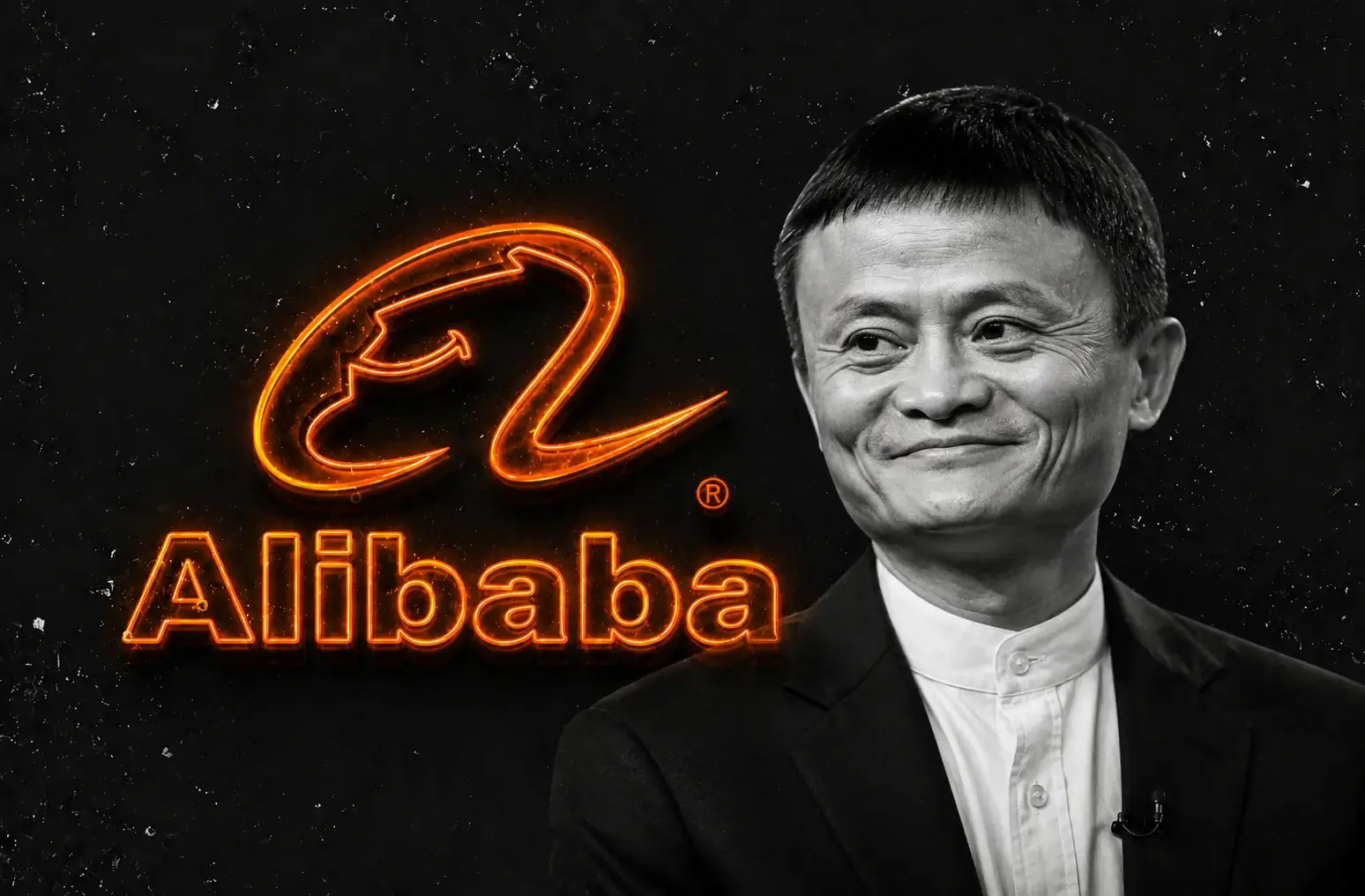
The regulatory history casts a long shadow. Alibaba spent years in the penalty box after Beijing's regulatory crackdown on tech platforms and the disappearance of co-founder Jack Ma from public life, which erased more than half the stock's peak value from its 2020 high of $319. The environment has improved — Xi Jinping has met with Ma and other tech founders, and Alibaba is now positioned as a backbone of China's AI ambitions — but the memory of the crackdown keeps investors wary of the political risk inherent in owning a Chinese tech champion.
For the forecast, the China macro overhang is the persistent discount and the recurring risk. It is why BABA trades at 14.4x forward instead of the 25-35x its growth might otherwise command, and it is the factor most likely to cap the upside or trigger sharp drawdowns. The bull case requires not just execution on the AI bet but also a stable-to-improving China macro and geopolitical environment. Any stimulus that lifts the Chinese consumer would be a major tailwind; any escalation in US-China tensions would be a sharp headwind. The macro is the wild card that sits above the entire investment case.
The Competitive Map: JD, PDD, Tencent, and the Cloud Wars
Alibaba competes on multiple fronts, and the competitive intensity is both a risk and a measure of the opportunity. In domestic e-commerce, it faces fierce competition from JD.com and Pinduoduo's PDD, which have pressured margins and market share, contributing to the sluggish growth in the core retail business. The Chinese e-commerce market is mature and brutally competitive, and Alibaba's quick-commerce investments are partly a defensive response to rivals encroaching on its turf.
In cloud and AI, the competition spans domestic and global players. Alibaba Cloud battles Amazon's AWS, Microsoft's Azure, and Google in AI infrastructure globally, while facing Tencent Cloud and Huawei Cloud domestically. Alibaba is the clear leader in Chinese cloud, but the AI infrastructure race is capital-intensive and competitive, with every major player spending heavily. Alibaba's advantage is its integrated stack and its government-subsidized capex, but it cannot rest — the cloud wars are a spending arms race where falling behind on capacity or model quality means losing share.
The AI model competition is the newest battleground. Alibaba's Qwen models compete with DeepSeek, whose R1 model shook global markets in early 2025 by showing China could rival US AI at a fraction of the cost, and with Zhipu AI, whose GLM-5.2 model was released under a permissive open-source license with a one-million-token context window. The Chinese AI model landscape is crowded and fast-moving, and Alibaba's open-source Qwen strategy is its bid to become the default ecosystem. Maintaining model leadership is essential to driving the cloud adoption that the entire bull case depends on.
The peer comparison frames the relative opportunity. Goldman's top China picks — Alibaba, JD.com, and NetEase — reflect a view that the Chinese internet sector broadly offers value, with Alibaba the AI-infrastructure leader among them. Against US hyperscalers, Alibaba trades at a fraction of the multiple despite comparable cloud growth rates, which is the core of the relative-value argument. The competitive map is intense, but Alibaba's position as China's AI-infrastructure champion gives it a structural advantage in the most important growth market.
For the forecast, the competitive map is a reminder that Alibaba's leadership is not guaranteed. The e-commerce competition caps the core business, the cloud wars require relentless spending, and the AI model race demands continuous innovation. But Alibaba's integrated full-stack position, its scale, its government-subsidized capex, and its open-source Qwen ecosystem give it durable advantages in China. The competitive intensity is the cost of playing in the largest AI opportunity outside the US, and Alibaba is positioned as the leader. The risk is execution; the opportunity is dominance of China's AI economy.
The Levels and the Calendar
Alibaba near $129 trades in a zone defined by recent lows below and a wide gap to analyst targets above. The stock sits near recent lows with a weak technical picture, having fallen 15% over the past 90 days and about 20% from the October 2025 high of $193. The recent-lows zone is the support the bulls — including Burry — are accumulating into, and holding it is the foundation of the base-building thesis. A break below the recent lows would signal the value case is failing and the China macro and execution fears are winning.
The upside levels are anchored by the fundamental estimates. The independent fair-value estimate of $162 sits about 25% above the current price, the 41-analyst average target of $191.48 implies roughly 48% upside, and bullish targets extend to $205 and even $230. The October 2025 high of $193 marks the recent peak the stock would need to reclaim to signal a full recovery, and the 2020 all-time high of $319 is the distant reminder of where Alibaba once traded. These levels frame a wide upside corridor if the cloud inflection delivers.
The technical picture is cautious, reflecting the weak momentum. The stock trades near recent lows with traders focused on the deteriorating chart rather than the fundamental story, indicating that momentum is currently against the bulls despite the smart-money accumulation. That weak technical backdrop means the stock could stay range-bound or drift lower in the near term even as the fundamental case strengthens — the classic disconnect between a base-building value play and the eventual re-rating. The chart needs a catalyst to turn.
The catalyst calendar centers on earnings. Alibaba's fiscal first-quarter 2027 results — covering the June quarter — are expected in mid-August, and that report is the key proof point for the J-curve thesis. The market will scrutinize whether cloud growth holds above 30-40%, whether the AI revenue ramp stays on its triple-digit trajectory, whether the model and application ARR hits the guided RMB10 billion for the June quarter, and whether free cash flow shows signs of recovering as the capex matures. A strong report validates the bull case; a weak one extends the value-trap narrative.
For the forecast, the levels and calendar reduce to a base near recent lows with August earnings as the catalyst. The support is the recent-lows zone where smart money is buying, the fair value is $162, and the analyst target is $191 — a wide upside corridor. The weak technicals mean the stock likely builds a base rather than breaking out before the August earnings, which is the event most likely to resolve the J-curve debate. The stock is coiled between depressed lows and bullish targets, waiting for the cloud inflection to show up in the numbers. August is when the market learns whether the J bends back up.
The Forecast: A J-Curve Bet on the Cloud Inflection
Alibaba near $129 is a J-curve bet trading at a value multiple, and reconciling the depressed present with the promising future is the entire forecast. The bull case is compelling: 40% cloud growth, triple-digit AI revenue for eleven straight quarters, a $56 billion AI capex bet partly subsidized by the government, a full AI stack spanning Qwen models, robotics, and proprietary chips, $41 billion in net cash, a 14.4x forward multiple, and smart-money endorsement from Burry and Goldman with a Strong Buy consensus targeting $191. The transformation into China's AI-infrastructure champion is real and accelerating.
The bear case is equally real. The AI capex is crushing current earnings — net income down 18%, group EBITA down 84% in the latest quarter, free cash flow swung to a multibillion-renminbi outflow. E-commerce, 65% of revenue, is sluggish in a Chinese economy growing at its slowest pace in decades. Geopolitical risk can gap the stock 5-10% on any headline, the convertible-note dilution adds modest pressure, and the weak technical picture shows momentum against the bulls. The 14.4x forward multiple is cheap, but it is cheap for reasons that are not trivial.
The near-term map is a base near recent lows with a wide upside corridor. Support sits at the recent-lows zone where smart money is accumulating, the fair value is $162, and the analyst target is $191 with bullish targets to $230. The October 2025 high of $193 is the recovery objective. BABA near $129 sits at the bottom of that corridor, building a base while the weak technicals and the China macro keep momentum subdued. The stock is coiled between the J-curve trough and the bullish targets.
The catalyst is August earnings. The fiscal first-quarter 2027 report, expected in mid-August, is the proof point for the J-curve thesis — whether cloud growth holds, the AI revenue ramp stays on track, the model and application ARR hits the guided RMB10 billion, and free cash flow begins to recover. A strong report validates the cloud inflection and the bull case; a weak one extends the value-trap narrative and the depressed multiple. The cloud-margin inflection management has guided for over the next two to three years is the longer-term proof.
The base case is a J-curve bet with a margin of safety. The most probable path is that BABA builds a base near current levels while the cloud and AI segments scale, with the $41 billion net cash and the smart-money accumulation providing a floor, and the August earnings serving as the catalyst that could begin closing the gap to the $191 target. The market is selling the investment phase and ignoring the cloud inflection, which is the opportunity if the J-curve bends back up — and the risk if it does not. The thesis rests on the cloud inflection: hold the recent-lows base and deliver on the August numbers, and the gap to $191 closes; disappoint on the cloud ramp or stumble on China macro, and the value-trap bears win. Everything hinges on whether the $56 billion bet converts to the $100 billion cloud-revenue prize, with August the next checkpoint.