Alibaba Stock Price Forecast – BABA at $155 as Qwen 3.5 and 34% Cloud Growth Drive AI Repricing
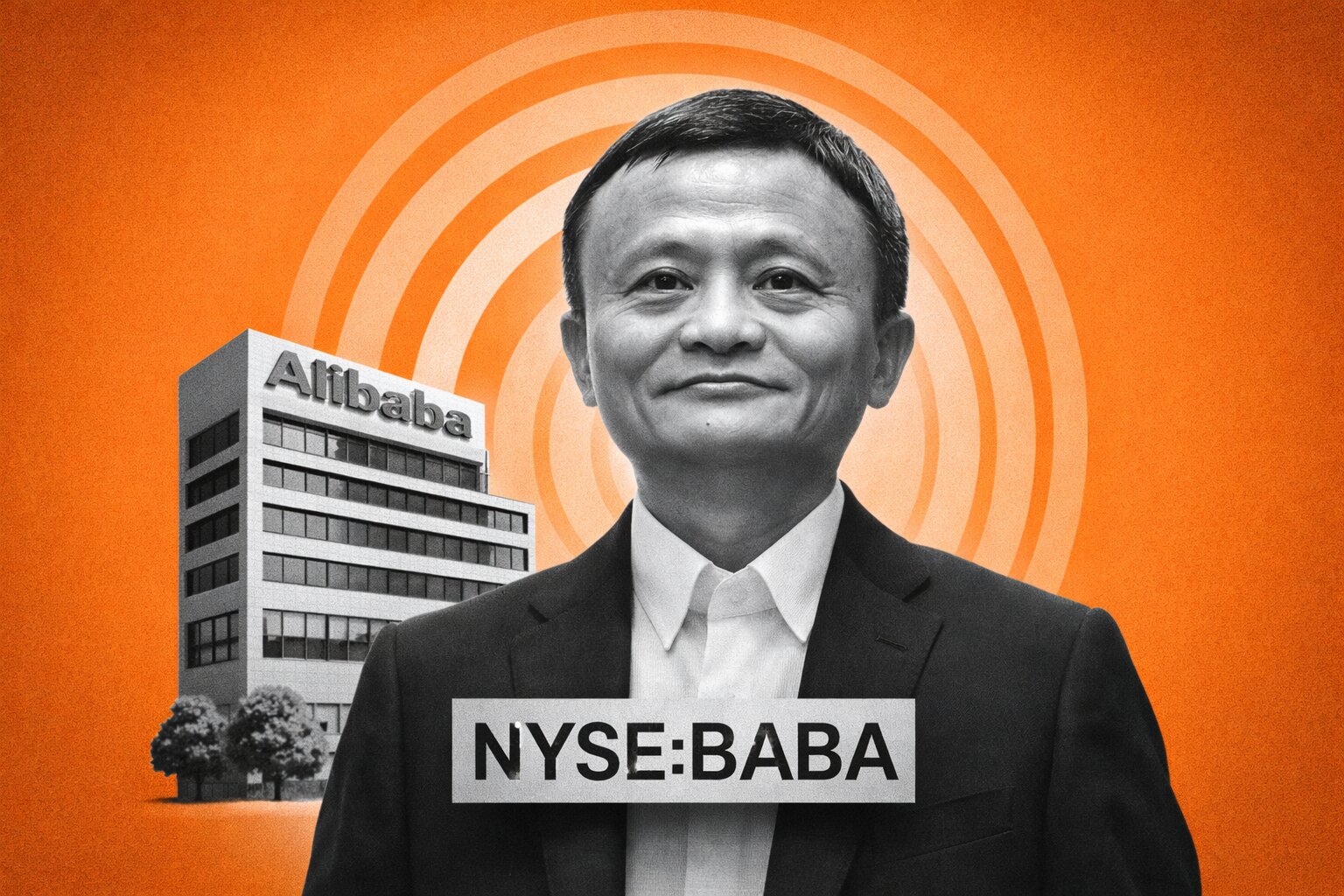
Alibaba trades near $156 above $145 support, with Qwen 3.5, RMB 380B AI capex and upcoming earnings set to decide a break toward $176–$200 or a renewed China discount | That's TradingNEWS
Alibaba Stock (NYSE:BABA) – AI build-out is hurting cash flow now, but the market still discounts the upside
Alibaba Stock (NYSE:BABA) – Where the share price stands and what the tape is signalling
Alibaba stock (NYSE:BABA) trades around $155.89 after a small +0.10% move on the day, inside a $153.46–$158.13 intraday range and a 52-week band of $95.73–$192.67. That level implies a market cap near $372B, a trailing P/E close to 20.6x and a cash dividend yield of about 0.67%. The yield is modest, but the fact that Alibaba is paying anything while committing to a massive AI and cloud capex cycle shows management is comfortable with the balance sheet and cash position. Shares have already doubled from the sub-$100 lows over the last year, yet they still sit below the $176–$200 valuation range implied by outer-year earnings scenarios that assume normalized EPS between $9 and $11 once the current investment wave matures. Technically, BABA has pulled back from the ~$193 high and is hovering above a clear demand area in the $145–$149 zone, where the rising 200-day moving average is clustered. Since April 2024, every deep slide has followed the same pattern: aggressive selloff, capitulation, then accumulation and a push to new recovery highs. The current congestion around the mid-$150s fits that template; the market is digesting a violent rerating, not pricing in a broken business.
Qwen as Alibaba’s ecosystem interface – why the AI pivot matters for the equity, not just the story
The upgraded Qwen platform shifts Alibaba Group Holding Limited from being a participant in China’s AI race to using AI as a control layer across its own empire. Qwen is being embedded directly into Taobao, Taobao Instant Commerce, Alipay, Fliggy and Amap, turning it into a unified AI interface that sits between users and the company’s core services. With reported monthly active users around the 100M mark on the Qwen front-end, this is not a cosmetic upgrade. Once Qwen intermediates search, discovery and transaction intent across commerce, payments and travel, it becomes the router for traffic and monetization: better targeting on Taobao, more personalised financial and merchant services via Alipay, and smarter travel and local recommendations through Fliggy and Amap. That is where AI starts to move GMV and ad budgets, not just headlines. China’s strategic focus on applied, embodied AI – integrating models into physical devices and mainstream services – plays directly into this architecture. The local AI hardware market is expected to grow at a high-teens clip through the decade, and Alibaba is positioned on both sides of that trade: as the cloud supplier providing compute and as the application operator capturing consumer and enterprise spend on top.
Qwen 3.5 – eight-times throughput, 60% lower costs and an AI price war that distorts the near-term P&L
Qwen 3.5 is the next step in that strategy. Alibaba positions this model as roughly eight times more capable on large-scale workloads than the previous generation while operating at about 60% lower cost, with day-one support on high-end accelerators like AMD’s Instinct MI300X and related GPUs. Benchmarks show Qwen 3.5 competing with or beating leading Western models on key workloads, especially in Chinese and regional language tasks. Despite that, the share price edged lower around the launch because the market is focused on the domestic AI price war and the cost of staying in it. Rivals such as ByteDance’s Doubao and DeepSeek are cutting aggressively, and Alibaba has responded with its own price reductions, including a prior 50% cut on Qwen3-Max in late 2025. Qwen 3.5 extends that stance: compress unit economics now to win share, then recapture margin once the ecosystem is locked in. The capital required for that strategy is significant. Management has flagged around RMB 380B – roughly US$53B – of AI and cloud infrastructure investment over three years. That spend is clearly visible in the accounts: quarterly profits down more than 50% year on year in recent prints even as cloud revenue accelerates. The difference with many “AI stories” is that Qwen 3.5 is already plugged into real contracts. AI Singapore, a government-backed national program, chose Qwen to power its initiative, citing better performance in Southeast Asian languages versus models from Meta and Google. In benchmark tests, a 32B-parameter Qwen-based model outperformed a 70B-parameter Meta-based system on regional tasks, underscoring Alibaba’s ability to turn local language advantages into infrastructure demand. The key for the stock is that this combination – better efficiency at the model layer and early international reference deals – underpins future revenue even while current margins get hit.
Alibaba Cloud – 34% revenue growth, 40% market share today and a credible path toward 60%
Alibaba Cloud is where the AI push turns into hard numbers. In the latest reported quarter, cloud revenue was roughly $5.6B, with total cloud sales up about 34% year on year and cloud revenue excluding divested assets up close to 29%. Roughly 20% of that revenue already ties directly to AI workloads, growing at triple-digit rates as enterprises move inference and training towards Qwen-powered services. Today Alibaba controls around 40% of China’s cloud computing market. Sell-side work suggests that if current trends hold, Alibaba Cloud could capture up to 80% of incremental industry revenue in the next couple of years, lifting its share toward 60%. That is the core of the rerating argument: as more mission-critical workloads standardise on Alibaba Cloud, the division transitions from a cyclical, project-heavy business into a platform with higher recurrence and stronger pricing power. The price is obvious in the income statement. Heavy AI and infrastructure spend, along with client incentives, have driven an 85% drop in operating income in one recent quarter and a 76% decline in core commerce adjusted EBITDA as cash is diverted from mature profit pools into long-duration projects. Free cash flow has swung negative on a trailing basis, and GAAP net income is more than 50% below the prior year in periods when capex is front-loaded. For the equity, that is exactly what a genuine platform transition looks like: painful in the near term, but a necessary condition for owning the infrastructure layer of Chinese AI and cloud.
Core commerce – still the profit engine, but deliberately cannibalised to fund the next leg of growth
Despite all the attention on AI, e-commerce remains the base that funds everything else. In the latest detailed period, China retail commerce revenue grew around 16% year on year, with customer management revenue – the paid-traffic and merchant-services component – up about 10%. On a revenue base of this size, mid-teens growth translates into billions of incremental gross profit each year. Management is intentionally recycling that surplus into cloud, AI and user experience. That decision is why core commerce adjusted EBITDA fell roughly 76% in a recent quarter and why free cash flow flipped into the red even though the underlying retail engine remains healthy. Importantly, the balance sheet still carries low leverage: debt-to-equity sits near 0.23 and return on equity around 14–15% despite depressed earnings. That combination gives Alibaba room to continue pressing on capex without threatening solvency. It is also telling that the firm still repurchased about $250M of stock in the same window. Relative to a $372B market cap this is not aggressive, but it sends a clear message: management believes the current valuation under-prices the company’s long-term earnings power even as it commits tens of billions to infrastructure.
Earnings revisions, options pricing and how the Street is repositioning around the AI capex wave
The last fully reported quarter was mixed. Non-GAAP EPADS of about $0.61 missed consensus near $0.81, while revenue of roughly $34.8B grew around 3% year on year and beat expectations by roughly $570M. Adjusted for divested assets, top-line growth was closer to 15%, with cloud Intelligence Group revenue around $5.59B and cloud growth at 34%. Shares fell roughly 2.3% after that release, less than half the 6.2% move implied by options going into the print. Looking ahead to the upcoming Q3 FY26 release, the at-the-money post-earnings straddle is only pricing about a 4.7% move. That is modest volatility for a name at the centre of China’s AI build-out. At the same time, analysts have been cutting near-term EPS forecasts aggressively: roughly two dozen downward revisions in the past 90 days versus a handful of upgrades. That pattern reflects the obvious trade-off: the sell side is lowering near-term profitability to reflect cloud and AI spending but is reluctant to abandon the structural growth story. AI-driven scoring systems echo that ambivalence. Quant models around the name assign scores in the high-60s out of 100 and point to fair-value targets in the high-$180s to low-$200s, explicitly citing weak free cash flow and margin pressure from AI as negatives while acknowledging a strong balance sheet, growing cloud franchise and multi-engine revenue mix.
Read More
-
Yen Stalls at 160 Despite a 3% JGB and Tokyo Core CPI at 2.0% — Intervention Sits at 164, Friday's Payrolls Decide
02.09.2026 · TradingNEWS ArchiveEnergy
-
QQQ ETF ($739) Fades From an Early Tech Rally as a 77.9 ISM Prices Index Meets Micron's $61.5B Guide — $760 Record Test Ahead
01.10.2026 · TradingNEWS ArchiveStocks
-
XRPR and XRPI Follow XRP's $1.49 Test as Spot Funds Hold 1.16B XRP and a 1 Billion Token Escrow Release Lands — $1.70 in Play
01.10.2026 · TradingNEWS ArchiveCrypto
-
November NG Slips Below $3 as Decade-High Storage Meets Capped LNG Exports — $2.75 in Sight
01.10.2026 · TradingNEWS ArchiveCommodities
-
Dollar-Yen at 158 Presses Toward 160 as a 363 bp Carry Gap Meets Katayama-Bessent Intervention Risk — 159 in Sight
01.10.2026 · TradingNEWS ArchiveForex
Technical structure – primary uptrend intact as long as $145–$149 holds
On a medium-term chart, BABA has already completed one clean breakout cycle since 2024. The stock based in the $80–$90 range, then broke higher, consolidated and ran toward the $193 region. That move essentially met the measured-move target derived from the prior base. The correction from that peak into the mid-$150s came with a clear bearish RSI divergence, signalling exhaustion and justifying the current consolidation. Price is now sitting above the rising 200-day moving average, with the $145–$149 band acting as key structural support. As long as that zone holds on a weekly closing basis, the primary trend remains to the upside. In that scenario, the mid-$150s represent a consolidation platform rather than the start of a structural downtrend. On the upside, the first serious resistance sits in the low $180s, with the prior $193 peak beyond that. A decisive break of $145, by contrast, would invalidate the existing pattern and force investors to treat the AI and cloud thesis with more scepticism, because it would show that even strong cloud growth and heavy investment are not enough to keep buyers in control.
Balance sheet strength, cash flow stress and the main risk vectors around Alibaba Stock (NYSE:BABA)
From a quality standpoint, Alibaba still looks like a company with capacity to absorb risk. Debt-to-equity at roughly 0.23 demonstrates modest leverage for a $372B platform, and return on equity near the mid-teens shows that the core operations still generate acceptable profitability even under the current investment load. Short interest around 1.8% is low, indicating that there is no large, coordinated short thesis dominating positioning at these prices. The weak areas are concentrated in cash generation and macro-political risk. Free cash flow has fallen by roughly 200% year on year as AI and logistics spending accelerated. Operating income fell about 85% in a recent quarter, adjusted EBITDA in core commerce dropped 76%, and GAAP net income is more than 50% below the prior year in the heaviest capex periods. If cloud and AI revenue do not ramp fast enough, or if pricing remains suppressed because of the domestic AI price war, that investment could end up looking like sunk cost instead of high-return capital allocation. Politically, the name remains exposed on two fronts. Inside China, the post-crackdown environment is more stable than a few years ago but still subject to regulatory shifts that can hit platform economics. Outside China, the brief inclusion and removal of Alibaba from the U.S. Pentagon’s Section 1260H list underlines how quickly sentiment can move on Chinese tech. Renewed trade tensions, fresh export controls on advanced chips or broader sanctions could compress the multiple regardless of what happens to earnings.
Valuation and stance – why the numbers still point to a bullish bias on Alibaba Stock (NYSE:BABA)
The central valuation question is whether Alibaba stock (NYSE:BABA) can deliver the $9–$11 of sustainable, non-GAAP EPS that some models project for FY 2027–2028 once the AI and cloud capex curve flattens. If normalized EPS around $9 is achieved and the market is willing to pay roughly 19.5x – a discount to U.S. mega-cap AI leaders but a slight premium to Alibaba’s own 10-year average multiple near 20.4x – the implied value is around $176 per share. If execution supports $11 of EPS, a similar multiple range pushes fair value closer to $190–$200. Today’s valuation – about 20.6x trailing earnings and mid-20s on a forward basis – sits below the high-20s to low-30s range of U.S. AI leaders and below Amazon’s low-30s forward P/E, even though both are running the same basic playbook of cloud plus AI plus commerce, adjusted for geography and regulatory risk. That discount reflects Chinese policy risk, AI capex drag and geopolitical noise, but it also creates upside if Alibaba proves that Qwen and Alibaba Cloud can translate into durable earnings and cash flow. On a broad, non-personal basis, the current configuration – $155–$156 spot, $145–$149 support, 34% cloud growth, RMB 380B AI and cloud plan, Qwen 3.5’s early traction, stressed free cash flow, but a still-solid balance sheet and discounted multiple – aligns with a bullish, Buy-leaning stance for investors who accept volatility and geopolitical risk in exchange for long-duration exposure to China’s dominant commerce-and-cloud platform.