

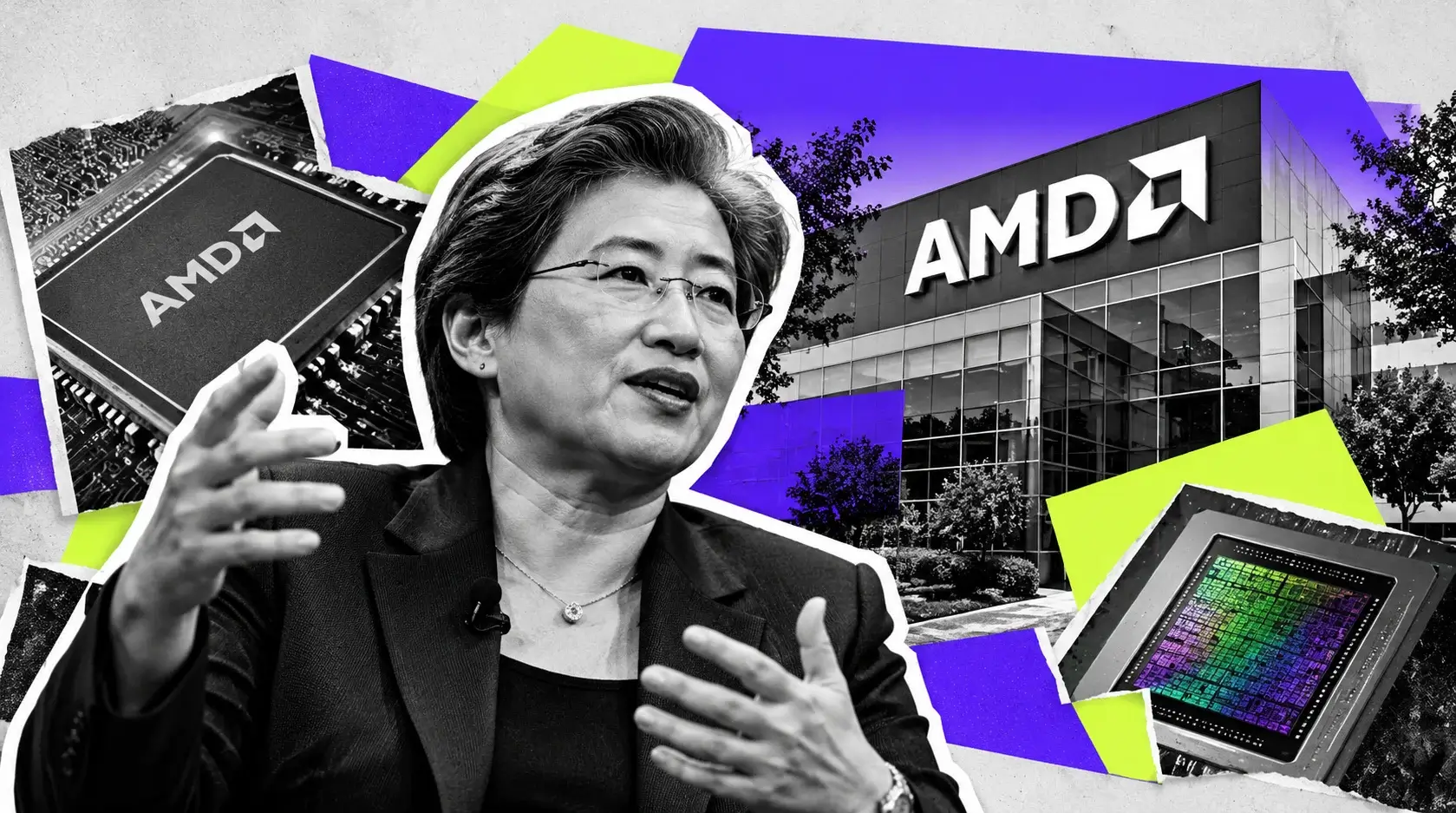
AMD ($560.68) Rebounds 10% From Its October Low on the Meta Helios Win — November 3 Report Holds the Key to $649
2nd-quarter data center revenue grew 107% to $6.7B and AMD guides 3rd-quarter revenue to $13.0B | That's TradingNEWS
Key Points
- AMD climbed 5.53% to $560.68 on Tuesday, recovering 10.4% from its $507.93 close on October 22.
- Helios racks are now running at Meta, and AMD will invest $1 billion in Meta’s $25 billion stock sale.
- AMD guides Q3 revenue to $13.0 billion, up 41%, ahead of its November 3 report after the close.
Advanced Micro Devices traded at $560.68 at midday on Tuesday, up $29.40 or 5.53% from Monday’s close at $531.28, after opening at $539.49 and running to an intraday high of $561.31. The session low printed at $538.50 in the first minutes of trade, and the stock never looked back. Volume reached 9.74 million shares by midday, against 16.80 million for all of Monday and 28.01 million during last Thursday’s selloff. At $560.68, AMD carries a market value of $915 billion.
The move puts AMD at the front of the semiconductor rally. The Philadelphia Semiconductor Index gained 3% to 11,416.10 intraday, Broadcom added 3.89%, Intel climbed 3.56%, Taiwan Semiconductor rose 3.03%, Micron gained 2.76% and Nvidia advanced only 1.20%. AMD’s 5.5% gain outpaced the chip index by 2.5 percentage points and Nvidia by more than 4 points, a gap that says investors are paying specifically for AMD’s story today rather than buying the sector blindly.
The catalyst is concrete. At 9:20 a.m. ET, AMD announced that its Helios rack-scale AI systems are running at Meta Platforms, that its EPYC processors power Meta’s Muse AI agent, and that it will invest $1 billion in Meta’s equity offering. Helios, the product AMD has staked its data-center future on, now has a named hyperscaler running it in production test.
The context makes the bounce matter. AMD set its record close at $649.42 on October 6 and an intraday all-time high of $658.52, then gave back 21.8% in 12 sessions to close at $507.93 on October 22 after an 8.1% single-day drop. Tuesday’s rally recovers $52.75 from that low, or 10.4%, across three sessions. The stock still sits 13.7% below its record close.
The year-to-date picture remains extraordinary. AMD was up 131.3% for 2026 at the October 23 close of $516.79, and at $560.68 it is up 151% since early January. Nvidia, the sector’s dominant name, is up roughly 23% over the same stretch. The 52-week range of $188.22 to $658.52 shows a stock that more than tripled from its low before the October correction.
The thesis for this forecast is direct. Tuesday’s rally is a vote that Helios is real, and the Meta disclosure answers the question the market had been asking since the July launch. But AMD trades at 51 times next-twelve-month earnings, and the stock’s next $100 in either direction will be decided on November 3, when the company reports third-quarter results and gives the first hard data on how fast Helios revenue ramps.
Meta Runs Helios, AMD Buys $1 Billion of Meta Stock
The Meta announcement carried three layers of news. First, initial Helios rack-scale systems are installed at Meta and under test on the path to broader deployment. Second, AMD’s EPYC processors power Muse, Meta’s personal AI agent, and AMD technologies provide day-zero support for Meta’s Muse Spark Open and Muse Glimmer models. Third, AMD will invest $1 billion in Meta’s equity offering.
The press release builds on the definitive agreement the companies signed on February 24, 2026, under which Meta will deploy up to 6 gigawatts of AMD Instinct GPUs across multiple product generations. Shipments supporting the first gigawatt were scheduled to begin in the second half of 2026, powered by a custom MI450-based GPU and 6th Gen EPYC “Venice” CPUs, running ROCm software on the Helios architecture. Helios itself was developed jointly by AMD and Meta through the Open Compute Project and is built on Meta’s Open Wide Rack specification.
The $1 billion investment is part of Meta’s broader capital raise. Meta priced $25 billion of Class A common stock at $625 per share, upsized from $22.5 billion, plus $12.5 billion of mandatory convertible preferred, and outlined up to $60 billion more through an at-the-market program from early 2027. AMD, Nvidia and Broadcom expressed interest in buying up to $5 billion of the offering collectively, with Nvidia committing $3 billion. Chip suppliers investing in the customers that buy their chips has become a feature of the AI build-out.
The financing loop carries risk. AMD is committing $1 billion of its own cash to a customer that is funding AI infrastructure purchases partly with equity, and that customer reported negative free cash flow in its third quarter for the first time since 2012. If Meta’s capital spending slows, AMD would lose both revenue and the value of its equity stake at the same time. The market chose to ignore that risk on Tuesday.
What the market rewarded was the confirmation. Before Tuesday, Helios had a production line, a launch event and a customer list, but no named hyperscaler running it. Meta now provides a proving ground at scale, and the testing language in the release is honest about the stage: installed and under test, with broader deployment as the next step. Full commercial rollout has not been established.
The day-zero model support matters for the software story. AMD’s biggest gap with Nvidia has been the CUDA ecosystem, and ROCm running Meta’s newest models on release day narrows that gap for at least one of the world’s largest AI buyers. Combined with the EPYC win for Muse, the announcement shows AMD selling CPUs, GPUs, networking and software into a single customer, which is the full-stack position Helios was built to win.
From $649.42 to $507.93: How the October Correction Unfolded
Tuesday’s rally only makes sense against the damage of the past three weeks. AMD closed at its record $649.42 on October 6, capping a run that took its market value above $1 trillion for the first time. The stock then fell on 10 of the next 13 sessions.
The first leg was the sector-wide AI scare. AMD dropped 3.90% to $620.68 on October 8 and 2.03% to $608.10 on October 9. On October 14, it fell 5.73% to $570.82, and two days later it lost another 5.95% to $528.75. The Philadelphia Semiconductor Index fell 11.4% in the week to October 16, its steepest weekly drop since March 2025, as a hot September CPI reading of 3.7% raised bets on Fed rate hikes and concerns over CoreWeave’s $50 billion debt load set off a crisis of confidence across AI infrastructure stocks.
The stock tried to recover. It bounced 1.76% to $538.05 on October 19 and 3.36% to $552.72 on October 21, a day when one large brokerage raised its price target on the shares. Then came the second hit.
On Thursday, October 22, AMD fell 8.10% to $507.93, a loss of $44.79, on volume of 28.01 million shares, the heaviest of the month. Three forces converged. Lam Research, a key chip-equipment supplier, said supply-chain and clean-room constraints held down its $8.6 billion revenue guidance and would persist into 2027. Meta’s third-quarter report showed negative free cash flow and signaled a large stock sale, raising questions about how the AI build-out gets funded. And renewed Houthi strikes on Saudi oil infrastructure pushed Brent crude above $112, reviving inflation fears. The Philadelphia Semiconductor Index fell 6.72% that day with all 30 members lower, Nvidia dropped 4.40%, the Nasdaq lost 2.6% and the S&P 500 fell 1.2%. AMD’s beta of 2.45 showed up in full.
The selloff compressed the valuation without touching the earnings outlook. Between September 30 and October 22, AMD’s next-twelve-month price-to-earnings ratio fell from 55 times to 46 times while the forward earnings estimate held near $11 per share and the 2027 revenue consensus rose 1%. The stock got cheaper because the market got scared, not because the numbers got worse.
The recovery began Friday. AMD gained 1.74% to $516.79 on October 23, added 2.80% to $531.28 on Monday as Anthropic’s IPO filing revived AI sentiment, and jumped 5.5% on Tuesday. Three straight up days, with a combined gain of 10.4%, have retraced 37% of the decline from the record close.
Q2 Recap: $11.54 Billion Revenue and Data Center Up 107%
AMD’s fundamental case rests on numbers already reported. In the second quarter of 2026, the company posted revenue of $11.54 billion, up 50% year over year and 13% sequentially, against guidance of $11.2 billion plus or minus $300 million. Non-GAAP earnings per share came in at $1.66, beating the $1.61 to $1.62 consensus by 3%, while GAAP EPS reached $1.38.
The data center segment drove the quarter. Data center revenue rose 107% year over year and 16% sequentially to $6.7 billion, accelerating from $5.8 billion in the first quarter, when it grew 57%. Server CPU revenue posted its fifth consecutive record quarter, with cloud and enterprise server CPU sales each growing more than 70% year over year and unit growth outpacing price growth. Management expects server revenue to grow more than 80% in the second half of 2026.
Margins held. Non-GAAP gross margin reached 55.9% in the second quarter, up from 53.9% a year earlier. Non-GAAP operating expenses fell to 29% of revenue from 32% a year earlier, a sign of operating leverage as revenue scales faster than costs.
Not every segment delivered. Gaming revenue fell 31% year over year, and management guided to another significant double-digit decline. Export controls have already cost AMD roughly $800 million in charges tied to its MI308 chips for China, a reminder that geopolitics can hit the data-center business directly.
The market’s reaction to Q2 was negative despite the beat. The stock fell 7.0% the day after the report, a pattern that has repeated: after the first-quarter report, AMD jumped 18.6%, but after the fourth quarter of 2025 it fell 17.3%. Post-earnings moves of 7% to 19% in either direction are normal for this stock, which is why November 3 carries so much weight.
The third-quarter guidance set a high bar. AMD guided to revenue of $13.0 billion, plus or minus $300 million, with the midpoint representing 41% year-over-year growth and 13% sequential growth, and non-GAAP gross margin of 56%. Consensus sits at $13.06 billion in revenue and $1.93 to $1.94 in non-GAAP EPS, compared with $9.25 billion and $1.20 in the year-ago quarter.
Two management statements from the August call frame the setup. Helios entered full production with initial shipments on track to begin later in the third quarter and ramp through the fourth quarter into 2027. And AMD expects data center segment revenue to more than double year over year in 2027. Revenue per gigawatt of deployed capacity runs in the double-digit billions of dollars.
The 14-Gigawatt Backlog: OpenAI, Meta, Anthropic and Oracle
AMD’s valuation rests on a pipeline of AI compute commitments that totals up to 14 gigawatts across three anchor customers, with a fourth providing the first quantified public deployment.
OpenAI came first. On October 6, 2025, AMD and OpenAI signed a multi-year, multi-generation agreement to deploy 6 gigawatts of AMD Instinct GPUs, starting with a first 1-gigawatt deployment of MI450-series GPUs in the second half of 2026. The deal included an unusual feature: a warrant giving OpenAI the right to buy up to 160 million AMD shares at $0.01 each, vesting in tranches tied to deployment milestones through October 2030. At $560.68, those 160 million shares would be worth $89.7 billion. The warrant aligns OpenAI’s incentives with AMD’s share price but represents dilution of roughly 10% of the current share count if fully vested.
Meta followed on February 24, 2026, with its own 6-gigawatt agreement on a custom MI450-based accelerator, the deal Tuesday’s announcement builds on.
Anthropic joined at AMD’s Advancing AI event in July. The company agreed to deploy up to 2 gigawatts of MI450-series GPUs in Helios racks, with the first gigawatt beginning in the first half of 2027, and AMD committed to invest up to $5 billion in Anthropic. Anthropic filed its S-1 on Monday for a Nasdaq listing, disclosing total compute commitments of $542 billion to $567 billion across all providers, and that filing revived AI-chip sentiment across the sector.
Oracle provides the first hard unit count. Oracle Cloud Infrastructure plans to deploy 50,000 Instinct MI450 GPUs on Helios racks starting in the third quarter of 2026, building what it described as the first publicly available MI450-based AI supercluster.
The arithmetic is what drives the stock. If revenue per gigawatt runs in the double-digit billions, a 14-gigawatt pipeline implies well over $140 billion of revenue over the deployment period, against AMD’s full-year 2025 revenue of $34.64 billion. The deployments stretch across 2026 through 2030, and the timing of each gigawatt matters as much as the total.
The risk is concentration. Three customers account for nearly the entire AI GPU pipeline, two of them have ties to AMD through equity, and all three are funding their build-outs through debt, equity raises or private capital. If any one of them slows, the revenue curve shifts. The Lam Research supply warning adds a second risk: even if demand holds, equipment and memory constraints into 2027 could cap how fast AMD can deliver.
Helios: 72 GPUs, 432GB of HBM4 and a Direct Shot at Nvidia
Helios is AMD’s attempt to stop selling chips and start selling complete AI systems, and the product specifications explain why the market treats it as the company’s defining bet.
Each Helios rack packs 72 liquid-cooled Instinct MI455X GPUs, the flagship of the MI400 series, alongside 6th Gen EPYC “Venice” CPUs as head nodes and AMD Pensando “Vulcano” networking chips supporting up to 800 gigabits per second per GPU. The GPUs connect over UALink and an Ultra Ethernet-aligned fabric. Each MI455X carries up to 432GB of HBM4 memory with 19.6 terabytes per second of bandwidth, compared with 288GB on AMD’s outgoing MI350X. AMD rates a full rack at 2.9 exaflops of FP4 compute, with each GPU delivering 40 petaflops at FP4.
The memory specification is AMD’s strongest technical claim. At 432GB of HBM4 per GPU, the MI455X outpaces Nvidia’s competing Rubin GPU on paper, an advantage that matters for inference on the largest frontier models, where memory capacity determines how much of a model fits on each chip. AMD has explicitly positioned Helios against Nvidia’s Vera Rubin NVL72 rack-scale systems and called it the world’s best AI rack at the July launch.
Venice gives AMD a CPU edge to pair with the GPUs. The 6th Gen EPYC processors are built on a 2-nanometer process with up to 256 cores and began shipping in the second half of 2026, the same window as Helios and the MI400 family. That lets AMD sell a coordinated CPU-plus-GPU platform rather than staggering launches.
The AMD acquisition of ZT Systems gave the company the rack-scale design expertise Helios required. Building an entire liquid-cooled cabinet is a different business from selling a GPU to a server maker, and it changes AMD’s revenue per customer, its margin structure and its execution risk.
The execution risk is real. Helios is a complex ramp, and yields are still improving. HBM4 memory supply is tightening across the industry, feeding both AMD’s and Nvidia’s next-generation accelerators. Oracle’s 50,000-GPU build puts pressure on AMD’s supply chain heading into the fourth quarter, and the Lam Research warning about equipment constraints into 2027 adds a second bottleneck.
What investors need now is proof. Independent benchmarks and tokens-per-dollar data in production against Nvidia’s Vera Rubin will validate or break the “best AI rack” claim within two quarters. Tuesday’s Meta disclosure is the first step: a hyperscaler running the system. November 3 is the second: revenue from the first shipments, which were due to begin in the third quarter.
Valuation: 51 Times Forward Earnings Leaves No Margin for a Miss
AMD is not a cheap stock, and the valuation is the central debate around it. At $560.68 and a next-twelve-month earnings estimate near $11 per share, AMD trades at 51 times forward earnings, up from 46 times at the October 22 low and down from 55 times at the end of September. On trailing earnings, the multiple runs well above 100 times. The stock trades at 21.8 times trailing sales.
The earnings curve explains why investors pay the premium. Consensus calls for AMD to earn $6.49 per share in 2026, up 98.5% from $3.27 in 2025, and $14.11 to $15.76 per share in 2027, a further gain of 117% to 143%. At $560.68, AMD trades at 35.6 times the higher 2027 estimate of $15.76 and 39.7 times the lower $14.11. If the 2027 numbers hold, the stock is expensive but not absurd for a company doubling its data-center business.
The comparison with Nvidia cuts against AMD. Nvidia trades at 25 times forward earnings with a 75% non-GAAP gross margin, against AMD’s 56%. Nvidia’s data center revenue of $89.02 billion last quarter, up 117% year over year, runs 13 times AMD’s $6.7 billion. Over the past 12 months, Nvidia earned $192.9 billion of net income, 30 times AMD’s $6.4 billion. Investors are paying AMD a 60% premium per dollar of expected earnings relative to Nvidia, while Nvidia is larger, more profitable and growing its data-center business faster.
The bull case rests on the gap closing. AMD’s data center grew 107% last quarter, close to Nvidia’s rate, and management expects that business to more than double again in 2027. If AMD captures even a modest share shift as hyperscalers diversify away from a single supplier, the earnings growth would justify the multiple. The market is paying for AMD to become a credible second source at scale.
The bear case is that the price already assumes success. A stock at 51 times forward earnings with a beta of 2.45 can lose 15% to 20% on a guidance disappointment, and AMD has done exactly that after two of its last four reports. Insiders sold $378.1 million of stock over the past 12 months, with no insider buying. The OpenAI warrant adds potential dilution.
Price targets on the Street span a wide range, from below the current price to a high of $1,250, which shows how far apart the bull and bear views sit.
For the forecast, the valuation sets an asymmetry. A clean beat with a fourth-quarter guide that confirms the Helios ramp would compress the multiple through earnings growth and support a move back to $649. A soft guide would compress it through the price.
The Competitive Squeeze: Nvidia’s Vera CPU and Custom Silicon
AMD faces competition on both sides of its data-center business, and Tuesday’s rally does not change that.
On GPUs, Nvidia remains dominant. Nvidia holds an estimated 75% to 87% of the AI accelerator market, carries a $5.33 trillion market value and earns $40 billion per gigawatt on its Vera Rubin platform, up from $25 billion on Blackwell. Its CUDA software ecosystem remains the default for AI developers, and its rack-scale NVL72 systems are the benchmark Helios must beat. AMD’s advantage is that hyperscalers want a second supplier for pricing leverage and supply security, and that desire has produced the 14-gigawatt pipeline.
On CPUs, the threat is newer and closer to home. Nvidia’s Grace CPU has generated more than $5 billion of trailing 12-month revenue, and its Vera CPU, now in full production and shipping to hyperscalers, is purpose-built for agentic AI. Nvidia claims Vera runs 1.8 times faster on a key benchmark and offers five times the bandwidth per watt of any other data-center CPU, and management expects CPU revenue to more than double in fiscal 2028. That puts Nvidia in direct competition with EPYC, the business that has posted five straight record quarters for AMD.
Custom silicon is the third front. Cloud giants continue building their own Arm-based CPUs, and Broadcom designs custom AI accelerators for several hyperscalers. Broadcom lined up $63 billion of financing on Tuesday to fund chips for Anthropic, the same customer that committed to 2 gigawatts of AMD Helios. AMD is competing with Broadcom’s custom chips inside the same customer accounts.
Intel remains a factor in x86 CPUs, and its shares gained 3.56% on Tuesday. AMD has taken substantial server share from Intel over the past five years, but a stabilizing Intel would slow that gain.
The Meta announcement addresses the competitive question in AMD’s favor for one account. Meta runs AMD EPYC for its Muse agent, is testing Helios racks, and is deploying custom MI450 GPUs. That is a full-stack win against Nvidia’s integrated offering inside one of the four largest AI spenders.
For the forecast, competition caps the multiple. AMD cannot trade at a sustained premium to Nvidia unless it proves it can win share in both GPUs and CPUs simultaneously. November 3 must show server CPU growth above 70% and data center revenue accelerating from the $6.7 billion second-quarter base.
Read More
-
Yen Stalls at 160 Despite a 3% JGB and Tokyo Core CPI at 2.0% — Intervention Sits at 164, Friday's Payrolls Decide
02.09.2026 · TradingNEWS ArchiveEnergy
-
Nasdaq Rips 1.3%, S&P 500 Hits 7,728, Dow Stalls as BA Drops to $171
27.10.2026 · TradingNEWS ArchiveStocks
-
Ethereum ($2,312) Lags Bitcoin and AI Stocks as BitMine Nears Its 5% Cap — Break of $2,295 Opens $2,200
27.10.2026 · TradingNEWS ArchiveCrypto
-
Brent ($113.88) Trades a $2.35 Range as Houthi Strikes Meet Saudi-Iran Diplomacy — Break of $117 Unlocks $120
27.10.2026 · TradingNEWS ArchiveCommodities
-
GBP/USD (1.3310) Can’t Cash In on 5.43% Gilt Yields as Budget Risk Meets a Firm Dollar — Break of 1.3274 Opens 1.3200
27.10.2026 · TradingNEWS ArchiveForex
The Sector Backdrop: Chips Bounce 3% While Still Down 12% for October
AMD’s rally is part of a sector-wide bounce, and the sector’s condition shapes how far the stock can run.
The Philadelphia Semiconductor Index jumped 3% to 11,416.10 on Tuesday after a 2.82% gain on Monday, its biggest daily advance since September 21. All eight of its largest members traded higher by late morning. Dell Technologies rose 7.7% and Super Micro gained 6.85%. On Monday, 57 of 60 stocks in a broad semiconductor basket finished higher. That kind of breadth signals sector buying, not stock picking.
The two-day bounce follows deep damage. The chip index remains down 12.2% for October, after the 11.4% weekly loss to October 16 and the 6.72% drop on October 22. Technology was the worst-performing S&P 500 sector for the month heading into Tuesday, down 4%.
The catalysts are capital-markets events. Anthropic filed its S-1 on Monday, disclosing compute commitments that read as a long-term demand signal for every AI chip supplier. Meta’s equity raise drew five times oversubscription. Broadcom’s $63 billion financing for Anthropic chips added a third data point. Together, they reassured investors that the AI build-out still has funding, despite last week’s concerns about debt loads and negative free cash flow.
The macro backdrop is restrictive. The 10-year Treasury yield sat at 5.00% on Tuesday, a level that weighs on long-duration growth stocks like AMD. The Federal Reserve meets this week, with a decision Wednesday at 2:00 p.m. ET and a hold at 3.75%-4.00% priced above 90%, but a December hike is close to fully priced. Brent crude traded below $114 after a spike to $116.93 on Friday.
The earnings calendar is the near-term driver. Microsoft and Alphabet report after the close Wednesday, and Amazon follows Thursday, with the three carrying more than $10 trillion in combined market value. Their capital spending guidance will set the tone for every AI chip stock heading into AMD’s own report the following Tuesday. Alphabet has guided 2026 capital spending to $195 billion to $205 billion and Amazon to roughly $220 billion. Any increase would read through directly to AMD’s demand outlook.
For the forecast, AMD needs the sector to hold. A strong set of hyperscaler capex numbers on Wednesday and Thursday would support a run toward $605. A disappointing set would send the chip index back toward its October lows, and AMD’s 2.45 beta would amplify the move.
Technical Map: $538 Floor, $605 Pivot, $649 Ceiling
The chart has drawn clear levels on both sides after the October round trip.
Support begins at $538.50, Tuesday’s session low and the opening gap level. A failure there would put $531.28, Monday’s close, in play, followed by $516.79, the October 23 close. The critical floor sits at $502.60 to $507.93, the October 22 intraday low and close, which marks the bottom of the correction. Below that, the $500 round number is the last line before the stock would retrace a larger share of its 2026 gain, with the $455 zone as the next support on a weekly basis.
Resistance starts at $561.31, Tuesday’s high. Above that, $570.82, the October 14 close, is the first test. The $591.88 intraday high from October 14 sits next, followed by $605.53, the October 13 close and the level where the stock last traded before the second leg of the selloff began. That $605 zone is the pivot: a close above it would recover more than half of the decline from the record and shift the trend back to bullish. Above $605, $620.68 marks the October 8 close, and $649.42 to $658.52, the record close and intraday high, form the ceiling.
The pattern is a V-shaped recovery off a capitulation low. The October 22 session delivered the heaviest volume of the month at 28.01 million shares on an 8.1% drop, a classic washout signature. The three sessions since have posted higher lows and higher closes, from $516.79 to $531.28 to $560.68. Tuesday’s gap above Monday’s high of $533.50 and close near the session high show buyers in control.
Volume is the caution flag. Tuesday’s 9.74 million shares by midday is solid but below the selloff volume, and a sustained recovery needs participation above 20 million shares on up days to confirm institutional buying.
The pre-earnings setup matters. AMD reports in five trading sessions, and the stock tends to drift into a report before moving 7% to 19% on the print. A run toward $591 to $605 before November 3 would leave less room for upside on the report itself; a pullback toward $538 would set up a cleaner reward-to-risk profile.
The trading range into earnings is $538 to $605, with a bullish bias as long as the stock holds above $531.
November 3: The Numbers That Will Move the Stock
AMD reports third-quarter 2026 results after the market close on Tuesday, November 3, with a conference call at 5:00 p.m. ET. Five numbers will decide the reaction.
The first is revenue against the $13.0 billion guide. Consensus sits at $13.06 billion, which means a print in line with the midpoint will not move the stock. AMD has beaten its revenue guidance midpoint in each of the past several quarters, and the market will expect a print of $13.3 billion or higher, the top of the guided range.
The second is data center revenue. The segment generated $6.7 billion in the second quarter, and a third-quarter figure that shows sequential acceleration beyond the 16% growth posted in Q2 would confirm the Helios ramp has begun. Helios shipments were due to start later in the third quarter, so any Helios revenue in the print is an upside signal. The single number investors will watch most closely is data center revenue for the quarter in which Helios was supposed to begin shipping.
The third is the fourth-quarter guide. The third-quarter guide implied 13% sequential growth. A fourth-quarter guide that implies another double-digit sequential gain would point to a revenue run rate approaching $15 billion as Helios ramps through the quarter. A guide that shows growth slowing would raise doubts about deployment timing.
The fourth is gross margin. AMD guided to 56% for the third quarter, matching consensus at 56.1%. Helios carries different margins from standalone GPUs because it includes CPUs, networking and system integration. Investors will want confirmation that the rack-scale business does not dilute margins as it ramps, and that HBM4 memory costs are under control.
The fifth is the 2027 data center outlook. Management said in August that it expects data center revenue to more than double year over year in 2027. A reaffirmation, or an upgrade, would anchor the $14.11 to $15.76 consensus for 2027 earnings per share. Any softening of that language would hit the stock hard, because the valuation rests on 2027 delivery.
Secondary items will matter too: server CPU growth against the 70%-plus rate of recent quarters, the client business after record 2025 revenue of $10.6 billion, the size of the gaming decline, and any update on export-control charges.
AMD’s post-earnings moves have been large in both directions: down 7.0% after Q2 2026 despite a beat, up 18.6% after Q1 2026, down 17.3% after Q4 2025. Expect a move of 8% to 12% in either direction on November 4.
Risk Map: Supply, Funding, Rates and Concentration
The bull case is strong, but five risks could derail it, and each has shown up in the past month.
Supply is the first. Lam Research warned on October 21 that supply-chain and clean-room constraints held down its guidance and would persist into 2027. HBM4 memory supply is tightening across the industry. If AMD cannot source enough memory, packaging capacity or equipment-dependent output, it cannot deliver Helios racks on the schedule its customers expect, regardless of demand. Supply constraints would push revenue to later quarters and test the 2027 doubling target.
Customer funding is the second. AMD’s three anchor customers are all funding their AI build-outs through capital markets. Meta reported negative free cash flow in its third quarter for the first time since 2012 and is raising up to $97.5 billion in equity. OpenAI and Anthropic depend on private capital and, in Anthropic’s case, an IPO. If any of these funding channels tightens, AMD’s deployment schedule slows.
Rates are the third. The 10-year Treasury yield sits at 5.00%, the Fed holds at 3.75%-4.00% with a December hike priced, and Brent crude above $110 keeps inflation elevated. Higher rates raise the cost of debt-funded AI infrastructure and compress multiples on long-duration growth stocks. AMD’s 8.1% drop on October 22 came partly from an oil spike that revived rate fears.
Concentration is the fourth. The 14-gigawatt pipeline rests on three customers. The OpenAI warrant for 160 million shares at $0.01 and AMD’s $1 billion Meta investment and up to $5 billion Anthropic commitment create financial ties that cut both ways. A setback at any one customer would hit AMD’s revenue outlook and its balance sheet simultaneously.
Competition is the fifth. Nvidia’s Vera CPU is shipping and targeting the EPYC franchise directly, while Broadcom’s custom accelerators compete for the same hyperscaler budgets.
Export controls round out the list. AMD has already absorbed roughly $800 million of MI308 charges, and any further tightening of China restrictions would hit revenue.
None of these risks is new, and Tuesday’s rally priced none of them out. They are the reason a stock with a 14-gigawatt pipeline trades 13.7% below its record and swings 8% in a single session.
AMD Stock Price Forecast: Three Scenarios Through November
The forecast splits into three paths, with hyperscaler capex this week and AMD’s own report on November 3 deciding which plays out.
The bull case requires a daily close above $605.53. The triggers would be strong capital-spending guidance from Microsoft, Alphabet and Amazon this week, followed by a November 3 report showing revenue at or above $13.3 billion, data center revenue accelerating with measurable Helios contribution, a fourth-quarter guide implying another double-digit sequential gain, and a reaffirmed or raised 2027 data center doubling. In that scenario, AMD would clear $605, then $620.68, and retest the $649.42 record close within 30 days, a gain of 15.8% from $560.68. A break above $658.52 would put the stock in price discovery.
The base case is a range between $531 and $605 into and through the report. Hyperscaler capex comes in line, the Fed holds with hawkish language, and AMD delivers a modest beat with an in-line fourth-quarter guide. The stock consolidates the October recovery, with buyers defending $531 to $538 and sellers capping rallies below $605. This scenario leaves AMD near current levels by mid-November.
The bear case is a daily close below $507.93. The triggers would be disappointing hyperscaler capex, a hawkish Fed surprise, or a November 3 report showing Helios revenue delayed to the fourth quarter or later, a soft fourth-quarter guide, or margin pressure from HBM4 costs. Given AMD’s history of 7% to 17% post-earnings drops, a soft guide could take the stock back through $507.93 toward $455, a decline of 18.8% from current levels.
Weighing the scenarios, the near-term balance tilts constructive. The Meta disclosure confirms Helios is running at a hyperscaler, the October correction compressed the forward multiple from 55 times to 46 times before Tuesday’s bounce, earnings estimates held through the selloff, and the sector has found a floor. The risks are concentrated on November 3, which makes the report a binary event for the stock.
The 30-day price target is $649, the record close, conditional on a daily close above $605.53 and a November 3 report that confirms the Helios ramp. A daily close below $507.93 would shift the target to $455.
Verdict: Constructive Above $531, $649 Target Hinges on November 3
AMD at $560.68 is a stock that just got the confirmation it needed and now faces the test it cannot avoid. Tuesday’s 5.5% rally on 9.74 million shares by midday came on the clearest Helios news since the July launch: rack-scale systems installed and running at Meta, EPYC powering Meta’s Muse agent, day-zero ROCm support for Meta’s newest models and a $1 billion AMD investment in Meta’s equity. The stock has recovered 10.4% from its October 22 low of $507.93, outpacing a 3% chip-sector bounce and Nvidia’s 1.2% gain.
The fundamentals behind the move are strong. Second-quarter revenue of $11.54 billion grew 50%, data center revenue of $6.7 billion grew 107%, server CPUs posted a fifth straight record, and the third-quarter guide calls for $13.0 billion in revenue, up 41%. A 14-gigawatt AI compute pipeline across OpenAI, Meta and Anthropic, plus Oracle’s 50,000-GPU build, gives AMD a revenue runway that stretches to 2030. Management expects data center revenue to more than double in 2027, supporting consensus earnings of $14.11 to $15.76 per share.
The risks are equally clear. AMD trades at 51 times forward earnings against Nvidia’s 25 times, with a 56% gross margin against Nvidia’s 75%. Supply constraints into 2027, debt- and equity-funded customers, a 5.00% 10-year yield and Nvidia’s Vera CPU all threaten the path. The stock has moved 7% to 19% after each of its last four reports.
The verdict is constructive with a binary catalyst. Above $531, the October washout looks complete and the trend favors buyers into hyperscaler earnings this week. A daily close above $605.53, backed by strong capex guidance from Microsoft, Alphabet and Amazon and a November 3 report that shows measurable Helios revenue and a fourth-quarter guide pointing to another double-digit sequential gain, would put the $649.42 record close in reach within 30 days. A daily close below $507.93, most likely triggered by a Helios delay or a soft guide, would shift the target to $455. AMD has proven Helios is real; November 3 must prove it is shipping at scale.