

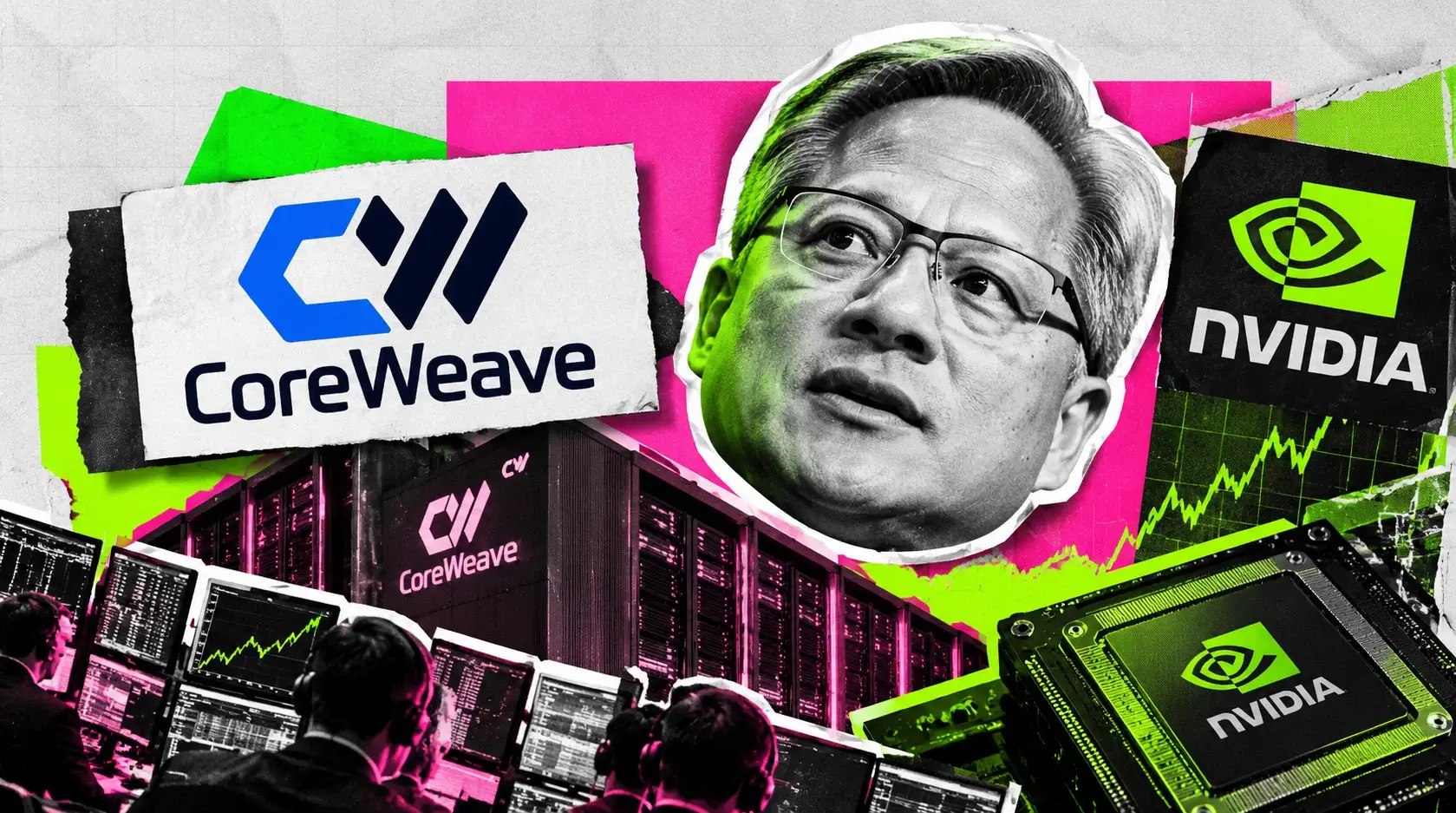
Coreweave ($63.08) Trades as an Option on Its Credit as 112% Revenue Growth Meets a 1,200bp Spread — $80 Above $70, $50 Below $59.51
Second-quarter revenue doubled to $2.58B, but third-quarter interest expense is guided to $860–940M and 2026 capex to $35–39B | That's TradingNEWS
Key Points
- CoreWeave rose 2.74% to $63.08 after falling 25% last week, its worst week since November.
- The yield on CoreWeave’s 2031 bonds eased 19.5 basis points to 15.13% after topping 16%.
- CoreWeave’s revenue backlog reached $104.2 billion at the end of June, up 246% year over year.
CoreWeave (NASDAQ:CRWV) traded at $63.08 at 11:26 a.m. ET on Monday, October 19, 2026, up $1.69, or 2.74%, from Friday’s close at $61.39. The stock had jumped as much as 7% in premarket trading after an upgrade to Buy from Neutral, then surrendered more than half of that gain once regular trading began. By early afternoon, shares were up 2.4% in choppy trading. Volume reached 41.7 million shares by late morning, already above the stock’s 32.27 million three-month daily average.
The fade is the story. On a day when the Nasdaq Composite rose 1.67%, chip stocks rallied 2.3% and other neocloud names bounced between 3% and 10%, CoreWeave lagged. Applied Digital rose 9.78%, IREN 5.41% and Nebius 4.41%. The market was willing to buy AI infrastructure, but it was not willing to pay up for the most indebted name in the group.
The context is a brutal week. CoreWeave fell 25% last week, its biggest weekly drop since November, including a 15.5% decline on Wednesday and an 11.91% drop on Friday on 95.4 million shares. The stock has lost 20% in October and trades 51.68% below where it stood a year ago. At $63.08 it sits $3.57 above its 52-week low of $59.51 and 55.5% below its 52-week high of $141.79. Market capitalization stands at $34.8 billion.
The thesis of this forecast is narrow. CoreWeave’s equity has become an option on its credit. The company has one of the strongest demand pictures in technology, with a $104.2 billion revenue backlog at the end of June and more than $25 billion in new commitments signed in the first weeks of the third quarter. But the bond market has repriced its debt to distressed levels. Notes issued in June at a 9.675% yield traded near 15% last week, the 2031 bonds briefly topped 16%, and the cost of protecting CoreWeave debt against default hit a record intraday high.
As long as CoreWeave’s bonds trade near 15%, the stock trades on solvency fears rather than on growth. The 2031 bond yield fell 19.5 basis points to 15.13% on Monday, which helped the stock open higher. The question for the next month is whether that credit relief continues into the third-quarter report in mid-November or reverses on the next round of rate fears.
Last Week’s Collapse: A 25% Drop on a $50 Billion Debt Scare
CoreWeave’s slide last week was the sharpest in the AI infrastructure sector and became a trigger for a broader sell-off. The company’s roughly $50 billion in debt triggered a crisis of confidence that sparked a global sell-off across AI and tech stocks.
The sequence started with inflation. On Wednesday, October 14, U.S. September CPI came in at 3.7% against a 3.6% forecast, with core at 2.6%. The hot print raised bets for interest-rate hikes, fueling concerns that heavily indebted AI companies would face higher borrowing costs. CoreWeave lost 15.5% that day, its worst single session of the week.
The bond market confirmed the fear. On Thursday, the yield on CoreWeave’s October 2031 bonds briefly topped 16%. Notes issued in June with a 9.675% yield were trading near 15%. CoreWeave’s debt fell to levels that typically indicate distress, and the cost of protecting its bonds against default rose to the highest intraday level on record. By the end of the week, CoreWeave’s credit spread had widened to 1,200 basis points.
The CEO pushed back, blaming the market for reacting irrationally to bond yields. Nvidia CEO Jensen Huang, whose company is both CoreWeave’s chip supplier and an equity holder, said on Thursday that he was optimistic about CoreWeave and that its cost of capital is actually decreasing. Neither comment stopped the slide.
Friday delivered the final blow. CoreWeave fell 11.91% to $61.39 on 95.4 million shares, three times its average volume, as the Nasdaq dropped 2.14% and the AI complex sold off. Nebius fell 12.18%, Applied Digital 11.48%, IREN 11.19% and Cipher Digital 10.56%. CoreWeave finished the week down 25%.
The market’s estimate of CoreWeave’s obligations frames the fear. Investors estimate roughly $51.6 billion of debt and leases, with interest costs that could exceed operating profit. At that leverage, a 5-percentage-point rise in borrowing costs on new debt would add billions in annual interest expense, and the company’s financing plan depends on continued access to open capital markets.
Some buyers stepped in. Retail investors bought the dip during the decline, and one active fund manager added 381,231 shares. That buying was not enough to stop a 25% weekly drop.
The Upgrade: Strong Operator, Manageable Borrowing Costs
Monday’s catalyst was an upgrade to Buy from Neutral by a major investment bank’s research desk. The argument rested on two points. First, CoreWeave ranks among the strongest operators in the AI cloud industry. Second, the company can continue financing its expansion at borrowing costs only modestly above existing levels.
That second point is the crux. The 15% yield on CoreWeave’s unsecured bonds reflects what investors now demand to buy existing debt in the secondary market, not what the company currently pays in interest. CoreWeave’s actual borrowing costs vary widely by structure. A tranche of its Meta-backed project financing priced at 5.9% in July, compared with roughly 10% on its unsecured bonds at the time.
That gap explains the bull case. CoreWeave finances much of its expansion at the project level, borrowing against specific GPU clusters and the contracts that pay for them. When the customer is Microsoft, Meta or another investment-grade buyer, lenders treat the debt more like a secured loan to that customer than an unsecured loan to CoreWeave. The government’s AI policy lead echoed that view, saying CoreWeave finances individual projects against valuable GPUs and contracts with creditworthy customers such as Microsoft, and that there is not a deeper credit problem in financing these projects.
The bear case is that unsecured markets set the marginal cost of capital for everything not backed by a specific contract. One credit market observer described CoreWeave as an early indicator of pressure in the sector. Another warned that Monday’s move could be a dead-cat bounce, because the bond market remains very skeptical about continuing to finance the build-out without demanding higher and higher yields.
The stock’s reaction tells you which argument the market believes today. A 7% premarket pop fading to 2% to 3% shows that investors took the upgrade as a valuation call rather than a change in fundamentals. The upgrade expressed confidence in the stock after its steep sell-off, not a new view of the business.
Q2 2026: Revenue Up 112% to $2.58 Billion
CoreWeave’s second-quarter results, reported on August 11, show a business growing at extraordinary speed. Revenue reached $2.575 billion, up 112% from $1.212 billion a year earlier and 24% sequentially, beating the $2.56 billion consensus. It was the second consecutive quarter in which CoreWeave more than doubled its top line. First-quarter revenue had reached $2.1 billion.
First-half revenue totaled $4.653 billion, up 112% from $2.194 billion in the first half of 2025.
Profitability lagged. Operating expenses reached $2.624 billion, including $165 million in stock-based compensation, as the company ramped active power and converted backlog into revenue. The operating loss came in at $49 million, a margin of minus 2%, against operating income of $19 million a year earlier. Adjusted operating income was $128 million, nearly double consensus.
Interest expense ate the rest. Net interest expense reached $640 million in the second quarter, up from $267 million a year earlier, and landed at the low end of the guided range. CoreWeave’s net loss widened to $626 million from $290 million, or $1.14 per share. Depreciation and interest are not accounting noise for CoreWeave; they are the core costs of the model.
Capital spending dwarfed revenue. Capex reached $9.4 billion in the quarter, slightly above the high end of guidance. CoreWeave spent $6.422 billion on property and equipment, up from $2.453 billion a year earlier, and construction in progress rose to $11.9 billion.
The company raised its outlook anyway. Full-year 2026 revenue guidance rose to $12.4 billion to $13.2 billion, and adjusted operating income guidance to $960 million to $1.15 billion. Third-quarter revenue guidance stands at $3.45 billion to $3.6 billion, a 34% to 40% sequential increase. Full-year capex guidance rose to $35 billion to $39 billion from $31 billion to $35 billion in May.
That last change matters. Capex guidance rose by more, in absolute dollars, than revenue guidance did. CoreWeave is deepening its bet on debt-funded expansion, and interest expense is already more than doubling year over year.
The $104 Billion Backlog: Contracted Demand, Not Speculation
The strongest argument for CoreWeave is its backlog. The company ended the second quarter with a revenue backlog of $104.2 billion, up 246% from a year earlier and up from $99.4 billion at the end of the first quarter. That number does not include more than $25 billion in net new customer commitments signed in the first weeks of the third quarter. Including those, the backlog approached $129 billion, having grown $29.6 billion in six weeks.
Scale puts that in context. CoreWeave’s backlog is 22 times its first-half 2026 revenue of $4.653 billion and roughly 8 times the midpoint of its full-year 2026 revenue guidance. At its current market capitalization of $34.8 billion, the backlog equals 3 times the company’s equity value.
The quality of the backlog matters as much as its size. Those are commitments customers have already made, not data centers built on spec in the hope of finding tenants. Management said more than half of the backlog was already tied to contracts where customer delivery had begun and expects that share to exceed two-thirds by year-end. Excluding OpenAI, remaining performance obligations rose 25%, which shows that demand is broadening beyond a single large customer.
The customer list is the backbone of the financing model. Microsoft has been CoreWeave’s largest customer historically, and the company has signed major agreements with Meta and OpenAI. Contracts with investment-grade buyers like Microsoft and Meta allow CoreWeave to borrow against those revenue streams at rates far below its unsecured bond yields, as the 5.9% Meta-backed tranche showed.
The weakness of the backlog is timing. Converting backlog into revenue is highly capital intensive. Under a typical five-year contract, capex is front-loaded and requires a combination of debt, customer prepayments and corporate-level capital to fund buildouts. CoreWeave must spend billions on GPUs, power and buildings before it collects most of the revenue those contracts promise.
That mismatch is what the bond market is pricing. The backlog guarantees future revenue if CoreWeave delivers capacity on time. Delivering capacity on time requires raising tens of billions in new capital. If the cost of that capital rises sharply or access tightens, the backlog cannot be converted as planned.
The Debt Load: $35 Billion on the Balance Sheet, $50 Billion Including Leases
CoreWeave’s debt sits at the center of the stock’s collapse. The company carried $35 billion in total debt on its balance sheet as of June 30, 2026. Including leases and other obligations, investors estimate total debt and lease liabilities of roughly $50 billion to $51.6 billion.
The near-term maturities are manageable but not trivial. Current recourse debt stood at $6.235 billion at the end of the second quarter, and current non-recourse debt at $1.278 billion. Deferred revenue from customer prepayments stood at $2.686 billion, a source of funding that helps offset the debt load.
CoreWeave has been raising capital aggressively. In the second quarter it raised more than $10 billion in unsecured debt and convertible bonds, including its inaugural Eurobond issuance. Gross debt proceeds totaled $13.46 billion, offset by $3.88 billion in repayments, for net financing inflows of $10.07 billion in a single quarter.
The pace has to continue. Full-year capex guidance of $35 billion to $39 billion compares with full-year revenue guidance of $12.4 billion to $13.2 billion. Even after operating cash flow and customer prepayments, CoreWeave needs to raise roughly $20 billion to $25 billion in external financing over the full year, a large share of it in the second half.
Interest costs are rising quickly. Interest expense reached $640 million in the second quarter, and management guided third-quarter interest expense to $860 million to $940 million. At the midpoint, third-quarter interest would equal 25% of the midpoint of third-quarter revenue guidance. Annualized, it would approach $3.6 billion, more than three times the full-year adjusted operating income guidance of $960 million to $1.15 billion.
That arithmetic is the bear case in its simplest form. Interest expense already exceeds adjusted operating income by a wide margin, and every new dollar of debt raised at higher rates widens the gap. The bull case rests on revenue growth closing that gap as backlog converts and operating leverage kicks in. Which side wins depends on the cost of the next $20 billion.
The Bond Market: From 9.675% to 15% in Four Months
CoreWeave’s bonds tell the story of the past four months more clearly than its stock. The company issued notes in June at a yield of 9.675%. By last week, those notes were trading near 15%, meaning their price had fallen enough that a new buyer would earn 15% a year. The October 2031 bonds briefly yielded more than 16% on Thursday.
Monday brought modest relief. The yield on CoreWeave’s 2031 bond fell 19.5 basis points to 15.13%, easing from more than 16% last week. That move, alongside the upgrade and the broader AI rally, explains the premarket pop.
The level remains in distressed territory. A 15% yield on corporate debt typically signals that investors see a meaningful probability of default. Earlier this year, bond markets priced roughly 50% default odds before CoreWeave’s second-quarter report, which then answered many of those concerns with stronger-than-expected results. The credit spread of 1,200 basis points over Treasuries sits far above the 300 to 500 basis points typical of high-yield issuers with stable outlooks.
Credit default swaps hit records. The cost of protecting CoreWeave bonds against default rose to the highest intraday level on record last week. CDS prices are a direct market estimate of default probability, and record levels mean the market sees CoreWeave as more likely to default now than at any point since the instruments began trading.
The distinction between secondary yields and actual borrowing costs matters. The 15% yield is what the market demands for existing bonds, not what CoreWeave pays on them. CoreWeave pays 9.675% on the June notes regardless of where they trade. The problem arises when CoreWeave needs to issue new unsecured debt, because new buyers will demand terms close to where existing bonds trade.
Project financing provides the escape route. The 5.9% Meta-backed tranche shows that lenders will fund contract-backed assets at far lower rates than unsecured debt. If CoreWeave can fund most of its remaining 2026 capex through project-level financing tied to investment-grade customers, the unsecured bond yield matters less. If it needs to tap unsecured markets, every percentage point matters.
Technical Picture: $59.51 Floor, $70 Resistance
CoreWeave’s chart is in a severe downtrend. The stock has fallen from $141.79 at its 52-week high to $63.08, a 55.5% decline, and lost 20% in October alone. It trades far below every major moving average.
The floor is close. The 52-week low sits at $59.51, $3.57 below Monday’s price. Technical analysis identifies $60.57 as the key support zone where traders may look to step in. Friday’s close at $61.39 and Monday’s opening area above $61 sit just above that support. A daily close below $59.51 would put CoreWeave at a new 52-week low and open a deeper decline toward $50.
Resistance sits higher. The premarket high near $65.70, reflecting the 7% pop, marks the first level. Above that, $70 is the round-number resistance where the stock traded at the start of last week’s slide. The $75 to $80 zone, where CoreWeave traded before the October 14 CPI report, marks the next level.
Volume tells a mixed story. Monday’s 41.7 million shares by late morning exceeded the 32.27 million daily average, which shows strong participation. The fade from premarket highs on heavy volume suggests that sellers used the upgrade-driven pop to exit positions.
The relative performance is weak. On Monday, CoreWeave rose 2% to 3% while Applied Digital rose 9.78%, TeraWulf 6.17%, IREN 5.41% and Nebius 4.41%. CoreWeave was the laggard among neocloud and AI infrastructure names that sold off together on Friday. That relative weakness is a warning sign: when a sector bounces and its most visible name lags, the market is pricing a specific problem.
The technical setup reduces to three levels. Above $70, the stock exits its October collapse and $75 to $80 comes into view. Between $59.51 and $70, CoreWeave is in a high-volatility base with a downward bias. Below $59.51, the decline resumes toward $50.
Read More
-
Yen Stalls at 160 Despite a 3% JGB and Tokyo Core CPI at 2.0% — Intervention Sits at 164, Friday's Payrolls Decide
02.09.2026 · TradingNEWS ArchiveEnergy
-
FDVV ETF ($61.42) Balances Nvidia, Apple and Microsoft Against Rate-Sensitive Income Holdings — $64.54 High in Reach if Yields Ease
19.10.2026 · TradingNEWS ArchiveStocks
-
XRPI ($6.98) and XRPR ($10.61) Trade 56% and 52% Below Their Highs as First-Mover Funds Lose the Fee Battle to 0.19% Spot Products
19.10.2026 · TradingNEWS ArchiveCrypto
-
NG Holds Its $3.00–$3.30 Range as Light Storage Builds Meet Record 112.2 Bcf/d Output — $3.50 Above $3.26
19.10.2026 · TradingNEWS ArchiveCommodities
-
Dollar-Yen (158.43) Stuck in a 1.39-Yen Box as Carry Meets the Intervention Line — 156.65 Below 157.55, Tokyo Waits at 160
19.10.2026 · TradingNEWS ArchiveForex
Valuation: 2.7 Times Sales on Equity, 6 Times on Enterprise Value
CoreWeave’s valuation depends on whether you look at equity or the whole capital structure. At a $34.8 billion market cap, the stock trades at 2.7 times the $12.8 billion midpoint of 2026 revenue guidance. On that basis, CoreWeave looks cheap for a company growing revenue 112%.
Adding debt changes the picture. With $35 billion of balance-sheet debt and roughly $50 billion including leases, CoreWeave’s enterprise value stands between $70 billion and $85 billion. That puts the stock at 5.5 to 6.6 times 2026 revenue on an enterprise basis, a more typical multiple for a high-growth infrastructure business.
The backlog provides a different lens. At $104.2 billion, or close to $129 billion including early third-quarter commitments, the backlog equals 1.5 to 1.8 times enterprise value. Investors buying CoreWeave’s equity are effectively buying a claim on that backlog, after debt holders are paid.
Profitability multiples do not work yet. CoreWeave lost $626 million in the second quarter, or $1.14 per share. Adjusted operating income guidance of $960 million to $1.15 billion for 2026 would value the equity at 30 to 36 times adjusted operating income, but interest expense running toward $3.6 billion annualized means there are no earnings for equity holders today.
The equity-as-option framing fits. With debt representing 60% to 70% of enterprise value, small changes in the value of CoreWeave’s assets produce large changes in the value of its equity. If the backlog converts on schedule and financing costs stabilize, the equity could double or triple. If financing costs rise or the backlog conversion slips, the equity could lose most of its remaining value.
That leverage explains the volatility. A 25% weekly drop and a 7% premarket pop in the same week are normal for a stock structured this way. It also explains why the bond market leads the stock: bondholders are senior, and their pricing tells equity holders how much value is left for them.
Sector Backdrop: Neoclouds, Nvidia and the AI Financing Debate
CoreWeave sits at the center of a broader debate about how the AI build-out is financed. The sector sold off sharply last week as investors questioned how much debt the AI infrastructure build-out can carry with the 10-year Treasury above 5% and the Fed in hiking mode.
The neocloud peers moved together. Nebius fell 12.18% to $165.47 on Friday before rebounding 4.41% to $172.76 on Monday. Applied Digital fell 11.48% on Friday, then rose 9.78% to $19.82. IREN fell 11.19%, then rose 5.41% to $28.45. Over 52 weeks, Applied Digital is down 49.72%, IREN 54.42% and Cipher Digital 54.90%.
Nvidia occupies a dual role. It supplies the GPUs that CoreWeave buys, holds an equity stake in the company and benefits from CoreWeave’s purchases. Nvidia rose 2.02% to $218.45 on Monday, valuing it at $5.275 trillion. Its CEO’s comment that CoreWeave’s cost of capital is actually decreasing was a direct attempt to calm the credit market.
The hyperscalers present a contrast. Amazon rose 4.85% to $262.11 on Monday after a top-pick designation, on the strength of AWS revenue growth of 36.7% and a $496 billion backlog. Amazon funds its $220 billion capex from operating cash flow and an investment-grade balance sheet. The market is drawing a sharp line between AI infrastructure funded by cash and AI infrastructure funded by high-yield debt.
The macro backdrop matters directly. The 10-year Treasury yield rose to 5.13% on Monday. U.S. CPI stands at 3.7%. The Federal Reserve decides on October 28, with markets pricing an 85% chance of a hold and a 92% chance of another hike by December. Every basis point on Treasury yields feeds into the cost of CoreWeave’s new debt.
This week’s earnings will shape sentiment. Meta reports Wednesday. As a major CoreWeave customer, its capital spending guidance will be read as a signal of demand for neocloud capacity. Microsoft and Alphabet report in the following week.
Catalysts: Q3 Results in Mid-November and the Financing Calendar
CoreWeave’s next major catalyst is its third-quarter report, expected in mid-November. Guidance calls for revenue of $3.45 billion to $3.6 billion and interest expense of $860 million to $940 million.
The report needs to answer three questions. First, did revenue hit or beat guidance, confirming that backlog conversion is on schedule? Second, did interest expense land at the low end of its range, as it did in the second quarter? Third, what is the financing plan for the remaining $20 billion to $25 billion of 2026 capex, and how much of it is project-level debt backed by investment-grade customers?
The second-quarter report offers a template. Before that report, bond markets priced roughly 50% default odds. The company then reported revenue above consensus, adjusted operating income nearly double estimates, interest expense at the low end of guidance and a backlog that had grown $29.6 billion in six weeks. The stock and bonds rallied. A similar outcome in November could reverse much of last week’s damage.
Financing announcements are the near-term catalysts. Any new project-level financing tied to Microsoft, Meta or OpenAI contracts at rates near the 5.9% Meta tranche would show that CoreWeave can bypass the unsecured market. A new unsecured bond priced near 15% would confirm the bear case.
Customer announcements matter as well. New commitments added to the backlog, particularly from investment-grade customers, strengthen CoreWeave’s ability to raise contract-backed debt.
The macro calendar adds risk. The Fed decision on October 28, the third-quarter GDP report on October 29 and November inflation data will move Treasury yields and, through them, CoreWeave’s bonds. A dovish Fed and cooling inflation would help. A hawkish Fed and hotter inflation would hurt.
Credit metrics are the daily signal. The 2031 bond yield at 15.13%, the 1,200-basis-point credit spread and CDS levels near records will tell investors more about the stock’s direction than any equity indicator.
Price Scenarios: $59.51 Floor, $70 Trigger, $80 and $50 Targets
The base case into the mid-November earnings report keeps CoreWeave between $59.51 and $70. That scenario requires the 2031 bond yield to hold between 14% and 16%, the 10-year Treasury yield to stay between 5.00% and 5.20%, the Fed to hold on October 28, and no major new unsecured bond issuance at distressed yields. Under those conditions, the stock trades in a volatile base, with buyers defending $60 and sellers active near $65 to $70.
The upside case needs a daily close above $70. That would mark the first sign that the October collapse has ended and target $75 to $80, a 19% to 27% gain from Monday’s price. It requires the 2031 bond yield to fall below 13%, new project-level financing announced at single-digit rates, strong Meta capex guidance on Wednesday that supports neocloud demand, and a dovish Fed. A third-quarter beat in November with interest expense at the low end of guidance could extend the move toward $90 to $100.
The downside case starts below $59.51. A daily close under the 52-week low would open $55, then $50, a 21% decline from Monday’s price. It requires the 2031 bond yield to rise back above 16%, CDS levels to set new records, a hawkish Fed signal or hotter inflation data that pushes Treasury yields toward 5.25%, or news of a new unsecured financing at distressed terms. A missed revenue target or higher-than-guided interest expense in November would deepen the decline.
The probability weighting favors the base case with a downside tilt. The credit market has not yet confirmed a recovery: a 19.5-basis-point improvement in the 2031 bond yield is meaningful but small relative to the 500-basis-point widening since June. The stock’s lagging performance on Monday shows that equity buyers are cautious.
The volatility is extreme. CoreWeave moved 15.5% in one session last week and 7% in premarket on Monday. Moves of 10% or more in either direction can happen on any day the bond market moves.
Verdict: Speculative Hold; Buy Above $70 on Credit Confirmation, Sell Below $59.51
CoreWeave’s setup on October 19 is speculative with a bearish tilt. The stock at $63.08 trades $3.57 above its 52-week low of $59.51, 55.5% below its 52-week high of $141.79, and after a 25% weekly decline. It lagged the neocloud rebound on Monday, rising 2% to 3% while peers rose 4% to 10%.
The bull case rests on demand. Second-quarter revenue rose 112% to $2.575 billion. The backlog reached $104.2 billion, up 246%, before more than $25 billion in new commitments in early third quarter. More than half of the backlog is tied to contracts where delivery has begun. Full-year revenue guidance stands at $12.4 billion to $13.2 billion. Customers include Microsoft, Meta and OpenAI, and project financing tied to those contracts has priced as low as 5.9%. The stock trades at 2.7 times 2026 revenue on equity value and 1.5 to 1.8 times backlog on enterprise value.
The bear case rests on credit. CoreWeave carries $35 billion in balance-sheet debt and roughly $50 billion including leases. Its June bonds trade near 15%, its 2031 bonds topped 16% last week, its credit spread stands at 1,200 basis points and CDS costs hit records. Interest expense is guided to $860 million to $940 million in the third quarter, far above adjusted operating income, and 2026 capex of $35 billion to $39 billion requires $20 billion to $25 billion of new external financing.
The bond market leads the stock. Until CoreWeave’s unsecured debt yields fall meaningfully, equity rallies are likely to fade as Monday’s did.
The verdict is a speculative Hold at $63.08, suitable only for investors who can tolerate 10% daily moves. A daily close above $70, ideally confirmed by the 2031 bond yield falling below 13%, upgrades the call to Buy with targets at $75 and $80. A daily close below $59.51 downgrades it to Sell, with $55 and $50 as the downside objectives.