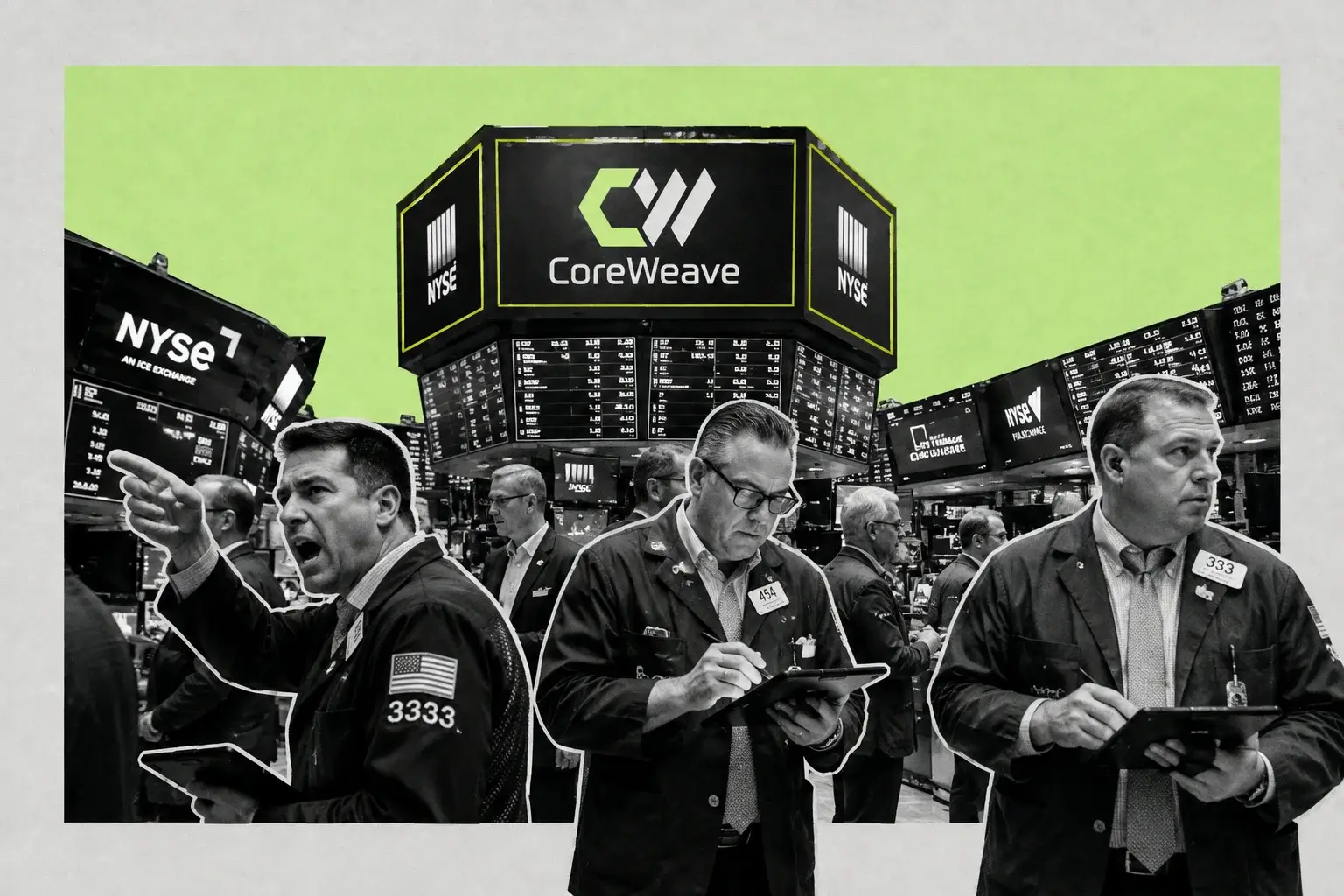
CRWV Trades 0.38x A $129B Backlog As Quarterly Interest Expense Hits $640M
Contribution margins on new contracts run 5 to 10 points above recent quarters | That's TradingNEWs
Key Points
- CRWV gapped roughly 6% premarket from $89.03, still 51.5% below its $183.58 peak from June 2025.
- Q2 revenue hit $2.58 billion, up 112%, with net loss widening to $626 million from $290 million.
- Backlog reached $104 billion at June 30 and $129 billion by August 11 after $29.6 billion in six weeks.
CoreWeave rose around 6% in premarket trading Thursday, taking the stock from a Wednesday close near $89.03 toward $94 and reversing a month of grinding underperformance.
Wednesday's session traded a $86.71 to $89.91 band, leaving market capitalization at $49.09 billion on roughly 551 million shares. The 52-week range runs $60.55 to $153.20, putting Wednesday's close 41.9% below the high and 47.0% above the low.
The catalyst is not company-specific and it is unusually direct for a company whose entire business is renting the supplier's hardware.
Nvidia reported quarterly revenue of $96.2 billion against a $92.07 billion consensus, with Data Center revenue at $89.0 billion, up 117% year over year. It guided the October quarter to $108.0 billion against $103.9 billion expected. CFO Colette Kress told investors to model approximately 70% revenue growth in fiscal 2028 against a Street sitting near 45%, with CEO Jensen Huang stating demand runs much greater than 70% and that supply is the constraint rather than orders.
Two disclosures matter more to CoreWeave than the headline. Nvidia declared that the Vera Rubin platform has entered full production — the architecture CoreWeave completed the first bring-up and validation of during the second quarter. And Amazon Web Services committed to purchasing 2 million Nvidia GPUs, which retires the argument that hyperscalers building custom silicon are about to stop buying merchant accelerators.
Supply commitments at Nvidia more than doubled from $119 billion to $279 billion in a single quarter, driven primarily by memory procurement. That is the supplier securing the components CoreWeave's forward backlog depends on.
Nvidia itself gained 7.32% premarket. Nebius rose around 7%, leading the neocloud complex. CoreWeave came in just behind at 6%.
The stock enters this gap having done nothing for a month. It closed around $89.76 on August 20, fell nearly 3% premarket on August 24 as the 30-year Treasury yield topped 5.3%, and has traded a narrow band ever since while the sector waited for the print that arrived last night.
What sits underneath is a company with a $129 billion backlog, $35 billion of debt, and $640 million of quarterly interest expense.
The Round Trip: $183.58 To $60.55 To $89
The price history since the March 2025 listing is one of the more violent in large-cap technology, and the direction has been down for fourteen months.
CoreWeave set its all-time closing high at $183.58 on June 20, 2025. Wednesday's close near $89.03 sits 51.5% below that peak. Over the same period, revenue has nearly tripled.
That divergence is the entire investment debate in one comparison. Full-year 2025 revenue reached $5.13 billion, up 167.94% from $1.92 billion in 2024, with losses widening 27.6% to $1.20 billion. Second-quarter 2026 revenue of $2.58 billion annualizes above $10 billion. The stock has halved.
The 52-week band tells the same story with different numbers: $60.55 at the low, $153.20 at the high. That is a 153% range, and current price sits almost exactly in the middle at 58% of the way up from the trough.
Year-to-date performance has been modest. As of the August 11 earnings close, CoreWeave had gained 26% in 2026 against roughly 13% for the S&P 500 — outperformance, but nothing resembling the 152% Nebius has produced over the same span.
The recent sequence: shares jumped 14% in extended trading on August 11 after the second-quarter beat. The stock then drifted, with a multibillion-dollar Hudson River Trading agreement announced August 19 producing a 1.4% decline on the day. Insider selling was flagged across August 19 and 21. On August 24, the stock fell nearly 3% premarket as technology came under pressure from rising global bond yields, with the 30-year Treasury above 5.3%.
Wednesday's $86.71 to $89.91 range on volume well below the 34.21 million daily average describes a market that had stopped participating.
The bond-yield sensitivity is the underappreciated feature here. CoreWeave carries $35 billion of debt against negative free cash flow. Every basis point on the long end feeds directly into its refinancing math, which is why a 5.3% 30-year sends the stock down 3% while the underlying business is signing $25 billion of new commitments.
That linkage is the reason this gap needs the regular session to confirm it.
Q2: $2.58 Billion Revenue, 112% Growth, $626 Million Loss
The August 11 print beat on both lines and the composition explains why the market's reaction was 14% rather than 40%.
Revenue came in at $2.58 billion against a $2.56 billion consensus, up 112% year over year. Adjusted loss per share was $1.03 against an expected loss of $1.20 — a beat of $0.17. Adjusted operating income reached $128 million with margins expanding sequentially and management guiding for continued improvement through the third and fourth quarters.
The GAAP number is where the model shows its cost. Net loss widened to $626 million from $290 million, or 60 cents per share, a year earlier. Revenue doubled and the loss more than doubled with it.
The driver is not operating expense. It is capital structure. Quarterly interest expense climbed to $640 million — five times the $128 million of adjusted operating income the business generated in the same period. Depreciation on $46.7 billion of deployed infrastructure does the rest.
Full-year 2026 guidance moved up on both lines: revenue to $12.4 billion to $13.2 billion, and adjusted operating income to $960 million to $1.15 billion. The full release publishes through CoreWeave's investor relations site.
Operating expenses rose meaningfully, including sales and marketing as the company invests in go-to-market capability — a signal that the customer base is broadening beyond the handful of anchor contracts that built the business.
CEO Michael Intrator described the quarter as an inflection point where scale began translating into operating leverage, with customer demand accelerating as enterprise adoption broadened.
The honest read on the numbers: revenue growth of 112% with adjusted operating income of $128 million against $640 million of interest expense means this business generates operating profit and hands all of it plus more to lenders. Positive adjusted operating income and a $626 million net loss coexist because the capital structure sits between them.
That gap closes only when the deployed asset base matures and depreciation normalizes against a revenue line that has stopped doubling — which is a 2028 event on the current buildout schedule, not a 2026 one.
The Backlog: $104 Billion At June 30, $129 Billion By August 11
The number that moved the stock more than the revenue beat was contracted future revenue, and its growth rate is the strongest data point in this story.
Revenue backlog stood at approximately $104 billion as of June 30, 2026, up from $99.4 billion at the end of the first quarter and $66.8 billion at the close of 2025. That is a 246% increase year over year.
That figure excludes more than $25 billion in net new customer commitments signed in the early weeks of the third quarter. Adding them, total backlog reached approximately $129 billion as of August 11 — growth of $29.6 billion in roughly six weeks.
The scale comparisons are what make it consequential. $129 billion represents roughly ten times projected full-year revenue at the guidance midpoint of $12.8 billion. It is approximately 2.7 times the $46.7 billion of deployed infrastructure on the balance sheet. And it is 2.6 times the current $49.09 billion market capitalization.
A company whose contracted forward revenue exceeds its equity value by 163% is either mispriced or carrying risk the backlog does not capture.
The caveat management itself acknowledges is conversion. Backlog is not immediately recognized revenue. CoreWeave still needs to build data centers, install GPU systems, secure electricity and bring infrastructure online before contracted demand converts. Every quarter of delay pushes revenue right while interest expense accrues on schedule.
The customer roster behind the backlog is the quality argument: Meta, Anthropic, OpenAI, Jane Street, Databricks, Runway ML, Cohere and Mistral. That is a mix of hyperscaler, frontier lab, quantitative trading and enterprise — considerably more diversified than the Microsoft-concentrated book that defined the company at IPO.
The renewal question drew a useful answer on the earnings call. Intrator noted that older-generation infrastructure retains significant value for many AI use cases, citing a recent A100 contract — a 2020-vintage SKU — priced out to 2029.
That single data point addresses the sharpest bear case on the entire neocloud model: that GPU assets depreciate to worthlessness in three years. A 2020 chip under contract through 2029 implies a nine-year useful life.
Meta's $35 Billion, Anthropic, Jane Street And Hudson River Trading
The contract activity across two quarters is where the backlog came from, and the deals are large enough to name individually.
Meta signed a $21 billion agreement to supply AI cloud capacity through 2032, layering on top of a prior $14 billion commitment. That takes the combined Meta relationship to $35 billion — roughly 27% of total backlog from a single counterparty.
CoreWeave reached a multi-year agreement with Anthropic to provide compute for Claude models. Jane Street committed $6 billion. Hudson River Trading signed a multi-year agreement announced August 19, described as multibillion-dollar.
Two quantitative trading firms with nine and ten-figure compute commitments is a genuinely new customer category. These are not AI labs training foundation models — they are latency-sensitive financial operations that historically built their own infrastructure. Their arrival signals the addressable market extending beyond the AI-native cohort.
The concentration risk cuts the other way. Meta at $35 billion is both the anchor that made the backlog credible and the single largest counterparty exposure in the book. Meta also happens to have narrowed its own full-year capital expenditure outlook upward to $130 billion to $145 billion, having swung from $19.8 billion to $31.1 billion of quarterly spend — a customer with the balance sheet and the stated intent to build its own capacity.
Meta has reportedly considered launching a cloud business of its own.
Other milestones during the quarter: CoreWeave was added to the Nasdaq-100 Index, which broadens the institutional holder base and increases index-flow sensitivity in both directions. And it completed what it described as the first bring-up and validation of Nvidia's Vera Rubin NVL72 system.
That last item is the direct link to Thursday's move. Nvidia confirmed last night that Vera Rubin has entered full production. CoreWeave was first to stand it up, which positions it to capture the earliest and highest-priced deployments of the architecture that will define the next eighteen months of AI infrastructure.
Being first on a new Nvidia platform is the closest thing this industry has to a moat.
Pricing Power: Contribution Margins 5–10 Points Higher
The most surprising disclosure in the quarter contradicted the consensus bear thesis outright.
New contracts are carrying contribution margins 5 to 10 percentage points higher than recent quarters. Intrator stated that pricing and margins for Blackwell and Vera Rubin SKUs are setting new highs, while pricing for prior-generation SKUs sits at or above where it was years ago.
CFO Nitin Agrawal confirmed the company is passing component price hikes down to customers.
That combination — rising prices on new hardware, holding prices on old hardware, and full pass-through of input cost inflation — is not what a commoditizing market looks like. It is what a supply-constrained one looks like.
The context makes it more striking. GPU rental was supposed to compress as capacity arrived. Instead, Nvidia notified clients of price increases exceeding 15% on servers built around Vera Rubin and Blackwell silicon, and CoreWeave has been able to move that entirely downstream.
Agrawal's framing on competition was direct: even with increased competition, demand, pricing and margin are all expanding, which signals growth in the product and in an already massive addressable market.
The memory cost dynamic reinforces it. Nvidia guided its own gross margin down from 75.0% to a 71% to 72% trough on memory pricing, having doubled supply commitments to $279 billion. Every operator downstream of that faces the same input inflation. CoreWeave's ability to pass it through while expanding contribution margin is the differentiating capability.
The A100 data point is the strongest evidence for durability. A 2020-generation chip priced under contract through 2029 means the asset base does not become worthless when the next architecture ships. It cascades down to inference, fine-tuning and less latency-sensitive workloads at lower but still profitable rates.
That changes the depreciation math materially. If GPUs generate revenue for eight or nine years rather than three, the $46.7 billion of deployed infrastructure supports a far longer amortization schedule and the current loss profile looks like an accounting artifact rather than an economic one.
The market has not yet accepted that framing. The stock trades 51.5% below its 2025 peak.
Power: 1.5 Gigawatts Active, 3.7 Contracted, 8 By 2030
The physical constraint on this business is electricity, and the numbers have been compounding fast.
Active power capacity reached 1.5 gigawatts as of June 30, having added nearly 500 megawatts during the second quarter alone, across 51 active data centers. That follows crossing 1 gigawatt during the first quarter.
Contracted power capacity stands at approximately 3.7 gigawatts — the pipeline from which future data centers get built. The stated target is more than 8 gigawatts by 2030.
The trajectory implied by those figures: 1.5 gigawatts active against 3.7 contracted means the company has secured 2.5 times its current operating capacity, with roughly 4.3 gigawatts of additional contracting required to reach the 2030 target.
Adding 500 megawatts in a single quarter is a genuine execution achievement. Grid interconnection queues across the United States run years long, and the ability to energize half a gigawatt in ninety days separates operators who can convert backlog from those who cannot.
The revenue translation is where power capacity becomes the valuation input. At the deal economics prevailing across this sector — roughly $20 million to $25 million per megawatt on multi-year contracts — 1.5 gigawatts of active capacity supports $30 billion to $37.5 billion of contract value at full utilization. Contracted power at 3.7 gigawatts supports $74 billion to $92.5 billion.
That reconciles reasonably with a $129 billion backlog, which implies either higher realized pricing or capacity commitments extending beyond the currently contracted power.
The risk management flagged on the call is regulatory. Community opposition to data center builds could affect future deployment locations, though current guidance remains unaffected. That is an increasingly live constraint as municipalities push back on power and water consumption.
The physical asset base underneath all of it is what secures the debt. CoreWeave borrows against GPU hardware clusters, using the creditworthiness of its take-or-pay contracts as the underlying collateral — a structure that only functions while the counterparties remain investment grade and the hardware retains resale value.
Capex At $35–$39 Billion Against $12.8 Billion Of Revenue
The spending guide is the number that stops every valuation model, and it went up rather than down.
Full-year 2026 capital expenditure guidance was raised to $35 billion to $39 billion, from a prior range of $31 billion to $35 billion. Second-quarter capex alone ran $9.4 billion.
Against full-year revenue guidance of $12.4 billion to $13.2 billion, the company plans to spend roughly three times its annual revenue on infrastructure in a single year.
Raising the range upward rather than signalling a pullback reflects management conviction that demand justifies continued acceleration. It also means cash flow pressure intensifies rather than easing through the second half.
The historical trajectory shows how fast this has scaled. Second-quarter 2025 capex was a then-record $2.9 billion. Second-quarter 2026 was $9.4 billion — a 224% increase in twelve months, with the bulk going toward Nvidia data center silicon.
The financing gap is the arithmetic problem. Adjusted operating income guides to $960 million to $1.15 billion for the full year. Capex guides to $35 billion to $39 billion. The difference has to come from debt, equity, vendor financing or customer prepayments.
CoreWeave has used all four. The company priced $2.25 billion of 1.75% convertible senior notes due 2031, upsized from an initially planned $2 billion. It has run a GPU-collateralized borrowing program throughout 2026.
The comparison to the closest peer is instructive on funding philosophy. Nebius guides to $20 billion to $25 billion of capex against $3.0 billion to $3.4 billion of revenue, with customer prepayments of $9 billion covering 50% to 60% of the spend. CoreWeave carries substantially more debt and has shown greater willingness to add more to accelerate expansion.
That is a deliberate strategic choice. Debt is cheaper than equity when the stock trades 51% below its peak, and speed matters when the constraint is capacity rather than demand.
It also means the equity is a leveraged call option on AI compute demand holding up through 2028.
Read More
-
Yen Stalls at 160 Despite a 3% JGB and Tokyo Core CPI at 2.0% — Intervention Sits at 164, Friday's Payrolls Decide
02.09.2026 · TradingNEWS ArchiveEnergy
-
Apple ($333.38) Loses $103B in Value as Memory Costs Squeeze Margins to 47–48%
09.10.2026 · TradingNEWS ArchiveStocks
-
XRP ($1.38) Slips Below Its 50-Day Average at $1.42 While Fund Buyers Keep Adding — 200-Day at $1.28 Is the Floor
09.10.2026 · TradingNEWS ArchiveCrypto
-
WTI ($91.63) Erases a 1.1% Loss on Gulf Shut-Ins, Brent Holds $100 After Iran Pledge — $104.26 in View Above $95.06
09.10.2026 · TradingNEWS ArchiveCommodities
-
S&P 500 +26 Points, Nasdaq +0.40%, Dow +0.34% as HUM Hits $433.77 and T Drops 6.81%
09.10.2026 · TradingNEWS ArchiveMarkets
-
Sterling Steady at 1.3240 After 5 Tests of 1.3182 as BoE Hike Bets Hit 85% — Budget on October 28 Decides the Break
09.10.2026 · TradingNEWS ArchiveForex
The Debt: $640 Million Of Quarterly Interest
The capital structure is the bear case and the numbers are large enough to matter.
Disclosures point to roughly $35 billion of total debt, with approximately $9.7 billion of obligations falling due within one year on the most recent breakdown of current and longer-term borrowings.
Quarterly interest expense climbed to $640 million in the second quarter. Annualized, that is $2.56 billion — against full-year adjusted operating income guided at $960 million to $1.15 billion.
The business generates roughly 40% of its own interest bill from operations.
That gap is the reason the net loss widened to $626 million even as revenue grew 112% and adjusted operating income turned positive at $128 million. The operating business works. The capital structure sitting on top of it does not yet.
Enterprise value to EBITDA runs approximately 20.5x, which is a demanding multiple for a business with this leverage profile and this level of near-term maturity.
The structural defence is take-or-pay contracting. CoreWeave borrows against GPU hardware clusters using the creditworthiness of its contracted revenue as underlying support. With $129 billion of backlog from Meta, Anthropic, OpenAI, Jane Street, Databricks and Hudson River Trading, the counterparty quality is genuinely high.
The vulnerability is refinancing rather than solvency. $9.7 billion due within twelve months has to be rolled, and the cost of rolling it depends on credit markets that have been volatile all month. The 30-year Treasury hit a 19-year high on August 17 and touched 5.3%, and CoreWeave fell nearly 3% on that alone.
The Treasury has since intervened, announcing it would at least double long-dated bond buybacks with operations running September 9 through November 4. The 30-year has settled to 5.161%.
That intervention is arguably as important to CoreWeave's equity as anything Nvidia said last night. A company refinancing $9.7 billion into a functioning long-end market is a different proposition from one refinancing into a disorderly one.
The $46.7 billion of deployed infrastructure on the balance sheet is the collateral base. Its value depends entirely on whether GPU assets hold residual worth — which the A100-through-2029 contract suggests they do.
Competition: SpaceX, Meta's Cloud Ambitions, And Nebius
The competitive set has broadened in ways that were not on anyone's list twelve months ago.
SpaceX has begun selling excess computing capacity. Meta — CoreWeave's largest customer at $35 billion of commitments — has considered launching a cloud business of its own. Both represent entrants with capital, power access and no need to earn a return on the infrastructure at market rates.
Nebius is the direct peer and it has been the better stock. Nebius reported second-quarter revenue of $582.3 million, up 454% year over year, with adjusted EBITDA of $236.2 million at a 41% margin. It carries more than $40 billion of committed backlog against a $58 billion market capitalization and has raised its contracted power target to 5 gigawatts.
The head-to-head: CoreWeave runs 4.4 times the revenue with 2.6 times the backlog. Nebius grows at 454% against CoreWeave's 112%. CoreWeave carries substantially more debt; Nebius funds through $9 billion of customer prepayments, asset-backed facilities and a $5.75 billion convertible.
Year to date, Nebius has run roughly 152% against CoreWeave's 26%. The market has paid for growth rate over scale.
IREN reports full fiscal-year results today, providing the third read on the sector before the November cycle.
Management's response to the competitive question was to point at the numbers. Even with increased competition, demand, pricing and margin are all expanding — which is measurably true given contribution margins on new contracts running 5 to 10 points higher.
The structural defence is that the addressable market is growing faster than the entrant count. Combined hyperscaler capital expenditure hit $166.0 billion in the June quarter, up 87% year over year and 27% sequentially, with ten-quarter growth of 272%. Nvidia just guided fiscal 2028 to approximately 70% revenue growth and committed $279 billion to supply.
In a market compounding at that rate, three additional operators do not compress pricing. They queue behind the same constrained silicon.
Valuation: A $49 Billion Cap Against A $129 Billion Backlog
The multiple is the most striking thing about this stock and the reason the bull case keeps getting restated.
At a $49.09 billion market capitalization, CoreWeave trades at 0.38 times its $129 billion backlog. Against the $104 billion June 30 figure, 0.47 times.
Against full-year 2026 revenue guidance of $12.4 billion to $13.2 billion, market cap represents 3.7 to 4.0 times sales at the midpoint. Enterprise value including $35 billion of debt takes that to roughly 6.6 times.
Compare that to Nebius at 18.2 times 2026 revenue guidance and 1.45 times committed backlog. CoreWeave trades at roughly a quarter of the peer's revenue multiple and a quarter of its backlog multiple.
The reason for the discount is entirely the balance sheet. $35 billion of debt, $640 million of quarterly interest, $9.7 billion due within a year, and a capex guide of $35 billion to $39 billion against $12.8 billion of revenue.
Enterprise value to EBITDA at 20.5 times is the multiple that actually captures the capital structure, and it is demanding rather than cheap.
The earnings picture remains negative. The trailing P/E of -24.04 reflects a $626 million quarterly net loss that widened year over year despite revenue doubling.
The bull framing is that the equity is optionality on a business that has already contracted ten years of revenue at current run rates. If backlog converts and the depreciation schedule proves conservative — the A100 evidence suggests it might — the company grows into its capital structure and the multiple re-rates violently.
The bear framing is that a leveraged business with negative free cash flow and a $9.7 billion near-term maturity does not get to choose its own timeline. Credit markets do.
The 12-month price history captures the disagreement: $60.55 to $153.20, with the stock currently at $89 and having spent fourteen months falling from $183.58 while revenue tripled.
Technical Structure: $153.20 Above, $89.03 Now, $60.55 Below
The chart is wide and the levels are far apart, which is what a 153% annual range produces.
Wednesday's close near $89.03 came inside a $86.71 to $89.91 session band. Premarket at 6% puts the stock near $94, which would clear the entire prior day's range.
Immediate resistance sits at $89.91, Wednesday's high, and then $93.55 — the level shares traded at shortly after the August 20 close of $89.76. Beyond that, the post-earnings pop on August 11 that produced a 14% extended-hours gain marks the next zone.
The 52-week high at $153.20 sits 72% above current price. The all-time closing high at $183.58 from June 20, 2025 is 106% above.
Support is more clearly defined. $86.71 marks Wednesday's low. Below that, the mid-$80s have held through the August consolidation, with the August 24 premarket dip on rising bond yields testing the lower end. The 52-week low at $60.55 sits 32% beneath current price.
Volume context matters for whether this gap holds. Wednesday's turnover ran well below the 34.21 million share daily average, and premarket activity has been thin. A 6% move on light volume is a positioning shift, not a repricing.
The behavioural pattern this stock has established since listing is that gaps get faded. Every rally since June 2025 has failed at a lower level, producing the 51.5% drawdown from peak despite revenue tripling.
Breaking that pattern requires the regular session to hold above $89.91 on volume at or above average.
The correlation worth tracking is not to Nvidia but to the long bond. CoreWeave fell nearly 3% when the 30-year topped 5.3% and has recovered as the yield settled to 5.161%. With $9.7 billion due inside a year, this equity trades credit conditions as much as AI demand.
Both are currently pointing the same direction. That will not always be true.
What Breaks This In Either Direction
The upside case now has supplier confirmation attached to it.
Nvidia guided fiscal 2028 revenue growth to approximately 70% against a 45% consensus, committed $279 billion of supply, disclosed a 2-million-GPU order from AWS, and declared Vera Rubin in full production. CoreWeave completed the first bring-up and validation of Vera Rubin NVL72, which positions it to capture the earliest and highest-priced deployments of that architecture.
Add contribution margins on new contracts running 5 to 10 points higher, Blackwell and Vera Rubin pricing setting new highs, prior-generation SKUs holding value with an A100 contract priced to 2029, and a backlog that grew $29.6 billion in six weeks to $129 billion.
If the third quarter shows adjusted operating income scaling toward the $960 million to $1.15 billion annual guide with margin expansion through the fourth quarter as management indicated, the leverage story starts resolving. At 0.38 times backlog and 3.9 times revenue, the re-rating room is substantial — $153.20 is 72% above spot.
The downside case is refinancing and conversion.
$9.7 billion of debt due within twelve months has to be rolled. Quarterly interest expense at $640 million exceeds annualized adjusted operating income. Capex guides to $35 billion to $39 billion against $12.8 billion of revenue, requiring continuous market access. The 30-year Treasury touched 5.3% ten days ago and the stock fell 3% on it.
Meta represents $35 billion of the backlog and has considered launching its own cloud. SpaceX has begun selling excess capacity. And backlog conversion requires data centers built, GPUs installed, and power energized on schedule — with community opposition already flagged as a deployment risk.
Any of those breaking sends the stock back toward the mid-$80s and, if credit conditions deteriorate, toward the $60.55 low.
The base case is neither. The gap holds or fades on Thursday's volume, and the genuine resolution arrives with third-quarter results in November — the first print that will show whether the $25 billion of early-Q3 commitments converted and whether operating leverage is real.
Forecast And Verdict: $89.91 Is The Gate, $86.71 Is The Line
CoreWeave at $94 premarket is the cheapest stock in the AI infrastructure complex on every forward metric and the most leveraged one on every balance sheet metric. Both facts are true and neither is going to resolve this week.
The bull case is documented. Revenue of $2.58 billion, up 112%, beating consensus. Adjusted loss of $1.03 against $1.20 expected. Adjusted operating income positive at $128 million with margins expanding sequentially. Backlog at $104 billion on June 30, up 246% year over year, reaching $129 billion by August 11 after $29.6 billion of growth in six weeks. Active power at 1.5 gigawatts after adding 500 megawatts in a quarter, contracted power at 3.7 gigawatts, targeting 8 by 2030. New contract contribution margins 5 to 10 points higher. A 2020-vintage A100 contracted through 2029. First to validate Vera Rubin NVL72, now confirmed in full production by the supplier. Market cap at 0.38 times backlog.
The bear case is the capital structure. $35 billion of debt with $9.7 billion due inside twelve months. Quarterly interest expense of $640 million against $128 million of quarterly adjusted operating income. Net loss widening to $626 million from $290 million. Capex guided to $35 billion to $39 billion against revenue of $12.4 billion to $13.2 billion. EV/EBITDA at 20.5 times. Meta at $35 billion of backlog considering its own cloud, SpaceX selling excess capacity, and a stock that has fallen 51.5% from its June 2025 peak while revenue tripled.
The levels: $89.91 is Wednesday's high and the minimum this gap must hold on the close. Above it, $93.55 and then the post-earnings zone, with the 52-week high at $153.20 the eventual objective. Below, $86.71 is Wednesday's low and the shelf; losing it returns the stock to the mid-$80s consolidation, with $60.55 the structural floor.
Call it justified on fundamentals and unproven on the tape. Nvidia just told the market that supply is the constraint and demand exceeds 70% growth into fiscal 2028. CoreWeave sells that supply and was first to stand up the architecture. The equity gets to participate only if the credit market stays open long enough for the backlog to convert.