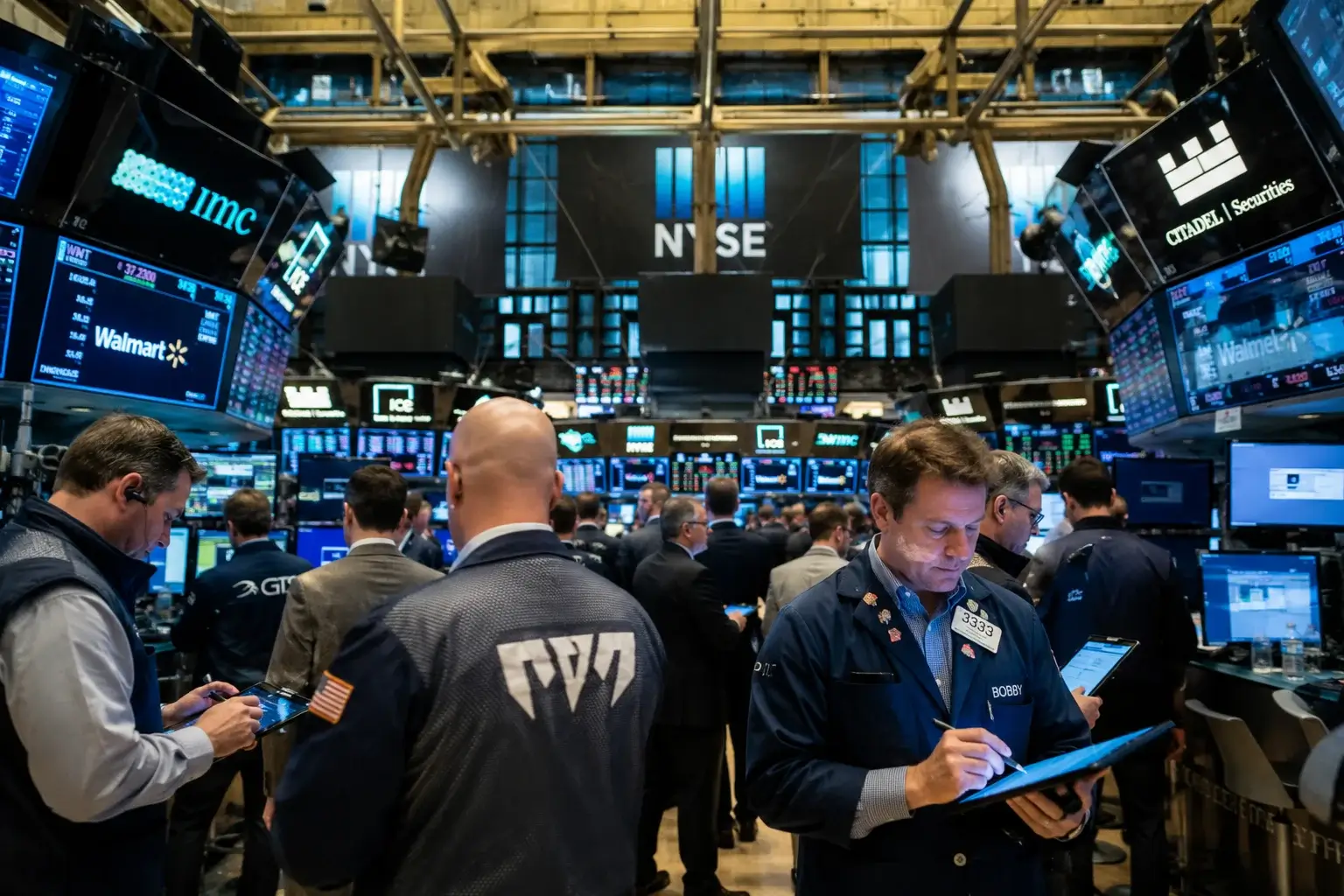
Dow DJI Holds +0.51% Near 52,233 as Oil Craters 6.5%, but Nasdaq IXIC Slips 0.25% and S&P 500 SPX Stalls at 7,411 on Chip-Equipment Rout
Wall Street round-tripped a 0.85% futures rally after reporting that a Shanghai state-backed firm began mass-producing immersion DUV lithography tools | That's TradingNEWS
Key Points
- S&P 500 (SPX) round-tripped to 7,411.25 from an intraday 7,430.83, landing within a point of Friday's 7,411.98 close.
- Dow (DJI) held +0.51% near 52,233 while Nasdaq (IXIC) fell 0.25% to about 24,913 on the chip rout.
- Brent gapped as much as 8.2% below $90 and WTI hit $83.37 as the US-Iran strike pause held.
The tape that opened Monday and the tape trading at midday are two different markets. Futures came in hot — S&P contracts up 0.85% at 7,511.00, Nasdaq-100 futures up 1.44% at 28,688.25, Dow futures up 0.86% at 52,572 — and the cash open delivered on it, pushing the S&P 500 (SPX) to 7,430.83 and the Nasdaq Composite (IXIC) to 25,021.14 by 10:13 a.m. Eastern. Ninety minutes later the entire move was gone. The S&P printed 7,411.25 at 11:16 a.m., down 0.73 points, sitting within three-quarters of a point of Friday's 7,411.98 settle. The Nasdaq had flipped from plus 45 points to minus 0.25%, near 24,913 against Friday's 24,975.82 close.
What survived was the Dow Jones Industrial Average (DJI), which held a gain of roughly 0.51% to 0.55% in a band between 52,212 and 52,233 versus Friday's 51,947.25. That divergence is the whole story: an index with no meaningful semiconductor weight and heavy exposure to transports, industrials, insurers and consumer names kept the oil dividend, while the cap-weighted benchmarks handed theirs back to a chip-equipment rout that arrived mid-morning and never let up.
Breadth told the same story in miniature. The Russell 2000 (RUT) opened up 1.28% at 2,967.43 and bled to plus 0.22% at 2,936.42 before stabilizing near 2,941.49, still green against Friday's 2,930.00 but a shadow of the small-cap risk appetite the futures session promised. Volatility went the wrong way for a relief rally: the Cboe Volatility Index (VIX) traded 17.74 in the pre-market, down 4.5% from Friday's 18.58, then reversed to 19.62 — a gain of 1.04 points, or 5.59% — as the chip selling accelerated. A rising VIX on a day the Dow is up 265 points is not a market that believes its own rally.
The weekly backdrop matters for context. The S&P shed 0.6% last week and the Nasdaq dropped 2.1%, back-to-back weekly losses for both, while the Dow's 0.4% decline marked a third consecutive down week. Thursday was the damage: the Dow lost 506.93 points, or 0.97%, to 51,711.65, the S&P fell 1.21% to 7,408.30 and the Nasdaq slid 2.15% to 25,137.69. Friday steadied things — the S&P closed up 3.68 points, the Dow gained 235.60 — but the Nasdaq still lost 0.64%. The index enters this week up 8.28% year to date, 16.48% over twelve months, and 2.8% below its 7,620.90 fifty-two-week high.
Brent Gaps Below $90 as the Iran Strike Pause Holds, Erasing a Month of Supply Panic
The bid under everything Monday morning came from crude, and the size of the move explains why equity futures were priced for a melt-up before the bell. Brent September futures gapped lower at the Asian open and fell as much as 7.4% to 8.2%, breaking below $90 a barrel from Friday's settle near $96.80, printing $89.43 by 7:24 a.m. Eastern before paring roughly half the loss and trading around $92. West Texas Intermediate September contracts dropped 6.7% to $83.37 at the same timestamp, and were down 6.45% near $83.50 by late morning against Friday's $89.31 close, having traded as high as $85.48 in the interim.
The trigger was the absence of gunfire. The United States paused an almost two-week campaign of strikes against Iran starting late Friday without an official announcement, and Tehran signalled it had halted retaliatory action and would keep doing so as long as the American pause held. No US strikes have been reported since Thursday overnight; no Iranian assaults on regional US bases since Friday. Iran opened a channel with Oman specifically on the Strait of Hormuz, the chokepoint that carried roughly a fifth of global oil and gas before the war and through which tanker traffic has been disrupted for weeks.
The pause is not a peace deal, and the tape is pricing that distinction. Iran-backed Houthi forces claimed responsibility over the weekend for attacks on Saudi Aramco-linked facilities at the Red Sea ports of Jizan and Yanbu — the alternative export route Riyadh has been leaning on precisely because Hormuz is compromised. Last week, Houthi strikes on two Saudi tankers in the Red Sea are what drove Brent above $100 on Thursday for the first time since late May. Separately, the Caspian Pipeline Consortium suspended crude loadings at its Black Sea terminal following tanker attacks, freezing roughly 80% of Kazakhstan's export capacity.
Scale the move properly. Even after Monday's collapse, Brent is up close to 40% this month and more than 50% year to date. This is a violent unwind of a supply premium, not a return to normal. European natural gas fell alongside crude. Gold pushed back above $4,100 overnight before settling near $4,076 to $4,077, up marginally on the day against Friday's $4,070.80. The dollar weakened against every G10 counterpart. That is a textbook risk-on, inflation-relief configuration — and equities still could not hold it.
A Shanghai DUV Breakthrough Report Detonates the Chip-Equipment Complex
The rally died at roughly 9:56 a.m. Eastern, when reporting landed that a Shanghai-based, state-backed Chinese company has begun mass-producing homegrown immersion deep-ultraviolet lithography machines for the first time. The account, sourced to two people familiar with the effort, said the firm assembled DUV development teams poached from other Chinese outfits, including a state-backed startup working on the same problem, to reach the milestone.
ASML (ASML), which had been trading higher through the Amsterdam session and was up more than 2% into the New York open, erased everything. The stock fell as much as 6.6% to its lowest level since early June and was down 7.21% in US trading. The math behind that reaction is not subtle. American and Dutch export controls already bar ASML from shipping cutting-edge EUV systems into China, so Chinese fabs spent years stockpiling the older immersion DUV tools instead — and China now accounts for 29.1% of ASML's net sales. If domestic Chinese suppliers can deliver viable DUV, the company's largest remaining Chinese revenue line is structurally exposed.
The read-through hit everything downstream, because lithography is the acknowledged hard problem. If Chinese engineering has cleared the toughest bottleneck in the process flow, deposition, etch and metrology look considerably more replaceable. Applied Materials, Lam Research (LRCX) and KLA were dragged down in sympathy, and the VanEck Semiconductor ETF (SMH) traded 3.7% lower, extending Friday's 3% decline. The timing amplified it: Congress is currently advancing bipartisan legislation aimed at restricting Chinese access to this exact category of equipment, which turns a single supply-chain report into a policy question.
There is a credible counter-case, and it circulated fast. The Chinese systems are being characterised as roughly comparable to what ASML shipped in 2007, and shipment plans for next year run to about twenty machines against ASML's output of hundreds annually. Separate reporting has China's EUV prototype still in testing without having produced functional chips, with an official 2028 target that people involved privately consider more realistic at 2030. Twenty tools of a two-decade-old generation does not displace a monopoly.
None of which mattered to the tape. The report reframed the entire semicap thesis from cyclical to terminal for a session, and positioning in a group that has tripled and quadrupled over twelve months had no cushion for that question.
Memory, Semicap and Optical Names Take the Full Hit, With Sandisk Down 11%
The loser board Monday was a single sector wearing twenty-five different tickers. Sandisk (SNDK) fell 11.07% to $1,277.48, shedding $159.08 in a session and lopping roughly $23 billion off a $189 billion market capitalisation. MaxLinear (MXL) dropped 10.48% to $64.08, extending a brutal run after a 21.54% collapse Friday. Silicon Motion (SIMO) lost exactly 10.00% to $243.80.
Then the equipment supply chain, in order of pain: Ichor (ICHR) down 8.58% to $79.13, Ultra Clean (UCTT) off 7.94% to $85.39, ACM Research (ACMR) down 7.84% to $77.71, Veeco (VECO) lower by 7.68% to $47.69, Bel Fuse (BELFB) off 7.57%, Amkor (AMKR) down 7.37% to $60.17, Coherent (COHR) lower 7.30% to $261.78, TTM Technologies (TTMI) off 7.03%, Cohu (COHU) down 6.91%, Lam Research (LRCX) lower 6.70% to $284.77, MKS (MKSI) down 6.65% to $307.29 and Lumentum (LITE) off 6.54% to $713.10. Teradyne fell more than 7%.
The large caps were not spared. Advanced Micro Devices (AMD) dropped 6.87% to $486.10, wiping roughly $58 billion from a $793 billion cap. Western Digital (WDC) fell an identical 6.87% to $484.10. Micron (MU) declined 3.95% to $884.61, trading with a $999 billion market value after failing to breach $1,000 a share earlier in the month. SK hynix (SKHY) lost as much as 7.00% to $143.76, printing a fresh fifty-two-week low against a $145.57 floor and carrying a $1.02 trillion valuation into Wednesday's results. Nvidia (NVDA) held up comparatively well, off 2.62% to $201.43 with a $4.879 trillion cap. Intel (INTC) fell 1.77% to $90.69 on 27.02 million shares.
The fifty-two-week columns explain the fragility. Sandisk is up 3,329% over twelve months. Western Digital is up 653%, Lumentum 612%, Micron 728%, Intel 346%. Ichor is up 303%, Ultra Clean 275%, MKS 222%, Amkor 206%, Lam 209%. This is a group that has repriced by multiples on an AI memory and optical supercycle, and it has no valuation floor to fall back on when the narrative gets questioned. Friday already delivered a warning shot — Intel fell nearly 8% despite beating on second-quarter earnings, Micron dropped 7%, Broadcom lost 2.7% and AMD fell 3.3%. Monday was the follow-through, with a new and more structural excuse attached.
Enterprise Software Rips Higher as Capital Rotates From Infrastructure to Applications
The mirror image of the chip wreckage was the best software tape in weeks. HubSpot (HUBS) gained 8.22% to $221.73. Shopify (SHOP) rose 8.13% to $123.00, adding roughly $12 billion to a $160 billion cap. Workday (WDAY) climbed 7.99% to $146.16 and Atlassian (TEAM) matched it at 7.99% to $93.82. RingCentral (RNG) added 7.97% to $52.16, following a 25.09% moonshot Friday. Wix (WIX) rose 7.90% to $55.47, Braze (BRZE) 7.84%, Pegasystems (PEGA) 7.72% and Vertex (VERX) 8.01%. Guidewire (GWRE) gained 6.63% to $147.40, Intapp (INTA) 6.90%, and Oracle (ORCL) rose 5.14% to $120.90 on 8.6 million shares.
Understanding the violence of that move requires the year's context. Software has been the wreckage of 2026. The iShares software index is down more than 21% year to date against a Nasdaq up 18%, on a thesis nicknamed the SaaSpocalypse: that autonomous AI agents would bypass per-seat subscription licensing entirely and gut the business models of every incumbent platform. The most recent leg down came on July 23, when an enterprise AI agent platform launched from the model layer packaging reasoning, data access, governance and policy control — precisely the capability stack SaaS vendors have been using to defend their own AI stories. Workday fell 9.9% off that news, Atlassian 11.8%, HubSpot 12.7%, Salesforce 7.7% and Okta 4.2%, with the broader software index down 3% in a session.
Monday's bid is that trade unwinding into a semiconductor scare, and it started Friday. Look at last session's closes: ServiceNow up 7.44%, Adobe 6.10%, Accenture 5.95%, Workday 5.84%, Intuit 5.26%, HP 5.06%, Cognizant 5.67%, Salesforce 4.29%, GoDaddy 6.32%, Paycom 4.79%, Trimble 5.08%, Gartner 5.09%. Meanwhile technology hardware bled: the technology sector ETF fell 1.4% while real estate gained 2.2% and materials added 1.9%, with ten of eleven S&P sectors closing green.
The mechanism is straightforward. Money is leaving the layer that requires $700 billion of annual capital expenditure to compete and moving to the layer that monetises what that capital builds. Whether the application layer actually captures that value is the question of the next four quarters. Monday it captured the flows.
SAP's Record €22.9 Billion Cloud Backlog Anchors the Software Bid
SAP (SAP) rose 6.79% to $170.87, up $10.87, carrying a $201 billion market value and extending a post-earnings run that has taken the ADRs from roughly $149 immediately after the print to a $160 handle by Friday's close and now through $170. That trajectory is the fundamental spine of the software rotation, because SAP delivered the one number the bears could not explain away.
The July 23 second-quarter results: total revenue of €9.88 billion, up 9% from €9.03 billion and ahead of the €9.85 billion consensus. Non-IFRS earnings of €1.59 per basic share against €1.50 a year earlier. Cloud revenue of €6.28 billion, up 22%. Cloud ERP suite revenue of €5.53 billion, up 25% and now representing 88% of total cloud revenue. Operating cash flow up 22% to €3.2 billion and free cash flow up 27% to €3 billion. Non-IFRS gross profit up 9% to €7.3 billion.
The headline figure was current cloud backlog: €22.9 billion, up 27% year over year and 26% in constant currency, against sell-side models clustered near 24.3%. That acceleration matters more than the quarter itself, because it directly contradicts the agentic-disruption thesis. Backlog is contracted future revenue. A company being structurally displaced by AI agents does not accelerate its committed pipeline by 26% while guiding to a slight deceleration.
Not everything was clean. Operating profit came in at €2.64 billion against €2.88 billion expected, up from €2.46 billion but margin-diluted to 27.8% by acquisition integration, elevated research spending, marketing tied to the Autonomous Enterprise launch and stock-compensation effects. Software license revenue fell 32% as the on-premise book continues to run off by design. Full-year non-IFRS profit guidance was trimmed slightly on acquisition dilution, while cloud revenue targets of €25.8 billion to €26.2 billion and free cash flow near €10 billion were reaffirmed. Cloud strength skewed to Asia-Pacific, Japan and EMEA, with standout performance in Brazil, France, Germany, Italy, India, South Korea and Spain, and particular strength in Australia, Singapore and the United States.
Price targets were trimmed at the margins while ratings held. The trims are noise; the €22.9 billion is the signal, and it is the number software bulls have been waiting eighteen months to point at.
Read More
-
Yen Stalls at 160 Despite a 3% JGB and Tokyo Core CPI at 2.0% — Intervention Sits at 164, Friday's Payrolls Decide
02.09.2026 · TradingNEWS ArchiveEnergy
-
T-Rex 2X Inverse MSTR ($4.39) Rips 10.44% as Strategy Pauses Bitcoin Buys for a 2nd Week — $4.63 Close Opens $5.27
15.09.2026 · TradingNEWS ArchiveStocks
-
XRPR ($10.59) and XRPI ($7.04) Open at Highs and Close at Lows After Senate Kills CLARITY Act
15.09.2026 · TradingNEWS ArchiveCrypto
-
NG ($2.908) Holds Above $2.80 Low as LNG Feedgas Hits 18.8 Bcf and TTF Trades 9.2x Henry Hub
15.09.2026 · TradingNEWS ArchiveCommodities
-
USD/JPY (155.09) Faces 275bp Policy Gap as BOJ Prepares 31-Year-High Rate — Close Below 154 Opens 153.40
15.09.2026 · TradingNEWS ArchiveForex
A Live Fed Meeting Wednesday With a One-in-Three Hike Priced
Wednesday at 2 p.m. Eastern the Federal Open Market Committee delivers its decision, followed by a press conference at 2:30. The consensus is a fifth consecutive hold at a 3.50% to 3.75% target range, unchanged since the end of last year. The tail is what makes this meeting genuinely two-sided.
Rate-futures pricing has repriced violently. On July 15, the probability of a July hike sat at 10.7%. By July 22 it had more than tripled to 34.7%. As of July 24 the market showed a 64.2% chance of no change and a 35.8% probability of a quarter-point increase, with some readings putting hike odds as high as 38%. A week earlier it had been near 90% for a hold. September is where the real conviction sits: odds of a hike at that meeting have climbed to roughly 82%, up from 52% a week prior.
The driver was crude. Oil above $100 fed straight into the inflation calculus, and Monday's collapse below $90 pulls in the opposite direction two days before the decision. That is the cleanest dovish input the committee has received in a month, and it arrives too late to change a statement that is already largely written.
The complication is the chair. Kevin Warsh, who took the seat in June, has explicitly abandoned traditional forward guidance and declined to submit individual projections at his first meeting. He told an audience in Sintra on July 1 that prices are too high, reaffirmed a hard 2% target, and dismissed any tolerance for drift above it. That leaves markets with far less insight into his reaction function than they had under his predecessor, which mechanically widens the distribution of outcomes around the announcement.
The committee itself is split down the middle. Of the eighteen policymakers who submitted June projections, half supported holding or cutting and half advocated raising rates before year-end. June CPI and PPI both cooled more than expected, handing the doves data cover. Against that, desk commentary has flagged that oil pass-through is incomplete, that the absence of demand destruction at elevated energy prices worsens the inflation trajectory, and that AI-driven price increases are contributing independently. The prints for the next several months are not expected to look good.
Treasuries Rally Across the Curve While the Dollar Slides Against Every Major Peer
The bond market took the oil move immediately and enthusiastically. The two-year yield traded almost four basis points lower at 4.29% early Monday, and the ten-year fell over four basis points to 4.63%. Both are retreating from cycle highs set Thursday and Friday — the highest levels across the curve since late 2024. The thirty-year sits at 5.16% after slipping 0.17% Friday.
The two-year is the instrument that matters here, and desk commentary has been consistent that its level is more informative than the long end for reading the policy path. A four-basis-point rally is a nod to cheaper energy, not a repricing of the Fed. Notes late Friday flagged that while easing energy prices support the front end, yields remain near the top of their recent range because investors are still pricing a hawkish central bank. That is the correct read: the curve has taken the oil relief and held the policy risk.
The Japanese curve flattened last week as front-end yields rose faster than the long end on expectations of further Bank of Japan tightening later this year. The two-to-ten spread there peaked at 145 basis points in early July and sat near 125 basis points Monday, with the ten-year JGB down five basis points against a one-basis-point decline at the two-year.
Currencies delivered the cleanest risk-on signal of any asset class. The dollar weakened against all of its G10 counterparts, a broad and uniform move that speaks to a genuine unwinding of the geopolitical premium rather than a rates-driven adjustment. Gold, which normally struggles when the safety bid fades, pushed above $4,100 overnight and held near $4,076, up on the session — the metal is trading as an inflation and debasement hedge, not a fear asset.
Digital assets firmed with the relief. Bitcoin traded between $64,580 and $65,250, up as much as 1.10%, while Ether outperformed at $1,963.57, up 4.45%. That follows a punishing Friday for crypto equities: Cipher fell 10.3%, IREN 8.7% and CleanSpark 7.0%, with Coinbase and Strategy each down about 2%. Institutional flows turned decisively negative — US spot bitcoin ETFs shed roughly $225 million Thursday and a further $240 million Friday, with about 90% of that concentrated in a single fund, erasing most of July's inflows. Coinbase reports Thursday.
Nvidia's Reported $250 Billion Backstop for an Ohio Campus Reopens the Circular-Financing Debate
The weekend's other headline was supposed to be bullish, and for about half an hour it was. Reporting Sunday said Nvidia is in talks to provide roughly $250 billion in financing guarantees to help OpenAI lease a 10-gigawatt data centre campus being developed in southern Ohio by SoftBank's energy subsidiary. Total project cost, including silicon, is put above $500 billion.
The structure is the story. The $250 billion guarantee covers the data centre lease and construction debt — not the Nvidia chips inside. If OpenAI misses lease payments or fails to service the debt, Nvidia covers the obligation and OpenAI keeps the building. Separately, Nvidia is reportedly discussing financing OpenAI's chip purchases worth up to $350 billion. Phase one is targeted for 2028 at roughly 800 megawatts. Power is controlled by the US government and funded separately by Japan under a recent trade arrangement tied to a $33 billion pledge for a natural gas plant, with the Commerce Secretary personally involved in allocating access. Anthropic, Microsoft and Google have also been in conversations about the site.
The market's problem is what the deal implies. A chipmaker co-signing a lease for its own customer is the clearest possible evidence that conventional lenders declined to underwrite that customer directly — OpenAI carries no investment-grade rating against roughly $25 billion in projected 2026 revenue. It is a contingent liability Nvidia cannot book as revenue or offset with equity upside.
The pushback was immediate and pointed. A prominent short-seller who disclosed and expanded a Nvidia position in a July 24 post reacted by framing the arrangement as Nvidia guaranteeing OpenAI's spending on Nvidia chips — the circular-financing critique that has been building for months, now with a $250 billion number attached to it. Nvidia closed Friday down 0.92% at $206.84 and fell a further 2.62% Monday to $201.43.
Meanwhile the credit market is flashing. The high-yield corporate bond ETF has slipped nearly 1% in July and is tracking a third straight monthly decline, five in the past six months, with March lows back in play. Discretionary investor positioning has fallen to the seventeenth percentile, back to early-April lows and well below what earnings and macro growth would imply, while systematic strategies remain at the seventieth percentile. Equity positioning is neutral into the biggest earnings week of the quarter.
Microsoft, Meta, Apple and Amazon Report Into a Market That Has Turned on Capital Expenditure
Wednesday after the close brings Microsoft (MSFT) and Meta Platforms (META). Thursday after the close brings Apple (AAPL) and Amazon (AMZN). Four of the most valuable companies on earth, reporting into a tape that has spent two weeks punishing exactly the thing all four are doing.
Microsoft closes fiscal 2026 with consensus earnings of $4.21 per share. Azure is the only number that matters: management guided 39% to 40% constant-currency growth against an investor bogey nearer 36%. The second question is capital expenditure, where the Street expects the 2026 forecast to be lifted toward $238 billion — a figure that will be read as either discipline or capitulation depending on whether it can be squared against rising memory costs. The stock carries a forward multiple near 20.6 times, a multi-year low, which is the market's way of saying bad news is substantially priced.
Meta reports second-quarter revenue against prior guidance of $58 billion to $61 billion, with earnings expected between $7.18 and $7.24 per share. Ad demand is not the issue: impressions grew 19% and pricing 12%. The swing factor is full-year capital expenditure guidance, currently framed at $125 billion to $145 billion, and whether operating margins hold above the 41.4% posted in the first quarter once Reality Labs losses and data-centre costs are absorbed. The stock slipped back below $600 ahead of the print, trading near 22 times earnings, and fell 1.80% Friday. Investors have been rotating out of Meta's AI story and into competitors that are showing cloud monetisation.
Apple reports fiscal third-quarter results with consensus earnings around $1.86 to $1.88 and revenue near $108.9 billion, in the final earnings call of Tim Cook's tenure as chief executive. Apple's advantage this quarter is what it has not spent: a deliberately capital-light AI approach that sidesteps the pressure crushing rivals. The stock closed Friday up 3.53% at $333.02 near its fifty-two-week high, and added another 1.06% to 1.10% Monday to $336.55. Amazon's consensus sits near $1.81 to $1.85 per share with North American segment revenue estimated around $113.8 billion, and AWS growth as the entire swing factor.
Combined 2026 AI capital expenditure across the four is running near $725 billion, up roughly 77% from about $410 billion in 2025.
Alphabet's $44.9 Billion Quarter Set the Template for How This Week Can Go Wrong
The reason the setup into Wednesday is hostile rather than merely uncertain is what happened to the company everybody considered the clean winner. Alphabet reported on July 22 and delivered a quarter that should have been unimpeachable: record revenue of $119.8 billion, cloud revenue growth of 82%, earnings of $9.11 per share, and robust growth across core segments driven by advertising performance that improved more than 14% year over year on model integration.
The stock fell 7% Thursday and has traded from $374 down to $319. The problem was $44.9 billion of quarterly capital expenditure, a full-year 2026 guide lifted to $195 billion to $205 billion, and a credit-rating agency warning that followed. Alphabet has the strongest AI position among the megacaps — popular consumer model products, homegrown data-centre silicon, an accelerating cloud franchise — and it was punished anyway for the cost of maintaining that position.
Tesla (TSLA) reported the same week and fell 14%. The index tracking the seven largest technology companies dropped 4.8% Thursday, its worst single session since the April 2025 tariff announcement. Tesla closed Friday down 2.08% and slipped a further 1.06% Monday to $309.72, holding a $1.223 trillion valuation at a trailing multiple near 290 times.
The mechanism is a genuine leadership rotation, not a sentiment wobble. The companies that have driven the S&P since the AI build-out began are ceding market leadership to the recipients of their spending — power producers, memory makers, optical suppliers, real estate operators with data-centre exposure. Digital Realty and a major oilfield services name each rose 11.01% Friday. Equinix gained 4.90%. Meanwhile, capital-expenditure concerns are overshadowing what is otherwise a strong reporting season, with S&P 500 net profit margins tracking toward the best level since 2009 and corporate optimism at a fifteen-year high.
That is the paradox this week has to resolve. Earnings are excellent. Margins are historically strong. Positioning is neutral and discretionary investors have cut exposure to April lows. And every incremental dollar of announced AI spending is being marked as a liability rather than an investment. Wednesday and Thursday will determine whether that repricing has run its course or is still in the early innings.
Baker Hughes Jumps 6.8% on an AI Power Order Book Even as Crude Craters
The single most instructive stock on Monday's board was an oilfield services company rallying hard on a day oil fell 6%. Baker Hughes (BKR) rose 6.79% to $61.13, up $3.88, on 5.16 million shares against an 8.44 million average — and it had only been up 2.36% at $58.60 in the pre-market before the conference call.
The company reported second-quarter results Sunday evening and hosted its call at 9:30 a.m. Eastern Monday. It beat expectations and raised its order outlook, guiding full-year 2026 revenue to $26.65 billion to $28.05 billion with adjusted EBITDA of $4.60 billion to $5.10 billion. The number that moved the stock was the Horizon 2 industrial and energy technology orders target, lifted to more than $45 billion, with management pointing explicitly at power generation and LNG demand rather than upstream drilling activity.
That is the reclassification. Baker Hughes is being priced as an AI infrastructure supplier that happens to sit in the energy sector — turbines and power systems for data centres, not pressure pumping. The company closed its acquisition of Chart Industries on July 16, adding cryogenic and gas-handling technology and broadening exposure to LNG, industrial technology and aftermarket services. It booked three awards in the second quarter for a Louisiana LNG facility covering liquefaction equipment, a boil-off gas re-liquefaction unit and a four-year fleet-wide turbine upgrade programme supporting over 6 million tonnes per annum of added capacity, plus a subsea production systems award for an Angolan ultra-deepwater development and a geothermal deployment agreement for North America.
The rest of energy behaved the way falling crude dictates. Chevron and ExxonMobil were each seen down 2.5% in the pre-market and ConocoPhillips off 3.2%, with the European majors lower alongside them. Venture Global (VG) fell 7.79% to $13.19. Energy led early losses on the S&P before the sector stabilised — Exxon closed Friday up 0.03%, Chevron up 0.19%, Conoco up 0.05%. Both Exxon and Chevron report Friday, closing out the week's calendar and giving the market a read on how a 40% monthly move in crude translates into realised earnings.
Biotech M&A, Quantum Squeezes and a $2.2 Billion Premium Round Out the Movers
Away from the chip-versus-software axis, the single-stock tape was unusually busy. Forte Biosciences (FBRX) surged after agreeing to be acquired for roughly $2.2 billion, at $77 a share in cash — a 41% premium to Friday's $54.78 close. That price is being read as a new valuation floor for clinical-stage immunology assets and is what pulled cash-rich acquirers into focus across the group.
On the other side, Legend Biotech (LEGN) fell 14.40% to $19.02 on 5.17 million shares against a 2.63 million average after disclosing that its chief executive stepped down from both the top job and the board effective July 24. That is the sharpest single-name decline on the loser board outside semiconductors.
Quantum computing squeezed violently higher. IonQ (IONQ) rose as much as 10.29% to $36.22 on 8.21 million shares, Rigetti (RGTI) gained 10.21% to $15.60 on 9.31 million, and D-Wave (QBTS) added 5.40% to $18.93 on 16.51 million. All three remain well below year-ago levels — IonQ down 22% over twelve months against an $84.64 high — which is precisely what makes them squeeze candidates when risk appetite returns to speculative tech.
Crypto-adjacent equities were mixed. Bitmine (BMNR) jumped 13.36% to $17.90 on 16.56 million shares, still down 55% over twelve months. Core Scientific (CORZ) fell 7.47% and Cipher (CIFR) dropped 7.26%, while IREN slipped 2.36% to $36.19.
Elsewhere: JBS (JBS) rose 8.53% to $13.33, Robert Half (RHI) gained 8.26% to $38.21, Wayfair (W) added 8.00% to $90.92, Academy Sports (ASO) rose 7.28%, Life360 (LIF) 7.20%, Thomson Reuters (TRI) 7.50% and Trump Media (DJT) 6.54%. SpaceX (SPCX) fell 3.05% to $111.56 and is now 50% off its all-time high, carrying a $1.47 trillion valuation. Bloom Energy (BE) closed Friday down 14.91% at $184.89 and reports Tuesday with a $20 billion contracted backlog against a stock sitting below its 20-day and 50-day averages. CoreWeave dropped 11.37%. Ford (F) rose 2.54% and American Airlines (AAL) 1.87% on cheaper fuel.
What Decides the Week: Wednesday's Statement, Thursday's Capex Guides, and Whether the Chip Bid Returns
The economic calendar is thin until the Fed. June durable goods orders landed Monday alongside Nucor's results. PayPal reports Tuesday. Wednesday brings the FOMC decision at 2 p.m. plus Qualcomm's third-quarter update, Procter & Gamble's fiscal fourth quarter and Coca-Cola, before Microsoft and Meta after the close. Thursday delivers Coinbase and then Apple and Amazon. Friday closes with Exxon and Chevron. SK hynix reports Wednesday into a stock already at fifty-two-week lows. AstraZeneca, Arm, Starbucks, Boeing and Ford fill in around them.
The backdrop numbers are constructive. Services PMI came in at 53.6, the fastest expansion in eight months. New home sales rose 1.6% to a 628,000 annualised pace in June from an upwardly revised May. June CPI and PPI both cooled. Corporate optimism is at a fifteen-year high and S&P 500 net margins are tracking the best since 2009. Global equities cooperated Monday: the DAX gained 1.31%, the Euro Stoxx 50 1.04%, the Stoxx 600 0.7%, the Hang Seng 1.01%, the Shanghai Composite 1.15%, Shenzhen 2.72%, the Kospi 0.97% after a 5.7% collapse Friday, and the ASX 200 1.39%.
The levels to watch are tight. The S&P is pinned at 7,411, exactly Friday's close, with the fifty-two-week high at 7,620.90 roughly 2.8% overhead and Monday's session floor at 7,396.53 from Friday's range. The Dow's 52,200 area is holding as the oil-relief beneficiary. The Nasdaq's 24,913 to 25,021 band is where the chip fight is being conducted.
Three things resolve this. Whether the Chinese lithography report survives scrutiny — twenty tools of 2007-vintage capability against hundreds of shipments annually is not a monopoly-breaker, and semicap has bounced from worse. Whether Microsoft and Meta can present capital expenditure as return-generating rather than value-destroying, after Alphabet proved that an 82% cloud growth rate does not buy immunity. And whether a committee split fifty-fifty on hiking treats a 6% single-day drop in crude as durable disinflation or as a two-day pause in a war that has already taken Brent above $100 twice this year. Positioning is neutral, credit is deteriorating, and volatility is bid on a green Dow. That is not a market with a clear direction — it is one waiting to be told.