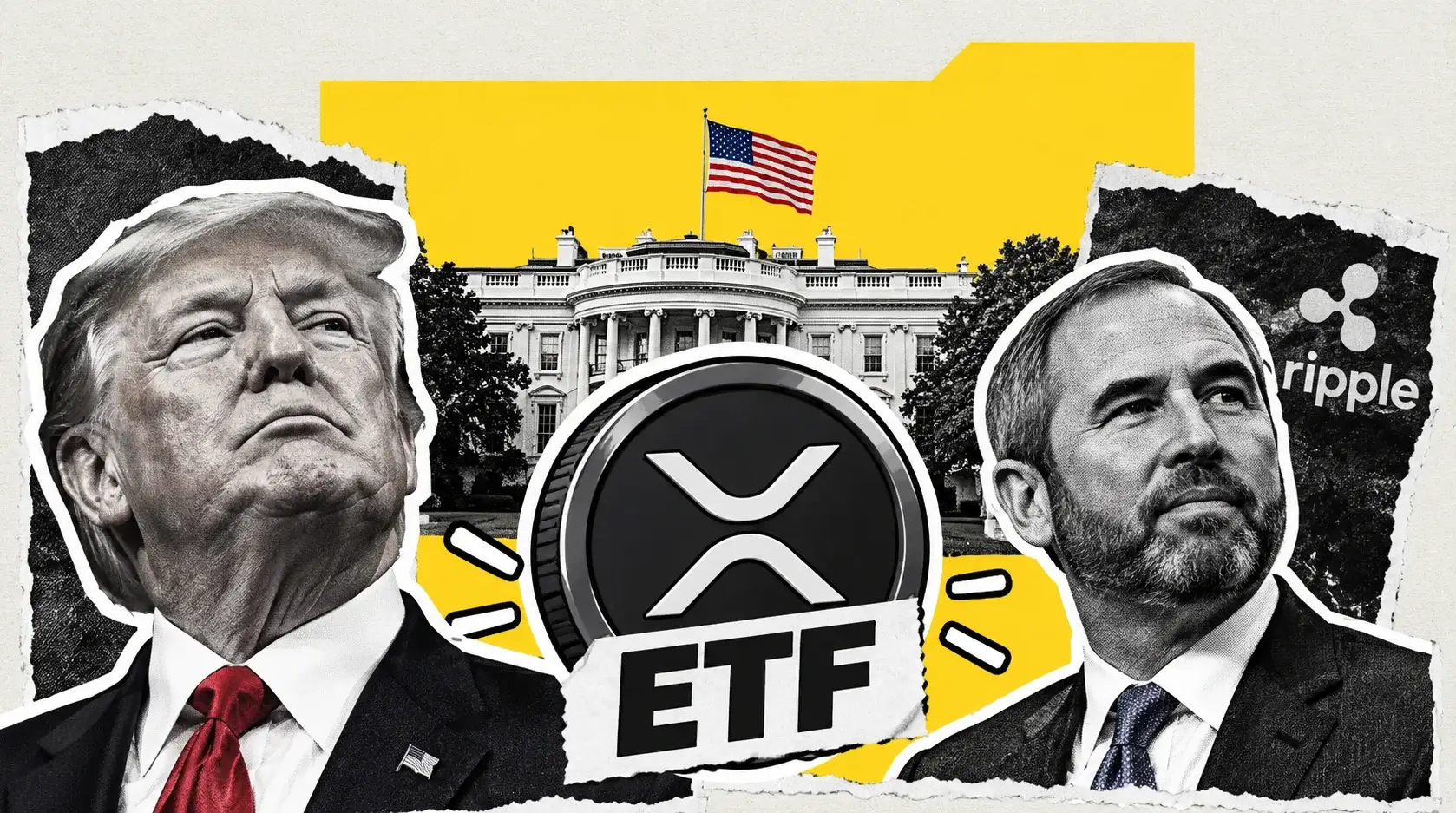
Eight Straight Green Weeks and XRP Still Sits at $1.39 — the Absorption Math Explains Why
The complex takes in roughly 109 million XRP a month against 200 to 400 million of net escrow release | That's TradingNEWS
Key Points
- XRP ETFs took $18.96 million last week, down 83% from the prior week's $110.49 million.
- Cumulative net inflows reached $1.66 billion with net assets near $1.44 billion.
- Locked tokens climbed from 478 million in January to over 900 million by June.
US spot XRP ETFs recorded approximately $18.96 million in net inflows during the week ended September 4. That extended the complex's positive streak to an eighth consecutive week.
It also represented a decline of roughly 83% from the prior week's $110.49 million — the largest weekly intake these products have posted in 2026.
On Friday, September 4 specifically, XRP ETFs recorded no net flows at all. Zero creations, zero redemptions, across the entire seven-fund complex on a session when Bitcoin ETFs took $174.60 million.
That is the state of regulated XRP demand nine days before the vote that determines whether it scales or stalls.
XRP itself traded near $1.39 on Tuesday with a market capitalisation of $89.26 billion and 24-hour volume of roughly $1.46 billion — down from $4.17 billion on September 4. Price has pulled back from an August peak near $1.70 and is consolidating above the $1.35 to $1.38 demand zone.
The complex holds approximately $1.44 billion in total net assets against cumulative net inflows of roughly $1.66 billion since launch. That gap is the mark-to-market loss carried by the funds' aggregate holdings.
Set the flow figure against its peers and the scale problem is immediate. In the same week that XRP ETFs took $18.96 million, US spot Bitcoin ETFs absorbed $986.9 million and Ethereum products took $218.41 million. Bitcoin's cumulative inflows since launch stand at $55.6 billion with net assets at $101.25 billion.
XRP's entire regulated complex is smaller than a single strong day for the Bitcoin funds.
The wider narrowing of institutional crypto demand explains part of it. Ether ETF weekly inflows fell 74% over the same window and XRP's fell 83%, as capital consolidated toward the largest and most liquid asset with the 10-year Treasury at 4.80% and a September 16 rate hike priced near 60%.
Eight Straight Positive Weeks and Nothing to Show for Them
The consistency of this complex is genuinely remarkable and it has produced no price result whatsoever.
Eight consecutive weeks of net inflows. An eleven-day streak adding $170 million through early September. Ten straight green sessions during the record week. A full month in May without a single day of net outflows.
That last achievement is unmatched by any other altcoin ETF class, and it happened during a window in which Bitcoin ETFs shed a record $4.4 billion.
XRP is down substantially over the same period. The token fell 7% to $1.20 during the broad crypto decline that accompanied May's record inflows, and it sits at $1.39 today against a July 2025 all-time high of $3.65703 — a drawdown of roughly 62%.
The flows are real. They are simply not large enough to matter against what is on the other side of the trade.
Three forces are adding supply while the ETFs absorb it. Escrow releases up to 1 billion XRP per month, adding predictable overhang even though most of it gets re-locked. Long-term holders who accumulated during the 2022 to 2023 base have been trimming into any strength. And retail speculative flow has thinned since the early-2026 rally, visible in lower daily turnover.
The net result is a price that grinds sideways and then lower despite steady wrapper demand.
The correct framing — established in prior coverage of this complex and confirmed by every month since — is that ETF inflows are a floor rather than a launchpad. Persistent accumulation provides downside support because every token locked inside XRPI, XRPR and the Bitwise product is a token that cannot be sold on an exchange.
But a floor is not a rally. Roughly $18.96 million of weekly buying against a $89.26 billion market capitalisation is 0.02% of the asset, and it does not move price against a structural supply schedule.
The volume collapse from $4.17 billion to $1.46 billion in four sessions tells you the marginal participant has stepped aside entirely ahead of the September 15 vote.
August at $150 Million Was the Best Month of 2026
The monthly progression through 2026 shows a complex that has been building rather than stalling, which makes the September slowdown more significant.
XRP ETFs gathered over $150 million in August — their best performance of the year, roughly $18 million above the previous 2026 high of $131.94 million recorded in May.
The distribution within the month is the important detail. The funds added roughly $1 million across the first two weeks of August, a window that also included a $3.5 million outflow on August 5. Then $31.78 million arrived in the week ending August 21, followed by $110.49 million in the week ending August 28.
So $142.27 million of a $150 million month landed in the final two weeks, and $110.49 million of it in a single week.
That week ranked as the funds' largest weekly total since the week ending December 5, when they pulled in around $231 million.
Two observations follow. First, XRP ETF flow is extremely lumpy — long stretches of near-zero activity punctuated by concentrated bursts tied to specific catalysts. Second, the August burst coincided precisely with XRP's rally from a cycle low of $0.9877 toward $1.70.
Flow followed price, as it does across every crypto ETF category. The funds did not drive the rally; they recorded it after the fact.
September's pace confirms the pattern in reverse. XRP peaked near $1.70 in late August, has since pulled back to $1.39, and weekly flow fell from $110.49 million to $18.96 million.
The forward projection offered on the August strength was that matching even half of that pace across all of September would produce roughly $220 million of net inflows — a level requiring only that current buyers continue at a rate below what the funds already recorded.
At $18.96 million in the first full week, that projection is running well behind schedule.
The Monthly Ladder: $58.09M, $81.59M, $131.94M, $150M
Laying out the 2026 monthly sequence gives the clearest picture of the underlying trend, and it is upward.
February delivered $58.09 million. April brought $81.59 million. May set a then-record at $131.94 million. August exceeded it at over $150 million.
That is a rising ladder across the year, with each new high roughly 15% to 40% above the prior one.
Weekly records tell the same story. The week ending May 15 produced $60.5 million, a 2026 high at the time, achieved even as Bitcoin and Ethereum products recorded outflows. The week ending August 28 more than doubled that at $110.49 million.
Cumulative inflows have grown accordingly — from roughly $1.4 billion in June to approximately $1.66 billion now, with a separate measurement putting the figure near $1.8 billion depending on the reporting window.
The trajectory is genuinely constructive. A newly launched altcoin ETF complex adding roughly $260 million of cumulative net inflows across a summer in which its underlying asset fell is not a failing product category.
The problem is the base. At $1.66 billion cumulative against an $89.26 billion market capitalisation, the entire regulated complex owns approximately 1.9% of XRP. Bitcoin's ETF complex owns roughly 6.5% of Bitcoin.
Reaching Bitcoin's penetration ratio would require roughly $4.1 billion of additional net inflows — which is, not coincidentally, close to the low end of the range estimated to arrive on regulatory clarity.
The current run rate does not get there. At $150 million a month, the complex would need more than two years, during which escrow would release between 4.8 billion and 9.6 billion additional tokens on a net basis.
That arithmetic is the reason September 15 matters more to this asset than any technical level.
Bitwise Took 61% of August and Its Filing Shows the Cost
Issuer concentration in this complex mirrors what has developed in Bitcoin ETFs, and the leader's own disclosure is the most revealing document available.
Bitwise's fund led XRP ETF issuers in August, adding roughly $92 million — 61% of the $150 million the complex recorded for the month.
The fund's quarterly filing for the period ended March 31, 2026 shows an investment in XRP carried at a cost of $371,842 thousand against a fair value of $261,933 thousand. The cost basis at December 31, 2025 was $265,678 thousand.
Read those numbers carefully. As of March 31, the fund had deployed $371.8 million of investor capital and that position was worth $261.9 million — an unrealized loss of $109.9 million, or 29.6% of cost.
The fund held 100% of net assets in XRP with assets in excess of liabilities at negative $78 thousand, a rounding item.
Cost basis rising from $265.7 million at year-end to $371.8 million at the end of March means the fund added roughly $106 million of new purchases in a single quarter while its existing position was declining in value.
That is the mechanics of a continuously-creating ETF in a falling market, and it is the honest financial picture behind every "record inflows" headline in this category. The complex has been buying steadily into a downtrend, and its shareholders carry the mark.
Filings are available at sec.gov.
The concentration itself is a structural feature worth flagging. When one issuer accounts for 61% of monthly flow, the complex has a single point of failure in the same way Bitcoin's does with its dominant product — and there is no second buyer positioned to offset a reallocation.
The seven-fund complex is anchored by REX-Osprey's XRPR, the XRPI wrapper product, and Bitwise's XRP ETF on NYSE Arca. The remaining four are marginal contributors.
XRPI Near $7 Against a $23.53 Fifty-Two-Week High
The named products themselves show what holding this exposure has cost.
XRPI traded near $7 against a 52-week range of $6.50 to $23.53. That is a decline of roughly 70% from the high, tracking XRP's own drawdown, with the product sitting within 8% of its all-time low.
XRPR traded near $10 against a floor around $9.50 — within 5% of its own low.
Bitwise's XRP product traded around $14.
Those levels reflect both the price decline and the support the flows provide. The products sit near their floors, depressed but held up by persistent creations.
For an investor evaluating entry, the setup has a specific shape. A wrapper trading at $7 against a $23.53 high offers substantial upside if XRP recovers toward prior levels, and the ETF structure removes custody and exchange counterparty risk relative to holding the token directly.
It also carries a management fee that a spot holding does not, and it does not participate in any yield.
The relationship between the wrapper price and the token is close to mechanical. XRPI at $7 with XRP at $1.39 implies roughly five XRP per share before fees. A move in XRP to $1.86 — the flagged breakout level — would take XRPI toward $9.30. A move to $2.00 would take it toward $10.
Conversely, a break of XRP's $1.35 demand zone toward $1.20 would put XRPI near $6.00, below its 52-week low.
The wrappers therefore offer no protection on the downside and full participation on the upside, minus fees. That is exactly what they are designed to do, and it means the entire analysis reduces to a view on the token.
Which reduces to a view on September 15.
Read More
-
Yen Stalls at 160 Despite a 3% JGB and Tokyo Core CPI at 2.0% — Intervention Sits at 164, Friday's Payrolls Decide
02.09.2026 · TradingNEWS ArchiveEnergy
-
QQQ ETF ($706.22) Slides 7.4% Below Its High as the Market Reprices the AI Capex Bill — $686.57 Target if $700 Breaks
22.10.2026 · TradingNEWS ArchiveStocks
-
XRPI ($7.00) and XRPR ($10.74) Slide Toward 52-Week Lows as Spot XRP ETF Flows Stall at $708,510
22.10.2026 · TradingNEWS ArchiveCrypto
-
NG ($2.775) Decoupled From Europe’s €88 Gas Crisis as LNG Feedgas Hits 18.9 Bcf/d — $3.30 Upside on Cold Weather
22.10.2026 · TradingNEWS ArchiveCommodities
-
Dollar-Yen (157.35) Loses 157.65 as the Yen Rallies on Haven Demand — 155 Target if 156 Breaks
22.10.2026 · TradingNEWS ArchiveForex
Locked Tokens: 478 Million to Over 900 Million in Five Months
The most durable achievement of this complex is measured in tokens rather than dollars.
XRP locked in ETF custody climbed from roughly 478 million tokens in January 2026 to over 900 million by June — a near-doubling in five months, achieved while the price was falling.
By early June the figure stood above 800 million, and the trajectory has continued through the eight-week positive streak since.
That steady accumulation regardless of the declining price is the defining feature of the complex. Institutions and retail buyers kept purchasing and locking up XRP through the wrappers throughout the decline, building a structural position that grows month after month.
Tokens locked inside an ETF are functionally removed from exchange order books. They can only be liquidated through the redemption mechanism, which requires an authorised participant transaction rather than a market sell order. That makes them materially stickier than tokens held on an exchange.
Nine hundred million XRP against a circulating supply near 64 billion is approximately 1.4% of the float. Not decisive, but real, and growing.
The comparison that matters is against escrow. Ripple releases up to 1 billion XRP per month from escrow, with net release after re-locking running 200 million to 400 million tokens.
The complex added roughly 422 million tokens across five months — an average of about 84 million per month, rising to approximately 109 million at the current absorption rate.
Escrow releases between 200 million and 400 million net over the same period.
So the ETF complex has been absorbing somewhere between one-quarter and one-half of net new supply while the rest goes to the market.
That is the arithmetic behind every "record inflows, falling price" headline this year, and no amount of flow consistency changes it until the absorption rate at least doubles.
Eighty-Four Percent Retail Is the Structural Problem
The composition of this complex's demand is the single most important thing separating it from the Bitcoin ETF category.
Retail drives 84% of XRP ETF inflows. Institutional capital is largely sitting out.
That ratio explains the flow pattern completely. Retail money is momentum-following and price-sensitive: it arrives after rallies and disappears during consolidations. Institutional money is allocation-driven and arrives on a schedule set by investment committees.
August's $110.49 million week coinciding with XRP's run toward $1.70, followed by $18.96 million once price pulled back to $1.39, is retail behaviour with a chart attached.
The Bitcoin complex has the inverse composition, which is why it produced $986.9 million in a week when its underlying asset was falling and why its flows show far more persistence.
The reason institutions are absent is regulatory rather than fundamental. XRP's legal classification remains unsettled in a way Bitcoin's and Ethereum's are not, and most institutional mandates cannot hold an asset whose regulatory status is a live question.
One institution holds roughly $87 million in XRP ETFs — a figure small enough that naming it as evidence of institutional adoption would be generous.
The CLARITY Act is designed to resolve exactly that. It aims to classify XRP legally as a commodity, which would remove the mandate obstacle for a large category of allocators currently unable to participate.
That is why the estimated inflow unlock on passage runs $4 billion to $8 billion — figures that represent institutional capital entering, not retail accelerating.
At the low end of that range, the complex would roughly triple in size. At the high end it would approach $10 billion, which would put absorption comfortably above net escrow release for the first time.
The mechanism is credible. The probability is not.
The Absorption Math: 109 Million In, 200 to 400 Million Out
Reduce the entire complex to its governing ratio and everything else becomes commentary.
ETF absorption currently runs near 109 million XRP per month. Net escrow release runs 200 million to 400 million per month.
XRP is issuing between two and four times more supply than its regulated demand channel absorbs, every month, mechanically, regardless of price or sentiment.
Ripple released 1 billion XRP from escrow on Monday, September 1, across three transactions — a routine operation repeating monthly. Historically a substantial portion returns to escrow rather than reaching the market, which is why net release lands well below the headline billion.
The market absorbed the September release without disruption, and price kept climbing in the days immediately after. That is a constructive signal about how well-understood the overhang has become.
It is also indistinguishable from a market that absorbed the supply and went nowhere, which is what happened.
To flip the ratio, ETF absorption would need to roughly triple on a sustained basis. That requires either institutional participation at multiples of the current level, or a period during which Ripple's re-escrow rate rises substantially.
The demand side has further structural weaknesses that compound the problem. The XRP Ledger burns approximately $29 of XRP per day — a deflationary mechanism so small relative to issuance that it is effectively decorative. Reserve requirements were cut 90% in December 2024, reducing locked XRP, and the account base has halved this year.
The original bridge-inventory use case would consume approximately 1.6% of supply even at $1 trillion of annual payment flow, because a bridge asset's velocity means very little inventory supports very large volumes.
Against all of that sits a $3 billion sell wall and a cohort of 2022-2023 accumulators trimming into every rally.
The ETF complex is absorbing supply on one side while escrow unlocks, profit-taking and the break-even wall add it back on the other. The flows are real. They are not yet big enough to clear the overhang.
May Proved the Complex Is Defensive, Not Offensive
One month in 2026 provides the cleanest test of what these products actually do, and the result is instructive.
In May, XRP ETFs posted their strongest inflow month of the year to that point at $131.94 million, without a single day of net outflows across the entire month. That achievement was unmatched by any other altcoin ETF class.
During the same window, Bitcoin ETFs bled a record $4.4 billion, including a thirteen-session outflow streak from May 15 to June 3 that shed $4.37 billion.
XRP's wrappers held while Bitcoin's largest holders redeemed at record scale.
That is a genuinely meaningful demonstration of holder quality. Retail-driven flow is momentum-sensitive on the upside, but it is also less prone to the institutional rebalancing that produces multi-billion-dollar redemption streaks.
The price outcome was the opposite of what that flow resilience would suggest. XRP fell roughly 7% to $1.20 during the broad crypto decline, dragging XRPI toward $7 and XRPR toward $10.
Steady, retail-led ETF demand simply could not overpower a $3 billion sell wall and a synchronised risk-off move.
The conclusion is precise. This complex provides genuine downside support — the funds keep buying when everything else is selling, which cushions declines. It does not provide upside leverage, because $130 million a month cannot generate a rally in an $89 billion asset.
Floor, not launchpad. May proved it in the most favourable conditions the complex has ever had.
For anyone holding XRPI or XRPR, that framing has direct consequences. The wrapper will not fall as fast as an unsupported altcoin during a crash, and it will not rise faster than the token during a rally. It tracks XRP with a modest structural bid underneath and a management fee on top.
$1.66 Billion Against Bitcoin's $55.6 Billion
Scale comparison across the regulated crypto ETF universe puts XRP's position in context, and the gap is widening rather than closing.
XRP ETF cumulative net inflows stand at approximately $1.66 billion with net assets near $1.44 billion. Bitcoin ETF cumulative inflows stand at $55.6 billion with net assets of $101.25 billion.
That is a ratio of roughly 33 to 1 on cumulative flow and 70 to 1 on assets, against a market capitalisation ratio of roughly 17 to 1.
XRP's regulated penetration is therefore running at roughly half of Bitcoin's on a market-cap-adjusted basis, and considerably worse on assets because the XRP funds are carrying mark-to-market losses while Bitcoin's are carrying gains.
The weekly comparison is starker. Bitcoin's $986.9 million against XRP's $18.96 million is a ratio of 52 to 1.
Ethereum sits between them, taking $218.41 million in the same week after a 74% decline.
The pattern across all three is the same: regulated capital consolidating toward Bitcoin as the macro environment tightens. That is not an XRP-specific rejection, and it should not be read as one.
But XRP is losing ground fastest, and the reason is the one thing that distinguishes it — unresolved legal classification.
The absent player is worth naming. BlackRock has denied filing for an XRP product but is widely expected to enter eventually. Its absence is the clearest available indicator of how the largest asset manager reads the regulatory picture.
When and if that changes, the flow profile of this complex changes with it, because BlackRock's distribution network is what turned Bitcoin ETFs from a product category into an asset allocation. Its dominant Bitcoin product took 70% of last week's inflows across twelve funds.
An XRP product from the same issuer would likely reproduce that concentration, and it would bring the institutional participation that 84% retail flow currently substitutes for.
September 15 and the $4 to $8 Billion Estimate
Everything in this complex now points at one date.
The Senate holds a procedural cloture vote on the CLARITY Act on September 15. The bill requires 60 votes to advance. Republicans hold 53 seats, meaning at least seven Democrats would need to cross over.
The Federal Open Market Committee announces its decision on September 16, the day after. The House is expected to leave Washington after September 17.
Estimates of what passage unlocks run from $4 billion to $8 billion of ETF inflows. Against cumulative inflows of $1.66 billion accumulated over roughly ten months, that would represent between two and a half and five times everything the complex has gathered since launch.
The mechanism is specific and credible. The bill aims to classify XRP as a commodity, which removes the mandate constraint currently keeping institutional allocators out of a product category that is 84% retail.
That is the one identified mechanism capable of tripling absorption and flipping the supply ratio.
There is also a fundamental argument fund managers can now make independent of price. XRP Ledger active addresses grew 35% in August — a non-price metric that gives distribution teams something to pitch beyond momentum.
The probability is the problem. Seven Democratic crossover votes on a crypto market-structure bill is a meaningful bipartisan lift, and the legislation has slipped repeatedly. Assessments range from a former federal prosecutor declaring the bill dead to a senator warning that failure could push the next real opportunity for comprehensive market-structure legislation to 2030.
Whale positioning suggests the market takes it seriously. XRP futures reached a six-month high as large holders positioned ahead of the vote, with CME open interest expanding from roughly 284 million XRP to approximately 387 million and its share of total futures exposure rising from about 10% to 17%.
Bill status is tracked at congress.gov.
A failed vote does not kill the complex. It removes the catalyst and leaves $18.96 million a week absorbing 109 million tokens against 200 to 400 million of release.
Verdict: The Most Consistent Flow Story in Crypto, and It Buys Nothing
The US spot XRP ETF complex has done everything a new product category is supposed to do and gotten no price for it. Eight consecutive positive weeks. An eleven-day streak adding $170 million. A full month in May with zero outflow days while Bitcoin ETFs shed a record $4.4 billion. A rising monthly ladder from $58.09 million in February to $81.59 million in April, $131.94 million in May and over $150 million in August. Locked tokens nearly doubling from 478 million in January to over 900 million by June. Cumulative net inflows reaching roughly $1.66 billion. And XRP trades at $1.39, roughly 62% below its July 2025 high, with the wrappers sitting near their floors — XRPI near $7 against a $23.53 fifty-two-week high, XRPR near $10 against a $9.50 floor. The reason is arithmetic that consistency cannot fix: absorption near 109 million XRP a month against 200 to 400 million of net escrow release, with 84% of that absorption coming from retail money that arrives after rallies and vanishes on pullbacks — which is exactly what happened when $110.49 million in the week ending August 28 became $18.96 million in the week ending September 4, an 83% collapse, with zero net flow on Friday itself. The cost is documented in the largest issuer's own filing: $371.8 million of cost basis against $261.9 million of fair value at March 31, a 29.6% unrealized loss, while that same fund added roughly $106 million of new purchases during the quarter and took 61% of August's flow. What to watch: weekly inflows recovering above $50 million would signal the retail bid has returned; a single institutional allocation exceeding the roughly $87 million currently held by the largest institutional holder would signal something structural changing; and a BlackRock filing would reprice the entire complex overnight. The September 15 cloture vote is the binary — 60 votes needed against 53 Republican seats, with $4 billion to $8 billion of estimated unlock on passage, enough to flip the absorption ratio for the first time. Until then this remains what it has been all year: a floor, not a launchpad, and a wrapper that gives full downside participation, full upside participation minus fees, and a structural bid underneath that is real but roughly one-third the size it needs to be.