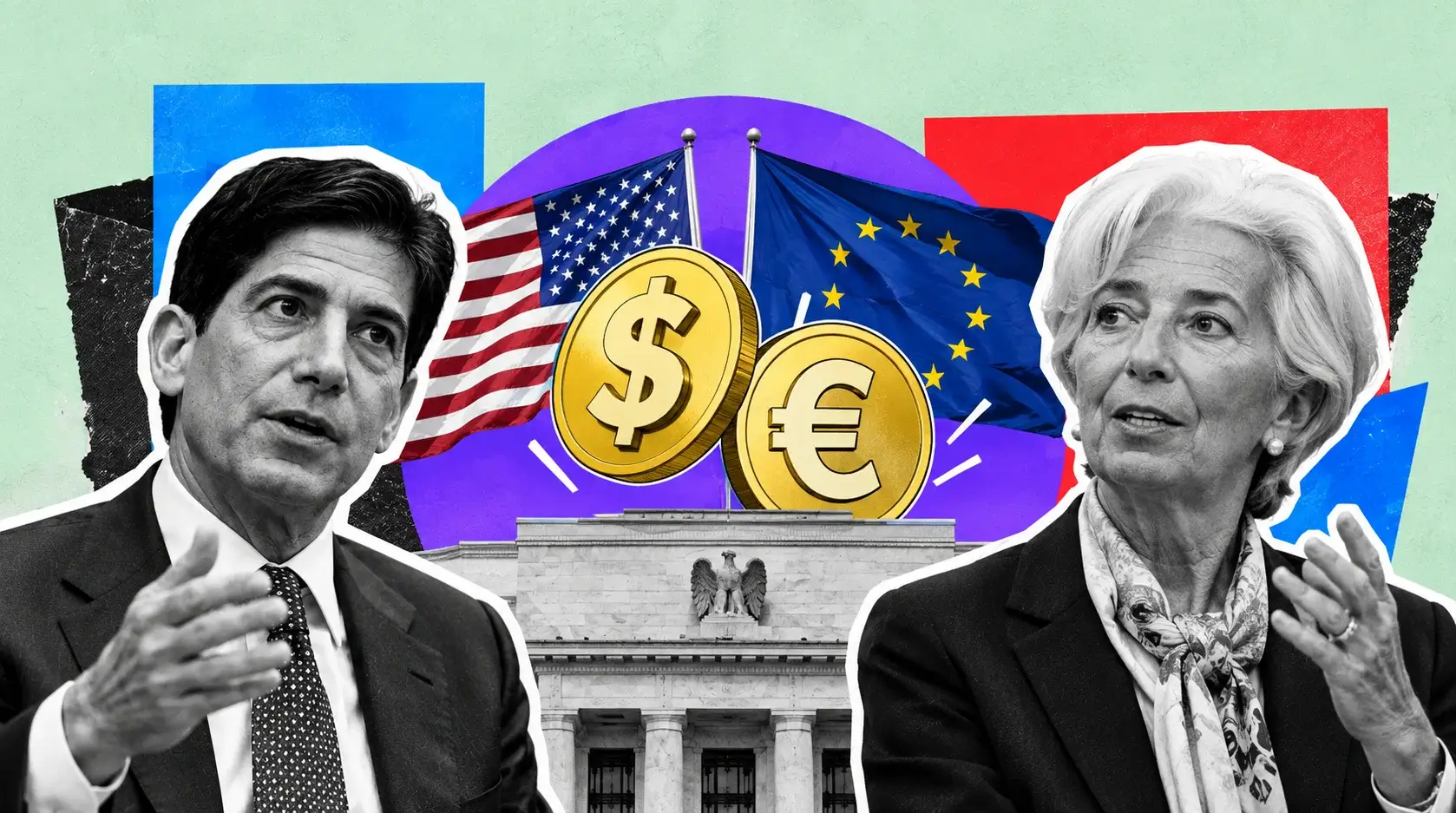
Euro Breaks to 1.1135 as 5.278% Treasury Yields and $106 Brent Widen the Gap — 1.1000 Next if 1.1135 Fails
The pair broke this week’s 1.1152 low after futures-implied October Fed hike odds jumped to 47% from 22% | That's TradingNEWS
Key Points
- EUR/USD dropped 0.55% to 1.1135, its weakest level since May 2025, after US core CPI hit 2.6%.
- The US-German 10-year yield spread widened to 182 basis points as Treasuries rose to 5.278% and Bunds eased to 3.45%.
- A daily close below 1.1135 targets 1.1000, while a reclaim of 1.1250 opens a path to 1.1312.
The euro spent the European morning trying to build a base and lost it inside an hour of the US inflation release. EUR/USD dropped 0.55% to 1.1135, its lowest level since May 2025, and the one-hour chart showed the pair at 1.1139 shortly after, pinned under both its 100-period moving average at 1.1194 and its 200-period average at 1.1209.
The session had started constructively. The pair climbed above 1.1200 in the European morning, and it pushed toward 1.1210 as the dollar retreated and Treasury yields eased ahead of the data. By the time New York walked in, the euro had slipped to 1.1192, down just 0.05% on the day. Then the inflation print landed at 8:30 a.m. ET and the pair fell almost 60 pips in a straight line.
The level matters. Earlier this week, EUR/USD set a 17-month low around 1.1150, with the intraday floor at 1.1152. Wednesday’s slide broke through that low and printed a new one at 1.1135. A break of the weekly low on the day of a major data release is a classic continuation signal, and the pair is now trading 15 pips below the floor that held on Monday and Tuesday.
The thesis for this forecast is straightforward. EUR/USD is being driven by three forces pointing the same way: a widening interest-rate gap after a hot US CPI, an energy shock that damages the eurozone’s terms of trade far more than America’s, and fiscal stress in France that adds a risk premium to euro assets. The ECB is hiking too, but from a lower base and into a weaker economy. Until one of those three forces turns, rallies in the euro are corrections inside a downtrend.
The trend has been running since January. At the end of that month, the euro hit a 4½-year high above $1.20. From that level to 1.1135, the single currency has lost more than 7% against the dollar. The decline accelerated through the summer as the Fed moved toward hikes and oil climbed, and it extended in October as French borrowing costs jumped.
There is a counterpoint. Before the release, the dollar rally looked stretched, EUR/USD appeared oversold, and bearish momentum was fading. Some of the hot inflation was arguably priced in. That setup is why the pair recovered toward 1.1210 earlier in the session. The CPI details were strong enough to override the oversold condition. The question now is whether 1.1135 marks a final flush or the start of the next leg toward 1.1100 and 1.1000.
The CPI Print That Flipped the Dollar Pullback
The euro’s European-session bounce rested on one assumption: that US inflation would disappoint or match forecasts and give the stretched dollar an excuse to correct. The Bureau of Labor Statistics delivered the opposite.
Consumer prices rose 0.6% in September, matching the monthly forecast, and the annual rate accelerated to 3.7% from 3.4% in August, above the 3.6% consensus. Core CPI, which excludes food and energy, rose 0.3% on the month against a 0.2% estimate and climbed to 2.6% year over year from 2.4%, also above the 2.5% forecast. US inflation has now been above the Fed’s 2% target for 67 straight months.
Energy drove the headline: gasoline jumped 9.1% in September and accounted for more than half of the monthly increase, and the broader energy index rose 5.2%. The core surprise came from shelter, up 0.4%, used vehicles, up 0.7%, plus airfares, recreation, education and medical services. Shelter alone added 0.15 percentage point to core.
For currency markets, the core number is what moved prices. A headline surprise driven by gasoline can be dismissed as a supply shock the Fed will look through. A core surprise forces a policy response. The rate market reacted at once. The probability of a 25-basis-point Fed hike in October jumped to 47% from 22% the day before, according to one measure of futures pricing. Other readings of fed funds futures still showed 78% odds of a hold, while one prediction market moved the October hike probability to 55% from 21%. Across every measure, the direction was the same: more Fed tightening priced in.
That repricing hit the euro through the most direct channel in FX: relative yields. The 10-year Treasury yield jumped more than 6 basis points to 5.278%. Higher US yields make dollar-denominated assets more attractive and pull capital out of lower-yielding currencies. The euro, with its larger yield discount to the dollar and its exposure to energy, took the hit.
Before the data, the risk being flagged across European trading desks was that US CPI would accelerate on both headline and core, sparking higher yields and a firmer dollar and pushing the euro below this week’s low at 1.1152. That is precisely what happened. The scenario some euro bulls had treated as a tail risk turned into the base case in one release.
The Yield Gap: 5.278% Against 3.45% Is a 182-Basis-Point Wall
The core driver of EUR/USD is the spread between what investors earn in dollars and what they earn in euros. That spread widened sharply on Wednesday.
The 10-year Treasury yield climbed more than 6 basis points to 5.278% after the CPI release. Germany’s 10-year Bund yield, the eurozone’s benchmark, eased to 3.45% on the same day, its lowest since September 9, as German bonds drew safe-haven demand during a global equity selloff. That puts the US-German 10-year spread at 182 basis points.
The direction of travel is as important as the level. In early October, Bunds were yielding near 3.5% and the 10-year Treasury was moving toward its October 7 high of 5.364%, the highest since 2002. Since then, Bund yields have drifted lower on safe-haven buying while Treasury yields have bounced back toward that peak. The gap has widened in the dollar’s favor on both sides.
The 2-year sector tells a similar story. Germany’s 2-year yield stood near 3.10% in early October, reflecting expectations for further ECB tightening. US 2-year yields sit well above that level with the Fed’s upper bound at 4% and markets now pricing a higher chance of an October hike. The short-end spread is the purest measure of relative policy expectations, and it moved against the euro on Wednesday.
Rate differentials matter more than ever in this environment because the dollar is also delivering positive real yields. A 10-year Treasury at 5.278% against US core inflation at 2.6% offers a real return of 2.68%. A 10-year Bund at 3.45% against eurozone headline inflation at 3.8% offers a negative real return. A global investor choosing between the two can lock in more than 2.5 percentage points of real yield in Treasuries and lose purchasing power in Bunds. That gap pulls capital toward the dollar steadily, not just on data days.
The spread also explains why the euro has struggled even as the ECB hikes. The ECB has raised rates twice this year, but Bund yields have not kept pace with Treasuries because markets see eurozone growth as weaker and the ECB as more constrained. The Fed is hiking into an economy with 3.7% inflation and still-positive growth. The ECB is hiking into stagflation risk.
For the forecast, the 182-basis-point 10-year spread is the line to watch. A move above 190 basis points, driven by Treasuries breaking 5.364%, would likely push EUR/USD toward 1.1000. A narrowing toward 170 basis points would give the euro room to retest 1.1250.
Fed vs ECB: A 4% Ceiling Against a 2.50% Deposit Rate
Both central banks are hiking. The Fed is doing it from higher ground, and that keeps the policy gap firmly in the dollar’s favor.
The Fed raised its target range by 25 basis points in September to 3.75% to 4%, its first increase since 2023, and 16 of 18 officials projected another hike. The October 27–28 meeting now carries real risk of a second move after Wednesday’s CPI, with futures-implied odds jumping to 47% on one measure. New York Fed President John Williams had said one more hike this year looks appropriate, with no further tightening needed in 2027. Boston Fed President Susan Collins wants another increase before year-end. Even the dovish read points to at least one more Fed hike in 2026.
The ECB has been tightening too. It held its main refinancing rate at 2.15% and its deposit rate at 2% in March, then hiked in June and again in September. The deposit facility rate has stood at 2.50% since September 16, the main refinancing rate at 2.65%, and the marginal lending rate at 2.90%. The ECB said the Middle East war was generating inflation pressures and that energy price inflation, then 10.9%, was broadening throughout the economy.
The arithmetic leaves the Fed’s upper bound 150 basis points above the ECB deposit rate. More important is the real-rate comparison. With US headline CPI at 3.7% and the Fed’s upper bound at 4%, US real policy rates are slightly positive. With eurozone flash inflation at 3.8% in September and the deposit rate at 2.50%, ECB real policy rates are 1.3 percentage points below zero. The Fed is restrictive. The ECB is still accommodative in real terms.
The meeting sequence sharpens the comparison. The Fed decides on October 28, and the ECB announces its decision exactly 24 hours later, on October 29 at 14:15 CET, followed by Lagarde’s press conference at 14:45 CET. The ECB will set policy knowing what the Fed has done. If the Fed hikes and the ECB holds, the policy gap widens to 175 basis points and EUR/USD likely breaks lower. If both hike, the gap is unchanged. If the Fed holds and the ECB hikes, the euro has its best chance of a sustained rebound.
Market pricing for the ECB has swung widely as French bond stress and eurozone inflation data have pulled in opposite directions. Lagarde, scheduled to speak twice on Wednesday, has repeatedly refused to commit to a rate path, saying risks to growth are tilted to the downside while inflation risks are tilted to the upside. That ambiguity caps the euro. The Fed is signaling another hike. The ECB is signaling maybe.
The ECB’s Dilemma: 3.8% Inflation, Stagflation Risk and October 29
The ECB faces a harder problem than the Fed, and currency markets are pricing that difficulty into the euro.
Eurozone inflation is running hotter than US inflation on the headline measure. Inflation hit 3.3% in August, its highest in three years, with energy inflation spiking to 14.3%. The September flash estimate accelerated further to 3.8% year over year, above the US rate of 3.7%. ECB staff project core inflation excluding energy and food at 2.5% in both 2026 and 2027, revised higher because of the energy shock feeding into food, goods and services prices.
That inflation backdrop argues for further ECB tightening. The growth backdrop argues against it. In September the ECB upgraded its growth forecasts to 0.9% for 2026 and 1.4% for 2027, citing greater-than-expected resilience. Those numbers are still weak, and they leave little room for error. German manufacturing has contracted repeatedly, and the energy shock hits European industry harder than American industry because the eurozone imports nearly all its oil and gas.
That combination, rising inflation and fragile growth, is the definition of stagflation. Central banks facing stagflation tend to tighten less aggressively than inflation alone would justify, because each hike risks tipping the economy into recession. Currency markets know this. A central bank that hikes reluctantly into weakness produces a weaker currency than one hiking confidently into strength.
The ECB’s own record this year shows the tension. In July, the ECB held rates after inflation came in at 2.8% against its 3.3% expectation, calling the data relatively benign. Two months later, with energy inflation at 14.3%, it hiked again. The policy path is reactive and data-dependent, which leaves the euro exposed to each new print.
French fiscal stress adds a layer. If French debt comes under heavier pressure, the ECB may be forced to abandon rate hikes to avoid a disorderly widening of sovereign spreads. That would leave the ECB choosing between fighting inflation and protecting bond market stability. In that scenario, the euro would come under more pressure because the inflation fight would effectively be paused.
Lagarde’s term adds a longer-term question. Her mandate runs until October 2027, and reports earlier this year suggested she could leave early, though the ECB said no decision had been made. Leadership uncertainty at a time of stagflation risk adds to the euro’s discount.
For the October 29 decision, the euro needs a hike with hawkish guidance to narrow the gap with the Fed. A hold, or a hike with dovish signaling about French spreads, would confirm the bearish case.
Oil at $106: The Euro’s Terms-of-Trade Problem
Energy is the second force pushing EUR/USD lower, and it hits the eurozone much harder than the United States.
Brent crude trades at $106.50 a barrel, up 0.79% on Wednesday, and WTI holds near $95.30. Houthi forces struck an administrative building belonging to Saudi Aramco in Dhahran, a ballistic missile was intercepted over Riyadh, and a container ship sank south of the Strait of Hormuz after hitting a naval mine. Iranian officials said they began deploying new tactics against shipping roughly ten days ago. The rise in oil prices, together with lingering concerns about France’s fiscal health, pushed the euro to a fresh 16-month low against sterling on Wednesday morning.
The terms-of-trade effect works through trade balances. The eurozone imports nearly all of its crude oil and natural gas. When energy prices rise, the bloc’s import bill climbs, its trade surplus shrinks, and more euros must be sold to buy dollar-denominated energy. The United States, by contrast, is a net energy exporter. Higher oil prices boost American export revenue and support domestic producers. An oil shock transfers income from Europe to America, and the currency market reflects that transfer.
The inflation channel compounds the damage. Eurozone energy inflation hit 14.3% in August, far above the US energy index rise of 5.2% in September. Energy feeds into eurozone headline inflation more heavily, which forces the ECB toward tightening even as the same energy shock weakens growth. The US economy absorbs oil shocks with less damage to output, which allows the Fed to tighten from a position of strength.
There is also a safe-haven component. During geopolitical stress in the Middle East, global capital tends to flow toward dollar assets, particularly Treasuries. The dollar’s role as the reserve currency gives it a bid during wars that the euro does not enjoy. Ongoing geopolitical tensions could support safe-haven demand for the dollar and limit any euro recovery.
The policy picture raises the risk further. President Trump has said he is considering joining strikes on the Houthis, who have threatened US personnel and interests across the region if he does. A direct US military escalation would likely push oil higher and add safe-haven demand for the dollar at the same time, a double hit for EUR/USD.
The reverse scenario is the euro’s best chance. A ceasefire or diplomatic breakthrough that drops Brent below $90 would improve the eurozone’s terms of trade, ease inflation pressure on the ECB, and reduce safe-haven demand for the dollar. That would likely lift EUR/USD toward 1.1250 quickly. With Brent at $106.50 and attacks intensifying, that scenario is not the base case.
France: Fiscal Stress and the Widening OAT-Bund Spread
The third force weighing on the euro is domestic: concern over France’s public finances and political stability.
The euro touched its fresh 17-month low against the dollar this week as soaring French borrowing costs added to energy-driven inflation concerns. Earlier in October, EUR/USD slid to 1.1312 as the spread between French and German 10-year government bond yields widened to nearly 130 basis points, a level that signals serious market stress over the eurozone’s second-largest economy.
The spread matters because France is too large to treat as a peripheral problem. A sustained widening in French borrowing costs raises questions about debt sustainability, about the political will to consolidate deficits, and about whether the ECB would intervene with bond purchases to cap spreads. Each of those questions adds a risk premium to euro-denominated assets.
The French situation interacts directly with ECB policy. If French debt comes under heavier pressure, the ECB may be forced to abandon rate hikes, which could put the euro under more pressure. That is the core of the euro’s fiscal discount. The market fears a scenario in which the ECB stops fighting inflation to protect France, leaving the eurozone with high inflation, negative real rates and a weaker currency.
The global fiscal backdrop is not helping. The IMF warned on Wednesday that fiscal risks are rising and that in major advanced economies, the effects of fiscal indiscipline do not stop at the border. The United States has its own debt problems, with national debt above $40 trillion, but the dollar’s reserve status shields it from the kind of spread pressure France faces inside the eurozone. Investors worried about US debt sell Treasuries across the curve; investors worried about French debt sell OATs relative to Bunds, which directly fragments the eurozone bond market.
German Bunds are benefiting from the stress, with the 10-year yield easing to 3.45%, its lowest since September 9, as safe-haven demand flows into German debt. That flight to quality inside the eurozone, from France to Germany, widens spreads and lowers Bund yields at the same time. Lower Bund yields widen the gap with Treasuries further. The French problem therefore damages the euro twice: through the risk premium and through the yield spread.
For the forecast, the French-German spread is a key secondary indicator. A widening back above 130 basis points would likely coincide with a break of 1.1135 toward 1.1100. Signs of fiscal consolidation or political stabilization in Paris would give the euro breathing room. Neither has arrived.
Dollar Index Back Above 102.50: Positioning and the 18-Month High
The euro’s weakness is also the mirror image of dollar strength, and the dollar index explains how stretched the move has become.
The euro makes up nearly 60% of the dollar index’s weighting, so EUR/USD and DXY move almost in lockstep. Before Wednesday, the dollar had been retreating from an 18-month high. The index fell 0.35% to 0.45% on Tuesday after dovish-sounding comments from Williams, slipping to 102.13, and traded near 101.80 to 102.10 in early European hours. That retreat lifted EUR/USD from its weekly low near 1.1150 back toward 1.1210.
The CPI release reversed that. By 8:13 a.m. ET, before the data, the dollar index had already recovered to 102.50. After the release, the index climbed further, gaining 0.48% on the day on some readings, with the move against gold showing a 0.4% rise in the immediate aftermath. That pushed DXY back toward its 18-month high and drove EUR/USD to its fresh low.
Positioning is the counterargument. Heading into the print, the dollar rally showed signs of exhaustion, EUR/USD looked oversold, and bearish momentum was fading. One-day implied volatility for EUR/USD had spiked ahead of the release, showing that traders were paying up for protection against a big move in either direction. In those conditions, a modest CPI disappointment could have triggered a sharp dollar pullback.
The data did not disappoint, but the oversold condition still matters for how the pair trades from here. Extended downtrends with stretched positioning tend to produce sharp short-covering rallies on any good euro news. A soft PPI print Thursday, a dovish Fed speaker before the blackout, or a hawkish ECB signal could trigger a quick bounce of 50 to 100 pips without changing the broader trend.
The dollar’s strength is not only about the euro. Sterling is outperforming the euro, with the single currency at a 16-month low against the pound, suggesting euro-specific weakness on top of dollar strength. The Australian dollar held near 0.7000 earlier in the day on Chinese trade data. The euro is underperforming even within the non-dollar group.
For the forecast, the dollar index is the fastest real-time signal. A break above the 18-month high would likely take EUR/USD toward 1.1100 and below. A drop back under 102.13 would reopen 1.1200 for the euro. Wednesday’s move puts the index closer to the first scenario.
From 1.20 in January to 1.1135: Mapping the 2026 Round Trip
The scale of the euro’s decline this year shows how much the macro story has shifted against the single currency.
At the end of January 2026, the euro hit a 4½-year high above $1.20 after President Trump said he was unconcerned about the dollar’s decline. At that point, the eurozone looked like the stronger story. Inflation had returned to the ECB’s 2% target in December and fell to 1.7% in January, its lowest since September 2024. Core inflation fell to 2.2%, its lowest since October 2021. ECB policymakers worried openly that further euro gains could force a resumption of rate cuts.
The ECB held its deposit rate at 2% through March, and German 10-year yields traded below 3%, at 2.76% to 2.92% in the first two months of the year. The Fed was still easing. The rate differential was narrowing in the euro’s favor, and the currency reflected that.
Then the Middle East war broke out and the energy shock hit. Eurozone energy inflation surged, headline inflation climbed back above 3%, and the ECB pivoted from discussing cuts to hiking in June. The Fed, facing its own inflation surge, moved even more aggressively, hiking in September for the first time since 2023 while the 10-year Treasury yield climbed more than 100 basis points over the year to reach 5.364% on October 7.
The result was a full reversal. From above 1.20 in January to 1.1135 on Wednesday, EUR/USD has fallen more than 7%. Over the same period, German 10-year yields rose to a monthly average of 3.64% in September before easing to 3.45% this week. The euro’s yield rose, but the dollar’s yield rose faster.
The decline has not been linear. EUR/USD traded near 1.1312 in early October before the latest leg lower. It reached 1.1150 earlier this week, bounced to 1.1210 on Wednesday morning, and fell to 1.1135 after the CPI release. Each bounce has been sold at a lower level, confirming a pattern of lower highs and lower lows.
The 17-month low takes the pair back to levels last seen in May 2025, before the euro’s 2025 rally began. That symbolic reversal is important. The entire euro advance that peaked in January has now been erased, and long positions built during that rally are underwater.
For the forecast, the 2026 round trip shows that the euro’s decline reflects a structural shift in the relative macro picture: higher US real rates, an energy shock that hurts Europe more, and fiscal risk concentrated in France. Those drivers are unlikely to reverse in two weeks.
Sterling, the Crosses and Euro-Specific Weakness
The euro’s underperformance is not just a dollar story, and the crosses confirm that the single currency carries its own discount.
On Wednesday morning, before the US data, the euro hit a fresh 16-month low against sterling. That move came even as the euro was roughly flat against the dollar, which isolates euro-specific selling. The same drivers that are hitting EUR/USD, oil above $106 and French fiscal stress, explain the EUR/GBP weakness. The United Kingdom faces its own energy and inflation pressures, but it does not carry the eurozone’s sovereign-spread risk.
The cross-currency picture before the release showed the dollar broadly softer: down 0.11% against the euro, 0.13% against the pound and 0.25% against the Australian dollar in early European trading. The euro outperformed only modestly against the yen, Swiss franc and Canadian dollar. Even on a day when the dollar was retreating, the euro lagged sterling and the Australian dollar.
That relative weakness matters for EUR/USD because it means the euro cannot rely on a general dollar pullback to recover. When the dollar weakens, sterling and commodity currencies have been capturing more of the gain. When the dollar strengthens, as it did after CPI, the euro tends to fall harder. That asymmetry reinforces the downtrend.
The Swiss franc offers another signal. As the eurozone’s traditional safe haven, the franc tends to strengthen against the euro during periods of eurozone stress, particularly sovereign-spread widening. Any acceleration in franc strength alongside wider French spreads would signal that European investors are moving capital out of the euro, adding pressure to EUR/USD.
The yen is the dollar’s other major cross. USD/JPY was set to react to the US CPI data as well, and a strong dollar against the yen confirms that Wednesday’s move is broad-based dollar strength, not just euro weakness.
For EUR/USD traders, the crosses provide confirmation of trend quality. A euro that is weak against the dollar but strong against sterling and the franc would point to a dollar-driven move that could reverse quickly. A euro that is weak against all three, as it is now, points to a currency carrying its own structural discount. That second pattern is harder to reverse and supports the bearish forecast.
The euro needs a euro-specific catalyst to change that pattern: a hawkish ECB, a narrowing in French spreads, or a drop in energy prices. Until then, EUR/GBP and EUR/CHF weakness will keep reinforcing the downside in EUR/USD.
Chart Map: 1.1135 Floor, 1.1194–1.1209 Moving Averages, 1.1250 Line
The technical picture turned decisively bearish on Wednesday.
The new low at 1.1135 is the immediate support. Directly above it sits 1.1152, the earlier weekly low that held on Monday and Tuesday and now acts as resistance after Wednesday’s break. Below 1.1135, the next support is the 1.1100 round number, followed by 1.1000. The 1.1000 level has been identified as a realistic near-term risk for the euro and represents a 1.2% decline from current levels.
Resistance stacks up overhead. The first barrier sits at 1.1152, the old weekly low. Above that, the one-hour 100-period moving average at 1.1194 and 200-period moving average at 1.1209 form a resistance band that capped Wednesday’s morning rally. The pair failed at 1.1210 before the release, which confirms the zone as a ceiling. The key level above is 1.1250. A sustained recovery above 1.1250 would make an immediate continuation lower less convincing and would break the pattern of lower highs.
Higher up, 1.1312 is the early-October level where the pair traded as French spreads widened toward 130 basis points. That marks the top of the near-term range and the level that would need to be reclaimed to shift the medium-term trend.
The structure is a clear downtrend: lower highs at 1.1312, 1.1210 and now 1.1152, and lower lows at 1.1150 and 1.1135. The longer-term bearish trend in the pair remains intact. Short-term momentum was oversold before the data, which can produce sharp countertrend bounces, but the break of the weekly low on a major macro release indicates sellers remain in control.
Volatility conditions also matter. One-day implied volatility for EUR/USD spiked ahead of the release. Elevated implied volatility tends to persist through event-heavy weeks, and the next two weeks carry PPI, the Fed blackout, the Fed decision and the ECB decision. That points to wider daily ranges, larger intraday reversals and more stop-hunting around key levels.
For the forecast, the levels are clear. A daily close below 1.1135 opens 1.1100 and then 1.1000. A recovery back above 1.1152 would suggest Wednesday’s break was a false move, and a close above 1.1250 would invalidate the near-term bearish view.
Read More
-
Yen Stalls at 160 Despite a 3% JGB and Tokyo Core CPI at 2.0% — Intervention Sits at 164, Friday's Payrolls Decide
02.09.2026 · TradingNEWS ArchiveEnergy
-
AMD Slides to $577.31 as a 2.45 Beta Meets 5.278% Yields, but Helios and a 2027 Data Center Doubling Keep the Long Case Alive
14.10.2026 · TradingNEWS ArchiveStocks
-
XRP-USD Slides to $1.3498 as Hot Inflation Overpowers 13 Weeks of ETF Inflows and Standard Chartered RLUSD Custody
14.10.2026 · TradingNEWS ArchiveCrypto
-
November Contract Slips to $3.119 as Mild Weather Outweighs a 107.1 Bcf/d Production Low — $3.09 EMA Guards the $3 Floor
14.10.2026 · TradingNEWS ArchiveCommodities
-
ZTAX Fund Jumps 7.36% to $22.83 After a Holiday Plunge to $21.26 Exposed a 10% Discount to NAV
13.10.2026 · TradingNEWS ArchiveMarkets
-
Pound Drops to 1.3185 as 5.278% Treasury Yields Outweigh a 3.75% Bank Rate Set to Rise — 1.3150 Floor Guards 1.3100
14.10.2026 · TradingNEWS ArchiveForex
Catalysts: Lagarde Today, PPI Thursday, the Fed on October 28, the ECB on October 29
The next two weeks are loaded with events that will decide whether EUR/USD extends its decline.
Wednesday: Lagarde is scheduled to speak twice. Any signal that the ECB is prepared to hike again on October 29 despite French spread stress would support the euro. A focus on downside growth risks or financial stability would confirm the dovish lean. The Fed’s Beige Book and remarks from Richmond Fed President Tom Barkin follow in the afternoon.
Thursday, October 15: US September PPI, retail sales, initial jobless claims and the Philadelphia Fed manufacturing index. A second hot inflation print in two days would cement the case for Fed tightening and likely push EUR/USD below 1.1135. A soft PPI and weaker retail sales would ease hike expectations and give the euro room to bounce toward 1.1200.
Thursday and Friday: Fed officials have their final chance to signal before the quiet period starts Saturday, October 17. Any voting member who explicitly opens the door to an October hike would hit the euro hard.
Throughout October: French fiscal developments and energy prices. A narrowing of the French-German spread would support the euro, while a widening back above 130 basis points would add pressure. Oil headlines from the Middle East remain the main swing factor for eurozone inflation.
October 28: the Fed decision. A hike would widen the policy gap to 175 basis points and likely push EUR/USD toward 1.1000. A hold with December guidance is closer to priced.
October 29: the ECB decision at 14:15 CET and Lagarde’s press conference at 14:45 CET. The ECB decides 24 hours after the Fed, giving it the last word on the policy gap. A hike with hawkish guidance offers the euro’s best chance of a sustained recovery. The same day, US September PCE inflation data lands, adding another US inflation input.
The sequence favors the dollar unless the data turns. The US has two inflation releases and a Fed meeting that could lift yields further. The eurozone has an ECB that may hike but faces French constraints and weak growth.
EUR/USD Forecast and Verdict: Bearish, 1.1000 Target on a Break of 1.1135
The verdict for EUR/USD is bearish. The euro at 1.1135 has broken to a 17-month low on a day when every major driver moved against it. September US CPI ran at 3.7% headline and 2.6% core, the 10-year Treasury jumped to 5.278%, the US-German 10-year spread widened to 182 basis points, and futures-implied odds of an October Fed hike more than doubled to 47% on one measure. Brent crude at $106.50 is draining the eurozone’s terms of trade, and French fiscal stress is adding a risk premium that the ECB cannot easily remove.
The base case into the October 28 Fed meeting and the October 29 ECB decision is a move toward 1.1100. A daily close below 1.1135 targets 1.1000, a 1.2% decline from current levels and the zone flagged as a realistic near-term risk. A hot PPI print Thursday or a hawkish Fed signal before Saturday’s blackout would accelerate that move.
The policy math supports the bearish view. The Fed’s upper bound at 4% sits 150 basis points above the ECB deposit rate of 2.50%. US real policy rates are positive, while eurozone real policy rates are 1.3 percentage points below zero with flash inflation at 3.8%. The ECB is hiking into stagflation risk and French spread pressure, while the Fed is hiking from a position of strength.
The bullish alternative requires a combination of events: a soft US PPI, a Fed hold on October 28 with dovish guidance, a hawkish ECB hike on October 29, and a narrowing of the French-German spread. That combination would likely push EUR/USD back above the 1.1194 to 1.1209 moving-average band and toward 1.1250. A daily close above 1.1250 would invalidate the near-term bearish forecast and target 1.1312, a 1.6% gain from current levels.
Positioning is the main risk to the view. The pair was oversold before the data, and stretched short positions can produce sharp short-covering bounces of 50 to 100 pips on any positive euro headline. Those bounces should be treated as selling opportunities while the pair stays below 1.1250.
Forecast: bearish, with a 1.1000 downside target on a confirmed break of 1.1135 and a 1.1312 upside target only if EUR/USD reclaims 1.1250. Until the transatlantic rate gap narrows or energy prices fall, the path of least resistance points lower for the euro.