EUR/USD Defends 1.0948 Above the 1.0882 Low as ECB Hike Matches the Fed; 1.1085 Rebound Target
A 137.5bp Fed-ECB gap that stops widening keeps 1.0882 intact; 1.0985 opens 1.1085 | That's TradingNEWS
Key Points
- EUR/USD slipped 0.19% to 1.0948, holding 66 pips above the 1.0882 yearly low set on November 23.
- Markets price a 98% Fed hike on December 9 and a 91% ECB hike on December 17, freezing the 137.5bp gap.
- Germany's Ifo rose to 90.6, a 3-year high, while Q3 GDP was revised down to 0.1% quarter over quarter.
The euro went into the U.S. holiday under pressure but still above its floor. EUR/USD traded at 1.0948 after the U.S. data on Wednesday, November 25. That is down 0.19% from Tuesday's 1.0969 close and gives back roughly half of Tuesday's 0.58% rebound. The pair opened the Asian session at 1.0969, slipped to 1.0960 in Tokyo, traded near 1.0953 in the European morning and dipped to 1.0940 ahead of the 8:30 a.m. ET release. Core PCE at 3.3% and third-quarter GDP at 4.3% kept the dollar bid, but the pair never broke Tuesday's base, and the 2026 low at 1.0882 was never threatened.
The broader trend is clearly bearish. EUR/USD has lost 1.86% over the past month and 5.23% over the past year. On November 5 it traded at 1.1235. Since then it has fallen 287 pips, or 2.6%, through three distinct legs: from 1.1235 to 1.1070 by November 13, to 1.0954 on November 18, and to the 2026 low of 1.0882 on Monday, November 23, when the dollar index reached a 19-month high. The 52-week range now runs from 1.0882 to 1.2081, so the euro sits 9.4% below its high and only 66 pips above its low.
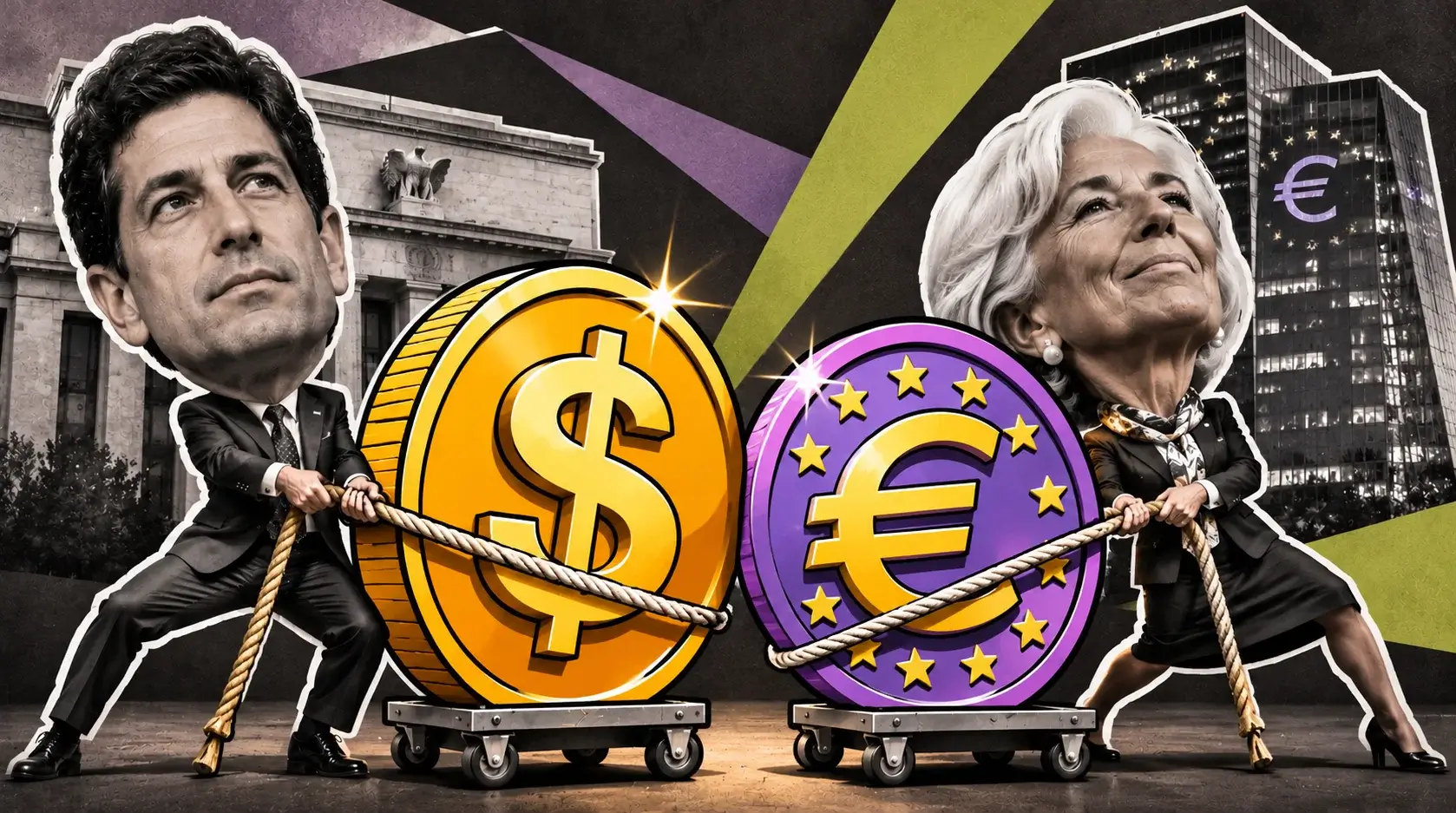
This forecast rests on one thesis: the rate gap between the Fed and the ECB is not widening further. The Federal Reserve is priced at 98% to hike on December 9, taking its target range to 4.00% to 4.25%. The ECB is priced at 91% to hike eight days later, on December 17, taking its deposit rate from 2.50% to 2.75%. Both central banks are tightening at the same pace, which keeps the policy gap at 137.5 basis points. The dollar's November rally priced the Fed's December move and most of January's. The euro's next leg depends on whether European data lets the ECB keep pace into 2027.
Two forces are pushing against each other. On the dollar side, U.S. growth at 4.3%, core inflation at a three-year high and a dollar index above 104 favor more downside. On the euro side, the German Ifo index at its highest in more than three years, euro-area inflation at 4.0% forcing the ECB to act, and falling U.S. Treasury yields all limit the dollar's upside. Wednesday's tape shows that balance: a hawkish U.S. data set produced only a 21-pip drop.
The upside target is 1.1085, the 1.1081 to 1.1086 resistance zone that capped the pair on its last attempt higher. It is 137 pips, or 1.25%, above current levels. Reaching it needs a daily close above the 1.0938 to 1.0954 pivot zone, a dollar index back below 103.30, and a hawkish ECB message ahead of December 17.
Session Map: 1.0969 to 1.0940 and the PCE Shrug
Wednesday's session was a slow grind, not a break. The pair opened Asia at 1.0969, Tuesday's closing level, after a 0.58% rally to 1.0969 by 4:00 p.m. New York time. In Tokyo, EUR/USD slipped to 1.0960 as caution set in before the U.S. data. Tuesday's U.S. consumer confidence report had printed well above expectations, with stronger views on current and future labor conditions, and that reading kept the dollar bid overnight.
The European morning brought the tariff headline. The administration proposed tariffs of up to 20% on goods from the European Union, part of a package covering 14 trading partners. The euro dipped only briefly. The proposal caps deal rates at 15% for the EU, Japan, South Korea and Switzerland, net of most-favored-nation duties, excludes steel, aluminum and autos, and does not stack on top of existing forced-labor tariffs. For the EU, the headline 20% figure overstates the real exposure, and the market read it that way. EUR/USD traded at 1.0953 in the London morning, down 0.1%.
The U.S. data brought the low. Ahead of the 8:30 a.m. ET release, EUR/USD dropped to 1.0940, down 0.21%. October core PCE came in at 3.3% year over year against a 3.2% forecast, headline PCE at 3.8%, and third-quarter GDP was revised up to 4.3%. The pair moved to 1.0948 after the print instead of extending lower, and the 1.0938 to 1.0954 pivot zone held.
The reason for the shrug was that most of the move was already priced. Before the data, rate markets had a December Fed hike at 96.4% and January at 64.3%. After the data, December moved to 98% and January eased to 60%. A hot core reading that barely shifts Fed pricing does not justify a new leg lower in EUR/USD.
The equity selloff pulled the dollar in two directions. The Nasdaq Composite fell 4% at the open and the Nasdaq 100 entered a bear market. Haven demand lifted the dollar index to 104.10 at its high, but the same selloff pushed the 10-year Treasury yield down more than 6 basis points to 4.84%, its lowest since November 9. Falling U.S. yields cut the dollar's rate advantage, and the dollar index spent the session in a tight 103.81 to 104.10 band, below Tuesday's 104.40 high. With both pressures pulling against each other, EUR/USD held a 29-pip range all morning.
Fed at 98%, ECB at 91%: Why the Rate Gap Is Not Widening
The rate gap explains most of EUR/USD's moves, and the gap is stable. The Fed's target range is 3.75% to 4.00%, and the ECB's deposit rate is 2.50%. Comparing the Fed's midpoint of 3.875% with the ECB deposit rate gives a 137.5-basis-point gap in the dollar's favor. That gap drove the euro's fall from 1.2081 to 1.0882 as the Fed restarted hiking in September and moved faster than the ECB.
December changes that pattern. Rate markets price a 98% chance of a 25-basis-point Fed hike on December 9, taking the range to 4.00% to 4.25%. They price a 91% chance of a 25-basis-point ECB hike on December 17, taking the deposit rate to 2.75%. If both hikes happen, the gap stays at exactly 137.5 basis points. For EUR/USD, a stable gap means the rate channel stops pushing the pair lower.
January is where the gap could move again. Fed pricing for a January hike sits near 60%, while the ECB's next meeting after December falls in early February. If the Fed hikes in January and the ECB waits, the gap widens to 162.5 basis points, and the euro would likely retest 1.0882 and push toward 1.0780. If January Fed odds drop below 50% after the December 4 jobs report, the gap stays put into February and EUR/USD has room to recover toward 1.1085.
ECB officials are signaling December clearly. Bundesbank President Joachim Nagel said a December hike is "very likely to be necessary." Dutch central bank governor Olaf Sleijpen said the policy direction is clear for the December meeting. Lithuania's Gediminas Simkus made similarly hawkish remarks, and Austria's Martin Kocher pointed to higher inflation forecasts. ECB President Christine Lagarde said the bank was watching indicators to judge whether a December move was needed but would not pre-commit. The ECB raised rates by 50 basis points earlier in 2026 before pausing in November.
A hawkish ECB is not automatically good for the euro, though. The ECB is hiking because euro-area inflation is at 4.0%, mostly from energy, while German growth is close to zero. Hiking into a stagnating economy can weaken growth expectations and the currency together. Markets also price the end of the ECB cycle sooner than the Fed's, since the ECB's September projections called for inflation of 3.0% in 2026, 2.5% in 2027 and 2.1% in 2028. For a durable euro recovery, the ECB has to signal that December is not the last hike.
US Data: 3.3% Core PCE and 4.3% GDP Keep the Dollar Bid
The U.S. data set gave the dollar every reason to stay strong. October core PCE rose 0.3% month over month, in line with the forecast, but the annual rate climbed to 3.3% against a 3.2% forecast, up from 3.1% in September. That is the highest core reading in three years. Headline PCE rose 0.3% on the month, down from 0.5% in September, but the annual rate rose to 3.8% from 3.6%.
Growth was stronger still. The final estimate of third-quarter GDP showed a 4.3% annualized pace, up from the first estimate of 3.4% and above the 3.5% consensus. An economy growing at more than 4% with core inflation at 3.3% gives the Fed no reason to stop. The gap between U.S. and euro-area growth is wide: the U.S. grew at 4.3% annualized in the third quarter, while Germany grew 0.1% quarter over quarter, close to 0.4% annualized.
That growth gap is the dollar's strongest support, beyond the rate gap. Capital flows toward the faster-growing economy, which drives equity inflows, corporate investment and portfolio allocation into dollar assets. Through most of 2026 the U.S. outgrew Europe, and the euro's slide from 1.2081 reflects that divergence as much as the rate gap.
The data did have limits. The core PCE miss was one tenth of a point, and the monthly rate was in line. Rate markets moved December hike odds up only 1.6 points, from 96.4% to 98%, and January odds slipped from 64.3% to 60%. The market is reading the data as confirmation of a Fed cycle already priced, not as a signal of a longer one. That explains why EUR/USD moved just 8 pips after the release.
The labor market is the next U.S. test. The November jobs report on December 4 lands five days before the Fed decision. A strong report would firm January hike odds above 70% and push EUR/USD back toward 1.0882. A soft report would pull January odds below 50%, weaken the dollar and open the path to 1.1085. Tuesday's consumer confidence beat, driven by stronger views on jobs, suggests the labor market is holding up, which favors the dollar going into the report.
Treasury Secretary Scott Bessent added a counterweight on Monday, warning that the Fed could hurt growth by hiking too aggressively. That has already pulled March hike odds down to 35% from above 50% a week ago. If that message spreads, the market will start pricing the end of the Fed cycle in early 2027, and the dollar loses its most important support.
Euro-Area Inflation at 4.0%: The ECB Has No Choice
The euro's strongest support is the inflation that forces the ECB to keep tightening. Euro-area headline inflation rose to 4.0% in October from 3.8% in September, the highest in three years. Eurostat confirmed that figure in its final release on November 18. Core inflation, excluding food and energy, was revised up to 2.6% from a 2.5% flash estimate. German national inflation came in at 2.9%, revised up from 2.8%.
Energy drives most of the gap between headline and core. Euro-area energy prices are up 20.8% year over year, reflecting the oil supply shock from the U.S.-Iran conflict and repeated shipping incidents near the Strait of Hormuz. European natural gas rose 3% on Tuesday on colder weather forecasts. Europe imports most of its energy, so an oil and gas shock hits euro-area inflation harder than U.S. inflation. That is why headline inflation runs at 4.0% in the eurozone against 3.8% in the U.S.
For the currency, energy-driven inflation is a mixed signal. It forces the ECB to hike, which supports the euro through the rate channel. But it also widens Europe's energy import bill, hurts the trade balance and weighs on growth, which hurts the euro through the growth channel. During the 2022 energy crisis, the same mechanism took EUR/USD below parity even as the ECB raised rates by 250 basis points. The euro fell because the energy shock overwhelmed the rate support.
The difference in 2026 is scale. Energy prices are up 20.8%, not the 40% to 50% of 2022, and core inflation at 2.6% is far below 2022's 5.7% peak. The ECB faces a more manageable problem, and markets trust that a few more hikes can contain it. That is why the euro is at 1.0948, not at parity.
The calendar sets the next test. The November flash HICP lands on Tuesday, December 1, the last major inflation reading before the ECB decision. Another print of 4.0% or higher, with core at 2.6% or above, would lock in December at close to 100% and push markets to price another hike in February or March. That is the most direct path to 1.1085. A drop toward 3.8% headline and 2.5% core would raise doubts about how many more hikes the ECB will deliver and leave the euro exposed to another test of 1.0882.
Leadership change adds a layer of uncertainty. Lagarde will step down as ECB President on February 7, 2027, almost nine months before her term ends. Markets will watch for signals about her successor's policy stance. A hawkish successor would support the euro. A more dovish choice would cap rallies.
Germany: Ifo at a 3-Year High, GDP Revised Down to 0.1%
German data sent opposite signals within two days. On Tuesday, the Ifo business climate index rose to 90.6 in November from a revised 90.1, beating the 90.5 forecast. It was the seventh straight monthly gain and took the index to its highest level in more than three years. The current assessment component rose to 89.4 from 88.8, ahead of the 89.1 consensus. Business sentiment is improving steadily, helped by fiscal spending on infrastructure and defense.
On Wednesday, hard data disappointed. The Federal Statistical Office revised third-quarter GDP growth down to 0.1% quarter over quarter from the 0.2% flash estimate of October 30. That is the weakest of the three quarters of 2026, after 0.4% in the first quarter and 0.3% in the second. Year over year, the economy grew 1.2%, or 1.1% adjusted for calendar effects.
The details were weak. Capital investment fell 1.2% from the second quarter, and machinery and equipment investment dropped 3.5%. Goods exports declined 0.8%, with losses in autos, chemicals and metals. Total final consumption rose just 0.1%, the same muted pace as in the second quarter. The only firm component was wages: average gross pay per employee rose 4.2% from a year earlier.
That split between soft sentiment and weak output defines the German story. Business surveys are improving because fiscal stimulus is coming, with infrastructure and defense spending approved but only beginning to flow into the economy. Output is still weak because exporters face U.S. tariff risk, a stronger euro over the past two years and high energy costs. Investment fell because firms are waiting for clarity on tariffs and energy before committing capital.
For EUR/USD, the Ifo signal matters more for direction and the GDP signal matters more for timing. Tuesday's Ifo beat drove the euro's 0.58% rally from near the yearly low. Wednesday's GDP revision limited the euro's ability to hold that rally. If sentiment keeps rising and fiscal spending starts to show in fourth-quarter output, the euro gains a growth story it has lacked all year. If GDP stays near zero into 2027, the ECB's hikes will hit a stagnant economy and the euro will struggle to break above 1.11.
German Bund yields reflect the split. The 10-year Bund yield fell to 3.235%, its lowest in two weeks, tracking the global rally in government bonds. The spread to the 10-year U.S. Treasury at 4.84% is close to 160 basis points, a wide gap that keeps rate-seeking capital flowing toward dollar assets.
Tariffs: Why the EU's 20% Headline Barely Moved the Euro
The tariff proposal was Wednesday's biggest headline, but it hardly moved EUR/USD. The administration proposed tariffs on 14 trading partners after an investigation into structural excess capacity. China faces 20%, which could rise to 40% if talks collapse before the January deadline. Vietnam faces up to 35%. India, Taiwan and South Korea face up to 25%. The European Union faces up to 20%.
The euro's reaction was limited because the EU's real exposure is far below 20%. Rates for the EU, Japan, South Korea and Switzerland are capped at 15% under existing trade deals, net of most-favored-nation duties. Steel, aluminum and autos are excluded, which removes the EU's largest export sectors from the new duties. The new tariffs also do not stack on top of existing forced-labor duties. For a German automaker or a French luxury group, the proposal changes very little in practice.
The timeline also limits the immediate impact. Written comments are due January 5, 2027, and public hearings begin January 25, 2027. Implementation comes in January at the earliest. The market has months to adjust, and earlier tariff proposals in this cycle were scaled back in negotiation.
Asia felt the tariff hit far more than Europe. Korea's Kospi fell 6.16% overnight. Chip-heavy Asian markets outside Japan lost 3.1%. European stocks were resilient by comparison, gaining 0.5% in the morning on strength in personal goods and retail before giving up the gains as the U.S. selloff spread. Relative to Asian currencies, the euro was a winner on Wednesday.
There is a second-order risk. If the tariffs push China to redirect exports from the U.S. to Europe, European manufacturers would face more competition at home, adding pressure on German industry, which is already seeing exports fall 0.8% in the third quarter. That would weigh on euro-area growth and the euro over 2027. It is a slow-moving risk, not one that moves the pair this week.
For the forecast, tariffs are a secondary factor. Unless the final rates for the EU come in above the 15% cap, or autos are added back to the list, the tariff channel will not be what pushes EUR/USD to 1.0882 or 1.1085. Rates and growth will.
Dollar Index at 104: Range-Bound Near a 19-Month High
The dollar index sets the backdrop. DXY reached a 19-month high on Monday, November 23, touching 104.59 and briefly near 104.7, the same day EUR/USD hit its 2026 low of 1.0882. On Tuesday it fell back below 104, trading as low as 103.75 and testing its 50-day moving average at 103.72 as traders took profits and focused on the U.S. tech selloff. On Wednesday it firmed within a 103.81 to 104.10 range, briefly regaining 104.00 as the risk tone soured.
The euro makes up 57.6% of the dollar index, so DXY and EUR/USD move as close mirrors. A 1-point move in DXY corresponds to 100 to 110 pips in EUR/USD in the opposite direction. That makes DXY's levels the most useful map for EUR/USD.
The resistance zone is 104.40 to 104.70, Tuesday's high and Monday's 19-month peak. A break above 104.70 would point to 105.00 and match EUR/USD falling through 1.0882 toward 1.0780. Support is at the 50-day moving average at 103.72, and below it at 103.15 to 103.30. A daily close below 103.72 would match EUR/USD reclaiming 1.0985 and opening 1.1085. A move into 103.15 to 103.30 would correspond to EUR/USD trading at 1.1080 to 1.1100.
The link between the dollar and equities is shifting. Through most of November, the dollar rallied with U.S. stocks as AI optimism and strong growth drew capital into dollar assets. This week, the dollar has followed equities lower at times, with DXY dropping from near 104.7 to 104.05 as the S&P 500 fell to 7,201 on Tuesday. When U.S. stocks lead the dollar, a deeper equity selloff can weaken the dollar rather than strengthen it, as foreign investors sell U.S. assets and repatriate capital. EUR/USD and equities have become more closely linked this month, and on days when U.S. stocks fall from domestic causes such as AI valuations, the euro can benefit.
Wednesday tested that link. The Nasdaq fell 4%, and DXY rose only to 104.10 before stalling. Haven buying of the dollar was offset by falling Treasury yields and by selling of U.S. tech assets. For the forecast, a DXY that cannot break above 104.40 while U.S. equities are in a bear market is a sign that the dollar's rally is exhausted.
France and Fiscal Risk: A Cap on Euro Rallies
France is the main European-specific drag on the euro. Budget uncertainty in Paris has weighed on euro sentiment for months, and the absence of a clear fiscal path has limited every euro recovery attempt this autumn. Wider French bond spreads raise the risk premium on euro assets overall, because France is the eurozone's second-largest economy and the largest issuer of sovereign debt after Italy.
This week brought some relief. The French National Assembly approved amendments to the 2026 budget, removing the immediate risk of a fiscal standoff. The euro drew support from that approval on Tuesday alongside the Ifo beat. A budget that passes, even with amendments, reduces the risk of a credit downgrade or a confidence crisis in French debt, both of which would hit the euro hard.
The structural problem has not gone away. France's deficit remains above the EU's 3% limit, and debt is above 110% of GDP. Rating agencies have flagged the risk of further downgrades, and any political setback could push French spreads wider again. For EUR/USD, France caps the upside rather than driving the downside. Even when rate and growth signals turn euro-positive, investors will want a discount for French fiscal risk.
Italy is a secondary concern. Italian spreads have stayed relatively contained in 2026, helped by stable government and fiscal discipline, but they would widen if the ECB hikes faster than expected. Higher ECB rates raise borrowing costs for the most indebted eurozone members, and the ECB has to weigh that risk in every decision. That is one reason markets expect the ECB to stop hiking sooner than the Fed.
The trade-off is clear. A more hawkish ECB supports the euro through the rate channel but raises fiscal stress in France and Italy, which hurts the euro through the risk-premium channel. Lagarde has managed that balance by moving slowly, with 50 basis points of hikes earlier this year, a pause in November and a likely hike in December. Her successor will inherit the same constraint.
For the forecast, French politics is a tail risk. A stable budget through year-end removes one obstacle to the 1.1085 target. A political crisis, such as a confidence vote against the government or a ratings downgrade, would push EUR/USD toward 1.0780 regardless of rate or growth data.
Cross-Currency Read: EUR/GBP, Gold, Oil and Risk
Other markets help explain where the euro stands. On Tuesday, the euro outperformed most major currencies after the Ifo report. EUR/GBP rose as German sentiment improved, even though sterling has its own support from expectations of back-to-back Bank of England rate hikes. GBP/USD held above 1.3100 on Wednesday after falling toward 1.30, its weakest since April 2025, on Monday. The euro and sterling are moving together against the dollar, which shows the dollar is driving the pair, not euro-specific factors.
Commodity currencies have split. Oil producers' currencies have held up better than the euro thanks to high crude prices, while importers have struggled. WTI holds above $81 to $83 a barrel and Brent near $90, pushed up by Middle East supply risk. For the euro, high oil is a headwind: Europe imports most of its energy, so every $10 rise in crude widens the euro area's trade deficit and weighs on growth.
Gold's collapse gives little relief to the euro. Spot gold fell more than 3% to $3,446, below $3,500 for the first time since September 2025. A falling gold price usually reflects higher real rates and a firm dollar. The euro does not track gold closely, but the same real-rate pressure that is crushing gold is supporting the dollar against the euro.
Risk sentiment is the swing factor. Global stocks fell on Wednesday as the tariff proposal and the AI selloff hit together. MSCI's global stock index lost 0.5%. Asian markets outside Japan fell 3.1%. The euro usually trades as a moderate risk currency: it weakens when global risk falls, but less than higher-beta currencies like the Australian dollar or emerging-market currencies. On Wednesday it held up well, a sign that it is starting to act as a partial haven against U.S.-specific risk.
For the forecast, the cross-currency picture favors range trading. The euro is outperforming sterling on German data, outperforming Asian currencies on tariffs and holding up against U.S.-specific equity risk. It is underperforming only against a dollar driven by rate expectations. If those rate expectations stabilize after the December Fed and ECB meetings, the euro's relative strength elsewhere would carry it back toward 1.1085.
Technical Structure: 1.0882 Floor, 1.0954 Pivot, 1.1085 Target
The technical picture is bearish but stretched. EUR/USD trades below its 100-day simple moving average with a relative strength index near 35, weak but not oversold. The hourly wave structure is still bearish, and the daily chart shows a clean pattern of lower highs since early November: 1.1235 on November 5, 1.1070 on November 13, 1.0969 on November 24.
The pivot is the 1.0938 to 1.0954 zone. On Tuesday, the pair closed above it and consolidated there. Wednesday's dip to 1.0940 tested it from above, and price is holding at 1.0948. A daily close below 1.0938 would confirm that Tuesday's rebound was a correction inside a downtrend and point to a return toward the 2026 low at 1.0882. A close above 1.0954 keeps the bounce intact.
Support is layered below the pivot. The first level is the 2026 low at 1.0882, set Monday, the floor for the whole November decline. Below that is the 1.0781 to 1.0797 zone, the next major support and the target for a confirmed break of 1.0882. A deeper break would point to 1.0730, a level last traded in early 2025.
Resistance is layered above. The first level is 1.0969, Tuesday's close and Wednesday's open. Above that is 1.0985, the November 23 Asian trading level. The key resistance is the 1.1081 to 1.1086 zone, which is the upside target of 1.1085. A break above it would open 1.1150, where the pair traded on November 9, and then 1.1235, the November 5 high.
The 1.1085 target is 137 pips above current levels, a 1.25% move. For context, EUR/USD covered 287 pips in the last three weeks on the way down and 81 pips on Tuesday alone. A move of 137 pips in two to three weeks is well within the pair's recent volatility. Reaching it requires a daily close above 1.0985 and a dollar index close below 103.72.
The invalidation level is a daily close below 1.0882. That would cancel the recovery scenario and point to 1.0780 to 1.0797. The confirmation is a daily close above 1.0985, which would signal that the rebound from 1.0882 has turned into a broader recovery.
Read More
-
Yen Stalls at 160 Despite a 3% JGB and Tokyo Core CPI at 2.0% — Intervention Sits at 164, Friday's Payrolls Decide
02.09.2026 · TradingNEWS ArchiveEnergy
-
Micron Crashes 20% in Two Days to $563 on 2028 Memory Fears; $710 Rebound Target Rides on December 17
25.11.2026 · TradingNEWS ArchiveStocks
-
Bitcoin Holds $58,432 After Record $4.94B ETF Exodus; $64,500 Squeeze Target in View
25.11.2026 · TradingNEWS ArchiveCrypto
-
Gold Breaks $3,500 to $3,446 as Real Yields Rise 22bp; $3,650 Rebound Target Hinges on $3,400
25.11.2026 · TradingNEWS ArchiveCommodities
-
Stock Market Today: Nasdaq IXIC Sinks 4.2%, S&P 500 SPX Tests 7,000, Dow DJI Slips; 7,240 Reclaim Target
25.11.2026 · TradingNEWS ArchiveMarkets
-
USD/JPY Climbs Back to 159.55 as Dual Rate Hikes Keep Gap at 263bp, Eyeing 160.90
24.11.2026 · TradingNEWS ArchiveForex
Calendar Risk: Thanksgiving, Flash HICP, Payrolls, Fed and ECB
The next three weeks hold a concentrated set of catalysts. Thursday, November 26, U.S. markets close for Thanksgiving, and Friday is a half-session. FX trading continues, but liquidity will be thin. Thin markets can produce outsized moves on small flows, so both the 1.0882 floor and the 1.0985 resistance could be tested without a fundamental catalyst. Eurozone consumer confidence for November is due Friday, forecast at -17.9, unchanged from October.
Tuesday, December 1, brings the November flash HICP for the eurozone, the last major inflation print before the ECB decision. A reading of 4.0% or higher with core at 2.6% or above would lock in a December hike and push markets to price another in early 2027. That is the strongest euro-positive catalyst on the calendar and the most direct path to 1.1085.
Wednesday, December 2, and Thursday, December 3, bring Nvidia chief executive Jensen Huang's congressional testimony. That matters for the euro through the equity channel. If U.S. tech stabilizes, the dollar keeps its growth premium. If the selloff continues, U.S.-specific equity risk could weigh on the dollar and support the euro.
Friday, December 4, brings the U.S. November jobs report. A strong print would firm January Fed hike odds above 70% and push EUR/USD toward 1.0882. A weak print would pull January odds below 50% and open the path to 1.1085.
Wednesday, December 9, brings the Fed decision, with a hike priced at 98%. The risk is in the statement and the dot plot, not the hike itself. A Fed that signals the end of the cycle would weaken the dollar and lift EUR/USD toward 1.1085. A Fed that signals more hikes would push the pair toward 1.0780.
Thursday, December 17, at 14:15 CET, brings the ECB decision, with a hike priced at 91% and new staff projections. Upward revisions to the 2027 inflation forecast from 2.5% would signal more hikes and support the euro. Unchanged forecasts would mark December as the last hike and cap the euro's upside. The order matters: the Fed moves first, and the ECB eight days later has the final word for the year.
Verdict: Bearish Trend, Stabilizing Rate Gap, 1.1085 Upside Target
EUR/USD's trend is bearish, but the pressure behind it is fading. At 1.0948, the pair is down 0.19% on the day, 1.86% for the month and 5.23% for the year, 66 pips above the 2026 low of 1.0882 and 9.4% below the 52-week high of 1.2081. The dollar's advantages are clear: U.S. GDP at 4.3% against German growth of 0.1%, core PCE at a three-year high of 3.3%, a dollar index near its 19-month high of 104.59, a 10-year Treasury yield 160 basis points above Bunds, and French fiscal risk capping euro rallies.
The euro's supports are building. The ECB is priced at 91% to hike on December 17, keeping the Fed-ECB rate gap at 137.5 basis points instead of widening. Euro-area inflation at 4.0% forces the ECB to keep tightening. German business sentiment is at a three-year high after seven straight monthly gains. The EU's tariff exposure is capped at 15% with autos excluded. And the dollar index could not break above 104.40 even with the Nasdaq 100 in a bear market and core PCE beating forecasts.
The forecast is two-sided with a clear hierarchy. The base case through the December 9 Fed and December 17 ECB decisions is a range between 1.0882 and 1.0985, with the dollar holding its edge but unable to extend it. The upside case is a move to 1.1085, triggered by a hot eurozone flash HICP on December 1, a soft U.S. jobs report on December 4, or a Fed on December 9 that signals the end of its cycle. The downside case is a daily close below 1.0882, which opens 1.0780 to 1.0797 and would need a strong U.S. jobs report, an ECB that signals December is its last hike, or a French fiscal shock.
For a position holder, 1.0882 is the line that must hold and 1.1085 is the upside target, 137 pips or 1.25% above current levels, on a confirmed daily close above 1.0985. For a trader, the risk-reward favors buying near the 1.0882 to 1.0938 support zone with a stop below 1.0880 rather than chasing the pair into thin holiday trading, with the December 1 flash HICP as the first real catalyst. EUR/USD's verdict for November 25 is bearish in trend, neutral in momentum, with a defined upside target of 1.1085 if 1.0882 holds through the two central bank meetings.