GBP/USD Rebounds to 1.3113 From 19-Month Low; Clearing 1.3150 Opens 1.3250 on BoE Hawks
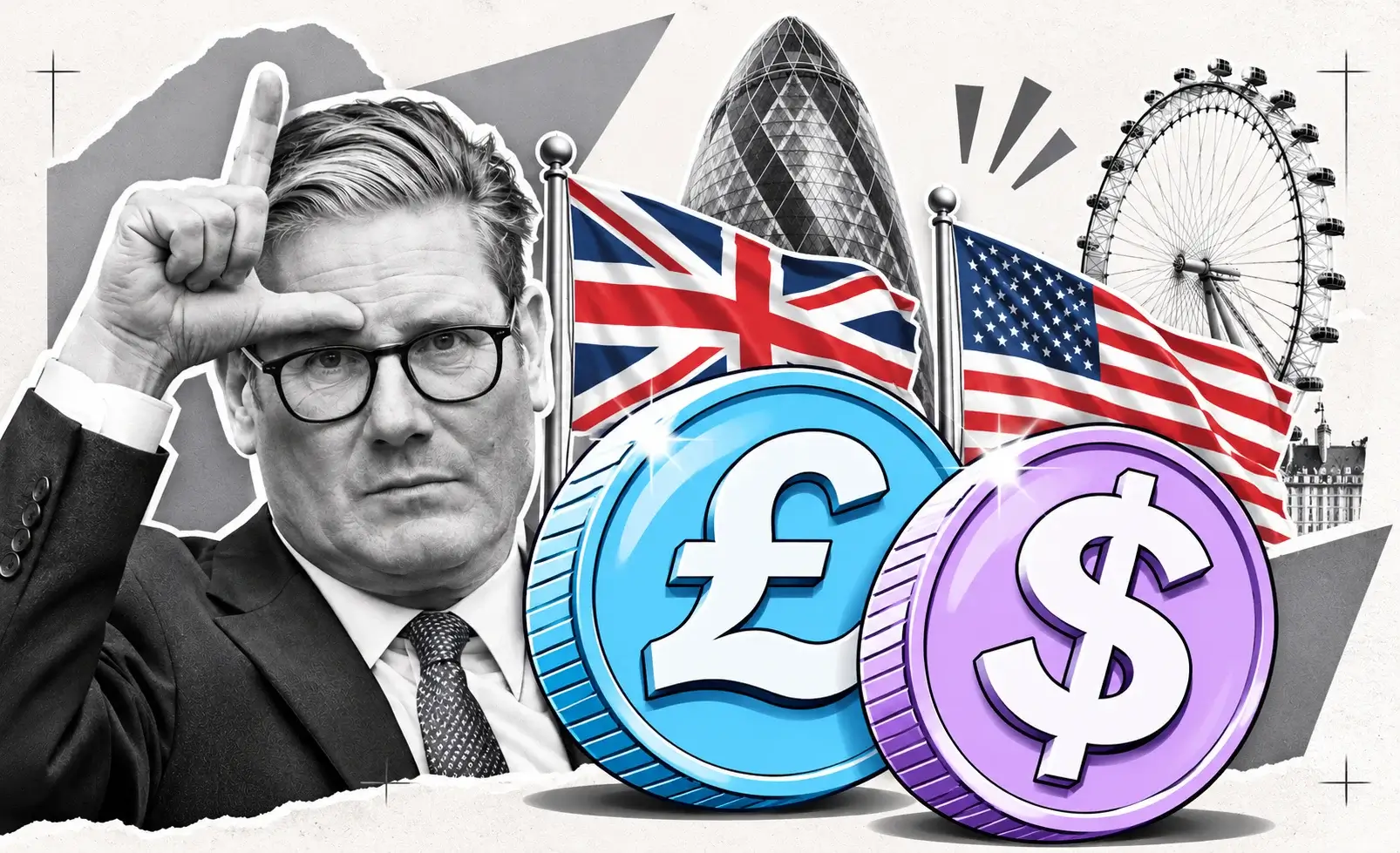
Hawkish BoE lifts cable to 1.3113; a close above 1.3150 opens 1.3250 | That's TradingNEWS
Key Points
- GBP/USD rose 0.62% to 1.3113, rebounding 102 pips from Monday's 1.3011 19-month low
- Markets price an 82% chance of a 25bp BoE hike on December 17 after Greene's push for speed
- UK CPI rose to 3.6% in October, with core inflation steady at 2.8%
GBP/USD trades at 1.3113, up 0.62% on the day as of 12:09 p.m. ET. It is 102 pips above Monday's 1.3011 low, the weakest level since April 2025 and a fresh 2026 low. Monday's drop was the pair's ninth decline in ten sessions. The pound lost the October low just below 1.3150 last Thursday and slid toward 1.3000 as the AI rally lifted the dollar and U.S. rate expectations. The pair was still trading 1.3038 in Asian hours on Tuesday, below its nine-day exponential moving average near 1.3135, before turning higher in the London morning.
Bank of England rate-setters drove the turn. Megan Greene, one of the Monetary Policy Committee's most hawkish members, said on Tuesday that the BoE is "a little bit behind the curve now" and needs to raise rates faster unless the Middle East conflict ends or the data turn sharply. She said a lasting, credible diplomatic resolution would be needed to change her view. On Monday, Chief Economist Huw Pill called for an immediate hike. Swaps now price an 82% chance of a 25 basis point hike at the December 17 meeting, with separate estimates between 80% and 84%.
The dollar is also giving ground. The AI trade that lifted the dollar on Monday is unwinding, with the Nasdaq Composite down 2.40% and Nvidia off 8.27%, and the dollar index has eased 0.10% to 104.19. Strong U.S. data limits the pullback. The Conference Board's consumer confidence index jumped to 103.3 against a 92.1 consensus. Fed funds futures price a 96% chance of a 25 basis point Fed hike on December 9, with Wednesday's PCE inflation report still to come.
The thesis for this forecast is that cable is now a contest between two hiking central banks, and the BoE has the more hawkish committee. Bank Rate at 4.00% matches the top of the Fed's 3.75% to 4.00% range, and the BoE's internal debate is about speed while the Fed's is about size. Against that, sterling carries a heavier inflation and energy burden, a fiscal backdrop that keeps gilt yields near 5.4%, and a services economy that is slowing. That points to a 1.3010 to 1.3150 range into the December decisions, with a 1.3250 upside target that becomes live only after a daily close above 1.3150.
Price Map: The 1.3011 Low, the 1.32255 High and the 1.3465 Hike-Day Level
The November decline has been steady. On November 5, the day the BoE raised Bank Rate to 4%, GBP/USD held 1.3465. On November 10, it traded at 1.3434. From there the pair fell in a series of lower highs. It hit 1.32255 on November 17, the high of the last seven sessions, and then slid through the October low just below 1.3150 last Thursday. Monday's move took it to 1.3011, with the largest one-day decline of the week on November 23. At the 1.3011 low, the pound had lost 3.4% from its hike-day level in under three weeks.
Tuesday's bounce has recovered part of that. At 1.3113, the pair is 102 pips above the low and back above the 1.3100 handle. It sits just below two resistance levels: the nine-day exponential moving average near 1.3135, and the broken October low just under 1.3150. A daily close above 1.3150 would turn that level from resistance back into support. That is the first condition for any recovery toward the November 17 high.
Above 1.3150, the next level is 1.32255, the November 17 high and the top of the seven-day range. The 1.3250 upside target in this forecast sits just above it. A move there would recover the second half of November's decline and put the pair back inside the range where it traded before the AI-driven dollar rally. Above 1.3250, the November 10 level of 1.3434 and the hike-day level of 1.3465 mark the next stretch.
On the downside, 1.3100 is the first support, then 1.3038, Tuesday's Asian-session level. The structural floor is 1.3011, Monday's 19-month low, and the 1.3000 round number below it. A daily close below 1.3000 would be the first since April 2025 and would open 1.2900. Beneath that, the April 2025 tariff-shock lows are the next reference.
The daily structure is still bearish. The pair is trading below its nine-day EMA and has posted lower highs since November 5. Tuesday's rebound is the largest single-day gain in two weeks, but one day does not reverse a nine-session slide. Bulls need a close above 1.3150 and then a higher low above 1.3038 to confirm that Monday was a capitulation low.
Greene and Pill: A BoE That Thinks It Is Behind the Curve
The Bank of England's policy debate is the pound's main support. The MPC raised Bank Rate to 4% at its meeting ending November 4, by an 8–1 vote, with the dissenter wanting a 50 basis point hike to 4.25%. It was the first increase since August 2023. Catherine Mann cast the dissent. Swati Dhingra and Alan Taylor, who had previously favored holding rates, supported the hike, reflecting growing concern that higher energy prices could feed into more persistent inflation. In September, the committee had held at 3.75% on a 6–3 vote, with Mann, Pill and Greene already voting to hike.
The hawks are pressing for more. Greene has voted for a hike since June and said on November 19 that the BoE moved too slowly. On Tuesday she said the UK needs to tighten faster unless there is a turnaround in the data or the war, and that a lasting diplomatic resolution would have to be visible before she would change her view. Pill called for an immediate hike on Monday and has said a single 25 basis point move is "unlikely to be sufficient." Deputy Governor Clare Lombardelli has said she would not rule out a December hike.
Governor Andrew Bailey has been more cautious. He has not ruled out a December hike but has repeatedly stressed that the MPC will assess the evidence at each meeting. The committee appears to have a majority for another hike, but not necessarily for back-to-back moves. Mann, Pill and Greene are the likely votes for a December increase. The question is whether Bailey and the centrists join them on December 17 or wait for the February projection meeting.
Market pricing has moved toward the hawks. The December hike probability rose from 50% after the November 5 decision to 82% now. The BoE's Market Participants Survey shows a median expected path to 4.25% by February. The one-year-ahead market-implied Bank Rate on the SONIA curve stood at 4.95% on November 16. Markets price three more hikes by the end of 2027. That curve is steeper than the Fed's, which is the core reason sterling has held above 1.3000.
For the forecast, the BoE is the pound's floor. As long as December pricing stays above 80%, sterling has rate support that limits downside below 1.3000. A signal from Bailey that he favors waiting until February would cut December pricing toward 50% and push the pair back to test 1.3011. A clear endorsement of a December hike from the governor would push pricing toward 100% and open the move to 1.3250.
The Rate Gap: BoE at 4.00% Against a Fed at 3.75% to 4.00%
For the first time this cycle, sterling is the higher-yielding side of the pair at the short end. Bank Rate at 4.00% matches the top of the Fed's 3.75% to 4.00% range. On November 5, the two-year gilt yielded 4.78% against 4.50% on the two-year Treasury, a 28 basis point advantage for the pound. That advantage shifted sentiment on the pound after the November hike and helped hold cable near 1.3465.
The gap has not been enough to stop the slide. Since November 5, Fed pricing has shifted faster than BoE pricing. The Fed hiked in September, held in October on a 10–2 vote, and is now priced at 96% for a 25 basis point hike on December 9, which would take the target range to 4.00% to 4.25%. Traders revived bets on at least two more Fed hikes after Monday's equity rally. The BoE's December odds are 82%, lower than the Fed's. On current pricing, the Fed moves first and with more certainty.
The December sequence matters for cable. If the Fed hikes on December 9 and the BoE follows on December 17, both policy rates end the year at 4.25%, and the gap stays flat. If the Fed hikes and the BoE holds until February, the Fed's upper bound moves 25 basis points above Bank Rate for two months, and the pound loses its short-end advantage. The market is pricing the first outcome with 82% conviction. Any wobble in that pricing hits the pound directly.
The longer end of the curve is less favorable to sterling. UK gilt yields reflect a fiscal risk premium that U.S. Treasuries do not carry to the same degree. The 10-year gilt yield reached 5.43% on October 21 and the 30-year near 5.89%. The U.S. 10-year Treasury yield is 4.916%. A higher gilt yield driven by fiscal risk tends to weaken a currency, because it signals investors demanding compensation for credit risk rather than rewarding growth.
The rate gap therefore gives sterling a narrow edge, not a decisive one. At the short end, the BoE's hawkish committee offers a modest yield advantage. At the long end, UK fiscal risk erodes it. For the pound to rally to 1.3250, the short-end advantage needs to grow, which requires the BoE to hike on December 17 with signals of more to come while the Fed pauses after December 9.
UK Inflation at 3.6%: Fuel Drives the Headline, Core Holds at 2.8%
UK inflation is rising again. The Office for National Statistics reported that CPI inflation rose to 3.6% in the 12 months to October 2026, up from 3.5% in September and in line with consensus. Prices rose 0.5% on the month, against 0.4% a year earlier. CPIH rose to 3.7% from 3.6%, and RPI was 4.2%. Headline inflation fell during the first half of 2026 but has risen over recent months.
Energy is the driver. Motor fuel prices jumped 33.2% year on year, the highest motor fuel inflation rate since July 2022. The average price of diesel reached a record 199.5 pence per litre in October, and petrol averaged 174.7 pence. A tobacco duty increase on October 1 also pushed up alcohol and tobacco inflation. Goods inflation rose from 3.2% to 3.5%. On the other side, food and non-alcoholic beverage inflation fell to 0.9% from 1.3%, and restaurants and hotels pulled the rate down.
The underlying picture is more stable. Core CPI, which excludes energy, food, alcohol and tobacco, was 2.8% in October, unchanged from September and down from 3.1% in January. Services inflation was broadly unchanged. The BoE watches core and services inflation as measures of domestic price pressure. A core rate of 2.8% is above the 2% target but not accelerating, which gives the doves an argument that the headline spike is an energy shock that will pass.
The BoE's own statement framed the November hike around that energy risk. It said it raised Bank Rate to reduce how much rising energy costs affect other prices, after conflict in the Middle East disrupted energy supply and pushed up households' motor fuel costs and utility bills. The worry is second-round effects: energy costs feeding into wages and services prices. Greene has warned that UK pay awards look set for 3.5% next year, too fast for 2% inflation.
For the pound, inflation cuts both ways. Higher headline inflation keeps the BoE hiking, which supports sterling. But inflation at 3.6% against a 4.00% Bank Rate leaves a real policy rate of only 0.4%, compared with a slightly positive real rate in the U.S. If falling oil prices bring headline UK inflation down quickly in the coming months, the case for further hikes weakens, and the pound would lose its rate support.
Flash PMI: Manufacturing at a 27-Month High, Services Slowing
Monday's flash purchasing managers' indexes gave a mixed signal. The S&P Global flash UK composite PMI fell to 52.3 in November from an eight-month high of 52.9 in October. The services PMI dropped to 52.0 from 52.8, a five-month low. The manufacturing PMI eased to 52.7 from 52.8. Consensus estimates varied, with forecasts for services between 51.8 and 53.0, so the print was a modest miss on some measures and a slight beat on others.
Manufacturing output was the bright spot. The flash manufacturing output index rose to 54.2 from 53.6, the fastest upturn in factory output in over two years and the highest level since August 2024. Survey respondents pointed to sales boosted by AI data-center buildouts, higher defense spending and stronger demand in food and beverages. Even with the slowdown in services, the survey points to a 0.6% increase in fourth-quarter GDP.
Cost pressures are the concern for the BoE. Firms widely reported strong cost pressures in November because of higher energy and transport bills. The prices charged and employment components feed directly into the BoE's worries about services inflation and wages. A services sector that is slowing but still facing rising costs is a stagflationary mix that makes the policy decision harder.
The UK is outperforming the eurozone on these numbers. The eurozone composite PMI held at 51.7, below the UK's 52.3, and France's composite collapsed to 46.2. Germany is the only large European economy growing faster than the UK, with its composite at a 56-month high of 55.0. A UK economy growing 0.6% per quarter while running 3.6% inflation gives the BoE little reason to stop hiking.
For GBP/USD, the PMIs are neutral to mildly supportive. They confirm the UK is not heading into recession, which keeps the BoE's tightening path credible. But the services slowdown and Monday's 52.3 composite were not strong enough to stop the pound falling to its 19-month low that afternoon. Growth data will matter less than inflation and central-bank communication until the December meetings.
Gilts and the Fiscal Backdrop: Healey's Budget and a 5.4% 10-Year
The UK's fiscal position is the pound's long-run weakness. Chancellor John Healey delivered the 2026 Budget on October 28. It prioritized stability over radical reform, with a focus on reassuring gilt investors and cost-of-living support such as extended energy VAT relief. Before the Budget, the rise in gilt yields had already cut the fiscal cushion against the government's rules from £23.6 billion to roughly £13 billion, making tax rises close to unavoidable.
Gilt yields have risen sharply this year. The 10-year gilt yield rose from 4.4% before the March 2026 Spring Forecast to 5.43% on October 21. The 30-year yield climbed from 5.2% to 5.9% by October 2. The global bond selloff that accompanied the escalation of the Iran war pushed the 10-year to 5.268% in early September, an 18-year high at the time. Higher yields raise debt-service costs, which shrinks fiscal room and keeps pressure on the government.
The rise in UK yields has been part of a global move, driven by higher inflation and higher policy rates, rather than a UK-specific crisis. That distinction matters for sterling. In September 2022, a UK-specific fiscal shock drove both gilts and the pound into freefall. In 2026, gilts have sold off alongside Treasuries, Bunds and French OATs. The pound has fallen, but in an orderly way, and mostly because of dollar strength rather than a flight from UK assets.
Fiscal risk still caps the upside. Investors who see UK debt interest consuming more of the budget will demand higher yields at the long end. If gilt yields rise because of fiscal worries rather than BoE hikes, the pound weakens even as yields go up. The BoE's Financial Stability Report on Wednesday, November 26, will include its assessment of gilt market functioning and the risks from rising long-term yields. Any warning about gilt liquidity or leverage in the system would weigh on sterling.
For the forecast, the fiscal backdrop is a reason sterling has not rallied more on the hawkish BoE. A central bank hiking into a 5.4% 10-year yield is defending against inflation in an economy with limited fiscal room. That supports sterling against currencies with dovish central banks, such as the euro, but it limits gains against a dollar backed by a Fed that is also hiking.
The Dollar Side: PCE, a 104 Dollar Index and the AI Tape
The dollar has driven most of November's decline in cable. The dollar index stands at 104.19, down 0.10% on Tuesday, after hitting a 19-month high of 104.30 on Monday. The index broke out last week on strong core retail sales and hawkish Fed commentary, and it got another push on Monday when Nvidia's reinstatement of Jensen Huang revived the AI trade and lifted U.S. growth and rate expectations. Sterling's slide to 1.3011 came in the same session.
The link between AI stocks and the dollar has been strong this month. When AI shares rallied, the dollar rose on expectations of stronger U.S. growth and more Fed hikes, and sterling fell. On Tuesday, AI stocks reversed, with the Nasdaq down 2.40%, and the dollar eased, giving cable room to bounce. If the AI selloff deepens and pulls U.S. yields lower, the dollar loses one of its main supports, which would help the pound recover toward 1.3150.
Wednesday's U.S. data is the key test. The October PCE price index, the second estimate of third-quarter GDP, durable goods orders and jobless claims are released at 8:30 a.m. ET. Core PCE is expected at 3.2% year on year. A soft print would cut expectations of Fed hikes beyond December, weaken the dollar and give cable the push to break 1.3150. A hot print would revive talk of a 50 basis point Fed move and send the pair back toward 1.3011.
The U.S. economy is giving the Fed cover to keep hiking. Tuesday's consumer confidence reading of 103.3 was the highest since January 2025, and the present-situation index rose 13.7 points to 132.8. Third-quarter GDP grew 3.4% annualized in the advance estimate. Consumers' 12-month inflation expectations eased to 5.7% from 5.8%, which is the only part of Tuesday's data that leans toward a Fed pause.
Holiday liquidity will magnify any move. U.S. markets close on Thursday for Thanksgiving and close early on Friday. Cable will trade in thin conditions through the end of the week, so the reaction to Wednesday's PCE print may carry through to the following Monday without a full U.S. session to correct it. For the forecast, the dollar side points to continued pressure into early December unless PCE surprises to the downside.
Energy and the Iran War: The UK's Exposure
Energy prices link UK inflation, the BoE's hiking cycle and the pound. The Iran war pushed Brent crude above $109 earlier in 2026 and briefly to $126.41 on April 30, driving UK motor fuel inflation to 33.2% and diesel to a record 199.5 pence per litre. The UK is a net energy importer, and higher oil and gas prices hit its trade balance and household spending power. That is the main reason UK inflation rose to 3.6% while core inflation held at 2.8%.
Energy prices are now falling sharply. Brent trades near $89.82, down 28.9% from its April peak and 23.5% over the past month. WTI is near $80.59. Both hit three-month lows on Tuesday before bouncing on attacks in the Strait of Hormuz. President Trump's signal of restraint on new strikes against Iran and recovering Gulf exports have turned the oil market from pricing a supply shock to pricing a surplus.
For the pound, cheaper oil cuts two ways. It improves the UK's terms of trade and will bring headline inflation down in coming months as motor fuel prices fall. That is good for growth and for real incomes. But it also weakens the case for further BoE hikes, because the BoE explicitly raised rates to stop energy costs feeding into other prices. If energy inflation fades, Bailey and the centrists have reason to pause after one more hike or even before it.
Greene's comments on Tuesday tied her hawkishness directly to the war. She said a lasting, credible diplomatic resolution would be needed for her to change her view, and expressed doubt that such a resolution is imminent. The BoE's hawks are betting on persistent energy shocks. The oil market is betting on a surplus. If the oil market is right, BoE hike pricing will fall over the next two months, removing support from sterling.
Read More
-
Yen Stalls at 160 Despite a 3% JGB and Tokyo Core CPI at 2.0% — Intervention Sits at 164, Friday's Payrolls Decide
02.09.2026 · TradingNEWS ArchiveEnergy
-
Pinterest Jumps 12.7% to $19.05 on Change-in-Control Filing; Reclaiming $20 Opens $20.92
24.11.2026 · TradingNEWS ArchiveStocks
-
XRP Slips to $0.9193 After $1.026 Rejection; Reclaiming $1 Opens $1.08 Before Dec 1 Unlock
24.11.2026 · TradingNEWS ArchiveCrypto
-
WTI Holds $80.59, Brent $89.82 After Three-Month Lows; Targets $86.85 and $95 on Hormuz Risk
24.11.2026 · TradingNEWS ArchiveCommodities
-
Stock Market Today: Nasdaq IXIC Drops 2.4%, Dow DJI Green, S&P 500 SPX Eyes 7,400 as NVDA Sheds 8%
24.11.2026 · TradingNEWS ArchiveMarkets
-
EUR/USD Rebounds to 1.0964 From 2026 Low; Clearing 1.1000 Opens 1.1100 Ahead of PCE
24.11.2026 · TradingNEWS ArchiveForex
The OPEC+ meeting on Sunday, November 29, adds another energy risk. A production cut that pushes Brent back toward $95 would support BoE hike expectations and the pound. A rollover that sends Brent below $88 would weaken them. For the forecast, energy is a medium-term negative for sterling's rate support, even though it is a positive for the UK economy.
EUR/GBP and the Cross Signals
The cross rates show sterling is weak against the dollar but steady against Europe. EUR/USD trades at 1.0964 on Tuesday, up 0.61%, a move similar in size to cable's 0.62% gain. EUR/GBP sits at 0.8361 on those levels. The pound to euro rate held above €1.20 after the BoE's November hike. Both European currencies are moving with the dollar, not against each other.
The policy comparison favors sterling over the euro. The BoE has Bank Rate at 4.00% with a December hike priced at 82%. The ECB has its deposit rate at 2.50% and faces a December 17 decision on whether to hike after eurozone inflation hit 4.0% in October. The ECB's real policy rate is deeply negative at minus 1.5%, compared with the BoE's slightly positive 0.4%. A 150 basis point policy gap in the BoE's favor is the main reason EUR/GBP has stayed in the low 0.83s.
Political risk also favors sterling. France's 10-year OAT-Bund spread stood at 156.3 basis points on November 17 after peaking at 176 basis points in October, the highest since the early 2000s. France's composite PMI collapsed to 46.2. The UK's fiscal position is strained, but it does not face a sovereign spread crisis inside a currency union. Investors looking to reduce European exposure have been selling the euro more than the pound.
That helps cable indirectly. When EUR/USD weakens because of French risk, part of the European selling spills into sterling, since the two currencies often trade together against the dollar. When French spreads ease, as they did briefly on Monday morning, both currencies get support. A clean S&P review of France on Friday, November 27, would help EUR/USD and cable together.
For the forecast, the crosses confirm that cable's direction depends mostly on the dollar. Sterling has a fundamental edge over the euro on rates and politics, but that edge does not protect it against broad dollar strength. GBP/USD can reach 1.3250 only if the dollar index falls back toward 103.50, which requires either a soft PCE print or a deeper AI-driven risk-off move that pulls U.S. yields lower.
Positioning and Technicals
The technical picture is a downtrend with an early sign of exhaustion. GBP/USD fell in nine of ten sessions before Tuesday's rebound. It is trading below its nine-day exponential moving average near 1.3135, and the daily chart shows a series of lower highs from 1.3465 on November 5 to 1.32255 on November 17. Monday's drop to 1.3011 broke the October low just below 1.3150, which turned a former support into resistance.
Tuesday's bounce has the features of a short-covering move. A 102-pip rebound from a 19-month low after nine down days, triggered by hawkish central-bank comments rather than new data, usually reflects traders taking profit on short positions rather than new buyers entering. Short-covering rallies tend to stall at the first major resistance, which for cable is the 1.3135 to 1.3150 zone. Tuesday's high so far sits just below it.
Speculative positioning in sterling futures has been net short through the autumn, according to Commodity Futures Trading Commission data. Leveraged funds rotated in and out of sterling longs during October and November as BoE hike expectations rose and fell. Positioning is not as stretched as in the euro, where speculative shorts reached multi-year extremes, so the pound has less fuel for a squeeze.
The levels define the trade. A daily close above 1.3150 would reclaim the broken October low and open 1.32255 and the 1.3250 target. A failure at 1.3135 to 1.3150 followed by a close below 1.3038 would confirm the downtrend and open a retest of 1.3011. A break below 1.3000 on a daily close would be the first since April 2025 and would target 1.2900.
Volatility will rise into the end of the week. Wednesday brings the BoE's Financial Stability Report and the U.S. PCE report in the same session. Thursday's U.S. holiday and Friday's early close will thin liquidity. One-week implied volatility on cable is elevated relative to one-month volatility, which signals the market expects a large move this week, then calmer trading until the central-bank meetings in December.
The Calendar: BoE FSR, PCE, the Fed on December 9 and the BoE on December 17
The next four weeks are packed with event risk for cable. On Wednesday, November 26, the Bank of England publishes its Financial Stability Report at 10:30 GMT. The report will cover gilt market functioning, leverage and the risks from higher long-term yields. Any warning about gilt market stress would weigh on the pound. In the U.S., October PCE, third-quarter GDP, durable goods and jobless claims come at 8:30 a.m. ET.
Thursday is Thanksgiving in the U.S., and markets are closed. Cable will trade in London hours on thin liquidity. Friday brings a shortened U.S. session and S&P Global's review of France's credit rating after the close, which will affect European currencies at the December 1 open. On Sunday, November 29, OPEC+ meets in Vienna to set 2027 quotas, which will move oil prices and, through them, UK inflation expectations.
December brings the decisions that matter most. U.S. November jobs data and CPI arrive before the Fed decides on December 9, with a 96% probability of a 25 basis point hike priced in. UK October GDP, labor market data and November CPI come before the BoE decides on December 17. Eight days separate the two decisions. If both hike, the policy gap is unchanged. If the Fed hikes and the BoE holds, the pound loses its short-end advantage.
UK wage data is the key domestic release. Greene has warned that pay awards look set for 3.5% next year. A wage print above that level would push December BoE pricing toward 100% and support the pound. A softer wage print would cut December pricing and send cable back toward 1.3011.
For the forecast, the calendar leans toward continued pressure on the pound into early December. U.S. data has been strong, and the Fed is priced with more certainty than the BoE. The pound's best chance for a sustained rally comes after December 9, if the Fed signals a pause and the BoE follows with a hawkish hike on December 17. That would set up a move toward 1.3250 and possibly 1.3434 into year-end.
GBP/USD Forecast, Key Levels and Verdict
GBP/USD heads into Wednesday's BoE Financial Stability Report and U.S. PCE data as a bounce inside a downtrend, supported by a hawkish central bank and pressured by a strong dollar. The near-term forecast is a 1.3010 to 1.3150 range through the December 9 Fed decision, with a 1.3250 upside target that becomes live only after a daily close above 1.3150.
Support starts at 1.3100, the handle reclaimed on Tuesday. Below it, 1.3038 is Tuesday's Asian-session level. The structural floor is 1.3011, Monday's 19-month low, and the 1.3000 round number beneath it. A daily close below 1.3000 would be the first since April 2025 and would open 1.2900, with the April 2025 lows as the next reference.
Resistance starts at 1.3135, the nine-day exponential moving average, and 1.3150, the broken October low. A daily close above 1.3150 would turn that zone back into support. Above it, 1.32255 is the November 17 high. The 1.3250 upside target sits just above that, and getting there requires the dollar index to fall back toward 103.50, which needs a soft PCE print or a deeper AI-driven risk-off move. Beyond 1.3250, the November 10 level of 1.3434 and the hike-day level of 1.3465 come into view.
The fundamental case is balanced. For sterling: Bank Rate at 4.00% matching the top of the Fed's range, an 82% probability of a December 17 BoE hike, Greene and Pill pressing for faster tightening, a 4.95% one-year-ahead SONIA rate, three more BoE hikes priced by the end of 2027, a 0.6% fourth-quarter GDP signal from the PMIs, manufacturing output at a 27-month high, and a 150 basis point policy advantage over the ECB. Against sterling: a dollar index at 104.19 near its 19-month high, a 96% probability of a December 9 Fed hike, strong U.S. consumer confidence at 103.3, UK inflation at 3.6% leaving a thin 0.4% real policy rate, a services PMI at a five-month low, a 10-year gilt yield that reached 5.43% in October, a fiscal cushion cut to roughly £13 billion, and falling oil prices that weaken the BoE's case for more hikes.
The verdict on November 24 is a bearish trend with a hawkish floor. Cable at 1.3113 is a sell-the-1.3150 market until the dollar turns. A soft PCE report on Wednesday and a clear signal from Bailey that he backs a December hike turn 1.3150 into the launch point for 1.3250. A hot PCE print and a BoE that leans toward waiting until February send the pair back through 1.3011 and below 1.3000 for the first time since April 2025.