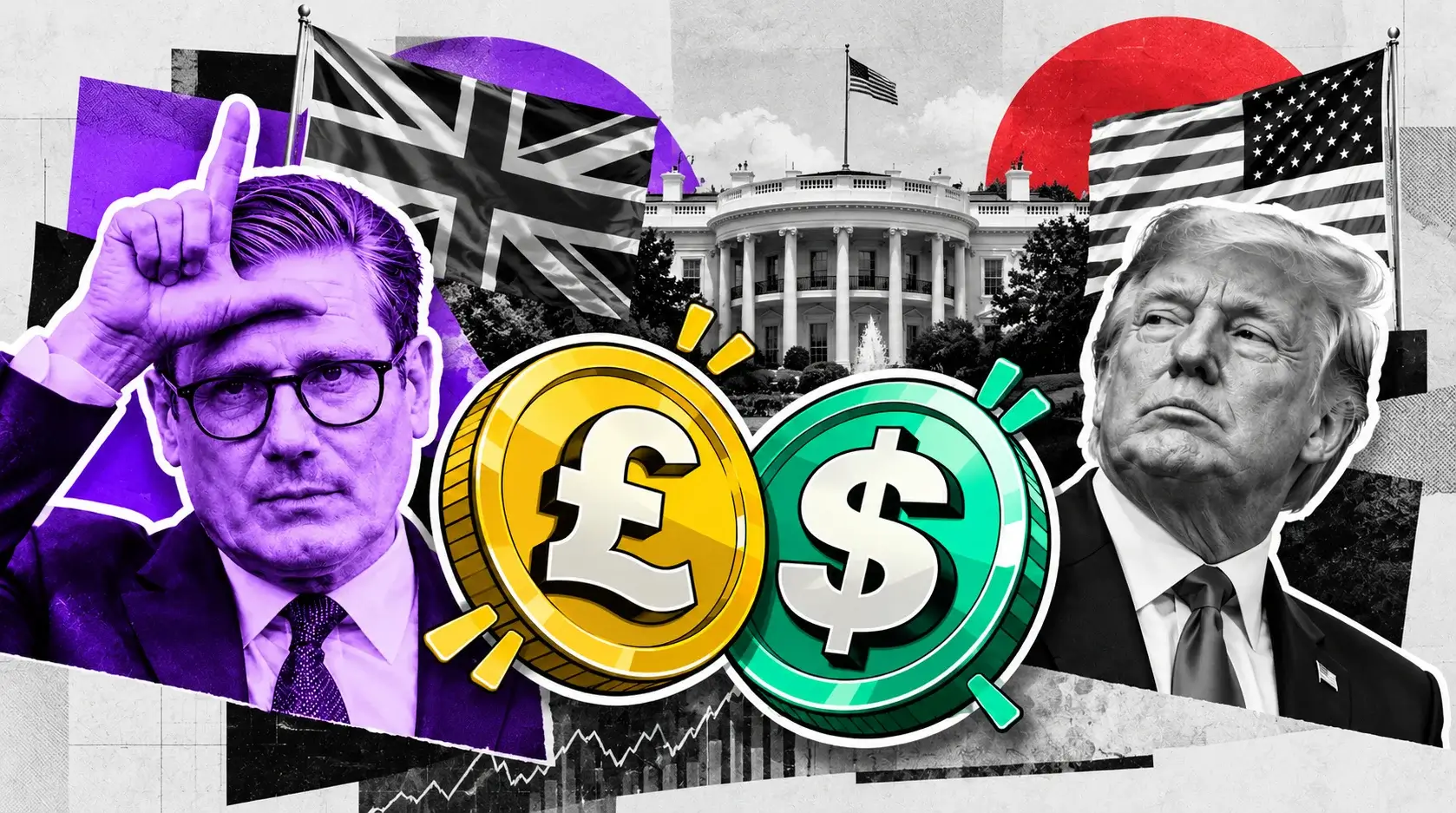
GBP/USD Price Forecast: Pound Cracks 1.3600 as 3.8% CPI and Starmer Crisis Pressure Cable
A break below 1.3500 exposes 1.3400, while political risks push 30-year UK gilt yields to their highest since 1998 | That's TradingNEWS
Key Points
- GBP/USD drops 0.55% to 1.3520 after April CPI prints 3.8%, breaking the 1.3600 Fibonacci ceiling
- Polymarket prices a 66% chance Starmer resigns by year-end as 80+ Labour MPs demand new leadership
- UK 30-year gilt yields surge to 1998 highs on fiscal risk fears, pressuring the pound versus the dollar
GBP/USD is changing hands at $1.3520 on Tuesday afternoon after sterling absorbed a punishing 0.55% slide that drove the cable pair through the $1.3600 psychological threshold and into a direct test of the medium-term ascending trendline that has anchored the recovery since mid-March. The session opened with a modest defensive tone and accelerated lower through the European hours as the heaviest U.S. inflation print since May 2023 forced a broad repricing across the foreign exchange complex. The pound is now trading roughly 0.30% lower against the dollar on the European session and has flirted with the $1.3500 round-figure support that bears have been targeting since the political pressure on Prime Minister Keir Starmer intensified over the weekend. The structural picture across timeframes is mixed but tilting decisively against sterling — the pair sits just below the SMA-20 at $1.3546, comfortably above the SMA-50 at $1.3431 and the SMA-200 at $1.3401, while the Ichimoku Kijun line has flipped from short-term support into the operative resistance level for the rest of the week.
Why The Cable Tape Cracked Beneath $1.3600 Today
The catalyst that finally forced cable through the $1.3600 ceiling was a dual-track macro shock that hit sterling from both directions simultaneously. On the U.S. side, the April CPI release accelerated to 3.8% year-over-year with monthly growth of 0.6%, both readings hotter than the consensus prints and triggering a fresh wave of dollar strength as the Federal Reserve's rate-cut path effectively closed for the coming months. The U.S. Dollar Index (DXY) firmed to $98.15, climbing 0.25% on the session as Treasury yields ratcheted higher across the curve. On the UK side, the political crisis around Starmer escalated dramatically over the past 72 hours, with more than 80 Labour Party MPs now publicly calling for the prime minister's resignation following the local election defeats. The combination of dollar strength and sterling-specific political stress created the perfect conditions for the $1.3600 resistance band — which corresponds to the 61.8% Fibonacci retracement from the previous major swing high — to finally give way after weeks of repeated tests.
The Polymarket Probability Shift Is The Single Most Underrated Data Point
The political risk variable that markets have been gradually pricing into the GBP curve has now accelerated into a near-term crisis. The Polymarket prediction platform is now pricing a 66% probability that Keir Starmer steps down as prime minister by the end of 2026, a dramatic shift from the 48% reading just days ago. That repricing matters enormously because it directly translates into UK gilt yield dynamics and currency risk premium. 30-year UK gilt yields have soared to their highest levels since 1998 on fears that a new Labour leader will abandon the principles of fiscal consolidation and push through additional stimulus that conflicts with the Bank of England's tightening stance. The historical analog being cited across trading desks is the autumn 2022 Liz Truss mini-budget crisis that briefly pushed cable to a record low — and while the current configuration is not identical, the structural parallels are uncomfortably close for sterling bulls who had been positioning for further upside.
The Bank Of England Stance Is The Last Pillar Supporting The Pound
Despite the political stress, the monetary policy backdrop has been the dominant supportive variable for sterling over recent quarters. Futures markets had been pricing up to three Bank of England rate hikes in 2026, an aggressive tightening cycle that placed the BoE alongside the most hawkish G10 central banks and pushed sterling into a top-three performer alongside the Norwegian krone and the Australian dollar. That hawkish positioning fundamentally separated GBP from the broader risk-off pattern that hit other European currencies during the Iran crisis escalation. The cable pair remained remarkably stable through the early phase of the Middle East conflict precisely because the BoE rate trajectory provided a structural carry advantage that compensated for the broader risk-off pressure. The risk now is that the political crisis forces the BoE to soften its hawkish posture, which would mechanically remove the last remaining pillar supporting sterling against the strengthening dollar.
The Statistical Anomalies In UK GDP Add A Layer Of Structural Doubt
A subtle but potentially consequential issue gaining attention across analytical desks is the pattern of statistical anomalies showing up in UK GDP data. Since the pandemic, the British economy has exhibited a distinct seasonal pattern of strong growth in the first half of each year followed by meaningful deceleration in the second half. That pattern has fueled persistent rumors that the Office for National Statistics has been making aggressive methodological adjustments to keep headline GDP figures within acceptable ranges. The market implication is that the underlying growth picture may be weaker than reported metrics suggest, which would mechanically reduce the economic justification for the BoE's hawkish stance and remove the carry advantage that has supported sterling. Combined with the political crisis and the dollar reacceleration, the GDP integrity question creates a third layer of fundamental pressure on the pound that bulls had not fully priced into positioning until recently.
The Critical Fibonacci Architecture That Bears Are Targeting
The technical map below current price is layered with notable precision. The immediate support sits at the $1.3500 psychological floor, with the 38.2% Fibonacci retracement near $1.3470 marking the next critical structural level. A confirmed close beneath $1.3500 would expose the $1.3450 zone, followed by the $1.3400 cluster where the medium-term ascending trendline aligns with prior horizontal support. Cable has not breached $1.3400 with conviction during the post-March recovery cycle, meaning that level represents the most consequential structural pivot for the entire bullish thesis off the spring base. Loss of $1.3400 on a closing basis would mechanically invalidate the multi-month uptrend that has been intact since late March and project the deeper bearish target of $1.3300 which sits below the trendline and would represent a meaningful capitulation event for sterling longs.
The Stablecoin Regulation Drag Is The Most Underreported Headwind
A genuinely underreported pressure point on sterling comes from the Bank of England's expanding focus on stablecoin regulation. Governor Andrew Bailey has explicitly raised concerns over the regulatory treatment of dollar-denominated stablecoins, highlighting potential disputes between international regulators and the United States over convertibility and redemption risks. The November 2025 BoE consultation papers proposed holding limits and reserve requirements for issuers of pound-backed stablecoins, reflecting a structurally more cautious regulatory approach for digital assets that touch sterling flows. The implication is that the BoE is preparing for a world in which cross-border GBP/USD liquidity could face genuine stress during periods of market dislocation — a regulatory framing that itself adds incremental risk premium to the pair and explains part of the persistent downside pressure that has built up over recent weeks even before the latest political shock.
The Momentum Picture Is Sending Conflicting Signals
The momentum readings across timeframes are producing the kind of mixed signal set that typically characterizes pivot moments rather than trending environments. The MACD continues to reflect a bias toward potential upside but is being directly contradicted by a high ADX reading that signals strong selling momentum, a divergence pattern that usually resolves with sharp directional movement once the conflict between indicators clears. RSI, Stochastic RSI, and CCI are all reading neutral, with no decisive directional bias visible in the technical structure. Bull/Bear Power on the intraday frame indicates buyers currently hold a slight advantage, but that read is being undermined by the price action itself, which has now closed at session lows on multiple consecutive sessions. The picture sharpens on the lower timeframes where the 2-hour RSI sits near 50 in neutral territory but lacks the divergence pattern that would suggest mean reversion in either direction.
The Performance Frame Captures The Cyclical Setup
The longer-term performance context provides essential perspective on where cable sits relative to its recovery trajectory. The pair is up 3.02% over the past twelve months from a baseline reading near $1.3913, 1.96% over the past month from the $1.377 zone, and 6.33% over the past three months from the $1.436 level that captured the early-year strength. Over a six-month horizon, sterling has gained 4.33% from the $1.409 base, indicating that the recent volatility has not yet eroded the broader recovery trajectory that built up through the first quarter. The recent weekly change is essentially flat at -0.04% from $1.35, confirming that the latest decline represents tactical pressure rather than a structural breakdown of the entire post-pandemic recovery pattern.
How Cable Compares With The Broader Dollar Complex
The relative performance dynamic across the major dollar pairs tells a story of sterling-specific stress rather than uniform dollar strength. EUR/USD has dropped to $1.1730, a comparatively modest decline against the euro, while cable has cracked through more significant technical layers. GBP/JPY pressure has been even more acute as the hawkish Bank of Japan signaling pulled the cross lower on multiple fronts. The asymmetric weakness in cable versus the euro decline confirms that markets are pricing UK-specific risk rather than just dollar strength — which means the resolution of the political crisis matters more than the macro environment for determining sterling's recovery trajectory. The $1.3500 floor that bears are now testing aligns with the most consequential technical level in the broader G10 currency complex over the next several sessions.
Where The Resistance Map Sits Above Current Price
The upside architecture is just as well-defined as the support layer below. Immediate resistance sits at the $1.3546 SMA-20 that has flipped from support into the operative ceiling, with the $1.3557 to $1.3577 swing cluster acting as the secondary barrier zone. Above that, the $1.3600 horizontal floor that has now been broken converts into resistance under classic polarity dynamics, with the $1.3700 round-figure level marking the major upside target if a recovery materializes. Beyond $1.3700, the path opens toward the $1.377 monthly average and ultimately the $1.3849 zone that represented the cycle peak earlier in the year. A confirmed break above $1.3700 with rising volume would credibly target the $1.3849 zone as the primary upside objective, with the $1.40 psychological threshold as the extended target if the political pressure on Starmer resolves favorably and the BoE maintains its hawkish posture.
The Probability Map For The Coming Week
Compressing the technical and fundamental inputs into a unified framework, cable is expected to trade within a $1.3400 to $1.3700 band over the coming sessions. The probability of an upward break above $1.3700 is currently estimated at approximately 20%, while the path of least resistance has shifted toward continued range trading with a downside bias unless the political situation in the UK resolves. A confirmed daily close above $1.3550 SMA-20 with rising volume would credibly target the $1.3700 ceiling, while a sustained break beneath $1.3500 would mechanically expose the $1.3450 Fibonacci confluence and ultimately the $1.3400 structural floor. The asymmetry tilts modestly toward the downside on the near-term technical setup, but the structural setup remains constructive enough that aggressive bears need to wait for confirmation of a $1.3400 break rather than fading every approach to support.
The DXY Architecture Adds Another Layer Of Context
The Dollar Index configuration provides essential context for cable's structural setup. DXY is consolidating at $98.15-$98.26 inside a descending channel that began from April's high, capped just below $98.50 by the 50-period moving average. The most recent swing has a retracement target sitting in the $98.59 to $99.09 zone, which represents the key area to watch for any meaningful dollar strength continuation. The $98.09 level below current price marks the long-term base of the descending channel structure, with higher lows intact inside the short-term consolidation pattern. The inverse correlation with GBP/USD means that any sustained DXY break above $99 would mechanically project cable toward the $1.3400 zone, while continued DXY rejection at $98.50 would help sterling consolidate around current levels rather than breaking down.
The Forward Trading Plan For Cable Bears
The structural setup currently favors short positioning as long as GBP/USD remains beneath the $1.355 resistance band that has now flipped from support into the operative ceiling. The political risk variable around Starmer's potential resignation provides the fundamental backdrop that justifies sustained sterling weakness, while the hot U.S. CPI print removes the rate-differential support that had been propping up cable through the early phase of the year. The technical confirmation comes from the breakdown beneath $1.3600 and the failed recovery attempts that have repeatedly stalled at the $1.3577 swing cluster. Tactical short setups make sense at any approach to the $1.355-$1.357 zone with disciplined stops above $1.3577, targeting the $1.3500 immediate floor and ultimately the $1.3450-$1.3470 Fibonacci cluster for partial profit-taking. The structural invalidation sits at a confirmed daily close above $1.3600, which would force a reassessment of the entire bearish thesis and potentially trigger a sharp short-covering rally back toward the $1.3700 ceiling.
How Political Resolution Could Reshape The Setup
Worth articulating carefully is the bullish counter-scenario that bears need to respect. If Starmer manages to consolidate political support and survives the immediate leadership challenge, sterling could stage a rapid recovery back through $1.3600 and beyond. The historical pattern in UK political crises has been for cable to bottom shortly after maximum political stress and rally substantially once the situation stabilizes. The current setup more closely resembles the early Truss government in autumn 2022 than the long-running May or Johnson periods, meaning resolution could occur on a compressed timeline rather than dragging through quarters of uncertainty. A clean resolution that maintains fiscal discipline and supports the BoE's hawkish posture would mechanically remove the political risk premium and project cable back toward the $1.40 zone that defined the late-2025 cycle peak before the most recent weakness phase began.
Read More
-
Yen Stalls at 160 Despite a 3% JGB and Tokyo Core CPI at 2.0% — Intervention Sits at 164, Friday's Payrolls Decide
02.09.2026 · TradingNEWS ArchiveEnergy
-
QQQ ETF ($706.22) Slides 7.4% Below Its High as the Market Reprices the AI Capex Bill — $686.57 Target if $700 Breaks
22.10.2026 · TradingNEWS ArchiveStocks
-
XRPI ($7.00) and XRPR ($10.74) Slide Toward 52-Week Lows as Spot XRP ETF Flows Stall at $708,510
22.10.2026 · TradingNEWS ArchiveCrypto
-
NG ($2.775) Decoupled From Europe’s €88 Gas Crisis as LNG Feedgas Hits 18.9 Bcf/d — $3.30 Upside on Cold Weather
22.10.2026 · TradingNEWS ArchiveCommodities
-
Dollar-Yen (157.35) Loses 157.65 as the Yen Rallies on Haven Demand — 155 Target if 156 Breaks
22.10.2026 · TradingNEWS ArchiveForex
The Long-Term Forecast Map And Strategic Positioning
The longer-term outlook for cable depends critically on how the current political crisis resolves and whether the BoE maintains its tightening trajectory through the year. Forecast distributions across analytical desks suggest a $1.30 to $1.40 trading range for the remainder of 2026, with the upper boundary contingent on political stabilization and the lower boundary triggered only if the leadership crisis morphs into a broader fiscal credibility shock similar to the Truss episode. The base-case scenario points to continued range trading between $1.3400 and $1.3700 through the summer driving season, with directional resolution depending on the cadence of UK political developments and the trajectory of U.S. inflation through the rest of the year. The asymmetric risk distribution favors continued caution on sterling longs at current levels while leaving room for tactical accumulation on confirmed defense of the $1.3400 structural floor.
The Position Framework — Cautious With Tactical Short Bias
The conviction read on GBP/USD resolves to a tactical short bias with structural neutrality, transitioning to potential accumulation only on confirmed defense of the $1.3400 structural support. The fundamental case against the pound is anchored by the political crisis around Starmer with Polymarket pricing 66% probability of resignation by year-end, the 30-year gilt yield surge to 1998 highs, the 80+ Labour MPs publicly calling for leadership change, the Bank of England regulatory pressure on stablecoin frameworks, and the hot 3.8% U.S. CPI print that has removed the rate-cut tailwind sterling had partially priced into positioning. The technical case is supported by the breakdown beneath the $1.3600 Fibonacci ceiling, the failure to recover the SMA-20 at $1.3546, the negative ADX configuration despite a positive MACD reading, and the layered support architecture beneath current price that suggests further downside risk before genuine structural buying interest emerges. The risks deserve respect — sentiment indicators show 70.4% bullish positioning that creates short-squeeze risk on any positive political development, the medium-term moving average alignment remains constructive with cable above both the SMA-50 and SMA-200, and a successful Starmer political survival would mechanically remove the largest fundamental drag on the pair. The base-case positioning is short on rallies toward $1.3550-$1.3577, with defined invalidation on a confirmed daily close above $1.3600, targeting the $1.3500 floor and ultimately the $1.3450-$1.3470 Fibonacci cluster as the primary objectives. A more aggressive bearish extension would project the $1.3400 structural floor as the final downside target, with strict structural invalidation only on a sustained daily close beneath $1.3400 which would open the path toward the $1.3300 zone in a deeper unwind. The structural recovery setup that has been intact since late March remains technically valid but requires defense of $1.3400 to remain operative, and the conviction read is Sell on rallies with tactical patience, transitioning to neutral to mild Buy on any confirmed defense of $1.3400 and to outright Buy only on a weekly close above $1.3700 that would confirm the political crisis has resolved favorably and the broader bullish structure remains intact through the back half of the year.