Euro Pinned at 1.14 Near One-Year Lows as the Dollar Seizes Control of the Pair
EUR/USD trades near 1.1410 after the ECB's first hike since 2023 failed to lift the euro; a hawkish Fed at 3.75% and a dollar index above 100 keep the pressure on | That's TradingNEWS
Key Points
- EUR/USD sits near 1.1410, close to one-year lows, after falling over 2% in June despite the ECB hiking to 2.25% — the dollar is in command.
- A hawkish Warsh Fed at 3.50–3.75% and a dollar index above 100 keep the 1.50% rate gap tilted against the euro.
- Support sits at 1.1324 then 1.13/1.11; reclaiming 1.15 opens 1.1765, with July 23 ECB and July 29 Fed meetings as key catalysts.
EUR/USD opened the third quarter clinging to the 1.14 handle, trading near 1.1410 after clawing back from one-year lows printed last week. The pair closed June at roughly 1.1400, a whisker off its weakest level since June 2025, and the bounce off the recent 1.1324 low did nothing to change the trajectory. The euro shed more than 2% against the dollar in June and gave back around 1.3% for the second quarter, sinking toward the bottom of the range that has contained it all year. This is a market where the euro isn't so much weak as overwhelmed — the single currency did something in June that should have lifted it, and the dollar steamrolled the move anyway. The technical structure leans bearish. EUR/USD trades below the 1.1500 psychological mark and beneath its key moving averages on the shorter timeframes, a configuration that keeps every bounce capped and hands the advantage to the sellers. The pair has been grinding lower in a series of lower highs, and the break to fresh one-year lows last week confirmed the downtrend's grip. Momentum readings sit in neutral-to-bearish territory, with the relative strength gauge hovering near the midline after recovering from oversold, signaling that the selling pressure has eased but not reversed. The forces pinning the euro are almost entirely on the other side of the pair. A hawkish new Fed regime, a dollar index that ripped above 100 to its highest in over a year, and a market pricing a U.S. rate hike this year have combined to crush EUR/USD even as the European Central Bank turned more hawkish itself. The dollar, not the ECB, is in the driver's seat, and that dynamic defines the tape. The 1.14 zone is the immediate battle line — a level that has absorbed multiple tests this year, from the March tariff-shock low to the June lows, and the pair is fighting to hold it. Lose it decisively and the next support levels open up; reclaim 1.15 and the euro has a shot at stabilizing. Still down only modestly over the past twelve months, EUR/USD hasn't collapsed — it's range-bound and sitting toward the soft end of that range, worn down by relentless dollar strength. The setup into July is a pair suspended at 1.14, caught between a hawkish Fed and a fading ECB tightening story, waiting on the jobs data and two central-bank meetings later in the month to break the deadlock.
The Paradox: The ECB Hikes and the Euro Still Falls
The defining puzzle of the euro's June was a move that should have sent it ripping higher but instead left it lower. The European Central Bank raised its deposit rate to 2.25% on June 11, a 25-basis-point hike and its first rate increase since 2023. The main refinancing rate climbed to 2.40% and the marginal lending rate to 2.65%, effective June 17. A first hike in three years is the kind of hawkish pivot that normally lifts a currency hard, as higher rates draw capital seeking better yield. The euro fell anyway. That paradox tells the whole story of where EUR/USD sits. The single currency's own monetary story turned decisively more hawkish, and it still couldn't gain ground against the dollar, because the dollar's story turned even more hawkish at the same time. When both sides of a pair lean the same direction, the relative move matters, and the Fed out-hawked the ECB. The market looked at the ECB's 25-basis-point hike, then looked at a Fed signaling potential hikes of its own from a much higher starting point, and kept selling the euro. The ECB's move also arrived with a wrinkle that undercut its punch. The hike looked almost counterintuitive against the backdrop of falling oil, with Brent tumbling from above $110 a barrel in April toward the low-$90s and lower after the U.S.-Iran ceasefire. The ECB was reacting to inflation that had already landed in the data rather than the oil price on any given day, but the falling crude signaled that the next leg of eurozone inflation would ease — which meant the June hike might be the last for a while. A one-and-done hike doesn't drive a sustained currency rally, and the market treated it accordingly. The rate increase reflected inflation that had already fed through: eurozone headline inflation had risen to 3.2% in May, the highest since September 2023, with core climbing to 2.5%. The ECB moved to address that, but with oil falling and price pressures set to ease, the tightening cycle looked capped almost as soon as it began. That's the paradox in full. The ECB delivered a hawkish surprise, the euro's rate story improved, and none of it mattered against a dollar backed by a Fed pointing toward hikes from 3.75%. The single currency's hawkish pivot got buried under the greenback's stronger one, and EUR/USD fell despite the ECB doing exactly what should have lifted it. The lesson of June is that in this pair, the dollar calls the shots.
The Dollar in Command
The force pinning EUR/USD near one-year lows isn't euro weakness — it's dollar strength, and that strength traces directly to the hawkish regime under Fed Chair Kevin Warsh. The greenback firmed sharply through June, with the U.S. Dollar Index breaking above 100 and peaking near 101.80, its highest level in over a year. That surge extended the positive momentum triggered by the Fed's hawkish hold, and it pressed EUR/USD lower even as the euro's own story turned more hawkish. The dollar is in command, full stop. The Fed held rates at 3.50% to 3.75% on June 17 but signaled a likely hike this year, with nine of eighteen members now projecting tightening. That shift — from a Fed expected to cut toward a Fed openly weighing hikes — repriced the entire dollar complex higher. The market moved from pricing U.S. easing to pricing U.S. tightening, and a currency backed by rising rates and a hawkish central bank attracts capital. The dollar drew that capital, and the euro paid the price. Warsh's arrival transformed the calculus. The new regime staked out a minimalist, data-dependent stance that pointed toward restrictive policy, and the market rewarded the dollar for it. His refusal to signal any softening at the ECB's Sintra forum reinforced the read, keeping the greenback bid. When the world's reserve currency carries both the higher rate and the more hawkish central bank, it wins the relative game against almost every rival, and the euro sits squarely in the crosshairs. The inflation backdrop backs the hawkish dollar. U.S. inflation running well above the Fed's 2% target — with some readings near 4.2% — gives the hawks all the cover they need to keep policy restrictive and threaten hikes. Sticky U.S. inflation plus a resilient labor market equals a Fed that stays tight, and a tight Fed equals a strong dollar. That combination has been the euro's undoing. The dollar's command over the pair also reflects its safe-haven role. Elevated geopolitical risk premiums and the general risk-off tone that swept markets to open the quarter drove flows into the greenback, adding another layer of demand on top of the rate story. When money seeks safety and yield at the same time, it buys dollars, and both impulses pointed the same direction in June. For EUR/USD to recover, the dollar would need to top out — which requires the Fed to soften or the U.S. data to weaken convincingly. Neither has happened. As long as the Warsh Fed points toward hikes and the dollar index holds above 100, the greenback stays in command, and the euro stays pinned near its lows. The dollar has the wheel, and it's steering EUR/USD lower.
The Rate Differential That Drives the Pair
At the heart of EUR/USD sits the rate differential between the Fed and the ECB, and right now that gap tilts firmly in the dollar's favor. The Fed holds at 3.50% to 3.75% while the ECB's deposit rate sits at 2.25%, leaving a differential of roughly 1.50 percentage points that rewards holding dollars over euros. That gap is the gravitational force pulling EUR/USD lower, and until it compresses, the euro fights an uphill battle. The differential has narrowed dramatically from its peak but still favors the greenback. Back in 2023, the gap ballooned to roughly 3.25 percentage points when the Fed hiked aggressively while the ECB lagged. Both banks then cut through 2024 and 2025, before the Fed stopped cutting first — holding at 3.75% since late 2025 while the ECB continued easing toward 2.0%. The ECB's June hike to 2.25% narrowed the gap to the current 1.50%, but 1.50% is still a meaningful yield advantage for the dollar, and it's the reason the euro can't gain traction. The core of any EUR/USD bull case rests on that gap compressing further. If the Fed eventually cuts while the ECB holds or hikes, the differential narrows, the dollar's yield advantage shrinks, and EUR/USD rises. That's the rate-divergence trade that has historically driven the pair. But the current setup has that trade running in reverse — or rather, stalled. With both central banks leaning hawkish, the divergence that typically moves the pair has gone quiet, and the 1.50% gap sits stubbornly in the dollar's favor. The differential's direction matters as much as its level. A 1.50% gap that's stable pins the pair; a 1.50% gap that's widening — because the Fed hikes while the ECB holds — pushes EUR/USD lower still. The market's pricing of a potential Fed hike this year raises exactly that risk. If the Fed lifts rates from 3.75% while the ECB stays at 2.25%, the gap widens back toward 1.75% or beyond, and the euro sinks further. That's the bear scenario embedded in the rate structure. For the euro, the path to recovery runs through the differential. Either the Fed has to abandon its hawkish tilt and move toward cuts, or the ECB has to deliver additional hikes that narrow the gap from the other side. The most bullish outcome combines both: a Fed forced to hold or cut as U.S. inflation cools, and an ECB delivering a second hike. That renewed divergence — ECB tightening, Fed on hold — is the combination that could send EUR/USD back toward the 1.20s. Absent it, the 1.50% differential keeps the dollar in front and the euro pinned. The rate gap is the engine of the pair, and right now it's running against the euro.
The ECB's Hawkish Story Fades
Just as the euro needed its central bank to keep tightening, the ECB's hawkish story began to fade — and the culprit is oil. The U.S.-Iran ceasefire reopened the Strait of Hormuz, sending oil prices and inflation expectations lower, and that easing prompted the market to scale back bets on further rate hikes by the ECB and the Bank of England. The single most important support for the euro — the prospect of continued ECB tightening — got undercut by falling crude, and the currency suffered for it. The mechanics are straightforward. The ECB's June hike responded to inflation that had already fed through, driven partly by the energy shock from the Middle East conflict. As the ceasefire took hold and oil tumbled from above $110 in April toward the low-$90s and then lower, the inflation outlook cooled. Lower energy prices mean lower headline inflation ahead, which means less pressure on the ECB to keep hiking. The market read that and dialed back its expectations for additional ECB moves, removing a key pillar of euro support. Falling oil eases the next leg of eurozone inflation even though it doesn't undo what has already landed in the data. That distinction matters. The ECB hiked because inflation had already climbed to 3.2% headline in May, but with crude falling, the forward path points toward cooling, and a central bank facing cooling inflation doesn't keep tightening aggressively. The June hike looked increasingly like a one-and-done move rather than the start of a cycle, and a one-and-done hike offers the euro little sustained support. The timing compounded the euro's problem. The ECB's hawkish story faded at precisely the moment the Fed's hawkish story intensified. As the market scaled back ECB hike bets, it ramped up Fed hike bets, widening the perceived policy gap in the dollar's favor. The euro lost its tailwind just as the dollar gained one, and EUR/USD sank toward one-year lows. The Bank of England faced the same dynamic, with falling oil trimming its hike expectations too, but for EUR/USD what matters is the ECB side of the equation, and that side weakened. The fading ECB story leaves the euro dependent on inflation staying hot enough to force additional hikes. If eurozone price pressures cool as the falling oil suggests, the ECB stays on hold, the divergence trade stays dead, and the euro stays pinned. For the currency to recover, the ECB would need to reassert its hawkish stance — delivering a second hike in July or September — which requires inflation to prove stickier than the oil price implies. Absent that, the ECB's faded story is another weight on the euro, removing the support it needed most exactly when the dollar was surging.
Eurozone Inflation Rolls Over
The inflation data that drove the ECB's June hike began rolling over in June, and that cooling removes the last strong argument for further tightening. Eurozone headline inflation eased to around 2.8% in June, down from the 3.2% May reading that had marked the highest level since September 2023, and below the 3.0% the market expected. The pullback signals that the energy-driven inflation spike is fading, and with it, the case for the ECB to keep hiking. Cooling inflation is euro-negative when it undercuts the tightening story, and that's exactly what June's data did. The breakdown across the major economies confirmed the softening. Inflation eased in Germany, France, and Italy in June, the eurozone's largest economies, pointing to broad-based cooling in price pressures. When the core of the currency bloc sees inflation decelerate, the ECB loses the justification for additional hikes, and the market prices accordingly — trimming euro support. The June data was a clear step down from May's multi-year highs, and it landed just as the falling oil price reinforced the disinflationary trend. One holdout complicated the picture. Spain's harmonized consumer prices stayed near two-year highs, rising 3.6% year over year in June, unchanged from May and holding at the highest level since June 2024. That stickiness in one major economy kept some pressure on the ECB, but it wasn't enough to offset the cooling elsewhere. The aggregate eurozone read pointed down, and the aggregate is what drives ECB policy. Spain's persistence gave the hawks a talking point, but the broader trend favored the doves. The rolling-over inflation interacts with the fading ECB story to compound the euro's weakness. The June hike responded to inflation that had already peaked, and with prices now cooling, the ECB has less reason to follow through with more tightening. The market sees a central bank that hiked into a peak and now faces a disinflationary path, which reads as one-and-done rather than a cycle. That interpretation strips the euro of the sustained rate support it needs to challenge the dollar. The inflation data also raises the stakes for the coming prints. If eurozone inflation continues to cool through the summer, the ECB stays on hold, the rate gap with the Fed stays wide, and EUR/USD stays pinned. If inflation reaccelerates — perhaps on the Spanish stickiness spreading or a fresh energy shock — the ECB could deliver a second hike, reviving the euro. But the June data leaned toward cooling, and cooling favors the dollar. For now, the rolling-over inflation is another force pressing EUR/USD lower, removing the price pressure that justified the ECB's hawkish turn and leaving the euro exposed to the surging greenback. The disinflation the eurozone wanted is the disinflation the euro didn't need.
The Sintra Signal
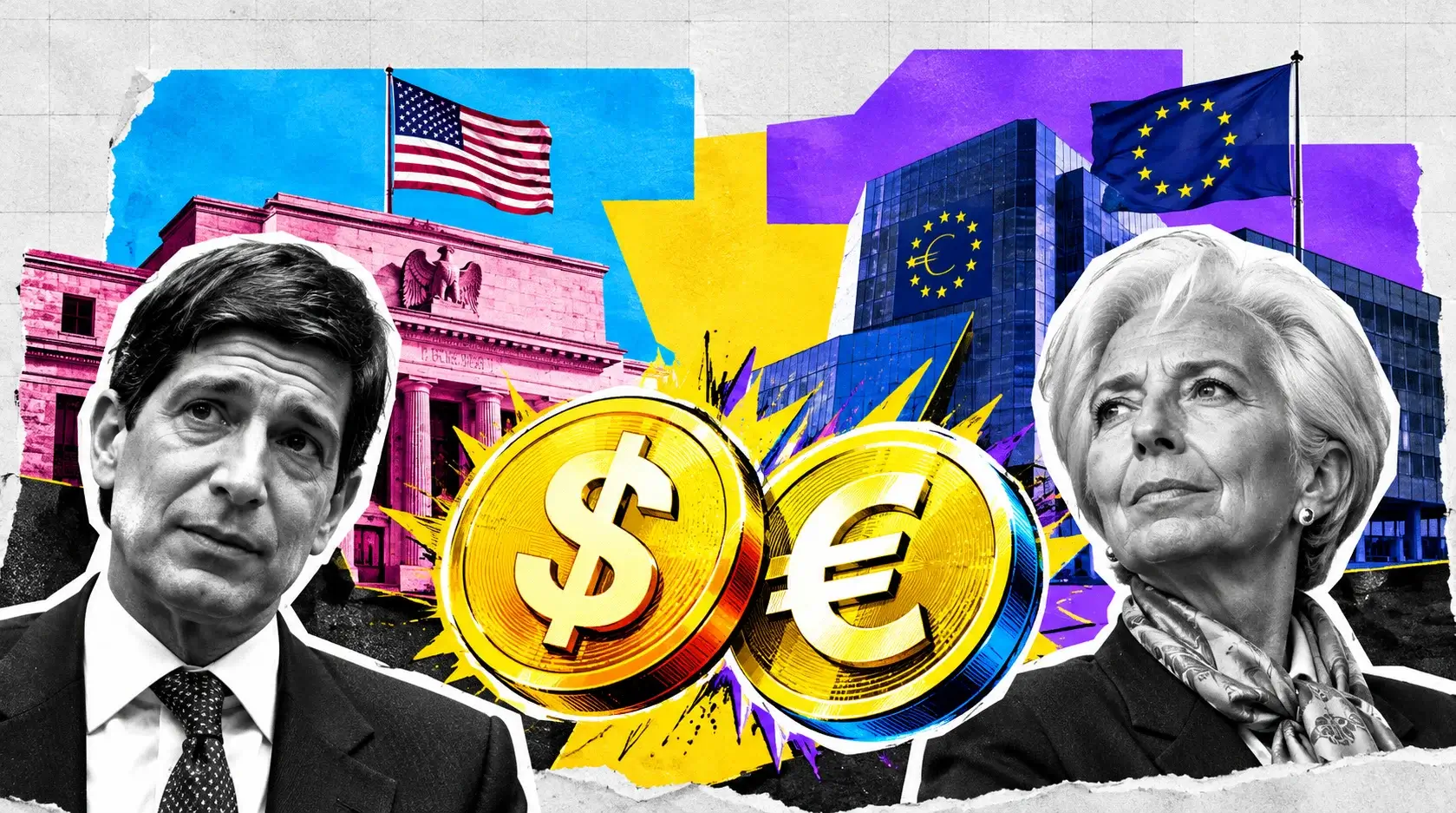
The ECB's annual forum in Sintra drew the market's full attention this week, headlined by a panel featuring ECB President Christine Lagarde, Fed Chair Kevin Warsh, and Bank of England Governor Andrew Bailey. The gathering of the three major central-bank leaders offered a rare chance to read their economic assessments and policy directions side by side, and for EUR/USD, the signals from Lagarde and Warsh carried direct weight. The market hunted for clues, and what it got tilted toward the dollar. Warsh offered no dovish comfort. His remarks gave no signal on the Fed's policy path, keeping the hawkish read intact and the dollar bid. For a market weighing whether the Fed hikes this year, a chair who declines to push back against that pricing effectively endorses it, and the greenback held its gains. Warsh's silence was its own signal — a Fed content to let the market price hikes, which keeps the dollar in command and the euro pinned. Lagarde's role was to clarify the ECB's stance after the June hike, and the market wanted to know whether the central bank would follow through with more tightening or treat June as one-and-done. With eurozone inflation cooling and oil falling, the pressure was on Lagarde to either reaffirm a hawkish path — which would support the euro — or acknowledge the disinflationary trend, which would confirm the fading tightening story. The forum's signals leaned toward the latter interpretation, reinforcing the sense that the ECB's cycle is capped. The Sintra panel crystallized the divergence that's pinning EUR/USD. On one side, a Fed chair declining to walk back hike expectations from a 3.75% starting point. On the other, an ECB president managing a cooling-inflation backdrop from a 2.25% base with the tightening story fading. That contrast — hawkish Fed holding firm, ECB story softening — is the exact setup that has driven the euro to one-year lows, and the forum put it on display. The market watched the panel for any shift in that dynamic and found none that favored the euro. The forum also underscored how much the pair now hinges on central-bank communication. Lagarde's speeches and comments are a key source of euro volatility, and Warsh's are the same for the dollar. With both leaders on the same stage, the market parsed every word for a hint of divergence, and the balance tipped toward the dollar's hawkish hold. The Sintra signal, in sum, was continuity — a Fed staying tight, an ECB story fading — and continuity means the euro stays under pressure. Absent a hawkish surprise from Lagarde reasserting the ECB's tightening resolve, the forum did nothing to lift EUR/USD off its lows. The signal from Sintra kept the dollar in the driver's seat.
The Data Wall on the Dollar Side
The U.S. economic data has consistently reinforced the hawkish Fed and the strong dollar, building a wall that EUR/USD keeps failing to climb. The JOLTS report showed job openings climbing to a two-year high, underscoring a labor market that refuses to crack and giving the Fed cover to stay restrictive or hike. Strong U.S. labor data is euro-negative for EUR/USD because it strengthens the dollar's rate story, and the two-year high in openings did exactly that. The resilient U.S. economy is the foundation of the dollar's strength. A labor market with openings at multi-year highs, a ratio of openings to unemployed workers sitting above 1, and broad signs of economic durability all point to a Fed with room to keep tightening. Every strong U.S. print consolidates the hawkish view and lifts the dollar, pressing EUR/USD lower. The euro can't compete against a currency backed by an economy that keeps outperforming. Wednesday brought one crosscurrent. The ADP report showed U.S. private payrolls grew just 98,000 in June, missing the 110,000 consensus and cooling from 122,000 in May. A softer U.S. labor print would normally weaken the dollar and lift EUR/USD by nudging the Fed toward patience, and the euro caught a modest bounce off the miss. But a single soft reading against the broader strength signaled by JOLTS wasn't enough to flip the dollar's trajectory, and EUR/USD stayed capped near 1.14. The real test comes Thursday, when the U.S. June nonfarm payrolls report lands a day early because of the July 4 holiday. That print is the swing catalyst for EUR/USD. Analysts expect another solid month of U.S. payroll gains, and if the number comes in hot, it confirms the resilient-economy narrative, cements the Fed hike odds, lifts the dollar, and likely sends EUR/USD below 1.14 toward the next support. A soft print — building on Wednesday's ADP miss — would weaken the dollar and give the euro room to bounce toward 1.15. The U.S. data wall stands taller than the eurozone's. While eurozone inflation cools and the ECB story fades, the U.S. economy keeps printing strength, and that asymmetry drives the pair. The dollar has the stronger data, the higher rates, and the more hawkish central bank, and the euro has none of those advantages right now. Until the U.S. data softens convincingly, the wall holds, and EUR/USD stays trapped beneath it. Thursday's jobs number is the next brick, and it will tip the near-term balance. Hot sends the euro lower; soft gives it a lifeline. The data wall on the dollar side has been the euro's enemy all quarter, and it stands firm into the payrolls print.
The Technical Breakdown
The chart confirms the euro's predicament: EUR/USD is in a downtrend, pinned below key resistance and probing one-year lows. The pair trades beneath the 1.1500 psychological mark and below its key moving averages on the shorter timeframes, a structure that keeps every rally capped and the sellers in control. The break to fresh one-year lows last week — with the pair dipping toward 1.1324 — confirmed the bearish grip and opened the door to further downside. Reclaiming 1.1500 is the first step toward neutralizing the downtrend, and the pair sits below it. The moving-average configuration tells the story. With price below the shorter-term averages and those averages flattening or turning lower, the trend structure leans bearish, and the 1.1500 zone that once acted as support has flipped into overhead resistance. Every bounce toward 1.15 gets sold, as the crowd that got caught at higher levels uses strength to exit. That's the classic overhead-supply dynamic that caps a downtrend, and EUR/USD is caught in it. Momentum readings offer a mixed picture. The relative strength gauge sits near the midline after recovering from oversold territory, signaling that the downside pressure has moderated but not reversed. A neutral RSI in a downtrend often precedes another leg lower once the oversold bounce exhausts, and that's the risk EUR/USD faces. The moving-average convergence indicator has shown modestly positive signs at times, hinting that the selling momentum is easing, but not enough to challenge the overhead resistance decisively. The bulls have a technical counterargument worth respecting. The 1.14 to 1.15 zone has absorbed multiple tests already — the March 2026 tariff-shock low at 1.1435, the June intraday lows — and the ascending channel structure that has guided the pair higher over the longer term remains intact. If the 1.14 level holds on a weekly closing basis, the repeated tests could form a failed breakdown, which would itself flip bullish. A level that gets tested repeatedly and holds can become a launchpad rather than a floor that breaks. That's the standoff. The near-term structure is bearish, with the pair below 1.15 and probing one-year lows, but the longer-term channel and the repeated defense of 1.14 keep a bullish reversal in play if the level holds. The resolution of that technical standoff, combined with the coming central-bank meetings, makes the next four to six weeks decisive for EUR/USD's direction. For now, the breakdown below 1.15 and the probe of one-year lows keep the charts pointed lower, and the 1.14 zone is the pivot. Hold it and the failed-breakdown bull case stays alive; lose it and the downtrend extends toward the next support. The technical picture is a coiled standoff, and the macro catalysts will break it.
The Support and Resistance Map
Navigating EUR/USD's next move means knowing the levels, and the map is well defined on both sides. On the downside, the 1.14 handle is the immediate support — the zone the pair is fighting to hold. Below it sits the recent one-year low near 1.1324, the level the euro probed last week, and losing that opens the door to the 1.13 region. Below 1.13, the map points toward 1.11, the level several forecasts flag as the likely floor if the downtrend extends through the summer. The 1.14-to-1.11 cascade maps the bear case, and each break would likely accelerate the selling as stops trigger and momentum builds. The 1.1435 level — the March 2026 tariff-shock low — sits within the current battle zone and has acted as support before, adding weight to the 1.14 area. On the upside, the resistance is stacked. The 1.1500 psychological mark is the first hurdle, the level the pair must reclaim to signal any near-term stabilization. Above it, the 1.15 to 1.16 zone caps further gains, as the crowd trapped at higher levels sells into strength. The more significant resistance sits at 1.1765 to 1.1800, a zone where the risk-reward for chasing the euro deteriorates and where prior rallies stalled. Beyond it looms the 1.20 psychological level — the threshold that has historically marked the divide between a soft-euro and firm-euro environment, and the target the bank forecasters aim for in their bullish year-end projections. The map reveals the euro's challenge. The downside levels are close, with 1.1324 and then 1.13 within easy reach if 1.14 breaks, while the upside resistance is dense and distant, requiring a reclaim of 1.15 and then a long grind toward 1.1765 and 1.20. That asymmetry reflects the bearish near-term structure — easy downside, hard upside — driven by the dollar's dominance. The pair can fall quickly through support but has to fight through layers of overhead supply to recover. For the near term, the 1.14 to 1.15 band defines the battle zone. Holding 1.14 keeps the base case of range-bound chop alive; reclaiming 1.15 opens the path toward 1.1765; losing 1.1324 confirms the bear case toward 1.13 and 1.11. Those are the three levels that matter most. The euro sits at the lower end of its range, pressed against 1.14 with the heavy resistance overhead and the support cascade below. The wide 1.13 to 1.21 range that has contained the pair all year frames the bigger picture — EUR/USD is toward the bottom of a broad band, not in a runaway collapse. But within that band, the near-term pressure points lower, and the map shows why. The levels are drawn, and the central-bank meetings and jobs data will determine which way the pair breaks from its 1.14 pivot.
The Divergence Trade Goes Quiet
The trade that normally drives EUR/USD — the divergence between Fed and ECB policy — has gone quiet, and its silence is itself a story. When one central bank hikes while the other holds or cuts, the resulting rate divergence moves the pair sharply. But right now both the Fed and the ECB lean hawkish, and when both banks point the same direction, the divergence trade that typically drives EUR/USD stalls. The pair loses its primary directional driver and drifts, pinned by the wide but stable rate gap. That's the current predicament. The Fed signals hikes from 3.75%; the ECB hiked to 2.25% and may or may not follow through. Both hawkish, both potentially tightening — which cancels the divergence that would otherwise send the pair trending. Instead of a clear rate-divergence move, EUR/USD gets range-bound chop, with every data print swinging expectations back and forth without establishing a trend. The quiet divergence trade is why the pair oscillates near 1.14 rather than trending decisively. The stalled trade raises the stakes for every data release. With the divergence quiet, each labor and inflation print on both sides of the Atlantic has the power to swing expectations and nudge the pair. A hot U.S. jobs number tilts toward Fed hikes and dollar strength; a hawkish ECB surprise tilts toward euro strength. The market whipsaws between these signals, and the pair chops within its range as the divergence stays balanced. That's a lower-conviction environment than a clear divergence trend, and it produces the grinding, directionless price action that has defined EUR/USD lately. The path out of the quiet divergence runs through a clear break in one direction. If U.S. inflation cools enough to take the Fed hike off the table while the ECB delivers a second hike, the divergence reawakens in the euro's favor — ECB tightening, Fed on hold — and EUR/USD ripples higher toward the 1.20s. If the Fed hikes while the ECB stays on hold as eurozone inflation cools, the divergence reawakens in the dollar's favor, and the pair breaks lower toward 1.13 and 1.11. Either resolution requires the central banks to diverge again. The coming meetings — the ECB on July 23 and the Fed on July 29 — are the events that could break the deadlock. Until then, the divergence trade stays quiet, and EUR/USD stays pinned near its lows, waiting for one central bank to blink. The quiet is the setup; the meetings are the trigger. When the divergence returns, the pair moves — and which way depends on who out-hawks whom in the second half.
The Bull Case for the Euro
For all the near-term pressure, a credible bull case for EUR/USD stands ready, and it rests on the rate differential eventually compressing in the euro's favor. The major banks maintain bullish year-end targets — clustered around 1.22 to 1.25 — built on the expectation that the Fed eventually cuts while the ECB holds or hikes, reviving the divergence trade that drives the pair higher. Those targets from the biggest forecasting shops assume the 1.50% rate gap narrows as U.S. policy softens, and if that plays out, EUR/USD has substantial room to rally from 1.14. The bull scenario has a clear trigger. If U.S. inflation cools faster than expected through the summer, taking the projected Fed hike off the table, while the ECB delivers a second 25-basis-point hike in July or September, the resulting renewed divergence — ECB tightening, Fed on hold — is the combination that sends EUR/USD back toward 1.22 to 1.25. That's the setup the bullish bank targets are built on, and it requires the two central banks to move in opposite directions after months of both leaning hawkish. The technical structure supports the bull case too. The 1.14 to 1.15 zone has absorbed multiple tests — the March tariff-shock low, the June intraday lows — and the ascending channel that has guided the pair higher over the longer term remains intact. If 1.14 holds on a weekly closing basis, the repeated failed breakdowns flip into a bullish signal, and the pair could reverse higher. A level that gets tested and defended repeatedly builds a base rather than breaking, and EUR/USD has defended 1.14 several times this year. The longer-term dollar picture adds fuel. The greenback's surge above 100 pushed the dollar index toward levels that historically mark a short-term peak, and if U.S. data softens, the dollar could top out and reverse, unleashing a EUR/USD rally toward the resistance zones. A dollar that's overbought and dependent on continued hawkish surprises is vulnerable to a pullback, and any dollar weakness lifts the euro. The bull case also draws on the structural story. Returning foreign inflows into European bonds and equities, an ECB with inflation near target, and the potential for the euro to reclaim its role as a firm currency all support a higher EUR/USD over the medium term. The 1.20 level has historically divided a weak-euro from a firm-euro environment, and reclaiming it would confirm a regime shift. The bull case, in sum, is that the current weakness is a dollar-driven dip within a range, and that the rate differential compresses in the euro's favor as the Fed eventually eases while the ECB holds firm. That case requires U.S. inflation to cool, the Fed to abandon its hike threat, and the ECB to reassert its tightening — a specific sequence that hasn't materialized yet. But the bank targets at 1.22 to 1.25 show that serious forecasters see the euro higher by year-end. The bull case is buried under the dollar's dominance for now, but it's live, and the July central-bank meetings could awaken it.
Scenarios Into July
EUR/USD's path forward splits into three scenarios, each hinging on the 1.14 floor and the direction of the two central banks. The bear case is the most immediate. A sustained break below 1.14 — losing the 1.1324 one-year low and then the 1.13 region — would confirm the downtrend and open a decline toward 1.11. This scenario requires the U.S. data to stay hot, the Fed to move toward actually delivering a hike, and eurozone growth to deteriorate while inflation cools enough to keep the ECB on hold. A collapse in the Iran ceasefire that re-spikes oil could add to the pressure by reviving the dollar's safe-haven bid. A hot Thursday jobs print is the near-term trigger that could send the pair toward 1.13, and losing 1.1324 would accelerate the move. Several forecasts flag 1.11 as the likely floor if the bear case plays out through the summer. The base case is range-bound chop, and it carries the highest probability. EUR/USD oscillates within the wide 1.13 to 1.21 band as both central banks hold or move in small increments, with no sustained trend absent a clear inflation surprise in either jurisdiction. In this scenario, the pair chops between 1.13 and 1.15 near-term, pinned by the quiet divergence trade and the stable 1.50% rate gap. The 1.14 level acts as a magnet, with the pair bouncing off support and failing at resistance as the market whipsaws on each data print. This is the most likely near-term path given the balanced hawkishness of both banks and the mixed data — Wednesday's ADP miss against the strong JOLTS print leaves the direction uncertain. The bull case requires renewed divergence. EUR/USD defends 1.14, U.S. inflation cools enough to take the Fed hike off the table, and the ECB delivers a second hike in July or September. The resulting divergence — ECB tightening, Fed on hold — sends the pair back through 1.15, then toward the 1.1765 to 1.1800 resistance, with the bank targets at 1.22 to 1.25 as the medium-term destination. This scenario needs the July 23 ECB meeting to deliver a hawkish hike and the July 29 Fed meeting to signal patience, plus U.S. data that cools convincingly. A soft Thursday jobs print would be the first step toward this outcome. Into July, EUR/USD sits at the decision point, pinned at 1.14 with the dollar in command and the central-bank meetings ahead. Thursday's payrolls print is the near-term swing factor — hot sends the euro toward 1.13, soft gives it room toward 1.15. The July 23 ECB and July 29 Fed decisions are the deeper catalysts that could reawaken the divergence trade and break the pair from its range. The three scenarios are drawn, and the data and the central banks will call it.
Read More
-
Yen Stalls at 160 Despite a 3% JGB and Tokyo Core CPI at 2.0% — Intervention Sits at 164, Friday's Payrolls Decide
02.09.2026 · TradingNEWS ArchiveEnergy
-
FDVV ETF ($61.42) Balances Nvidia, Apple and Microsoft Against Rate-Sensitive Income Holdings — $64.54 High in Reach if Yields Ease
19.10.2026 · TradingNEWS ArchiveStocks
-
XRPI ($6.98) and XRPR ($10.61) Trade 56% and 52% Below Their Highs as First-Mover Funds Lose the Fee Battle to 0.19% Spot Products
19.10.2026 · TradingNEWS ArchiveCrypto
-
NG Holds Its $3.00–$3.30 Range as Light Storage Builds Meet Record 112.2 Bcf/d Output — $3.50 Above $3.26
19.10.2026 · TradingNEWS ArchiveCommodities
-
Dollar-Yen (158.43) Stuck in a 1.39-Yen Box as Carry Meets the Intervention Line — 156.65 Below 157.55, Tokyo Waits at 160
19.10.2026 · TradingNEWS ArchiveForex
The Levels and Triggers That Matter Now
Cutting through the noise, a handful of levels and catalysts will dictate Bitcoin's next move, and keeping them in front of you is the whole game. On the downside, $58,000 is the line that matters most — the $58,115 to $58,212 support that has held through June and defines the floor. A weekly close below it is the single most bearish trigger on the board, opening $55,000 and potentially the mid-$50,000s. That's the level to defend and the level to fear. On the upside, the sequence runs $62,000 to $62,500 as first resistance, then $64,178 as the level Bitcoin must close above to signal real strength, then the 50-month EMA at $65,631 as the pivotal line whose reclaim would flip the structure and open $70,000. Each level has to fall in order for the recovery to build. The flow data is the leading indicator. The daily and weekly ETF numbers drove this cycle's price action more than any on-chain metric or sentiment gauge, and they're the first place to look for a turn. A break in the seven-week outflow streak — even a single week of net inflows — would be the earliest signal that the institutional bid is returning and the supply overhang is clearing. Until that flips, the redemption-driven supply keeps capping rallies. On the macro side, Thursday's June nonfarm payrolls report, pulled forward for the holiday, is the near-term swing catalyst. A soft number strengthens the rate-relief case and gives Bitcoin room to bounce; a hot print revives rate-hike fears and pressures the coin toward the floor. The Fed's posture, still murky after Warsh declined to signal anything at Sintra, is the deeper driver — the rate expectations that turned holders into sellers will determine whether they turn back into buyers. Sentiment is the contrarian tell. The Extreme Fear reading at 15 marks the kind of washed-out positioning that has historically preceded rebounds, and the RSI near prior-bottom levels adds to the case that the downside is closer to exhausted than not. But fear alone doesn't turn a market — it takes the flows and the macro to cooperate. Into July, Bitcoin sits pinned against $58,000, bleeding institutional money at a record pace, gripped by fear, and waiting on the Fed and the jobs data to break the tension. The setup is a coiled spring with the direction undetermined. Hold $58,000 and reclaim $65,631, and the recovery is on. Lose $58,000, and $55,000 comes into view fast. The levels are drawn, the triggers are set, and the flows will call it.