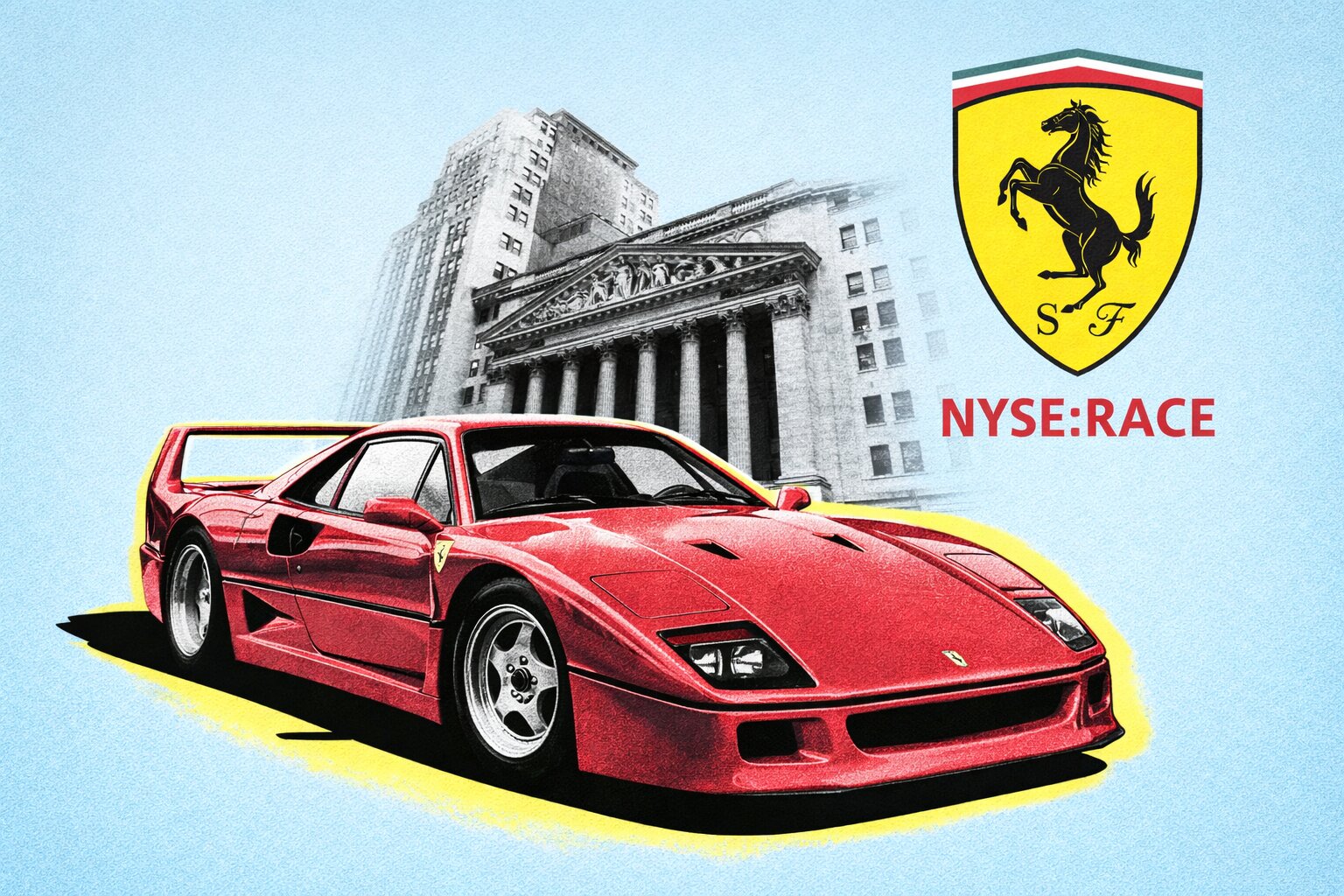
Ferrari Stock Price Forecast - RACE Roars Back: Q4 2025 Beats, NYSE:RACE Rallies Toward $370
With revenue at €7.15B, free cash flow up 50% to €1.5B and a fresh €3.5B buyback after the slide from $500 to $280, Ferrari stock is resetting its premium at around $365–$370 | That's TradingNEWS
Ferrari (NYSE:RACE) – Q4 2025 re-prices the stock as a premium compounder, not a bubble
Earnings recap: lower volumes, stronger P&L and a double-digit rebound in Ferrari stock
Ferrari (NYSE:RACE) is trading around $365–$370, up about 8–10% on the session from a previous close near $336, after Q4 2025 and full-year numbers confirmed the core thesis: the brand generates more revenue, more profit and more cash even when it ships fewer cars.
Full-year 2025 revenue reached roughly €7.15 billion, an increase of about 7% year on year, and comfortably ahead of the guidance Ferrari had put out earlier in the year. EBITDA was approximately €2.8 billion, up about 8%, with an EBITDA margin just under the 40% line. Operating profit came in near €2.1 billion, up around 12%, and pushed the EBIT margin to about 29.5%, roughly 120 basis points above the prior year. Net income was about €1.6 billion, translating into EPS of €8.96, slightly ahead of market expectations.
The key datapoint is free cash: industrial free cash flow was roughly €1.5 billion, up around 50% year on year. That scale of FCF expansion in a year where volumes fell is the clearest possible confirmation that the business model does not depend on chasing units.
Volume discipline and regional mix: how Ferrari grew 7% with 13,640 cars
Ferrari delivered around 13,640 cars in 2025, which is a decline of 112 units compared with the previous year. Despite that, revenue still advanced 7%. That outcome is only possible when price, mix and non-car revenues are doing the heavy lifting.
The reduction is highly targeted. The main pressure point is China, where Ferrari has been deliberately pulling back allocations and tightening supply to preserve exclusivity and pricing power in a market it still considers immature for its brand positioning. Those cars are being reallocated to regions where the pricing architecture and long-term brand equity are deeper, notably the Americas, which continue to absorb demand at attractive economics.
On a constant-currency basis, cars and spare parts revenue rose about 6%, despite the shipment decline. That tells you the mix is skewing toward higher-priced configurations and more profitable nameplates. Above that, sponsorship and commercial income – Formula 1, licensing and related media – grew around 23%, and the broader lifestyle and experience bucket, covering fashion, theme parks and similar verticals, advanced roughly 17%.
The direction is clear. Ferrari stock is increasingly backed by a three-engine model: a capped and premiumised car franchise, a high-margin global sponsorship platform and an emerging lifestyle ecosystem that monetises the brand without dumping more metal on the road.
Margins and free cash flow prove Ferrari stock is not a typical automaker
The structure of the 2025 results is exactly what you want from a high-end luxury industrial: units modestly down, revenue up mid-single digits, profitability up high single to low double digits and free cash flow up sharply.
With an EBIT margin around 29.5% and an EBITDA margin in the high-30s, Ferrari is moving further away from traditional OEM economics. The margin expansion was even more visible in Q4, where revenue growth slowed and shipments fell by roughly 173 units, but operating margin still improved more than on the full year, signalling ongoing mix improvement and operational efficiency gains.
The €1.5 billion of industrial FCF, up roughly 50%, underpinned aggressive capital returns. Ferrari completed its €2 billion share repurchase program a full year ahead of schedule, using the collapse from about $500 down toward the $280–$330 band post-CMD to retire stock at materially lower prices. That is disciplined capital allocation and directly accretive for long-term holders of NYSE:RACE.
Guidance and growth trajectory: 5% official, 7–8% increasingly plausible
The 2026 outlook looks cautious on paper, which is exactly how Ferrari likes to set it up. Management is guiding to: net revenue around €7.5 billion, roughly 5% growth over 2025; adjusted EBITDA close to €2.93 billion, again about 5% growth with incremental margin expansion; and EPS growth around 5.5%.
Those numbers look pedestrian for a stock that used to trade near 50x earnings, and that is why the October Capital Markets Day triggered such a brutal de-rating. The market had priced Ferrari as a clean 10%-plus secular grower and suddenly heard the phrase “at least 5%” out to 2030.
The actual 2025 print already hints at something different. Ferrari outpaced its own revenue guidance by about €150 million, hit an EBITDA level that sits above several external 2026 forecasts that were published only months ago, and delivered free cash flow at the upper end of what a 5% growth framework would imply. One detailed set of assumptions had called for 2026 EBITDA of €2.72 billion, EBIT of around €2.05 billion and industrial FCF of €1.5 billion; Ferrari has effectively arrived there a year early.
With six new models scheduled between late 2025 and mid-2026 and the more powerful impact of high-margin special series such as the 296 Speciale expected mainly from 2027, the probability that realised revenue growth sits closer to 7–8% rather than the guided 5% is significant.
Model cycle and EV pivot: why the Ferrari Luce de-risks rather than defines the story
The October Capital Markets Day reset two narratives at once. First, Ferrari cut its pure EV ambition, moving from a 40% EV mix target to 20% by 2030. Second, it revealed a plan centred around one flagship EV, the Ferrari Luce, slated for launch in May, rather than a broad EV lineup.
The market initially treated this as a backward step relative to high-growth EV peers. For Ferrari stock, the move actually protects margins and capital discipline. A single halo EV model allows the company to price at the very top of the segment, limit complexity and keep capex tight. If the Luce sells out and commands strong pricing, it becomes a meaningful incremental earnings lever. If demand disappoints, Ferrari is not saddled with a multi-model EV infrastructure that drags on returns.
That is why NYSE:RACE can live with a slower EV mix ramp than mass-market manufacturers. The demand pool it serves is less price-sensitive and more brand-driven, and regulatory pressure can be managed with a combination of highly efficient combustion, hybrid offerings and one showcase EV, rather than a full platform overhaul.
Read More
-
Yen Stalls at 160 Despite a 3% JGB and Tokyo Core CPI at 2.0% — Intervention Sits at 164, Friday's Payrolls Decide
02.09.2026 · TradingNEWS ArchiveEnergy
-
QQQ ETF ($739) Fades From an Early Tech Rally as a 77.9 ISM Prices Index Meets Micron's $61.5B Guide — $760 Record Test Ahead
01.10.2026 · TradingNEWS ArchiveStocks
-
XRPR and XRPI Follow XRP's $1.49 Test as Spot Funds Hold 1.16B XRP and a 1 Billion Token Escrow Release Lands — $1.70 in Play
01.10.2026 · TradingNEWS ArchiveCrypto
-
November NG Slips Below $3 as Decade-High Storage Meets Capped LNG Exports — $2.75 in Sight
01.10.2026 · TradingNEWS ArchiveCommodities
-
Dollar-Yen at 158 Presses Toward 160 as a 363 bp Carry Gap Meets Katayama-Bessent Intervention Risk — 159 in Sight
01.10.2026 · TradingNEWS ArchiveForex
Balance sheet, buybacks and insider alignment for Ferrari stock
Ferrari’s balance sheet remains structurally conservative. Outside of the customer-financing arm, the company effectively carries no net industrial leverage. The cash generation profile in 2025 showed that capex, R&D and a heavy model cycle can be funded internally while still leaving room for sizeable distributions.
The completed €2 billion buyback was the first leg. The second leg is a newly authorised €3.5 billion repurchase program running through 2030. At today’s valuation, that program alone can add roughly one percentage point per year to total shareholder return through share count reduction. A cash dividend that remains below 1% today and will probably move toward 1.2% on the next declarable payout adds another modest layer.
Valuation reset: Ferrari stock moves from perfection to “premium at a price”
The share price collapse from roughly $500 to as low as $280 in four months took Ferrari stock from a perfection multiple to a level where the long-term case can be grounded in arithmetic instead of narrative. At around $365–$370 today and a market capitalisation near €58.8 billion, the picture is very different from a year ago.
On current 2026 estimates, NYSE:RACE trades on roughly 32x forward EPS. The €1.5 billion industrial free cash flow implies a forward FCF yield of about 2.6%. Layer a roughly 1.2% dividend and around 1% annual impact from repurchases on top of that and the mechanical total shareholder return runs toward 4–5% a year before any earnings growth or re-rating.
A conservative long-term scenario that keeps shipments essentially flat, assumes modest price and mix gains and respects Ferrari’s own ~€9 billion revenue ambition for 2030, produces a 2027 P/E around 27.9x and a 2030 P/E near 23x, using one of the more restrained modelling frameworks published around the stock. That is still a premium set of multiples, but it is no longer anchored in a fantasy of endless 10–12% growth at any price.
Over the past five years, Ferrari has often traded above 40x forward earnings. That kind of valuation required a flawless growth story and zero narrative risk. Today’s low-30s forward multiple already embeds decelerating growth, EV uncertainty and a more cautious CMD path. The premium that remains is being asked to compensate for something Ferrari demonstrably delivers: high, stable margins, intelligent control of supply and a unique brand.
Risk map: where the Ferrari story can still misfire
The current setup is far more attractive than when Ferrari stock sat near $500, but the risk profile has not disappeared. Several pressure points remain material.
EV execution is the first. If the Luce fails to command a waiting list at Ferrari-level pricing or if regulatory environments force faster electrification than the company’s 20% by 2030 roadmap, the brand may need to accelerate EV investment, raising capital intensity and potentially trimming margins.
Mix and shipments are the second. The 2025 result showed that Ferrari can expand revenue and profit with slightly lower unit volume, but that depends on demand for high-margin special series and top-end configurations. A sustained soft patch in those categories, or an extended period where volume is capped but price and mix cannot fully compensate, would hit both earnings and the multiple.
Macro and wealth-cycle risk is the third. A sharp downturn in global wealth, or a severe tightening in liquidity, would eventually filter into high-ticket discretionary purchases. Ferrari’s client base is more insulated than mainstream buyers, but not immune.
Finally, policy risk in China sits in the background. Ferrari is already restricting shipments into that market by choice. Any additional regulatory restriction, tax changes or geopolitical tension could turn a managed constraint into a more volatile factor.
What needs to work to support a 30x multiple on Ferrari stock
For Ferrari (NYSE:RACE) to sustain and possibly expand a 30x-plus forward multiple, several conditions need to hold together over the next three to five years.
Revenue needs to land consistently at or above the upper end of guidance, meaning realised growth in the 7–8% band rather than the “at least 5%” floor. EBIT margins must remain anchored near 30% and, ideally, edge higher as mix, price and cost control continue to offset inflation and product-cycle investment. Non-car revenue streams – sponsorship, licensing and lifestyle – have to continue growing at double-digit rates, tightening the link between brand monetisation and earnings. The EV Luce launch must demonstrate that Ferrari can participate in the EV space on its own terms, not as a margin-dilutive concession to regulation.
On top of that, buybacks under the €3.5 billion program must remain opportunistic and weighted toward periods when the stock trades closer to the low end of its valuation range rather than when sentiment is euphoric. If these pieces align, high single-digit EPS growth, a shrinking share count and even modest multiple expansion from the current ~32x forward can reasonably generate annual total returns in the low-double-digit area.
Final stance on Ferrari stock (NYSE:RACE): premium compounder, rated Buy
At roughly $365–$370, Ferrari stock sits well below its $519 high, only moderately above its $328 52-week low and about 8–10% higher on the day post-earnings. The business just posted 7% revenue growth, 12% EBIT growth and 50% FCF growth with 112 fewer cars shipped, while completing a €2 billion buyback early and authorising another €3.5 billion through 2030.
The growth scare that followed the CMD has reset expectations and valuation without breaking the fundamental engine. With a forward multiple around 32x, a 2.6% FCF yield, an additional 2–3 percentage points of annual return potential from dividends and repurchases, and a credible path to high single-digit EPS growth, Ferrari (NYSE:RACE) now earns a clear Buy rating as a high-quality, brand-driven compounder priced at a premium that is justified by its economics rather than by hype.