USD/JPY Price Forecast: Yen Strength Pressures 155 After 157.65 Spike
USD/JPY extends its slide from 157.65 toward 155.00 as post-election yen gains, softer US data and June-timed BoJ hike expectations clash with Fed easing bets and 150–160 targets | That's TradingNEWS
USD/JPY Price Forecast – Post-election yen strength meets a 155 support test
USD/JPY – From 157.65 spike to a one-week low near 155.00
USD/JPY has flipped from post-election euphoria to a classic support test. After spiking to roughly 157.65–157.66, the pair has slid for two straight sessions and is now trading just above 155.00, at one-week lows. That move wipes out a good part of the rally but does not yet break the medium-term pattern of higher highs and higher lows. Price is consolidating rather than collapsing, and the key question now is whether 155.00–155.50 holds as a base or opens the door for a deeper correction toward prior congestion zones
USD/JPY – Weekly performance confirms a clean JPY rebound
On a cross-section basis, the yen has clearly been the outperformer so far this week. Against the US Dollar it is up around 1.47%, while gains versus the euro and pound sit near 0.78% and 0.72% respectively, and it is stronger versus all the other majors in the weekly heat map. That pattern tells you the current move is not a USD-only story; it is a genuine JPY bounce driven by the election outcome, official rhetoric out of Tokyo and profit-taking after a very extended run higher in USD/JPY
USD/JPY – ING’s 160 upside cap and the path back toward 150
ING’s scenario maps out the broad range that matters. They see room for USD/JPY to stretch toward 160.00 in the short term as long as the yen stays fundamentally weak and global risk appetite remains firm, but they also expect the pair to settle closer to 150.00 by the end of the year as Fed rate cuts start to bite and the dollar loses some altitude. The implication is clear: upside from current 155–157 levels exists but is capped, and anything near 160.00 would be late-cycle, stretched territory rather than the start of a new leg higher
USD/JPY – HSBC’s “elevated but rough” trajectory into late-2026
HSBC frames USD/JPY as staying high on average but moving in a jagged pattern rather than a smooth trend. Their view is built on one dominant axis: US policy remains restrictive and yields stay well above Japan, while the Bank of Japan normalizes painfully slowly. That rate gap keeps carry trades alive, with capital still borrowing yen at ultra-low cost and rotating into higher-yielding USD assets. At the same time, the pair is hypersensitive to any hint of change: even small tweaks to BoJ yield-curve control or communication about exiting negative rates can trigger sharp JPY rallies, while soft US data that brings forward Fed easing can knock the dollar back quickly. Net result: USD/JPY remains biased higher into 2026, but with repeated, violent swings around that upward baseline
USD/JPY – Technical structure: 155.00–155.50 as the line in the sand
Technically, USD/JPY is moving from trend acceleration into a classic consolidation phase. On the daily chart, price has slipped back toward the cluster of short-term moving averages around the mid-150s, which had been acting as dynamic support on the way up. Those averages are still pointing higher, which confirms that the primary uptrend is not broken. However, the current failure to hold cleanly above them shows that momentum has clearly cooled. The 155.00–155.50 zone now acts as a key reference area. Holding above it keeps the bullish structure intact and favors a later retest of 157.50–158.00 and, potentially, the 160.00 ceiling ING highlights. A decisive daily close below 155.00 would instead argue for a more meaningful correction, opening space toward earlier congestion levels closer to 152.00 and ultimately the 150.00 area that sits at the heart of the year-end forecasts
USD/JPY – Momentum gauges: RSI cooling, intraday oscillators stretched
Momentum indicators back up the “pause, not collapse” story. On the daily timeframe, the 14-day RSI has retreated from elevated levels toward the mid-40s. That signals a substantial reduction in upside pressure without any sign of classic capitulation or a deep oversold print. On the intraday side, stochastic oscillators on the one-hour and four-hour charts have dropped into oversold territory, reflecting how quick and concentrated the two-day slide from above 157.50 to near 155.00 has been. That combination – daily momentum cooled but not broken, intraday momentum stretched on the downside – is typical of a market that is digesting previous gains and vulnerable to sharp counter-moves in both directions around support
USD/JPY – Election landslide for Takaichi and the fiscal-yield nexus
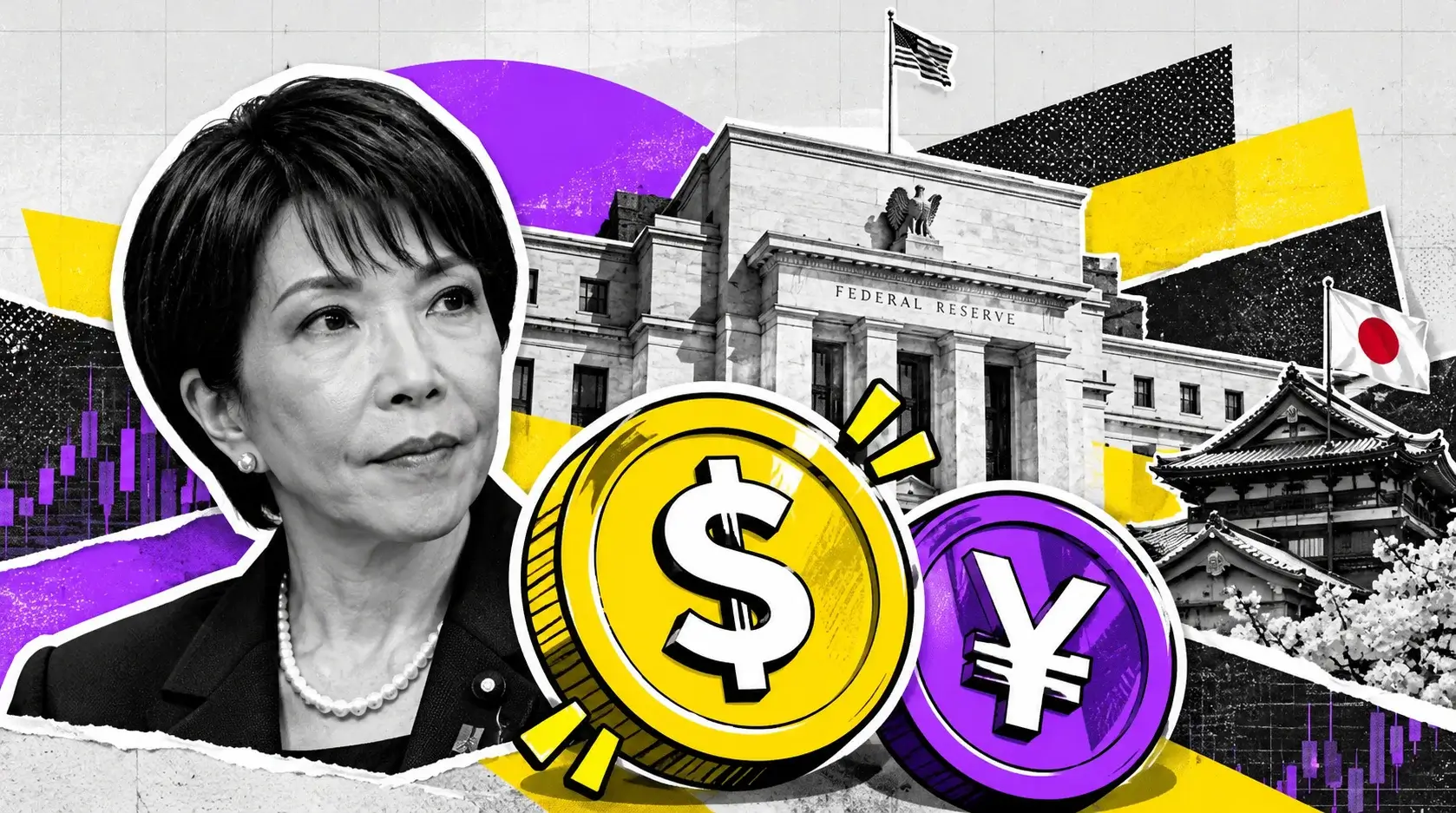
The political backdrop in Japan has shifted decisively. Sanae Takaichi’s ruling LDP secured around 316 of 425 seats in the lower house, delivering a clear super-majority and strong mandate. Her agenda remains firmly expansionary: more fiscal spending and the prospect of cutting food taxes. That mix supports domestic demand but also raises the risk of renewed selling in the JGB market as investors demand compensation for higher issuance and more inflation risk. Higher domestic yields, if they emerge, would be a structural positive for the yen, but the transition is delicate. Move too fast and borrowing costs spike, stressing a government balance sheet with heavy debt and undercutting growth. Move too slowly and markets extend yen selling on the assumption that Japan will remain a funding currency indefinitely. For USD/JPY, that tension translates into sporadic JPY rallies whenever markets think the BoJ is being pushed toward more decisive tightening by fiscal policy and the bond market
USD/JPY – Bank of Japan timing: June hike expectations cap JPY support near term
On the monetary side, ING expects the next BoJ rate hike to be delayed until June, which limits how much fundamental support the yen can gather in the next few months. The central bank has already loosened yield-curve control by allowing the 10-year JGB to fluctuate more around its target, but policy is still deeply accommodative, with short-term rates parked at negative levels. A formal end to yield-curve control, an exit from negative rates or a slowdown in balance sheet expansion would all be structural positives for JPY when they appear, yet the BoJ is likely to proceed in small, cautious steps. That slow-motion normalization explains why USD/JPY can remain elevated despite the recent pullback: the policy gap versus the Fed remains wide, and markets see any BoJ tightening path as incremental rather than aggressive
USD/JPY – Fed path, delayed NFP and the US data gauntlet
On the US side, the recent pressure on the dollar is equally data-driven. A run of weaker employment releases has shifted expectations toward more Fed easing in 2026, and comments from the White House’s Kevin Hassett about slower job growth in the coming months have reinforced that view. The January Non-Farm Payrolls report, delayed by the partial government shutdown, now lands alongside a busy run of US Retail Sales, Unemployment Claims and CPI. Retail Sales are expected to show a cooling consumer, while CPI remains the key anchor for how restrictive rates need to stay. For USD/JPY, softer-than-expected data, especially on jobs and inflation, would validate the idea of a lower Fed path, flattening the rate differential and favoring further downside toward 152–150. Conversely, any upside surprise that challenges the easing narrative would quickly put a floor under the dollar and could trigger a squeeze higher from the 155 area back toward 157.50 and beyond
Read More
-
Yen Stalls at 160 Despite a 3% JGB and Tokyo Core CPI at 2.0% — Intervention Sits at 164, Friday's Payrolls Decide
02.09.2026 · TradingNEWS ArchiveEnergy
-
QQQ ETF ($706.22) Slides 7.4% Below Its High as the Market Reprices the AI Capex Bill — $686.57 Target if $700 Breaks
22.10.2026 · TradingNEWS ArchiveStocks
-
XRPI ($7.00) and XRPR ($10.74) Slide Toward 52-Week Lows as Spot XRP ETF Flows Stall at $708,510
22.10.2026 · TradingNEWS ArchiveCrypto
-
NG ($2.775) Decoupled From Europe’s €88 Gas Crisis as LNG Feedgas Hits 18.9 Bcf/d — $3.30 Upside on Cold Weather
22.10.2026 · TradingNEWS ArchiveCommodities
-
Dollar-Yen (157.35) Loses 157.65 as the Yen Rallies on Haven Demand — 155 Target if 156 Breaks
22.10.2026 · TradingNEWS ArchiveForex
USD/JPY – Short-term USD weakness and JPY strength: how durable is the move?
Short-term price action across the board lines up with the USD/JPY dip. USD is showing weakness against most major currencies after a brief burst of strength, and JPY is firmer post-election as confidence in political stability and fiscal support improves. Market commentary already flags the risk that this bout of yen strength proves temporary once the US data shock passes and as carry trades re-engage at cheaper levels. The oversold intraday readings in USD/JPY and the lack of a clear, clean upward trend channel on some shorter-term charts underline that the pair is in an assessment phase, not a one-way trend reversal. Traders are probing how much of the recent rally was stretched and how much of the pullback has already priced in the weaker US numbers and the election outcome
USD/JPY – Safe-haven status, carry trades and intervention risk around 160
Three structural forces define the medium-term backdrop. First, USD/JPY remains a pure expression of the US–Japan rate gap and the carry trade built on it. With US yields materially higher, borrowing in yen to buy dollar assets remains attractive as long as volatility is manageable. Second, the yen retains its safe-haven profile. During stress, capital can flood back into JPY, cutting USD/JPY sharply regardless of interest differentials. Third, authorities in Tokyo have signalled a low tolerance for runaway yen weakness. Japan’s Finance Minister Satsuki Katayama and currency diplomat Atsushi Mimura have both warned that they stand ready to act in the face of speculative moves. That means any push toward the 160.00 area – the region ING flags as a plausible near-term ceiling – would come with an elevated risk of verbal or even direct intervention. Put together, USD/JPY trades in a band where carry and policy divergence push higher, but safe-haven flows and intervention risk cap the top
USD/JPY – Practical impact on Japan and the US at current levels
At current mid-150s levels, the economic trade-offs on both sides of the Pacific are visible. For Japan, a weaker yen supercharges overseas earnings for large exporters, supporting profits at major manufacturers and sustaining equity strength. At the same time, it inflates the local cost of imported energy, food and raw materials, squeezing real incomes and complicating the politics of inflation. That is where Takaichi’s mix of fiscal stimulus and tax cuts collides with reality: too much currency weakness and imported inflation becomes a domestic political problem. For the US, a firm dollar makes imports cheaper and helps dampen price pressures, but it erodes export competitiveness for US companies selling into Asia and other overseas markets. In that environment, the authorities on both sides can live with USD/JPY in the 150s, but repeated spikes toward 160.00 or drops toward 140.00 would trigger louder policy responses
USD/JPY – Trading map: key levels, scenarios and risk-reward from 155.00
From a trading standpoint, the structure is straightforward. The first critical zone is 155.00–155.50. As long as USD/JPY holds above this band on a closing basis, the medium-term bullish structure is intact, and dips are likely to attract buying from those still running carry exposure or looking for another attempt at 157.50–158.00 and potentially the 160.00 region. A sustained recovery back above the short-term moving averages and a push through the recent swing high near 157.65 would confirm that the current move was a corrective shake-out, not the start of a deeper trend change. If 155.00 breaks with conviction, downside vacuum opens quickly toward the low-150s, with 150.00 as the obvious magnet given the major forecasts and the prior consolidation. At that point, the market would be signalling that Fed easing and BoJ normalization, however gradual, are finally compressing the rate gap enough to force a repricing
USD/JPY – Strategic stance: Hold with a mild downside bias, structurally still elevated
Taking the full picture for USD/JPY – the 157.65 high, the current test of 155.00, ING’s 160/150 range, HSBC’s rough but elevated path into late-2026, the delayed NFP and US data risks, the Takaichi landslide, the June-timed BoJ hike expectations and the explicit intervention warnings from Tokyo – the risk-reward from mid-150s argues for a neutral-to-slightly-negative stance rather than an aggressive position in either direction. Structurally, the pair is still elevated and supported by the rate differential and active carry flows. Tactically, the combination of stretched intraday momentum, JPY outperformance this week and a crowded long USD/JPY narrative leaves room for more downside toward 152–150 if US data continues to underwhelm or if BoJ rhetoric edges more hawkish. The clean call here is a Hold with a mild bearish bias from 155–158: not an attractive place to initiate fresh longs given the capped upside toward 160 and intervention risk, but also not yet a deep value level for large, long-term shorts while the Fed remains restrictive and BoJ normalization is still slow and cautious