GBP/USD Defends 1.3450 as the Oil Shock Spares Sterling's Rate Case — GBP/USD Trapped Between 1.3550 and 1.3165 Into the Fed Minutes
GBP/USD outperformed the euro Wednesday, holding above 1.3450 as UK services inflation at 3.7% and the 3.75% Bank Rate cushioned the Iran shock | That's TradingNEWS
Key Points
- GBP/USD held above 1.3450 as the Iran shock spared the pound but buckled the euro; sticky UK services inflation at 3.7% cushioned sterling.
- Cable is trapped 1.32-1.35 with the rate gap to the Fed near zero (BoE 3.75% vs Fed 3.50-3.75%); a break above 1.3550 targets 1.3650-1.3700.
- Starmer's June resignation is the real overhang; the July 22 UK CPI, July 28-29 Fed, and July 30 BoE decide the range breakout.
GBP/USD is the resilient one, and Wednesday proved it. While the euro got dragged to its 1.1400 make-or-break support on the Iran shock, cable recovered above 1.3450 in the European session as the renewed Middle East tensions failed to offer any inspiration to the U.S. dollar. Trump declared the Iran ceasefire "over," oil ripped, and the euro buckled — but the pound held. The reason is fundamental: sterling has a genuine yield-and-inflation story that the euro lacks, and the dollar's haven bid was muted enough that the pound could defend its ground while the single currency slid.
The divergence between cable and the euro tells you something important about how the oil shock hits different currencies. The eurozone is a heavy energy importer with fragile 0.8% growth, so higher crude is a direct euro-negative that pushed EUR/USD toward its floor. The UK, while also an energy importer, carries the highest policy rate in the G7 after the Fed and sticky services inflation that keeps the Bank of England hawkish. The oil shock that hurts the euro's growth actually supports sterling's rate case by keeping UK inflation elevated. That distinction let cable hold up Wednesday while the euro couldn't.
The immediate focus is the Fed. Traders are awaiting the minutes of the June 16-17 FOMC meeting, due Wednesday at 18:00 GMT, for fresh trading impetus. The minutes should shed light on the hawkish hold Kevin Warsh delivered at his first meeting as Fed Chair, though doubts remain about how much they'll reveal given Warsh's refusal to provide forward guidance. Coming on a day the oil shock already repriced Fed expectations, the minutes are the catalyst that could push cable through its resistance or back toward its support. The pound is holding, but it's waiting on the Fed to break the range.
What makes the setup interesting is that cable is trapped despite its resilience. The pair recovered above 1.3450 but sits below its 2026 average near 1.344-1.345 and well within a choppy 1.32-1.35 range that's held for weeks. It's above the June low zone around 1.3140-1.3165 but capped by resistance near 1.35. The pound held up better than the euro on the Iran shock, but "better than the euro" still means range-bound, pinned between a hawkish Fed capping the upside and a genuine sterling yield story providing a floor. Cable held its ground Wednesday. Now it needs a catalyst to break out.
The Rate Gap to the Fed Collapsed to Zero
The defining feature of GBP/USD right now is that the yield gap has essentially disappeared. The Bank of England's Bank Rate sits at 3.75%, and the Federal Reserve's target range is 3.50-3.75% — the two are almost level, with no meaningful yield gap pulling the pair one way. That's a dramatic change from prior cycles when a wide rate differential drove cable trends. With rates on both sides of the Atlantic essentially matched, GBP/USD has become unusually sensitive to the dollar and to sterling sentiment rather than to the carry that normally anchors a currency pair.
The collapsed rate gap changes how cable trades. When two central banks hold rates at the same level, there's no carry advantage to owning one currency over the other, so the pair moves on relative shifts in expectations rather than on the absolute rate difference. Every data point that changes the odds of a BoE or Fed move gets amplified, because the market is trading the direction of the next move rather than a stable yield gap. That makes cable a pure play on which central bank turns more hawkish or dovish next, and right now both are leaning hawkish, which pins the pair.
The Fed's hawkish turn is the dominant force. Warsh held rates at 3.50-3.75% on June 17 but removed the easing bias and published a dot plot pointing to a year-end rate near 3.8%, implying a possible hike. US inflation was revised up to 3.6% for 2026 on the energy shock, and 9 of 19 policymakers favored a hike by year-end. That hawkish signal lifted the dollar and broke above 100 on the Dollar Index, capping cable's upside. A Fed that's threatening hikes rather than delivering cuts is a headwind for GBP/USD, because it strengthens the dollar side of the pair.
The BoE provides the counterweight. The Bank held at 3.75% on June 18 in a 7-2 vote, with two members voting to raise rates to 4%. That hawkish dissent — two policymakers wanting a hike — gives sterling a floor, because it signals the BoE could tighten if inflation stays sticky. So both central banks lean hawkish: the Fed capping cable's upside, the BoE providing a floor. The collapsed rate gap means the pair trades on the relative hawkishness of the two, and with both firm, cable stays range-bound. The trade is which bank blinks first — and until one does, the near-zero rate gap keeps GBP/USD pinned between a firm dollar and a supported pound.
Trapped in a 1.32-1.35 Range
Cable's price action reduces to a clear range, and it's 1.32 to 1.35. GBP/USD starts the second half of July below its 2026 average near 1.344-1.345 but above the June low zone around 1.314-1.317, making 1.35 and 1.3165 the key levels to watch. The base case is a choppy 1.32-1.35 range because UK inflation remains firm while GDP, jobs, and services activity weaken — a fundamental tug-of-war that keeps the pair oscillating rather than trending. The range has held for weeks, and breaking it requires a decisive catalyst.
The range reflects the balanced fundamentals. On the bullish side, sticky UK services inflation and a cautious BoE that could hike keep sterling supported near the bottom of the range. On the bearish side, softer UK GDP, labour, and services data limit the upside near the top. Neither force is strong enough to break the range on its own, so cable chops between 1.32 and 1.35 as the market weighs firm inflation against weakening growth. That's why the cleanest way to read the pair is through conditional scenarios rather than a single directional forecast — the range is the base case, and the breakout depends on the data.
The decision map is precise. A hold above 1.32 keeps the range intact. A break above 1.3550 gives bulls a cleaner route toward 1.3650-1.3700. A move below 1.3165, the June low, shifts attention to the 1.30-1.31 area. Those three levels — 1.32 as the range floor, 1.3550 as the bullish trigger, 1.3165 as the bearish trigger — define the entire trade. Cable at 1.3450 sits in the upper-middle of the range, closer to the bullish trigger than the bearish one, but still firmly range-bound until one of the triggers gives.
The range-bound structure makes cable a mean-reversion trade until it breaks. In the middle of the range, the pair offers little directional edge — it's chopping between support and resistance, and the reward-to-risk favors fading extremes rather than chasing breakouts. The breakout, when it comes, will be driven by the July data and central-bank meetings that tip the balance between UK inflation and growth. Until then, cable trades the range: buy near 1.32, sell near 1.35, and wait for the decisive catalyst. The pair is trapped, and the July double-header of central-bank meetings is the most likely event to spring it. Watch 1.3550 and 1.3165 — those are the levels that end the range.
The Oil Shock Actually Helps Sterling's Rate Case
Here's the counterintuitive angle that let cable hold up Wednesday: the oil shock helps sterling's rate case. The Middle East conflict and disruption around the Strait of Hormuz pushed energy risk into inflation pricing, and while a mid-June ceasefire framework briefly pulled oil lower, the Bank of England warned that global energy prices remained volatile and above pre-conflict levels, leaving the inflation path uncertain. Wednesday's re-escalation sent crude ripping again, which reignites UK inflation risk — and higher UK inflation keeps a BoE hike on the table, supporting sterling.
The mechanism cuts differently for the pound than for the euro. For the euro, higher oil is primarily a growth negative because the eurozone's industrial base is so energy-dependent and its growth so fragile. For the pound, higher oil is more of an inflation story — it keeps UK price pressures elevated, which supports the case for the BoE to hold or hike rather than cut. Energy-driven inflation keeps a hike on the table, and a hawkish BoE is pro-sterling. That's why cable held up on the Iran shock while the euro buckled — the same oil spike hits the two currencies through different channels, hurting the euro's growth and helping the pound's rate case.
The distinction rests on the UK's economic structure. The UK economy leans heavily on services rather than energy-intensive manufacturing, so it's less directly damaged by higher energy costs than Germany's industrial base. Instead, the transmission runs through inflation — higher energy feeds into UK consumer prices, keeping the BoE cautious about cutting. With two BoE members already voting to hike, an energy-driven inflation impulse tips the balance further toward tightening, which supports sterling. The oil shock that's a clear euro-negative is a more ambiguous, even mildly pro-sterling, development for the pound.
The catch is that the energy-inflation benefit is double-edged. Higher energy costs also squeeze UK consumers and businesses, which could weaken the already-fragile UK growth and eventually argue for cuts rather than hikes. So the oil shock helps sterling's rate case in the near term by keeping inflation sticky, but if it persists and damages UK growth, it could flip to a negative. For now, with the BoE finely balanced and two members wanting hikes, the energy-driven inflation impulse supports the pound. That's the subtle reason cable outperformed the euro Wednesday — the oil shock helps sterling's rate case even as it hurts the euro's growth. The pound found a floor where the euro found a headwind.
Services Inflation at 3.7% Is the Pound's Best Card
Sterling's strongest fundamental support is UK services inflation, and it's running hot. UK headline CPI held at 2.8% in May, but services inflation rose to 3.7% — well above the BoE's comfort zone. That 3.7% services print is the strongest pro-sterling data point available: as long as it holds up, the market can keep pricing a hawkish hold, or even a later hike, and the rate differential leans cable's way. Services inflation matters more than headline for the BoE because it reflects domestic, wage-driven price pressure that's harder to dismiss as a temporary energy effect.
The importance of services inflation comes from the UK economy's structure. Britain leans heavily on services — financial services, in particular, are a major export — so services inflation is the truest gauge of underlying domestic price pressure. When services inflation runs at 3.7% while headline sits at 2.8%, it tells the BoE that the disinflation isn't complete and that cutting rates would risk reigniting price pressures. That keeps the Bank cautious, supports the case for holding or hiking, and provides the floor under sterling that let cable hold up on the Iran shock.
The services print is the bull case for the pound. The bullish scenario for GBP/USD doesn't rest on strong UK growth — there isn't much of that. It rests on inflation staying sticky enough to keep rate expectations supported while the dollar loses momentum. That's a specific, sterling-positive thesis: firm services inflation keeps the BoE hawkish, and a hawkish BoE supports the pound even without growth. As long as services inflation holds near 3.7%, the market can price a hawkish hold or a later hike, and that rate-expectation support is what keeps cable's floor intact near 1.32.
The risk is that services inflation cools. If the June CPI print due July 22 shows services inflation easing, it would undermine the BoE's hawkish case, open the door to cuts, and remove the pound's best support. That's why the July 22 UK CPI is the single biggest input for BoE pricing and one of the most important events for cable this month. A sticky services print keeps the bull case alive and supports the pound; a cooling print removes the floor and exposes the June low. Services inflation at 3.7% is the pound's best card, and whether it holds determines whether sterling keeps its rate-driven support. The whole bull case runs through that one number.
But UK Growth Is Contracting
The problem sitting opposite sterling's inflation support is that UK growth is contracting. The composite PMI fell to a 14-month low of 49.4 in June, signalling contraction, and the services PMI slipped to 48.8, a second consecutive month below the 50 line that separates expansion from contraction. For an economy that leans so heavily on services, a services PMI below 50 for two straight months is a serious warning — it means the UK's core economic engine is shrinking, not growing. That contraction is the bearish counterweight to the sticky inflation.
The growth weakness creates the macro split that holds sterling in place. On one side, sticky services inflation at 3.7% argues for a hawkish BoE and supports the pound. On the other, contracting PMIs and weakening growth argue for the BoE to cut and pressure sterling. Those two forces pull cable in opposite directions, which is precisely why the pair is trapped in its 1.32-1.35 range rather than trending. The inflation keeps the floor; the weak growth caps the ceiling. Neither wins, so the pair chops.
The contraction complicates the BoE's job enormously. A central bank facing sticky inflation and contracting growth is caught between its two mandates — fight inflation by holding or hiking, or support growth by cutting. Energy-driven inflation keeps a hike on the table, while slowing hiring and contracting PMIs keep a cut in the conversation. That's the stagflation-adjacent bind that leaves the BoE finely balanced and the pound range-bound. The Bank can't commit to a clear direction because the data pulls it both ways, and cable reflects that indecision by refusing to break its range.
For the forward view, the growth data is the bearish risk that could break cable lower. If the July UK data — May GDP on July 16, labour data on July 21 — confirms the contraction is deepening, it would tip the BoE toward growth concern, open the door to cuts, and pressure sterling toward the June low and the 1.30-1.31 area. The deciding factor for cable is whether July's UK inflation and labour data push the BoE back toward price risk or closer to growth concern. Right now the sticky inflation is winning narrowly, keeping the pound supported. But the contracting PMIs are a real and growing threat. UK growth is contracting, and if the data confirms it, sterling's rate support crumbles and the range breaks lower.
Starmer's Resignation Is the Real Overhang
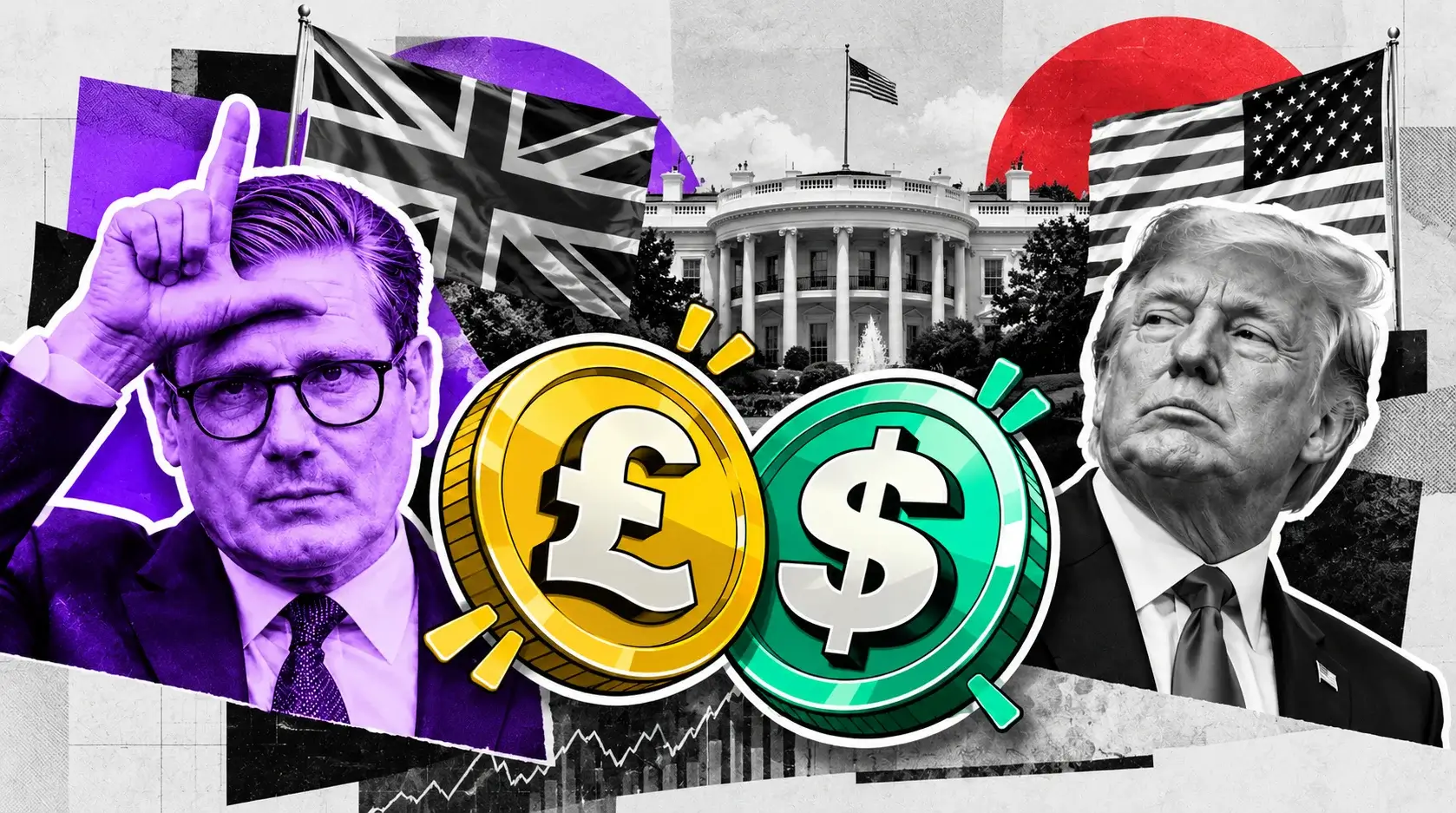
The biggest sterling-specific risk isn't the BoE — it's politics. Prime Minister Keir Starmer resigned in June after a by-election defeat, with Greater Manchester Mayor Andy Burnham emerging as the frontrunner to succeed him. That leadership uncertainty, combined with the weak PMI data, has put sterling under pressure and raised questions about the UK's fiscal outlook. Political risk, more than the Bank of England, is now the pound's main domestic driver — and it's a headwind that the rate story can't fully offset.
The political overhang matters because currency markets punish fiscal uncertainty. A leadership transition in the middle of an economic soft patch raises questions about the UK's fiscal trajectory — whether the next government maintains discipline or loosens the purse strings in ways that spook the gilt market. Sterling is uniquely sensitive to fiscal credibility because of the UK's twin deficits and its reliance on foreign capital to fund them. When political leadership is in flux, that credibility comes into question, and the pound weakens as investors demand a risk premium.
The precedent that haunts sterling is 2022. The market reaction to Liz Truss's mini-budget was the most severe for sterling since the Black Wednesday ERM crisis of 1992 — gilt yields spiked to levels not seen since 2008, forcing the Bank of England into emergency intervention to prevent a UK pension fund liquidity crisis, and Truss resigned shortly after. That episode remains the defining moment for sterling's volatility in the current cycle and serves as the relevant precedent for assessing Starmer's June resignation. The market remembers how fast UK political and fiscal risk can spiral into a sterling crisis, and that memory keeps a risk premium on the pound.
For the trade, the political risk is the wildcard that could override the rate story. Sterling's rate-driven support — sticky services inflation, a hawkish BoE — provides a floor, but political instability can punch through that floor if it escalates into fiscal concern. Any progress on the Labour transition would relieve the pressure and could push cable back above 1.34-1.35, while a messy leadership fight or fiscal wobble could send it toward the June low. The political overhang is the reason cable stays capped even when the rate story supports it — the pound carries a political risk premium that the near-zero rate gap can't offset. Starmer's resignation is the real overhang, and until the leadership question resolves, it keeps a lid on sterling.
The BoE Is Finely Balanced
The Bank of England sits at a genuine crossroads, and the June vote showed it. The BoE held Bank Rate at 3.75% on June 18 in a 7-2 vote, with two members voting to raise rates to 4%. That split — seven for a hold, two for a hike — captures a committee genuinely divided about the path. The hawkish dissent from two members signals that a hike is a live possibility if inflation stays sticky, which supports sterling. But the seven-member majority for a hold reflects caution about the contracting growth, which caps the pound. The BoE is finely balanced, and its indecision is cable's indecision.
The balance reflects the conflicting data. UK inflation at 2.8% headline but 3.7% services keeps price risk on the table, while the composite PMI at 49.4 and services PMI at 48.8 keep growth concern in the conversation. Energy-driven inflation keeps a hike possible; slowing hiring keeps a cut possible. The BoE can't commit to a direction because the data pulls it both ways, and the 7-2 vote is the committee splitting the difference — holding while signaling that some members want to tighten. That balanced stance removes a near-term directional catalyst for the pound and keeps cable range-bound.
The finely balanced BoE is actually a stabilizer for sterling in one sense. A central bank that's neither clearly cutting nor clearly hiking provides a floor without providing a rally catalyst — the hawkish dissent supports the pound, but the cautious majority prevents a breakout. That's part of why cable is range-bound: the BoE isn't giving the market a reason to break the pair in either direction. Until the Bank tips decisively toward hikes or cuts, sterling stays pinned between its inflation support and its growth drag.
The next BoE decision, on July 30, is the moment the balance could tip. That meeting comes with a fresh Monetary Policy Report — new forecasts and a press conference — which makes it the natural moment for the Bank to signal a change of direction and the most likely trigger for cable to break its range. If the BoE tilts hawkish, citing sticky services inflation and energy risk, sterling could break higher toward 1.3550. If it tilts dovish, citing the contracting PMIs, the pound could break lower toward the June low. The finely balanced BoE keeps cable range-bound now, but the July 30 decision with its fresh forecasts is where the balance could finally break. Watch that meeting — it's the domestic catalyst that ends the range.
The Fed Minutes Are Wednesday's Trigger
Wednesday's near-term catalyst is on the U.S. side: the Fed minutes. The minutes of the June 16-17 FOMC meeting, due at 18:00 GMT, should shed light on the hawkish hold Warsh delivered at his first meeting as Chair. Investors will read them closely to gauge the reasons officials abandoned forward guidance and to assess how strong the lean toward a hike really was. Coming on a day the oil shock already pushed Fed hike expectations higher, hawkish minutes would firm the dollar and pressure cable, while any dovish nuance could let the pound extend its recovery.
The June meeting set a hawkish tone that the minutes will detail. The Fed held at 3.50-3.75% citing upside inflation risks, removed its easing bias, and published a dot plot pointing to a year-end rate near 3.8% — with 9 of 19 policymakers favoring a hike by year-end. That's a committee split nearly down the middle on whether to tighten, and the minutes will reveal the internal debate. For cable, a hawkish read confirms the dollar strength that's been capping the pair, while evidence of more caution could ease the dollar and give sterling room to run.
The complication is Warsh's approach to communication. The new Fed Chair has refused to provide forward guidance, which raises doubts about how much the minutes will actually reveal. A Fed that deliberately withholds guidance leaves the market to parse the minutes for hints, and if those hints are ambiguous, the minutes may not move cable decisively. Warsh's July 1 speech — the "Warsh Warning" — reinforced his hawkish reputation, so the market is primed to read the minutes hawkishly. But the lack of clear guidance means the reaction could be muted if the minutes don't offer a clear signal.
For the trade, the Fed minutes are the first of the July catalysts that could break cable's range, but they're likely the weakest. The bigger events come later: the July 14 US CPI, the July 28-29 Fed decision, and the July 30 BoE meeting. The minutes set the near-term tone for the dollar, but they're backward-looking and constrained by Warsh's guidance aversion. A hawkish read pressures cable toward the lower part of its range; a dovish nuance lets it test 1.35. Either way, the minutes are Wednesday's trigger, and the pound's hold above 1.3450 into the release shows the market isn't positioned for a major hawkish surprise. The minutes matter, but the July double-header matters more.
The Technical Map: 1.35 vs 1.3165
Cable's chart offers a clean decision map, and it centers on two levels: 1.35 above and 1.3165 below. On the topside, the immediate resistance is the downward trendline with its break level around 1.3500, followed by 1.3550 — a sustained close above which, ideally confirmed above 1.3550, validates the bullish case and opens the route toward 1.3650-1.3700. On the downside, support sits at the 20-day EMA around 1.3321, and a daily close below that would weaken the constructive tone and force a revisit of the June low around 1.3140-1.3165. Break below 1.3165, and the 1.30-1.31 area comes into focus.
The current position favors the bulls modestly. Cable at 1.3450 has bounced from the 1.32 area and stayed supported by its short-term EMA, with the RSI showing modest positive momentum without entering overbought territory. The pair sits closer to the 1.35 resistance than the 1.3165 support, which gives it a mildly constructive tilt within the range. But 1.35 has repeatedly capped rallies — it's the downward trendline resistance that has to break for the bullish scenario to trigger. Until cable closes above 1.3550, the range remains intact and the upside is capped.
The moving-average picture reflects the range-bound structure. Cable trades near its 8-day, 21-day, 50-day, and 100-day EMAs simultaneously — a sign of a market with no clear trend, coiling within its range. When price sits near all its moving averages, it signals indecision and consolidation rather than direction, which is exactly what the 1.32-1.35 range represents. The 50-day SMA near 1.32 and the 200-day near 1.34 bracket the range, and cable oscillating between them confirms the trendless, range-bound condition.
For the trade, the technical map is a set of conditional triggers. Above 1.3550, the bullish route opens toward 1.3650-1.3700 — buy the breakout. Below 1.3321, the tone weakens toward the June low — caution. Below 1.3165, the bearish scenario triggers toward 1.30-1.31 — sell the breakdown. In between, at 1.3450, the pair is range-bound with no directional edge, favoring mean reversion over trend-following. The technical map is clear: 1.3550 is the bullish trigger, 1.3165 is the bearish trigger, and everything in between is chop. Cable sits in the upper-middle, leaning mildly bullish but capped by the 1.35 trendline. The chart won't break until the July fundamentals force it. Watch 1.3550 and 1.3165 — those are the lines that end the range.
The July Double-Header Decides It
Cable's range will break on the July central-bank double-header, and the calendar is front-loaded with the catalysts. The month's risk is concentrated in the back half: US CPI on July 14 sets the dollar tone, then UK data lands in quick succession — May GDP on July 16, labour data on July 21, and June CPI on July 22, the single biggest input for BoE pricing. The month closes with the double-header: the Fed's decision on July 28-29 and the Bank of England's decision plus a fresh Monetary Policy Report on July 30. That last event is the natural moment for either central bank to signal a change of direction and the most likely trigger for a breakout.
The UK CPI on July 22 is the key domestic input. With services inflation at 3.7% providing sterling's main support, the June CPI print determines whether that support holds. A sticky services print keeps the BoE hawkish and supports the pound toward the top of its range; a cooling print undermines the hawkish case and exposes the June low. The July 22 CPI is the single biggest input for BoE pricing, and it lands just eight days before the BoE decision, setting up the July 30 meeting to either confirm or reverse the hawkish tilt. Cable's direction runs through that inflation print.
The July 28-30 double-header is the main event. The Fed decides July 28-29, and while a hold is expected, the guidance on future hikes will move the dollar. The BoE follows July 30 with a fresh Monetary Policy Report — new forecasts and a press conference — which makes it the natural moment for the Bank to signal direction. The two meetings, a day apart, are the dominant near-term driver of GBP/USD. If the Fed stays hawkish while the BoE tilts hawkish too, cable stays range-bound. If one diverges from the other — a dovish Fed or a hawkish BoE — the range breaks.
The clustering of events means volatility and a likely breakout. Cable rarely trends smoothly through a run of high-impact releases; it whipsaws around each print as the market recalibrates. The US CPI, the UK CPI, and the July 28-30 central-bank double-header form a dense catalyst cluster that will almost certainly resolve the 1.32-1.35 range one way or the other. The direction depends on the relative hawkishness of the Fed and BoE and on whether UK inflation stays sticky. For traders, the July double-header is the event that decides cable's next big move — intraday swings of 1-2% are possible around the meetings. The range holds until then; the double-header breaks it.
Wall Street Is Split from 1.28 to 1.47
The forecasting community can't agree on cable, and the spread is enormous. The H2 2026 base case is a 1.32-1.41 range, but the individual bank targets span from deeply bearish to strongly bullish. JPMorgan is the most cautious at 1.28 by December. Goldman Sachs sits at 1.36, Scotiabank at 1.37. Morgan Stanley's bull case reaches 1.47 — but it needs Fed cuts to materialise. That's a spread of nearly 20 cents between the most bearish and most bullish views, which captures how much uncertainty surrounds the pound's path.
The split reflects the core disagreement about the dollar. The broad institutional consensus is that the pound rises modestly against the dollar in 2026 — most major banks project GBP/USD higher than the current ~1.34 by year-end, primarily because they assume the dollar will weaken as Fed rate expectations normalise. That's the bull case: a softer dollar lifts cable toward 1.36-1.47. The bear case, embodied by JPMorgan's 1.28, assumes the dollar stays firm on a hawkish Fed while UK growth and political risk weigh on sterling. The disagreement is really a disagreement about whether the Fed stays hawkish or pivots dovish.
The near-term forecasts cluster tighter but still lean cautious. Exchangerates.org.uk projects cable at 1.3339 in one month, 1.3355 in three months, 1.3459 in six months, and 1.3545 in one year — a gradual grind higher that reflects the modest-appreciation consensus. UOB sees scope for further pound weakness toward 1.3110 in the near term while also expecting cable to extend its recovery over time. The near-term views bracket the current 1.3450 level, reflecting the range-bound reality — most forecasters see cable chopping around current levels before a modest year-end recovery contingent on the dollar softening.
The wide bank spread is a signal to respect the range and the catalysts. When forecasts span from 1.28 to 1.47, it means the outcome is genuinely uncertain and hinges on variables — the Fed's path, UK politics, UK inflation — that no one can predict with confidence. The bull targets require Fed cuts and a softer dollar; the bear targets require sustained Fed hawkishness and UK weakness. The base case of 1.32-1.41 brackets the realistic range, with the July double-header likely to determine which direction cable takes within it. Wall Street is split from 1.28 to 1.47 because the pound's fate depends on the Fed-BoE dynamic that the July meetings will clarify. The spread is the uncertainty; the catalysts are the resolution.
The "Good Yield, Uncertain Growth" Pound
Sterling's fundamental profile in mid-2026 is best described as "good yield, uncertain growth," and that phrase captures why cable is range-bound. On the yield side, the UK's 3.75% Bank Rate is the highest of the G7 central banks after the Fed, gilt yields sit 35-45bp above equivalent US Treasuries, and services exports — particularly financial services — provide a structural income stream. That yield advantage supports the pound and provides its floor. On the growth side, the contracting PMIs, the political uncertainty, and the fragile fiscal outlook create genuine doubt. The pound has the yield but lacks the growth.
The yield advantage is real and meaningful. Gilt yields sitting 35-45bp above US Treasuries means UK government bonds pay more than American ones, which attracts foreign capital into sterling assets and supports the pound. The 3.75% Bank Rate — highest in the G7 after the Fed — reflects a central bank that's been slower to cut than most peers, maintaining a yield that draws income-seeking capital. That structural yield support is the reason cable held up on the Iran shock while lower-yielding currencies buckled. The pound pays you to hold it, and that carry provides a floor.
The uncertain growth is the offsetting weakness. The contracting composite PMI at 49.4, the services PMI at 48.8, and the leadership uncertainty after Starmer's resignation create a growth-and-fiscal question mark that caps the pound. A currency with good yield but uncertain growth is stable but not trending — the yield prevents a collapse, but the growth doubt prevents a rally. That's the "good yield, uncertain growth" profile in action: it produces a range-bound currency that holds its floor but can't break its ceiling. Cable's 1.32-1.35 range is the market pricing exactly this profile.
The profile makes sterling a carry-and-range play rather than a trend play. Investors can earn the yield advantage while the pound trades sideways, collecting the 35-45bp gilt premium and the 3.75% rate while cable chops in its range. The trade isn't a directional bet on sterling appreciation — the uncertain growth prevents that — but a bet on the pound holding its range while paying its yield. The risk to the profile is that the uncertain growth deteriorates into clear contraction or the political risk escalates into a fiscal crisis, either of which would break the "good yield" support. But as long as the yield holds and the growth stays merely uncertain rather than collapsing, cable stays range-bound and the pound pays you to wait. Good yield, uncertain growth — that's the sterling story, and it's a range, not a trend.
Read More
-
Yen Stalls at 160 Despite a 3% JGB and Tokyo Core CPI at 2.0% — Intervention Sits at 164, Friday's Payrolls Decide
02.09.2026 · TradingNEWS ArchiveEnergy
-
QQQ ETF ($706.22) Slides 7.4% Below Its High as the Market Reprices the AI Capex Bill — $686.57 Target if $700 Breaks
22.10.2026 · TradingNEWS ArchiveStocks
-
XRPI ($7.00) and XRPR ($10.74) Slide Toward 52-Week Lows as Spot XRP ETF Flows Stall at $708,510
22.10.2026 · TradingNEWS ArchiveCrypto
-
NG ($2.775) Decoupled From Europe’s €88 Gas Crisis as LNG Feedgas Hits 18.9 Bcf/d — $3.30 Upside on Cold Weather
22.10.2026 · TradingNEWS ArchiveCommodities
-
Dollar-Yen (157.35) Loses 157.65 as the Yen Rallies on Haven Demand — 155 Target if 156 Breaks
22.10.2026 · TradingNEWS ArchiveForex
Where Cable Breaks From Here
GBP/USD is the resilient pound, and Wednesday showed why. While the euro buckled to its 1.1400 support on the Iran shock, cable held above 1.3450 because the dollar's haven bid was muted and sterling has a genuine yield-and-inflation story the euro lacks. The UK's 3.75% Bank Rate is the highest in the G7 after the Fed, sticky services inflation at 3.7% keeps a BoE hike on the table, and the oil shock that hurts the euro's growth actually supports sterling's rate case. The pound held its ground where the euro found a headwind.
But cable is trapped in a 1.32-1.35 range, pinned by two forces. The rate gap to the Fed has collapsed to essentially zero — BoE 3.75% versus Fed 3.50-3.75% — leaving the pair a pure dollar-and-sentiment play with no carry to drive a trend. And UK politics turned toxic after Starmer's June resignation, with leadership uncertainty and contracting PMIs (49.4 composite, 48.8 services) hanging over the pound. The sticky inflation provides a floor; the weak growth and political risk cap the ceiling. Neither wins, so cable chops.
The technical map is a decision tree. A hold above 1.32 keeps the range intact. A break above 1.3550 — the downward trendline resistance — opens the bullish route toward 1.3650-1.3700. A break below 1.3165, the June low, exposes the 1.30-1.31 area. Cable at 1.3450 sits in the upper-middle of the range, leaning mildly bullish but capped by the 1.35 trendline. The pair trades near all its moving averages, confirming the trendless, range-bound condition that won't break until the July fundamentals force it.
The trade from here is to respect the range and watch the July double-header. Watch the July 22 UK CPI — sticky services inflation keeps the pound's floor, a cooling print removes it. Watch the July 28-29 Fed and the July 30 BoE with its fresh Monetary Policy Report — the two meetings a day apart are the dominant catalyst, and divergence between them breaks the range. Watch UK politics — the Starmer transition is the real overhang, with the 2022 Truss crisis as the precedent for how fast sterling can unravel on fiscal risk. Cable is the "good yield, uncertain growth" pound — resilient on rates, vulnerable on politics, and pinned between 1.32 and 1.35. It held up better than the euro on the Iran shock, but "better than the euro" still means range-bound. Watch 1.3550 and 1.3165 — the July double-header decides which one breaks.