CVX Climbs to $177 as Oil Shock and the Microsoft Data-Center Deal Fire Both Engines — Chevron Eyes a Q2 Windfall and Guyana Cash Inflection
Chevron rallied on the crude spike, trading ~18% below its $214.71 all-time high with a forward P/E near 12x | That's TradingNEWS
Key Points
- CVX rose 3.47% to $173.94 July 7 and ~2% Wednesday toward $177 on the oil spike, trading 18% below its $214.71 record.
- Three catalysts: a Q2 windfall with a $1B timing reversal, Guyana's H2 2026 FCF inflection, and a 20-year 2.7 GW Microsoft data-center deal.
- Analysts target $205-220 (24-28% upside) with a 4.1% yield; risks are the 103% dividend payout, Russell 1000 removal, and Trump's DOJ gouging probe.
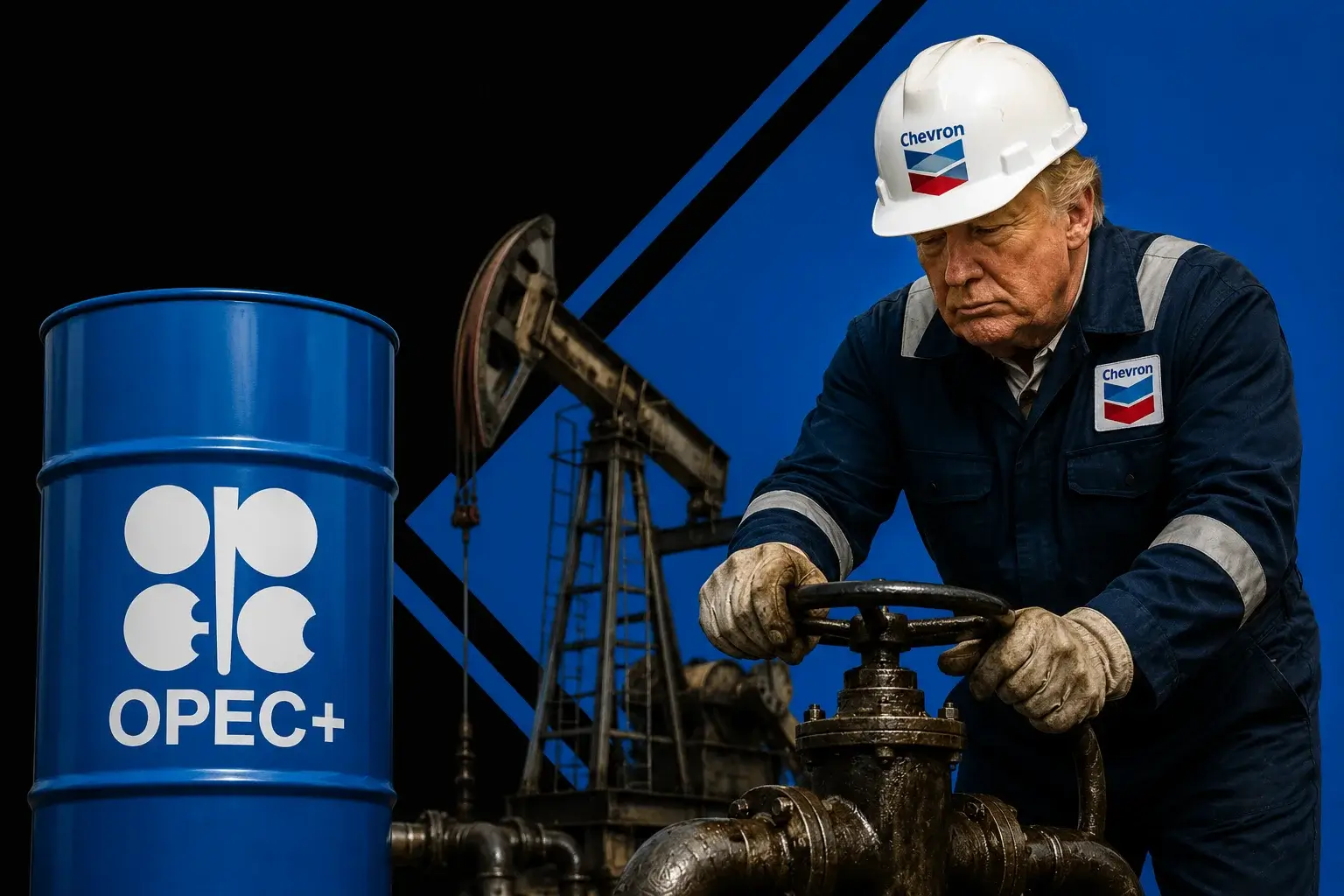
Chevron (CVX) is the energy major with two engines, and both fired this week. The stock rallied 3.47% to $173.94 on Tuesday, July 7, as the Strait of Hormuz tanker attacks sent crude higher, then added roughly 2% Wednesday toward $177 as Trump declared the Iran ceasefire "over" and oil ripped again. That's the oil bid — Chevron catching the crude spike alongside every energy name. But CVX carries a second engine the other majors don't: a 20-year deal to power a Microsoft data center, turning its natural gas into an AI-infrastructure play. Chevron caught the oil bid and the AI bid at once.
The two-day energy rally put Chevron among the sector leaders. On July 7, CVX rose 3.18% while Exxon jumped 3.25% and Shell added 3.71%, the top three by turnover in the fossil-fuels sector. Wednesday's escalation extended the move as crude surged 7% on Trump's ceasefire declaration and the revocation of Iran's oil waiver. Chevron, as an integrated major with heavy upstream exposure, captures the crude spike directly — higher oil prices flow to its production revenue, and the stock tracks the barrel higher. The oil shock that smoked airlines and chips lifted Chevron.
What sets Chevron apart is the data-center story layered on top of the oil trade. The company's recent strategic moves — securing long-term power agreements with major tech firms to support AI data centers — have broadened its appeal beyond the pure commodity play. That mix of direct commodity upside, institutional backing, and secular growth catalysts in both deepwater production and AI power triggered a wave of buying that drove the stock higher. Chevron isn't just an oil bet anymore; it's an oil-and-AI hybrid, and that dual identity is the differentiator.
The setup leaves CVX around $177 after the two-day rally, but still well below where it traded at its peak. The stock hit an all-time high of $214.71 on March 30, 2026, and sits roughly 18% under that level even after the oil-driven bounce. The analyst consensus clusters around $205-220, implying substantial upside from current levels. Chevron caught both bids this week — the oil shock and the AI-power theme — but the stock hasn't fully re-rated for either. The question is whether the Q2 windfall, the Guyana cash-flow inflection, and the Microsoft deal close the gap to the targets, or whether the dividend-coverage worries and political overhang cap it. Both engines are running. The trade is whether they're enough.
$40 Below Its March Record
Chevron trades well off its highs, and the gap frames the opportunity. The stock's 52-week range runs from $145.58 at the low to $214.71 at the high — the all-time high set March 30, 2026. At around $177 after the two-day oil rally, CVX sits roughly 18% below that peak, a $38-40 gap that represents the upside if the stock reclaims its record. For a company whose earnings move with the oil price, trading well below its high while crude spikes is the kind of dislocation that draws value buyers.
The decline traces to the oil round trip that defined 2026. Chevron declined approximately 7% to 10% over the past month as a spring rally unraveled — the stock followed crude down as the June 18 peace deal reopened Hormuz, OPEC+ hiked output, and Morgan Stanley warned of a global glut. Oil collapsed below $70, and energy stocks including Chevron gave back their war premium. The stock got repriced for a benign oil environment that Wednesday's escalation just blew up. CVX is caught between the glut-scare selloff and the fresh war premium, and it hasn't fully re-priced the new reality.
The dislocation is the setup for the bull case. Wolfe Research's Doug Leggate captured it when he upgraded Chevron to Outperform with a $210 target, citing an "opportunistic entry point" after the stock's spike and subsequent decline. The idea is that Chevron sold off with crude during the glut scare, and the escalation plus the company's structural catalysts make current levels attractive. If oil holds its war premium and the Guyana and data-center stories play out, the 18% gap to the March high closes, and the stock re-rates toward the $205-220 consensus.
The negative beta adds a wrinkle worth noting. Chevron carries a beta of -0.41 — it tends to move inversely to the broad market, which makes it a genuine diversifier. On a day like Wednesday, when the S&P 500 and Dow got smoked while oil ripped, Chevron rose. That defensive, counter-cyclical character is part of why institutional money rotates into it during risk-off episodes — it provides oil exposure and portfolio ballast at once. Trading $40 below its record with a negative beta, a fresh oil tailwind, and structural growth catalysts, Chevron offers a dislocated entry into a high-quality major. The gap to the March high is the opportunity, and the catalysts are the path to closing it.
The Microsoft Data-Center Deal Changes the Story
Chevron's single most differentiating move is its bet on AI power, and it's a big one. On June 22, 2026, Chevron signed a 20-year energy deal with Microsoft to supply 2.7 gigawatts of electricity to a Microsoft data center in West Texas — a "behind-the-meter" natural gas arrangement that powers AI infrastructure directly. That deal transforms Chevron from a pure oil-and-gas producer into an energy supplier for the AI boom, giving it a secular growth vector tied to the most powerful demand trend in the market. No other supermajor has moved this aggressively into powering data centers.
The strategic logic is compelling. AI data centers consume enormous amounts of electricity, and the buildout is accelerating faster than the grid can handle. Chevron produces vast quantities of natural gas, and gas is the cleanest-burning, most scalable fuel to power data centers at the required scale and reliability. By pairing its gas production with power generation "behind the meter" — meaning the electricity goes straight to the data center rather than through the grid — Chevron captures the AI power demand directly and monetizes its gas at premium rates. It's a natural fit that turns a commodity into a growth business.
Chevron isn't stopping at Microsoft. The company is exploring additional data-center deals across the U.S., including the Midwest, Rockies, and Gulf Coast, following the West Texas contract. It's developing Project Kilby, securing land and brackish water resources from Texas Pacific Land to build out the power infrastructure. The 2.7 GW Microsoft deal is the anchor tenant for what Chevron envisions as a broader AI-power business — a portfolio of long-term contracts supplying gas-fired electricity to the data centers driving the AI revolution. That's a multi-decade growth story layered on top of the oil business.
For the investment case, the data-center deals change the narrative from "oil major" to "energy company with AI exposure." That reframing matters for the valuation — a pure oil producer trades on the oil cycle, but a company with a growing, contracted AI-power business deserves a premium for the secular growth. The 20-year Microsoft contract provides visible, long-dated cash flow insulated from oil-price swings, diversifying Chevron's earnings and broadening its appeal to investors who want AI exposure. The data-center strategy is the differentiator that separates Chevron from Exxon and the other majors, and it's the reason CVX is more than a commodity bet. The Microsoft deal changes the story, and the story is now oil plus AI.
Guyana Hits a Free-Cash-Flow Inflection
Chevron's biggest near-term catalyst is Guyana, and it's about to hit an inflection point. The company's massive Uaru project in Guyana is on track to reach a critical free-cash-flow inflection in the second half of 2026 — the moment the project shifts from consuming capital to generating substantial cash. Heavily boosted by the integration of the Hess portfolio, Guyana is expected to become Chevron's single largest contributor to free cash flow. That transition, arriving in H2 2026, is the fundamental event that could drive the stock's re-rating.
The Guyana economics are exceptional. The offshore fields produce oil at some of the lowest costs in the industry, which means they generate enormous free cash flow even at moderate oil prices — and with crude spiking on the Iran escalation, the cash flow potential is even greater. The Uaru project ramping to its FCF inflection means Chevron is about to add a major low-cost cash engine right as oil prices rise. Analysts expect this cash-flow surge to comfortably cover the dividend commitments linked to the Hess acquisition, dramatically improving Chevron's financial resilience in a volatile energy environment.
The Guyana catalyst directly addresses one of the bears' concerns. The worry about Chevron's dividend coverage — that the 4.1% payout isn't fully covered by near-term earnings and organic free cash flow — gets resolved by the Guyana FCF inflection. As Uaru ramps and Guyana becomes the largest free-cash-flow contributor, the cash generation that covers the dividend materializes. The H2 2026 inflection is the point where Chevron's cash flow catches up to its capital-return commitments, easing the coverage concern that's weighing on the stock. Guyana is the answer to the dividend question.
For the timeline, the Guyana inflection makes the second half of 2026 the key window for Chevron. The Q2 earnings on July 31 will offer an update on the Uaru project's progress and the Guyana ramp, and management's commentary on the FCF inflection timing will be closely watched. If Chevron confirms Guyana is hitting its stride and generating the cash flow the bulls expect, it validates the thesis that the stock is undervalued at $177 with a $205-220 target. Guyana, fueled by the Hess acquisition, is transitioning from a capital sink to Chevron's largest cash engine, and that transition — arriving in H2 2026 as oil spikes — is the catalyst that could carry the stock back toward its March high. The inflection is coming, and it changes Chevron's cash-flow profile.
The Hess Acquisition Is Paying Off
The deal that reshaped Chevron is the Hess acquisition, and it's delivering. Worldwide net oil-equivalent production rose 15% year-over-year to a record 3.86 million barrels per day in Q1 2026, with U.S. production exceeding 2 million barrels per day for the third consecutive quarter — driven primarily by the integration of legacy Hess assets. Production rose by 500,000 barrels per day year-over-year, almost entirely from Hess. The acquisition gave Chevron high-margin growth in Guyana and the Bakken, and it's the foundation of the company's production expansion.
The Hess integration is ahead of schedule on synergies. Chevron hit its initial $1 billion Hess synergy target and is working toward $3-4 billion in structural cost reductions by year-end 2026. Capturing synergies faster than planned improves the deal's economics and the cash flow it generates, which supports both the dividend and the buyback. The acquisition wasn't just about adding barrels — it was about adding low-cost, high-margin barrels in Guyana and the Bakken while extracting cost savings, and Chevron is executing on both fronts. The 500,000 bpd production boost and the synergy capture show the deal working as designed.
The production growth underpins Chevron's guidance. Management has set 7-10% production growth guidance for 2026, and the Hess-driven volume increase provides a significant buffer against global supply volatility. In an environment where oil prices swing on Hormuz headlines, Chevron's growing production means it captures more upside when prices rise and maintains volume when they fall. The Hess assets — particularly the Guyana offshore fields and the Bakken shale — give Chevron a diversified, growing production base that supports its cash flow and its capital-return commitments through the cycle.
For the investment case, the Hess acquisition is the growth engine that justifies Chevron's premium. Critics who dismiss the majors as no-growth dividend payers have to reckon with Chevron adding 500,000 bpd and growing production 7-10% — that's genuine expansion, not managed decline. The Hess deal transformed Chevron's growth profile, adding the Guyana fields that are about to hit their FCF inflection and the Bakken shale that boosts U.S. output. The acquisition is paying off in production records, synergy capture, and the cash-flow ramp that's coming in H2 2026. Hess is the reason Chevron can grow production, cover its dividend, and fund its buyback — it's the deal that reshaped the company for the better, and it's delivering on schedule.
A Q2 Windfall With a Timing Tailwind
Like Exxon, Chevron is set up for a strong Q2 on the oil spike, and it has a specific tailwind the market may be underappreciating: the reversal of Q1's timing headwinds. Chevron's Q1 2026 was heavily impacted by $3 billion in unfavorable timing effects, split between inventory valuation and derivative positions — the friction of rapid price increases on short-term reported earnings. Roughly $1 billion of that is expected to unwind in Q2, providing a mechanical boost to reported earnings on top of the oil-price benefit. Chevron reports Q2 results July 31.
The Q1 timing hit obscured strong underlying performance. Despite the $3 billion drag, Chevron delivered adjusted EPS of $1.41, crushing the $0.97 estimate by 46% — its sixth consecutive earnings beat. Revenue of $47.81 billion missed the $52.70 billion estimate due to the timing effects and lower realized prices, but the underlying refining margins and production were strong. The timing effects were a reporting artifact of rapid price swings, not a deterioration in the business, and $1 billion of that artifact reverses in Q2, flattering the comparison.
The oil spike amplifies the Q2 setup. With crude ripping on the Iran escalation and Chevron's production at record levels, the company captures the higher prices across its 3.86 million bpd of output. Every $10 move in Brent impacts Chevron's annual cash flow by roughly $4.5 billion, so a sustained crude spike toward the $105-120 the Hormuz closure scenario implies would generate a massive cash-flow surge. The combination of higher oil prices and the $1 billion timing reversal sets up a potentially strong Q2 print — the kind of quarter that could catalyze the stock's re-rating toward its targets.
The Q2 earnings call on July 31 is the near-term catalyst. CEO Mike Wirth and CFO Eimear Bonner will present, and the market will focus on the guidance for capital returns, the Guyana FCF inflection, and the impact of the oil spike. A strong Q2, boosted by the oil tailwind and the timing reversal, would validate the bull case and could push the stock toward the $205-220 consensus. The risk is that timing effects cut the other way or that the oil spike proves temporary, but the setup favors a strong print. Chevron has a Q2 windfall coming with a timing tailwind attached, and the July 31 call is where it shows up. The oil shock plus the $1 billion reversal make the quarter one to watch.
Read More
-
Yen Stalls at 160 Despite a 3% JGB and Tokyo Core CPI at 2.0% — Intervention Sits at 164, Friday's Payrolls Decide
02.09.2026 · TradingNEWS ArchiveEnergy
-
QQQ ETF ($706.22) Slides 7.4% Below Its High as the Market Reprices the AI Capex Bill — $686.57 Target if $700 Breaks
22.10.2026 · TradingNEWS ArchiveStocks
-
XRPI ($7.00) and XRPR ($10.74) Slide Toward 52-Week Lows as Spot XRP ETF Flows Stall at $708,510
22.10.2026 · TradingNEWS ArchiveCrypto
-
NG ($2.775) Decoupled From Europe’s €88 Gas Crisis as LNG Feedgas Hits 18.9 Bcf/d — $3.30 Upside on Cold Weather
22.10.2026 · TradingNEWS ArchiveCommodities
-
Dollar-Yen (157.35) Loses 157.65 as the Yen Rallies on Haven Demand — 155 Target if 156 Breaks
22.10.2026 · TradingNEWS ArchiveForex
The Dividend Coverage Problem
The biggest knock on Chevron is its dividend, and it's a legitimate concern. The stock yields around 4.1%, and while that's attractive for income investors, the payout ratio hit 103.22% in 2025 — meaning Chevron paid out more in dividends than it earned. Analysts flag that the current 4.2% payout is not fully covered by near-term earnings or organic free cash flow, escalating capital-allocation risks. Dividend growth is cooling to just 4% for 2026, a deceleration that reflects the coverage strain. A dividend that isn't covered by earnings is a yellow flag.
The coverage problem stems from the oil-price environment and the Hess acquisition. When oil prices fell during the June glut scare, Chevron's earnings and cash flow compressed, pushing the payout ratio above 100%. The Hess acquisition added dividend commitments that the near-term cash flow struggles to cover until the Guyana assets ramp. The result is a dividend that's currently stretched — sustainable in the near term because Chevron's balance sheet can bridge the gap, but not comfortably covered by organic cash generation. That's the capital-allocation risk the bears point to.
The resolution runs through Guyana. The Uaru project's free-cash-flow inflection in H2 2026 is expected to generate the cash flow that comfortably covers the dividend commitments linked to the Hess acquisition. As Guyana becomes Chevron's largest FCF contributor and oil prices rise on the Iran escalation, the cash generation catches up to the payout, easing the coverage concern. The dividend problem is a timing issue — the commitments came before the cash flow — and the Guyana ramp plus the oil tailwind close the gap. If Guyana delivers on schedule, the coverage worry resolves in the second half of 2026.
For income investors, the dividend coverage is the key risk to monitor. A 4.1% yield is compelling, but only if it's sustainable, and the 103% payout ratio and cooling growth signal near-term strain. The bull case assumes the Guyana FCF inflection and higher oil prices restore coverage; the bear case worries that if oil rolls over or Guyana disappoints, Chevron could face pressure on the dividend. Chevron has a long history of maintaining and growing its dividend through cycles, and its balance sheet provides a buffer, so an outright cut is unlikely. But the coverage strain is real, the growth is decelerating, and investors should watch the Q2 cash flow and the Guyana ramp for confirmation that the dividend is secure. The coverage problem is the legitimate bear point on an otherwise strong story.
$10-20 Billion in Annual Buybacks
Beyond the dividend, Chevron returns cash through one of the largest buyback programs in the market. The company runs a $10-20 billion annual buyback plan, repurchasing $2.5 billion of stock in Q1 2026 alone and marking its 16th consecutive quarter above $5 billion in total shareholder returns. That buyback capacity, combined with the dividend, makes Chevron a capital-return powerhouse — it returns enormous sums to shareholders through both channels, reducing the share count and boosting per-share metrics over time.
The buyback scale is a statement about Chevron's cash generation. A company committing $10-20 billion a year to repurchases has substantial free cash flow to deploy, and the buyback provides steady demand for the shares that supports the price. At current levels around $177, Chevron is buying back stock well below the $205-220 analyst targets — repurchasing undervalued shares, which is the most accretive use of buyback capital. The lower the stock trades relative to its intrinsic value, the more value the buyback creates per dollar spent, so buying back at a discount to the targets amplifies the return.
The buyback complements the dividend in the total-return equation. While the dividend faces near-term coverage strain, the buyback provides flexibility — Chevron can dial buybacks up or down with cash flow, whereas the dividend is a fixed commitment. That flexibility is valuable in a volatile oil environment: when cash flow is strong, Chevron buys back more; when it's weak, it can pull back on buybacks while protecting the dividend. The combination gives Chevron a balanced capital-return framework that returns cash aggressively while maintaining the flexibility to navigate the oil cycle.
For the investment case, the buyback is the reason Chevron's total return can be attractive even with the dividend coverage concern. The 4.1% yield plus the buyback yield from a $10-20 billion program creates a substantial total capital return, and the buybacks at a discount to fair value compound the per-share growth. As the Guyana FCF inflection boosts cash flow in H2 2026, Chevron's ability to sustain both the dividend and the buyback improves, strengthening the total-return story. The $10-20 billion buyback, combined with the dividend and the Guyana cash ramp, makes Chevron a capital-return machine — one that's returning cash aggressively at a discount to its targets, which is exactly what long-term shareholders want to see. The buyback is a core pillar of the CVX thesis.
Cheap on Forward Earnings, Rich on Trailing
Chevron's valuation splits the same way Exxon's does — expensive on trailing earnings, cheap on forward. On a trailing basis, CVX trades at a P/E around 30-31x, elevated because 2025 and Q1 2026 earnings were depressed by the oil-price weakness and the $3 billion in timing effects. That high trailing multiple makes Chevron look expensive, and the skeptics — including TD Cowen, which cut its target to $197 with a Hold — argue the valuation already discounts the recovery. Operating margin compressed to 7.3% from over 11.6% in prior years, reinforcing the trailing-earnings concern.
On forward earnings, the picture reverses sharply. Analysts forecast Chevron's 2026 EPS at $14.41, and against the roughly $177 stock price, that's a forward P/E near 12x — a cheap multiple for a company with Chevron's quality, growth, and capital return. The gap between the 30x trailing and 12x forward multiple is the entire valuation debate. Bears anchor on the depressed trailing earnings; bulls anchor on the forward recovery driven by the oil spike, the Guyana ramp, and the timing reversal. The forward EPS estimate of $14.41 implies earnings roughly tripling from the current trailing level, which collapses the multiple.
The forward earnings recovery rests on identifiable drivers. The oil spike lifts realized prices across Chevron's production, the $1 billion Q1 timing effect reverses in Q2, the Guyana FCF inflection adds low-cost cash flow in H2, and the Hess synergies boost margins. Each of these drives the forward earnings toward the $14.41 estimate, and if they materialize, the trailing multiple compresses toward the forward multiple and the stock re-rates. The 2026 earnings forecast of roughly $28-29 billion, up sharply from the depressed 2025 level, reflects this recovery.
For an investor, the valuation question is whether to trust the forward recovery. The trailing 30x P/E and the compressed 7.3% operating margin say the stock is expensive and the business is under pressure. The forward 12x P/E and the $14.41 EPS estimate say the stock is cheap for the growth coming. The tiebreaker is the oil environment and the execution on Guyana and Hess. If oil holds its war premium and the Guyana inflection delivers, the forward earnings materialize and CVX is cheap at $177. If oil rolls over and Guyana disappoints, the trailing multiple stays elevated and the stock stalls. Chevron is rich on trailing and cheap on forward — and the oil shock plus the H2 catalysts determine which valuation wins.
The Technical Map: $181 Resistance, $166 Support
Chevron's chart shows a stock in recovery but capped by its longer-term averages. After the two-day oil rally to around $177, CVX trades above its short- and mid-term moving averages but has been contending with its longer-term average as resistance. The stock holds a buy signal from the short-term moving average, but the long-term average holds a general sell signal, with the long-term average above the short-term — a configuration that signals a stock recovering within a broader downtrend. The key resistance sits at the long-term moving average around $181.64.
The levels define the near-term trade. On the upside, resistance at $181.64 (the long-term moving average) is the first hurdle, followed by the old highs and the path toward the March record of $214.71. A break above $181 would confirm the recovery and open the route toward the analyst targets. On the downside, support sits at the short-term moving average around $168.86, then $166.30. A drop below the short-term average would weaken the recovery and risk renewed selling. Chevron at $177 sits between these levels, having cleared the near-term consolidation band but not yet the long-term resistance.
The momentum indicators are mixed but improving. The MACD reads -1.534 — still negative but recovering, with a buy signal issued from a pivot bottom on June 30 that has risen roughly 5% since. Some models flag overbought conditions after the sharp two-day rally, warning of a potential near-term pullback, with one forecast assigning a 75% probability to a downside move over the next few sessions. The stock is stretched short-term after the oil-driven pop, which creates the risk of a consolidation before the next leg higher. The momentum is turning up, but the rapid rally leaves it vulnerable to a pullback.
For the trade, the technical map argues for patience on entry. The oil spike drove a sharp two-day rally that left CVX overbought short-term, so chasing the move here risks buying into a pullback. The better setup is to watch for either a break above $181 (confirming the recovery toward the targets) or a pullback toward the $168-166 support (offering a lower-risk entry). The long-term average at $181 is the level that, once reclaimed, flips the broader trend bullish. Below $166, the recovery stalls. Chevron's chart reflects a stock recovering on the oil bid but capped by its longer-term downtrend — constructive but not yet confirmed. Watch $181 as the bullish trigger and $166 as the line that would negate the recovery. The technicals are improving; the confirmation is a break of $181.
Analysts See 24-28% Upside to $205-220
Wall Street is broadly bullish on Chevron, with substantial upside in the targets. The consensus price target clusters between $205 and $220 — MarketBeat at $205.71, WallStreetZen at $209.20, Google Finance at $205, and multiple sources at $216.48, with TickerNerd's median at $220. Against the roughly $177 stock, that implies 24-28% upside over the next 12 months, on top of the 4.1% dividend. The high target reaches $236; the low sits at $170. The consensus rating is Buy, with the majority of analysts recommending the stock.
The bullish case rests on Chevron's growth catalysts and capital return. Analysts project the stock will recover toward the $205-220 consensus, supported by the integrated Hess acquisition, the massive $10-20 billion annual buyback, and the Guyana FCF inflection. Wolfe Research's Doug Leggate upgraded Chevron to Outperform with a $210 target, citing an "opportunistic entry point" after the stock's decline. The upgrade reflects the view that Chevron sold off too far during the glut scare and that the structural catalysts — Guyana, Hess, the Microsoft data-center deal — justify a higher valuation.
Not every analyst is bullish, and the recent target cuts matter. TD Cowen lowered its target to $197 from $205 on July 2 while keeping a Hold rating, citing near-term earnings pressure and the timing headwinds. That cut reflects caution ahead of Q2 earnings and skepticism about the dividend coverage and margin compression. The spread between the bullish $210-236 targets and the more cautious $197 reflects genuine disagreement about whether the growth catalysts outweigh the near-term earnings and coverage concerns. The bulls see the Guyana and AI-power stories; the bears see the stretched dividend and compressed margins.
One technical factor is worth flagging: Chevron's removal from the Russell 1000 Dynamic Index. That removal may prompt short-term passive outflows as index funds tracking the benchmark sell their CVX holdings, affecting near-term liquidity and creating selling pressure unrelated to fundamentals. The passive outflows are a technical headwind that could weigh on the stock in the near term, independent of the bullish fundamental case. For investors, the 24-28% upside to the $205-220 consensus is compelling, but the Russell removal, the TD Cowen caution, and the dividend concerns temper the bull case. The analyst consensus sees real upside, driven by Chevron's growth and capital return, but the path isn't riskless. The targets point higher; the near-term technicals and coverage worries provide the counterweight.
Trump's Gouging Probe and the Russell Exit
Chevron faces two overhangs that have nothing to do with oil prices, and both weigh on the stock. The first is political: Trump announced that Exxon and Chevron are under DOJ investigation over rising U.S. gas prices, part of his pressure campaign on Big Oil to lower prices ahead of the November midterms. That probe, like the one facing Exxon, turns Chevron's coming Q2 profit windfall into a political liability — a company reporting record profits while consumers pay high gas prices becomes a target for regulatory scrutiny and windfall-tax rhetoric.
Chevron's response mirrors Exxon's plea of helplessness. CFO Eimear Bonner has emphasized there's "no quick fix" for gas prices, pointing out that pump prices are set by global crude markets rather than corporate decisions. That's factually accurate — Chevron can't lower gas prices when oil is spiking on a Middle East war — but the political reality doesn't care about the mechanics. An administration facing midterm pressure over gas prices needs a villain, and Big Oil reporting record profits fits the role. The DOJ probe is a headline risk that can pressure the stock regardless of Chevron's actual earnings, and it caps the upside narrative just as the Q2 windfall approaches.
The second overhang is technical: Chevron's removal from the Russell 1000 Dynamic Index. Index funds and ETFs that track the benchmark must sell their CVX holdings when the stock is removed, creating passive outflows that pressure the price and reduce near-term liquidity. Those outflows are mechanical — they have nothing to do with Chevron's fundamentals — but they create selling pressure that can weigh on the stock in the near term. The Russell exit is a technical headwind layered on top of the political one, and together they help explain why CVX trades below its targets despite the strong fundamental case.
For the trade, the two overhangs are the reason Chevron stays cheap relative to its catalysts. The political risk from the DOJ probe and the technical pressure from the Russell removal both cap the stock independent of the oil tailwind, Guyana inflection, and Microsoft deal. The political overhang is the more serious of the two — it's open-ended, tied to the midterm cycle, and could escalate into windfall taxes or regulatory action if gas prices stay high. The Russell exit is a one-time technical drag that should fade as the passive selling completes. Both weigh on CVX now, and both are the reason the stock trades at a discount to its $205-220 targets. The gouging probe and the Russell exit are the overhangs that keep Chevron cheap even as its fundamentals improve.
Chevron vs Exxon vs ConocoPhillips
Within the majors, Chevron offers a distinct proposition against Exxon and ConocoPhillips. Exxon (XOM) is the larger, more diversified supermajor, leaning on massive global scale across upstream, refining, chemicals, and LNG, with a 43-year dividend and the strongest balance sheet. ConocoPhillips (COP) is the purer upstream play, offering the most direct oil-price torque with Willow in Alaska and Port Arthur LNG driving growth. Chevron sits between them — a supermajor with Exxon-like scale but a differentiated bet on U.S. shale, the Hess-fueled Guyana growth, and the AI data-center power business.
Chevron's differentiator is the combination of Guyana growth and the AI-power pivot. Where Exxon leads on absolute scale and LNG, and ConocoPhillips offers pure upstream leverage, Chevron pairs its Hess-driven Guyana ramp with the 20-year Microsoft data-center deal — a growth vector neither peer has developed as aggressively. That AI-power angle gives Chevron a secular growth story tied to the data-center boom, diversifying its earnings beyond the oil cycle. Chevron is the major making the boldest bet on tech-driven energy demand, which sets it apart in a sector often dismissed as pure commodity plays.
The trade-offs among them are clear. Exxon offers the most durability — the biggest balance sheet, the longest dividend streak, the most diversified earnings. ConocoPhillips offers the most oil-price torque for investors wanting maximum crude leverage. Chevron offers the growth-plus-AI combination — Guyana's low-cost cash flow ramping to its FCF inflection, plus the Microsoft data-center business, wrapped in a 4.1% dividend and a $10-20 billion buyback. The knock on Chevron relative to Exxon is the stretched dividend coverage and the compressed margins; the advantage is the higher growth from Guyana and the unique AI-power exposure.
For investors choosing among the majors, the decision depends on priorities. Exxon is the choice for maximum durability and dividend safety. ConocoPhillips is the choice for pure oil-price leverage. Chevron is the choice for growth-oriented investors who want a supermajor with a genuine expansion story — Guyana's FCF inflection and the AI data-center pivot — plus a high dividend and aggressive buyback. Chevron's negative beta adds defensive appeal, and its 24-28% upside to consensus is the widest of the three on a percentage basis. The trade-off is accepting the dividend-coverage risk and the political overhang for the higher growth. In the peer group, Chevron is the oil-and-AI hybrid — the major with the second engine, and the one with the most differentiated growth story.
Where CVX Breaks From Here
Chevron is the energy major with two engines, and both are running. The stock rallied 3.47% to $173.94 on July 7 and added roughly 2% Wednesday toward $177 on the oil spike, catching both the crude bid and the AI-power bid. It sits about 18% below its March all-time high of $214.71, with a 24-28% gap to the $205-220 analyst consensus. The bull case is three-pronged: the oil shock sets up a strong Q2 with a $1 billion timing reversal, the Hess-fueled Guyana Uaru project hits a free-cash-flow inflection in H2 2026, and the 20-year Microsoft data-center deal gives Chevron a secular AI-power growth vector no other major has.
The bull case is compelling and differentiated. Guyana becoming Chevron's single largest FCF contributor addresses the dividend-coverage concern, the Hess acquisition delivered a 500,000 bpd production boost and record 3.86 million bpd output, and the Microsoft deal plus the pipeline of data-center opportunities reframe Chevron from a pure oil bet to an oil-and-AI hybrid. Add a 4.1% dividend, a $10-20 billion buyback, a forward P/E near 12x, and a negative beta that makes it a genuine diversifier, and Chevron offers growth, income, and defense in one name. Wolfe Research called current levels an "opportunistic entry."
The bear case is real and worth respecting. The dividend payout hit 103% in 2025 and isn't fully covered by near-term free cash flow, with growth cooling to 4%. Operating margin compressed to 7.3% from 11.6%. The stock got removed from the Russell 1000 Dynamic Index, creating passive outflows. And Trump's DOJ gouging probe hangs over Chevron like it does Exxon, turning the coming Q2 windfall into a political target. TD Cowen cut its target to $197 with a Hold, citing near-term earnings pressure. The coverage strain and the overhangs are the legitimate counterweights to the growth story.
The trade from here is to own the oil-and-AI hybrid while watching the coverage and the catalysts. Watch the July 31 Q2 earnings — the oil tailwind plus the $1 billion timing reversal set up a strong print, and management's Guyana FCF guidance is the key. Watch $181 on the chart — a break confirms the recovery toward the targets; $166 is the line that negates it. Watch the dividend coverage — the Guyana inflection is supposed to resolve it in H2. Watch the DOJ probe and the Russell outflows — the overhangs keeping the stock cheap. At $177 with a Q2 windfall, a Guyana cash inflection, a Microsoft data-center deal, and 24-28% upside to consensus, Chevron is the major with the second engine — buy the ballast-plus-growth, mind the dividend and the politics. Both engines are running; the H2 catalysts decide whether they carry CVX back toward its record.