

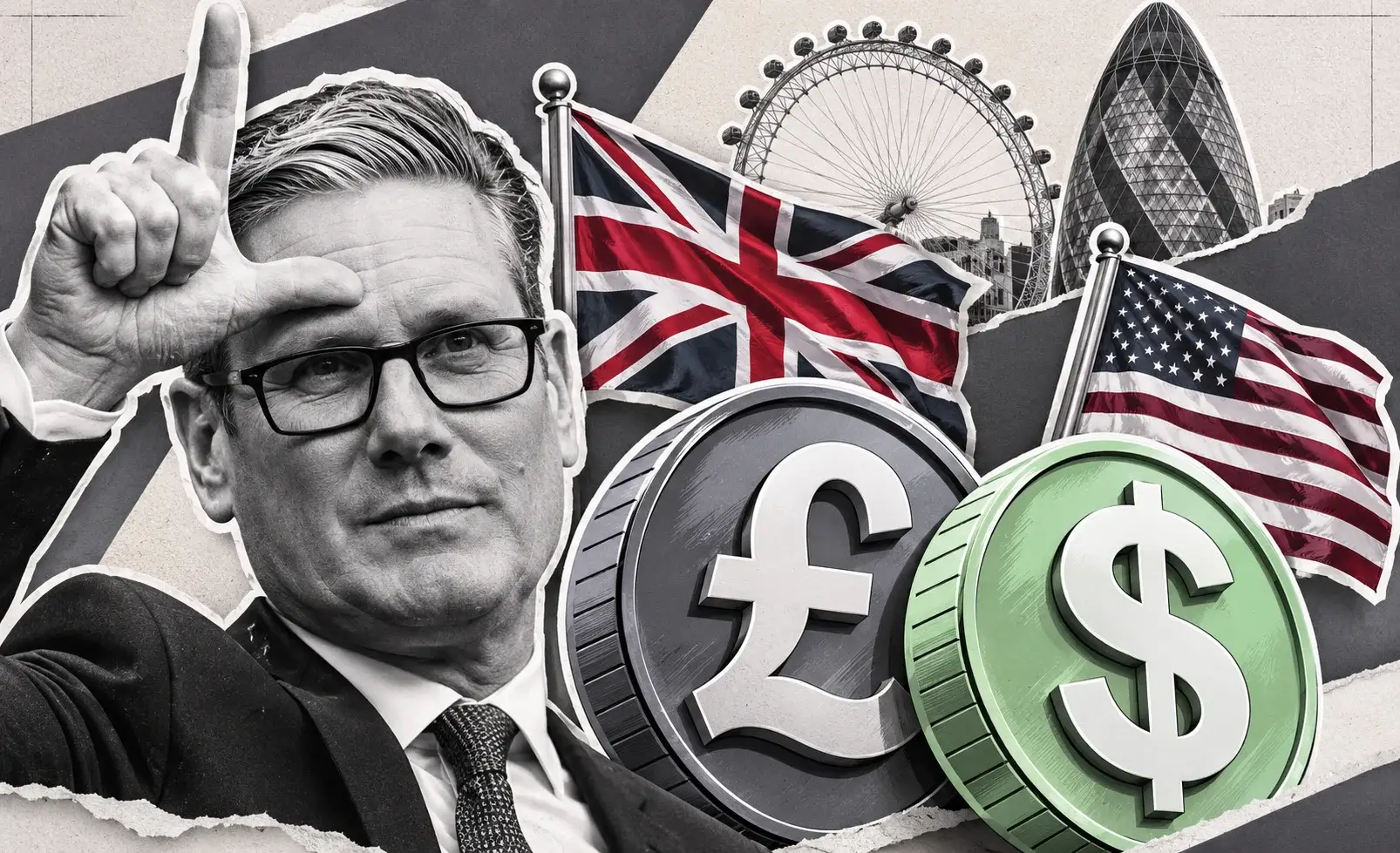
GBP/USD Holds 1.3115 After Rebounding From 1.3011; Close Above 1.3150 Opens 1.3269
BoE rate parity with the Fed sets up 1.3269 if cable clears 1.3150 | That's TradingNEWS
Key Points
- GBP/USD rose 0.77% on the week to 1.3115, rebounding from Monday's 1.3011 2026 low.
- Markets price an 88% BoE hike to 4.25% and a 99% Fed hike, keeping policy rates at parity.
- A daily close above 1.3150 opens the 1.3269 target; a loss of 1.3011 exposes 1.3000.
The pound is ending a volatile week with a small gain against the dollar. GBP/USD traded at 1.3115 in the U.S. session, up 0.09% on the day, after bouncing from a daily low of 1.3091. Earlier it reached 1.3126, up 0.14% from Thursday's session. Thursday was flat, with the pair moving sideways around 1.3100 and closing at 1.31047, down 0.05%. Thanksgiving liquidity kept Thursday's range tight, and Friday's half-day U.S. session is doing the same.
The weekly picture is better than the daily one. On Monday, November 23, GBP/USD fell to 1.3011, a fresh 2026 low and its weakest level in more than a year. From 1.3011 to 1.3115 is a 104-pip recovery, and the pair is set to finish the week up 0.77%. Sterling gained against most major currencies this week. That's the pound's best relative showing in a month that has otherwise been bearish.
November's damage is still large. On November 4 GBP/USD traded near 1.3500. From there to Monday's 1.3011 is a 489-pip decline, 3.6%, in 13 sessions. The pound dropped about 400 pips in the eleven sessions from November 4 through November 19, when it broke under 1.3100 and set a new 2026 low below every daily low since at least late July. Over the past year GBP/USD is down 0.84%.
The pound is doing better against the euro than against the dollar. EUR/GBP trades at 0.8365, down 0.05% on the day and down 4.55% over the year. That's because the Bank of England is matching the Fed hike for hike while the ECB lags. Against the yen, GBP/JPY trades at 209.11, up 0.19%.
Today's thesis follows from that. Sterling has one advantage the euro lacks: the BoE's policy rate is level with the Fed's. Bank Rate stands at 4.00%, the same as the top of the Fed's 3.75%–4.00% range. Markets price an 88% chance of a BoE hike to 4.25% on December 17 and a 99% chance of a Fed hike to 4.00%–4.25% on December 9. Rate parity protects sterling from the carry drag hitting the euro. It doesn't overcome the dollar's haven bid or the U.S. growth gap, which keep GBP/USD below 1.3269.
The upside target is 1.3269, where the pair's main moving averages converge into a triple resistance. Getting there requires a daily close above 1.3150, the October 14 low that broke in mid-November. On the downside, 1.3091 is today's low, 1.3011 is Monday's 2026 low, and 1.3000 is the big round number.
The Bank of England: 4.00% Bank Rate and an 88% December Hike
The Bank of England is the main reason the pound has held up better than the euro. On November 5 the MPC voted eight to one to raise Bank Rate by 25 basis points, from 3.75% to 4.00%. The one dissent favored a 50-basis-point move. The Bank of England said it raised rates to limit how much rising energy costs spread into other prices, citing higher global energy prices and the degree of inflationary pressure in the pipeline.
The next decision is December 17. Markets price an 88% chance of another 25-basis-point hike, which would take Bank Rate to 4.25%. Hawkish comments from BoE officials this week pushed those odds up. MPC member Megan Greene pointed to UK pay growth relative to a 3% mark she sees as consistent with the inflation target. Officials have framed the energy shock as a risk to inflation expectations, not a temporary blip.
The BoE's own forecast supports more hikes. Staff project CPI inflation, which was 3.5% in September 2026, to rise to about 5% in the second quarter of 2027. That's well above the 2% target. A central bank expecting inflation to keep rising for two more quarters isn't close to stopping.
Business expectations are moving the wrong way for the BoE too. In the Decision Maker Panel survey, firms' year-ahead CPI expectations rose to 3.3% in the three months to October, from 3.1% in the three months to September. Year-ahead own-price inflation expectations rose 0.1 percentage points to 3.8%. Three-year-ahead CPI expectations stayed at 2.8%. When businesses expect higher inflation and plan to raise their own prices, the BoE has reason to keep tightening.
That's why sterling has outperformed the euro. The ECB's deposit rate is 2.50%, and markets price only one hike to 2.75% on December 17. The BoE is at 4.00% and heading to 4.25% the same day. The 150-basis-point gap between the BoE and the ECB explains EUR/GBP's 4.55% annual decline.
For GBP/USD, the BoE's hawkishness is necessary but not enough. It keeps the pound from falling as fast as the euro. To lift cable toward 1.3269, the BoE would need to signal more hikes than the Fed in 2027.
The Fed Side: 99% December Hike and Two More Priced for Early 2027
The Fed is the main force capping GBP/USD. Fed funds futures price a 99% chance of a 25-basis-point hike at the December 8–9 FOMC meeting, taking the target range from 3.75%–4.00% to 4.00%–4.25%. Traders are also pricing two more Fed hikes in early 2027. That's more tightening than markets expect from the BoE.
US data drove it. October core PCE came in at 3.3%, a tenth above forecast, according to the Bureau of Economic Analysis. Headline PCE was 3.8%. Third-quarter GDP was revised to 4.3% annualized from 3.4%. A US economy growing above 4% with core inflation at 3.3% leaves the Fed with no reason to stop.
The rate comparison is the key to cable. Today, Bank Rate at 4.00% equals the top of the Fed's range. After both December hikes, the BoE would be at 4.25% and the Fed's range at 4.00%–4.25%, parity again at the top. Rate parity is unusual. For most of 2025 the Fed's rate sat above the BoE's. The UK's energy-driven inflation has forced the BoE to keep pace.
Parity doesn't mean neutral for the pound, because markets price the future path, not today's rate. With two more Fed hikes priced for early 2027 and fewer BoE hikes, the expected rate gap moves in the dollar's favor next year. If the Fed reaches 4.50%–4.75% by mid-2027 while the BoE stops at 4.25% or 4.50%, the dollar regains a carry advantage. That outlook caps GBP/USD rallies even with parity today.
Growth explains the gap. The US is growing at 4.3%. The UK's Office for Budget Responsibility expects CPI to average 3.1% in 2026 and 3.4% in 2027, with a quarterly peak of 3.8% in early 2027, while growth stays modest. The Fed can hike into a strong economy. The BoE is hiking into one where higher energy costs are squeezing households. Markets expect the Fed to tighten longer because the US economy can absorb it.
For cable, the Fed's December 9 statement and projections will matter more than the hike itself, which is priced. Guidance signaling more hikes in 2027 would push GBP/USD back toward 1.3011. A signal that December is likely the last would let cable rally toward 1.3269.
UK Inflation at 3.6%: Energy-Driven, With Services Cooling
The UK's inflation data explains why the BoE is hiking and why markets aren't fully sure about December. Headline CPI rose to 3.6% in October from 3.5% in September, its highest rate in a year and well above the 2% target. Fuel and diesel prices rose as the Iran war kept oil elevated, and they drove most of the increase. UK inflation has risen for four straight months.
The details are softer than the headline. Core inflation, which excludes energy, food, alcohol and tobacco, held at 2.8%. Services inflation stayed at 3.7%. Both were slightly softer than expected. The headline matched economists' forecasts but came in a tenth below the BoE's own 3.7% projection. That reduced, but didn't eliminate, bets on a back-to-back hike in December.
The pattern matches the eurozone's. Energy is pushing headline inflation up while underlying measures stay steadier. The difference is the BoE's response. The ECB has been slow to hike against energy inflation, arguing rate hikes do little to lower imported energy prices. The BoE has hiked anyway, citing the risk that energy costs spread into wages and services. With services inflation at 3.7% and pay growth above the 3% mark officials watch, the BoE sees more risk of second-round effects.
The next UK CPI report, for November, comes on December 16, one day before the BoE decision. Another modest rise in the headline rate is possible. A rise to 3.7% or 3.8% would make a December hike close to certain and lift the pound. A drop back to 3.5%, especially with services cooling further, would cut December odds below 88% and weigh on sterling.
The forward path favors the hawks. BoE staff expect CPI near 5% in Q2 2027. The OBR sees a peak of 3.8% in early 2027. Both forecasts show inflation rising for months, which supports more BoE hikes in 2027. If those forecasts hold, the BoE may end up hiking as much as the Fed next year, which would be bullish for GBP/USD.
For the forecast, UK inflation is a two-sided risk. Higher inflation supports the BoE and the pound in the short run but weighs on UK growth and gilts. Lower inflation weakens the BoE case and the pound but helps growth. The pound's best case is inflation high enough to keep the BoE hiking but not so high that it breaks gilts.
The Fiscal Overhang: Healey's Budget, Gilts and the 30-Year Above 6%
UK fiscal risk is the pound's other weak point. On October 28, Chancellor John Healey delivered his first Budget. Borrowing and public debt forecasts were revised higher, and the Budget included an additional £20.4 billion in funding for the National Wealth Fund and the British Business Bank, financed through more borrowing. Sterling held around $1.33 at the time, near a two-week low.
The gilt market had already shown stress. On October 1, the UK 30-year gilt yield rose above 6% for the first time since 1998. GBP/USD fell under 1.3200 that day, its lowest since late June. A 30-year yield above 6% means the UK government pays more to borrow long-term than at any point in 28 years. Higher gilt yields usually support a currency through higher returns, but when they rise because of fiscal concerns, they hurt it. Investors demand more yield because they see more risk.
The OBR's October 2026 Economic and Fiscal Outlook shows the scale. It expects 10-year gilt yields to average 4.6% in 2026 and 5.0% in 2027. It also expects the energy shock to keep CPI above the 2% target through 2026 and 2027. Higher borrowing costs and inflation above target leave the Treasury little fiscal room if growth weakens.
That creates a risk for the pound when the BoE hikes. Higher Bank Rate raises gilt yields across the curve, which increases debt service costs and widens the deficit. If markets start to question UK fiscal sustainability, gilts sell off, and the pound falls with them, as happened in September 2022. The pound's 2026 low on November 23 came during a broad risk sell-off, but fiscal worries are part of the backdrop.
Politics offers some support. Prime Minister Andy Burnham's efforts to improve relations with the EU helped cap sterling's losses after the 1.3011 low. Closer trade ties with the EU would improve the UK's growth outlook and ease some of the drag from Brexit, which helps sterling's medium-term case.
For the forecast, fiscal risk sets the floor. As long as gilts trade without a disorderly sell-off, the BoE's hikes support the pound. A gilt sell-off that pushes the 30-year back above 6% would override the BoE effect and send GBP/USD toward 1.3000.
The Dollar Index: 104.30 Peak, 103.81 Now
The dollar's strength explains most of the pound's November decline. The Dollar Index hit 104.30 on Monday, a 19-month high, then eased to trade between 103.73 and 103.92 on Friday, holding near 103.81. The pound makes up 11.9% of the DXY basket, smaller than the euro's 57.6%. GBP/USD moves with the broad dollar but has its own drivers more than EUR/USD does.
Three things support the dollar. The first is the Fed's tightening, a 99%-priced hike with two more priced for early 2027. The second is safe-haven demand. The Iran-Saudi-Houthi escalation, with strikes on Ras Tanura and Jazan this week, has boosted haven demand for the dollar. When geopolitical risk rises, investors buy dollars and Treasuries, not pounds. The third is US growth at 4.3%, which draws capital into US assets.
The AI equity crash helped the dollar too. When US stocks fell 2% on November 19, foreign buying of the Anthropic IPO added dollar demand. Investors needed dollars to buy shares. That pushed GBP/USD under 1.3100 for the first time in 2026. The pound didn't need UK news to fall. Equity turmoil and dollar buying did it.
The dollar's pause this week helped the pound. When the Nasdaq Composite fell as much as 4.6% on Wednesday, Treasury yields dropped as money moved into bonds, and the dollar gave back some of its gains. GBP/USD climbed from 1.3011 toward 1.3150. Friday's equity rebound, with the Nasdaq up 1.47%, lifted US yields again, which capped the pound's gains.
The Dollar Index levels set the range. A weekly close above 104.50 would point to new lows in GBP/USD below 1.3011. A move below 103.50 would signal the dollar's rally has stalled and support a push toward 1.3269. At 103.81 the index sits in between, so cable is likely to stay between 1.3011 and 1.3150 until next week's data.
Treasury yields are the link. The US 10-year traded between 4.848% and 4.918% on Friday, with the 30-year above 5%. As long as US yields hold near these levels, the dollar keeps its bid. A drop in Treasury yields, from weak data or a dovish Fed, would be the fastest way for the pound to rally.
EUR/GBP at 0.8365: Sterling's Advantage Over the Euro
The pound's clearest strength is against the euro. EUR/GBP trades at 0.8365, down 0.05% on the day and down 4.55% over the year. A falling EUR/GBP means the pound is gaining against the euro. Sterling's annual gain against the single currency contrasts with its 0.84% annual loss against the dollar.
Policy explains it. The BoE's Bank Rate is 4.00%, the ECB's deposit rate is 2.50%, a 150-basis-point gap in sterling's favor. Both central banks are expected to hike on December 17, the BoE to 4.25% and the ECB to 2.75%, keeping the gap at 150 basis points. Investors holding pounds instead of euros earn 1.5 percentage points more a year. That carry advantage pulls capital toward sterling.
The inflation backdrop also helps the pound against the euro. The BoE is hiking actively against 3.6% UK inflation. The ECB is moving slowly against 4.0% eurozone inflation, arguing energy-driven inflation doesn't respond well to rate hikes. Markets reward central banks that fight inflation, and the BoE has been more aggressive. Friday's soft French and Spanish CPI readings made further ECB hikes after December less likely, which widened the expected gap with the BoE.
Growth divergence helps too. France's economy contracted 0.2% and its flash composite PMI fell to 46.2. Germany's composite PMI rose to 55.0, but the eurozone as a whole is at 51.7. The UK isn't growing fast, but it isn't facing the French contraction or the sovereign stress that pushed French 10-year yields to 5.1415% in October.
For GBP/USD, the EUR/GBP strength matters in two ways. First, it shows sterling has its own support beyond the dollar story. When the broad dollar weakens, the pound tends to gain more than the euro. Second, flows from euro to sterling, such as European investors buying gilts for the higher yield, add steady demand for the pound.
The risk to sterling's relative strength is the BoE stopping. If UK inflation peaks earlier than expected and the BoE pauses after December, the 150-basis-point gap over the ECB would stop widening. EUR/GBP could rebound toward 0.85, and GBP/USD would lose one of its supports.
Geopolitics: The Iran-Saudi-Houthi Escalation and Haven Demand
The Middle East escalation is a headwind for the pound through the dollar. The Houthis claimed strikes on Ras Tanura, Saudi Arabia's largest refinery, on Wednesday, November 25. A projectile halted some operations at Saudi Aramco's Jazan refinery on Thursday and killed a worker. Tanker attacks and Iranian mines threaten the Strait of Hormuz. The US-Iran war is at day 272. Each escalation raises demand for the dollar as a haven.
The energy channel hits the UK directly. The UK imports much of its oil and gas, so higher energy prices widen its trade deficit and push up inflation. Brent traded at $95.20 on Friday, after touching $98.06, and is 30.5% above its pre-war level. UK CPI rose to 3.6% in October largely because of fuel and diesel prices tied to the war. Higher energy costs squeeze UK household incomes and weigh on growth.
That creates a policy bind for the BoE. Energy-driven inflation pushes it to hike, which supports the pound in the short run. The same energy shock weakens UK growth, which hurts the pound over time. The BoE's forecast of CPI near 5% in Q2 2027 reflects energy feeding into the wider economy. If energy prices keep rising, the BoE may have to hike more than markets expect, but growth would suffer.
Gas is a separate risk. EU gas inventories could fall below 10% of working capacity by the end of March 2027. The UK has limited gas storage and depends on imports through the winter. A cold winter combined with low European storage could push UK gas prices sharply higher, adding to inflation and to the trade deficit. That would be negative for sterling despite the BoE's hikes.
OPEC+ meets Sunday to set its 2027 production framework. A decision to extend cuts would keep oil elevated and add to UK inflation and BoE hike expectations. A decision to let cuts expire would ease oil prices, lower UK inflation pressure and reduce BoE hike odds. Both outcomes affect the pound, in opposite directions on rates and growth.
For GBP/USD, a geopolitical de-escalation would be the best outcome. Lower oil and less haven demand would weaken the dollar and ease UK inflation, which would help both the pound and UK growth.
Positioning and Technicals: Below the 1.3269 SMA Triple
GBP/USD remains in a bearish trend on the charts. The pair trades at 1.3106 to 1.3115, below a triple convergence of key simple moving averages at 1.3269. When three major moving averages bunch together above the price, they form a heavy resistance zone. Sellers who bought along those averages will look to exit at breakeven if the price returns there.
The breakdown path is clear. The pound dropped about 400 pips in eleven sessions from its November 4 high near 1.3500. On November 19 it broke its October 14 low just under 1.3150 and fell below 1.3100, a new 2026 low. That move took the pound below every daily low since at least late July. On Monday, November 23, it extended to 1.3011.
The week's bounce is modest. From 1.3011 to 1.3126 is a 115-pip recovery at the high. The pair has recovered 24% of the drop from 1.3500 to 1.3011. A bounce that small after a decline that large doesn't change the trend. For a meaningful recovery, GBP/USD needs to retrace at least 38.2% of the drop, which would take it to 1.3198, and then challenge the 1.3269 resistance.
Momentum is improving but still weak. The pair has made higher daily lows since Monday: 1.3011 Monday, around 1.3050 to 1.3090 midweek, and 1.3091 Friday. Higher lows are the first sign of a short-term base. But each daily high has been capped below 1.3150, so the range is narrow and the trend is still down.
Weekly performance gives context. A 0.77% weekly gain would be sterling's first winning week since early November. After four weeks of losses, one positive week shows selling pressure easing. It doesn't confirm a reversal.
The 1.3000 level is the main psychological support. GBP/USD came within 11 pips of it Monday. A break below 1.3000 would trigger stops and open a move toward 1.2900. Options interest around 1.3000 likely helped hold the level this week. A sustained break below it would be a clear bearish signal.
For the forecast, technicals favor the downside unless the pair clears 1.3150. Above 1.3150, the path to 1.3269 opens. Below 1.3091, the pair is back in the lower half of the range.
Support Map: 1.3091, 1.3050, 1.3011 and 1.3000
GBP/USD has a tight set of supports below today's 1.3115.
The first is 1.3091, Friday's intraday low. It's 24 pips below the current price and the line for the rest of the thin holiday session. With US markets closing early at 1:00 p.m. ET, a break below 1.3091 in the afternoon could carry into Monday's open on low volume. Holding it keeps Friday's gain intact.
The second is 1.3050, the midweek area where the pair consolidated after Monday's low. It marks the floor of the higher-lows pattern. A daily close below 1.3050 would break that pattern and show the week's recovery is fading.
The third is 1.3011, Monday's 2026 low and the pound's weakest level in more than a year. It's the most important support on the chart. A daily close below 1.3011 would confirm a new leg lower in the downtrend that began near 1.3500 on November 4. It's 104 pips below the current price.
The fourth is 1.3000, the big round number just below Monday's low. Heavy options interest and psychological importance make it a strong support. A break below 1.3000 would likely trigger stop-loss orders and accelerate selling. It's the line markets will watch most closely if the dollar resumes its rally.
Below that sits 1.2900, the next major support and the bear-case target if the Fed signals more 2027 hikes and UK gilts sell off. A move to 1.2900 would mean a further 1.6% decline from current levels and would take the pound to levels last seen in 2025.
The spacing is tight. From 1.3115 to 1.3011 is 0.79%, a normal two-day move in this market. The pair covered that distance in reverse this week. With the 1.3000 round number just 11 pips below Monday's low, a break below 1.3011 would quickly test 1.3000.
The most important line for the forecast is 1.3011. Above it, the week's base holds and a push toward 1.3269 remains possible. Below it, the downtrend resumes toward 1.3000 and 1.2900.
Resistance Map: 1.3126, 1.3150, 1.3198 and the 1.3269 Target
The resistance levels above GBP/USD are spaced more widely than the supports.
The first is 1.3126, Friday's intraday high. It's 11 pips above the current price. A move back to 1.3126 would show buyers can hold the week's gains through the US session.
The second is 1.3150, the October 14 low that broke on November 19. Broken support becomes resistance, and 1.3150 has capped every daily high this week. A daily close above 1.3150 is the first condition for this forecast. It would put the pair back above the level that marked the start of its 2026 lows and confirm the November breakdown has failed.
The third is 1.3198, the 38.2% retracement of the drop from 1.3500 to 1.3011. Clearing it would show a meaningful recovery is underway. It sits just below the 1.3200 round number, where GBP/USD fell on October 1 when the 30-year gilt yield broke above 6%.
The fourth is the 1.3269 upside target, where the triple convergence of key simple moving averages sits. Reclaiming it would end the short-term bearish trend and put the pound back above its main trend indicators. The target is 154 pips above the current 1.3115, a 1.17% move. For a pair that dropped 400 pips in eleven sessions, that's reachable within a week or two if the dollar's rally fades.
Above 1.3269, the next resistance is 1.3330, the level the pound held after Healey's October 28 Budget, then the 1.3500 November 4 high. A return to 1.3500 would require a Fed that signals December is its last hike while the BoE keeps going. That's not the base case.
The path from 1.3115 to 1.3269 has to clear three resistances: 1.3150, 1.3198 and the target itself. Each is where sellers who bought during the November decline will look to exit. The 1.3269 target marks both the trend line and the point where selling pressure is likely heaviest.
The Week Ahead: US Payrolls, BoE Officials and Month-End Flows
Next week's calendar will decide whether GBP/USD breaks out of its 1.3011 to 1.3150 range.
On Monday, November 30, month-end flows come into play. After a month in which the pound lost 3.6% from its November 4 high, some portfolio managers will need to rebalance. UK-based funds with US assets that rose in sterling terms may sell dollars to bring hedges back to target. That could give the pound a modest bid into the London fix.
On Tuesday, December 1, the US releases the ISM Manufacturing PMI and the JOLTS job openings report. Strong numbers would support the Fed's hiking path and pressure the pound. On Wednesday, December 2, ADP private payrolls give an early read on US employment. On Thursday, December 3, the US releases weekly jobless claims and the ISM Services PMI.
On Friday, December 4, the November US nonfarm payrolls report is due, covering payrolls, the unemployment rate and wage growth. It's the last major labor report before the Fed's December 9 decision and the most important release for GBP/USD next week. A strong report would cement the December hike and raise the odds of two more in early 2027, pushing the Dollar Index toward 104.50 and GBP/USD toward 1.3011. A weak report would be the pound's best chance to rally. It would signal the Fed might stop sooner, narrowing the expected rate gap and lifting GBP/USD toward 1.3269.
Read More
-
Yen Stalls at 160 Despite a 3% JGB and Tokyo Core CPI at 2.0% — Intervention Sits at 164, Friday's Payrolls Decide
02.09.2026 · TradingNEWS ArchiveEnergy
-
Micron Rips 7% to $643.81 Off the $548 Low; Close Above $650 Opens the $700 Target
27.11.2026 · TradingNEWS ArchiveStocks
-
Ethereum Fades to $1,676 After $1,754 High; Close Above $1,754.7 Opens $1,850
27.11.2026 · TradingNEWS ArchiveCrypto
-
Oil: Brent Fades to $95.20, WTI Holds $83.74; Closes Above $98.06 and $85.78 Open $100 and $88.50
27.11.2026 · TradingNEWS ArchiveCommodities
-
Stock Market Today: S&P 500 SPX Targets 7,500 as Nasdaq IXIC Rises 1.5%, Dow DJI Tops 50,600, Micron MU Gains
27.11.2026 · TradingNEWS ArchiveMarkets
-
EUR/USD Slides to 1.0951 on Soft French and Spanish CPI; Close Above 1.1006 Opens 1.1100
27.11.2026 · TradingNEWS ArchiveForex
UK data is lighter next week, but BoE officials will speak. Any comments that reinforce the 88% December hike pricing would support the pound. Comments suggesting the BoE could pause after December, given softer core and services inflation, would weigh on it. Watch for updates on pay growth, which officials have flagged as the key indicator for second-round effects.
The bigger UK events come later. November CPI comes December 16, the BoE decision December 17. The Fed decides December 9. Between now and December 17, GBP/USD will trade the Fed's guidance first, then UK inflation and the BoE.
Sunday's OPEC+ meeting also matters. An extension of production cuts would keep oil high, adding to UK inflation and BoE hike expectations. A dovish OPEC+ outcome would ease UK inflation pressure but help UK growth.
GBP/USD Verdict: Range-Bound Below 1.3150, 1.3269 on a Fed Pivot
GBP/USD ends Black Friday at 1.3115, up 0.09% on the day and 0.77% on the week after rebounding from Monday's 1.3011 2026 low. The pair traded between 1.3091 and 1.3126 Friday. It's still down 3.6% from the November 4 high near 1.3500 and 0.84% over the past year. Against the euro, sterling is strong, with EUR/GBP at 0.8365 and down 4.55% over the year.
The BoE is the pound's main support. Bank Rate is 4.00%, level with the top of the Fed's range. Markets price an 88% chance of a hike to 4.25% on December 17. BoE staff project CPI near 5% in Q2 2027, and business inflation expectations rose to 3.3%. A 150-basis-point gap over the ECB explains sterling's strength against the euro. Rate parity with the Fed keeps the pound from falling as fast as the euro against the dollar.
The dollar is the main headwind. The Fed is hiking to 4.00%–4.25% on December 9, priced at 99%, with two more hikes priced for early 2027. US growth at 4.3% and core PCE at 3.3% support that path. The Dollar Index holds at 103.81 after a 19-month high of 104.30. The Iran-Saudi-Houthi escalation adds haven demand for the dollar. UK fiscal risk, with the 30-year gilt having broken 6% in October and borrowing revised higher in Healey's Budget, limits the pound's upside.
The roadmap is specific. Holding 1.3091 into the Friday close keeps the week's gain. A daily close above 1.3150 breaks the week's ceiling and the October 14 breakdown level. A move through 1.3198, the 38.2% retracement, opens the 1.3269 target at the triple moving-average convergence. Reaching it requires a weak US payrolls report on December 4 or a Fed that signals December is its last hike.
The downside is just as clear. A daily close below 1.3050 breaks the higher-lows pattern. Below 1.3011 the downtrend resumes, with 1.3000 next and 1.2900 the December bear target. A gilt sell-off or a weekly Dollar Index close above 104.50 would speed that move.
The verdict is range-bound with a bearish tilt. GBP/USD trades between 1.3011 and 1.3150 until next week's data breaks the range. The BoE's hikes keep the pound from collapsing, and the Fed's 2027 path caps rallies. The pound reaches 1.3269 only if the Fed signals it's done after December. Until then, rallies toward 1.3150 are more likely to draw sellers than to start a trend reversal.