GBP/USD Price Forecast: Four BoE Hikes, Iran Stagflation, and the $1.3430 Breakout
Cable recovers from $1.3223 to $1.3398 on Trump's Iran pause — but UK CPI heading toward 5%, BoE-Fed rates both at 3.75% | That's TradingNEWS
GBP/USD at $1.3398 — Four BoE Rate Hikes Now Priced, Stagflation Fears Real, and the Falling Wedge That Could Change Everything
GBP/USD opened Monday, March 23, 2026 under serious pressure, trading as low as $1.3223 during Asian hours before staging a recovery that pushed Cable above $1.3400 after Trump's Iran ceasefire announcement sent the USD sharply lower and risk appetite flooded back into markets. The intraday range — from $1.3223 to $1.3457 by mid-session — captures in a single session the entire psychological battlefield that GBP/USD has been fighting across the past several weeks. The FTSE 100 was down 0.24% at 9,894, GBP/EUR was trading at 1.1560, and the DXY pulled back from its intraday high of above 100.06 to approximately 98.83 — a dollar weakening that mechanically lifted Cable even as the UK's fundamental economic picture continued to deteriorate. Before Trump's post, Sterling had been trading 0.5% lower against the dollar and was below the $1.33 mark — a level that has been functioning as a psychological floor for a pair that has seen its narrative completely rewritten by the Iran war and the Bank of England's dramatic pivot from rate-cutting institution to potential aggressive hiker. The market was pricing two Bank of England rate cuts before the war began on February 28. As of Monday, the market is pricing four quarter-point BoE rate hikes this year — a swing of 150 basis points in expected policy direction over 23 days that represents one of the most violent repricing events in UK rate expectations since the 1992 ERM crisis. Understanding GBP/USD right now requires understanding why that repricing happened, whether it is justified, and what the technical structure tells us about where Cable goes from the current $1.3398 level.
From Two Cuts to Four Hikes in 23 Days — The BoE's Iran War Forced Hand
The Bank of England held rates at 3.75% at its March meeting last week — a decision in line with expectations, but the guidance that accompanied it was anything but routine. Governor Andrew Bailey explicitly characterized the Middle East conflict as a "shock to the economy" that will push inflation substantially higher in the near term and stated that restoring safe shipping through the Strait of Hormuz is "key to addressing energy price rises." Those two sentences amount to the BoE acknowledging that its monetary policy path is now hostage to a geopolitical variable that it has no ability to influence. The bank is simultaneously facing rising inflation from the energy shock and slowing growth from the same energy shock — the classic stagflationary bind that no central bank wants to navigate. Analysts at JP Morgan and Barclays have both published forecasts predicting two BoE rate hikes this year, with the first increase expected in April. The market has gone further, pricing four quarter-point hikes — implying the BoE could lift rates from 3.75% to 4.75% by year-end. That projection prices in a scenario where the Iran war's energy price impact drives headline UK CPI to 5% or above, forcing the BoE into an aggressive tightening cycle even as the UK economy contracts. UK economists surveyed by Reuters expect the upcoming UK CPI reading to show headline inflation at 3% in February — before the war's full energy price impact has transmitted — with core CPI at 3.1% against the BoE's 2% target. By April and May, when the energy shock is fully embedded in the price index, those numbers are expected to be dramatically higher. The BoE hiking into a slowing economy is not a growth-supportive policy for Sterling — but in the short term, a hawkish BoE narrows the interest rate differential against the Fed's 3.75% and provides relative yield support for GBP/USD at a time when the pair needs all the fundamental support it can find.
GBP/USD at 1.3398 — The Intraday Reversal From $1.3223 and What It Means Technically
The sequence of price action on Monday for GBP/USD was technically instructive. The pair opened with a gap down and traded near $1.3335 during Asian hours, pressured by dollar safe-haven demand as oil pushed above $100 and equity markets were in freefall before the U.S. session. The pair held above the critical $1.3223 support level — the March low that represents the lower bound of the current corrective structure — and when Trump's announcement hit, Cable recovered sharply above $1.3400, testing the 200-day simple moving average that has been acting as a dynamic ceiling. The fact that $1.3223 held on two separate tests — both the earlier intraday low and the prior week's extreme — is technically meaningful. Double bottoms at the same support level, confirmed by a recovery above $1.3400, create the structural precondition for the falling wedge and inverted head-and-shoulders patterns that multiple technical analysts are now flagging as potential reversal setups. The Percentage Price Oscillator on the daily chart has formed a bullish crossover pattern — a momentum signal that has preceded significant Cable recoveries in prior cycle analogues. The RSI at approximately 45 sits below the neutral 50 midline, which is a cautiously bearish reading, but the combination of RSI putting in higher lows while price tests established support is the classic positive divergence setup that precedes trend exhaustion in the bearish direction. None of this constitutes a confirmed reversal — the pair remains below the flattening 100-day exponential moving average and is trading beneath the Bollinger Band middle, keeping it anchored in the lower half of the volatility envelope. But the technical evidence that downside momentum is exhausting is accumulating in a way that justifies watching for a breakout above the critical $1.3430-$1.3470 resistance zone.
The Falling Wedge and Inverted Head-and-Shoulders — Two Bullish Patterns Forming Simultaneously
The simultaneous formation of a falling wedge pattern and an inverted head-and-shoulders on the GBP/USD daily chart deserves more analytical weight than it is currently receiving from markets focused on macro headlines. A falling wedge is a bullish reversal pattern formed by two converging downward-sloping trendlines — it signals that selling pressure is compressing and losing momentum, with each successive lower high and lower low coming in smaller increments until the pattern resolves in a breakout. The falling wedge is most powerful when it forms after a sustained downtrend — which is precisely the context here, with Cable having fallen from a high of $1.3470 to a low of $1.3223 in a compressed timeframe as the Iran war drove dollar demand and stagflation fears weighed on Sterling. The inverted head-and-shoulders overlaid on the same timeframe adds a second layer of structural bullish evidence. An inverted head-and-shoulders — a left shoulder at approximately $1.3300, a head at $1.3223, and a right shoulder forming near $1.3300-$1.3320 — is one of the most statistically reliable reversal patterns in technical analysis, with the completion signal requiring a break and close above the neckline. For GBP/USD, the neckline of the inverted head-and-shoulders pattern coincides approximately with the $1.3430 resistance level — the Bollinger Band middle cluster and 100-day EMA. A daily close above $1.3430 would simultaneously confirm the inverted head-and-shoulders neckline break and the falling wedge breakout, creating a dual-pattern confirmation that would target $1.3500 as the immediate objective and potentially $1.3560 as the extended target. The stop for any long position based on these patterns sits at $1.3225 — just below the inverted head-and-shoulders head, where the pattern's invalidation point sits.
The Dollar-Sterling Yield Differential: Fed at 3.75%, BoE at 3.75% — And Why Parity Matters
One of the most important fundamental observations for GBP/USD is that the Fed funds rate and the Bank of England policy rate are currently identical — both sitting at 3.75%. This is an unusual historical configuration that removes the pure yield differential argument that has been driving dollar strength against most other G10 currencies. EUR/USD faces a 160 basis point disadvantage — ECB at 2.15% versus Fed at 3.75%. GBP/USD faces no such disadvantage at the current rate settings. The dollar's strength against Sterling is being driven not by yield differential but by the dollar's petrocurrency premium — the phenomenon where oil price surges now benefit the dollar because the U.S. is the world's largest oil producer and exporter. When Brent was at $114 and WTI was above $100, the dollar's petrocurrency bid was maximum. After Monday's 10% oil decline, the petrocurrency bid retreated along with crude prices, which is mechanically why GBP/USD recovered from $1.3223 to $1.3398 even though the BoE's fundamental situation hasn't changed in 24 hours. The critical implication is that GBP/USD's path forward is more directly tied to oil prices than to interest rate spreads — which means the pair's near-term direction will be determined by whether the Iran ceasefire holds and Brent sustains below $105, or whether the five-day diplomatic window collapses and crude spikes back toward $115. In the ceasefire-holds scenario, the dollar's petrocurrency premium evaporates, the BoE's April rate hike expectations provide yield support for Sterling, and GBP/USD can recover toward $1.3500-$1.3560. In the ceasefire-fails scenario, oil spikes, the dollar premium returns, and Cable breaks below $1.3223 toward $1.3160 and potentially the psychologically important $1.30 level.
UK Stagflation: CPI Expected at 3% for February, 5% Potential for 2026 — The Sterling Paradox
The UK inflation trajectory created by the Iran war presents GBP/USD with a paradox that makes it analytically more complex than most other dollar pairs. In a normal inflationary environment, rising UK inflation forces the BoE to hike rates, which increases Sterling's yield attractiveness, which supports GBP/USD. But the Iran war's inflation is supply-driven and simultaneously growth-negative — it inflates prices while destroying economic activity. Farmers in Wiltshire are paying £1.20-£1.30 per litre for red diesel versus 65p before the war. Heating oil has more than doubled. The RAC confirms petrol has risen 9% and diesel 17% at ordinary UK filling stations. These cost increases are not going to workers in the form of wage increases — they are extractive transfers from household budgets to energy producers. UK consumers who are already cutting spending on leisure and dining by £40 per week — as official figures suggest for households with gross income around £55,000 — are now facing compounded pressure from energy costs that will become embedded in food prices over the coming months when fertilizer cost increases transmit through the supply chain. The NFU has confirmed food price increases are coming. The combination of higher energy costs, higher food prices, and consumer discretionary spending contraction represents the exact stagflation scenario that the BoE characterized as a "shock to the economy." When a central bank hikes rates into that environment, it does not address the supply-side inflation — it merely adds credit cost pressure on top of energy cost pressure, further compressing consumer spending and potentially triggering a recession that would be deeply negative for Sterling on a medium-term basis. The near-term BoE rate hike narrative supports GBP/USD through the yield channel. The medium-term UK recession risk from stagflation undermines it. This contradiction explains why Cable's technical patterns show bullish reversal setups while the fundamental backdrop remains deeply uncertain — the market is simultaneously pricing the hawkish BoE short-term catalyst and the economic damage long-term consequence.
Read More
-
Yen Stalls at 160 Despite a 3% JGB and Tokyo Core CPI at 2.0% — Intervention Sits at 164, Friday's Payrolls Decide
02.09.2026 · TradingNEWS ArchiveEnergy
-
QQQ ETF ($739) Fades From an Early Tech Rally as a 77.9 ISM Prices Index Meets Micron's $61.5B Guide — $760 Record Test Ahead
01.10.2026 · TradingNEWS ArchiveStocks
-
XRPR and XRPI Follow XRP's $1.49 Test as Spot Funds Hold 1.16B XRP and a 1 Billion Token Escrow Release Lands — $1.70 in Play
01.10.2026 · TradingNEWS ArchiveCrypto
-
November NG Slips Below $3 as Decade-High Storage Meets Capped LNG Exports — $2.75 in Sight
01.10.2026 · TradingNEWS ArchiveCommodities
-
Dollar-Yen at 158 Presses Toward 160 as a 363 bp Carry Gap Meets Katayama-Bessent Intervention Risk — 159 in Sight
01.10.2026 · TradingNEWS ArchiveForex
$1.3430 Resistance, $1.3500 Target, $1.3223 Stop — The Complete Trading Framework
The technical framework for GBP/USD from current levels is well-defined and actionable. The primary resistance cluster sits at $1.3430, where the 100-day EMA, the Bollinger Band middle, and the falling wedge upper boundary all converge. This is the line that determines whether Monday's recovery is a genuine reversal or another relief bounce within the sustained downtrend. On the 2-hour chart, Cable faces an intermediate ceiling at $1.3354 before $1.3430 — a level that was acting as a horizontal cap before Trump's announcement. The RSI on the 2-hour timeframe had backed off to the 45-50 range, suggesting neither overwhelming buyers nor sellers in control in the very short term, and that the next directional move will be catalyzed by either a break above $1.3354 with conviction or a failure there that sends price back to test $1.3300. If the American session closes GBP/USD above $1.3430 on a daily basis — which requires a level not visited since last week's high at $1.3467 — the falling wedge and inverted head-and-shoulders both trigger simultaneously, targeting $1.3500 as the first objective and $1.3560 as the extended target. Below the current price, the critical support architecture is: $1.3300 as the immediate floor, $1.3254 as the next support, $1.3223 as the March low and pattern invalidation level, and $1.3160 as the next meaningful downside reference where the lower Bollinger Band had previously tracked. A break below $1.3160 would constitute a bearish trend confirmation that opens the pair toward $1.30 — a level that would represent a full re-pricing of the UK economic outlook into recession territory. The stop-loss for any long trade initiated at current levels sits at $1.3225 — just below the $1.3223 low that defines the head of the inverted head-and-shoulders and the support floor that has held through multiple tests.
The PM-President Phone Call and Diplomatic Dimensions for GBP/USD
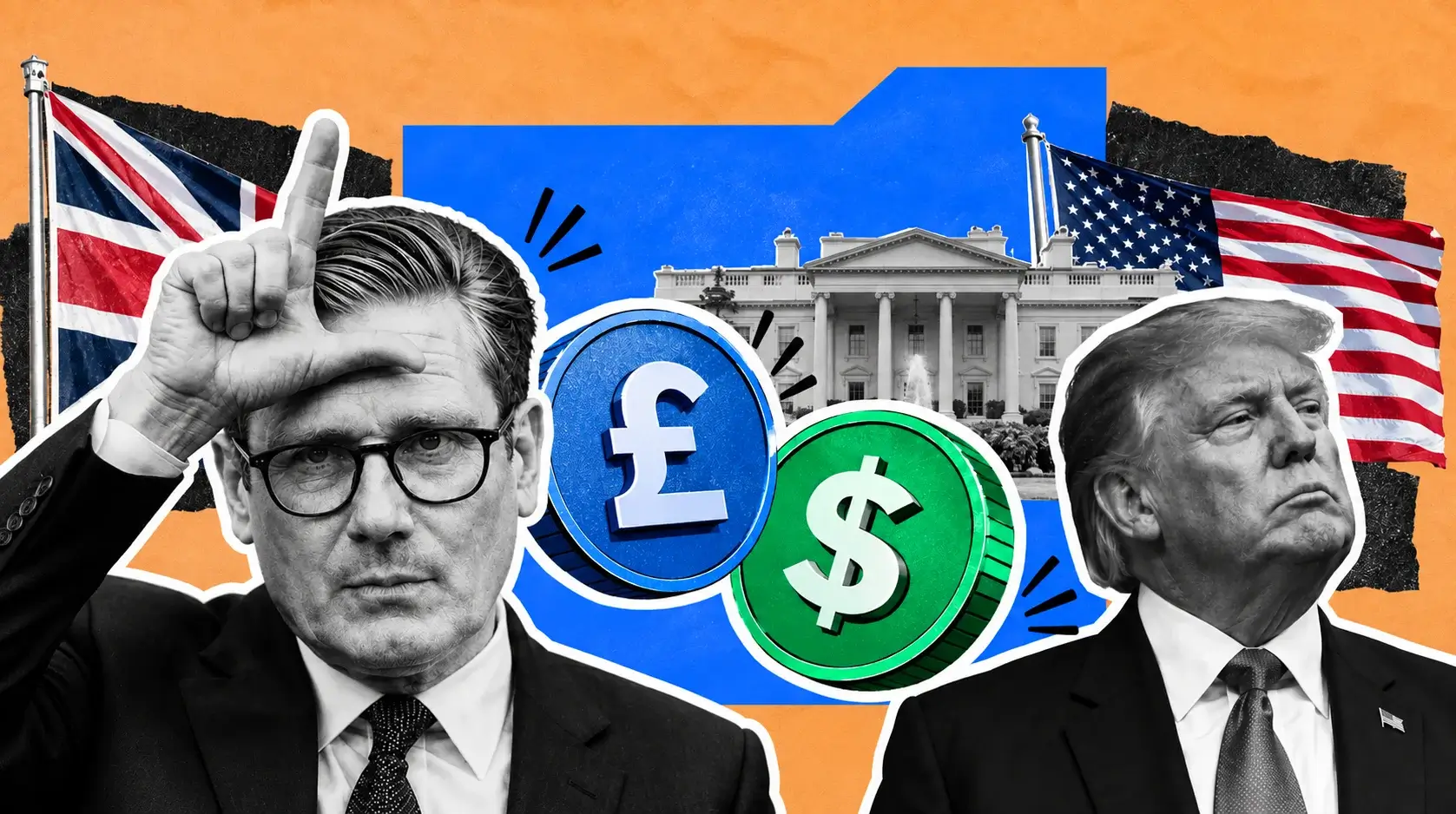
One element of Monday's GBP/USD setup that extends beyond technical analysis and central bank policy is the diplomatic dimension: Prime Minister Keir Starmer and President Trump held a 20-minute phone call on Sunday evening — the night before Trump's ceasefire announcement — in which they discussed halting trade disruption through the Strait of Hormuz. The timing of that phone call, immediately preceding Trump's Truth Social post by hours, raises the possibility that UK diplomatic engagement was part of the pressure architecture that led Trump to announce the five-day pause. This matters for GBP/USD because UK diplomatic involvement in any Hormuz resolution framework would reduce the UK's exposure to the energy shock disproportionately — the UK imports a significant share of its energy from Middle East-linked sources, and a Hormuz reopening would relieve the specific pressure that has been driving UK stagflation fears and the BoE's forced hawkish pivot. If UK diplomatic efforts through Starmer's channel contribute to a genuine Hormuz opening, it removes the primary negative catalyst for UK growth while simultaneously allowing the BoE to calibrate its rate path more moderately — a scenario where the BoE hikes once rather than four times, inflation retreats faster than feared, and the UK avoids the deep stagflation recession scenario. That would be strongly positive for GBP/USD on a fundamental basis that goes beyond the mechanical oil-price-drives-dollar-premium relationship.
The Verdict on GBP/USD: Tactical Buy Above $1.3430 With Stop at $1.3225 — Medium-Term Complexity Remains
GBP/USD at $1.3398 sits at one of the most technically and fundamentally pivotal junctures it has occupied in months. The bull case is structured and quantified: a falling wedge breakout and inverted head-and-shoulders pattern formation with a neckline at $1.3430, confirmed by a PPO bullish crossover, RSI positive divergence at the $1.3223 low, and a dollar that has lost its petrocurrency bid as oil fell 10% on Monday. The market has swung from pricing two BoE rate cuts to four hikes — a massive repricing that provides near-term yield support for Sterling even against a hawkish Fed at 3.75%. The BoE-Fed rate parity means GBP/USD is fighting on an equal yield footing that other G10 pairs like EUR/USD cannot claim. A daily close above $1.3430 triggers both bullish reversal patterns and targets $1.3500-$1.3560. The bear case is equally concrete: the BoE is hiking into a stagflationary recession, which is historically devastating for currency values over 6-12 month horizons. The UK's structural energy import dependence means every dollar of elevated oil price is a direct current account deterioration. The five-day Iran ceasefire is being denied by Iranian officials, meaning the oil price relief — and with it the dollar softening that lifted Cable from $1.3223 to $1.3398 — is contingent on diplomatic progress that is actively disputed by one of the parties. The position is: buy GBP/USD on a confirmed daily close above $1.3430, with a stop at $1.3225 and targets of $1.3500 first and $1.3560 extended. Do not buy ahead of the $1.3430 confirmation — the falling wedge and head-and-shoulders are patterns that require the neckline break to confirm. If $1.3223 breaks on a daily close and the ceasefire collapses, flip to short with a target of $1.3160 and $1.30 as the extended bear scenario. The five-day clock is the decisive variable — not the BoE, not the Fed, not the PPO crossover. Everything follows from whether Trump's diplomatic window produces actual Hormuz flow restoration or evaporates into another escalation cycle.