
GBP/USD Price Forecast: Pound Plunges to Three-Month Lows at 1.3300 as Oil Shock Kills BoE Rate-Cut Odds
March cut probability crashes from 75% to 28% in three days, DXY surges to 99.31, asset managers hold near-record 110K GBP shorts — next targets 1.3200 and 1.3000 | That's TradingNEWS
GBP/USD Forecast: Pound Crashes to Three-Month Lows at 1.3300 as Oil Shock Destroys BoE Rate-Cut Odds and Dollar Absorbs Every Safe-Haven Flow
Sterling Was Already Vulnerable — The Iran War Just Exposed How Much
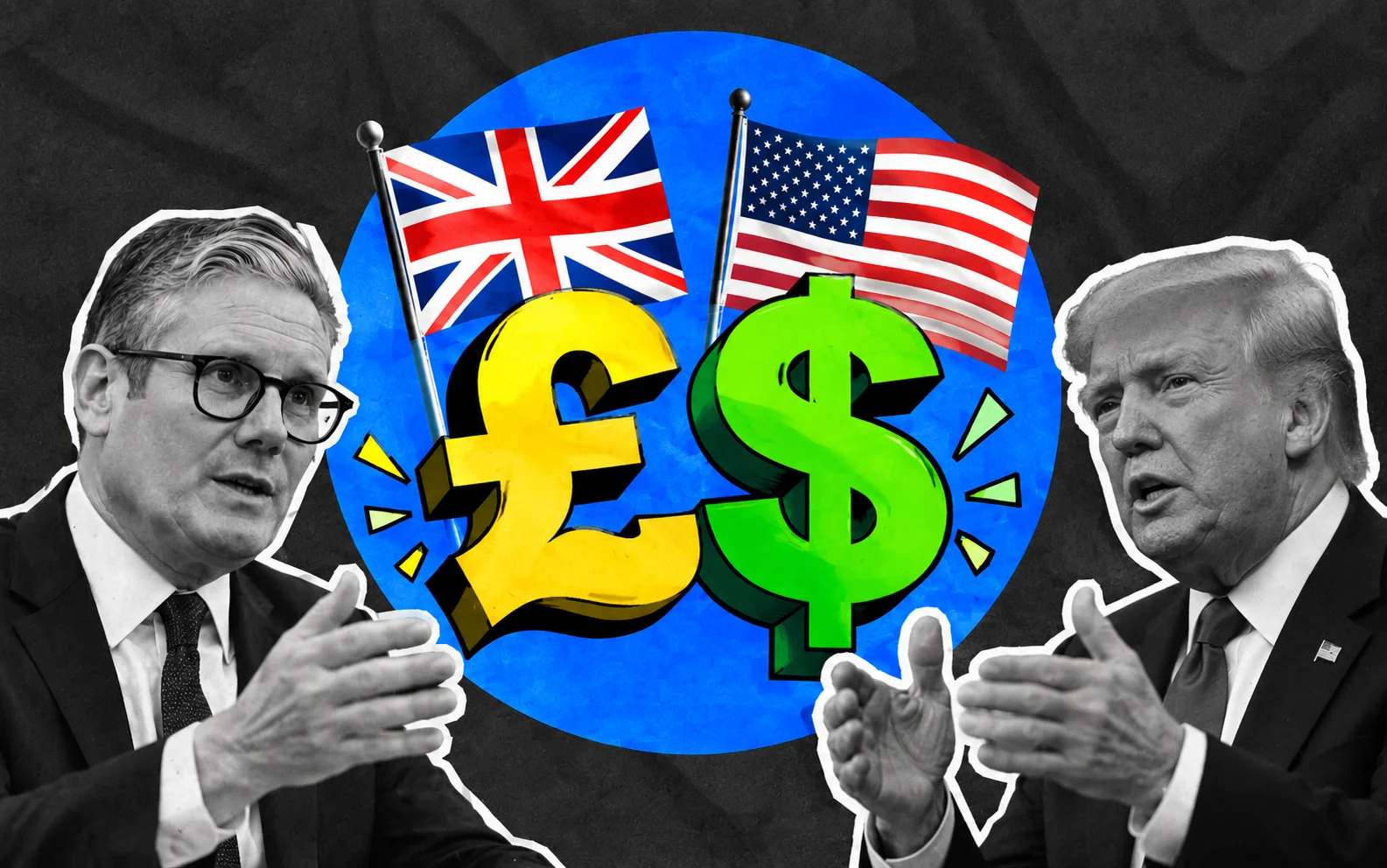
GBP/USD plunged 0.73% to 1.3304 on Tuesday, accelerating through 1.3360 and 1.3315 to print fresh three-month lows as the U.S. dollar devoured everything in its path. The pair has dropped more than 1.5% since Friday's close and nearly 4% from the January high of 1.3869. The Pound Sterling — a currency that thrives on risk appetite and wilts in crisis — is getting crushed by the exact combination of forces it handles worst: surging energy costs, collapsing global equities, and a ripping dollar driven by safe-haven inflows.
The Dollar Index (DXY) surged 0.78% to 99.31 on Tuesday, its strongest level in over a month, after gaining nearly 1% in Monday's session alone. Over the past five sessions, the greenback has appreciated 1.7%. Danske Bank summarized the dynamic cleanly: equities under pressure, oil surging 6% since Friday, USD boosted by improved terms of trade, and safe-haven assets rallying broadly. The dollar is not gaining because U.S. economic fundamentals suddenly improved overnight. It is gaining because in a genuine geopolitical crisis involving energy supply, the U.S. — as a net oil exporter — benefits from higher crude prices on a relative basis while Europe, Asia, and the UK suffer the inflationary consequences.
ING identified three transmission channels driving dollar strength: U.S. energy independence versus the energy dependence of Europe and Asia, the inflationary impact of higher oil on Fed rate expectations, and the broad risk-off rotation out of high-beta currencies. All three channels are working simultaneously and reinforcing each other. Until at least one of them reverses — which requires either de-escalation in the Middle East, a collapse in crude, or a dovish Fed surprise — GBP/USD has no fundamental reason to bounce.
BoE March Rate Cut Odds Collapse From 75% to 28% in Three Trading Days
The most dramatic shift in the GBP/USD fundamental picture is the repricing of Bank of England rate expectations. On Friday, money markets priced a 75% probability of a 25-basis-point cut at the BoE's March meeting. By Tuesday afternoon, those odds had crashed to just 28%. In three trading sessions, the market went from "almost certain cut" to "probably on hold" — and the catalyst is entirely external.
Brent crude above $85, European gas prices doubling in two days, and UK natural-gas futures hitting three-year highs at 165 pence per therm have made any near-term easing almost impossible to justify. The BoE cannot cut rates into an energy-driven inflation shock without risking a further decline in Sterling and an amplification of imported inflation. Nomura's European rates team — which still forecasts a 25-bps cut in March and another in June — acknowledged that the decision has become "finely balanced" and that the evolution of Middle East risks and energy prices will be crucial.
The comparison to 2022 is becoming unavoidable. When Russia invaded Ukraine and gas prices spiked, the BoE was forced into an aggressive tightening cycle even as the UK economy was weakening. Rabobank drew the parallel explicitly, noting that the current oil shock is "inflationary, just as it was when Russia invaded Ukraine." UK gas prices have doubled since Saturday's airstrikes began. If Qatar's LNG production remains offline and the Strait of Hormuz stays functionally closed, UK household energy bills face significant upward pressure — though the existing price cap shields consumers until July.
The market's repricing of BoE expectations is simultaneously GBP-supportive (higher rates for longer) and GBP-negative (slower growth, stagflation risk). Right now, the growth concern is winning. The pound is falling despite higher expected rates, which tells you the market views the UK's economic vulnerability to the energy shock as more consequential than the interest-rate differential.
Chancellor Reeves Cuts Growth Forecast as Spring Statement Delivers Grim Outlook
The domestic backdrop for Sterling was already deteriorating before the Iran war added an external shock. Chancellor Rachel Reeves presented her Spring Statement on Tuesday, projecting UK GDP growth of just 1.1% for 2026 — significantly below the Office for Budget Responsibility's prior 1.4% estimate. She acknowledged that the world "has in the last few days become yet more uncertain."
The Spring Statement itself was largely a non-event — the Autumn Budget is the UK's primary fiscal vehicle, and most major policy changes were announced three months ago. But the OBR's revised forecasts on the economy and public finances matter for fiscal headroom. The focus is on whether the government can still meet its fiscal rules given spending commitments, U-turns on cost-cutting measures, and a growth downgrade that will mechanically reduce tax receipts.
Labour's political position has also weakened after a crushing by-election defeat, losing a seat the party had held for nearly a century. The result cast a cloud over PM Starmer and Chancellor Reeves, raising internal pressure for leadership changes and higher fiscal spending. Markets are watching for any signal that political instability could lead to looser fiscal policy — which would be GBP-negative in an environment where the BoE is already struggling to contain inflation expectations.
MUFG captured the broader concern: "Our forecast for a weaker US dollar was built on the assumption that the Fed would lower rates by another 50-75bps this year, but that will be more difficult to justify if inflation remains higher for longer in the US." The flip side of that statement is equally important for GBP/USD: if the Fed holds while the BoE eventually capitulates under growth pressure, the rate differential widens further in the dollar's favor.
COT Positioning: Asset Managers Near Record GBP Shorts
The Commitment of Traders data from the CFTC paints an extremely bearish picture for Sterling positioning. Asset managers have pushed their net-short GBP/USD exposure to 110,000 contracts — just 2,500 contracts away from an all-time record. They are simultaneously increasing short bets while trimming long exposure, a textbook aggressive bearish configuration.
Large speculators are also net-short at 57,000 contracts, though their positioning is less extreme. Importantly, their increase in net-short exposure was driven by the closure of long positions rather than the initiation of new shorts — meaning conviction in the bearish thesis is building through liquidation of bulls rather than aggressive new selling. Gross shorts among large speculators remained flat on the week but are elevated in absolute terms.
The positioning creates an asymmetric dynamic. On one hand, the extreme short positioning means that any positive catalyst — a ceasefire, Hormuz reopening, or dovish Fed surprise — could trigger a violent short-covering rally. Asset managers sitting on 110,000 contracts of shorts near record levels represent enormous latent buying power if forced to cover. On the other hand, the trend is clear and the fundamental drivers (energy shock, dollar strength, BoE repricing) all support the existing positioning direction. Until the narrative changes, the shorts are likely to add rather than cover.
Fed Officials Split Between Patience and Hawkishness
Two Federal Reserve speakers on Tuesday underscored the market's dilemma. New York Fed President John Williams struck a relatively balanced tone, noting that the easing cycle "remains on track if inflation pressures moderate as I expect" and that monetary policy is "currently well positioned to support the stabilization of the labor market and return inflation to our 2% goal."
Kansas City Fed President Jeffrey Schmid delivered a markedly more hawkish message, stating bluntly that "inflation is too hot" and that "there is no room for complacency." He reported hearing optimism from business contacts about the economic outlook and shared that sentiment, adding that the growth trajectory remains strong and is being supported by fiscal policy.
The divergence between Williams and Schmid captures the fault line within the FOMC. If oil-driven inflation continues to push headline and core readings higher — and Tuesday's ISM Prices Paid explosion to 70.5 versus 59.5 expected suggests it already is — the Schmid wing gains influence and rate cuts get pushed further into the future. CME FedWatch now shows a 53.5% probability of a June hold, up from 42.7% on Friday. The probability of two or more cuts in 2026 has collapsed from 79% to 57%.
For GBP/USD, the Fed repricing matters enormously. The pair had been supported through much of late 2025 and early 2026 by expectations that the Fed would cut 50-75 bps while the BoE held steady, compressing the rate differential. That assumption is being dismantled in real time. ING's assessment is direct: "This oil shock comes at a time when the January FOMC made it clear that the central bank was losing patience with inflation. Inflation really needed to show signs of falling — otherwise stabilisation in the US jobs market would question whether the Fed needs to cut rates at all."
GBP/USD Technical Picture: Below All Moving Averages, Bearish Structure Dominant
The technical damage to GBP/USD is significant. The pair has broken below its rising trendline support from the 1.3035 October low, sliced through the 50-day and 200-day simple moving averages (which had been clustered around 1.35), and printed a bearish engulfing candle on the daily chart. The RSI sits below 50 and declining, just above 35 — not yet oversold but with strong selling momentum intact.
The descending resistance line from the 1.3869 January high has capped every recovery attempt. Repeated failures at lower highs — 1.3660, 1.3575, 1.3508 — confirm the downtrend structure. The pair is now well below the moving average cluster that had served as support for most of 2026.
Key support: The 1.3290-1.3313 zone is the immediate floor and represents Tuesday's lows. UoB flagged 1.3320 as critical — a break below would signal further significant downside. Below there, 1.3250 is the next level, followed by 1.3200 and then 1.3182. A failure at 1.3200 opens the door to the psychologically important 1.3000 level, which would represent a complete retracement of the second half of the 2025-2026 rally.
Key resistance: The 1.3400 level is the first barrier, where the broken support trendline and the lower edge of the moving average cluster converge. Above there, 1.3500-1.3508 represents the more significant resistance zone aligned with prior reaction highs. A daily close above 1.3550 would be required to neutralize the bearish bias and reopen the topside toward 1.3700. That appears unlikely while the Iran conflict persists and oil prices remain elevated.
Cross-Currency Context: GBP Is Outperforming AUD and NZD, But Losing to Everything Else
The currency heat map tells the full story. Sterling is down 0.80% against the dollar, down 0.50% versus the yen, and down 0.58% versus the Canadian dollar. The pound managed modest gains only against the Australian dollar (+0.64%) and New Zealand dollar (+0.62%) — two commodity-linked currencies that are paradoxically being sold despite the commodity boom because of their high-beta, risk-sensitive characteristics.
The Japanese yen has lagged other safe havens, down nearly 1% against the dollar since the war began, as Japan's near-total dependence on imported oil crushes its terms of trade. USD/JPY pushed above 155 with the BoJ's March 19 rate decision now in doubt as multiple Reuters sources indicated the central bank needs more time to assess the conflict's economic impact. The Canadian dollar gained on the back of surging crude prices, with Canada as a major net oil exporter benefiting directly from the commodity spike.
The GBP weakness against USD, EUR, JPY, CAD, and CHF while only outperforming AUD and NZD places Sterling firmly in the "risk-sensitive but not commodity-linked" bucket — the worst possible positioning during an energy-driven geopolitical crisis. The UK imports the vast majority of its oil and refined fuel, meaning higher crude prices directly worsen the current account while amplifying inflation. There is no natural hedge in the UK's economic structure against this type of shock.
GBP/USD Verdict: Sell — The Energy Shock, Dollar Strength, and BoE Paralysis All Point Lower
GBP/USD is a sell at 1.3300 with a near-term target of 1.3200 and an intermediate target of 1.3000 if the Hormuz crisis persists beyond two weeks. The conviction behind this call is high.
The fundamental drivers are unambiguously bearish for Sterling: UK energy vulnerability (gas prices doubled in two days, Brent above $85), collapsing BoE rate-cut odds (75% to 28% in three sessions), downgraded growth forecasts (1.1% GDP for 2026), political instability after the by-election loss, extreme COT short positioning approaching record levels, a ripping dollar (DXY at 99.31), and Fed hawkishness intensifying (Schmid: "inflation is too hot"). The technical breakdown below the trendline, the 50-day and 200-day SMAs, and the bearish engulfing candle confirm the directional bias.
For existing shorts: hold and trail stops above 1.3500. For new entries: rallies toward 1.3400-1.3430 represent sell-the-bounce opportunities as long as the Iran conflict continues and oil remains elevated. The 1.3250 level is the next support target, followed by 1.3200. A break below 1.3200 would open a path toward 1.3000 — the level where the entire 2025-2026 rally began.
The one risk to this call is a violent short-covering squeeze if a ceasefire emerges or the Strait reopens. Asset managers sitting on 110,000 contracts of shorts near record levels means the reversal, when it eventually comes, will be sharp and painful for late sellers. But positioning against the prevailing trend, the fundamental backdrop, and the technical structure based solely on the hope of de-escalation is not a trade — it is a prayer. Until the geopolitical situation changes, GBP/USD has nowhere to go but lower, and 1.3000 is a realistic destination within the next two to three weeks if the war continues.
That's TradingNEWS
Read More
-
Yen Stalls at 160 Despite a 3% JGB and Tokyo Core CPI at 2.0% — Intervention Sits at 164, Friday's Payrolls Decide
02.09.2026 · TradingNEWS ArchiveEnergy
-
BLCK ETF ($22.85) Rides AI-Hosting Pivot — Coinbase, Hut 8 and Riot Lead a 49.8% Top Ten
23.09.2026 · TradingNEWS ArchiveStocks
-
XRPI ($8.42) Futures vs XRPR ($12.28) Spot as XRP Tests $1.50 — Break of $1.70 Lifts XRPR NAV to $13.12
23.09.2026 · TradingNEWS ArchiveCrypto
-
November NG Targets $3.35 as Storage Surplus Shrinks From 148 Bcf to 118 Bcf
23.09.2026 · TradingNEWS ArchiveCommodities
-
USDJPY Targets 159 on Fed-BoJ Divergence — July's 163.73 Intervention Caps the Rally Near 160
23.09.2026 · TradingNEWS ArchiveForex