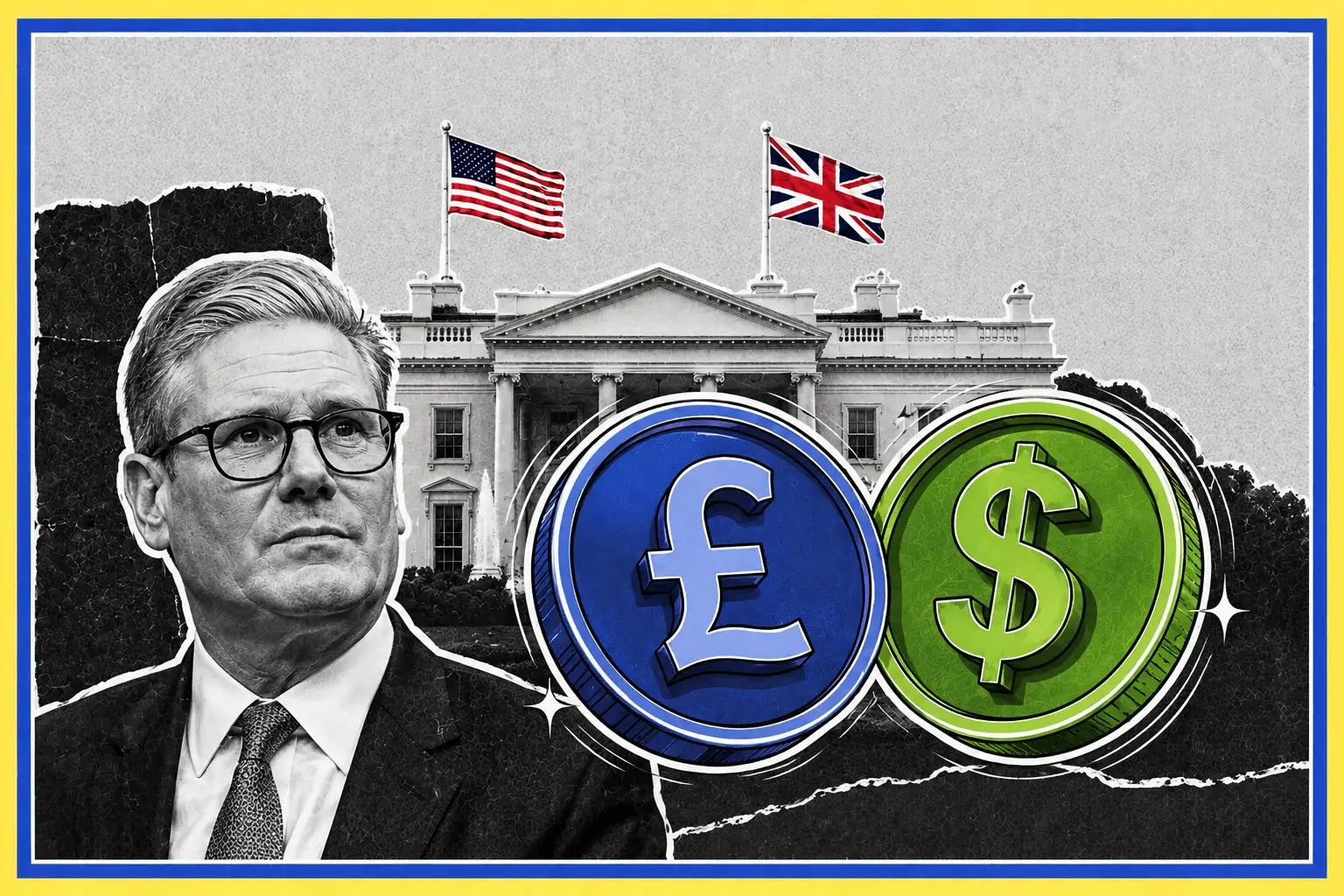
GBPUSD Climbs to 1.3675 With Bank Rate at 3.75% Against a Fed Range of 3.50%–3.75%
3 MPC members voted for 4.00% on July 30 while UK August PMIs beat expectations | That's TradingNEWS
Key Points
- GBP/USD trades 1.3675, up 1.88% in thirty days and 510 pips off the June low of 1.3165.
- Bank Rate at 3.75% now matches the top of the Fed's range, erasing the dollar's carry advantage.
- Acceptance above 1.3660 targets the 2026 high of 1.3817; a hawkish Friday exposes 1.3450.
GBP/USD is trading at 1.3675 in the early London session, holding the midrange of the 1.3600s and sitting just beneath six-month highs. That marks the fourth consecutive session of gains for sterling against the dollar, with Friday's close of 1.3645 registering the highest daily settlement in more than half a year.
The recent range is tight and constructive. The pair has traded between 1.3618 and 1.3676 across the past two sessions, with a Friday spike to 1.3675 after UK preliminary activity data beat expectations. The pound has strengthened 1.88% over thirty days and 0.91% over the past week, leaving it 2.07% higher than a month ago and up 0.77% across twelve months.
Against the June low, the recovery is substantial. GBP/USD bottomed at 1.3165 on June 24 and has since added 510 pips — a 3.9% advance across two months. The 2026 range has run from 1.3204 to 1.3817, a spread of more than 4.5%, which places current spot within 142 pips of the yearly ceiling.
Sterling is the only major currency to have made a convincing long-term push against the dollar in this stretch, yet the market's response to the breakout has been restrained. That restraint is the tell. Cable has broken higher and the market has not yet decided whether it is prepared to reward the move.
The reason is that this is a dollar debate rather than a pound debate. The dollar index has fallen to 98.723, its lowest reading since May 14, after the Treasury announced it would at least double purchases of longer-dated government bonds. Every G10 currency appreciated on that news. Sterling above $1.363 — its strongest level in six months — was a direct consequence.
The cross-asset confirmation is total. EUR/USD sits at a three-month high of 1.1682, gold has ripped to $4,645.90, and Bitcoin has blown through $78,766. Every dollar alternative is bid simultaneously.
Where cable differs from the euro is the rate structure underneath it — and that difference is the entire reason 1.3817 is reachable here in a way that most forecasters have not priced.
The 1.3660 Supply Zone Is the Only Thing Between Here and 1.3817
The technical picture is unusually clean because the pair has broken out of a range it occupied for most of the summer.
The immediate battleground is the 1.3660 supply zone. GBP/USD needs a breakout and acceptance above that level before the next leg higher can develop. Spot at 1.3675 sits marginally above it, which means the pair is currently testing acceptance rather than approaching resistance — a meaningfully different technical position and one that resolves within days rather than weeks.
Above 1.3660, the path opens toward the 2026 high at 1.3817, currently 142 pips or 1.04% away. There is little structural resistance between those two levels because the pair spent almost no time in that zone during the descent earlier in the year. Thin volume profiles on the way down mean thin resistance on the way back up.
Beneath spot, first support sits at 1.3600. Any corrective pullback toward that level is likely to be bought into and should remain limited near 1.3570. Those two figures are 75 and 105 pips below current price respectively — a narrow cushion that reflects how vertical the recent advance has been.
The moving-average structure supports the bullish read. Measured in mid-August, GBP/USD sat near its 8-day and 21-day EMAs while trading 0.77% above its 50-day EMA and 0.89% above its 100-day EMA. The pair has since extended further, which widens all four cushions.
Momentum is the qualifier. Breakouts in cable matter because momentum often becomes self-reinforcing in this pair — but the muted response to Friday's six-month closing high suggests the market is waiting for confirmation rather than chasing.
The forecast band for the week runs 1.34 to 1.38, a four-figure spread. That width is an honest admission that Friday's macro calendar can move this pair 200 pips in either direction, and that neither side has conviction until it does.
The single most important level: acceptance above 1.3660 on a daily close basis. Everything else follows from it.
Bank Rate at 3.75% Versus a Fed Range of 3.50%–3.75%: the Gap Has Closed
Here is the structural fact that separates GBP/USD from every other major pair right now, and it is the strongest argument in the bull case.
The Bank of England holds Bank Rate at 3.75%. The Federal Reserve's target range is 3.50% to 3.75%. The significant interest rate advantage the dollar previously enjoyed has largely disappeared — sterling now yields at or above the top of the Fed's range, depending on where within the band effective rates settle.
Compare that to the euro. The ECB deposit rate sits at 2.25%, leaving a 125 to 150 basis point differential in the dollar's favour that has not narrowed at all during the euro's rally. EUR/USD is fighting carry every day it rises. GBP/USD is not.
That distinction has practical consequences for how far each move can run. A currency pair rallying against a negative carry needs continuous fresh news to sustain the move, because the position bleeds while it waits. A pair rallying at flat or positive carry can consolidate indefinitely without cost. Sterling longs are not paying to hold the trade.
The Federal Open Market Committee kept rates unchanged at its July 28–29 meeting, the fifth consecutive meeting without a policy change, with the next decision scheduled for September 17. The Monetary Policy Committee also held on July 30, with its own next decision on September 17 — the same day.
That synchronised calendar concentrates risk into a single 48-hour window three weeks out, which is worth planning around for anyone carrying exposure. Intraday moves of 1% to 2% around clustered central bank decisions are not rare. On a $500,000 position, a 1.5% swing is roughly £5,600.
For now, the read is straightforward. The carry drag that killed sterling rallies through 2024 and 2025 has been removed. That does not make cable a buy on its own, but it removes the mechanical headwind that capped every prior attempt at 1.38.
Three MPC Votes for 4.00% — the Hawkish Minority Nobody Is Pricing
The most underappreciated data point in this pair sits in the July meeting minutes.
The Monetary Policy Committee held Bank Rate at 3.75% on July 30 by six votes to three — with the minority preferring 4.00%. Three members voted to hike. Not to cut. To raise rates in an economy widely described as stagnating.
That vote split matters more than the headline decision. A 6-3 hold with a hawkish dissent is a materially different signal from a unanimous hold or a 6-3 split with doves on the other side. It means a third of the Committee judged UK inflation persistent enough to require additional tightening, and it means the risk distribution around the September 17 decision is skewed toward a hike rather than a cut.
The market has not priced that. Consensus positioning through 2026 has been built on the assumption that the Bank of England would be relatively more dovish than the Federal Reserve — an assumption that underpins most of the bearish sterling forecasts still in circulation. The July vote directly contradicts it.
Set that against the American picture and the asymmetry sharpens. The most recent FOMC minutes were hawkish in their own right: several policymakers had been prepared to raise rates in July, while many judged that another increase would be needed if inflation failed to return toward target. Both central banks have hawkish minorities. The difference is that the Fed's hawkishness is now competing with a Treasury Department actively suppressing long-end yields, while the Bank of England faces no equivalent fiscal interference in its policy transmission.
The practical translation for the forecast: if UK inflation surprises higher into September, sterling gets a rate-hike repricing that the forward curve does not currently contain. That is genuine two-way risk in the pound's favour, and it is rare.
The absence of any UK data this week means that repricing cannot happen before September. This week, cable is a pure dollar trade.
UK CPI at 2.9% With Services Easing to 3.4% — a Split Inflation Picture
The British inflation data delivers a genuinely mixed signal, and the composition matters more than the headline.
Consumer price inflation rose to 2.9% in July from 2.6% in June — a meaningful acceleration and comfortably above the 2% target. Core inflation was unchanged at 2.6%. Services inflation eased to 3.4%.
Those three numbers point in different directions, which explains the 6-3 vote split.
The headline acceleration is the hawks' argument. A 30 basis point jump in a single month, taking inflation to 90 basis points above target, is the kind of print that justifies a vote for 4.00%. It also raises the risk that expectations become unanchored if the trend persists into the autumn.
Core holding steady at 2.6% is the moderates' argument. If the headline is rising while core is flat, the acceleration is being driven by volatile components — energy and food — rather than by broad domestic price pressure. Elevated crude, with Brent at $93.09 and WTI at $85.65 after two consecutive weekly gains above 5%, feeds directly into that channel for an energy-importing economy.
Services easing to 3.4% is the most genuinely dovish element and the one the Bank watches most closely. Services inflation is the cleanest read on domestically generated price pressure — wages, rents, discretionary spending — and it is decelerating. That is the evidence the majority used to justify holding.
For sterling, the mixed picture is neutral in the near term and constructive in the medium term. It gives the Committee no reason to cut, which protects the carry position that has removed the dollar's advantage. It also leaves the door open to a hike if headline inflation keeps accelerating, which is the tail risk positioned against consensus.
Euro-area inflation at 2.9% in July sits at exactly the same level, but the ECB is 150 basis points lower on policy rates. That is the relative-value case for GBP over EUR.
August PMIs Beat While Retail Sales Missed — Britain's Two-Speed Data
Friday's UK data release was genuinely mixed and produced the immediate move to 1.3675.
Retail consumption increased in July but came in below expectations — a soft consumer print consistent with the picture of an economy close to stagnation that has dominated commentary on Britain all year. Slower wage growth and weak hiring have reinforced that reading through the summer.
August's preliminary services and manufacturing activity data beat expectations, and it was that beat that lifted sterling. The pound jumped to $1.3675 on the services release specifically, which is the component that carries the most weight for an economy where services generate roughly 80% of output.
That combination — soft consumer, firm business activity — describes an economy where the forward-looking indicators are improving faster than the backward-looking ones. Purchasing managers' surveys lead retail sales by several months, so a services beat in August is a reasonable predictor of a better consumer print in October.
Context is required, though. The US composite PMI hit 56 in August, its highest since April 2022, with services at 56.8 — the strongest reading since December 2024 — beating estimates of 54 and crushing the prior 54.6. American manufacturing slowed to 53.2, a five-month low, but the composite gap between the two economies remains wide in the dollar's favour. Third-quarter US GDP estimates were lifted from 2% to 2.5%.
A UK PMI beat that lifts sterling 40 pips against an American composite at a four-year high is not a fundamental divergence. It is a relief rally in a data series that had been consistently disappointing.
The critical scheduling point for this week: there are no UK releases at all. With no domestic catalyst, sterling's direction depends entirely on the dollar and, to a lesser degree, on the euro. Every pip of movement between now and Friday will be imported.
The Dollar Index at 98.723 Is Doing Most of the Work
Strip the analysis back and one number explains the majority of cable's 510-pip recovery from the June low.
The dollar index has fallen to 98.723, its lowest level since May 14, and has been grinding lower without a meaningful bounce for several sessions. Sterling carries roughly 12% weight in that basket, so the relationship is less mechanical than for the euro — but the direction is identical because the driver is the same.
The pound looks strong in comparison to a struggling dollar. Measured against other major currencies, its performance is less impressive. GBP/EUR has been anchored between 1.16 and 1.18, going nowhere, which tells you sterling is not appreciating on its own merits — the dollar is depreciating against everything.
That distinction determines how durable the move is. A currency that rises against one counterpart while flat against another is a beneficiary rather than a driver. It also means that any dollar reversal hits cable immediately and without a domestic offset, because there is no independent sterling story providing a floor.
The dollar's decline has a specific origin. The Treasury's decision to double long-dated bond buybacks sent 10-year and 30-year yields lower and eased financial conditions. The 10-year fell 3 basis points to 4.708% on Monday and the 30-year retreated 4 basis points to 5.23%. Weaker retail sales and softer labour-market data earlier in the month had already encouraged traders to scale back tightening expectations.
There is a live argument that the Federal Reserve's failure to recognise the easing effect of the Treasury's operations would itself constitute an additional dollar-negative driver. That framing is what makes Friday's keynote so consequential.
For the forecast, the operational rule is simple. Watch the dollar index level of 98.723. Cable will not sustain a break of 1.3817 while that floor holds, and it will not hold 1.3570 if the index breaks decisively beneath it.
Read More
-
Yen Stalls at 160 Despite a 3% JGB and Tokyo Core CPI at 2.0% — Intervention Sits at 164, Friday's Payrolls Decide
02.09.2026 · TradingNEWS ArchiveEnergy
-
QQQ ETF ($706.22) Slides 7.4% Below Its High as the Market Reprices the AI Capex Bill — $686.57 Target if $700 Breaks
22.10.2026 · TradingNEWS ArchiveStocks
-
XRPI ($7.00) and XRPR ($10.74) Slide Toward 52-Week Lows as Spot XRP ETF Flows Stall at $708,510
22.10.2026 · TradingNEWS ArchiveCrypto
-
NG ($2.775) Decoupled From Europe’s €88 Gas Crisis as LNG Feedgas Hits 18.9 Bcf/d — $3.30 Upside on Cold Weather
22.10.2026 · TradingNEWS ArchiveCommodities
-
Dollar-Yen (157.35) Loses 157.65 as the Yen Rallies on Haven Demand — 155 Target if 156 Breaks
22.10.2026 · TradingNEWS ArchiveForex
"Sell America": How the $4 Billion Buyback Broke the Greenback
The mechanism behind the dollar's slide deserves precise description, because it determines whether this is a trend or a squeeze.
The Treasury announced it would at least double the maximum size of its liquidity-support buyback operations for longer-dated government debt, raising the per-operation ceiling from $2 billion to at least $4 billion across the 10-to-20-year and 20-to-30-year maturity buckets. The enlarged window runs from September 9 through November 4. GBP/USD climbed roughly 0.5% on the announcement day, breaking above 1.3600 for the first time since May as the dollar sold off across the majors.
Monday extended the story. Two senior Treasury officials indicated the department could tap its General Account — holding roughly $950 billion against a stated target of $550 to $600 billion under the prior administration — to fund the expanded purchases. That converts a $4 billion-per-operation programme into one with substantially larger latent firepower, and the market repriced accordingly.
The interpretation driving currency markets is that Washington is prioritising lower long-term yields over currency strength, effectively raising dollar supply to the benefit of every other currency in the basket.
The fiscal arithmetic explains why the market believes the intervention will persist. National debt has crossed $40 trillion, the deficit runs near 6% of GDP, July's shortfall alone reached $432.3 billion — the largest monthly figure since March 2021 — and interest expense is running roughly $1.2 trillion this year. The 30-year yield touched above 5.33% this month, its highest since June 2007.
A government facing those numbers and choosing financial engineering over fiscal consolidation is the definition of the trade currently bidding gold to $4,645.90 and sterling to 1.3675.
The complication for cable bulls: the bond market has already rebounded sharply from the initial intervention. Yields recovered. The dollar did not. That divergence means the currency is trading an institutional question rather than a rate question — and institutional questions reverse violently on a single credible pushback.
The Hawkish FOMC Minutes Cable Has Ignored
There is a piece of American policy information sitting in the market that GBP/USD has priced at essentially zero, and it constitutes the sharpest risk to the current level.
The FOMC minutes following the buyback announcement were more hawkish than expected. Several policymakers had been prepared to raise rates at the July meeting. Many judged that another increase would be needed if inflation failed to return toward target.
That is a Federal Reserve with an active tightening bias, meeting on September 17, at a moment when crude has gained more than 5% in each of the last two weeks and the composite PMI has hit a four-year high with services at 56.8. Every input into the inflation path is firming.
Cable rallied through that news without pausing. Dollar sentiment had been weak, and it is now meeting a more hawkish discussion around US interest rates — creating exactly the tension the current price action reflects: the pair has broken higher, but the market has not decided whether to reward the breakout.
The resolution mechanism is Friday. If the Fed Chair uses Jackson Hole to reassert the tightening bias visible in those minutes, the dollar has substantial room to recover because positioning is now short the greenback across the board. A firmer inflation message than expected makes cable vulnerable precisely because the pound's strength has little to do with Britain.
The counter-scenario is equally live. If the keynote acknowledges the fiscal constraint, declines to push back on the Treasury's yield management, or signals tolerance for the easing those operations produce, the dollar decline extends and 1.3817 falls quickly.
What makes this asymmetric in sterling's favour relative to the euro is the rate structure. Even under a hawkish outcome, GBP retains flat carry against the dollar and a hawkish MPC minority of its own. The euro would have to absorb the same dollar rebound while paying 125 to 150 basis points for the privilege.
Sterling Trades 250 Pips Above the Institutional Consensus
The positioning data is where this forecast diverges most sharply from published research, and the gap is large.
A survey of 25 forecast providers, last updated with a bearish bias, places GBP/USD at 1.3327 by late 2026, 1.3479 in early 2027 and 1.3695 by late 2027. The one-month projection sits at 1.3328. The median across 25 major institutions is approximately 1.33 for the third quarter of 2026 and 1.34 for the fourth.
Spot is 1.3675. The pair trades roughly 348 pips — 2.6% — above the median expectation for the quarter it is currently in, and roughly 348 pips above where the aggregate one-month projection sits.
A second published range puts GBP/USD between $1.32 and $1.36 for the remainder of 2026, ending the year near $1.34, with explicit doubt that sterling can sustain a move significantly above $1.36. Another places the pair between 1.3300 and 1.3430 by end-2026, citing UK political uncertainty and a relatively more dovish Bank of England.
Cable is already above the top of two of those three ranges.
The market-implied forward tells a different story. One-month pricing sits at 1.3645, essentially at spot, meaning the options and forward market sees no depreciation at all. Model-driven projections put the one-month average at 1.3690 with a range of 1.3505 to 1.3875 — bracketing the yearly high.
That divergence between institutional forecasts and market pricing is the trade. When spot sits 2.6% above consensus and consensus has a bearish bias, either the forecasts get revised upward or the pair mean-reverts. Historically, sustained breaks above consensus in cable have resolved through forecast revision rather than price reversion, because forecasters anchor to the prior range.
The upside forecast risk is therefore substantial. A close above 1.3817 forces a wave of upgrades into the September round.
Fiscal Risk and the Gilt Market: the Domestic Tail Sterling Carries
The one genuinely sterling-specific risk in this pair is fiscal, and it is the reason the bearish consensus exists.
Government policy announcements and signs of pressure in the UK bond market remain the most credible source of a sudden sterling downdraft. Britain has a documented history of currency stress originating in the gilt market rather than in the data — the 2022 episode remains the template, and bond markets have demonstrated repeatedly that they can force policy reversals on governments that test them.
The current global backdrop makes that risk live rather than theoretical. Long-dated yields have surged across every major sovereign market this month. The US 30-year touched above 5.33%, its highest since June 2007. Japan's 10-year reached its highest level in three decades. German 30-year bunds hit their highest since 2011 and French 30-year rates touched levels last seen in 2008.
In an environment where every long-end curve is under pressure simultaneously, a fiscally expansive announcement from any government gets punished harder than it would in calm conditions. Fiscal giveaways that would pass without comment in a benign bond market become currency events when the term premium is already elevated.
The mitigating factor is that Britain is not currently the marginal fiscal concern. The United States is running a deficit near 6% of GDP with $40 trillion of debt and a Treasury actively intervening to suppress its own borrowing costs. That is the fiscal story the market is trading right now, and it is dollar-negative rather than sterling-negative.
The practical read: UK fiscal risk is a tail rather than a base case for this week, because there are no scheduled UK events. It becomes relevant into the autumn budget cycle and into the September 17 MPC decision, at which point any perception that monetary policy is being subordinated to fiscal needs would hit the pound the same way it has hit the dollar.
Until then, it belongs in the risk section rather than the forecast.
1.3817, 1.3660 and 1.3570: Mapping Every Level That Matters
The trading structure reduces to four numbers.
Acceptance above 1.3660 is the immediate requirement. Spot at 1.3675 sits marginally through that supply zone, but a single daily close is not acceptance — the pair needs to hold above it through a full session with the dollar index staying beneath 98.723. Failure here sends cable back toward 1.3600.
1.3817 is the yearly ceiling and the primary upside target, 142 pips or 1.04% above spot. It marks the 2026 high and the top of a range that has run from 1.3204. A break there triggers forecast upgrades and opens 1.3875, the top of the model-implied one-month range.
1.3600 is first support, 75 pips below. Corrective moves toward that level are likely to attract buying and should remain contained near 1.3570 — the level that separates a healthy pullback from a failed breakout. That 1.3570 to 1.3600 band is the pivot for the entire structure.
1.3450 is the deeper support, 225 pips or 1.65% down. That is where the weekly forecast band's floor sits and where a hawkish Friday outcome would send the pair. Beneath it, 1.3327 — the institutional consensus for late 2026 — becomes the target, and only a break of the June low at 1.3165 would end the recovery entirely.
The asymmetry is the most attractive feature of the setup. From 1.3675, the distance to the yearly high is 1.04%. The distance to 1.3570 is 0.77%. Those are nearly symmetrical, but the momentum, the carry and the market-implied forward all sit on the upside.
The moving-average configuration reinforces it: the pair trades above its 8-day, 21-day, 50-day and 100-day EMAs simultaneously, with the 50-day and 100-day cushions having widened since mid-August.
The trade expression is a hold above 1.3570 targeting 1.3817, with the Friday keynote as the binary event that resolves it.
Two Events at 15:00 BST Friday: Warsh and the Payrolls Benchmark
Everything in this pair between now and the weekend funnels into a single hour.
Two significant US events are scheduled for 15:00 BST on Friday. The Federal Reserve Chair delivers his first Jackson Hole keynote in the role, having been sworn in during May 2026, and the Bureau of Labor Statistics releases its payrolls benchmark revision.
The absence of a communication record is itself a reason to expect a wider reaction than a routine keynote would produce. Markets have no established pattern for how this Chair handles ambiguity, how he signals, or how forcefully he defends the central bank's independence from fiscal encroachment. That uncertainty widens the distribution of outcomes in both directions.
The substantive question he cannot avoid is whether the Fed regards the Treasury's buyback programme as complementary policy or as interference. His answer sets the dollar for the next month.
The benchmark revision compounds it. Annual payroll revisions have repriced entire labour-market narratives in prior years. A substantial downward adjustment landing alongside a dovish keynote produces the sharpest sterling rally available this week. A neutral revision alongside a firm inflation message produces the sharpest dollar recovery.
Wednesday's July PCE and core PCE print is the earlier and smaller test, arriving with the second estimate of second-quarter GDP, July personal income and spending, and July durable goods orders. A soft core reading reinforces the easing case underwriting the dollar's decline. A hot print alongside crude near $86 puts inflation back in control before the Chair speaks.
The trade file adds background noise. Fifty percent US tariffs on $20 billion of Canadian goods took effect Saturday, with Canadian retaliation scheduled for September 8. Tariff escalation between the two largest bilateral trading partners is a growth negative, and growth negatives eventually reach the dollar through the demand channel rather than the rate channel.
With no UK data at all this week, every one of those events transmits directly to cable without a domestic offset.
Verdict and Price Forecast: 1.3817 on a Dovish Warsh, 1.3450 If He Holds the Line
GBP/USD at 1.3675 is a six-month high that is better supported than the consensus recognises, and the reason is structural rather than sentimental.
The bull case rests on five verifiable numbers. Bank Rate at 3.75% now matches or exceeds the top of the Fed's 3.50%–3.75% range, eliminating the carry drag that capped every prior sterling rally. Three MPC members voted for 4.00% on July 30 in a 6-3 hold, meaning the September 17 risk skews toward a hike the market has not priced. The dollar index has fallen to 98.723, its lowest since May 14, on a Treasury programme with up to $950 billion of latent firepower behind it. August UK services and manufacturing PMIs both beat expectations. And spot trades 348 pips above a 25-provider median of 1.33 for this quarter, with market-implied one-month pricing at 1.3645 — essentially flat, versus a consensus calling for depreciation.
The bear case rests on four equally verifiable numbers. The most recent FOMC minutes showed several policymakers prepared to hike in July with many judging another increase necessary if inflation fails to converge. US composite PMI hit 56 in August against a UK economy widely described as near stagnation. GBP/EUR has been anchored at 1.16 to 1.18, confirming sterling is a dollar beneficiary rather than an independent story. And UK gilt-market fragility remains the live tail in an environment where every long-end sovereign curve is under pressure.
The forecast: GBP/USD holds 1.3570 to 1.3817 through Wednesday's PCE print. Acceptance above 1.3660 on a daily close, with the dollar index breaking beneath 98.723, opens 1.3817 — a 1.04% advance and the yearly high — with 1.3875 reachable on a dovish Friday keynote paired with a soft benchmark revision.
Downside: a rejection at 1.3660 targets 1.3600 then 1.3570. A hawkish Warsh breaks that shelf and sends cable to 1.3450, a 1.65% decline. Only a close beneath 1.3327 would validate the bearish consensus and reopen the June low at 1.3165.
The verdict is constructive with the risk fully imported: bullish above 1.3570, target 1.3817, and 15:00 BST Friday decides it.