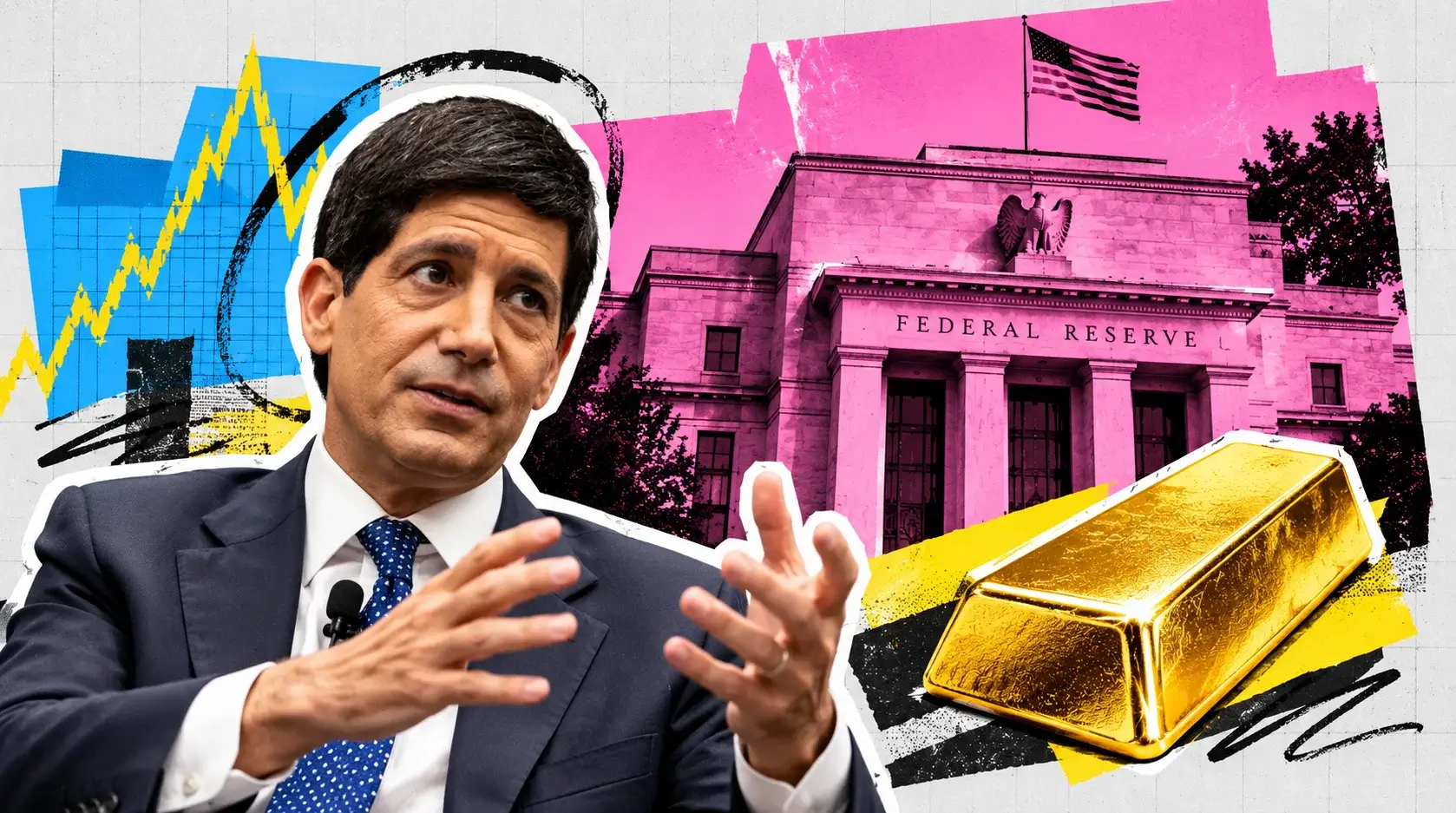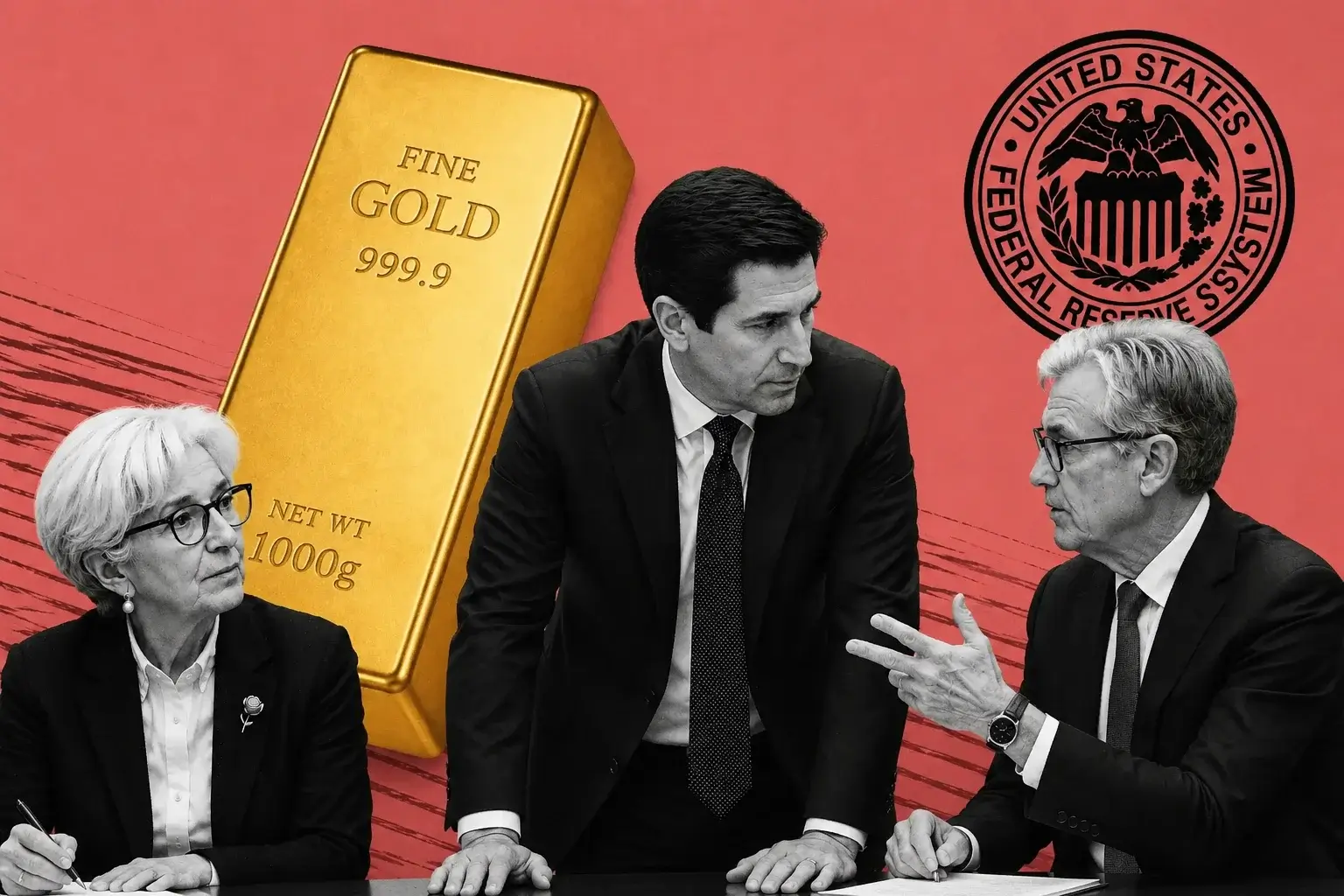
Gold Claws Back Above $4,000 to $4,050 as the Dollar Corrects, but the Warsh Fed Keeps the Downtrend Intact
XAU/USD recovered from a $3,959.51 low as the DXY slipped from its 101.80 yearly high, yet bullion sits nearly 20% below January's record and capped under the $4,232 EMA on hawkish rate-hike bets | That's TradingNEWS
Key Points
- Gold trades near $4,050 after bouncing off $3,960; it broke $4,000 this week for the first time since November 2025.
- A hawkish Warsh Fed and a dollar near 13-month highs drove the slide; hike odds for 2026 sit near 80%.
- Resistance is $4,098 then $4,232; support is $3,960 then $3,900, with Goldman cutting its target to $4,900.
Gold is trying to find its feet. The metal trades near $4,050 in Friday dealing, up about 0.6%, after discovering support near $3,960 over the past two sessions and bouncing off the $3,959.51 low printed on June 24. That bounce is real, but it's a relief rally inside a downtrend, and the distinction is the whole story. Gold broke below $4,000 on June 24 for the first time since November 2025, and the crowd that's been blaming the fading Middle East premium for the slide is reading the wrong driver. This is a real-rates and dollar event. The geopolitical risk premium has unwound. The Fed has not.
That's the thesis holding every tick today: the $4,000 break was a rate story wearing a war-story costume. Much of the safe-haven bid that carried gold to its January record near $5,600 was built on stagflation fear — the idea that the Iran conflict would keep oil and inflation elevated while growth stalled. That argument is collapsing in real time. Oil has cratered back to pre-conflict levels, a 60-day US-Iran peace roadmap is signed, and the war premium is bleeding out of the price. What's left is a hawkish Fed under Kevin Warsh, a dollar near 13-month highs, and rising real yields — the exact macro vise that punishes a non-yielding asset. Gold at $4,050 is caught in that vise, and the modest bounce doesn't change the direction of the pressure.
Warsh's Fed Pulled the Rug
The single most important thing that happened to gold this month wasn't a rate move — it was a posture shift. The Fed held its benchmark at 3.50%-3.75% on June 17, a unanimous 12-0 vote in Warsh's first meeting as Chair. The rate didn't budge, and that was the least interesting part. The projections underneath were the bombshell: nine of 18 FOMC participants projected at least one rate hike before year-end, and the median dot shifted up to 3.8% from 3.4% back in March. The committee stripped out its easing-bias language entirely.
For gold, that repricing works through one channel and one channel only — the opportunity cost of holding a yield-free asset. When the central bank signals hikes instead of cuts, the cost of parking capital in bullion that pays nothing climbs, and the crowd rotates toward cash and bonds that now pay more. Warsh has made his intent plain, indicating a commitment to bringing inflation under control, and the market took him at his word. The dot plot moving from cuts to hikes in a single meeting is the kind of regime change that resets the entire valuation framework for gold. The metal spent two years pricing an easing cycle. Warsh's Fed erased it, and the $4,000 break is the price adjusting to the new reality.
The Dollar at 13-Month Highs
Gold is priced in dollars, and the dollar has been on a tear. The US Dollar Index surged to a 13-month high near 102.00 this week, its strongest level in more than a year, before easing back. A stronger greenback makes dollar-denominated commodities like gold costlier for holders of other currencies, mechanically capping demand from the rest of the world. That dollar strength is the transmission belt converting the Fed's hawkish turn into lower gold prices.
The move into the dollar is the flip side of the same trade hammering Bitcoin and the broad risk complex. When US rate expectations shift hawkish, capital flows toward dollar assets chasing higher yields, the greenback rips, and gold gets squeezed from two directions at once — higher opportunity cost and a more expensive unit of account. The DXY pushed above 101 immediately after the June meeting and kept climbing toward 102, and every leg higher in the dollar pressed gold lower. This is why the metal can't catch a sustained bid even as it sits near multi-month lows: the dollar backdrop won't let it. Until the greenback rolls over, gold rallies run into a structural headwind that caps every attempt to reclaim higher ground.
Today's Bounce Is a Dollar Correction, Not a Reversal
The relief in today's session traces directly to the dollar taking a breather. The DXY trades around 101.20, down about 0.25%, correcting from the 101.80 yearly high it posted on Wednesday. That pullback is what's handing gold its 0.6% bounce to $4,050 — a textbook inverse move. When the dollar pauses, gold exhales. But a one-day dollar correction is not a trend change, and the bounce should be read as exactly that: temporary relief, not a bottom.
The rate-hike odds have softened just enough to give bullion room. The CME FedWatch tool now puts the chance of at least two Fed hikes this year at 41.7%, down from 50.2% a week prior, and the September hike probability has eased to around 63% from 68%. That marginal dovish drift, paired with the dollar correction, is the entire fuel for today's move. The problem is what sits overhead: the broad rate picture is still hawkish, with the odds of at least one hike this year running near 80%. A bounce built on a 0.25% dollar dip and a few basis points of softer hike pricing is a bounce on a thin foundation. The desk that's been selling rallies all month has no reason to stop until the macro story actually turns, and it hasn't.
The War Premium Unwound
The geopolitical leg of gold's rally has been kicked out from under it, and the speed of the unwind matters. A 60-day US-Iran peace roadmap is signed, and the conflict that drove oil and inflation higher through the spring is now easing. Brent crude fell to its lowest level since late February, with vessels transiting the Strait of Hormuz, and oil has returned to levels seen before the outbreak of the Iran conflict. That collapse in crude does two things to gold at once, both bearish.
First, it removes the acute safe-haven bid — the flight-to-bullion impulse that kicks in when tankers are at risk and the Middle East is on fire. Second, and more important, cheaper oil guts the stagflation thesis that was one of gold's main structural supports. The whole bull case rested partly on the idea that energy-driven inflation would force the Fed to keep policy loose while growth suffered. Falling oil pulls headline inflation down, eases the price pressure, and hands the Fed room to stay hawkish without breaking the economy. The same conflict that powered gold to $5,600 is now, in its de-escalation, one of the metal's biggest weights. The war premium that built the top is the premium unwinding into the lows, and that unwind is far from finished.
PCE Landed In Line, and That Mattered
The inflation data this week cut against the most aggressive hike fears, and gold caught a small break because of it. The May reading of the Personal Consumption Expenditures index — the Fed's preferred gauge — came in broadly in line with expectations, easing concerns about a sharper-than-expected acceleration in price pressures. That in-line print is part of why the dollar and Treasury yields slipped on Thursday, lending gold the support that's carried into Friday's bounce.
The relief is genuine but narrow. Inflation remains well above the Fed's 2% target, with headline CPI running at 4.2% year-over-year in May, driven by energy costs up 23.5% after the conflict shock, and core PCE near 3.3% to 3.4%. So the data eased the fear of an imminent, panicked hike without removing the hawkish bias that's been crushing the metal. The collapse in oil should pull future inflation prints lower, which is a double-edged read for gold — it eases the stagflation case the bulls relied on, while also trimming the odds of the most aggressive tightening. The net effect this week was a small dovish nudge that let gold stabilize near $3,960 and bounce toward $4,050. It was not enough to flip the trend, and the next hot print would erase it.
The Week's Damage: Down 5%
Step back from the daily bounce and the weekly picture is ugly. Gold is on track to lose about 5% for the week, one of its worst stretches of 2026, as the hawkish Fed signals overwhelmed whatever support came from the peace progress. The metal is down roughly 5% year-to-date and sits nearly 20% below the January record high it reached before the conflict escalated. From the January peak near $5,600, the drawdown runs close to 29%, with the 52-week range stretching from $3,247.86 all the way to $5,595.46.
That's a brutal repricing for an asset that spent the back half of 2025 and the first weeks of 2026 looking unstoppable. The metal carved a path of continuous gains to open 2026, peaked in late January, cooled into late March, and has been grinding lower since, recently reaching an intra-year floor near $4,170 before slicing through $4,000 this week. The sideways-to-lower grind reflects a market that lost its two biggest tailwinds at once — the easing-cycle bet and the war premium — and hasn't found a new story to replace them. A 5% weekly loss with the metal pinned near eight-month lows is the kind of move that shakes out the late longs, and the bounce off $3,960 is the market testing whether the selling is exhausted or merely pausing.
Technical Map: Support and the $3,900 Trapdoor
The chart is bearish and the levels are clean. Immediate support sits at the $3,960 zone, anchored by the June 24 low of $3,959.51, which has held over the past two sessions and is the floor today's bounce is built on. Below that, $3,900 is the line that matters most — a break there opens a path toward the October 28 low at $3,886.62 and the September 23 high at $3,791.12. Lose those, and the structure points toward $3,500, a level that would mark a wholesale capitulation of the post-conflict gains.
The momentum picture says the selling isn't done but the metal is stretched. The Relative Strength Index sits at 34.63, just above oversold territory, signaling that negative momentum persists while leaving scope for a corrective bounce — exactly the bounce playing out today. Gold sliced through both its 50-period and 200-period moving averages in a single session on June 24, the kind of decisive break that flips short-term structure from sideways to down. The $3,960 floor is the pivot: hold it and the metal can grind toward overhead resistance; lose it and the $3,900 trapdoor opens. With the RSI near oversold, the path of least resistance is a corrective bounce first, then a retest of support — and whether that retest holds is the question that defines next week.
The Ceiling: $4,098, Then $4,232, Then $4,200
For the bulls to claim anything more than a dead-cat bounce, gold has to clear a stack of overhead resistance, and the first barrier is close. The immediate ceiling sits at the March 23 low of $4,098.88, the level the metal needs to break for any mean-reversion move to gain traction. Above that, the 20-period EMA near $4,232.13 acts as overhead supply — the metal trades below it, which means the average now functions as a wall, capping rallies while price stays underneath. One read puts the short-term ceiling at $4,200, with rallies expected to get sold into until the market starts focusing on something other than Fed hikes.
That's the bind. Gold at $4,050 sits in a no-man's land between the $3,960 support it just bounced off and the $4,098 resistance it hasn't tested. A push through $4,098 would open the door to the EMA near $4,232 and a genuine mean-reversion move. Failure there, which is the base case while the dollar stays bid, sends the metal back toward $3,960 and the $3,900 trapdoor below it. The longer-term moving averages tell the same story from higher up: the 200-day sits near $4,340 and the 50-day near $4,730, leaving gold trudging well below both, stuck in technical no-man's land. Every rally into resistance is a chance for the sellers who've controlled the tape all month to reload, and until the Fed narrative cracks, that's how it stays.
The Big Banks Cut Their Targets
The sell-side has been trimming its gold call, and that matters because these are the desks that helped drive the rally. Goldman Sachs cut its year-end 2026 gold forecast to $4,900 from $5,400 on June 19, pinning the revision on fading ETF inflows and the removal of all 2026 rate cuts from its forecast. That's a clean read on the regime change: when the bank that was bullish takes out the rate cuts and flags weaker fund demand, the near-term setup has shifted from tailwind to headwind.
The cuts are tempered by structural bullishness further out. The banks remain constructive on gold's long-term path, with forecasts still pointing toward $4,900 to $5,000-plus over the coming quarters as the debasement and diversification themes stay intact. But the near-term revisions are the relevant signal for today's tape. One framework sees gold ranging $4,186 to $4,933 over the month with a path toward $4,516, while a more bearish scenario points toward $4,370 down to $3,816 by year-end on continued geopolitical normalization and the possibility of further Fed hikes. The spread between those scenarios is the uncertainty the market is pricing. What the target cuts confirm is that the easy money in gold's rally is behind it, and the path forward depends entirely on whether the Fed stays hawkish or blinks.
Read More
-
Yen Stalls at 160 Despite a 3% JGB and Tokyo Core CPI at 2.0% — Intervention Sits at 164, Friday's Payrolls Decide
02.09.2026 · TradingNEWS ArchiveEnergy
-
SMCX ETF ($9.83) Delivers a Clean 2x Day on Super Micro’s Beat — Meta Capex and November 3 Cash Flow Decide $12.88 or $8.13
21.10.2026 · TradingNEWS ArchiveStocks
-
XRPR ($11.24) and XRPI ($7.45) Ride XRP’s Short Squeeze as Futures Basis Gives XRPI an 87bp Edge — Roll Costs Favor the Spot Wrapper
21.10.2026 · TradingNEWS ArchiveCrypto
-
NG ($2.829) Drops 7.5% in Two Sessions While TTF Holds $29 — Winter Strip Keeps a 35-Cent Premium
21.10.2026 · TradingNEWS ArchiveCommodities
-
USD/JPY (158.18) Stuck in a 200-Pip Range as BoJ Eyes 1.50% in December — Fed Guidance Sets the Path to 155.50 or 160
21.10.2026 · TradingNEWS ArchiveForex
ETF Flows and the Western Buyer
The flow picture under the surface is where the bearish case gets its teeth. Western ETF demand, which powered much of gold's surge, has cooled, and the risk the banks are flagging is a flip to sustained outflows. The most significant bearish scenario is a macro setup where US growth and employment hold up but inflation keeps accelerating, solidifying a Fed hiking cycle — a backdrop that would crack the fund demand that's been holding the metal up. That's the scenario the market is inching toward, and a flip to persistent Western ETF outflows would raise a durable headwind for prices.
This is the slow-moving force that could extend the slide well beyond the current bounce. ETF redemptions, like the spot selling hitting other risk assets, inject supply directly into the market on every outflow day. Gold has been described as stuck in technical no-man's land, trudging above its 200-day average and capped below its 50-day, on the back burner for most of the crowd at the moment. That loss of attention is itself bearish — the metal rallies hardest when fresh capital chases it, and right now that capital is chasing AI infrastructure equities and dollar yield instead. The Western buyer who needs to show up to put a floor under gold has gone quiet, and until the rate story turns, there's little to pull that buyer back.
Central Banks Cooled
The other demand pillar — central bank buying — has softened too, removing a support that did heavy lifting over the past year. Official-sector demand drove much of gold's rise through 2025, with central banks diversifying reserves away from the dollar, but that buying intensity appears to have cooled. A dip in central bank accumulation, paired with weaker Western ETF flows, strips out two of the three legs that held the price up, leaving gold leaning almost entirely on the safe-haven bid that's now fading with the war premium.
The central bank story is more nuanced than a simple retreat — a closer look at the data tells a more complex picture, with buying continuing in pockets even as headline intensity drops. The structural case for official diversification hasn't disappeared: the long-term themes of inflation risk, purchasing-power erosion, and reserve diversification away from the dollar remain intact, and the way the Iran conflict unfolded arguably reinforces those themes rather than undermining them. But for the near-term tape, a cooler central bank bid means one less source of price-insensitive demand to absorb the ETF outflows and the war-premium unwind. When the buyer who doesn't care about price steps back, the metal becomes more vulnerable to the macro forces pushing it down, and that's exactly the soft spot gold is sitting in right now.
Silver and the Broader Complex
The weakness isn't confined to gold — the entire precious-metals complex has been hit, and silver has taken it on the chin. Silver futures changed hands near $58.74, down about 0.90%, as the same dollar strength and hawkish-Fed repricing that hammered gold dragged the more industrial metal lower. Precious metals broke to new lows this week and have fallen sharply from their 2025 highs as the market prices in Fed rate hikes, a synchronized move across the complex that confirms the driver is macro, not metal-specific.
Silver's dual nature — part precious metal, part industrial input — makes it especially sensitive in this environment. The same rate backdrop that lifts the opportunity cost of holding gold weighs on silver, while the growth concerns rippling through the tech selloff cloud the industrial-demand side of its story. Copper has been volatile since the Iran conflict began, with macro risks arguably not yet fully priced in. The broad message from the complex is consistent: when the dollar rips and the Fed turns hawkish, the whole metals space de-rates together. Silver at $58.74 falling alongside gold at $4,050 isn't a divergence — it's confirmation that the move is being driven from the top down by rates and the dollar, not by anything specific to bullion's own supply-demand picture.
The Bull Case That Survives
For balance, the long-term case for gold is bruised but not broken, and the bulls have real arguments left. The RSI near 34.63, just above oversold, says the selling is stretched and a corrective bounce is overdue — the bounce already underway. The structural themes that drove the multi-year rally remain intact: de-globalization, reserve diversification away from the dollar, long-term inflation risk, and the erosion of purchasing power. The major banks, even as they trim near-term targets, keep their longer-horizon forecasts well above current levels, with some framing the path toward $4,900, $5,000, and beyond into 2027.
The way the geopolitical picture has unfolded arguably reinforces the diversification demand rather than killing it, and the metal sitting near eight-month lows with an oversold RSI is the kind of setup that long-term accumulators treat as a discount rather than a warning. The catalyst that would flip the whole tape is straightforward: a reversal in Fed expectations. If the hawkish bets crack — if growth softens, the labor market wobbles, or the oil-driven disinflation forces the Fed to back off its hiking signal — gold could turn sharply bullish, because the same opportunity-cost math that's crushing it now would reverse in its favor. The bull case isn't dead. It's parked, waiting for the Fed to give it a reason to wake up.
Forecast Into the Weekend and Beyond
The map into next week is clear even with the bounce muddying the near-term tape. Support stacks at $3,960, then $3,900, then $3,886.62 and $3,791.12, with $3,500 the level that would mark full capitulation of the post-conflict gains. Resistance runs at $4,098.88 first, then the 20-period EMA near $4,232 and the $4,200 short-term ceiling, with the 200-day average up at $4,340 marking the line that would signal a genuine trend repair. Gold at $4,050 sits squarely between the floor it just bounced off and the ceiling it has to reclaim.
The forecast follows the thesis: the $4,000 break is a rate-and-dollar story, and until the Fed narrative turns, rallies get sold. The base case into the weekend is a corrective bounce that struggles to clear $4,098, followed by a retest of the $3,960 support, with the $3,900 trapdoor live if the dollar resumes its climb or the next inflation print runs hot. The bullish scenario requires the dollar to keep correcting from 101.80 and the hike odds to keep easing from the current ~80% — a reclaim of $4,098 then $4,232 would put that case back on the table. The metal is oversold enough for a bounce and bearish enough that the bounce gets sold. With a hawkish Warsh Fed, a dollar near 13-month highs, and the war premium still unwinding, the burden of proof sits with the bulls, and the path of least resistance points lower until the rate story cracks.