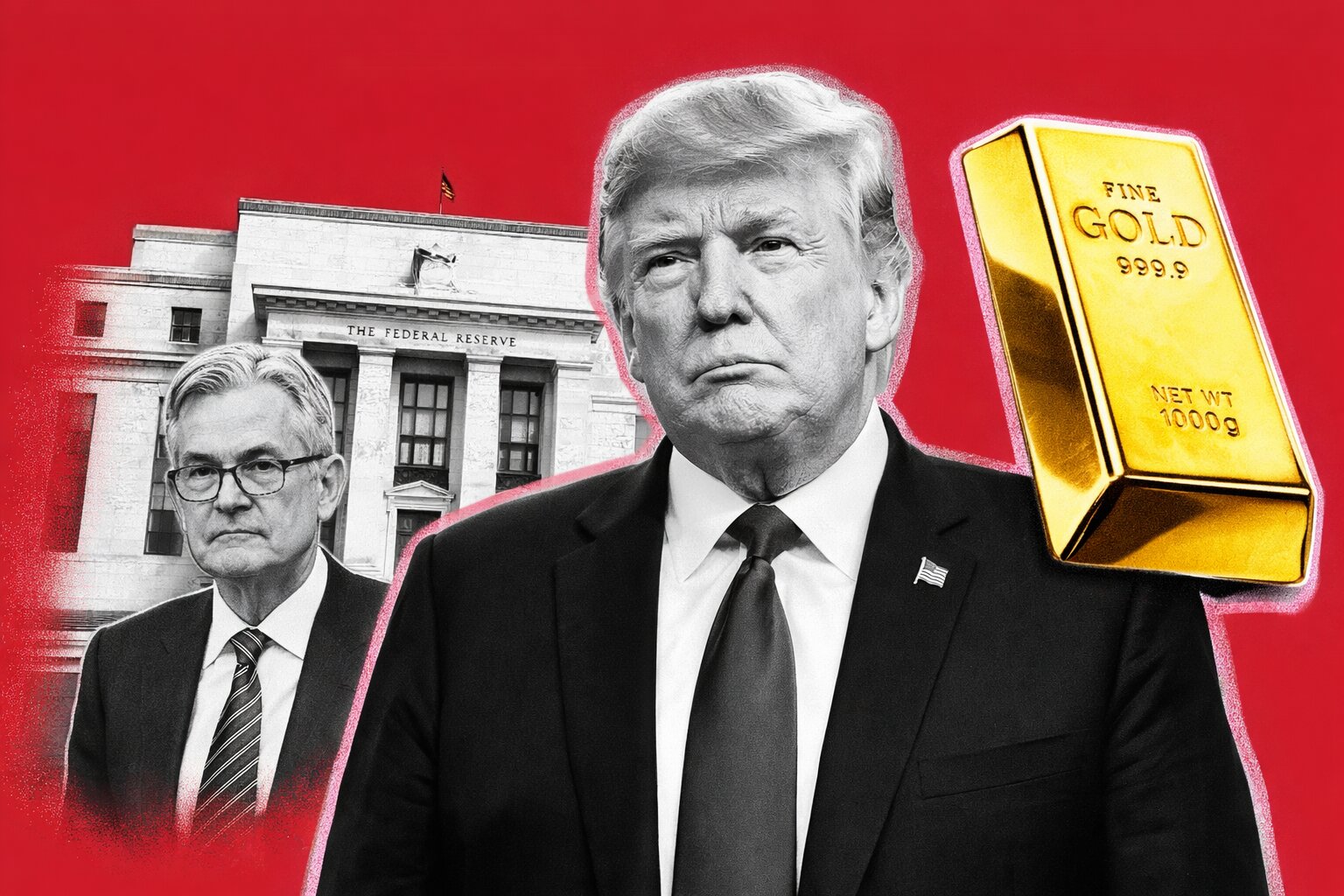
Gold Price Forecast - Gold Pops Back Above $5K As Fed Split, Tariff Ruling And Middle East Risk Revive XAU/USD Bulls
With spot XAU/USD holding near $5,050–$5,100 after a slide to $4,860, softer US GDP, sticky inflation, a Supreme Court blow to Trump’s 10% global tariffs | That's TradingNEWS
Gold Price Forecast: XAU/USD Holding 5,000 With 6,000–6,300 Back In Sight
Macro Shock: GDP 1.4%, PCE 0.4% And The 5,000 Pivot In XAU/USD
Spot XAU/USD is holding above 5,000 $/oz after a compressed but aggressive macro week. US GDP for Q4 slowed sharply from roughly 4.4% to about 1.4% annualised, while core PCE for December rose 0.4% month-on-month and is still sitting a bit above 3% year-on-year. That mix – weaker growth with persistent inflation – keeps the case for gold as both hedge and safe haven firmly in play around the 5,000 handle. Early in the week, thin Presidents’ Day liquidity in the US let sellers push spot down to around 4,860 $/oz, extending the late-January liquidation. Once US desks came back, the market flipped: fresh capital rebuilt positions and drove gold back just over 5,000 $/oz, with intraday swings wider than 150 $ but a clear refusal to stay below the psychological line. Subsequent sessions saw spot add roughly 1% on the day to around 5,047.10 $/oz, April futures around 5,065.70 $/oz, and later a close near 5,106.68 $/oz – a 2.57% weekly gain that confirms dips into the high-4,800s are being bought rather than dumped.
Fed Split, Real Yields And The Warsh Overhang For XAU/USD
The latest FOMC minutes confirmed a committee split into two blocs. One side is open to earlier cuts if incoming inflation prints keep trending softer. The other side insists on keeping policy tight for longer and only cutting later in 2026 after multiple light CPI and PCE reports. Markets have reacted by pricing roughly two 25 bp cuts this year but pushing the probability of any move before June lower. The 10-year yield is oscillating around 4.08–4.09%, while the dollar index trades near 97.7–97.8, still on track for its strongest weekly gain since October. For gold, that is a mixed setup: nominal yields are a headwind because XAU/USD does not pay interest, but softening growth alongside still-elevated inflation keeps real yields capped and maintains demand for hard assets. Add in the nomination of Kevin Warsh as the next Fed Chair, with a reputation for being tough on the balance sheet and liquidity, and you get a structure where any misstep in tightening could easily trigger another wave into gold as a hedge against policy risk.
Tariff Ruling, Supreme Court Shock And The Policy Risk Premium In Gold
The Supreme Court ruling against the broad global tariff package has changed the policy landscape but not removed uncertainty. The court struck down the framework that imposed a 10% minimum duty on all US imports and layered extra 15–50% surcharges on selected countries under emergency powers. Roughly 175 billion dollars in tariff revenue is now under review. Equities liked the decision; risk appetite improved and main indices recovered intraday losses. For XAU/USD, the immediate impact came via a weaker dollar and a small pullback in risk aversion, helping gold climb back above 5,000–5,060 $/oz. However, the administration has already signalled that 10% global tariffs will be re-implemented via a different legal route while preserving national-security tariffs under other statutes. That keeps trade policy unstable. Combined with already stretched fiscal balances in developed markets, the message is clear: sovereign balance sheets remain under pressure, long-term credibility questions persist, and the structural case for holding gold as a hedge against both inflation and policy missteps stays strong.
Middle East Escalation, Safe-Haven Flows And Overnight XAU/USD Spikes
Geopolitics has underpinned much of the bid in gold through the week. Reports of a sizeable US military build-up in the Middle East and open discussion of limited strikes on Iranian targets pushed markets into a classic risk-off posture mid-week. Oil prices spiked; credit spreads widened at the margin; and XAU/USD jumped back through 5,000 $/oz as safe-haven demand returned. Earlier, headlines around US–Iran tension had already created a whipsaw pattern: spot hovered around 4,979 $/oz while traders waited on inflation data, then surged when the weak 1.4% GDP and firm core PCE confirmed that the stagflation narrative is still live. The key point is the reaction function: every geopolitical flare-up is still being met with immediate demand for gold, especially in the overnight Asia–Europe window, which reinforces 5,000 as more than just a psychological number – it is now an active defence line.
Read More
-
Yen Stalls at 160 Despite a 3% JGB and Tokyo Core CPI at 2.0% — Intervention Sits at 164, Friday's Payrolls Decide
02.09.2026 · TradingNEWS ArchiveEnergy
-
SOFI ($16.71) Posts Its Best Day of the Quarter as Profit Guidance Finally Rises — Holding $15.70 Unlocks $20
27.10.2026 · TradingNEWS ArchiveStocks
-
XRP-USD ($1.30) Defends a $1.27 Double Bottom as Whales Hold 68.5% of Supply — Break of $1.31 Opens $1.35 and $1.40
27.10.2026 · TradingNEWS ArchiveCrypto
-
NG($3.002) Takes the Front Month Near a Multi-Month Low as Record Production Meets Mild Weather — Break of $2.945 Opens $2.80
27.10.2026 · TradingNEWS ArchiveCommodities
-
Nasdaq Rips 1.3%, S&P 500 Hits 7,728, Dow Stalls as BA Drops to $171
27.10.2026 · TradingNEWS ArchiveMarkets
-
USD/JPY (157.86) Squeezed Between a 2.8-Point Carry Edge and Tokyo’s 160 Line — BoJ Hawkish Hold Friday Sets the Break
27.10.2026 · TradingNEWS ArchiveForex
Flows, Central Banks, Dubai Premiums And Emerging-Market Retail Demand
Flow dynamics remain decisively constructive for XAU/USD. Central banks continue reallocating reserves into gold to reduce reliance on any single fiat issuer. This is a slow, systematic process with little sensitivity to short-term price spikes; it functions as a structural bid under the market. Alongside that, household allocations to gold and gold-linked products are rising. Retail portfolios are gradually assigning a larger percentage to the metal, visible both in ETF activity and in physical hubs. In Dubai, 24K prices are now around 615.25 AED per gram, after several weeks trading between 590 and 610 AED, as global XAU/USD oscillated between 4,900 and above 5,100 $/oz. Physical demand has not collapsed at these elevated levels, which confirms that dips below 5,000 are treated as opportunities, not an exit signal. In Bangladesh, the pricing committee lifted top-tier 22-carat gold by Tk 3,266 per bhori to roughly Tk 258,824. That equals about Tk 22,190 per gram for 22-carat, Tk 21,185 for 21-carat, Tk 18,155 for 18-carat and Tk 14,860 for traditional categories; silver now stands around Tk 575 per gram for 22-carat. Those adjustments show local markets are passing global prices through to consumers rather than suppressing them, but demand remains strong enough that higher levels are still accepted.
Technical Structure In XAU/USD: 4,681–4,850 As The Accumulation Zone
Technically, gold is digesting a parabolic move at altitude rather than breaking down. The lower edge of the active range sits near 4,850 $/oz, where multiple pushes lower – including the thin-liquidity slide to around 4,860 $/oz and the intraweek low around 4,841.74 $/oz – have been rejected. Below that, a broader demand area starts around 4,700 $/oz, aligning with the 50-day simple moving average close to 4,681 $/oz. As long as XAU/USD holds above that band, the dominant narrative is consolidation after a strong rally, not a completed top. On the upside, resistance is clearly defined: 5,100 $/oz is the immediate ceiling. A daily close above that level opens 5,200 $/oz, then the late-January swing high near 5,451 $/oz, with the cycle record still anchored around 5,598 $/oz. The current pattern is a sideways plateau between roughly 4,850 and 5,100, with volatility compressed but price stubbornly elevated – a typical profile for a bull trend that is pausing, not reversing.
Short-Term Trading Dynamics: Range Behaviour Around 5,000–5,100 $/oz
Short-term behaviour in XAU/USD is dominated by range trading and headline sensitivity. The combination of 1.4% GDP, core PCE above 3%, and a 10-year yield just over 4.08% keeps both bulls and bears engaged. The dollar index near 97.7 adds another layer: strong enough to cap impulsive breakouts, but not strong enough to force a clean rejection of 5,000 $/oz. Inside that backdrop, the price action is straightforward. Buying interest clusters between 4,850 and 4,900 $/oz, where every test has been defended. Profit-taking emerges around 5,080–5,120 $/oz, where previous rallies stalled. February has delivered a narrow but high-level range compared with the explosive moves of late January, which is often one of the more bullish signals a trending market can send: speculative froth has cooled, but the market refuses to give back territory. In that environment, better risk-reward comes from accumulating weakness into the lower half of the band rather than chasing strength above 5,100 without a decisive daily close.
Medium-Term Outlook: 6,000–6,300 Targets And The 10,000 Scenario
Medium term, institutional commentary around gold remains strongly constructive. One specialist precious-metals manager is openly projecting spot prices above 6,000 $/oz this year, while a major global bank pegs 6,300 $/oz as a realistic target by the end of 2026, driven by central-bank demand and ongoing portfolio diversification into hard assets. Some macro funds are already debating a multi-year pathway towards 10,000 $/oz if current trends persist. The logic is straightforward: developed-market fiscal positions are deteriorating; reserve managers want neutral assets outside any single jurisdiction; and geopolitical fragmentation from Eastern Europe to the Middle East keeps risk premia elevated. At the same time, more cautious desks are managing around the volatility spike that took XAU/USD above 5,500 $/oz. Their approach has been to tighten stops and crystallise gains as spot approached 5,000–5,100 $/oz, while staying structurally bullish. In their framework, a pullback into 4,700–4,850 $/oz is a normal correction in a long-term uptrend, not a regime change. A deeper and more persistent drawdown would require simultaneous easing of geopolitical stress, a clearly more hawkish Fed path, and a visible slowdown in central-bank gold buying – conditions that are not present yet.
Strategic Verdict On Gold: Hold At 5,000+, Accumulate On Deep Dips
The combined macro, policy, flow and technical picture keeps XAU/USD in a strong secular uptrend, but entry quality at current levels is not symmetric. At prices around 5,050–5,100 $/oz, immediate upside points first to 5,200 $/oz, then 5,451 $/oz, and potentially a retest of the 5,598 $/oz record, with credible institutional roadmaps towards 6,000–6,300 $/oz and – on a longer horizon – even higher levels if the fiscal and geopolitical backdrop deteriorates. Downside protection is anchored around 4,850 $/oz and reinforced near 4,700–4,681 $/oz via the major moving average cluster. A clear break underneath that lower platform would signal a deeper correction, likely tied to softer geopolitical risk and a more restrictive Fed stance. Under current conditions, gold at 5,000+ is a HOLD with a bullish bias, while the higher-conviction strategy is to accumulate XAU/USD on pullbacks into the 4,850–4,700 $/oz zone, as long as growth remains soft, inflation stays above target, the Fed is divided, tariff policy is unstable and Middle East risk remains unresolved.