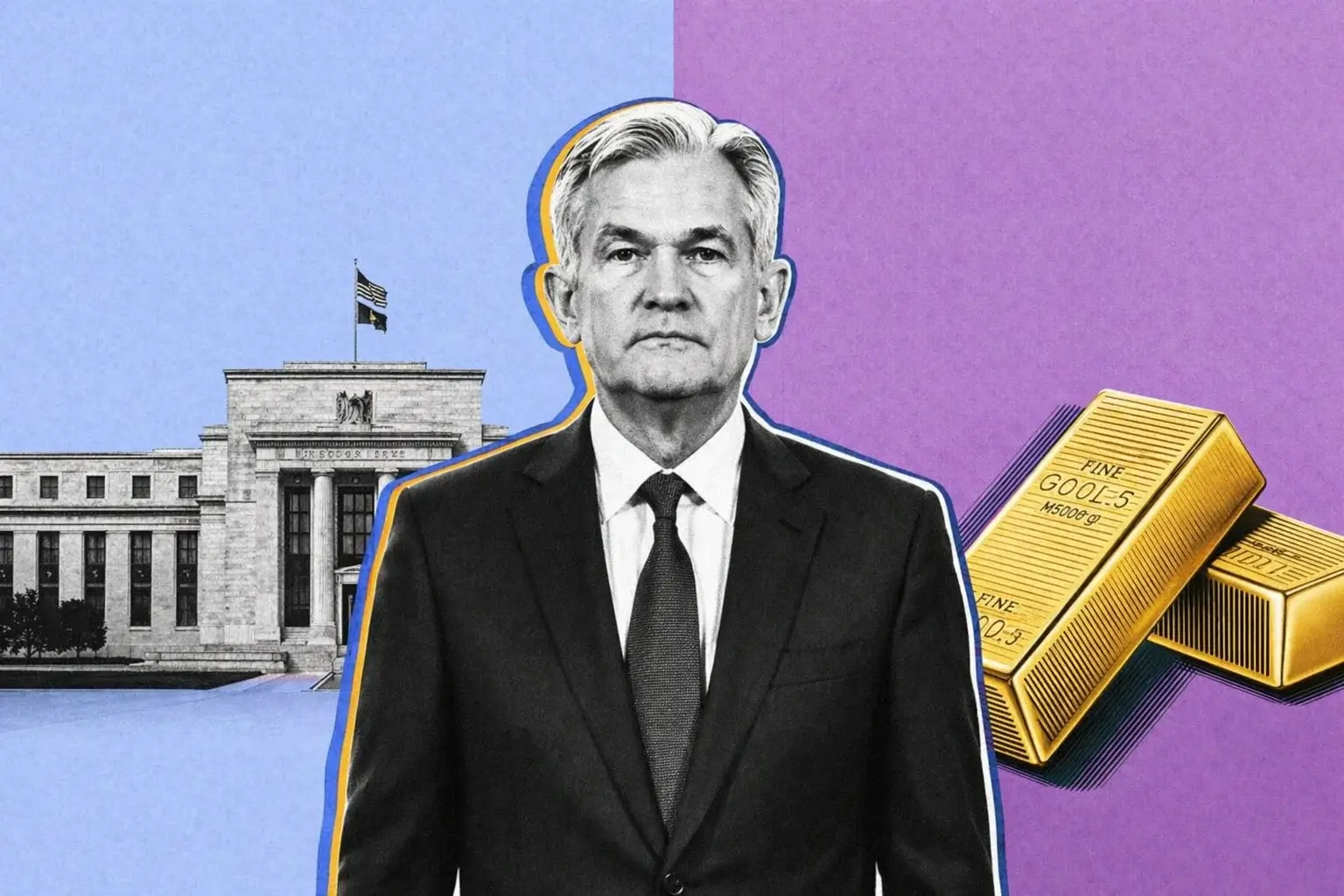
Gold Price Forecast: XAU/USD $4,763 Battles Critical Support as Dollar Surge and Iran Uncertainty Cap Upside
Break below $4,760 opens path to $4,701 and $4,645; reclaim of $4,821 targets $4,881 and $4,937 ahead of Wednesday ceasefire expiration | That's TradingNEWS
Key Points
- Gold (XAU/USD) trades at $4,763, down 1% as dollar strength and rising 10-year yields at 4.28% cap upside.
- Break below $4,760 targets $4,701 and $4,645; reclaim above $4,821 opens path to $4,881 and $4,937 zone.
- Iran ceasefire expires Wednesday; Warsh Fed hearing and April 29 FOMC key catalysts for gold price direction.
Spot gold (XAU/USD) is changing hands at approximately $4,763 per ounce, shedding roughly 1% or $41 from yesterday's $4,804 close and printing the weakest level in over a week. U.S. gold futures are holding marginally better at $4,800, down 0.6% on the session. The broader corrective phase has now stripped roughly 10% from bullion since the Middle East conflict erupted at the end of February, and with the U.S.-Iran ceasefire clock ticking toward Wednesday expiration alongside Kevin Warsh's Federal Reserve confirmation hearing unfolding in Washington, the precious metal is trapped between safe-haven demand and dollar strength. The path forward for XAU/USD is anything but linear, and the numbers reveal precisely where bullion is likely to travel over the coming sessions.
The $4,800 Ceiling That Refuses to Crack
Gold continues to reject the $4,800 psychological handle, and that rejection carries structural weight rather than noise. The failure to sustain trade above $4,821.84 — the nearest meaningful resistance pivot — has produced a textbook Evening Star candlestick formation on the 4-hour timeframe, which ranks among the highest-probability reversal signatures in technical analysis. Layered onto that, both the VWAP and 20-period simple moving average sit above current price, locking in the bearish short-term pressure regime. MACD is drifting sideways in negative territory close to the zero line, confirming the absence of directional thrust, while RSI has ticked down to around 47 with room to extend lower. The MFI is the sole cross-current, reflecting modest liquidity inflow — a small bid underneath but insufficient to flip the structure unilaterally. For the tape to neutralize and shift constructive, XAU/USD needs a decisive daily close above $4,820. Without that reclaim, the gradient continues pointing lower, and the descent accelerates meaningfully on any break beneath $4,750.
Exact Support and Resistance Ladder for XAU/USD
The full technical ladder for gold maps out with no ambiguity about where reaction zones sit. Downside support stacks at $4,760.74, $4,701.55, $4,645.91, $4,576.74, $4,509.74, $4,441.34, $4,376.04, $4,313.67 and $4,254.97. Upside resistance unfolds at $4,821.84, $4,881.57, $4,937.88, $4,996.26, $5,052.87, $5,107.72, $5,153.72, $5,208.41, $5,266.41 and $5,320.89. The base-case setup involves short exposure on volume expansion below $4,760.74, with objectives stacking down to $4,701.55, $4,645.91, $4,576.74, $4,509.74 and extending to $4,202.40 if momentum cascades. The protective stop rests at $4,788.87. The contrarian long activates on volume-backed acceptance above $4,821.84, with projections climbing through $4,881.57, $4,937.88, $4,996.26, $5,052.87, $5,107.72, $5,153.72, $5,208.41 and $5,266.41. Same stop at $4,788.87. Reward-to-risk asymmetry favors patience over aggression in the current zone.
The Dollar Mechanism Dominating Every Other Input
Here is the mechanical reality every gold-focused trader has to internalize: the U.S. Dollar Index (DXY) has pushed to multi-week highs, and that rally is suppressing XAU/USD more than any other single variable. Because gold is quoted in dollars globally, every tick higher in DXY mechanically lifts the purchasing cost for non-dollar holders, reducing international demand at the margin. The 2-year Treasury yield just printed a session high at 3.77%, up five basis points, while the 10-year sits at 4.288%. Rising real yields are the single cleanest bearish input for a non-yielding asset like bullion, because they widen the opportunity cost of holding gold versus yield-generating Treasury paper. March retail sales in the United States jumped 1.7% month-over-month against 1.3% consensus, with February revised up to 0.7%. That print mechanically undercuts the case for near-term Fed cuts and reinforces dollar strength. Year-over-year growth at 4% signals the consumer is not folding despite 24.1% gasoline price increases and the 30% Brent crude surge since the Iran conflict ignited. Everything feeds back into a stronger DXY, which caps gold upside regardless of geopolitical tail risk.
The Warsh Wildcard Reshaping Fed Expectations
Kevin Warsh's Senate confirmation hearing opened Tuesday morning with language that matters enormously for the gold forecast. He is explicitly calling for a new inflation framework and arguing the Federal Reserve has drifted from its price-stability mandate. That is implicit hawkishness, and Warsh also stated he does not believe in forward guidance as a policy tool — which suggests future rate decisions under his chairmanship would become less predictable and more data-dependent. For XAU/USD, this is a double-edged catalyst. If the market interprets Warsh as willing to tolerate elevated rates longer to crush residual inflation, gold faces continued pressure toward the $4,700 and $4,645 zones. If the confirmation fight produces unexpected dovish concessions, or Senator Thom Tillis blocks the nomination over the DOJ investigation into current Chair Jerome Powell, the dollar loses its bid and gold mechanically reprices higher. CME Group data currently implies a 99.5% probability the Fed holds rates in the 3.50-3.75% range at the April 29 decision — any deviation from that expected hold would trigger significant XAU/USD volatility.
Iran Ceasefire Expiration as the Near-Term Binary
The two-week truce between Washington and Tehran lapses late Wednesday. President Trump told CNBC Tuesday morning he expects "to be bombing" if Iran fails to cooperate, while simultaneously acknowledging that a "great deal" remains possible. Iran is reportedly dispatching a delegation to Islamabad for the second negotiation round — contradicting Iranian Foreign Ministry spokesperson Baghaei, who explicitly denied such plans earlier this week. That messaging whipsaw is the single reason gold cannot find directional conviction right now. Traders are being thrown between de-escalation scenarios that press XAU/USD lower and breakdown scenarios that send it rocketing higher. The Strait of Hormuz is the true catalyst underneath it all. Roughly one-fifth of global crude transits that waterway daily, and its closure at the start of the conflict disrupted the energy supply chain, reduced expectations of monetary easing across global central banks, and created the headwind that has compressed gold by 10% over two months. A durable reopening of the strait combined with a ceasefire extension drives XAU/USD toward $4,700. Talks collapsing and military action resuming reignites the safe-haven bid and squeezes gold back through $4,820 toward $4,881 and $4,937 with minimal resistance.
Short-Term Forecast for Wednesday and the Week Ahead
For April 22, XAU/USD is projected to consolidate within a band of $4,760.74 to $4,881.57, with daily lows potentially probing $4,645.91 on a bearish extension and daily highs reaching $4,937.88 on an upside squeeze. Average price for the session pencils out around $4,791.89 — essentially flat to modestly recovering from current levels. Zooming out to the full week spanning April 20 through April 26, volatility expands meaningfully. Weekly lows could extend to $4,254.97 in a worst-case bearish cascade, while the weekly high carries theoretical reach to $5,320.89 if a geopolitical shock ignites aggressive safe-haven flow. Average weekly price sits at $4,787.93. The macro calendar stacks densely with April manufacturing and services PMI prints, initial jobless claims, the University of Michigan inflation expectations survey, and the Fed decision on April 29 — each with capacity to trigger single-session moves of 1-2%.
The 30-Day Outlook Spans $4,000 to $6,300
Over the coming month, the projection window for gold widens substantially. The expected range runs from $4,000.00 on the bearish extreme to $6,300.00 on the bullish extreme, with average monthly price around $5,150.00. That is a wide band, and it reflects the magnitude of macro uncertainty currently priced into XAU/USD — central bank purchasing activity, geopolitical risk premium, Federal Reserve policy inflection, and dollar trajectory all pulling in different directions simultaneously. Historical context matters here: by the end of March, gold had already corrected more than 13%, and it currently trades approximately 19% below the all-time high set earlier in 2026. This is not a parabolic rally running out of steam — it is a correction within a structurally bullish multi-year trend that appears to be locating support in the current zone.
Central Bank Demand Establishing the Structural Floor
Official-sector buying activity is among the most underappreciated inputs in the current gold outlook. World Gold Council data shows global central bank purchases slowed to just 5 tonnes in January 2026 versus the 27-tonne monthly average through 2025 — yet the key shift was geographic diversification rather than demand destruction. Countries dormant for years, including Malaysia and South Korea, resumed accumulation. Uzbekistan ranked as the largest single buyer in January. China continued adding to reserves. Notably, the Bank of Russia recorded the largest sale at 9 tonnes, which likely reflects tactical fiscal management rather than strategic divestment. Uganda's central bank announced a three-year domestic purchase pilot program this week, further evidence of new-market entry. Swiss gold exports surged 30% in March, with UK-bound deliveries climbing from 19.8 metric tons in February to 57.6 tonnes — a 191% monthly jump that signals powerful physical demand reaching London vaults. This official-sector activity establishes a structural floor beneath XAU/USD unlikely to break regardless of short-term dollar strength. Goldman Sachs and JPMorgan both maintain publicly stated ranges suggesting fluctuation between $4,000 and $6,300, anchored precisely by this official-sector dynamic.
Read More
-
Yen Stalls at 160 Despite a 3% JGB and Tokyo Core CPI at 2.0% — Intervention Sits at 164, Friday's Payrolls Decide
02.09.2026 · TradingNEWS ArchiveEnergy
-
T-Rex 2X Inverse MSTR ($4.39) Rips 10.44% as Strategy Pauses Bitcoin Buys for a 2nd Week — $4.63 Close Opens $5.27
15.09.2026 · TradingNEWS ArchiveStocks
-
XRPR ($10.59) and XRPI ($7.04) Open at Highs and Close at Lows After Senate Kills CLARITY Act
15.09.2026 · TradingNEWS ArchiveCrypto
-
NG ($2.908) Holds Above $2.80 Low as LNG Feedgas Hits 18.8 Bcf and TTF Trades 9.2x Henry Hub
15.09.2026 · TradingNEWS ArchiveCommodities
-
USD/JPY (155.09) Faces 275bp Policy Gap as BOJ Prepares 31-Year-High Rate — Close Below 154 Opens 153.40
15.09.2026 · TradingNEWS ArchiveForex
Physical Demand From Asia Cushioning the Downside
Physical bullion demand from the two largest global gold consumers — China and India — remains robust enough to limit downside acceleration. Every time XAU/USD probes the $4,700 or $4,645 zones, physical buyers step in aggressively, which mechanically prevents the kind of disorderly decline that would unlock a deeper correction. The Saudi Arabia pricing confirms this strength: gold is quoted at 577.42 Saudi Riyals per gram, down from 581.38 the prior session, with the tola (traditional South Asian measurement unit) at 6,734.98 SAR versus 6,781.10 SAR a day earlier. The proportional move mirrors the dollar-denominated decline but does not accelerate — precisely the signature of physical buyers absorbing supply at key technical pivots.
Cross-Asset Positioning Against the Competition
Positioning XAU/USD against competing asset classes crystallizes the current relative underperformance story. Gold is down roughly 2.5% quarter-to-date while the S&P 500 (^GSPC) at 7,125 is up 4.1% on earnings resilience and AI-driven optimism. The DXY has advanced 3.8% on Fed policy divergence. Bitcoin (BTC-USD) has dramatically outperformed at +15.2%, driven by institutional ETF flows that have partially diverted capital that might otherwise have rotated into gold as a store-of-value hedge. Silver is quoted at $78, platinum at $2,071, and palladium at $1,565 — all showing mixed action, with gold's relative stability against the more industrial precious metals being one of its structural advantages. Against its own one-year history, gold is up 40.96% from $3,379 a year ago, so the longer-horizon picture remains overwhelmingly bullish even as the short-term tape grinds sideways to lower.
Historical Precedent From the 1990s and Early 2010s
Market regimes where dollar strength coexists with geopolitical stress typically produce volatile, range-bound trading rather than clean directional moves. The current environment closely resembles phases observed in the late 1990s and early 2010s, both of which ultimately resolved bullishly once the dollar peaked and inflation dynamics shifted. Those periods taught one essential lesson: gold rarely breaks decisively higher until either the DXY rolls over or geopolitical tail risk graduates from simmering tension to fully disruptive action. That pattern argues strongly for patience in the current setup. The structural drivers for higher gold prices — central bank buying, de-dollarization flows, inflation hedging, and geopolitical risk premium — are all intact. What remains missing is the cyclical trigger to unlock them. That trigger may arrive via a dovish Fed surprise, a dollar breakdown, or a Middle East escalation, but until one of those three materializes, XAU/USD is positioned for choppy consolidation rather than breakout.
Macro Calendar Events That Will Move Gold
The next month features specific event risks clustered tightly together. April 21 delivers ADP weekly employment data. April 23 brings initial jobless claims and the flash manufacturing and services PMI prints. April 24 produces the University of Michigan April inflation expectations report — historically among the most market-moving consumer inflation surveys. April 29 is the Federal Reserve rate decision, with the 99.5% implied probability of a hold at 3.50-3.75% meaning any surprise deviation creates outsized XAU/USD volatility. Layered on top sits the Warsh confirmation vote timing, the ceasefire expiration, and the April 30 Apple (AAPL) earnings print — which affects broader risk sentiment and therefore dollar flows through its impact on the S&P 500 (^GSPC) and Nasdaq (^IXIC). The month ahead carries meaningful event concentration.
Trade Management Framework for XAU/USD
For traders positioning into this environment, the disciplined approach involves scaling rather than all-in commitment. Short exposure below $4,760.74 with the stop at $4,788.87 offers roughly 29 points of risk against potential targets extending 500+ points lower — a reward-to-risk profile better than 15-to-1 if the full bearish sequence unfolds. Long exposure above $4,821.84 with the same $4,788.87 stop carries 33 points of risk against upside targets stacking to $5,266+, producing comparable asymmetry. Neither trade should be executed in the dead zone between $4,788 and $4,822 where no edge exists. The single biggest mistake professionals make in this setup is forcing directional exposure in the chop window simply because news flow feels urgent. Waiting for confirmed activation is the correct discipline.
My Gold Call: Hold at $4,763, Tactical Sell Below $4,760.74, Buy Above $4,821.84
XAU/USD at $4,763 is a Hold within the current range, downgrading to tactical Sell on confirmed break below $4,760.74, upgrading to Buy only on volume-backed acceptance above $4,821.84. Strategically, gold remains structurally bullish over the 6-12 month horizon — the central bank demand backbone, Fed policy inflection risk, inflation persistence, and geopolitical tail-risk premium all point toward eventual upside resolution targeting $5,150 as the month's midpoint and $5,320+ as the weekly extreme. Tactically, however, the next 72 hours favor the downside. The technical structure is bearish, the dollar is strong, real yields are rising, and the market is repeatedly failing to reclaim $4,800. The base-case probability-weighted path involves roughly 50% weight on a flush toward $4,700-$4,645 before the Fed decision, 30% weight on range-bound chop between $4,750-$4,820, and 20% weight on a geopolitical-shock squeeze back through $4,881 toward $4,937. Downside acceleration beyond $4,576 opens a deeper correction toward $4,441 and $4,376, representing a 7-9% drop from current prices. Upside acceleration above $4,937 unlocks the psychologically important $5,000 handle and clears the path to $5,107 and beyond — a 5-8% move higher. Reward-to-risk favors waiting for confirmation rather than front-running either direction. The single most important variable over the coming seven sessions is the dollar response to Warsh's testimony. If DXY rolls over, gold rips. If DXY breaks higher, gold bleeds. Everything else — Iran, retail sales, central bank buying — is secondary to that one macro pivot. XAU/USD is not broken, but it is also not yet ready to run — and the disciplined play is patience, with a bias toward selling rips and buying confirmed reclaims rather than forcing the middle of the range.