
Oil Price Forecast: WTI at $94 and Brent at $98.52 Rip Higher as Hormuz Stays Shut and Iran Vessel Seized
Dated Brent at $106 signals acute physical tightness as ceasefire expires Wednesday | That's TradingNEWS
Key Points
- WTI crude jumps 4.93% to $94.03 and Brent rises 3.18% to $98.52 after US Navy seizes Iranian cargo vessel.
- Break above $100 Brent targets $104, $110 and $120 if Strait of Hormuz stays closed through month-end.
- Dated Brent at $106 signals acute tightness; Hormuz reopening could trigger $10-$20 flush toward $85 support.
West Texas Intermediate crude (WTI) is trading at $94.03, ripping 4.93% higher on the session after the U.S. Navy seized an Iranian-flagged cargo ship in the Gulf of Oman, while Brent crude is changing hands at $98.52 — up 3.18% — and some regional pricing feeds show Brent as high as $98.61. The snapshot masks a much more violent reality underneath: over the last two weeks, the front-month contract has printed as high as $104 per barrel and as low as $86 per barrel, with daily swings of 5-10% in both directions becoming the baseline rather than the exception. Dated Brent — the spot delivery benchmark to Northwest Europe — is printing $106 per barrel right now, a long way off its $144 per barrel peak on April 7 but still reflecting the severe physical tightness that paper markets are struggling to price accurately. With the U.S.-Iran ceasefire set to expire late Wednesday, Vice President JD Vance headed to Islamabad alongside Steve Witkoff and Jared Kushner for a second round of negotiations, and the Strait of Hormuz functionally closed, crude is sitting at the exact inflection point where the next $20 move — in either direction — is going to be determined within 48 hours.
The Timeline From $72 to $120: How Oil Got Here
To understand where crude trades next, the chronology of how it got here matters. Before the conflict erupted, Brent was changing hands at roughly $72 per barrel on February 27 — a world where traders were debating a range between $65 and $80 and whether OPEC would tighten further. That all ended on February 28 when joint U.S.-Israel strikes against Iran killed multiple senior officials including Supreme Leader Ayatollah Ali Khamenei, setting off the biggest oil-supply disruption in modern market history. By the time markets opened on March 2, prices gapped higher as Tehran struck back at energy facilities across Qatar, Iraq, and the UAE. March 9 saw Brent spike toward $120 per barrel after Iranian oil facilities were hit for the first time — a moment President Trump publicly called a "small price to pay" for defeating Iran. Then on March 18, the Israeli attack on Iran's South Pars gas field — the world's largest known natural gas reserve at roughly 1,800 trillion cubic feet — triggered Iranian retaliation against Ras Laffan in Qatar, compounding the supply panic and sending prices to fresh highs. Brent ultimately gained 51% in March alone, one of the largest single-month crude price surges ever recorded.
A brief risk-off on March 23 took Brent back under $100 when the first U.S.-Iran contact was reported, but the relief evaporated quickly. April 7 saw Trump suspend planned strikes on Iranian infrastructure for two weeks after having threatened to destroy Iran's "whole civilization." April 13 brought fresh spikes when the U.S. Navy imposed a blockade on Iranian ports after the first Islamabad negotiation round collapsed. April 17 delivered the dramatic 10% single-session drop when Iran's Foreign Minister Seyed Abbas Araghchi declared the Strait of Hormuz fully open to commercial traffic — only for the reprieve to last hours before the IRGC re-imposed tighter control. Then on April 19, the U.S. Navy fired on and seized an Iranian container vessel in the Gulf of Oman, which is precisely the catalyst driving Tuesday's 4.93% rip in WTI.
Why $95 Brent Is Not Yet a Crisis — Historically Speaking
Putting the current $95-100 Brent range in proper historical context is essential. Nominal Brent peaked near $147 per barrel in July 2008 — and adjusted for U.S. CPI since then (a ratio of roughly 1.47x), that equivalent level in today's money is approximately $215 per barrel. The 2011-2014 era when Brent averaged $100-112 nominally translates to somewhere between $140-155 per barrel in today's inflation-adjusted prices. Where the front month sits right now — high-$90s nominally, mid-$100s on Dated Brent — is nowhere near inflation-adjusted crisis territory for crude itself. The real pain point sits further down the barrel. Distillate and gasoline cracks have exploded as the Strait of Hormuz disruption hit Middle East product exports and Asian refining flows. Heating oil is up 4.69% to $3.707, gasoline is up 2.54% to $3.196, and it's diesel and jet fuel, not raw crude, that are doing the primary damage to end-user inflation right now.
The Dated-to-Frontline (DFL) Blowout Signals Acute Physical Stress
Here is where the numbers tell the real story about market conditions. The Dated-to-Frontline Brent benchmark — which represents the premium that physical barrels for immediate loading command over the Brent Futures front month — has reached $25 per barrel. That is a stunning reading. In normal conditions this spread runs at a couple of dollars. The first week of April saw it average $21, and it has since pushed even higher. The DFL explosion tells you the "time value" of ASAP barrels has become so extreme that the physical market is signaling genuine shortage conditions — not speculative positioning. Extreme backwardation on this scale will not flatten gently. A market this short corrects through higher prompt prices, and the longer the refinery margin squeeze runs, the sharper the eventual correction needs to be. Rystad's Chief Oil Analyst Paola Rodriguez-Masiu explicitly warned that anyone interpreting last week's retrace as the end of the acute disruption phase is reading the tape wrong.
The Ceasefire Talks and Why "No Pressure" Is the Tell
The diplomatic picture is where the short-term price direction gets decided. Vance, Witkoff, and Kushner are en route to Islamabad for the second round of negotiations as of Tuesday, but Iran has publicly rejected the format, pointing to the continued U.S. naval blockade as a "disqualifying violation" of the existing ceasefire terms. Iranian Foreign Minister Araghchi told his Russian counterpart overnight that U.S. behavior is "incompatible with diplomacy" and told his Pakistani counterpart that continued U.S. ceasefire breaches remain the main obstacle to progress. Trump told reporters that a deal could come "quickly" but emphasized he feels "no pressure" to strike one and that it is "highly unlikely" he extends the ceasefire. That "no pressure" framing, combined with the hardening of the naval blockade rather than any softening, is arguably the most important single data point for oil traders. It signals the White House is not going to blink first.
There is also a political dimension worth putting on the table directly. Trump's overall approval in the latest CNN poll is 35%, one point off his all-time low. The Real Clear Politics average sits near 41%, and Silver Bulletin's net approval reads -16.6. Net approval on the economy runs -22, and on inflation specifically -34 — both near second-term lows. CNN's data desk has flagged that his inflation disapproval now exceeds Carter and Biden at comparable points in their terms. The uncomfortable question for the oil market is whether a president this deep in the polling hole still feels genuinely constrained by November midterms, or whether he has quietly accepted that those midterms are lost and is now singularly focused on coming out of the Iran conflict as the perceived winner. If that is the real calculus, duration risk on the conflict is meaningfully higher than what the futures curve is currently pricing, and that translates directly into higher risk premium for crude.
The Hormuz Reality: 20% of Global Supply, Still Closed
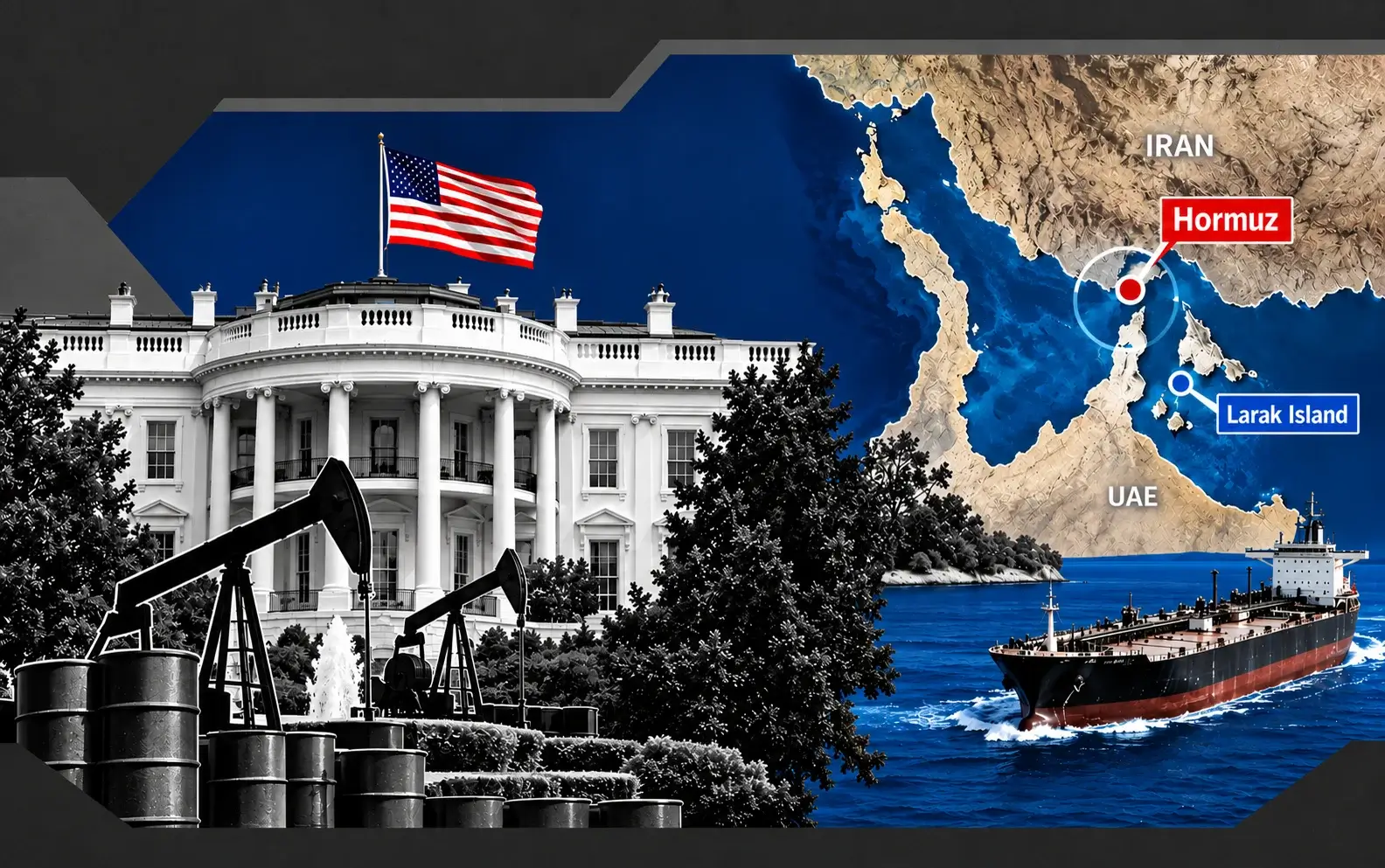
The Strait of Hormuz handles approximately 20% of all global oil and liquefied natural gas traffic in normal conditions, and it remains functionally closed as of Tuesday. A sanctioned Iranian VLCC did cross the Hormuz line just hours before the ceasefire deadline, but that is an isolated event rather than a reopening. The International Energy Agency has now formally declared that Hormuz has "lost its status as a reliable energy route" — a devastating structural downgrade that reshapes long-term risk premium calculations across the entire crude complex. Every day the strait stays shut, the tail gets fatter and the paper-physical spread becomes less sustainable. If the disruption persists another month, cumulative lost supply hits approximately 1.0-1.1 billion barrels, and Brent gets pushed back toward $110 per barrel on the math alone.
Asia has been hit hardest by the disruption since roughly 90% of the region's energy imports transit the strait under normal conditions. Governments across Southeast Asia have ordered work-from-home mandates, shortened work weeks, declared national holidays, and closed universities early to conserve fuel. Singapore and Thailand have both asked citizens to reduce air conditioning use. Even China, which typically holds reserves equivalent to roughly three months of imports, is rationing — limiting fuel price hikes as citizens face a 20% jump at the pump. The IEA's Fatih Birol warned that Europe has "maybe six weeks of jet fuel left," and long-haul flight fares are soaring as airspace restrictions from the conflict force airlines to reroute. Air Canada has already scrapped key U.S. routes on fuel cost grounds.
The Scenario Math: What Reopening Actually Unlocks
Commodity Context founder Rory Johnston flagged that any confirmed reopening of the Strait of Hormuz would likely trigger an immediate $10-$20 drop in crude prices on pure speculative positioning unwind. But that relief would be temporary. Supply chain bottlenecks, infrastructure damage, and lingering production outages would keep the market tight regardless of whether ships can physically transit the waterway. Johnston's view is that Brent would anchor in the $80-$90 range rather than returning to pre-crisis levels near $70. This is still, in his framing, "the largest oil supply shock in the history of the oil market." Without sustained restoration of flows, prices may need to rise further to curb demand before the market clears. The Rystad base case calls for oil flows to take until July to normalize to 80-90% of pre-war production levels, with another 1-2 months for those barrels to actually reach ports for refining into finished products.
The June contract curve is currently pricing rest-of-year Brent at around $88 per barrel. That reading assumes a clean Hormuz reopening by early May and that refiners don't have to chase replacement barrels far up the cost curve. That is an aggressively optimistic path given everything the physical market is currently signaling. Freight rates are spiking, insurance premiums are widening, voyage times are lengthening, product cracks are blowing out, and inventory draws are accelerating — every physical indicator is moving the wrong direction while the paper curve prices a benign resolution.
Global Pricing Snapshot: WTI, Brent, Murban, and the Asian Premium
The full price matrix Tuesday afternoon: WTI is at $94.03 up 4.93%, Brent is at $98.52 up 3.18%, Murban Crude is at $95.27 up 2.40%, WTI Midland is ripping at $92.94 up 7.01%, OPEC Basket sits at $99.60 actually down 4.95%, and the Indian Basket is at $100.40 down 9.24%. The Indian Basket decline despite the broader rally is a meaningful tell — it reflects India's aggressive rotation into discounted Russian barrels paid partially in yuan under U.S. waivers, which is distorting Asian benchmark pricing relative to the Atlantic basin. Pakistan is now paying a record premium for fuel imports. U.S. oil exports are on pace to hit an all-time high as the tanker fleet reroutes to load American barrels while Middle East supply crumbles. Norway is pumping near full capacity with its spare output buffer effectively gone. Kuwait has declared force majeure following the U.S. seizure of the Iranian vessel.
Natural gas at $2.70 per MMBtu — up 0.45% — is trading far more calmly than crude, though the divergence partly reflects the fact that global LNG flows through Hormuz have been disrupted differently from crude cargoes. The correlation between oil and gas tends to compress during supply shocks as industrial users swap between fuels where they can.
Equity Market Response Confirms the Risk Regime
The equity tape is reading exactly what oil is telling it. The S&P 500 (^GSPC) rotated into the red as crude ripped Tuesday, and the VIX edged higher on Iran uncertainty despite markets not yet hitting full panic mode. European indices took harder hits on oil sensitivity — the FTSE 100 closed down 0.5%, Germany's DAX dropped more than 1%, and France's CAC 40 also shed more than 1%. Asian markets had risen earlier in the cycle, with Japan's Nikkei up 0.6% and South Korea's Kospi up 0.4%, but that was before the Iranian vessel seizure reset risk premiums. Europe is taking the worst of it because the region depends on Hormuz transit for a meaningful slice of its energy imports and has the weakest buffer against sustained fuel price spikes.
What South America and the Long-Term Supply Response Look Like
The structural repricing of long-term supply risk is already underway. Rystad has raised its 2026 forecast for average Brent from $60 per barrel in January to $89 per barrel currently — a 48% revision that reflects the new reality. A sustained $100 per barrel environment could unlock up to 2.1 million barrels per day of additional crude supply across South America by the mid-2030s, with government revenues across the continent rising approximately $43 billion this year alone relative to previous base cases. Rystad's Radhika Bansal explicitly called out that the Middle East conflict has "exposed how dangerously concentrated global supply chains are around the Strait of Hormuz" and positioned South America as "the world's most consequential source of incremental supply" going forward. That is a multi-year structural story, but it matters for price forecasting because it signals the market is beginning to underwrite permanent risk premium into crude rather than pricing this as a transient shock.
Technical Framework and Key Price Levels
On the chart, WTI's two-week range between $86 and $104 defines the operative trading band. Current price at $94.03 sits roughly in the middle of that range but with clear upside bias given the rejected ceasefire talks and active seizure of Iranian shipping. Immediate resistance sits at $98 — which corresponds to the Brent level currently — followed by $100 as the psychological barrier and $104 as the recent cycle high. A break above $104 opens the path to $110 as Rystad's supply-loss math implies. On the downside, $90 is the near-term support, with $86 as the two-week low that must hold. A break below $86 would signal the market is pricing a Hormuz reopening in real time, and the next support cluster sits at $80 and $76.
Brent at $98.52 has its own defined levels. Resistance at $100 round-number, then $104, then $110. Support at $95 — roughly 10% below where April started — then $90, then the $86 two-week low. The curve currently pricing $88 for rest-of-year Brent means the market has baked in considerable optimism that is visibly at odds with physical-market signals.
Read More
-
Yen Stalls at 160 Despite a 3% JGB and Tokyo Core CPI at 2.0% — Intervention Sits at 164, Friday's Payrolls Decide
02.09.2026 · TradingNEWS ArchiveEnergy
-
CHAT Fund Holds $96.37 as Korean Memory and Chip Exposure Drive a 109.73% Year — Break of $98.02 Opens $105.20
18.09.2026 · TradingNEWS ArchiveStocks
-
First-Generation XRPR and XRPI Ride XRP's Rebound to $1.386 as Spot Funds Post First Outflow — Break of $1.40 Opens $1.54
18.09.2026 · TradingNEWS ArchiveCrypto
-
NG Holds $2.9255 as Storage Surplus Narrows From 5.5% to 3.7% in 3 Weeks — Break of $3.00 Opens $3.15
18.09.2026 · TradingNEWS ArchiveCommodities
-
Dollar Surges to 157.90 as BoJ's Divided Hike Fails to Lift the Yen — Break of 158.87 Opens 159
18.09.2026 · TradingNEWS ArchiveForex
Scenario-Weighted Path for Brent and WTI Over the Next Week
The probability distribution breaks out with precision. The base case at roughly 45% weight has the ceasefire formally lapsing Wednesday without a deal, Iran escalating rhetoric but not major kinetic action, and crude grinding between $90 and $105 on headline volatility. Under this scenario, Brent ends the week in the $95-$100 zone and WTI in the $92-$98 band. The bullish (for price) scenario at 30% weight involves Trump authorizing renewed strikes on Iranian infrastructure, the Strait of Hormuz remaining closed through month-end, and Brent ripping toward $110 with WTI toward $105. Physical premiums would explode under this path, with Dated Brent potentially retesting the $130-$144 zone seen earlier in the conflict. The bearish scenario at 25% weight involves a genuine diplomatic breakthrough in Islamabad — Iran agreeing to reopen Hormuz in exchange for a U.S. naval blockade suspension — which triggers Rory Johnston's projected $10-$20 immediate drop, pushing WTI to $80 and Brent to $85 before finding support.
Trade Management Framework
For traders positioning around these levels, the disciplined approach involves scaling rather than all-in directional commitment. Long exposure above $100 Brent with confirmation offers targets at $104 and $110, stops below $95. Short exposure only makes sense below $90 Brent with acceptance, targeting $86 first and $80 on extension, stops above $95. The range between $90 and $100 is explicit chop territory where directional edge disappears. The Iran ceasefire Wednesday expiration is the single binary event that will collapse probability mass onto one scenario within 24 hours of resolution, which is why sizing conservatively into that catalyst is the only defensible framework right now.
My Crude Oil Call: Cautiously Bullish with WTI Buy Above $95 and Brent Buy Above $100
WTI at $94.03 is a Hold within the current range, upgrading to Buy on confirmed acceptance above $95 targeting $100 and $104, with Sell bias only below $86 with follow-through. Brent at $98.52 is a Hold, upgrading to Buy on break above $100 targeting $104, $110, and ultimately $120 if Hormuz stays closed through month-end, with Sell bias only below $90. The structural setup favors further upside given that every major variable points toward escalation rather than de-escalation. The U.S. seized an Iranian vessel. Iran has publicly rejected the current negotiation format. Trump is signaling he feels no political pressure to cut a deal and is hardening rather than softening the naval blockade. The Strait of Hormuz remains functionally closed. The Dated-to-Frontline spread at $25 per barrel is signaling acute physical shortage. Refinery cracks are blowing out. The IEA has formally downgraded Hormuz's reliability status. Kuwait has declared force majeure. Every physical indicator is deteriorating in real time while the futures curve prices a benign resolution — that dislocation resolves through higher prompt prices, not lower ones.
The single most underappreciated catalyst in the current tape is Trump's political calculus. If he has genuinely accepted that November midterms are lost, the optionality curve shifts toward prolonged conflict rather than quick resolution. Under that scenario, Brent at $110 by early May is the base case rather than the bull case, and $120 becomes achievable if Hormuz stays shut into June. The bearish case requires a genuine diplomatic breakthrough that the current rhetoric from both Washington and Tehran suggests is highly unlikely within the Wednesday deadline window.
For traders, the disciplined framework is to own crude exposure — whether through WTI futures, Brent futures, or oil-weighted equities like ExxonMobil (XOM) and Chevron (CVX) — with defined downside stops below $86 WTI and $90 Brent. For investors with longer horizons, the structural repricing of Middle East supply concentration into permanent risk premium favors names positioned to supply incremental barrels outside the Gulf region — U.S. shale producers, Canadian oil sands operators, Brazilian and Guyanese offshore developers, and Norwegian North Sea infrastructure. The current environment is not a temporary spike being faded back to $70 Brent within months. It is a structural reset in how global energy markets price supply concentration risk, and crude is now sitting at the exact level where the next 72 hours determine whether this moves to $110 or stalls in the $90-$100 range. Position accordingly, respect the levels, and do not mistake easing paper prices for an easing physical market — because the two are currently telling very different stories.