Intel Sold $15B of Stock at a 175% Gain and the Anchor Foundry Customer Still Has No Name
A 59% jump in Data Center and AI to $6.26 billion funded the pitch | That's TradingNEWS
Key Points
- Intel opened a $15 billion offering plus a $2.25 billion option, diluting holders roughly 3.0% to 3.4%.
- Q2 revenue hit $16.13 billion, up 25.4%, the fastest growth for any quarter since 2011.
- Analyst targets sit at $101.38 to $115.17 on a Hold consensus, implying zero to 17% upside.
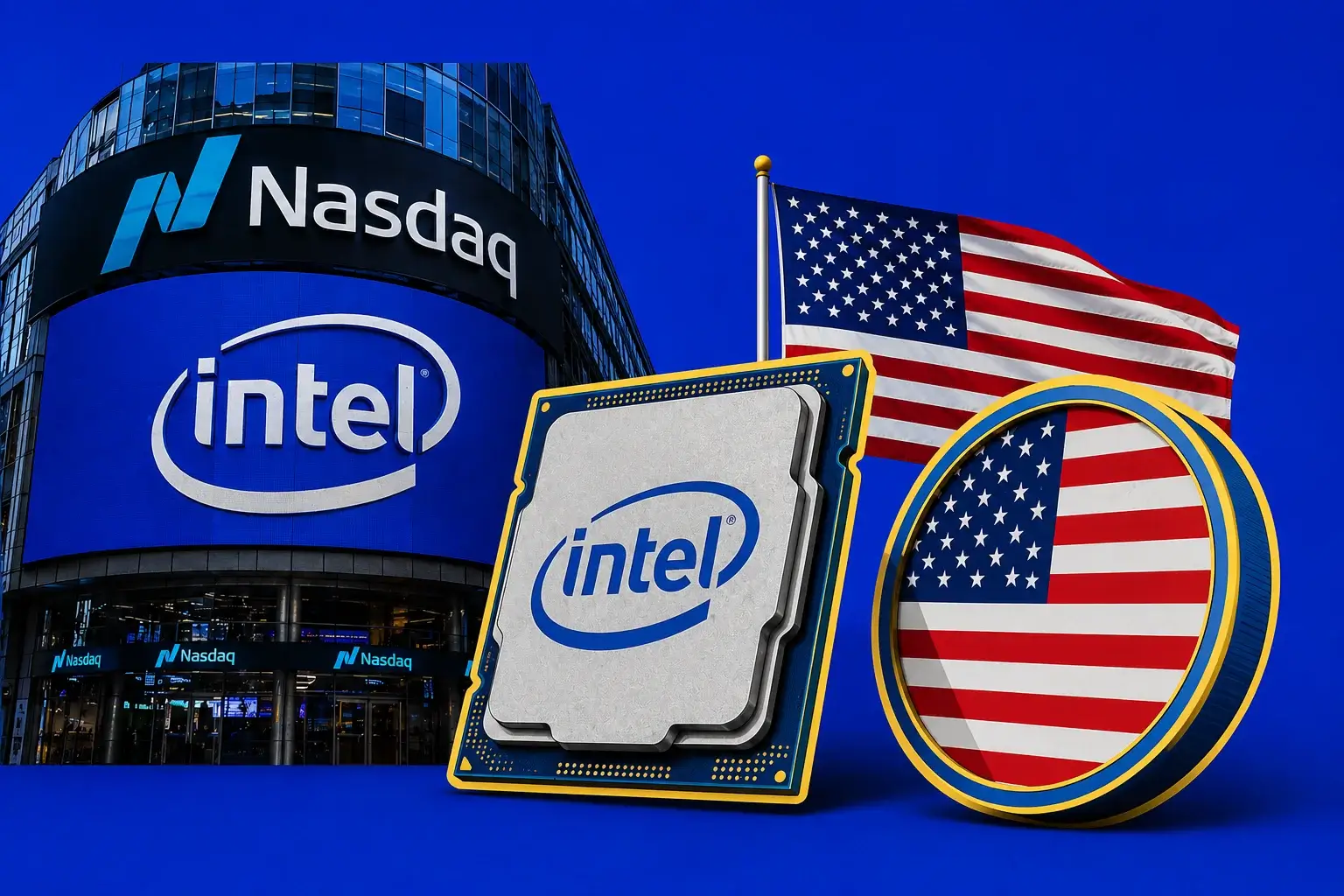
Intel announced a $15 billion underwritten public offering of common stock at 7:45 a.m. ET Monday. Shares fell over 3% in premarket trade and were down roughly 4% to 5% in morning trading from Friday's close of $101.65. The stock had traded a Friday range of $98.03 to $103.65 on volume of 76.76 million shares against a 123.39 million average, closing $1.84 above its prior settlement of $99.81.
The offering carries a 30-day option allowing underwriters to purchase up to an additional $2.25 billion of shares. JPMorgan Chase, Goldman Sachs, Morgan Stanley and Citigroup are joint book-running managers. The preliminary filing sets no price, share count, underwriting discount, proceeds figure or delivery date. Proceeds are earmarked for general corporate purposes, which the company said may include capital expenditures and working capital.
This may be Intel's first public share sale since it listed in 1971.
The forecast here rests on separating two things the market conflated Monday morning. The raise itself is the most rational capital-markets decision this management team could make. Intel was up 175% year-to-date through Friday and has quintupled over twelve months. Issuing equity when your paper is expensive is textbook opportunistic financing, and the dilution is small — at an assumed $100 price, $15 billion produces 150 million shares, roughly a 3.0% increase in the July share count, or about 3.4% if the full option is exercised.
Three percent dilution to raise $15 billion is a genuinely good trade.
What the raise reveals is the problem. Intel lifted its 2026 capital expenditure target to over $20 billion from $18 billion in July. It held $12.874 billion of cash and $16.853 billion of short-term investments at June 27 against total debt of $48.549 billion. The base offering equals roughly half its combined cash and short-term investments. And the single catalyst that would justify the buildout — a signed, named, high-volume external foundry customer — has still not arrived.
Management is asking the equity market to fund a bet whose validation is pending. Everything below develops that thesis.
What the Offering Actually Costs Shareholders
Work the dilution arithmetic properly, because the 4% drop is larger than the mechanical impact and that gap is the market's judgment on something else.
At an assumed issue price near $100, a $15 billion base offering generates approximately 150 million new shares. Against Intel's July share count, that is an increase of roughly 3.0%. Exercising the full $2.25 billion underwriter option raises the increase to around 3.4%. Market capitalisation stood at $512.7 billion on Friday, so the raise represents about 2.9% of the equity value.
Three percent is not a meaningful dilution event by any historical standard for a capital-intensive manufacturer. Intel is not issuing at distressed levels into a falling market — it is issuing after a 175% advance, which is precisely when a board should be selling paper. Unlike debt financing, equity raises capital without adding to the $48.549 billion of borrowings already on the balance sheet, and the company explicitly framed the transaction as maintaining a strong balance sheet and its commitment to an investment-grade rating.
So why is the stock down 4% rather than 3%?
Two reasons, and both matter for the forecast.
The first is that unpriced offerings create a technical overhang. The preliminary filing sets no price and no share count, which means the market does not know where the book will clear. Underwriters price into demand, and a roadshow for $15 billion of a stock that has quintupled in a year will find price-sensitive buyers. Traders front-run that by selling ahead of an expected discount, and the discount is typically wider than the pure dilution because it has to attract 150 million shares of new demand.
The second is information content. A management team with $29.727 billion of liquidity that chooses to raise another $15 billion is signalling that its capital needs exceed what the market had modelled. Intel had already raised its 2026 capex outlook to over $20 billion. Raising equity on top of that says the spending trajectory goes higher still, and that free cash flow will stay negative longer than the consensus assumes.
The offering also uses up the easiest financing lever. If Intel needs more capital in 2027 for the 14A ramp, the next raise starts from a bigger share count.
The Second Quarter Was Genuinely Excellent and It Explains the Timing
The reason underwriters can market this deal is a print delivered on July 23, and it was the strongest quarter Intel has produced in over a decade.
Revenue came in at $16.13 billion, up 25.4% year-over-year against a consensus near $14.42 billion — a beat of 11.6% and the fastest revenue growth rate for any quarter since 2011. Non-GAAP EPS reached $0.42 against expectations of $0.21 to $0.22, a beat of roughly 93%, swinging from a non-GAAP loss of $0.10 in the year-ago period.
Segment detail shows where the growth came from. Data Center and AI revenue surged 59% to $6.26 billion. Client Computing rose 13% to $8.88 billion and remains the largest unit. Intel Foundry posted a 31% gain to $5.76 billion on improved factory yields and faster cycle times, with the division narrowing its operating loss to $2.1 billion from $3.2 billion a year earlier.
Chief Executive Lip-Bu Tan framed it as AI driving unprecedented demand for compute, with Intel positioned to capture growth across its CPU franchise, ASICs, advanced packaging and wafer foundry network. Chief Financial Officer David Zinsner told analysts that customers continue to signal a strong and sustainable spending environment — language Intel repeated almost verbatim in Monday's offering release, describing a strong and sustainable demand environment driven by unprecedented investment in AI compute.
Guidance extended the momentum. Third-quarter revenue is forecast at $15.8 billion to $16.8 billion with GAAP EPS of $0.31 and non-GAAP EPS of $0.38.
The execution record supports it. Intel has topped revenue estimates for seven consecutive quarters and beaten earnings estimates in three straight and seven of the past ten.
That is the package underwriters will present on the roadshow, and it is a credible one. A 59% data center growth rate, foundry losses halving, and a guidance range whose midpoint of $16.3 billion exceeds the quarter just reported gives the book-runners real operating momentum to point to.
The timing is not accidental. Management is capitalising on a turnaround rally to raise growth capital from a position of strength, and a rare window to issue equity at elevated levels after the stock more than doubled.
The GAAP Loss of $2.16 Per Share Is the Part Nobody Discusses
Underneath the non-GAAP beat sits an accounting event that reframes the balance sheet discussion, and it is directly relevant to why $15 billion is being raised.
On a GAAP basis Intel recorded a net loss of $2.16 per share in the second quarter, with total earnings of negative $11.03 billion. The driver was a $12.53 billion non-cash charge tied to the company's CHIPS Act escrow arrangement.
That charge is non-cash, so it does not consume liquidity directly. But it does two things that matter.
First, it demonstrates that the government support underpinning Intel's manufacturing expansion carries accounting and structural complexity rather than being clean subsidy. The move comes amid ongoing discussions about CHIPS Act subsidies and Intel's competitive position. A $12.53 billion escrow-related charge is the kind of item that makes forward modelling of government-funded capex genuinely difficult, and it sits alongside the U.S. government's 10% equity stake taken in 2025 as part of the effort to support domestic chip manufacturing.
Second, it explains the trailing EPS figure that makes conventional valuation impossible. Intel's trailing twelve-month EPS is negative $2.09, which means no price-to-earnings ratio exists. A company with a $512.7 billion market capitalisation and negative trailing earnings is being valued entirely on forward expectations, and forward expectations for a foundry buildout are the least reliable category of estimate in semiconductors.
Put the full-year context on it. Intel's 2025 revenue was $52.85 billion, down 0.47% from $53.10 billion in 2024, with losses of $267 million. So the company went from roughly breakeven on flat revenue in 2025 to a quarter growing 25.4% with an $11.03 billion GAAP loss in 2026. Both the growth and the loss accelerated simultaneously.
That is what a capital-intensive transition looks like on financial statements, and it is why the equity raise is defensible on its own terms. A company generating negative GAAP earnings while lifting capex above $20 billion either raises capital or slows the buildout. Management chose capital.
The Foundry Customer Gap Is the Actual Bear Case
This is where the analysis has to be precise, because the distinction between confirmed and unconfirmed customers is the entire investment question.
Stifel lowered its price target to $110 from $120 and maintained a Hold, stating that the stock's 2026 re-rating has already priced a meaningful chunk of the early turnaround and that the key catalyst investors are waiting on — a signed external foundry customer — has not yet arrived. Mizuho's Vijay Rakesh cut his target to $109 from $135 with a Neutral rating, noting that while agentic AI server tailwinds exist, margin headwinds and foundry execution risk remain longer-term. Several analysts flagged directly that Intel announced no new customer wins alongside the second-quarter report.
Sort the customer situation into three tiers.
Confirmed: Intel secured Tesla as a 14A foundry customer, which is a meaningful validation of the next-generation node. The company has committed to high-volume 14A production in 2028. It also disclosed that the 18A production node secured a manufacturing deal with a major cloud service provider, though the customer was not named.
Channel-checked but not announced: KeyBanc's checks indicated Intel has onboarded Apple as an 18A-P customer for low-end M-series processors in MacBooks and iPads, with production expected in 2027, and that Intel is in discussions with Apple regarding 14A for low-end A-series iPhone processors in 2029. That is analyst research rather than company disclosure.
Unverified: President Trump stated that Apple would manufacture processors with Intel, but neither company has confirmed the arrangement and the claim remains unverified.
The market has been pricing all three tiers as though they were the first. A $512.7 billion valuation on a company with negative trailing earnings requires the foundry business to become a genuine second-source alternative to TSMC, and that requires named, contracted, high-volume customers on the record.
Tesla on 14A in 2028 is real and it is small relative to what the capacity being built requires. An unnamed cloud provider on 18A is encouraging and unquantified. Apple is either a 2027 customer or a political statement depending on which source you credit.
Raising $15 billion to build capacity before the anchor customer is signed is the sequence that concerns Stifel, and it is the correct concern.
18A Yields at Over 60% Are Good, Not Best in Class
The technical execution question deserves specific numbers because the whole foundry thesis rests on it.
KeyBanc's work put 18A yields at over 60%, which the firm characterised as good enough to enable the ramp of Panther Lake. For context, the firm noted that TSMC was running 70% to 80% when it launched its 2nm node, while Samsung Foundry's SF2 is believed to be below 40%. Intel's aspiration is to be the number two foundry supplier, and 60% yields are significantly better than Samsung's while trailing TSMC.
That framing is the honest one and it defines the competitive position precisely. Intel is not challenging TSMC for leading-edge supremacy at 18A. It is competing to be the credible alternative, which means winning the business of customers who want a second source and are willing to accept somewhat lower yields to get one.
The second-source thesis is genuinely strong in the current environment. Geopolitical concentration risk in Taiwan, U.S. government policy explicitly designed to support domestic manufacturing, and a 10% federal equity stake all create structural demand for a non-TSMC leading-edge option. That is why customers would onboard at 60% yields rather than waiting.
The competitive pressure is also real and it moved recently. Reports at the end of July indicated TSMC is developing AI chip packaging technology to rival Intel's, which attacks advanced packaging — one of the four growth areas Tan named and one of the pillars in Monday's offering release alongside physical AI, purpose-built silicon and external wafers.
Server CPU tightness provides near-term support independent of foundry. KeyBanc's checks indicated Intel is almost sold out for the year in server CPU as hyperscalers accelerate data center construction, and that the company was considering a 10% to 15% increase in average selling prices. A supplier that is sold out and raising prices has pricing power, and the 59% Data Center and AI growth in the second quarter is that dynamic showing up in revenue.
For the forecast, 60% yields are sufficient to keep the foundry story alive and insufficient to justify a premium to it. The next yield datapoint — and any disclosure on 14A progress toward the 2028 high-volume commitment — matters more than the next revenue beat.
Analyst Targets Cluster at $101 to $115 Against Spot Near $98
The sell-side picture on Intel is unusual: near-consensus on rating, wide dispersion on price, and a target average that implies almost nothing.
Forty-eight analysts produce a consensus rating of Hold with a twelve-month target of $115.17, implying roughly 17% upside from Friday's close. A separate count of 32 analysts as of Monday shows a Hold consensus with a target of $101.38 — effectively zero upside from Friday's $101.65. Another aggregator puts the target at $107.93. The range spans a low of $74.00 to a high of $200.00.
A Hold consensus with a target at or barely above spot is the market's way of saying the re-rating is complete. That is Stifel's argument expressed as a number.
The revision pattern through 2026 tells the story of how far the stock outran the analysts. KeyBanc upgraded to Overweight in January with a $60 target. Rosenblatt raised to $80 from $65. Wedbush raised to $98 from $60. Those were targets set as the stock passed through them, which is what happens when a re-rating is driven by narrative faster than models can be updated.
The post-earnings revisions moved the other way. Stifel cut to $110 from $120. Mizuho cut to $109 from $135. One desk reaffirmed a Buy with a $160 target unchanged on improving server and foundry outlook. So the most recent research actions were target reductions on a quarter that beat revenue by 11.6% and EPS by 93%.
Cutting targets after a blowout beat is the clearest possible signal that valuation rather than execution is the binding constraint. Both Stifel and Mizuho maintained neutral ratings while lowering targets, which is a timing revision on the foundry catalyst rather than a change in view on the business.
The long-horizon forecasts should be treated as noise. Model-driven projections have produced averages near $137.42 for 2027 with ranges spanning $53.05 to $590.00, five-year estimates near $268.31, and bullish scenarios as high as $2,142.00 if Intel becomes a top global contract manufacturer. A range that wide is not analysis.
The usable read: $101 to $115 is where the covering universe sits, spot has just fallen below the bottom of that band on the offering, and the $74 low estimate becomes relevant only if the foundry customer never materialises.
Capex Above $20 Billion Is Why This Raise Was Inevitable
The capital requirement is the mechanical explanation for Monday, and the numbers are worth laying out in sequence.
Intel lifted its 2026 capital expenditure outlook to over $20 billion from $18 billion in July. Management has since said it is targeting a meaningful increase next year as it aggressively tries to morph into a manufacturer of chips for other companies. Cash and short-term investments totalled $29.727 billion at June 27 — $12.874 billion in cash and $16.853 billion in short-term investments — against total debt of $48.549 billion.
Now run the funding math. Capex above $20 billion in 2026 with a meaningful increase in 2027 implies a two-year spending programme of roughly $45 billion or more. Against $29.727 billion of liquidity, negative GAAP earnings, and $48.549 billion of existing debt, that programme cannot be funded from the balance sheet as it stood.
The company had three options. Cut capex, which abandons the foundry thesis and the 14A commitment. Issue debt, which adds to $48.549 billion of borrowings and threatens the investment-grade rating management explicitly said it wants to protect. Or issue equity at elevated prices after a 175% run.
Framed that way, Monday's decision is not merely defensible — it is the only sensible choice. Intel said it remains disciplined in capital deployment, aligning investments with customer demand and clear return expectations, and the raise is consistent with that language.
The scale is also worth noting. If completed as announced, the transaction would rank among the largest equity offerings ever undertaken by a U.S. technology company, which underscores the capital requirements facing chipmakers as the AI compute race accelerates.
The uncomfortable implication for the forecast is what happens next. Proceeds will fund competition with TSMC for leading-edge foundry share. Fifteen billion dollars covers roughly nine months of the current capex run rate. If capex rises meaningfully in 2027 as guided and free cash flow stays negative, this is not the last raise. Investors buying at $98 should model a further offering in 2027 at whatever price prevails then.
That is the structural cost of the buildout, and it caps how much multiple expansion is available.
Read More
-
Yen Stalls at 160 Despite a 3% JGB and Tokyo Core CPI at 2.0% — Intervention Sits at 164, Friday's Payrolls Decide
02.09.2026 · TradingNEWS ArchiveEnergy
-
Microsoft Rebounds From $491 Low as $678B Backlog and Positive Free Cash Flow Shield It From 5.15% Yields
24.09.2026 · TradingNEWS ArchiveStocks
-
XRP Slides to $1.50 After $1.66 Peak as Escrow Supply Meets $20M Daily ETF Bid, With $1.70 in Reach
24.09.2026 · TradingNEWS ArchiveCrypto
-
Brent Retakes $105 From $98 Low as Houthis Hold Bab al-Mandab and Hormuz Runs at Half Capacity, WTI at $93.96
24.09.2026 · TradingNEWS ArchiveCommodities
-
Nasdaq Falls to 26,804, S&P 500 Drops to 7,688, Dow Sheds 191 Points as Oracle Tumbles 7% on Project Jupiter Notice
24.09.2026 · TradingNEWS ArchiveMarkets
-
Euro Sinks to 1.1380 on 125–150bp ECB-Fed Rate Gap as RSI Hits Oversold 25.47
24.09.2026 · TradingNEWS ArchiveForex
The Memory Shortage Is a Near-Term Revenue Constraint
A specific operational headwind flagged on the earnings call deserves attention because it affects the largest segment.
Intel said it expects flat PC sales in the third quarter because of the memory shortage. Client Computing generated $8.88 billion in the second quarter, up 13% year-over-year, and remains the biggest unit. Flat sequential performance in a segment that size materially caps the guidance range.
The shortage is industry-wide rather than Intel-specific. Samsung has confirmed the memory constraint that drove Micron's price action, with Micron trading near a $1,255 high before retreating — it was down 1.6% to $885.52 in Monday's session. Memory pricing power has been the dominant semiconductor trade of 2026, and the flip side of that trade is that PC and server OEMs cannot obtain the DRAM they need to ship complete systems.
Two implications for the forecast.
First, it constrains the third quarter mechanically. Guidance of $15.8 billion to $16.8 billion against $16.13 billion delivered means the midpoint of $16.3 billion implies only 1% sequential growth. With Client flat on memory availability, all incremental growth has to come from Data Center and AI plus Foundry. That is achievable given 59% and 31% growth rates respectively, but it removes the margin of safety.
Second, it is temporary and therefore a source of pent-up demand. Memory shortages resolve as capacity comes online, and when they do the PC units that could not ship in the third quarter ship later. That converts a Q3 revenue cap into a Q4 or Q1 tailwind, which is why the guidance did not damage the stock when issued.
The subtler point concerns the foundry business. A global memory shortage is evidence of exactly the capacity scarcity Intel is spending $20 billion a year to address on the logic side. If leading-edge logic follows memory into structural shortage — and hyperscaler capex trends suggest it might — Intel's timing on the buildout looks prescient rather than reckless.
That is the strongest version of the bull case for the raise, and it is why management can credibly describe demand as strong and sustainable while asking shareholders for $15 billion.
A Beta of 2.24 Means This Stock Trades Macro Harder Than Fundamentals
Position sizing on Intel requires respecting a volatility profile that is extreme for a company of this size.
Intel's five-year monthly beta is 2.24. The 52-week range runs from $20.44 to $142.35, meaning the stock has traded across a 596% band in twelve months. It rose 84% in 2025, gained 175% year-to-date through Friday, quintupled over the past year — and dropped 28% during July alone. Average daily volume is 123.39 million shares.
A 2.24 beta on a $512.7 billion market capitalisation is unusual. It means Intel moves more than twice as much as the S&P 500 for a given market move, which makes it a leveraged expression of the macro tape rather than an idiosyncratic holding.
That matters acutely this week. July U.S. CPI publishes Wednesday, August 12 at 8:30 a.m. ET, with consensus expecting the headline annual rate stepping down to 3.4% from 3.5% in June. September Federal Reserve hike odds sit near 44% to 46% after July payrolls contracted by 23,000. The semiconductor complex is already soft — the VanEck Semiconductor ETF is down 0.33% Monday with Micron off 1.6%.
Apply the beta. If a hot CPI print takes the S&P 500 down 2% from 7,766, Intel's expected move is 4.5% on top of whatever the offering overhang produces. That compounds into a potential $10 move in a single session.
The July drawdown of 28% demonstrates this is not theoretical. That decline occurred during a month when the stock was up 175% year-to-date and the business was performing well enough to deliver an 11.6% revenue beat weeks later. Fundamentals did not deteriorate in July. Positioning did.
The practical read for the forecast: Intel's price this week will be determined more by the offering book-building and Wednesday's inflation print than by anything about 18A yields or foundry customers. Those variables set the destination. The macro sets the path, and the path is violent.
Anyone establishing a position should size for a 10% adverse move rather than a 3% one, and should not do it before the offering prices.
Where the Offering Likely Prices and What That Means Technically
The near-term price action will be governed by the deal mechanics, and those follow a predictable pattern.
Underwritten equity offerings of this scale typically price at a discount to the prevailing market. With Intel down 4% to 5% Monday from $101.65, spot is near $96 to $98. Book-runners at JPMorgan, Goldman Sachs, Morgan Stanley and Citigroup have to place 150 million shares, and the discount required to clear that volume in a stock that has quintupled will not be trivial.
The reference point for modelling is the $100 assumption used in the dilution arithmetic. If the book prices near $95, the offering raises the same $15 billion by issuing roughly 158 million shares, taking dilution to about 3.2%.
Technical levels frame the risk. Friday's low of $98.03 has already been tested and is the first reference. Below that, the $95 area is where the offering discount likely sits, and $89.45 was identified as support during the pre-earnings consolidation. Resistance sits at Friday's high of $103.65, then the $107 to $109 EMA cluster that has repeatedly capped advances, and $110 to $115 where the Stifel target and the 48-analyst consensus converge.
The 52-week high at $142.35 requires a foundry customer announcement to be relevant.
The pattern to expect is standard. Weakness through pricing as traders position for the discount, then stabilisation once the shares are allocated and the overhang clears. Offerings frequently mark short-term lows because the uncertainty about size and price is resolved and 150 million shares move into holders who bought deliberately rather than being distributed into the open market.
That gives a usable trade structure. The window between announcement and pricing is where the discount is manufactured. Buyers waiting for the deal to clear rather than catching Monday's 4% decline get the same exposure with the pricing risk removed, and the offering discount is effectively a subsidy to whoever is patient.
The risk to that patience is a foundry customer announcement during the roadshow. Management has every incentive to disclose good news while the book is open, and a named anchor customer would take the stock through $110 before the offering prices.
What Intel Named in the Offering Release Is a Roadmap
Corporate language in a securities filing is chosen carefully, and the four areas Intel highlighted Monday tell you where the $15 billion goes.
The release cited progress in emerging areas including physical AI, purpose-built silicon, advanced packaging and external wafers as representing significant growth opportunities. Bloomberg reported the money is meant to help Intel tap new markets such as real-world uses of artificial intelligence and purpose-built silicon. Tan's earnings-call framing named the CPU franchise, ASICs, advanced packaging and the wafer foundry network.
Take them individually.
Physical AI — robotics, autonomous systems, edge inference — is a compute market where Intel's x86 franchise and edge portfolio have genuine incumbency, and it is early enough that no supplier has locked it. Intel already provides driving assistance and self-driving solutions.
Purpose-built silicon, referenced as ASICs, is the direct competitive response to the custom accelerator business that hyperscalers have been routing through Broadcom and Marvell. Winning ASIC design and manufacturing work is a foundry win that arrives without a marquee logo attached, which is why it may be understated in the customer discussion.
Advanced packaging is the area under active attack. TSMC is developing packaging technology to rival Intel's, and packaging has been one of Intel's few areas of clear technical leadership. Defending it requires capital, and some of the $15 billion goes there.
External wafers is the foundry business stated plainly — selling capacity to third parties. That is the line item requiring the named anchor customer.
Recent operational signals support the commercial push. Intel appointed Dean Jarnac as Chief Sales Officer on August 7 in a move described as strengthening customer engagement, and made progress on HDMI 2.1 that lifted the stock on August 7 and 8. Bringing in a new sales leader immediately before a $15 billion raise is a signal about where management thinks the gap is: not technology, but customer acquisition.
For the forecast, the four named areas are where to look for the catalysts. External wafers is the one that re-rates the stock.
Levels, Scenarios and What to Watch Into October 22
The forecast resolves into three paths with defined triggers.
Base case, roughly 50%: the offering prices at a modest discount near $95 to $98, the overhang clears within two weeks, and Intel consolidates between $95 and $110 into the October 22 earnings report. Third-quarter revenue lands within the $15.8 billion to $16.8 billion guidance range with Data Center and AI extending its 59% growth trajectory and Client flat on the memory shortage as guided. No named foundry customer is announced. The 48-analyst consensus target of $115.17 and the 32-analyst target of $101.38 bracket the range, and the Hold rating stays intact.
Bull case, roughly 30%: a named, high-volume external foundry customer is confirmed — Apple on 18A-P moving from channel check to company disclosure would qualify, as would a named cloud provider on the existing 18A deal. That single announcement invalidates the Stifel argument that the key catalyst has not arrived, and the offering becomes accretive rather than dilutive in the market's framing. The stock clears the $107 to $109 EMA cluster, takes $115, and the $160 target from the bullish desk becomes the reference. The 52-week high at $142.35 is reachable in that scenario before year-end.
Bear case, roughly 20%: the offering prices at a wide discount, Wednesday's CPI prints hot and the 2.24 beta amplifies a semiconductor selloff, and no customer news arrives. Intel loses $95, then the $89.45 support identified during the July consolidation. A repeat of July's 28% drawdown from current levels puts the stock near $70, which is where the $74.00 low analyst estimate sits. Confirmation that TSMC's packaging technology erodes Intel's advantage would extend it.
Watch list, in order: the offering pricing and final share count. Any named external foundry customer announcement, particularly during the roadshow. The 18A yield trajectory beyond 60% and progress toward the 14A high-volume commitment for 2028. Whether 2027 capex guidance implies a further raise. Memory availability easing for Client Computing. Wednesday's CPI at 8:30 a.m. ET. October 22 earnings.
Discipline: the raise was the right decision and the stock is still expensive on trailing numbers that do not exist. Do not buy before the deal prices — the discount is being manufactured this week and there is no reward for impatience.