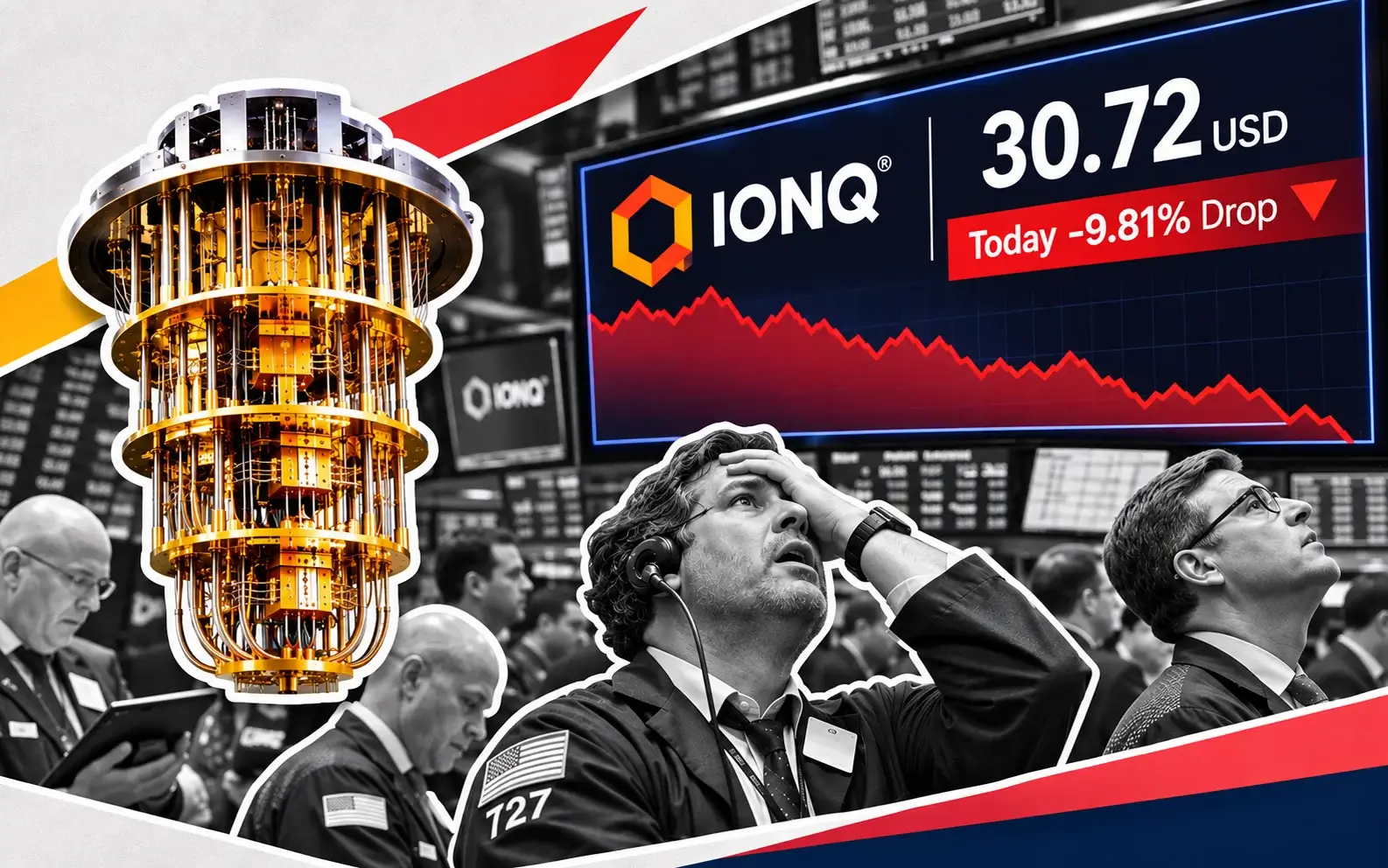
IONQ ($31) $36.35 Upside Target on $1.2B Backlog After 8% Risk-Off Drop
IonQ shares fell $2.78 as Nvidia’s leadership shock and rising yields hit quantum stocks | That's TradingNEWS
Key Points
- IonQ dropped 8.17% to $31.28 on Huang’s Nvidia resignation and a 5.07% 10-year yield, not on company news, and remains 18.35% above the $26.43 pre-earnings close.
- Q3 revenue of $173.8M (+336%), platform revenue of $90.32M (+127%), a $1.2B backlog and FY26 guidance raised to $505–$515M imply a record Q4 of at least $186.45M.
- At 26.5x forward sales with ~$3.7B pro forma liquidity, the stock targets $36.35 (+16.2%) and then $39–$41, with $27.61 as the stop level.
IonQ (NYSE:IONQ) fell $2.78, or 8.17%, to $31.28 on Thursday, November 12, 2026, from a $34.06 close. At the intraday low the loss was 9.44%. The stock opened weak, traded at $32.96 before the bell and was at $32.34, down 5.06%, by 10:06 ET. Selling picked up through the session. The trigger came from outside the company. Jensen Huang resigned as Nvidia’s chief executive at 8:59 ET, with Colette Kress named interim CEO. Nvidia traded near $163–$164. The market reacted by cutting exposure to the most speculative names tied to the AI and next-generation computing trade. Money moved toward semiconductor companies with large current earnings, so Broadcom rose 5.21% and AMD 5.46% on the same day. Long-duration stories took the selling: SoundHound lost 7.91%, Oklo fell 3% and the quantum group dropped together. IonQ’s company news did not change on Thursday. Its fundamentals are the same as they were on November 11, when the stock closed at $34.06 after a strong post-earnings run. What changed was the price the market will pay for revenue that pays off years from now. The 10-year Treasury yield sits at 5.07%, the dollar index is at a 19-month high of 103.08, and October CPI came in at +0.4% headline and +0.3% core. In that setting, a stock with a five-year monthly beta near 3.3 falls harder than the indexes on any risk-off day. Thursday was that day. The selling should be read in context. IonQ is still up 18.35% from the $26.43 close on November 5, the session before the third-quarter results moved the stock. The drop from the post-earnings high of $36.35 now measures 13.9%. The stock has given back roughly half of the gain from the Nov 5 close to that high, but the earnings move has not reversed. Every number in the quarterly report still stands: record revenue of $173.8 million, a raised full-year revenue range of $505–$515 million, remaining performance obligations of $1.2 billion, and cash and investments of $1.7 billion before the October equity raise. The question for the rest of the article is whether Thursday’s 8.17% drop reflects a change in IonQ’s value or a change in market risk appetite. The evidence points to the second. That makes $31.28 a better entry than $34.06 for anyone who held the same view two days ago, provided the $27.61 floor holds.
Q3 Revenue of $173.8M, Up 336%, Is the Sixth Straight Record Quarter
IonQ reported third-quarter 2026 revenue of $173.8 million on November 5, up 336% from $39.87 million a year earlier. It was the company’s sixth straight record quarter, and it was 117% above the $80.1 million reported in the second quarter. Nine-month revenue reached $318.55 million against $68.13 million in the first nine months of 2025. That 368% increase means IonQ has already booked about 2.45 times its full 2025 revenue of $130.0 million with one quarter left to report. The full release and filings are on IonQ’s investor relations site. The size of the jump needs explaining, because much of it is acquired revenue. SkyWater Technology, the foundry IonQ bought for $1.8 billion and closed on July 31, contributed $83.5 million, or 48% of the quarter’s total. Q3 was the first full quarter with SkyWater consolidated, so the year-over-year comparison mixes an acquisition with organic growth. That doesn’t mean the growth is not real; IonQ chose to buy the revenue. The core business carries the strategic case. IonQ Platform revenue, which covers quantum computing systems, cloud access, networking and sensing, reached $90.32 million, up 127% from a year earlier. That figure alone is more than double IonQ’s total revenue in the third quarter of 2025. Management also put full-year growth in quantum computing revenue at 110%, which separates the original business from the foundry and shows that demand for IonQ’s systems is growing in triple digits without help from the acquisition. The quarter answers the bear case from 2024 and 2025, when critics said quantum revenue would stay a rounding error until fault-tolerant machines arrived late in the decade. A company that books $90.32 million of platform revenue in one quarter is selling hardware, access and services to paying customers now. Government agencies, national labs, cloud partners and enterprise research groups account for the bulk of that demand. Contract sizes have grown as IonQ moved from selling compute time toward selling complete systems and networking deployments. The concern is quality and repeatability. System sales arrive in lumps. One large delivery can lift a quarter and leave a gap in the next. That is why the backlog and the raised annual guidance matter more than the headline 336%. Both indicate that Q3 starts a higher revenue base rather than marking a one-quarter peak.
SkyWater Adds $83.5M and Gives IonQ Its Own Chip Supply
The $1.8 billion SkyWater purchase turned IonQ from a quantum hardware designer into a vertically integrated manufacturer, and the third quarter is the first clean view of what that means financially. SkyWater generated $83.5 million in the period. Excluding sales between SkyWater and IonQ, foundry revenue grew 30% from a year earlier. Annualized, the Q3 SkyWater contribution comes to roughly $334 million. On that run rate IonQ paid about 5.4 times sales for the foundry, while IonQ itself trades at more than 26 times forward revenue. In plain terms, IonQ used expensive stock to buy cheaper revenue, and that alone added to reported growth. The strategic reason goes beyond the financial engineering. Trapped-ion quantum computers depend on specialized chips, photonic components and precision ion-trap fabrication. Before the deal, IonQ depended on outside fabs for parts of that supply chain, which meant uncertain delivery times, shared capacity and exposure to customers with far larger orders. Owning a U.S.-based, trusted foundry gives IonQ control over the timeline for its 256-qubit roadmap and its Tempo system, and it puts the company in a position to bid for government programs that require domestic manufacturing. SkyWater also brings a defense and aerospace customer base that does not depend on quantum demand. That gives IonQ a revenue floor that holds up even if quantum adoption slows. The cost is margin and complexity. Foundry gross margins are far lower than the margins IonQ targets on quantum systems and cloud access, so the consolidated gross margin falls as SkyWater revenue grows as a share of the total. Because the foundry made up 48% of Q3 revenue, comparisons with pure-play quantum peers are less direct than they were a year ago. Investors valuing IonQ on a price-to-sales basis now need to split the business in two: roughly $360 million of annualized platform revenue that deserves a premium multiple, and roughly $334 million of annualized foundry revenue that should trade closer to semiconductor manufacturing peers. That split matters for the valuation work later in this article. It shows that the headline price-to-sales multiple understates what the market pays for the quantum business. The integration itself looks on track. The 30% organic foundry growth shows SkyWater’s base business is growing under its new owner. In the first full quarter after an acquisition this size, that is the first thing to check.
The $564M GAAP Profit Is a Warrant Accounting Gain; Adjusted EBITDA Was −$133.6M
IonQ reported GAAP net income of $564.0 million, or $1.42 per share, for the third quarter. That number does not mean the company is profitable. Nearly all of the profit came from the quarterly mark-to-market on IonQ’s outstanding warrants. When the share price falls during a quarter, the fair value of those warrant liabilities drops, and the decline runs through the income statement as a gain. IonQ shares fell sharply during the third quarter, so the warrant liability shrank and produced a large accounting profit. The same mechanism ran in reverse in the second quarter, when a rising share price produced a GAAP net loss of $1.8677 billion, about $1.6 billion of it the non-cash warrant charge. Neither figure says anything about operating performance. Taken together, the two quarters show that GAAP earnings for IonQ mostly track the share price and are not a useful measure of the business. The operating numbers that matter are adjusted EBITDA and adjusted EPS. Adjusted EBITDA was a loss of $133.6 million, a negative margin of 76.9% on $173.8 million of revenue. Adjusted EPS was a loss of $0.29. Those figures show a company still spending heavily on research, engineering talent, manufacturing scale-up and integration, with revenue far below the cost base. Losing $133.6 million on an adjusted basis in a single quarter is significant, even for a company holding $1.7 billion in cash and investments at quarter-end. The direction matters as much as the level. Revenue more than doubled from Q2 to Q3, and the adjusted loss did not grow at the same pace. That means operating leverage is starting to appear. Margins remain negative but are moving in the right direction. Part of the improvement comes from SkyWater’s revenue, which carries its own cost base but runs closer to breakeven than IonQ’s research operations. Part comes from larger quantum system sales, which spread fixed engineering costs over more revenue. The market currently rewards revenue growth and tolerates losses, but that tolerance weakens when the 10-year yield climbs above 5%, as it has this week. A company burning roughly $130 million a quarter needs either cheaper capital or a visible path to breakeven to hold a premium multiple when rates are high. IonQ has the capital, as the next sections show. What it lacks so far is a date for breakeven, and that missing date is part of why the stock trades at $31.28 instead of near the $84.64 high.
Raised FY2026 Guidance of $505–$515M Implies a Q4 of at Least $186M
Management raised its full-year 2026 revenue range to $505–$515 million from $450–$460 million. It was the third increase of the year. The original range set at the start of 2026 was $225–$245 million. The company lifted it after closing SkyWater and again at the September 8 Investor Day, and the November increase adds a further $55 million at the midpoint. From the original $235 million midpoint to the current $510 million midpoint, guidance has risen 117% in ten months. That pattern carries information on its own. A management team that keeps raising guidance is either setting low bars on purpose or seeing demand arrive faster than it planned. With $1.2 billion in remaining performance obligations, the second explanation fits the evidence better. The implied fourth quarter is the most useful number in the release. Nine-month revenue stands at $318.55 million. The full-year range therefore requires Q4 revenue of $186.45 million at the bottom and $196.45 million at the top. Both figures exceed Q3’s record $173.8 million, so the guidance points to a seventh straight record quarter. Against fourth-quarter 2025 revenue of $61.87 million, derived from the $130.0 million full year minus the $68.13 million nine-month total, the implied Q4 growth comes to 201% at the low end and 218% at the high end. A company that still guides to more than 200% growth in its seasonally strongest quarter, after adding an acquisition that by itself doubled the revenue base, is not losing momentum. The 110% growth target for quantum computing revenue is the key detail for investors who want the organic picture. It tells shareholders that, after removing SkyWater’s contribution, IonQ’s core business is on track to more than double in 2026. Applied to that base, the guidance also sets up a demanding 2027. If platform revenue keeps growing at even half the 2026 rate, and SkyWater keeps growing near the 30% organic pace, IonQ could pass $750 million in revenue next year. Wall Street’s 2027 estimates will move toward that range as the backlog turns into revenue. The risk is lumpiness. System deliveries tied to government budgets and customer site readiness can slip from December into January, and a slip of $15–$20 million would push Q4 to the bottom of the range. That is the scenario the stock would punish. However, management raised guidance only six weeks before quarter-end, with most Q4 orders already in hand. A miss of that size would be unusual.
A $1.2B Backlog Shows Demand Extends Well Beyond This Quarter
Remaining performance obligations, the contracted revenue IonQ has signed but not yet recognized, more than doubled to $1.2 billion. That is the strongest long-term number in the third-quarter report. It equals 2.35 times the midpoint of 2026 guidance and almost seven times Q3 revenue. In a sector where critics argued for years that customer interest stopped at pilot projects and research grants, $1.2 billion of signed contracts is direct evidence of paid demand. The backlog has three sources. Quantum system sales to national governments and research institutions make up a large share. These contracts are multi-year, recognized as systems are built, delivered and accepted, and backed by public budgets rather than venture funding. Networking and quantum-secure communications deployments add a second layer, typically with defense and telecom customers. SkyWater’s foundry agreements add a third layer of more conventional manufacturing contracts. This mix gives IonQ a pipeline that does not depend on any single customer type or the health of the venture funding cycle. RPO also changes the debate over valuation. At a market capitalization of about $13.53 billion, IonQ trades at roughly 11.3 times its contracted backlog. That is not cheap by industrial standards, but it is a very different picture from a company valued on hope alone. Each quarter in which bookings outpace recognized revenue extends the visibility. IonQ booked enough new business in Q3 to double RPO while recognizing $173.8 million of revenue, so bookings ran well ahead of billings. That is the condition growth investors look for in a hardware company scaling into a new market. The caution is timing. RPO does not say when revenue will be recognized, and multi-year government contracts often load revenue into later periods. Investors should look for the share of the $1.2 billion expected within twelve months when the full filing details it. If half or more converts in 2027, revenue estimates have room to rise. If most of it stretches into 2028 and beyond, near-term growth slows even as the backlog grows. In either case the number shows a business moving past early testing. Thursday’s 8.17% drop happened on the same day IonQ’s signed revenue stayed at $1.2 billion. Nothing in the Nvidia leadership change affects government quantum procurement budgets or contracts already signed.
Read More
-
Yen Stalls at 160 Despite a 3% JGB and Tokyo Core CPI at 2.0% — Intervention Sits at 164, Friday's Payrolls Decide
02.09.2026 · TradingNEWS ArchiveEnergy
-
NVD ETF ($6.48) $7.74 Upside Target as Nvidia Loses Huang Before Its $108B Earnings Test
12.11.2026 · TradingNEWS ArchiveStocks
-
XRPI ($5.53) $6.01 and XRPR ($8.41) $9.15 Upside Targets as XRP Defends $1 With RSI at 23
12.11.2026 · TradingNEWS ArchiveCrypto
-
NG Rebounds to $3.306, Eyes $3.50 Upside Target as Cold Weather Tests a 3,801 Bcf Storage Cushion
12.11.2026 · TradingNEWS ArchiveCommodities
-
Dollar Presses 159.93, Eyes 162 Upside Target as Tokyo Warns Against Forgetting the ¥15.4T Summer Intervention
12.11.2026 · TradingNEWS ArchiveForex
$1.7B in Cash Plus a $2B October Raise Funds the Roadmap but Expands the Share Count to 432M
IonQ ended September with $1.7 billion in cash, cash equivalents and investments. In October, after the quarter closed, it raised another $2 billion through a stock sale. On a simple pro forma basis that gives the company roughly $3.7 billion of liquidity, against an adjusted EBITDA loss of $133.6 million in the third quarter. At that burn rate, the cash covers about 27 quarters, close to seven years, before IonQ would need more funding. In practice, few growth companies at this stage have that much runway. It removes financing risk from the investment case through at least the end of the decade, and it gives management money to fund the 256-qubit roadmap, scale the Tempo system, expand SkyWater capacity and pursue more acquisitions. The cost of that security is dilution. The share count rose from about 381 million at the end of September to 432.46 million now, an increase of 13.5% in roughly six weeks. Over the past year, shares outstanding have grown about 46.5%, driven by the SkyWater deal, earlier equity raises and stock-based compensation. That is a heavy rate of dilution even for a high-growth company, and it explains part of the stock’s weakness this year. Per-share value has to grow faster than the share count for shareholders to gain, and in 2026 the price fell while the share count rose. The October sale priced at roughly $39 per share, based on the change in share count and the $2 billion raised. That was well above Thursday’s $31.28 close. Buyers in that deal now sit on losses of about 20%, which adds supply whenever the stock rallies back toward that level. It is one reason the $36.35 high this week ran into selling. The positive side of the same fact is that IonQ raised at a price 25% above where the stock trades today, so the company sold shares near a local high, not at a low. Management also keeps the option to issue more stock. With $3.7 billion in hand, another raise in the next 12 months would be hard to justify, and the market would penalize it. Investors should treat the October sale as the funding round for the next phase of the roadmap. Unless IonQ announces another large acquisition, dilution should slow from the 46.5% pace of the last year to the low single digits, mostly from stock-based compensation. That slowdown is one of the conditions for a rerating. Per-share revenue growth will start tracking total revenue growth more closely once the share count stops climbing.
Valuation at 26.5x Forward Sales, About 19x on an Enterprise Value Basis
At $31.28 and 432.46 million shares, IonQ’s market capitalization is about $13.53 billion. Against the $510 million midpoint of 2026 revenue guidance, that is 26.5 times forward sales. Subtracting roughly $3.7 billion of pro forma liquidity gives an enterprise value near $9.8 billion, or about 19.3 times the guidance midpoint. On annualized third-quarter revenue of $695.2 million, the market capitalization falls to 19.5 times sales and the enterprise value to about 14.1 times. Those multiples are high by any traditional standard, but they are much lower than a year ago. At the 52-week high of $84.64, with fewer shares outstanding, IonQ traded above 100 times forward revenue. Both the falling share price and the rising revenue have pulled the multiple down. The stock has dropped 63.0% from its high while guidance has more than doubled, a mismatch that improves the risk-reward for new buyers. The split between businesses sharpens the picture. Value SkyWater’s roughly $334 million of annualized foundry revenue at 4 times sales, a reasonable multiple for a specialized U.S. foundry with defense exposure, and it accounts for about $1.34 billion of enterprise value. The remaining $8.5 billion of enterprise value is the market’s price for a quantum platform business running at about $360 million annualized and growing 127%. That implies roughly 23.5 times platform sales. For a business with more than 100% growth, a $1.2 billion backlog and an integrated manufacturing base, that multiple fits within the range the market has paid for leading software and infrastructure companies at similar growth rates. The comparison is not free of risk. Software businesses carry 75–85% gross margins, while hardware does not, and IonQ’s adjusted EBITDA margin is still −76.9%. The market will not award a software-like multiple until IonQ shows platform gross margins expanding and losses shrinking as a share of revenue. Rates matter as well. Every 25 basis points on the 10-year yield moves the present value of cash flows a decade out more than for any profitable mid-cap, which is why IonQ falls 8% on days like Thursday. For investors with a 12-month horizon, the case is simple. If IonQ hits the bottom of its Q4 range and the multiple holds at 26.5 times forward sales, rising 2027 estimates alone lift the price target. Applying the same multiple to a 2027 revenue base of $650–$750 million points well above $36.35, and that level sits well short of the full rerating potential.
Macro Pressure: A 5.07% 10-Year Yield, Hot CPI and Fed Repricing Weigh on Long-Duration Assets
The macro setting explains much of Thursday’s drop. The 10-year Treasury yield stands at 5.07%. October CPI rose 0.4% headline and 0.3% core, the third straight 0.3% core reading. Inflation is not cooling fast enough to justify aggressive rate cuts. The Fed’s policy rate sits at 3.75–4.00%. Futures price an 89% chance of a 25 basis point cut at the December 9 meeting and an 11% chance of 50 basis points, with the larger option kept alive by Governor Waller’s recent comments. Weekly jobless claims of 200,000 and continuing claims of 1.697 million show a labor market that is not breaking, which also weakens the case for deeper cuts. Producer prices arrive Friday, November 13, and a hot PPI would push yields higher still. For a company like IonQ, the discount rate matters more than for almost any other part of the equity market. A large share of IonQ’s value depends on cash flows that arrive after 2030, when quantum computing is expected to reach commercial scale. Higher discount rates shrink the present value of those future dollars far more than they shrink the value of a company earning money today. The dollar index at 103.08, a 19-month high, tightens financial conditions further and pulls capital toward dollar assets with current yield. That is why the market split so clearly on Thursday. Semiconductor companies with large current earnings, Broadcom and AMD, rose 5.21% and 5.46%, while companies whose value depends on long-dated growth fell. The Nasdaq at 25,306 and the S&P 500 at 7,588 remain near record territory, so this was a rotation inside the market rather than a broad crash. Capital rotated out of the most speculative part of the market into names with current earnings. For IonQ, the macro picture sets the timing of a recovery more than its eventual size. A cooler PPI on Friday, a confirmed 25 basis point December cut and any retreat in the 10-year yield below 5% would ease the pressure on long-duration growth names and support a move back toward $36.35. A hot PPI and yields climbing toward 5.25% would keep the pressure on and raise the odds of a retest of the $27.61 low. Neither scenario changes the company’s fundamentals. Signed contracts and guidance do not respond to the bond market, though the multiple the market pays for them does. The current setup favors buying weakness over chasing strength, with a clear stop below $27.61.
Quantum Peers and the Huang Shock: Why IonQ Falls With the Group
IonQ trades as part of a group with Rigetti Computing, D-Wave Quantum and Quantum Computing Inc. On risk-off days the group moves together, regardless of differences in revenue, backlog and balance sheets. During the November 5 session, when the sector reacted to a round of earnings and rate pressure, D-Wave and Rigetti fell as much as 18% intraday and IonQ about 15%, before IonQ closed down 10.53%. On Thursday, the Nvidia leadership change hit the whole group again. The reason is ownership. The same retail traders, options desks and thematic ETFs hold all four names, so when traders cut exposure to the quantum theme they sell every name at once. Nvidia matters to the sector for reasons beyond sentiment. Under Huang, Nvidia promoted quantum-classical hybrid computing, built software for quantum simulation and partnered with quantum hardware companies, including IonQ, on integration with GPU clusters. Investors treated Nvidia’s backing as validation of quantum’s commercial timeline. Huang’s resignation removes the executive most closely associated with that endorsement, and the market now has to wonder whether Nvidia’s interim leadership under Colette Kress will keep the same priorities. Nothing announced Thursday suggests a change in Nvidia’s quantum strategy, and the CUDA-Q software platform and existing partnerships remain in place. The selling reflects uncertainty about Nvidia’s quantum priorities, not news of any change. IonQ’s position inside the group is strongest on fundamentals. Its $173.8 million quarterly revenue is a multiple of what the other three pure-play companies report combined. Its $1.2 billion backlog and $3.7 billion pro forma liquidity give it more contracted demand and more cash. It is also the only one with its own foundry. When the group sells off on theme-wide news, IonQ’s discount to its fundamentals widens more than for weaker peers, which tends to make it the first to recover when sentiment turns. The post-earnings rally from $26.43 to $32.62 on November 6, a 23.42% single-day gain, showed how quickly the market can reprice IonQ when it focuses on company results. Thursday’s 8.17% drop shows the reverse when the market focuses on the theme. For traders, the takeaway is that IonQ’s day-to-day moves will follow the quantum group and the AI trade for as long as rates stay above 5%. For investors, that correlation creates entry points. When IonQ falls with peers that have a fraction of its revenue, the selling reflects positioning, not a change in IonQ’s value.
From $84.64 to $24.92: Mapping the 2026 Price Structure
IonQ’s 2026 chart is a sharp decline followed by an attempt to form a base. The stock hit its 52-week high of $84.64 during the speculative peak, then fell for most of the year. It is down 26.63% year to date, 41.08% over six months and 27.17% over three months. In early October the stock still traded above $41, closing at $41.34 on October 7. It then fell steadily: $36.27 on October 12, $31.42 on October 14 after a 9.53% drop, and $31.28 on October 16 after an 8.94% drop. The October $2 billion share sale, priced near $39, added supply into that decline. By early November the stock reached the lows of its yearly range. It closed at $28.17 on November 2 and $26.43 on November 5, its lowest close of the decline, with the 52-week low at $24.92. The earnings report changed the trend. On November 6 the stock opened at $28.01, traded as low as $27.61 and closed at $32.62, up 23.42%, on 42.53 million shares, roughly double average volume. That volume shows buyers committing real size to the results. The rally continued into this week, with the stock reaching $36.35 before Tuesday’s $34.06 close. Thursday’s 8.17% drop to $31.28 now tests whether the post-earnings move was a turn in the trend or a short-covering spike. A few features of the structure support the idea of a bottom. The stock set a higher low on the earnings day: $27.61, above the $24.92 yearly low. The rally broke above the October 16 close of $31.28 and the October 27 close of $32.95, and it reached $36.35 before stalling below the $36.27 level that marked the October 12 close. Thursday’s close at $31.28 sits right on top of the October consolidation zone between $30.76 and $32.95, where the stock traded for most of the second half of October. That zone now acts as first support. A daily close below $30.38, the low of the late-October range, would weaken the base and expose $27.61. As long as that level holds, the trend since November 5 points higher. Month-to-date, IonQ is still up 9.59%. The two numbers to watch are $27.61 on the downside and $36.35 on the upside. A close above $36.35 would complete a higher high and open the path to the $39–$41 zone where the October share sale priced and the early-October decline started.
Positioning, Short Interest and the $36.35 Upside Target
Positioning adds a second layer to the price setup. Short interest stood at 11.1% of the free float as of November 3, about 47.3 million shares out of 426.46 million in float, with 2.1 days to cover and a 1% borrow cost. That level of short interest, combined with a five-year beta near 3.3, means IonQ moves in larger swings than its fundamentals alone would suggest. The 23.42% gain on November 6 was partly short covering. Shorts who had bet on a weak quarter saw a record revenue print, a raised full-year range and a doubled backlog, and they had to buy to close positions. Thursday’s drop gives shorts a better re-entry price, but it also rebuilds the fuel for the next squeeze. Any catalyst that pushes the stock back above $34.06, whether a cooler PPI, easing yields or a new contract announcement, would force shorts to cover again. The $36.35 upside target rests on three factors. First, it is the post-earnings high, the level where buyers last ran out of momentum, and the first resistance any recovery must clear. Second, it sits 16.2% above Thursday’s close, a gain IonQ has covered in a single session several times this quarter, including the 23.42% move on November 6. Third, the target is conservative relative to valuation. At $36.35, IonQ’s market capitalization would be about $15.72 billion, or 30.8 times the 2026 guidance midpoint and well under 25 times the 2027 revenue path the backlog supports. Beyond $36.35 lies the $39–$41 zone where the October stock sale priced and where the early-October breakdown began. That is the next target if the first level clears, though holders from the share sale will likely sell into that range. On the downside, $30.38 is first support, $27.61 is the earnings-day low that defines the base, and $24.92 is the 52-week low. A close below $27.61 would invalidate the bullish structure and turn the post-earnings rally into a failed breakout. The risk-reward from $31.28 runs $5.07 to the upside target against $3.67 to the key support, about 1.4 to 1. Using $30.38 as the stop narrows the risk to $0.90 against the same $5.07 upside. Options volatility on IonQ remains high, so traders who prefer defined risk can use call spreads into the $35–$37 strikes to express the same view while capping exposure to another risk-off session.
Verdict: Buy the Risk-Off Drop With $36.35 as the First Target and $27.61 as the Line
IonQ’s 8.17% drop to $31.28 on November 12 reflected the market’s reaction to Nvidia’s leadership change, a 5.07% 10-year yield and a hot October CPI print. Nothing in IonQ’s own business changed. The company reported $173.8 million of third-quarter revenue, up 336% for a sixth straight record. Platform revenue alone reached $90.32 million, up 127%. Management raised 2026 guidance to $505–$515 million, which requires a fourth quarter of $186.45–$196.45 million and growth of 201–218% over the same quarter last year. The core quantum business is on track for 110% growth. Remaining performance obligations more than doubled to $1.2 billion. Liquidity stands near $3.7 billion including the October raise, about 27 quarters of runway at the current adjusted EBITDA loss of $133.6 million. The $564.0 million GAAP profit is a warrant accounting gain and should be ignored, just as the $1.87 billion Q2 loss should be. The risks are real. The share count has grown 13.5% in six weeks and 46.5% over a year. Adjusted EBITDA margins are still −76.9%. Revenue is lumpy and depends on government timing. The stock moves with a quantum group and an AI theme that sell off together on any shock, with a beta near 3.3. At 26.5 times forward sales and about 19 times on an enterprise value basis, IonQ is priced for continued execution. But that multiple is a fraction of the 100-plus times sales the stock carried at the $84.64 high. Revenue guidance has more than doubled since then, and the shares are down 63% from that peak. The setup favors buyers. Thursday’s close puts the stock on the October consolidation zone between $30.76 and $32.95, above the $27.61 earnings-day low and the $24.92 annual low. Short interest of 11.1% of the float leaves fuel for another squeeze when sentiment turns. The verdict is a buy on weakness at $31.28, with a first upside target of $36.35, 16.2% above the close, and a second target in the $39–$41 zone if $36.35 breaks on a closing basis. The stop goes below $27.61, the level that defines the post-earnings base; a daily close beneath it would cancel the bullish case and point to a retest of $24.92. Near-term catalysts are Friday’s PPI report, the December 9 Fed decision, any update on Nvidia’s leadership and quantum strategy, and new contract or system-delivery announcements before the fourth quarter closes. If the PPI print cools and the 10-year yield eases below 5%, IonQ should be among the first speculative tech names to recover. Its revenue base, backlog and cash put it ahead of every quantum peer, and the market will price that again once the risk-off selling ends.
That's TradingNEWS