LLY Reclaims $1,200 as Mounjaro and Zepbound Deliver $14.9B a Quarter — Buy Rating, $1,292 High in Sight
Lilly's 2026 guidance of $85B to $87B implies a second half below its Q2 run rate | That's TradingNEWS
Eli Lilly (NYSE: LLY) traded at $1,205.00 at 12:28 p.m. ET on Wednesday, October 7, up $47.51 or 4.10% from Tuesday's $1,157.49 close. The stock opened at $1,173.62, held a low of $1,166.00 and climbed steadily to a session high of $1,205.24. Volume reached 1.07 million shares by midday. Market capitalization stood at $1.07 trillion on 891.36 million shares outstanding.
The rally stood out against the tape. The S&P 500 was down 0.6%, the Dow had lost more than 500 points and the Russell 2000 more than 1% as the 10-year Treasury yield climbed to 5.345%, its highest since 2002. Lilly rose close to five percentage points more than the index.
Two company developments drove the move. Lilly announced a strategic collaboration with InnoCare Pharma worth up to $3.35 billion, extending a run of deals that has broadened the pipeline beyond obesity and diabetes. A sell-side price target was also lifted to $1,430 from $1,419, 19% above the current price, with an overweight rating maintained. Shares were already up 2.3% at $1,184.04 in morning trading and nearly doubled that gain by midday.
The setup behind the headlines is what makes the stock interesting. Lilly has a beta of 0.45, which means it typically moves less than half as much as the market. On a day when investors were selling anything sensitive to interest rates, a company growing revenue 48% with earnings that do not depend on the economic cycle drew money in.
Lilly is the rare trillion-dollar company still compounding at venture-like rates, and the market is paying 27.77 times forward earnings for it. Second-quarter revenue beat consensus by $2.2 billion. Full-year guidance, raised twice already, implies a second half that is flat with the first, which the company's own trajectory suggests is conservative. Third-quarter results arrive October 29. The forecast below argues the stock moves toward its $1,292.65 high and the $1,329.21 consensus target ahead of that report.
From $783.85 to $1,292.65: A Year of Rerating
Lilly's 52-week range runs from $783.85 to $1,292.65. At $1,205.00 the stock sits 54% above the low and 6.8% below the high. Market value has risen 35.1% over the past year.
That gain looks large until it is set against the fundamentals. Trailing twelve-month revenue is $79.67 billion, up 49.6%. Net income is $26.71 billion, up 93.6%. Earnings per share are $29.79, up 94.8%. The stock price rose a third while profits nearly doubled, which means the multiple contracted. A year ago investors were paying a far higher price for each dollar of Lilly's earnings than they are today.
The recent path has been one of consolidation. The stock closed at $1,138.28 on September 14, up 2.02% that day, ahead of the European diabetes conference where the company presented new data. It worked higher through late September on trial results and regulatory news, pulled back to $1,157.49 by Tuesday's close, and broke out on Wednesday.
Wednesday's move matters technically because it reclaimed $1,200, a round number the stock had struggled to hold. The session high of $1,205.24 is the best level in weeks. From here, $87.65 separates the price from the all-time high.
The contrast with the rest of the health care sector is sharp. On Tuesday, when 10 of 11 S&P sectors rose, health care was the only one that fell, with the sector fund down 0.2%. Large pharmaceutical companies have lagged as investors chased artificial intelligence stocks and worried about drug-pricing policy. Lilly has separated from that group on the strength of a single product family.
A market value of $1.07 trillion puts Lilly in a category occupied almost entirely by technology companies. It is the only drugmaker there. Founded in 1876, the company is 150 years old this year, and it reached this valuation on medicines launched within the past four years.
The stock pays a dividend of $6.92 a year, a yield of 0.57%. The most recent ex-dividend date was August 14. The payout is modest because the company is directing cash toward manufacturing capacity and acquisitions, and at the current growth rate that allocation is hard to fault.
For investors assessing the price today, the relevant comparison is the trajectory of earnings against the trajectory of the multiple. One has been rising sharply and the other has been falling.
Second-Quarter Results: A $2.2 Billion Beat
The numbers reported on August 5 were among the strongest any large company has posted this year. Revenue reached $22.97 billion, up 48% from $15.56 billion a year earlier. The consensus estimate was $20.73 billion. Lilly beat it by $2.24 billion, or 11%.
The composition of that growth is the important part. Volume rose 60%. Realized prices fell 13%. Lilly is selling far more product at lower prices and growing rapidly anyway. That is the profile of a company expanding a market, as opposed to one extracting more from existing customers.
Earnings followed. Reported earnings per share were $7.94, up 26%. On a non-GAAP basis they were $8.38, up 33%, against a consensus of $6.01. That is a beat of $2.37 a share, or 39%. The figure included $3.03 a share of acquired in-process research and development charges tied to business development, compared with $0.14 a year earlier. Excluding that charge, underlying earnings would have been $11.41 a share.
Non-GAAP gross margin dollars rose 50% to $19.8 billion, which works out to 86% of revenue. Few manufacturing businesses of any kind earn gross margins at that level.
By geography, U.S. revenue grew 33% to $14.4 billion, with price down 3%. Revenue outside the United States grew 80% to $8.6 billion, on a 113% increase in volume and a 36% decline in price. The international price decline was tied largely to Mounjaro's inclusion on China's national reimbursement formulary for type 2 diabetes. Revenue in China rose 93% at constant currency. Japan grew 30%.
The first quarter had been stronger still in percentage terms: revenue of $19.8 billion, up 56%, and non-GAAP earnings of $8.55 a share, up 156%. First-half revenue therefore totals $42.8 billion and first-half non-GAAP earnings $16.93 a share.
For the full year of 2025 the company reported revenue of $65.18 billion, up 44.7%, and earnings of $20.64 billion, up 94.9%. First-half 2026 revenue alone equals two-thirds of that annual figure.
The company also grew market share in oncology and neuroscience during the quarter, with contributions from immunology. Those franchises are small next to the incretin business, though they show the growth is not confined to one therapeutic area.
Mounjaro and Zepbound: $14.9 Billion in One Quarter
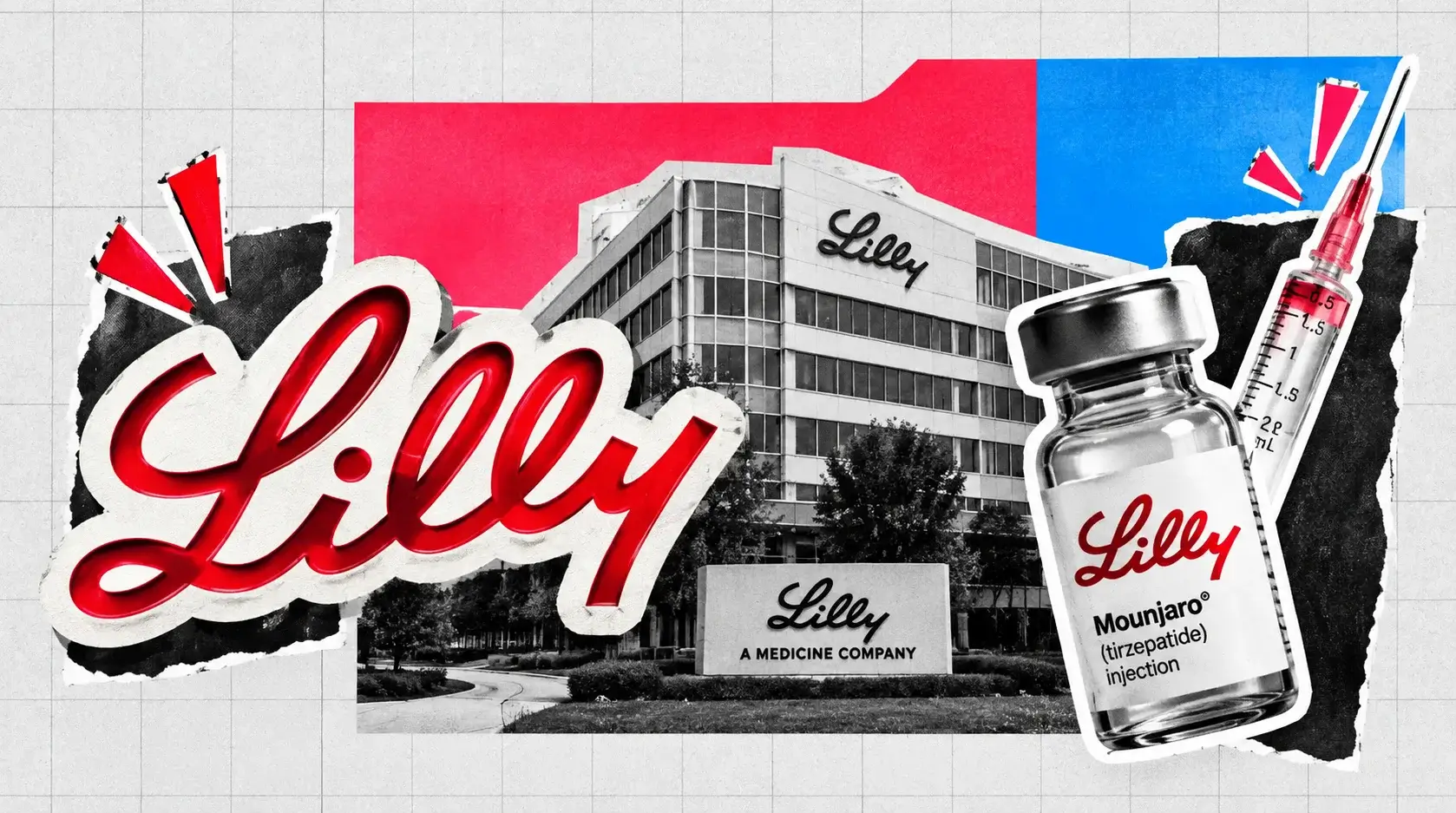
Two products built on the same molecule account for the bulk of Lilly's growth. Mounjaro, the diabetes brand of tirzepatide, generated $9.943 billion in the second quarter, up 91%. Zepbound, the obesity brand, generated $4.928 billion, up 46%. Together they produced $14.9 billion, 65% of company revenue, and contributed $6.3 billion of growth compared with the second quarter of 2025.
Mounjaro's geographic split shows where the next phase of growth is coming from. U.S. sales were $4.8 billion. International sales were $5.2 billion, up 172% from a year earlier. For the first time, more Mounjaro revenue came from outside the United States than inside it.
That shift matters for the durability of the franchise. The U.S. market for these medicines is large and competitive, with pricing under pressure from insurers, employers and the government. International markets are earlier in their adoption curves. China's decision to reimburse Mounjaro for type 2 diabetes cut the price sharply and opened access to a population several times the size of the American one. Revenue in China grew 93% as a result.
Zepbound is sold only in the United States under that name, and its 46% growth came with modest price erosion. Obesity treatment is still largely paid out of pocket or through employer plans with restrictions, so the addressable market expands each time coverage does.
The pricing trend deserves attention. A 13% decline in realized prices company-wide is substantial, and it is a deliberate strategy. Lilly has lowered prices through direct-to-consumer channels, accepted formulary discounts abroad and signed a most-favored-nation pricing agreement with the U.S. government. Each step trades margin per unit for volume and for policy certainty.
So far the trade has worked. Volume growth of 60% has overwhelmed the price decline, and gross margin has held at 86% because manufacturing scale lowers unit costs as output rises. New production capacity is coming online, which was the main constraint on sales for most of the past three years.
The key question for the third quarter is whether Mounjaro and Zepbound can exceed $15 billion combined. Sequential growth from the first quarter to the second was strong, and prescriptions have continued to climb. The products' combined second-quarter revenue annualizes to $59.6 billion.
Concentration is the obvious risk. Two brands generating 65% of revenue leaves the company exposed to anything that affects tirzepatide.
Guidance Raised Twice and Still Conservative
Lilly has lifted its full-year outlook at each of its two reports this year. In April it raised the revenue range to $82.0 billion to $85.0 billion. In August it raised it again, to $85.0 billion to $87.0 billion, a $2.5 billion increase at the midpoint. Non-GAAP earnings guidance stands at $35.50 to $36.50 a share.
The earnings guide needs unpacking. Management raised the underlying non-GAAP earnings outlook by $2.78 a share at the midpoint on the strength of the business. That was more than offset by the $3.03 of acquired research charges booked in the second quarter. The range therefore moved from $35.50 to $37.00 down to $35.50 to $36.50 even though operating performance improved. Without the deal-related charge the midpoint would be near $39.
Performance margin guidance, the company's measure of operating profitability, was raised by two percentage points to a range of 49.0% to 50.5%, from 47.0% to 48.5%.
The arithmetic of the revenue guide is revealing. First-half revenue was $42.8 billion. The full-year range of $85.0 billion to $87.0 billion implies second-half revenue of $42.2 billion to $44.2 billion. That is an average of $21.1 billion to $22.1 billion a quarter, below the $23.0 billion the company just reported.
For that guidance to be accurate, revenue would have to decline sequentially in the second half. Nothing in the business suggests that. Volume grew 60% year over year, new manufacturing capacity is ramping, international Mounjaro sales grew 172%, and a new oral medicine is in its first months on the market. Even if third- and fourth-quarter revenue merely matched the second quarter, the full year would come in at $88.8 billion, above the top of the range.
The same logic applies to earnings. First-half non-GAAP earnings were $16.93 a share. The guidance implies $18.57 to $19.57 for the second half, or $9.29 to $9.79 a quarter. The second quarter delivered $11.41 before the research charge.
Lilly has a pattern of guiding cautiously and raising. It beat second-quarter revenue consensus by 11% and earnings by 39%. A third raise on October 29 is the most likely outcome, and the size of the gap between guidance and run rate suggests it could be meaningful.
The main variable that could prevent it is price. If realized price declines accelerate beyond 13%, revenue per unit falls faster than volume rises.
Foundayo: The Pill That Widens the Market
The most important new product in Lilly's portfolio is Foundayo, the brand name for orforglipron. It received U.S. approval earlier this year for adults with obesity, or overweight with weight-related medical problems, and is the only approved GLP-1 pill that can be taken at any time of day without food or water restrictions.
That convenience is the commercial point. Injectable medicines require cold storage, needles and a weekly routine that some patients will not accept. A once-daily tablet with no dosing restrictions removes those barriers. It is also far easier to manufacture at scale than an injectable peptide, which matters for a company that spent three years unable to make enough product.
Early sales were modest. Foundayo generated $98 million in the second quarter, slightly below the $103 million analysts expected. The launch metrics tell a more encouraging story. The number of prescribers grew to 36,000 from 8,000, and one in four new patient starts in the category is now on the drug. A product capturing a quarter of new starts within months of launch is on a steep adoption curve, and revenue typically lags prescriber growth.
The clinical evidence has continued to build. In the ACHIEVE-4 trial, the largest and longest study of the drug in type 2 diabetes, participants taking Foundayo had a 16% lower risk of a four-component measure of major adverse cardiovascular events and a 23% lower risk on the three-component measure, meeting the primary objective of non-inferiority against insulin glargine. The trial also showed sustained reductions in blood sugar and weight.
Separate analyses presented in Milan showed that the 17.2 milligram dose helped adults with type 2 diabetes reach blood sugar and weight goals faster than dapagliflozin and faster than oral semaglutide at both 7 and 14 milligram doses. A post-hoc analysis of the ATTAIN-1 obesity trial associated the same dose with a predicted 57% reduction in ten-year risk of developing type 2 diabetes and an 18% reduction in cardiovascular disease risk against placebo.
The regulatory path is extending. Lilly has submitted orforglipron for type 2 diabetes in the United States, which would add a second, larger indication.
Cardiovascular safety data matter beyond the label. Insurers and government payers are far more willing to cover a weight-loss medicine that demonstrably reduces heart risk. Each such result strengthens the case for reimbursement.
Read More
-
Yen Stalls at 160 Despite a 3% JGB and Tokyo Core CPI at 2.0% — Intervention Sits at 164, Friday's Payrolls Decide
02.09.2026 · TradingNEWS ArchiveEnergy
-
Spotify Rallies 5.5% Off Its $472.89 Low on Record 33.4% Margins — Buy Rating, $552 Then $597 in Sight
07.10.2026 · TradingNEWS ArchiveStocks
-
XRP-USD ($1.42) Underperforms Bitcoin as Weekly ETF Inflows Fade to $4.74M — Hold, Buy Zone at $1.37 to $1.40
07.10.2026 · TradingNEWS ArchiveCrypto
-
Brent $101 and WTI $89 Split on War Risk and Recovering Supply — EIA Sees $105, Support at $88
07.10.2026 · TradingNEWS ArchiveCommodities
-
Dow Sheds 539 Points, S&P 500 Back Under 7,800, Nasdaq Off 0.75% as Yields Reach 2002 Highs; PENG +17%
07.10.2026 · TradingNEWS ArchiveMarkets
-
Pound Retreats From 1.3284 Trendline as U.S. Yields Hit 2002 Highs — Sell Rallies to 1.3303, Downside to 1.3139
07.10.2026 · TradingNEWS ArchiveForex
For the October 29 report, Foundayo revenue is the number most likely to surprise. A figure well above $98 million would confirm that prescriber growth is converting to sales.
Retatrutide and the Next Generation
Lilly is already preparing the successors to tirzepatide. The most advanced is retatrutide, a triple hormone receptor agonist that targets three metabolic pathways where tirzepatide targets two.
The clinical package is complete. Lilly reported positive data from three additional Phase 3 trials of retatrutide in obesity during the second quarter, and it plans to submit the drug to U.S. regulators in the first quarter of 2027. In the pivotal TRIUMPH-2 trial in patients with obesity and type 2 diabetes, retatrutide delivered weight loss of up to 20.8% and a reduction in A1C, the standard measure of blood sugar control, of 1.6 percentage points. An earlier Phase 3 trial had shown significant reductions in both measures in type 2 diabetes.
Weight loss above 20% in patients with diabetes, a group that typically loses less than those without it, places retatrutide at the top of the efficacy range for any medicine in the class. If approved on that timeline, it would reach the market in late 2027 or 2028, well before tirzepatide faces generic competition.
A second program takes a different approach. Eloralintide is an amylin-based drug, a separate biological lever from the GLP-1 pathway. Lilly is testing it in combination with tirzepatide under the name eloraTZP. In a Phase 2 study, patients on the combination lost an average of 23.3% of their body weight, outperforming tirzepatide alone. The trade-off was a higher rate of side effects, which will need to be managed through dosing in later trials.
Amylin matters strategically. Both Lilly and its main rival are developing amylin drugs as independent treatments or as additions to existing therapies. The mechanism may offer weight loss with a different tolerability profile, and it gives patients who do not respond well to GLP-1 drugs an alternative.
The pipeline creates a sequence. Tirzepatide dominates today. Foundayo extends the franchise to patients who want a pill. Retatrutide offers greater efficacy for those who need it. EloraTZP and other combinations follow. Each product arrives before the previous one matures, which is how a company sustains growth through patent cycles.
There is a point of comparison in the data that helps frame expectations. Tirzepatide produced weight loss in the low 20s as a percentage of body weight in its obesity trials. Retatrutide at 20.8% in a diabetic population and eloraTZP at 23.3% suggest the next generation will exceed it.
The risk is execution. Retatrutide still requires approval, and side-effect profiles at higher efficacy levels will draw scrutiny.
Building Beyond Obesity: $3.35 Billion With InnoCare and a String of Deals
Wednesday's collaboration with InnoCare Pharma, valued at up to $3.35 billion, is the latest in a rapid series of transactions that is reshaping Lilly's pipeline outside cardiometabolic health.
The pace has been intense. After the second quarter closed, Lilly completed three acquisitions to build an infectious disease portfolio and agreed to acquire AtaiBeckley. On Monday it expanded a research and licensing agreement with Gate Bioscience, in a deal potentially worth more than $870 million, to develop treatments targeting disease-causing proteins. The $3.03 a share of acquired research charges in the second quarter alone represents roughly $2.7 billion spent on bringing in new assets.
The logic is plain. Lilly is generating cash faster than it can deploy it internally, and two products account for 65% of revenue. Using the incretin windfall to buy and license programs in oncology, immunology, neuroscience and infectious disease reduces that concentration over time.
Oncology is progressing on its own as well. On October 2 the Food and Drug Administration approved an additional indication for Jaypirca, the first and only approved non-covalent BTK inhibitor, for certain patients with previously untreated chronic lymphocytic leukemia or small lymphocytic lymphoma. Moving a cancer drug into earlier lines of treatment substantially enlarges the patient population. European regulators had already approved it as monotherapy across all lines of therapy.
The agency also granted orphan drug designation to olomorasib, an experimental treatment, for pancreatic cancer. Orphan status provides development incentives and a period of market exclusivity on approval.
In immunology, the company secured approval for Ebglyss with a maintenance dose once every eight weeks in moderate-to-severe atopic dermatitis and is presenting 21 studies from its dermatology portfolio at a medical meeting this month. A trial combining Taltz with Zepbound in adults with psoriasis and obesity produced positive Phase 3 results, an early example of pairing the weight-loss franchise with other medicines.
Not every program advances. Lilly and Foghorn Therapeutics decided not to move forward with FHD-909 after reviewing Phase 1 data, and the two companies do not plan further collaboration. Early-stage attrition of that kind is normal and costs little relative to the company's scale.
The financial capacity behind this strategy is the notable feature. With trailing net income of $26.71 billion, a $3.35 billion collaboration paid largely in milestones represents a small fraction of one year's profit. Lilly can pursue a dozen such deals without straining its balance sheet, and several of its recent partners are companies that could not have funded the same programs alone.
Valuation: 27.8 Times Forward Earnings for 48% Growth
Lilly trades at 38.86 times trailing earnings of $29.79 a share and 27.77 times forward earnings. Against the midpoint of 2026 non-GAAP guidance at $36.00, the multiple is 33.5.
Those are high numbers in isolation. They look different next to the growth rate. Revenue rose 48% in the latest quarter and 56% in the one before. Trailing earnings per share are up 94.8%. A company growing earnings at even half that pace would normally command a multiple well above 28 times forward estimates.
The forward multiple implies earnings of roughly $43.40 a share over the next twelve months. That is 20% above the midpoint of this year's guidance, which itself absorbs $3.03 of deal charges. On an underlying basis, with 2026 earnings near $39 before those charges, the implied growth to $43.40 is 11%. Given that the company just grew earnings 33% in a quarter while taking a $3.03 charge, that expectation looks low.
A simple scenario shows the sensitivity. If 2027 earnings reach $48 a share, a figure consistent with revenue growth in the mid-20s and stable margins, the stock at $1,205 trades at 25 times. At 30 times those earnings it would be worth $1,440.
The consensus price target across 30 analysts is $1,329.21, implying 10.3% upside, with an average rating of Buy. The target raised on Wednesday to $1,430 implies 18.7%. Those figures bracket a reasonable range for the next twelve months.
Other measures support the case. Market value of $1.07 trillion against trailing revenue of $79.67 billion gives a price-to-sales ratio of 13.4. That is a technology-company multiple, and it is earned by technology-company margins: 86% gross and a guided performance margin of 49.0% to 50.5%.
The comparison with other trillion-dollar companies is instructive. Nvidia trades at 30.21 times trailing earnings. Lilly's trailing multiple is higher at 38.86, though its forward multiple of 27.77 is lower than most large technology names, and its earnings are far less cyclical. Demand for diabetes and obesity treatment does not depend on corporate capital spending.
The bear case on valuation is straightforward. If price erosion accelerates or a competitor takes meaningful share, earnings growth slows toward the teens and a 28 multiple compresses toward 20. At $43.40 in earnings and 20 times, the stock would be $868, a 28% decline.
That scenario requires the business to deteriorate in ways not currently visible. The 52-week low of $783.85 shows such repricing can happen when sentiment shifts.
Pricing Policy and the Medicare Rule
Drug pricing is the policy risk that has weighed on the entire pharmaceutical sector this year, and the news on that front has turned in Lilly's favor.
A federal rule designed to cut hospital drug prices for Medicare patients may apply to as few as four drugmakers, according to reporting last week. Companies that signed separate most-favored-nation pricing agreements with the administration are exempt. Lilly is among those that reached such an agreement.
The significance is in what it removes. For most of the year investors feared an across-the-board mandate tying U.S. drug prices to the lowest paid in other developed countries. Companies that negotiated voluntary agreements accepted price concessions on specific terms in exchange for certainty. The exemption from the Medicare rule suggests those agreements are being honored, which reduces the chance of further unilateral action against the same firms.
Lilly's reported numbers show the cost of that strategy. U.S. realized prices fell 3% in the second quarter. Total company prices fell 13%, driven mostly by international discounting. The company has also lowered prices through its direct-to-consumer channel for patients paying out of pocket.
The trade has been favorable. Volume grew 60% and revenue 48%. Lower prices expanded access, and expanded access drove volume. In a category where demand far exceeds what insurance will cover, price is the main lever for reaching more patients.
Policy risk has not disappeared. Midterm elections are in November, and drug costs remain a political issue for both parties. Future negotiations under Medicare could target tirzepatide directly as it becomes one of the program's largest expenses. Coverage of obesity medicines under Medicare is still limited, and a decision to expand it would bring both a large new market and tougher price negotiation.
International policy matters as well. China's formulary inclusion cut Mounjaro's price there by enough to drag total ex-U.S. pricing down 36%, and other national health systems will seek similar terms.
A separate development this week touches the long-term addressable market. The World Health Organization issued its first guidelines on childhood and adolescent obesity on Wednesday, discouraging weight-loss drugs for children under 10 and emphasizing other interventions first. The guidance has little near-term revenue effect, since pediatric use is a small share of prescriptions. It does signal how health authorities are thinking about the boundaries of treatment.
Taken together, the policy picture is clearer than it was six months ago. Lilly has accepted lower prices, secured an exemption from the most onerous rule, and kept growing.
Why LLY Rises When Yields Spike
Wednesday's 4.10% gain on a day of broad selling reflects a characteristic of the stock that matters in the current market.
Lilly's beta is 0.45. Over time its shares have moved less than half as much as the S&P 500 for any given market swing. Demand for insulin, diabetes medication and obesity treatment does not fluctuate with interest rates, consumer confidence or corporate spending. Patients take these medicines regardless of where the 10-year Treasury trades.
That profile is unusual for a company growing this fast. High-growth stocks are normally the most rate-sensitive, because their value depends on earnings far in the future. On Wednesday, with the 10-year at 5.345% and the 30-year at 5.724%, speculative growth names fell hardest. Life-science tools companies dropped 6% to 7%. Crypto-linked stocks lost 6%.
Lilly combines the growth rate of those companies with the stability of a consumer staple. Its earnings are large today, not projected for some later year. Trailing net income is $26.71 billion. A higher discount rate reduces the present value of future cash flows, though it has less effect when so much of the value is already being generated.
The stock has also taken on a role in portfolios that technology megacaps have played. In a market where three companies make up a fifth of the S&P 500 and investors worry about concentration in artificial intelligence, Lilly offers trillion-dollar scale and comparable growth in an unrelated industry. Money rotating out of rate-sensitive sectors on Wednesday had few places to go that offered both.
The macro backdrop helps in a second way. Oil above $100 and record diesel prices are squeezing household budgets, and the consumer data show strain in discretionary categories. Prescription medicines covered by insurance are among the last expenses households cut.
Currency is a modest headwind. With 37% of revenue earned outside the United States and the dollar index at 102.45, an 18-month high, international sales translate into fewer dollars. Revenue in China grew 93% at constant currency, and the reported figure will be lower. The effect is small next to 80% international growth.
Balance-sheet strength removes another rate risk. A company earning $26.71 billion a year does not depend on capital markets to fund operations, acquisitions or its dividend.
The practical implication is that Lilly can serve as a defensive holding without sacrificing growth, which is why it attracted buyers on a day when most stocks fell.
Competition and the Risks to the Thesis
The case for Lilly is strong, and it has clear vulnerabilities.
Competition is the first. Novo Nordisk (NVO) pioneered the modern obesity market and remains the main rival, with both injectable and oral semaglutide. Lilly has taken share on the strength of tirzepatide's superior weight-loss data, and its own analyses now show Foundayo reaching treatment goals faster than oral semaglutide. The contest is far from settled. Both companies are developing amylin drugs. Pfizer (PFE) and several others are working on oral and injectable candidates, and a wave of new entrants is expected later in the decade.
More competitors mean more pressure on price, which is already falling 13% a year at the company level. The question is whether volume growth continues to outpace it.
Concentration is the second risk. Mounjaro and Zepbound generate 65% of revenue from a single molecule. A safety signal, a manufacturing problem or an adverse regulatory decision affecting tirzepatide would hit the entire company. The pipeline and the acquisition program are designed to reduce this exposure, though that will take years.
Side effects are a third. The eloraTZP trial that produced 23.3% weight loss also showed more adverse events than tirzepatide alone. As efficacy rises, tolerability becomes the limiting factor, and long-term safety data on the newest agents are limited.
Reimbursement is the fourth. Much obesity treatment is paid for out of pocket or through employer plans with restrictions. Growth depends on payers expanding coverage, which in turn depends on evidence that the drugs reduce other medical costs. Cardiovascular results such as those from ACHIEVE-4 help. A decision by large insurers or Medicare to restrict coverage would slow adoption.
Policy remains a risk despite recent progress. Government price negotiation could target tirzepatide, and international health systems will demand discounts similar to China's.
Valuation is the last. At 38.86 times trailing earnings the stock prices in continued rapid growth. A single quarter that merely meets expectations could produce a sharp decline, as it has for other highly valued companies this year. The stock's 52-week low of $783.85, 35% below the current price, shows the range of outcomes.
Execution on manufacturing deserves mention. Supply constraints capped sales for three years. New capacity is coming online, and any delay would limit how much of the demand Lilly can serve.
Against these stand the facts of the latest quarter: 60% volume growth, an 86% gross margin and a second consecutive guidance increase.
Technical Levels: $1,200 Reclaimed, $1,292.65 Ahead
Wednesday's rally changed the short-term chart.
The stock cleared $1,200, a round number that had capped it in recent weeks, and held above it at midday with a high of $1,205.24. A close above $1,200 would confirm the breakout. The session's range, from $1,166.00 to $1,205.24, was entirely above Tuesday's $1,157.49 close, leaving a gap between the two days that often acts as support afterward.
The next major reference is the all-time high at $1,292.65, $87.65 or 7.3% above the current price. No resistance from prior trading exists beyond it. The consensus price target sits at $1,329.21, and the highest recently published target is $1,430.
Support is layered. The $1,200 level is first. Below it, Wednesday's open at $1,173.62 and low at $1,166.00 define the bottom of the breakout session. Tuesday's close at $1,157.49 marks the lower edge of the gap. A decline through that level would fill the gap and negate the move. Further down, $1,138.28, the September 14 close, is the next reference.
The longer-term picture is constructive. The stock has risen from $783.85 to within 7% of its high over the past year, and it has done so with a pattern of sharp advances on earnings followed by sideways consolidation. The period since the August 5 report fits that description. Wednesday's move has the look of a resolution higher from that range.
The relative strength is notable. Lilly gained 4.10% while the S&P 500 fell 0.6%, a spread of nearly five percentage points for a stock with a 0.45 beta. Moves of that size in a low-volatility name usually reflect institutional buying.
Volume of 1.07 million shares by 12:28 p.m. indicates steady participation. A stock priced above $1,200 trades fewer shares than lower-priced names, and that count represents close to $1.3 billion in value changing hands in three hours.
The risk-reward from current levels is reasonable. From $1,205.00, the distance to gap support at $1,157.49 is $47.51, or 3.9%. The distance to the all-time high is $87.65, or 7.3%, and to the consensus target $124.21, or 10.3%. That is roughly 1.8 to 1 against the first objective and 2.6 to 1 against the second.
The earnings report on October 29 is the scheduled catalyst. The stock has tended to run into its reports this year and extend after them when guidance was raised.
A failure to hold $1,200 on a closing basis would suggest the breakout needs more time.
Verdict on LLY: Buy, With a $1,329 Target and Support at $1,157.49
Eli Lilly at $1,205.00 is a Buy. The stock offers the fastest growth of any trillion-dollar company outside semiconductors, at a forward multiple below most of them, with a business that does not depend on the economic cycle.
The fundamentals are documented in the company's filings. Second-quarter revenue rose 48% to $22.97 billion, beating consensus by $2.24 billion. Non-GAAP earnings of $8.38 a share beat by $2.37 even after a $3.03 charge for acquired research. Mounjaro and Zepbound together generated $14.9 billion. Gross margin was 86%. Trailing net income is $26.71 billion, up 93.6%. Guidance has been raised twice and still implies a second half below the second quarter's run rate, which makes a third increase on October 29 the most probable outcome.
The pipeline extends the story. Foundayo is taking one in four new patient starts with 36,000 prescribers and new cardiovascular data. Retatrutide showed 20.8% weight loss in diabetic patients and heads to regulators in the first quarter of 2027. The eloraTZP combination reached 23.3%. Oncology and immunology approvals are adding up, and the company is using its cash flow for deals such as Wednesday's $3.35 billion collaboration to diversify beyond obesity.
Valuation is demanding but supported. At 27.77 times forward earnings, the stock prices in growth well below what the company has been delivering. The market value rose 35% in a year when earnings rose 95%.
The risks are specific. Realized prices are falling 13% a year. Two products make up 65% of revenue. Competitors are advancing, and at 38.86 times trailing earnings a disappointing quarter would be punished. The $783.85 low is a reminder of how far sentiment can swing.
For positioning, the breakout above $1,200 offers an entry with defined risk. The first target is the $1,292.65 all-time high and the second is the $1,329.21 consensus, 10.3% above the current price. A stretch target of $1,430 is achievable if third-quarter results prompt another meaningful guidance increase. A close below $1,157.49 would signal the breakout has failed and argue for waiting.
Lilly's performance on Wednesday, up 4.10% as the 10-year yield hit a 24-year high and most stocks fell, shows the role it now plays. It offers growth without rate sensitivity, a combination that is scarce in the current market. The earnings report three weeks out is likely to raise the bar again.