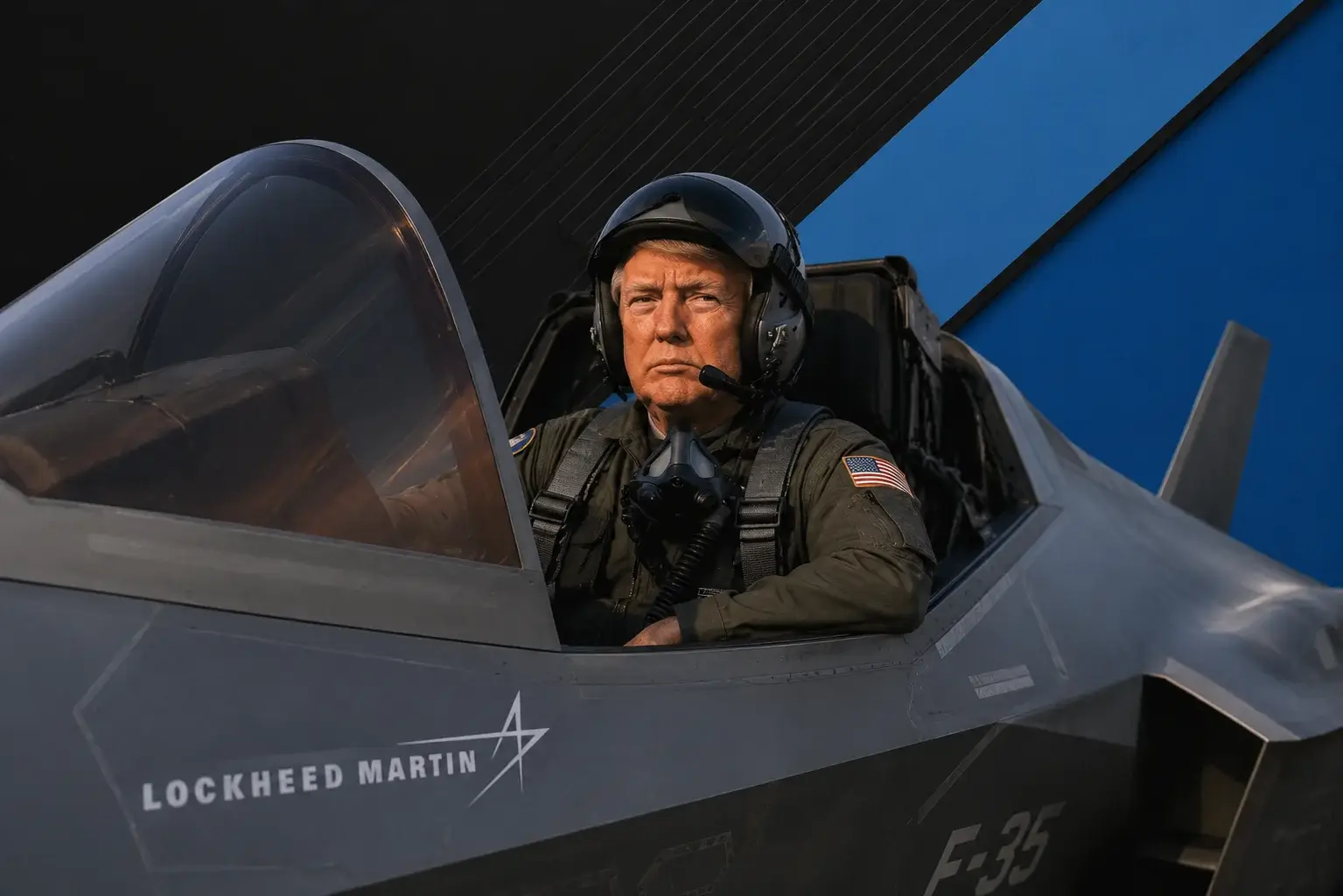
LMT Surges 11% After Q2 Sales Hit $20.1B, EPS Reaches $7.94 and Backlog Climbs to a Record $230.4B — $606.68 Target in View
Lockheed reported second-quarter sales of $20.1 billion, up 11% | That's TradingNEWS
Key Points
- Q2 sales reached $20.1 billion, up 11%, with EPS of $7.94 topping the $7.22 consensus by 10.3%.
- Free cash flow swung to $2.9 billion from negative $150 million a year ago and negative $291 million in Q1.
- Backlog hit a record $230.4 billion on $65 billion of new orders, including a $35 billion multi-year THAAD contract.
Lockheed Martin opened Thursday at $545.00 against a Wednesday close of $514.36 and kept going. The stock traded as high as $575.20 and was changing hands near $571 by mid-morning, up roughly 11% on the session. Pre-market had it at $543.52, a 5.64% gain, which turned out to understate the reaction by half. Market capitalization crossed $132.6 billion on roughly 230.6 million shares outstanding.
The move is remarkable for two reasons beyond its size. First, it happened on a day when the S&P 500 fell 0.8%, the Nasdaq Composite dropped 1.5%, and the Dow shed roughly 365 points as Brent crude crossed $100 and the 10-year Treasury yield sat at 4.695%. An 11% gain in a $130 billion defense prime against that tape is not a sympathy move — it is a repricing.
Second, it reclaimed a technical level that had been resistance since spring. The 200-day moving average has been sitting near $570, and the stock had spent the prior three months trading below it. The 50-day at roughly $521 had been acting as the ceiling. Thursday's session cleared both in a single gap.
The context makes the move more legible. Lockheed closed at $626.83 on January 29 following its fourth-quarter report, ran to $676.70 within thirty days, then gave the entire advance back. It dipped to approximately $490 in mid-June on index-driven pressure and sector rotation, recovered to $545.91 by July 2 on a 4.62% single-day gain after a broker upgrade, then drifted back to the low $510s into the print. The 52-week range spans $412.55 to $692.00.
What broke the stock in the first place was the first quarter. Sales came in at $18.021 billion, up just 0.3% and below a roughly $18.2 billion consensus. Diluted EPS of $6.44 fell 11.5% year over year and missed estimates near $6.70. Cash from operations collapsed to $220 million from $1.4 billion, and free cash flow turned negative at minus $291 million. Backlog fell to $186.4 billion from $193.6 billion at year-end. Management reaffirmed full-year guidance without raising it. The stock dropped about 5%.
Thursday reversed every one of those data points simultaneously. Sales, earnings, cash flow, backlog and guidance all moved decisively in the other direction in the same release. That is why an established, low-beta industrial with a 0.11 five-year beta just traded like a growth stock.
The Numbers: $20.1 Billion in Sales and $7.94 of EPS Against a $7.22 Bar
Second-quarter sales came in at $20.1 billion against $18.2 billion in the same quarter of 2025, growth of 11%. Consensus sat at roughly $19.33 to $19.35 billion depending on the compiler, so the top line cleared by something close to $750 million.
Net earnings were $1.8 billion, or $7.94 per diluted share. Wall Street had modelled between $7.11 and $7.28, with the most widely cited figure at $7.22 across fifteen to eighteen analysts. The GAAP print came in 10.3% above consensus.
The year-over-year comparison requires an immediate caveat, because the headline growth rate is distorted beyond usefulness. Second-quarter 2025 net earnings were $342 million, or $1.46 per share, and that figure included $1.6 billion of program losses and $169 million of other charges. Diluted EPS therefore increased $6.48 year over year, but roughly two-thirds of that improvement is the absence of a one-time disaster rather than underlying operating leverage.
Working through the bridge: consolidated operating profit rose $1.7 billion, driven largely by the prior-year reach-forward losses of $1.6 billion — recognised on a classified program at Aeronautics and on the Canadian Maritime Helicopter Program and Turkish Utility Helicopter Program at Rotary and Mission Systems — plus a prior-year $66 million fixed-asset write-off and a $43 million increase in the FAS/CAS operating adjustment. Business segment operating profit rose $1.6 billion from the same reach-forward comparison plus genuine munitions ramps at Missiles and Fire Control. Net earnings increased $1.5 billion, partially offset by a $267 million increase in income tax expense.
Strip the noise and the underlying growth is still real: an 11% top line with the fastest-growing segment expanding 19% and margins improving sequentially from a first quarter that management had already flagged as the trough.
The cash statement is where the quarter becomes genuinely difficult to argue with. Cash from operations reached $3.2 billion against $201 million a year earlier. Free cash flow was $2.9 billion against negative $150 million. Both figures are large in absolute terms, not just relative to a weak base, and both arrive after a first quarter that burned $291 million.
For a business whose entire investment case rests on converting a contracted backlog into distributable cash, that is the line item that matters most.
A $65 Billion Order Quarter and a Backlog That Went Vertical
Lockheed booked $65 billion of new orders in three months. Against quarterly sales of $20.1 billion, that is a book-to-bill ratio above three — a figure that essentially does not occur in mature defense primes outside of multi-year contract signings.
The result is a record backlog of $230.4 billion, up from $193.6 billion at year-end 2025 and up 38.3% from $166.5 billion a year ago. On an annualised run rate of roughly $80 billion in sales, that is close to three years of revenue already contracted. Management framed the prior record of $194 billion at year-end as about two and a half times annual sales; the multiple has now expanded further even as the sales base grows.
The composition matters more than the headline. Missiles and Fire Control backlog nearly doubled to $87.9 billion, driven by a $35 billion multi-year contract with the Missile Defense Agency for THAAD interceptors signed during the quarter. That single award is roughly 54% of a full year of consolidated sales, booked in one quarter, in the highest-growth segment the company operates.
Backlog quality is the right question to ask about any number this large, and the THAAD structure answers part of it. Multi-year interceptor contracts with the Missile Defense Agency are among the most durable revenue streams in the industry — they carry funded and unfunded components, they survive administration changes better than platform programs, and they are supported by allied demand that is currently unconstrained.
The book-to-bill trajectory has been building. Full-year 2025 produced a ratio of 1.2 with backlog growing $17.3 billion, or 17%, marking the fourth consecutive annual increase. The second quarter of 2026 did more than the whole of 2025 in a single period.
The obvious caution is that backlog is a promise, not revenue. Converting $230.4 billion into sales requires production capacity that does not currently exist, and management has been explicit that building it takes years rather than quarters. A backlog growing faster than the ability to work it down is a good problem, but it is still a constraint — and it is the constraint that determines how much of Thursday's enthusiasm survives the next four quarters.
Missiles and Fire Control Is Now the Entire Story
Missiles and Fire Control posted sales of $4.1 billion, up 19% or $668 million year over year. The composition is precise: approximately $560 million came from integrated air and missile defense programs on production ramps for PAC-3 and THAAD, and roughly $100 million from tactical and strike missile programs on the Precision Strike Missile ramp. Segment operating profit rose $115 million, or 24%, growing faster than sales — which is the signature of genuine operating leverage rather than mix.
The structural story behind those ramps was set earlier this year. Lockheed signed a seven-year framework agreement for PAC-3 missiles in the first quarter and announced a comparable arrangement for THAAD on the same call. The stated objective is to lift annual PAC-3 production capacity from roughly 600 to 650 units to 2,000 per year. The framework agreements also carry make-whole provisions that protect returns if the customer changes procurement strategy mid-stream — a meaningful de-risking of the capital being committed.
Management has guided Missiles and Fire Control to at least double-digit compound annual sales growth through the end of the decade. On a $4.1 billion quarterly base growing 19%, that is a conservative-sounding target that implies the segment roughly doubles by 2030.
The demand backdrop is not speculative. NATO awards approaching $50 billion have been announced this year. European rearmament has accelerated, with Britain's new government redirecting spending toward defense and space capability. The US-Iran war that began in late February has run continuously since, with a twelfth consecutive night of strikes completed this week, consuming interceptors at a rate that guarantees restocking demand for years. A pledge to allow Ukraine to license Patriot production layers additional volume onto a queue that is already committed.
Here is the honest limitation, and it came directly from the chief executive earlier this year. The ramp from 650 Patriot missiles annually to 2,000 will take three to four years depending on supply chain conditions. Demand is not the constraint. Physical production capacity is. That timeline is what paces how quickly $87.9 billion of segment backlog becomes recognised revenue, and it is why the segment's growth rate — impressive at 19% — is not going to inflect to 40% no matter how many contracts get signed.
Capital is being deployed against it. Lockheed put more than $3.5 billion into production capacity and next-generation technology in 2025 and is guiding combined capital and internal research spending toward approaching $5 billion in 2026.
Aeronautics Cleaned Up After a Genuinely Bad First Quarter
Aeronautics generated $8.1 billion of sales, up 9%, led by higher F-35 production volume. Segment operating profit increased $858 million, though the bridge again requires care: the improvement was primarily attributable to the $950 million reach-forward loss recognised on a classified contract in the prior-year quarter, plus higher sales volume on F-35 production contracts, partially offset by $160 million of lower net favourable profit adjustments across the portfolio.
That last item deserves attention. A $160 million reduction in favourable profit booking adjustments means the underlying program performance was slightly less generous than a year ago even as volume improved. Defense primes recognise profit on long-term contracts through estimates-at-completion, and adjustments swing both ways. This quarter they leaned modestly negative on the margin line even while the headline exploded.
Compare that with the first quarter, when the same segment produced sales of $6.953 billion — down 1% — with operating profit of $619 million, down 14%, and margin compressing to 8.9% from 10.2%. The damage came from $125 million of unfavourable profit adjustments on the F-16 program tied to production performance and development delays, plus $55 million of net unfavourable adjustments on the C-130 program from diminishing manufacturing source integration challenges and associated delivery delays. Thirty-two F-35 aircraft were delivered in that quarter.
The F-35 franchise itself remains the anchor. Deliveries reached 191 aircraft in 2025, up sharply from 110 in 2024. Contract awards tied to Lots 18 through 21 plus full-year sustainment total more than $15 billion, and a $700 million award for long-lead materials on Lots 20 and 21 for international partners was booked earlier this year. The program's estimated lifetime cost to purchase, operate and sustain exceeds $2 trillion, making it the largest acquisition program the Pentagon has ever run and one Lockheed expects to operate into the 2060s.
International expansion continues to add optionality. Reports this month indicated the administration is likely to support F-35 sales to Turkey, which would restore a partner removed from the program in 2019. Allied commitment has strengthened as the aircraft has been used operationally.
Aeronautics is not the growth engine anymore — that title belongs to munitions. But it is roughly 40% of consolidated sales, and a quarter where it grows 9% with clean execution removes the single biggest overhang the stock carried into this print.
Rotary, Space, and the Ultra Maritime Chapter That Is Not Yet in the Numbers
Rotary and Mission Systems delivered $4.4 billion in sales, up 9%. Space contributed $3.5 billion, up 6%. Neither segment produced fireworks, and after the first half of this year that is precisely the point.
Rotary and Mission Systems carried two of the prior year's three reach-forward losses — the Canadian Maritime Helicopter Program and the Turkish Utility Helicopter Program — and its recovery to clean 9% growth removes a source of recurring negative surprise. Government helicopter deliveries reached 90 units in 2025, up from 72 in 2024, and the production base has been stabilising alongside that volume.
The forward-looking item for this segment is the pending acquisition of Ultra Maritime for $3.45 billion, announced earlier this month. The deal expands undersea and anti-submarine warfare capability and would sit inside Rotary and Mission Systems. It remains subject to regulatory approvals and — this matters for anyone modelling the guidance — it is explicitly not incorporated into the raised outlook. Every figure management published Thursday excludes it.
That is a meaningful piece of hidden upside if the transaction closes on schedule. Anti-submarine warfare is among the fastest-growing niches in allied procurement given undersea infrastructure vulnerability and great-power naval competition, and Lockheed's existing sonar and maritime systems positions give it a credible integration case. It is also a capital deployment of roughly 2.6% of market capitalisation into a business the company will now have to prove it can absorb.
Space at $3.5 billion and 6% growth is the quietest part of the portfolio and the one most exposed to a shifting competitive landscape. Commercial launch economics have changed the calculus for national security space, and the segment's growth rate reflects that.
Two smaller items from recent weeks fill in the innovation picture. On July 21 the company announced a joint technology development agreement with a propulsion startup to evaluate and mature rotating detonation rocket engine technology for future long-range precision fires — a genuine attempt to leapfrog conventional propulsion for hypersonic-class weapons. Separately, it unveiled a counter-swarm interceptor system aimed at the drone threat that has dominated recent conflicts.
Neither moves the model this year. Both indicate where the roughly $5 billion of combined capital and research spending planned for 2026 is going.
Read More
-
Yen Stalls at 160 Despite a 3% JGB and Tokyo Core CPI at 2.0% — Intervention Sits at 164, Friday's Payrolls Decide
02.09.2026 · TradingNEWS ArchiveEnergy
-
AMD ($560.68) Rebounds 10% From Its October Low on the Meta Helios Win — November 3 Report Holds the Key to $649
27.10.2026 · TradingNEWS ArchiveStocks
-
Ethereum ($2,312) Lags Bitcoin and AI Stocks as BitMine Nears Its 5% Cap — Break of $2,295 Opens $2,200
27.10.2026 · TradingNEWS ArchiveCrypto
-
Brent ($113.88) Trades a $2.35 Range as Houthi Strikes Meet Saudi-Iran Diplomacy — Break of $117 Unlocks $120
27.10.2026 · TradingNEWS ArchiveCommodities
-
Nasdaq Rips 1.3%, S&P 500 Hits 7,728, Dow Stalls as BA Drops to $171
27.10.2026 · TradingNEWS ArchiveMarkets
-
GBP/USD (1.3310) Can’t Cash In on 5.43% Gilt Yields as Budget Risk Meets a Firm Dollar — Break of 1.3274 Opens 1.3200
27.10.2026 · TradingNEWS ArchiveForex
The Guidance Raise Is What Actually Re-Rated the Stock
A beat on a quarter with a distorted comparison base is worth a few percent. An 11% move requires the outlook, and Lockheed raised all three headline metrics.
Full-year 2026 sales guidance went to approximately $79.75 billion to $81.75 billion from a prior range of $77.5 billion to $80.0 billion. The midpoint of $80.75 billion sits roughly 2% above the analyst consensus of $79.1 to $79.14 billion — and it is worth noting that the bottom of the new range now exceeds the old midpoint.
Full-year diluted EPS guidance moved to $29.95 to $30.65 from $29.35 to $30.25, against a consensus estimate of $29.89. The entire new range sits above the Street's central case.
Free cash flow guidance rose to $7.0 billion to $7.2 billion from $6.5 billion to $6.8 billion. That is a $450 million increase at the midpoint on a base that, three months ago, management had declined to touch.
The chief executive's framing tied the numbers together: accelerated year-over-year sales growth of approximately 8%, driving 28% higher segment operating profit, with free cash flow now projected above $7 billion. The prior segment operating profit guide was $8.425 billion to $8.675 billion; the 28% growth figure implies the upper portion of that range or better.
Context is what makes the raise credible rather than promotional. Ninety days ago, after a quarter that missed on revenue, missed on earnings and burned cash, management reaffirmed the full-year outlook without raising it — a decision that read at the time as either discipline or denial. Management also told investors on that call to expect margins to improve over the course of the year, with gains concentrated in the second half as production milestones were achieved and risks retired.
That is exactly what happened. The company said second-half margin expansion was coming, delivered it a quarter early, and then raised guidance rather than banking the beat. Doing what you said you would do is not a common experience in defense contracting, and the multiple expansion Thursday reflects a market repricing execution risk rather than simply marking up a number.
The unaddressed question is what the guidance assumes about production capacity. An 8% growth rate against a backlog growing 38% means the constraint is real.
Free Cash Flow Was the Real Beat, and It Comes With a Bill
Free cash flow of $2.9 billion against negative $150 million a year earlier, following negative $291 million in the first quarter, is the single most important number in the release. Defense investors buy backlog conversion, and conversion shows up in cash.
Cash from operations of $3.2 billion against $201 million tells the same story with the working-capital noise included. Both figures reflect milestone achievement and customer payments landing in the period, which is inherently lumpy — the first quarter's collapse and the second quarter's surge are the same phenomenon viewed from opposite ends.
The raised full-year target of $7.0 billion to $7.2 billion implies roughly $4.4 billion of free cash flow across the second half, against $2.6 billion generated in the first. That is achievable given the margin trajectory management has described, but it is not conservative.
The bill arrives on the capital expenditure line. Full-year capex guidance sits at $2.5 billion to $2.8 billion in support of production ramps and strategic growth opportunities, and combined capital plus internal research and development spending is guided toward approaching $5 billion in 2026, up from more than $3.5 billion deployed in 2025. Tripling PAC-3 output and quadrupling THAAD output does not happen without physical plant.
Shareholder returns remain steady rather than aggressive. The company repurchased $3.0 billion of stock in 2025, retiring 6.6 million shares, and has raised its dividend for 23 consecutive years. The forward dividend of $13.80 per share yields 2.68% at Wednesday's close and roughly 2.42% after Thursday's move. The ex-dividend date was June 1.
The tension worth naming: at $7.1 billion of guided free cash flow against roughly $5 billion of combined capex and research spending plus approximately $3.2 billion of annual dividend obligations, the buyback is being funded at the margin. That is a defensible allocation when the incremental capital is going into capacity that is fully contracted for seven years. It is less defensible if the ramp slips.
The Ultra Maritime acquisition adds $3.45 billion of cash or debt to that calculation, and it is not in any of these figures.
Valuation: What You Are Actually Paying After an 11% Day
At roughly $571, Lockheed trades at approximately 18.8 times the midpoint of its newly raised 2026 EPS guidance of $30.30. That is a modest multiple for a business with three years of contracted backlog, a 38% backlog growth rate and a raised outlook.
The trailing figures are misleading and should be discarded. Trailing twelve-month EPS of $20.63 produces a price-to-earnings ratio of 27.88, but that denominator contains the $1.6 billion of prior-year reach-forward losses and the weak first quarter. As those roll off, the trailing multiple compresses mechanically toward the forward figure without the price doing anything.
On cash, the arithmetic is cleaner. Guided free cash flow of $7.0 billion to $7.2 billion against a market capitalisation of roughly $132.6 billion produces a free cash flow yield of approximately 5.4%. Against a 10-year Treasury at 4.695%, that is a spread of roughly 70 basis points for an equity with a contracted revenue base — thin by historical standards but defensible given the visibility. Price-to-sales sits near 1.6.
The dividend yield of about 2.42% post-move, backed by 23 consecutive years of increases and a payout that consumes under half of guided free cash flow, provides a floor for the income-oriented holders who make up a meaningful share of the register.
Where it gets interesting is against analyst targets. The consensus twelve-month price target across 21 analysts stands at $606.68, implying roughly 6% upside from current levels. That consensus was constructed before Thursday's guidance raise and includes a series of July reductions: one house cut to $575 from $650 on July 8, another to $560 from $600 on July 13 while maintaining a Hold. A Buy upgrade with a $582 target arrived on July 1. Older marks include Equal-Weight at $653 and a Positive rating at $700.
Thursday's move has already carried the stock through two of those targets and to within a dollar of a third. The consensus rating is Hold. Both the ratings distribution and the target distribution now look stale, and the mechanical consequence of a beat-and-raise of this magnitude is a wave of upward revisions over the coming week.
The counterweight is the five-year sales compound annual growth rate of 2.9%. That is the number bears will point at, and it is accurate — this company has not been a grower.
The Demand Backdrop Is Structural, Not a Single Quarter
The reason this print is not being treated as a one-off is that the underlying spending environment has changed in ways that are difficult to reverse quickly.
The US-Iran war has run continuously since late February, with a twelfth consecutive night of strikes completed this week and Brent crude crossing $100 as a direct consequence. Interceptor consumption in that theatre, combined with Red Sea and Strait of Hormuz shipping defense, is depleting inventories that took years to build. Pentagon restocking demand is the phrase management used, and it is the cleanest driver of the $65 billion order quarter.
European rearmament is the second leg. Britain's new government has explicitly redirected fiscal priorities toward defense, with the appointment of a chancellor who resigned a prior defense post over insufficient security spending read by markets as a commitment to higher outlays. Awards approaching $50 billion tied to NATO requirements have been announced this year. A partnership with a major German land systems manufacturer expands Lockheed's European missile production footprint, addressing the localisation requirements that increasingly govern allied procurement.
The third leg is allied fighter demand. Support for restoring F-35 sales to Turkey would add a partner nation, and international long-lead awards for Lots 20 and 21 indicate continued commitment from existing ones.
The counterweight, and it is significant, is customer concentration. Lockheed derived nearly 75% of its $71 billion in 2024 sales from the US military. That is a single customer operating the largest defense budget on earth, but it is also a customer whose appropriations run through an inherently political process. A change in administration priorities, a continuing resolution, or a sequestration-style budget mechanism can alter the trajectory faster than any competitive dynamic.
The make-whole provisions embedded in the PAC-3 and THAAD framework agreements are management's answer to part of that risk — they protect returns on capacity investment if procurement strategy changes. They do not protect the revenue line.
The broader observation is that this is the first quarter in which the defense spending cycle showed up in Lockheed's reported numbers rather than in commentary. Order books have been signalling it for eighteen months. Revenue and cash flow only started confirming it in the last ninety days.
What Can Still Go Wrong, and It Is Not Demand
The risk register for this stock has almost nothing to do with whether customers want the products.
The first and largest risk is production capacity. Lifting PAC-3 output from 650 units annually to 2,000 will take three to four years depending on supply chain conditions. That is management's own timeline, delivered plainly. A backlog of $230.4 billion against roughly $80 billion of annual sales means the company is now selling capacity it will not have for years. Any slippage in that ramp converts directly into pushed-out revenue and a backlog that keeps growing without converting.
The second is fixed-price program risk, and the recent record is not reassuring. The prior-year quarter carried $1.6 billion of reach-forward losses across a classified Aeronautics program, the Canadian Maritime Helicopter Program and the Turkish Utility Helicopter Program. The first quarter of this year carried $125 million of unfavourable F-16 adjustments on production performance and development delays plus $55 million on C-130 delivery delays from manufacturing source integration problems. This quarter carried $160 million of lower net favourable adjustments across the portfolio. Reach-forward losses on development-heavy fixed-price contracts have been the single most reliable source of negative surprise at this company for five years, and nothing in Thursday's release suggests that has been structurally solved.
Third, the guidance embeds a second-half free cash flow acceleration to roughly $4.4 billion from $2.6 billion in the first half, at the same time capital and research spending approaches $5 billion for the year. Those two commitments compete.
Fourth, Ultra Maritime carries both regulatory risk and integration risk, and none of it is in the guidance. A deal of $3.45 billion into a segment that produced two of last year's three reach-forward losses is not a free option.
Fifth, and most subtly: a 0.11 five-year beta means this stock does not fall with the market. It also means it does not get rescued by one. When Lockheed sells off, it sells off on company-specific news, and there is no broad rally to lift it back. The mid-June dip to approximately $490 and the 5% drop after the first-quarter miss are both examples.
Finally, energy costs. Brent moving from $70 to above $100 in a month raises input costs across a manufacturing base that has already been struggling with supplier performance.
Forecast: Levels, Scenarios and the Calendar That Matters
The technical picture reset entirely on Thursday. The stock gapped from a $514.36 close to a $545.00 open and ran to $575.20, clearing both the 50-day moving average near $521 and the 200-day near $570 in one session. Those two levels now invert into support.
Immediate support sits at $545, marking the opening print and the session low of $545.38 — a gap that would need to fill for the move to be considered a failure. Below that, $521 at the 50-day and $514.36 at the prior close define the retracement zone. Resistance begins at Thursday's high of $575.20, then the consensus target of $606.68, then the January 29 close of $626.83, with the post-earnings peak of $676.70 and the 52-week high of $692.00 defining the upper structure.
The base case, carrying the highest probability, is consolidation between $545 and $600 over the coming weeks as analysts revise targets upward and the initial buying exhausts itself. Gap-up moves of 11% in low-beta industrials typically see partial retracement within two to three sessions, and the fundamental case does not require immediate follow-through. At 18.8 times guided earnings with a 5.4% free cash flow yield, the stock is not stretched, but it is also no longer cheap.
The bullish scenario requires holding above $575 on a weekly closing basis and clearing $606.68. Triggers: upward analyst revisions in the coming week, Ultra Maritime regulatory clearance, further multi-year munitions awards, or a European defense budget announcement of scale. That path opens the $626 to $676 zone, which would take the stock back to its January highs and imply roughly 21 times guided earnings.
The bearish scenario activates on a close back below $545, which would fill the gap and signal the move was mechanical rather than fundamental. Triggers: any indication on the earnings call or in follow-up commentary that the production ramp timeline is slipping, a new reach-forward loss disclosure, or budget headlines that call the appropriations trajectory into question. First objective would be $521, then the pre-print $514 level.
The calendar ahead is thinner than the past twenty-four hours. The third-quarter report is the next hard catalyst, with Ultra Maritime's regulatory progress the main event before it. The broader market backdrop — the FOMC decision on July 28-29 and an oil price above $100 — matters less for a 0.11-beta stock than it does for almost anything else in the index, which is exactly why this name outperformed by nearly twelve percentage points on Thursday.