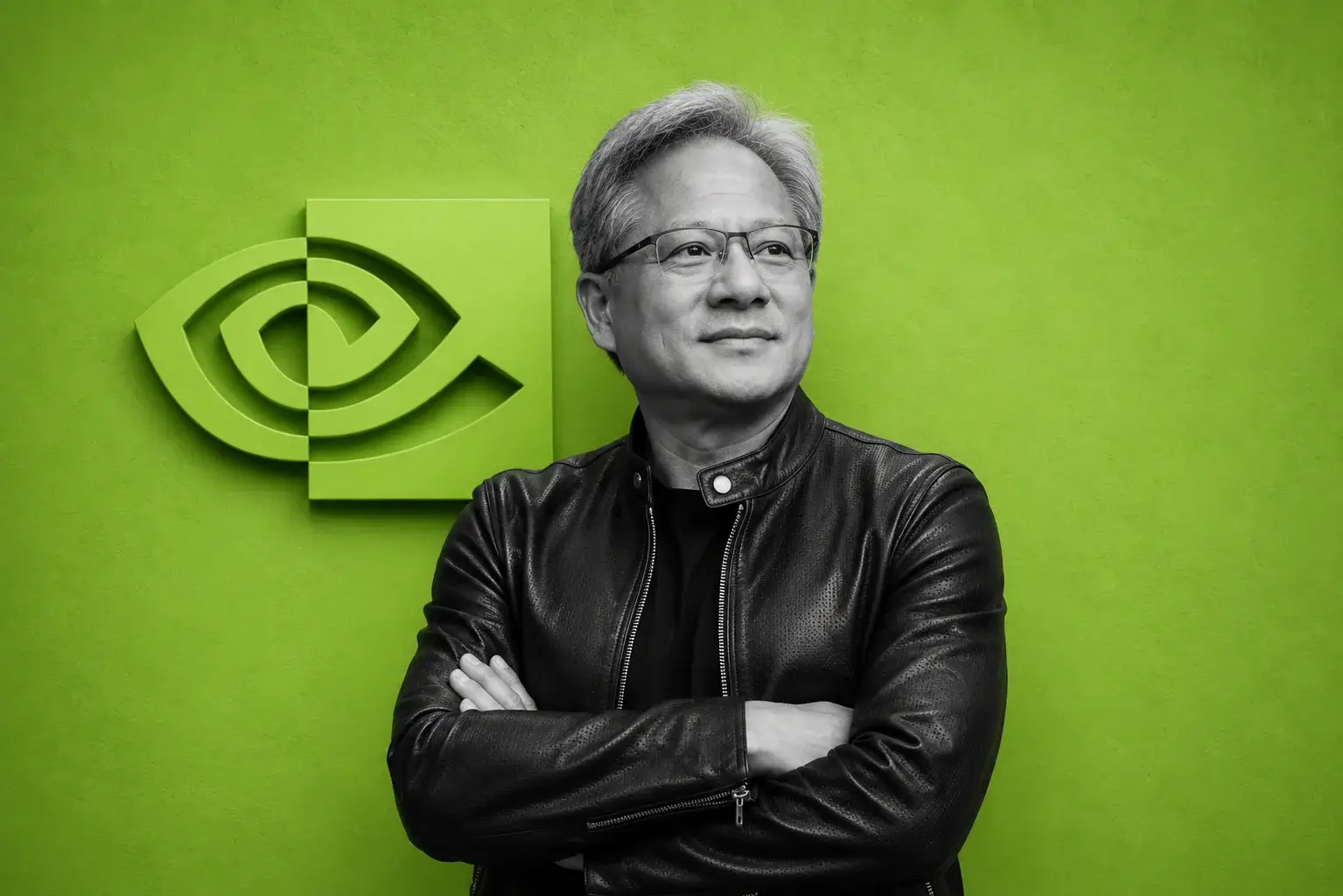
NVDA Detonates on the N1X PC Reveal — $75B Data Center Engine and a New TAM Push the Stock Toward Its $236 Record
Nvidia kicked off June by muscling into the PC market and confirming Vera is shipping to OpenAI and Anthropic | That's TradingNEWS
Key Points
- NVDA rips to $221 on the N1X PC reveal and Vera full production, reclaiming the 20-day EMA toward the $236 record.
- Data Center revenue hit $75.2B, up 92%, with total revenue up 85% to $81.6B and free cash flow surging to $49B.
- Margins held at 75% as Blackwell scaled; the N1X opens a new PC TAM, with the path to $236 now back in play.
This is Nvidia's (NASDAQ:NVDA) day, and the stock is acting like it. Shares are changing hands near $220.67, up better than 4% on the session after trading a range of $215.10 to $222.17, and the move is the cleanest expression of the AI trade reigniting across the entire market. The catalyst is the company's own keynote — Jensen Huang used the Computex stage in Taipei, which Nvidia branded "GTC Taipei," to unveil the N1X, the chip designed to serve as the main processor inside a Windows PC, co-developed with Microsoft and anchored by a new RTX Spark laptop line shipping this fall. Huang called it the biggest reinvention of the computer in four decades. The reveal didn't just lift NVDA — it dragged the whole complex with it, sending software names like ServiceNow and Adobe higher while smoking Intel and AMD, the two companies whose x86 turf Nvidia just invaded. Volume of 74.9 million shares ran below the 181 million daily average, which tells you this is a catalyst-driven gap rather than a capitulation or blow-off. The most important AI stock on the planet just handed itself a new growth narrative, and the tape is repricing it in real time.
Reclaiming the 20-Day EMA on the Path Back to $236.54
The technical setup is a stock breaking out of a three-month coil right into striking distance of its record. NVDA chopped sideways for roughly three months after setting its all-time high of $236.54 (closing high $235.74 on May 14), and today's surge is the breakout attempt, reclaiming the 20-day EMA and turning the near-term structure back up. The chart read is constructive: the post-earnings selloff that followed the May 20 print is now being recovered, and the Fibonacci retracement work points toward $226 as the first upside target, with the $236.54 all-time high the magnet beyond it. The 52-week range runs from a $135.40 low to that $236.54 peak, so the stock sits about 7% below its record and roughly 63% above its trough. The structure to watch is whether this gap holds — a daily close back above the 20-day EMA that sustains into $226 confirms the breakout and reopens the path to a fresh all-time high, while a fade back below the recent consolidation lows re-arms the sideways grind. With a beta of 1.42 and 6.3% volatility, Nvidia stock moves hard in both directions, and today it's moving up toward the level that defines a new leg.
The Q1 FY2027 Blowout That Underpins Everything
The fundamental backbone of this move is a quarter that was, on every line, exceptional. Nvidia reported fiscal first-quarter results on May 20 with total revenue of $81.6 billion, up 85% year-on-year and 20% sequentially — the third consecutive quarter of accelerating year-on-year growth and the fourteenth straight quarter of sequential gains, with the $13.5 billion sequential increase a company record. GAAP earnings came in at $1.87 per share, ahead of the $1.77 consensus. The scale of the beat matters less than the trajectory: a company this size still compounding at 85% is the engine behind the entire AI equity narrative, and the acceleration rather than deceleration is what justifies the premium. Free cash flow reached a staggering $49 billion in the quarter, up from $35 billion the prior quarter, and the company backed it with capital returns that signal confidence — an $80 billion new share repurchase authorization and a dividend raised sharply from $0.01 to $0.25 per quarter. When the most important AI company posts record sequential growth and floods $49 billion of cash through in a single quarter, the burden of proof shifts to the bears, and today's tape reflects exactly that.
The $75 Billion Data Center Engine
The heart of Nvidia is the data center, and the number is colossal. Data Center revenue hit a record $75.2 billion in the quarter, up 92% year-on-year and 21% sequentially, driven by the ramp of the Blackwell 300 products and demand for the company's InfiniBand, Spectrum-X Ethernet, and NVLink networking solutions. Inside that figure, the split is telling: Data Center compute revenue was a record $60.4 billion, up 77% year-on-year, while Data Center networking revenue was $14.8 billion, up 199% — nearly tripling — as customers buy the full rack-scale system rather than just the chips. The networking explosion is the underappreciated story, because it shows Nvidia is selling an integrated platform, not a commodity GPU, which is what protects its pricing and its moat. Hyperscaler revenue held at roughly 50% of the Data Center total, with the other half coming from a widening base of AI clouds, enterprise, industrial, and sovereign customers — a diversification that reduces the risk of any single hyperscaler pausing orders. A $75 billion data center business growing 92% is the most powerful single line item in technology, and it's the foundation under every bull case for NVDA.
Margins Held the Line at 75%
The margin question was the one that mattered most into the print, and Nvidia answered it. Non-GAAP gross margin held around the 75% level even as the Blackwell architecture became the majority of revenue, clearing the bar the market set — consensus sat at 74.5% against company guidance near 75%, with anything below 73% flagged as a pricing-pressure warning and anything at or above 75% confirming pricing power remains intact. Nvidia landed on the right side of that line. Gross margin actually increased year-on-year on lower inventory provisions, lapping the prior year's $4.5 billion charge tied to H20 excess inventory, and held approximately flat sequentially as Blackwell scaled. This is the crux of why the stock works: a company ramping a complex new architecture is supposed to suffer margin compression, and Nvidia is holding 75% gross margins while doing it. That pricing power is the difference between a chip vendor and a platform monopoly, and it's the single cleanest piece of evidence that the competitive moat is intact even as the company pushes Blackwell into volume. Margins held, and the bear's best argument lost its ammunition.
The N1X Reveal Opens an Entirely New TAM
Today's catalyst isn't about the quarter that was — it's about the addressable market Nvidia just claimed. The N1X chip, built with Microsoft and slated to anchor the RTX Spark laptop line this fall, is the company's first serious push to put its silicon at the center of a Windows PC, expanding its AI footprint from the data center to the desktop. The strategic logic is straightforward and powerful: Nvidia already dominates AI training and inference in the cloud, and now it's extending that franchise to the roughly quarter-billion-unit annual PC market, a category that's been the exclusive domain of Intel and AMD's x86 architecture for forty years. The reveal pushes Arm-based processing into mainstream computing and reframes the PC from a declining legacy category into a potential AI-PC refresh cycle, with premium price points and agentic AI running locally on-device. For a stock already priced for AI dominance, opening a brand-new multi-hundred-million-unit TAM is precisely the kind of growth optionality that justifies a higher multiple. The market grasped it instantly — NVDA gapped up while the incumbents it's displacing got crushed, with Intel sliding nearly 6% and AMD off around 4%.
Vera in Full Production With OpenAI and Anthropic
The second bombshell from the keynote may matter more than the PC chip for the core business. Huang confirmed that the new Vera CPU is in full production, with early adoption already locked in from OpenAI, Anthropic, and SpaceX — the marquee names whose compute demand is the entire AI capex story. Vera is the CPU piece of Nvidia's push into agentic AI, and full production with named frontier-lab customers tells the market the data-center build-out hasn't slowed a step even as the company chases the consumer PC. This is the part of the business that's been minting the company's trillions, and confirmation that Vera is shipping to the labs building the most advanced AI systems is direct evidence that the demand pipeline extends well beyond Blackwell. The combination is what makes today's move so potent: the N1X grabs a new market while Vera confirms the existing one is accelerating, and the two together tell a story of a company expanding its TAM on both ends simultaneously. The data-center engine that drove the $75 billion quarter has its next leg already in production and already spoken for.
Sovereign AI and the Diversifying Customer Base
A quieter but structurally important theme is who's buying. Sovereign AI revenue grew more than 80% year-on-year, as nation-states race to build domestic AI infrastructure rather than depend on foreign clouds, and that demand is a durable, multi-year tailwind that's largely independent of the hyperscaler capex cycle. The diversification matters because the single biggest bear argument against Nvidia has always been customer concentration — the fear that a handful of hyperscalers could pull back orders in unison and crater revenue. With hyperscalers now at only half of Data Center revenue and the other half spread across AI clouds, enterprises, industrials, and sovereigns growing 80%-plus, that concentration risk is visibly easing. The customer base is broadening at exactly the moment the bears need it to narrow for their thesis to work. Sovereign demand in particular is a geopolitical phenomenon — governments treating AI compute as strategic infrastructure the way they treat energy or defense — and it gives Nvidia a buyer pool that spends through economic cycles. The diversification is the structural answer to the concentration fear, and it's strengthening.
The China Overhang That Caps the Upside
The one genuine cloud over Nvidia remains China, and it's a real number. No shipments of Data Center Hopper products to China occurred during the quarter, compared with $4.6 billion in the year-ago period — a complete shutout of what was once a major market, with management excluding the region from forward guidance entirely since the H20 restrictions took effect. The previously disclosed $4.5 billion inventory charge tied to H20 excess remains the baseline. The China situation is the highest-variance line in the entire model: it's a headwind today because billions in revenue have evaporated, but it's also embedded option value, because any constructive policy signal — a reopened H20 channel or an approved H200 variant — would reset the model higher overnight. The bear reads it as a permanent loss of a key market; the bull reads it as upside that isn't in any estimate. What's not in dispute is that Nvidia is posting 85% revenue growth and record results with China contributing essentially nothing, which is itself a remarkable demonstration of how strong the rest-of-world demand is. China is the overhang and the wildcard at once, and it's the main reason the stock isn't already through its record.
The Rubin Hand-Off Is the Next Catalyst
The forward roadmap is what keeps the growth story alive beyond Blackwell, and the market is watching the transition closely. The GB300 Ultra is moving from sampling to production as the next leg of the Blackwell cycle, and the Rubin architecture is targeted for a second-half calendar-2026 ramp — the generational hand-off that has to go smoothly to preserve the momentum. The risk is execution: any delay in the Blackwell-to-Rubin transition reshapes 2027 estimates and ripples through the supply chain, hitting Broadcom and TSMC alongside Nvidia. The bull case requires a clean cadence — GB200 NVL72 rack timing flowing smoothly across hyperscalers, GB300 Ultra ramping on schedule, and Rubin handing off without an order pause that signals customers are digesting rather than buying. So far the signals are constructive, with Huang framing the demand as exponential and declaring the agentic AI inflection point has arrived. The roadmap is the reason Nvidia isn't a one-architecture story — there's always a next-generation product driving the upgrade cycle, and the smooth progression from Hopper to Blackwell to Rubin is what underwrites the durability of the data-center engine through 2027.
Read More
-
Yen Stalls at 160 Despite a 3% JGB and Tokyo Core CPI at 2.0% — Intervention Sits at 164, Friday's Payrolls Decide
02.09.2026 · TradingNEWS ArchiveEnergy
-
QQQ ETF ($706.22) Slides 7.4% Below Its High as the Market Reprices the AI Capex Bill — $686.57 Target if $700 Breaks
22.10.2026 · TradingNEWS ArchiveStocks
-
XRPI ($7.00) and XRPR ($10.74) Slide Toward 52-Week Lows as Spot XRP ETF Flows Stall at $708,510
22.10.2026 · TradingNEWS ArchiveCrypto
-
NG ($2.775) Decoupled From Europe’s €88 Gas Crisis as LNG Feedgas Hits 18.9 Bcf/d — $3.30 Upside on Cold Weather
22.10.2026 · TradingNEWS ArchiveCommodities
-
Dollar-Yen (157.35) Loses 157.65 as the Yen Rallies on Haven Demand — 155 Target if 156 Breaks
22.10.2026 · TradingNEWS ArchiveForex
Valuation, the $5 Trillion Question, and the Analyst Wall
Nvidia now carries a market capitalization around $5.1 trillion, which puts the valuation debate front and center — is the most valuable company on earth still worth buying at that scale? The bull answer rests on the growth and the cash: a company compounding revenue at 85% with 75% gross margins and $49 billion of quarterly free cash flow can grow into almost any multiple, and the N1X reveal just expanded the TAM that multiple is priced against. The sell-side is firmly in the bull camp — Bank of America reiterated a Buy with a $320 target heading into June, implying roughly 45% upside, while Goldman Sachs reaffirmed its Buy and sees modest upside post-Computex. The targets cluster well above the current $220.67, and the consistency of the Buy ratings across the major shops reflects a Street that views the AI infrastructure build-out as durable rather than a bubble about to burst. The $80 billion buyback authorization is itself a valuation statement — management spending that kind of capital on its own stock signals it views the shares as undervalued relative to the cash-generation trajectory. At $5 trillion the bar is high, but the growth, the margins, and the new TAM all argue the multiple has room.
The Competitive Battlefield: Intel, AMD, Arm, and Broadcom
Today's reveal redrew the competitive map in real time. The N1X is a direct assault on Intel and AMD's x86 stronghold, and the market priced it instantly — Intel sank near 6% and AMD fell around 4% as traders recognized that Nvidia just brought a credible challenge to the architecture that's owned Windows computing for four decades. Arm Holdings, whose instruction set the N1X is built on, ripped higher as the obvious beneficiary, with its stock already up more than 200% this year on the Arm-eats-x86 thesis that Nvidia just supercharged. Broadcom sits on the other side of the trade as both partner and bellwether — its AI-chip guidance, due Wednesday, carries the weight to validate or puncture the broader semiconductor narrative, and a strong print would confirm the AI capex Nvidia is riding. The competitive dynamic is the entire bull case in miniature: Nvidia isn't defending its turf, it's invading everyone else's, expanding from data center into PC and from GPU into CPU and networking. The companies it competes with are watching it take their markets, and the relative stock moves today told you exactly who's winning.
The Verdict: Buy, With the $236 Record Back in Play
Pulling every thread together, Nvidia stock (NASDAQ:NVDA) is a buy on this breakout, and the conviction is high. The case is overwhelming on the fundamentals: total revenue up 85% to $81.6 billion, a $75.2 billion data center engine growing 92%, networking nearly tripling, gross margins holding the critical 75% line as Blackwell scales, $49 billion of quarterly free cash flow, an $80 billion buyback, and sovereign demand up 80%-plus diversifying the customer base away from hyperscaler concentration. On top of that fortress, the N1X reveal opens an entirely new PC TAM while Vera enters full production for OpenAI and Anthropic, expanding the growth story on both ends at once. The technical picture confirms it — the stock reclaimed the 20-day EMA and broke out of a three-month coil with $226 the first target and the $236.54 all-time high the magnet beyond. What invalidates the bull case is specific and worth respecting: a hard negative on China that turns the overhang permanent, a stumble in the Blackwell-to-Rubin hand-off that signals demand digestion, gross margins cracking below 73% on a future print, or a Broadcom miss Wednesday that punctures the broader AI capex narrative. What invalidates the bear case is what's happening today — the stock clearing its consolidation, the new TAM repricing the multiple, and the path to a fresh record reopening. At a $5 trillion valuation the expectations are enormous, but Nvidia keeps clearing them, and the company just gave itself two new reasons to grow. The most important AI stock on the board is breaking out on its own catalyst, and the $236 record is back in play.