Nvidia Slides to $223.20 as Rates Hit Chips, but a $108T Guide and $150B Buyback Keep $6T in Sight
The stock broke its $228.32 20-day average on Wednesday, putting a 10% correction to $219 in play | That's TradingNEWS
Key Points
- Nvidia dropped $5.32, or 2.33%, to $223.20 as the 10-year Treasury yield climbed to 5.278% after CPI.
- Q3 fiscal 2027 revenue guidance of $108.0 billion sits 12% above Q2’s $96.2 billion with zero China revenue assumed.
- A close below $219 targets $210, while a reclaim of $228.32 opens a path to $238.90 and $248.96.
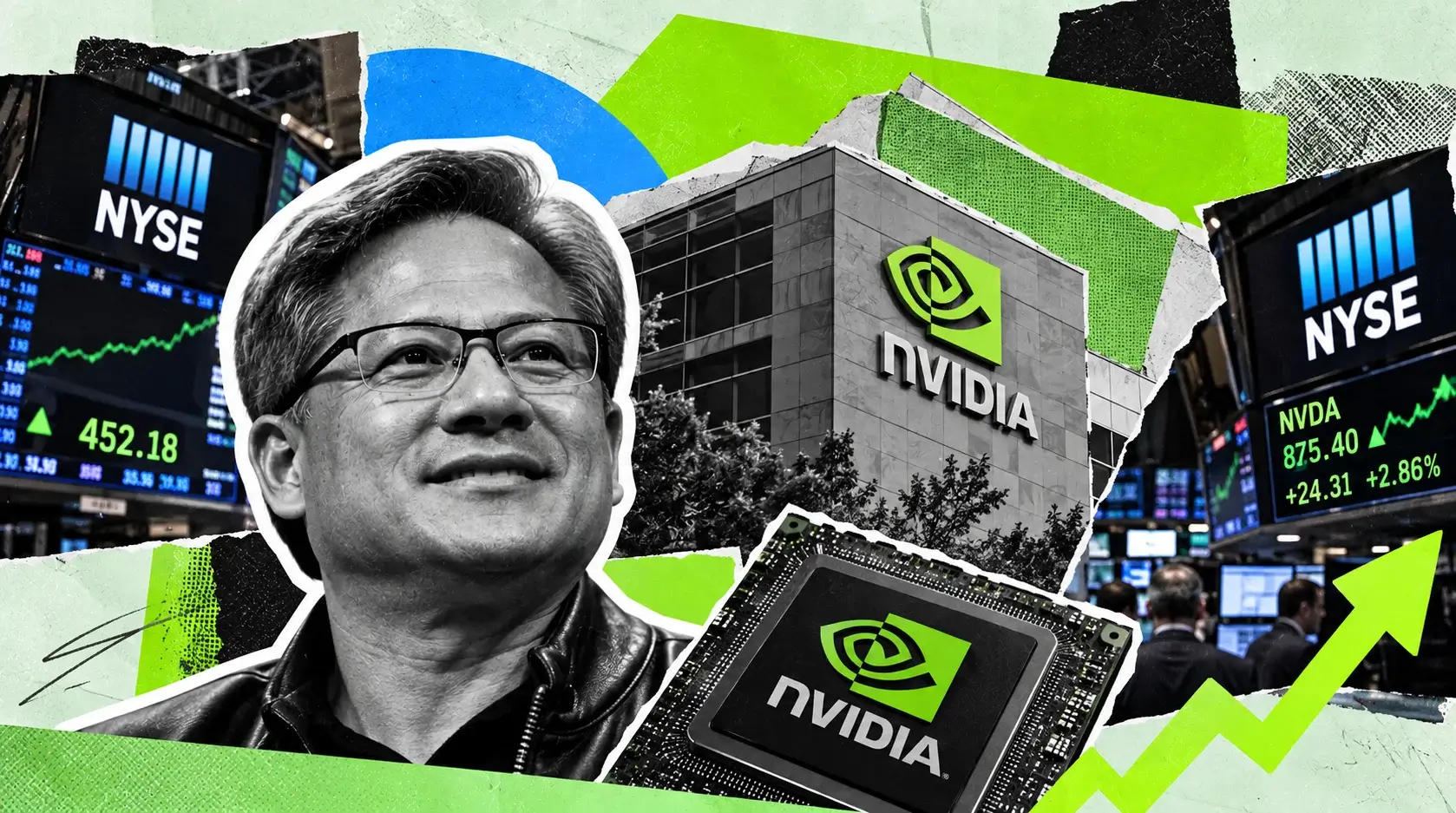
Nvidia walked into Wednesday’s session looking steady and walked into lunchtime bleeding. By 11:25 a.m. ET, NVDA traded at $223.20, down $5.32, or 2.33%, from Tuesday’s close of $228.52. The stock opened at $225.53 to $225.60, touched an early high of $226.00, and slid steadily as the 10-year Treasury yield climbed after the September inflation report. Volume had already reached 32.16 million shares by late morning, on pace to clear the stock’s typical turnover.
The premarket gave no hint of trouble. NVDA gained 0.06% before the bell while Nasdaq futures slipped 0.08%, and the shares sat just above their 20-day simple moving average of $228.32 and 20-day exponential moving average of $228.46. The relative strength index stood at a neutral 52.53. Then CPI landed hot, yields jumped, and the entire semiconductor group rolled over with the Nasdaq Composite, which fell 1.14% to 26,893.54 by 11:10 a.m.
The drop interrupts a strong run. NVDA closed Tuesday up $2.20, or 0.97%, on a day the Nasdaq lost 0.15%. Earlier this month the stock set a record close of $238.90, its first record finish since May, after the board approved a $150 billion buyback, the largest in history. The 52-week range spans $164.27 to $243.37, with the top end set during this month’s breakout. At $223.20, Nvidia trades 8.3% below its intraday record and 6.6% under its record close.
At 24.3 billion shares outstanding, the current price values Nvidia at $5.42 trillion. The record close of $238.90 put the company near $5.76 trillion. Reaching $6 trillion requires a share price above $248.96, 11.5% above where the stock trades now. Nvidia remains the most valuable company on the planet.
The thesis for this forecast is direct: Nvidia’s fundamentals have never been stronger, and its stock is being priced by the bond market this week, not by its earnings. A $108 billion revenue guide, a 70% growth outlook for fiscal 2028 and 75% gross margins sit against a 10-year Treasury at 5.278%, a semiconductor selloff of more than 8% in five sessions, and a market questioning whether enterprise AI demand will follow hyperscaler spending. The fundamentals set the long-term direction. Rates and sector flows set the next 5% to 10%.
That framing leaves two zones in focus. Below sits $219.03, a 10% correction from the $243.37 record and the level where tactical buyers have reason to step in. Above sits $228.32, the 20-day moving average that NVDA lost on Wednesday and needs to reclaim before any run back toward $238.90.
The Q2 Fiscal 2027 Print: $96.2 Billion Revenue, $89.0 Billion Data Center
The case for Nvidia rests on numbers that keep outrunning expectations, and the August report extended that streak.
Nvidia’s results for the second quarter of fiscal 2027, ended July 26, 2026, showed revenue of $96.2 billion, up 18% from the prior quarter and 106% from a year earlier. GAAP and non-GAAP gross margins were both 75.0%. GAAP earnings per diluted share reached $2.46, and non-GAAP EPS was $2.22.
Against Wall Street’s bar, the beat was clean. Forty-one analysts had revenue at $92.07 billion and earnings at $2.09 a share. Revenue came in 4.5% above consensus and 5.7% above the company’s own $91.0 billion guidance midpoint. Non-GAAP EPS beat by 6.3%. That was the fourteenth consecutive quarter in which revenue topped Nvidia’s own outlook.
Data Center did almost all of the work. Segment revenue reached $89.0 billion, up 18% sequentially and 117% year over year, landing 3.9% above the $85.7 billion consensus and near the top of the estimate range. Data Center accounted for 93% of total revenue, and it grew faster than the company overall. One quarter earlier, Data Center contributed $75.2 billion of $81.6 billion in total revenue. The segment added $13.8 billion in three months.
The composition is shifting in Nvidia’s favor. Blackwell Ultra drove much of the acceleration, with hyperscale customers ramping deployments at a pace that more than doubled that business year over year. Data Center networking revenue rose 138% year over year, a sign the AI buildout extends well beyond GPUs into the switching and interconnect fabric that ties clusters together. Non-hyperscale customers now account for 45% of Data Center revenue and are growing at twice the hyperscale rate. That diversification answers one of the oldest bear arguments, that Nvidia depends on five or six cloud buyers.
Outside Data Center, Edge Computing revenue reached $7.2 billion, up 13% sequentially and 27% year over year. That business is small next to Data Center, but it still produces more revenue in a quarter than many large-cap semiconductor companies generate in a year.
The trailing twelve-month numbers capture the scale. Nvidia has produced $302.97 billion in revenue and $192.88 billion in net income over the past four quarters, a profit margin of 63.66%. Diluted EPS over that span stands at $7.91. Return on equity sits at 117.21%. Those are not the economics of a hardware company. They reflect a platform with pricing power across chips, networking and software.
The $108 Billion Guide and the 70% Fiscal 2028 Call
The quarter was strong. The guidance was the real event.
Nvidia expects third-quarter fiscal 2027 revenue of $108.0 billion, plus or minus 2%, with gross margin near 74.0%, plus or minus 50 basis points, and GAAP and non-GAAP operating expenses of $9.2 billion and $9.0 billion. The guide assumes zero Data Center compute revenue from China. At the midpoint, $108.0 billion represents a sequential step of $11.8 billion, or 12%, from the $96.2 billion just reported, and it landed 4.0% above where the Street sat before the print.
The range math is useful for the November report. Plus or minus 2% gives a band of $105.84 billion to $110.16 billion. Given that Nvidia has topped its own outlook for fourteen straight quarters, the market will treat anything below $110 billion as a disappointment.
The bigger surprise was a first-ever fiscal 2028 growth outlook. Nvidia forecast revenue growth of roughly 70% for fiscal 2028. That guide implies annual revenue of $690 billion to $700 billion, more than $100 billion above where analysts had been modeling. At that level, Nvidia would become the second-largest US technology company by revenue, ahead of Apple and Alphabet and behind only Amazon.
That forward call changes the valuation discussion. If Nvidia delivers $690 billion in fiscal 2028 revenue at anything close to current margins, earnings would far exceed the $192.88 billion trailing figure, and today’s $5.42 trillion market cap would look cheap against forward profits. The bear case has to argue either that the forecast is too aggressive or that margins will collapse. Neither is visible in current results.
The margin guide is the one soft spot. Third-quarter gross margin of 74.0% sits 100 basis points below the 75.0% just reported. The decline reflects the early ramp of the Vera Rubin platform, which typically carries lower margins until yields and volumes improve. Analysts project Data Center gross margin for fiscal 2027 at 76.6%, down from 78% in fiscal 2024 and 2025. A gradual drift lower in margins is the cost of moving to new architectures at this pace.
The China exclusion is a hidden cushion. Nvidia assumes no Data Center compute revenue from China, and Hopper shipments to the region represented less than 1% of Data Center revenue in Q2. Any easing of export restrictions would be pure upside to guidance. Any tightening has almost no downside left.
For the stock, the guidance sets a floor under expectations. Even if the market derates the semiconductor group on rates, Nvidia’s earnings path keeps climbing.
Vera Rubin Ramp: 20% of Data Center Revenue and $279 Billion in Supply Commitments
The next growth leg is already in production, and the commitments behind it show how locked-in demand has become.
Nvidia said its Vera Rubin platform is ramping into full production, with racks running at partners including CoreWeave, Google Cloud, Microsoft Azure, Oracle Cloud Infrastructure and Nebius. Supermicro began shipping server racks equipped with Vera Rubin on September 23. Management guided Rubin to roughly 20% of Data Center revenue in the third quarter, a fast ramp for a platform that only entered volume production this summer.
At a $108 billion revenue guide with Data Center around 93% of the total, Data Center revenue in Q3 would land near $100 billion, putting Rubin at roughly $20 billion in its first full quarter. That pace exceeds the early ramp of Blackwell and shows customers moving to the new platform without waiting for the previous generation to age out.
The supply side confirms it. Nvidia’s supply commitments have swelled to $279 billion, mostly memory for Vera Rubin. A company does not lock in $279 billion of components without firm customer demand behind it. Those commitments also reveal the link to this week’s memory-chip selloff: Nvidia is the single largest buyer of high-bandwidth memory, and its Rubin ramp depends on that supply.
The customer list is broadening. Beyond the hyperscalers, sovereign AI programs, specialty cloud providers and enterprises are placing orders. Nvidia’s CFO estimated hyperscaler capital spending at nearly $800 billion in 2026, and Nvidia holds more than 80% of the data center chip market. If even half of that spending flows to compute and networking, Nvidia’s share of the pie supports the guidance.
The company is also pushing into new markets. On Tuesday, Nvidia agreed to buy a minority stake in Doctolib, the French healthcare software firm. Small investments like that extend Nvidia’s ecosystem into vertical applications and position its platform in healthcare AI, one of the sectors where enterprise adoption is expected to accelerate.
The risk in a fast ramp is execution. New architectures carry yield challenges, and early Rubin margins will run below mature Blackwell margins, which explains the 74.0% gross margin guide. Any supply bottleneck in high-bandwidth memory, advanced packaging or power delivery could slow deliveries. So far, nothing in the reported numbers points to those problems.
For investors, Rubin turns a two-year growth story into a three-year one. Blackwell carried fiscal 2026 and 2027. Rubin is positioned to carry fiscal 2028, which is where the 70% growth outlook comes from.
Valuation: 28 Times Trailing Earnings on $7.91 of EPS
For a company growing revenue 106% a year, Nvidia’s valuation looks restrained, and that is part of why the stock reached a record this month.
At $223.20, NVDA trades at 28.2 times its trailing diluted EPS of $7.91. That multiple sits in the same range as many slower-growing megacap technology companies and below where Nvidia traded during most of its 2023 to 2025 run. Earlier this month, the stock’s valuation was described as near multi-year lows even as it reached a record price, and that combination of strong growth and a cheap multiple drew investors back into the stock after a disappointing start to the year.
The forward math is more striking. Third-quarter revenue guidance of $108 billion annualizes to $432 billion. If net margins hold near the trailing 63.66%, that run rate implies annual net income near $275 billion, and per-share earnings well above $11. At that earnings level, the current price represents a forward multiple below 20 times. If fiscal 2028 revenue reaches $690 billion to $700 billion as guided, the forward multiple compresses further.
Wall Street’s price targets reflect that gap. The average analyst target stands at $328.72, 47% above the current price, with a range from $180 to $515. Another tally puts the consensus target at $342.38. Of 72 analyst ratings, 95.8% are Buy, 2.8% Hold and 1.4% Sell. Few large-cap stocks carry that degree of consensus.
The bear case on valuation rests on durability, not current multiples. If AI capital spending peaks in 2027 and orders fall, today’s earnings could prove to be a cyclical high, and a 28 times multiple on peak earnings would be expensive. That is the classic semiconductor cycle argument. Nvidia’s supply commitments of $279 billion and its fiscal 2028 guide argue against an imminent peak, but the market will keep testing that assumption on every negative headline.
The dividend yield sits at 0.23% to 0.44% depending on the measure, essentially symbolic. Nvidia returns capital mainly through buybacks.
Interest rates affect the valuation through the discount rate. A higher risk-free rate lowers the present value of distant earnings, and Nvidia’s equity value depends heavily on profits several years out. That is why a 6-basis-point jump in the 10-year can knock 2.3% off the stock in a morning even when nothing about the business has changed.
For the forecast, valuation provides support on pullbacks. At 28 times trailing and under 20 times forward run-rate earnings, NVDA has a fundamental cushion that most high-growth stocks lack.
Read More
-
Yen Stalls at 160 Despite a 3% JGB and Tokyo Core CPI at 2.0% — Intervention Sits at 164, Friday's Payrolls Decide
02.09.2026 · TradingNEWS ArchiveEnergy
-
AMD Slides to $577.31 as a 2.45 Beta Meets 5.278% Yields, but Helios and a 2027 Data Center Doubling Keep the Long Case Alive
14.10.2026 · TradingNEWS ArchiveStocks
-
XRP-USD Slides to $1.3498 as Hot Inflation Overpowers 13 Weeks of ETF Inflows and Standard Chartered RLUSD Custody
14.10.2026 · TradingNEWS ArchiveCrypto
-
Brent Holds $106.50 and WTI Climbs to $95.30 as the War Premium Outruns Saudi’s 8.372M-Barrel Output — $109.96 Next Above $106.65
14.10.2026 · TradingNEWS ArchiveCommodities
-
ZTAX Fund Jumps 7.36% to $22.83 After a Holiday Plunge to $21.26 Exposed a 10% Discount to NAV
13.10.2026 · TradingNEWS ArchiveMarkets
-
Pound Drops to 1.3185 as 5.278% Treasury Yields Outweigh a 3.75% Bank Rate Set to Rise — 1.3150 Floor Guards 1.3100
14.10.2026 · TradingNEWS ArchiveForex
The $150 Billion Buyback and a $62.47 Billion Cash Pile
Nvidia’s capital return program is now large enough to act as a direct source of demand for the stock.
The board added $150 billion to its share repurchase authorization, the biggest buyback in corporate history. That announcement helped push the stock to its first record since May, as NVDA reached $237.88 intraday on October 2 and lifted its market value to $5.7 trillion. Combined with the strong revenue outlook, the buyback signaled that management views the stock as undervalued relative to its growth.
The scale matters. At $223.20 a share, $150 billion would retire 672 million shares, 2.8% of the 24.3 billion outstanding. Executed over time, that steady repurchase activity provides a bid on weakness, particularly on days like Wednesday when broad sector selling hits the stock.
The balance sheet can fund it. Nvidia holds $62.47 billion in cash and short-term investments, with debt at 16.97% of equity. With quarterly net income now running above $55 billion on a GAAP basis, the company generates enough cash every quarter to fund repurchases, continued investment in research and development, and strategic stakes like Doctolib without stretching its finances.
Buybacks also change the earnings math. Fewer shares mean higher per-share earnings even at constant net income. Over a fiscal year, a 2% to 3% reduction in share count adds 2% to 3% to EPS growth, a meaningful boost on top of the revenue expansion.
The rate environment makes the buyback more valuable. When borrowing costs rise and equity valuations compress, companies with large cash flows can repurchase stock at lower prices. Nvidia does not need to borrow to buy back shares. Higher rates make it harder for competitors to raise debt-financed capital for chip development, a dynamic that hurts rivals more than it hurts Nvidia.
There is a signaling component too. A $150 billion authorization at a time when the stock trades near its record tells investors management sees sustained earnings growth ahead. Companies rarely commit that much capital to buybacks unless they expect the business to keep producing cash at a rising rate.
For the forecast, the buyback acts as a shock absorber. It will not stop a sector-wide derating driven by interest rates, but it reduces the depth of pullbacks and supports the stock on weakness near $219.
Rates: A 5.278% 10-Year Against a Long-Duration Growth Stock
The single biggest reason NVDA is down on Wednesday has nothing to do with Nvidia. It is the bond market.
The Bureau of Labor Statistics reported that consumer prices rose 0.6% in September and 3.7% year over year, above the 3.6% forecast. Core CPI rose 0.3% on the month against a 0.2% estimate and climbed to 2.6% year over year from 2.4%. Gasoline jumped 9.1%, shelter rose 0.4% and used vehicles gained 0.7%. U.S. inflation has run above the Fed’s 2% target for 67 straight months.
The bond market reacted at once. The 10-year Treasury yield jumped more than 6 basis points to 5.278%, within 9 basis points of the 5.364% intraday high set on October 7, the highest since 2002. The 30-year yield rose to 5.59%. The probability of an October Fed hike jumped on several measures, with one futures-based reading moving to 47% from 22%.
The transmission to Nvidia runs through valuation. The stock’s equity value rests on earnings that stretch years into the future, including the fiscal 2028 revenue outlook of $690 billion to $700 billion. A higher discount rate lowers the present value of those future profits. Long-duration growth stocks feel that most, which is why the Nasdaq fell 1.14% while the Dow, weighted toward healthcare and industrials, was down 0.12%.
The Fed’s path drives the discount rate. The Fed raised its target range to 3.75% to 4% in September, its first hike since 2023, and 16 of 18 officials projected another increase. New York Fed President John Williams said one more hike this year looks appropriate, with no further tightening needed in 2027. Wednesday’s inflation data revived the possibility that the second hike comes on October 28 rather than December.
The broader market context matters. The S&P 500 is up 14% this year, but the median stock has gained less than 5%. A small group of AI-related megacaps, Nvidia first among them, has carried most of the index gain. That concentration makes Nvidia a funding source when investors cut risk: it is the most liquid, most widely held growth stock, and it gets sold first in a rate shock.
The S&P 500’s forward multiple has fallen below 19 times, the lowest since 2023, as earnings growth outpaces prices. Third-quarter S&P 500 earnings are expected to grow 30%, and semiconductor earnings are forecast to jump 130%. Nvidia is the largest contributor to both figures.
For the forecast, rates are the key near-term variable. A 10-year above 5.364% would likely push NVDA toward $219. A retreat toward 5.20% would give it room to reclaim $228.32.
Chip Contagion: CXMT, the Memory Selloff and an 8% Drop in the SOX
Nvidia is also caught in a semiconductor-wide derisking that began in China and spread across global chip stocks.
The trigger came from CXMT, a Chinese memory maker. Its president said at a Shanghai conference that a denser server-grade DRAM chip built on a 4F² cell architecture would launch by year-end, putting pricing at risk across the most profitable segment of the memory market. On October 12, the Philadelphia Semiconductor Index fell 2.67% to 12,236.79, Micron dropped 3.87% and broke below $1,000, and Micron, SK Hynix and SanDisk lost a combined $108 billion in market value. The chip index has now fallen more than 8% across five sessions.
The selloff spread to Asia. SK Hynix tumbled more than 10% and Samsung Electronics lost 7.4% in Seoul on Tuesday, and South Korea’s KOSPI fell 12% over five days before bouncing Wednesday. Micron opened Wednesday at $938.85 in premarket, down 1.50%, and Intel slipped 1.1% before the bell. Taiwan Semiconductor’s US shares were down 1.80% by mid-morning.
Nvidia’s exposure to this story is indirect but real. Nvidia does not make memory, but it buys enormous amounts of high-bandwidth memory for every GPU and Rubin rack. Lower memory prices would actually help Nvidia’s margins. The problem is sentiment. Semiconductor stocks have traded increasingly as a group, with weakness in SK Hynix spilling into U.S. chip names. When the group sells, Nvidia gets sold with it.
Index mechanics amplify the effect. Nvidia accounted for 17.55% of the VanEck Semiconductor ETF as of its June 30 filing, roughly double the next-largest holding, TSMC, at 9.29%. When investors sell semiconductor ETFs to reduce sector exposure, Nvidia absorbs the largest share of the outflow regardless of its own fundamentals.
The market reaction to CXMT looks outsized. The Chinese company has not proven it can manufacture at volume and holds a fraction of the share of Samsung and SK Hynix. Channel checks show CXMT modules pricing in line with, or slightly above, comparable Korean products. The threat to Micron’s margins is real over several years. The threat to Nvidia’s business is close to zero.
For the forecast, the chip contagion is a near-term overhang. Until the SOX stabilizes, Nvidia is likely to trade with the group rather than on its own fundamentals. A rebound in memory stocks would remove one source of pressure quickly.
The Enterprise AI Question: A Dell Downgrade, the OpenAI Setback and $800 Billion in Capex
Beyond rates and memory, the market is debating whether AI demand will broaden beyond the hyperscalers, and Wednesday delivered a negative data point.
Dell Technologies fell 8.28% after a sell-side downgrade that also hit Hewlett Packard Enterprise and NetApp. The rationale was elevated valuations and a lack of meaningful enterprise AI-driven growth so far. Dell traded at $528.13, down 7.75%, by late morning. The downgrade goes to the heart of the next phase of the AI trade: hyperscaler spending has been enormous, but the enterprise wave, corporations buying AI servers for their own data centers, has not arrived at the pace priced into some hardware stocks.
For Nvidia, the read-through is mixed. Dell is one of Nvidia’s major channel partners, and enterprise AI servers carry Nvidia GPUs. If enterprise demand stays slow, Nvidia loses a growth vector. But Nvidia’s own numbers show non-hyperscale customers at 45% of Data Center revenue and growing twice as fast as hyperscale. The enterprise slowdown visible at Dell is not visible in Nvidia’s results.
The AI trade has also had to absorb a demand scare from the model makers. On October 8, the Nasdaq fell 1.25% to 27,193.34 as the AI trade stumbled following a revenue setback at OpenAI. Concerns about the economics of AI model developers, the companies whose compute needs drive much of the GPU demand, can hit Nvidia even when its order book is full.
The capex numbers remain the strongest counterargument. Nvidia’s CFO estimated hyperscaler capital spending at nearly $800 billion in 2026. The company’s $279 billion in supply commitments and $108 billion revenue guide reflect orders already in place. Even if enterprise adoption lags, the hyperscalers and specialty clouds are contracted to keep buying through the Rubin ramp.
The bear version of this debate says hyperscaler capex will peak in 2027 and enterprise demand will not fill the gap, leaving Nvidia with a cyclical decline. The bull version says enterprise adoption lags hyperscaler buildouts by 12 to 24 months, and that the Dell downgrade reflects timing, not absence of demand.
For the forecast, the enterprise question matters more for the stock’s multiple than for near-term earnings. Nvidia’s next two quarters look secure. Its valuation beyond fiscal 2028 depends on the answer.
Ecosystem Read-Throughs: ASML’s €44–45 Billion Outlook and TSMC on Thursday
Two of Nvidia’s most important supply-chain partners report this week, and the first delivered a strong signal.
ASML, the sole supplier of extreme ultraviolet lithography machines, reported third-quarter net sales of €11.66 billion, gross margin of 57.5% and net income of €4.96 billion. Sales jumped 25% from €9.33 billion in the prior quarter. The company guided fourth-quarter sales to €14.2 billion to €15.2 billion and full-year 2026 sales to €44 billion to €45 billion. In January, ASML had guided 2026 revenue to €34 billion to €39 billion. The new midpoint sits more than 20% above the January midpoint.
That revision is direct evidence of accelerating AI capacity investment. ASML’s machines are used to build the leading-edge chips that Nvidia designs. When chipmakers order more lithography tools than anyone expected nine months ago, they are preparing to manufacture more advanced chips for AI workloads. ASML’s results confirm that Nvidia’s foundry partners are expanding capacity to meet demand.
ASML shares rose 0.88% by mid-morning before slipping into the red as the broader chip group sold off. The pattern matches Nvidia: strong fundamental news overridden by rate-driven selling.
Thursday brings the bigger catalyst. Taiwan Semiconductor reports third-quarter results, and TSMC manufactures virtually all of Nvidia’s advanced GPUs. The foundry’s commentary on AI-related revenue, advanced packaging capacity and 2027 capital spending will either confirm or challenge Nvidia’s guidance. TSMC’s US-listed shares fell 1.80% Wednesday ahead of the report.
Three questions matter for Nvidia. First, AI accelerator revenue growth at TSMC, which serves as a proxy for Nvidia’s order flow. Second, advanced packaging capacity, the bottleneck that limited Blackwell supply in earlier quarters. Third, 2027 capex guidance, which signals whether TSMC sees sustained demand beyond next year.
A strong TSMC report would give the semiconductor group a fundamental floor after its 8% five-session slide and likely lift Nvidia back toward $228. A cautious one would extend the selloff and push NVDA toward $219.
For the forecast, the supply chain is sending a bullish message. ASML’s €44 billion to €45 billion outlook and Nvidia’s $279 billion in supply commitments both point to multi-year AI capacity growth. TSMC on Thursday is the next confirmation point.
China at Zero and an 80% Market Share
Nvidia’s competitive position and its China exposure both look more favorable than headlines suggest.
Nvidia holds more than 80% of the data center chip market. That share reflects not only GPU performance but the full stack: networking, the CUDA software platform, system design and the developer ecosystem built over nearly two decades. Competitors offer alternative accelerators, and hyperscalers develop custom chips, but none has dented Nvidia’s growth. Data Center revenue rose 117% year over year last quarter, faster than the AI market as a whole.
The networking business strengthens the moat. Data Center networking rose 138% year over year, outpacing compute. As AI clusters scale to hundreds of thousands of GPUs, the interconnect between them becomes as important as the chips themselves. Nvidia’s control of both compute and networking makes its platform harder to replace piece by piece.
China, once a major market, is effectively out of the numbers. Nvidia’s third-quarter guidance assumes no Data Center compute revenue from China, and Hopper shipments to the region represented less than 1% of Data Center revenue in Q2. That limits China’s ability to hurt Nvidia’s guidance. If export restrictions tighten further, Nvidia’s numbers barely change. If they ease, revenue would come in above guidance.
The CXMT story connects back here. China’s push to build domestic memory and AI chip capacity reflects export controls that cut off access to Nvidia’s top products. A self-sufficient Chinese chip industry reduces Nvidia’s addressable market in China over time, but Nvidia has already removed that market from its forecasts.
The broader geopolitical backdrop adds noise. The Iran conflict has pushed Brent crude to $106.50, raising energy costs for power-hungry data centers. Any disruption to Taiwan, where TSMC manufactures Nvidia’s chips, would be the single largest risk to the business. Neither factor has shown up in reported results.
Competition from custom silicon remains the long-term watch item. Hyperscalers have invested heavily in in-house accelerators to reduce dependence on Nvidia and control costs. So far, those chips have supplemented rather than replaced Nvidia GPUs, and every major hyperscaler is among Nvidia’s largest customers for Rubin.
For the forecast, Nvidia’s competitive moat and its zero-China baseline limit fundamental downside. The stock’s near-term risk is sentiment and rates, not lost market share.
Chart Map: $219 Correction Line, $228.32 Moving Average, $238.90 Record Close
The technical structure turned cautious on Wednesday, but the longer-term trend remains intact.
NVDA broke below its 20-day simple moving average of $228.32 and its 20-day exponential moving average of $228.46 on the session. Before Wednesday, the 20-day average sat above the 50-day, and the 50-day above the 200-day, a bullish alignment that confirmed the intermediate uptrend. Losing the 20-day line shifts the short-term picture to neutral but does not break the larger structure.
Support starts at Wednesday’s low near $223.20. Below that sits the $220 round number and then $219.03, which marks a 10% correction from the $243.37 intraday record. A test of that zone would be a normal pullback inside an uptrend and the level where the $150 billion buyback and long-term buyers have the strongest case to step in. A daily close below $219 would open a deeper retracement toward $210.
Resistance begins at $228.32 to $228.52, the 20-day moving average and Tuesday’s close. Reclaiming that zone would signal Wednesday’s drop was a rate-driven shakeout. Above it, the record close of $238.90 and the intraday record of $243.37 form the next barrier. Beyond those, $248.96 is the level that would push Nvidia’s market value above $6 trillion for the first time.
Volume adds context. NVDA’s three-month average daily volume stands at 123.5 million shares. Wednesday’s 32 million shares by late morning puts the session on track for average to above-average turnover, consistent with institutional repositioning rather than panic selling.
Momentum readings had cooled before the session. RSI at 52.53 in premarket signaled neutral momentum, neither overbought nor oversold. Wednesday’s 2.3% decline likely pushed RSI toward the mid-40s, still well above oversold territory. That leaves room for further downside before the stock looks stretched to the downside.
The year-to-date and one-year performance provide perspective. NVDA started 2026 near $188.85, so the current price represents an 18% gain for the year. It traded near $185.54 a year ago, a 20% one-year gain. The stock is well above its levels from the start of the year, even after this month’s pullback.
For the forecast, the levels are clear. A close below $219 targets $210. A reclaim of $228.32 targets $238.90 and then $248.96.
Catalysts: TSMC Thursday, the Fed Blackout, October 28 and the November 18 Report
The next five weeks carry a dense calendar of events that will decide whether NVDA resumes its record run or extends the pullback.
Wednesday afternoon: the Fed’s Beige Book and remarks from Richmond Fed President Tom Barkin. A Beige Book flagging broad price pressure would add to rate fears and weigh on growth stocks. One emphasizing softer hiring would ease them.
Thursday, October 15: Taiwan Semiconductor’s third-quarter results and September PPI. TSMC’s AI revenue, packaging capacity and capex outlook are the most direct read on Nvidia’s supply chain. A hot PPI would extend the rate pressure; a soft one would give growth stocks room to recover.
Thursday and Friday: Fed speakers before the quiet period begins Saturday, October 17. Any signal that October is live would push the 10-year toward 5.364% and pressure NVDA.
October 28: the Fed decision. A hold with December guidance is closer to priced. A hike would hit the Nasdaq and likely push NVDA toward $219 or below.
October 29: the September PCE inflation index, the Fed’s preferred gauge, which will shape December expectations.
Throughout October: hyperscaler earnings. Microsoft, Alphabet, Amazon and Meta report in the second half of the month, and their capital spending guidance is the most important demand signal for Nvidia outside its own results. Any increase in 2027 capex plans would confirm Nvidia’s fiscal 2028 outlook.
November 18: Nvidia’s third-quarter fiscal 2027 report. The bar is set: revenue above the $108 billion guidance midpoint, gross margin near 74%, Rubin at roughly 20% of Data Center revenue, and fourth-quarter guidance that supports the 70% fiscal 2028 growth outlook. Fourteen straight beats of its own guidance make anything below $110 billion a likely disappointment.
Background risks persist. The memory-chip selloff tied to CXMT could extend if Korean stocks resume their decline. Oil at $106.50 keeps inflation risk alive and with it rate risk. The enterprise AI debate will flare on any further hardware downgrades.
Nvidia Stock Forecast and Verdict: Tactical Pullback to $219, Long-Term Bull Case Intact
The verdict for NVDA is bullish on fundamentals with a cautious near-term bias. Nvidia at $223.20 is down 2.33% on a day when every macro input moved against long-duration growth stocks. September CPI ran at 3.7% headline and 2.6% core, the 10-year Treasury jumped to 5.278%, October Fed hike odds rose sharply, and the semiconductor index extended a five-session slide of more than 8%. Nothing about Nvidia’s business changed. Its stock is being priced by rates and sector flows.
The fundamentals are as strong as they have ever been. Second-quarter revenue reached $96.2 billion, up 106%. Data Center revenue hit $89.0 billion, up 117%. Gross margin held at 75.0%. Third-quarter guidance of $108.0 billion came in 4.0% above consensus with zero China revenue assumed, and the first fiscal 2028 outlook calls for growth of roughly 70%, implying revenue of $690 billion to $700 billion. Supply commitments of $279 billion lock in the Rubin ramp, and a $150 billion buyback, the largest in history, supports the stock on weakness. At 28 times trailing earnings and under 20 times forward run-rate earnings, the valuation is restrained for a company growing at this pace.
The near-term base case is a test of the $219 area, a 10% correction from the $243.37 record and a 1.9% decline from current levels. A hot PPI print Thursday, a weak TSMC outlook or a hawkish Fed signal before Saturday’s blackout would accelerate that move. A daily close below $219 would target $210.
The bullish path requires the 10-year to retreat below 5.20%, the semiconductor index to stabilize, and TSMC to confirm strong AI demand Thursday. That combination would likely lift NVDA back above its $228.32 20-day moving average and toward the $238.90 record close, a 7.0% gain from current levels. A break above $243.37 would put the $248.96 level, the threshold for a $6 trillion market cap, within reach, an 11.5% upside.
Forecast: Hold with a buy bias on pullbacks. Near-term downside target of $219, with the $210 to $219 zone the area where the long-term case is most attractive. A reclaim of $228.32 targets $238.90, and a break of $243.37 opens the path to $248.96 and a $6 trillion valuation ahead of the November 18 report. Wednesday’s drop is a rate-driven shakeout in a stock whose earnings path is still climbing.