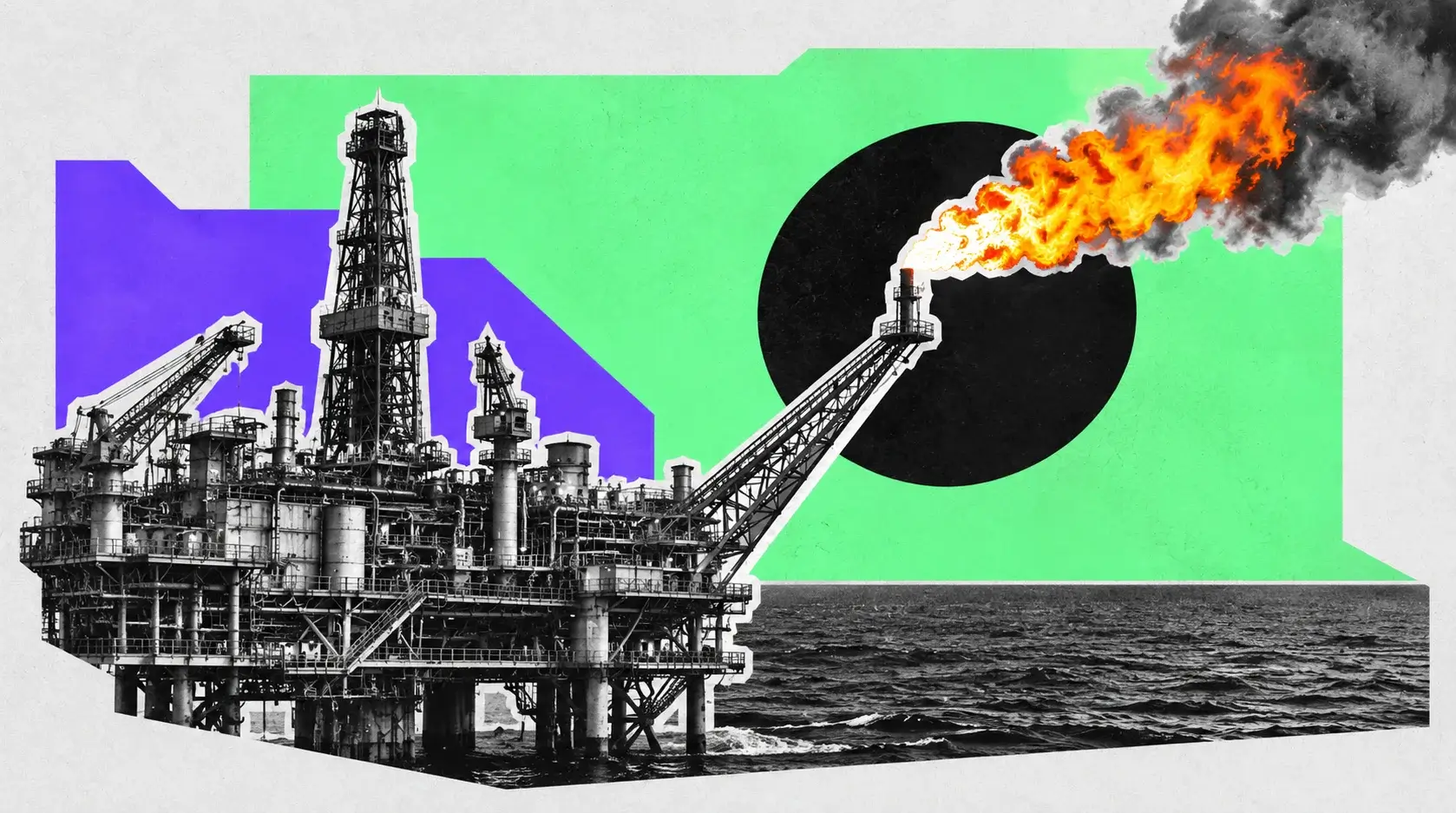
Oil Price Forecast 2026: Brent Near $72, WTI At $67 As War Risk Collides With $60 Bank Targets
Oil holds in the high-$60s while US–Iran tensions, Geneva nuclear talks and Trump’s 15% global tariff push prices away from Goldman and Morgan Stanley’s $60 Brent path and open a $90–$100 spike scenario | That's TradingNEWS
Oil Price Map: WTI CL=F And Brent BZ=F Between Surplus Models And War Risk
Spot Levels For Oil, WTI CL=F And Brent BZ=F After The Latest 1% Pullback
WTI CL=F is trading near $67.07, having faded from an earlier move that took it down to roughly $65.75. Brent BZ=F sits around $72.34 after slipping from about $71.03. The pullback is modest – roughly 1% – and follows a strong run driven by US–Iran tension. The key point is simple: spot is holding in the high-$60s for CL=F and low-$70s for BZ=F, while the main bank decks still anchor fair value closer to $60 over the coming year. That mismatch between current pricing and modelled equilibrium is the heart of the current risk range for oil.
Goldman’s Oil Deck: Brent At $60 In Q4 2026 With A 2.3M Bpd Surplus
Goldman Sachs now projects Brent around $60 and WTI roughly $56 for Q4 2026. For the full year, the bank expects Brent to average $64 a barrel, up from a previous $56 call, and WTI to average $60 versus a prior $52. The shift acknowledges tighter-than-expected inventories and a stronger starting point, but the structure remains bearish versus today’s prices. The forecast still embeds a 2.3 million barrels-per-day surplus in 2026 and assumes no Iran-related supply disruption and no Russia–Ukraine peace deal that radically reshapes flows. In its framework, today’s Brent level in the low-$70s carries about a $6 geopolitical premium plus another roughly $5 overshoot versus a fair-value path driven by rising OECD stocks. If tensions ease and stocks build, that premium is designed to fade out of the curve.
Morgan Stanley’s View: Short-Term Risk Premium, Same $60 Brent Anchor
Morgan Stanley’s numbers are aligned with that structural story but recognise the near-term risk bid. The bank now sees Brent averaging $62.50 in Q2 2026, up from $57.50, and $60 in Q3, also lifted from $57.50. The message is clear: a higher path in the short run due to geopolitical risk, then a glide path back toward $60 as long as flows remain intact. At current levels, Brent near $72 and WTI near $67 trade roughly 15–20% above the range that both houses consider sustainable once the risk premium leaks out and the 2.3 million bpd surplus reasserts itself. For CL=F and BZ=F, that means every spike driven by headlines has to be measured against models that still see mid-$60s as a ceiling, not a floor.
US–Iran Standoff: Largest US Build-Up Since 2003 Keeps Oil Supported
The market is not trading bank spreadsheets in a vacuum. The US has executed its largest regional military build-up since the 2003 Iraq invasion, positioning assets for a sustained campaign if ordered. At the same time, Oman’s foreign minister confirms a third round of US–Iran nuclear talks in Geneva, scheduled for Thursday. That combination explains the price action: oil rallied hard into the weekend on headlines that war looked “increasingly likely,” then gave back roughly 1% when the Geneva track was confirmed and some traders booked profits. Trump has raised the global tariff rate from 10% to 15% and publicly set a 10–15 day window for Tehran to accept strict conditions on its nuclear programme. On the other side, Iranian leadership has little domestic room to accept those demands without collapsing its internal legitimacy. That is why seasoned energy strategists argue that it is difficult to see both fleets quietly turning back without either a deal that looks like capitulation for one side, or a direct confrontation. As long as that structural conflict is unresolved, Oil, WTI CL=F and Brent BZ=F will carry a persistent risk premium.
Hormuz And Gulf Infrastructure: The $90–$100 Oil Scenario
The upside risk is straightforward. If diplomacy fails and military action begins, Iran has two clear levers: attack on production facilities in Saudi Arabia, the UAE or Kuwait, and disruption of shipping through the Strait of Hormuz, where roughly a fifth of global seaborne crude moves. FGE’s Fereidun Fesharaki explicitly points to $90–$100 Brent as “within reach” if Middle East supply is hit. That is not a theoretical model; it reflects past episodes where partial loss of Gulf barrels or credible threats to Hormuz pushed benchmarks sharply higher. In that environment, the 2.3 million bpd surplus disappears overnight and the debate shifts from inventory builds to basic availability. For BZ=F, a jump from $72 into a $90–$100 band becomes a live scenario. For CL=F, a proportionate move would target the mid-$80s and above.
Global Tariffs At 15%: Demand Damage On Top Of Supply Fear
While the supply side is dominated by US–Iran risk, demand faces its own shock. Trump’s decision to lift temporary tariffs from 10% to 15% on all imports adds a new drag on global trade and industrial activity. Higher uniform tariffs raise input costs, slow cross-border flows and, if persistent, erode global GDP. China has already called on Washington to reverse the measures to avoid broader trade disruption. If the 15% rate holds or moves toward the 15–20% band that some policy voices favour, refined product consumption, freight demand and industrial fuel use will feel the pressure. That is the mechanism behind forecasts that still put Brent around $60–$65 and WTI around $56–$61 through 2027. Even when the Middle East risk premium is high, tariff-driven demand risk pushes in the opposite direction, limiting how long Oil, CL=F and BZ=F can sustain triple-digit levels without real physical shortages.
OPEC+, OECD Stocks And The 2.3M Bpd Surplus Path
Underneath the noise, the supply-demand balance still leans toward surplus on paper. Goldman’s 2.3 million bpd 2026 surplus forecast already trims both supply and demand by 0.2 million bpd against earlier assumptions because Asian growth has softened at the margin. The supply side is downgraded in Kazakhstan, Venezuela, Iran and Iraq after repeated misses on realised output, but this is offset by upgrades across the Americas and within core OPEC producers that still have spare capacity in reserve. Critically, OPEC+ is expected to begin raising production gradually from Q2 2026 because OECD inventories have not swollen enough to justify deeper restraint. That means any risk-driven rally in Oil faces a cartel that is willing to add barrels once prices stretch too far above the $60–$70 band. At the other end of the spectrum, if sanctions relief accelerates for Iran or Russia and more barrels hit the water, bank models point to downside risks of roughly $5 for Brent and $8 for WTI versus their Q4 2026 targets.
Technical Structure In WTI CL=F: 66.43 Resistance, 64.14 Mid-Support, 62.36 Line In The Sand
The chart on CL=F reflects that macro tug-of-war. On the daily time frame, WTI has rallied back to a resistance cluster around $66.43–$66.50. Each test of that band has met supply as traders fade geopolitically driven spikes and lean into the surplus narrative. Support levels are staggered below spot. Around $64.14 sits a mid-range demand zone where short-term buyers start to appear. Deeper down, $62.36 marks a more important support shelf. As long as CL=F holds above $62.36 on daily closes, the bullish case for tactical longs remains intact: there is a clear risk marker, and the market can continue to use geopolitical dips to reload. A decisive breakout above the $66.50 band opens a path toward $70.50, which is the next major technical reference from recent swing highs. Failure at resistance and a break below $64.14 would put $62.36 back into focus and strengthen the argument that the price action is rolling back toward the bank decks rather than breaking away from them.
Read More
-
Yen Stalls at 160 Despite a 3% JGB and Tokyo Core CPI at 2.0% — Intervention Sits at 164, Friday's Payrolls Decide
02.09.2026 · TradingNEWS ArchiveEnergy
-
T-Rex 2X Inverse MSTR ($4.39) Rips 10.44% as Strategy Pauses Bitcoin Buys for a 2nd Week — $4.63 Close Opens $5.27
15.09.2026 · TradingNEWS ArchiveStocks
-
XRPR ($10.59) and XRPI ($7.04) Open at Highs and Close at Lows After Senate Kills CLARITY Act
15.09.2026 · TradingNEWS ArchiveCrypto
-
NG ($2.908) Holds Above $2.80 Low as LNG Feedgas Hits 18.8 Bcf and TTF Trades 9.2x Henry Hub
15.09.2026 · TradingNEWS ArchiveCommodities
-
USD/JPY (155.09) Faces 275bp Policy Gap as BOJ Prepares 31-Year-High Rate — Close Below 154 Opens 153.40
15.09.2026 · TradingNEWS ArchiveForex
Short-Term Volatility: ATR Expansion Signals Wider Daily Swings In Oil
Volatility has ticked higher again across Oil, WTI CL=F and Brent BZ=F. On the 4-hour and daily charts, Average True Range has climbed, which translates directly into larger candles and wider daily ranges. When ATR rises, each bar carries more risk, stops need more space, and gap risk increases on geopolitical headlines. This environment favours momentum strategies but punishes late entries. From a structural perspective, rising ATR fits a market that has shifted from quiet range trading into active expansion as US–Iran headlines, Geneva talks, tariff changes and revised bank forecasts all hit the tape within days of each other. As long as ATR stays elevated, traders should expect sharp responses around levels like $66.43, $64.14, $62.36 for CL=F and $70–$75 for BZ=F.
Macro Spillovers: Lower Oil Helps Inflation While Exporters Face Budget Pressure
At today’s levels and the bank forecast path, oil is no longer behaving like the main inflation engine it was at $100 plus. If Brent averages around $64 in 2026 and drifts toward $60 in Q4 as Goldman expects, fuel costs and freight rates ease further, giving households and companies some breathing room. That supports consumption and makes it easier for central banks to argue for stable or lower policy rates, especially if other inflation components cool. For exporting economies and high-cost producers, the story is less comfortable. A $60–$65 Brent world compresses margins for capital-intensive upstream projects, particularly outside the Gulf. It forces capex rationing, encourages portfolio high-grading and puts pressure on fiscal balances in countries whose budgets were built around higher reference prices. That is one reason sovereigns in the Gulf are pushing hard on projects like the $100 billion Jafurah development and new condensate streams: they need diversified hydrocarbon and non-oil revenue to handle a structurally lower oil-price base.
Positioning Oil Between $60 Models And $100 Shock: Where WTI CL=F And Brent BZ=F Stand Now
The current tape places WTI CL=F near $67 and Brent BZ=F around $72. Those marks sit midway between two credible poles. On one side, bank models and surplus math point to Brent at $60–$65 and WTI at $56–$61 through 2027, underpinned by a 2.3 million bpd surplus, gradual OPEC+ supply increases and tariff-related demand risks. On the other, US military deployments, explicit talk of likely conflict, and the structural vulnerability of Gulf infrastructure and the Strait of Hormuz make $90–$100 Brent a realistic outcome if the worst-case scenario materialises. Spot is not cheap relative to the surplus view and not expensive relative to the war case. It is pricing a blend of both: some risk premium, some surplus, and a sizeable amount of uncertainty.
Oil Verdict – WTI CL=F And Brent BZ=F: Tactical Buy On Dips, Structural Sell Into Spikes
Bringing the numbers and structure together points to a split stance on Oil, WTI CL=F and Brent BZ=F. In the near term, while WTI holds above $62.36 and continues to respect the $66.43 band, the bias is bullish on geopolitical dips. US–Iran risk, the largest US build-up in the region since 2003 and credible scenarios involving Hormuz or regional facilities justify maintaining tactical long exposure when prices retreat toward support. On a 6–12 month horizon, with Goldman and Morgan Stanley both anchoring Brent around $60–$64, WTI around $56–$60, and a 2.3 million bpd surplus plus OPEC+ flexibility in the background, chasing spikes into the $70s–$80s turns unattractive unless actual supply is hit. In that medium-term window, rallies driven purely by headlines and sentiment look better suited for scaling out or building staggered short exposure than for fresh aggressive longs. Under current information, the stance is clear: short-term, oil leans bullish on controlled pullbacks; structurally, it trends toward a HOLD / SELL-ON-STRENGTH profile unless the Middle East moves from brinkmanship to real disruption.