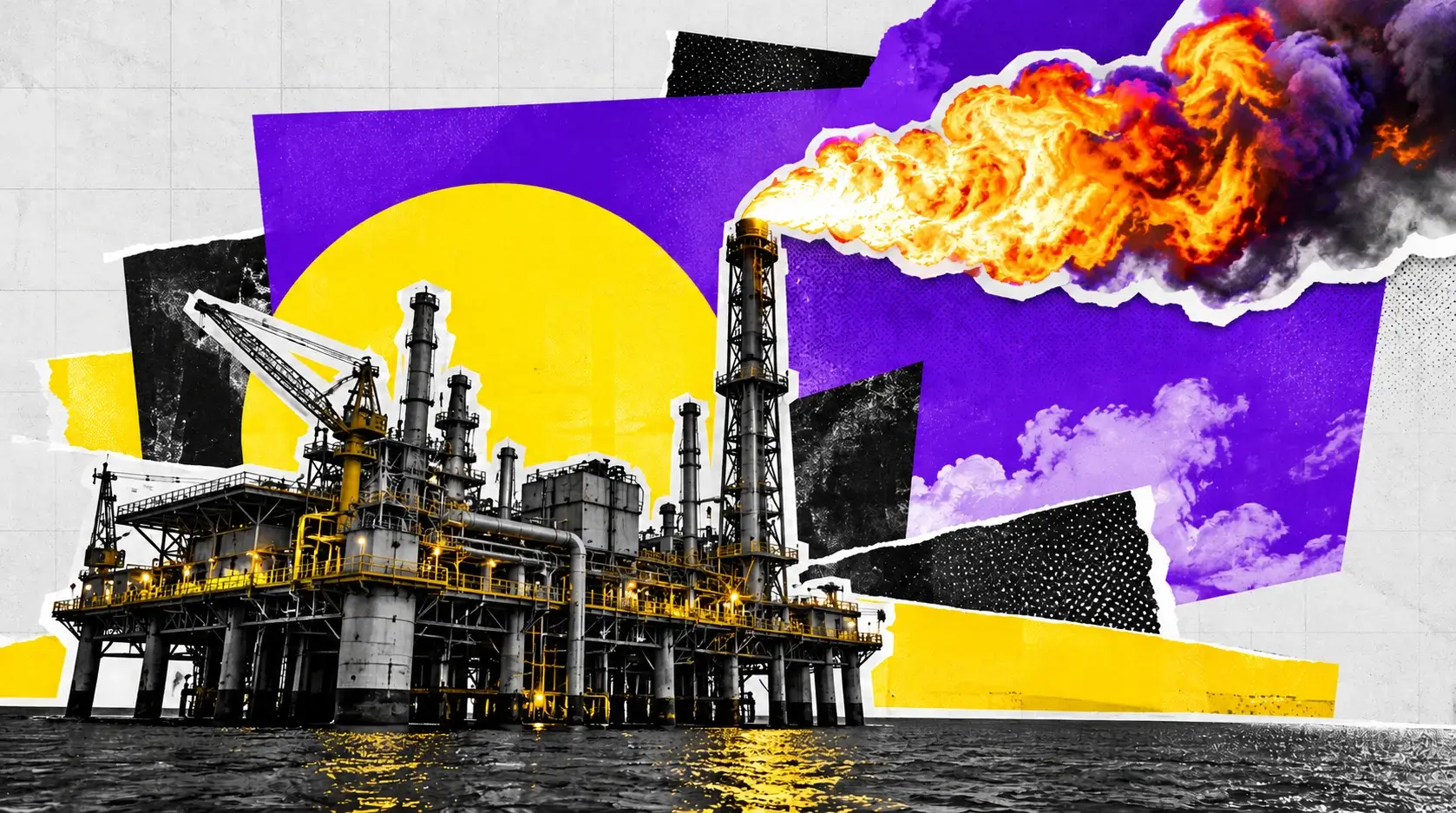
Oil Price Forecast — Brent at $90.08, WTI at $87.89, Qatar Warns $150 as Force Majeure Declared and 200 Tankers Remain Stranded
Trump demands unconditional surrender from Iran, Hormuz effectively closed, TTF up 70% in five days, European storage at 22-27% versus 41% average | That's TradingNEWS
Brent Crude at $90.08, WTI at $87.89 — Qatar Warns All Gulf Production Stops Within Days, 200 Tankers Stranded, $150 Price Target if Hormuz Stays Closed, and the Stoxx 600 Heading for Its Worst Week Since April
Brent crude is trading at $90.08 on March 6, 2026, up 5.4% on the session. WTI hit $87.89, up 8.4% — posting the biggest weekly gain since Russia invaded Ukraine in early 2022. These are not speculative positioning moves. They are physical supply shock prices backed by a single devastating reality: QatarEnergy has halted LNG production following military attacks on its facilities, declared force majeure, and CEO Saad al-Kaabi told the Financial Times on Friday that he expects every Gulf energy exporter to follow with identical declarations within days if the conflict continues. His explicit price target: $150 per barrel within two to three weeks if the Strait of Hormuz remains effectively closed.
The Hormuz Arithmetic — 14 Million Barrels Daily, 200 Tankers Stranded, Zero Alternative for Qatar
Roughly 3,000 ships transit the Strait of Hormuz monthly under normal conditions. That traffic has effectively halted since U.S.-Israeli strikes on Iran began last weekend. Approximately 200 tankers are stranded in or around the waterway right now. The strait carries more than 14 million barrels per day — one-fifth of total global oil supply according to Kpler. The UAE and Saudi Arabia both have pipeline infrastructure capable of routing exports without Hormuz transit. Qatar has no such alternative. Every barrel of its 77 million metric ton per year LNG output must pass through the strait — which is why QatarEnergy's force majeure declaration is the most consequential single energy market event since Nord Stream. Al-Kaabi stated that even if hostilities ceased immediately, resuming normal output would take "weeks to months." The supply disruption is not a forward risk — it is a present reality with an undefined recovery timeline.
Al-Kaabi's FT comments were unambiguous: "If this war continues for a few weeks, GDP growth around the world will be impacted. Everybody's energy price is going to go higher. There will be shortages of some products and there will be a chain reaction of factories that can't supply." A sitting energy minister describing a chain reaction of factory shutdowns is not hyperbole — it is a supply chain stress assessment from the person running the world's largest LNG operation.
Read More
-
Yen Stalls at 160 Despite a 3% JGB and Tokyo Core CPI at 2.0% — Intervention Sits at 164, Friday's Payrolls Decide
02.09.2026 · TradingNEWS ArchiveEnergy
-
QQQ ETF ($706.22) Slides 7.4% Below Its High as the Market Reprices the AI Capex Bill — $686.57 Target if $700 Breaks
22.10.2026 · TradingNEWS ArchiveStocks
-
XRPI ($7.00) and XRPR ($10.74) Slide Toward 52-Week Lows as Spot XRP ETF Flows Stall at $708,510
22.10.2026 · TradingNEWS ArchiveCrypto
-
NG ($2.775) Decoupled From Europe’s €88 Gas Crisis as LNG Feedgas Hits 18.9 Bcf/d — $3.30 Upside on Cold Weather
22.10.2026 · TradingNEWS ArchiveCommodities
-
Dollar-Yen (157.35) Loses 157.65 as the Yen Rallies on Haven Demand — 155 Target if 156 Breaks
22.10.2026 · TradingNEWS ArchiveForex
Trump's "Unconditional Surrender" Post Eliminates Every De-Escalation Assumption
The proximate catalyst for Friday's final oil leg higher was President Trump's Truth Social post declaring there will be no deal with Iran "except UNCONDITIONAL SURRENDER." Defense Secretary Pete Hegseth compounded the signal Thursday, stating the U.S. had "only just begun to fight" and that combat power still flowing toward Iran represents "multiples of what it currently is." Operations could last three to eight weeks by Hegseth's own estimate. The Senate failed to block continued military action. Every institutional de-escalation assumption that had been providing any floor under risk assets was eliminated in a 24-hour window. Wall Street analysts now flag Brent above $100 as the base case if Hormuz stays closed — and at that price level, Goldman Sachs and Morgan Stanley recession probability models historically trigger for the global economy.
European Markets — Stoxx 600 Down 1.7%, Weekly Loss 4.6%, Germany and France Leading Declines
The pan-European Stoxx 600 fell 1.7% Friday, reversing an early positive open, on pace for a 4.6% weekly loss — its steepest since last April's U.S.-China trade war fears. The energy asymmetry is the core explanation: the United States has been a net oil exporter since 2019 and absorbs energy price spikes with significantly more resilience than Europe. European economies are net energy importers. Every dollar Brent climbs above $70 is direct margin compression for European manufacturers, transportation cost inflation, and consumer purchasing power destruction — simultaneously and without offset. Germany's industrial base, France's manufacturing sector, and the UK consumer are all absorbing an energy tax with no domestic production windfall on the other side.
Individual movers provided isolated exceptions to the broad selloff: Sectra surged 10.5% after posting 8% net sales growth to $272 million with operating profit up 21% to $54 million — a company-specific earnings beat the macro cannot touch. German defense name Renk gained 2.5%, extending the defense sector's outperformance as NATO military spending expectations accelerate. ITV added 5% on Sky acquisition reports. These are single-stock stories in a market where the macro dominates everything else.
TTF Up 70% in Five Days, JKM +39%, European Storage at 22-27% vs 41% Average — The Supply Deficit That Outlasts the War
TTF April futures reached $53 per MWh — up 70% in five days. JKM surged 39%. India directed 10-20% gas consumption cuts as LNG spot prices hit $23.30-$23.50 per MMBtu, a $7.80-$7.90 single-session increase. European gas storage exits winter at 22-27% capacity versus the 41% historical average — meaning the continent requires approximately 700 LNG cargo deliveries for summer refill against 520 in a normal year. That is a 36% procurement increase in an environment where Qatar's 77 million metric ton per year terminal is offline and additional suppliers cannot cover the gap. Cheniere's Corpus Christi Stage 3 and Golden Pass commissioning represent new U.S. LNG capacity — but neither can offset 77 million metric tons of annual production offline in the near term.
Kazakhstan's National Bank revised its 2026 Brent average forecast upward to $66.30 before Friday's $90 print — making the institutional forecast stale the moment it was published. Governor Suleimenov acknowledged prices could "temporarily exceed earlier projections" before declining toward $60 as supply and demand rebalance. That $60 long-run equilibrium assumes Hormuz reopening and Qatar restart — neither of which has a defined timeline.
Brent crude and WTI are buys above $88 targeting $100 first, with $150 as the Qatar full-closure scenario. XOM, CVX, and OXY remain the only sector where the geopolitical catastrophe scenario is simultaneously the maximum earnings scenario — every barrel they produce above $70 WTI generates operating cash flow well above sustaining capital requirements. Stop on Brent on a sustained daily close below $82, which requires confirmed ceasefire progress and Hormuz reopening signals. Until that appears, the physical supply disruption, force majeure declarations, and Trump's unconditional surrender demand combine to make the path of least resistance unambiguously higher.