Oil Price Forecast: Brent at $99 After 5% Drop — Trump's 15-Point Iran Plan Cracks the War Premium
WTI Falls to $88.62, Shell CEO Says Europe Faces Shortages in April, BlackRock Flags $150 Recession Trigger — Goldman's Base Case Targets Strait Normalization by April | That's TradingNEWS
Key Points
- 5% Drop Still Leaves Oil 36% Above Pre-War Levels — Brent fell from $102.47 to $99.75 on Trump's peace signals, but oil remains 36% higher than a year ago at $73, with Shell's CEO warning Europe faces its worst supply shortage impact in April.
- Goldman Says Worst-Case Risk Premium Drives Every Move — Goldman Sachs confirmed crude is "trading on geopolitical risk premium" with the largest supply shock in decades, and its base case assumes Strait of Hormuz normalization over four weeks starting in April.
- $150 Recession Trigger vs. $75 Ceasefire Target — BlackRock's Larry Fink warned $150 oil triggers a global recession, while Iran's military said prices won't normalize "until regional stability is secured under military control" — Thursday's proposed U.S.-Iran meeting decides which scenario dominates.
Oil Price Forecast: Brent at $100, WTI at $89 — Trump's 15-Point Plan Cracked the War Premium but Didn't Break It
Brent crude is trading at approximately $99.75–$101.28 per barrel on Wednesday, March 25, 2026 — down 3.8%–5% on the day depending on the session snapshot, having briefly dipped below $100 before partially recovering. West Texas Intermediate (WTI) sits at $88.62–$89.01, down roughly 3.6%–4% from Tuesday's close of $102.47 on Brent. These numbers look like a relief. They are not a resolution. One year ago, Brent was trading at $73.11 per barrel. The current price — even after Wednesday's sharp decline — is still 36.4% higher than a year ago and 33% above where it was before the U.S. and Israel launched strikes on Iran on February 28. Every equity rally, every bond yield move, every currency fluctuation, every recession probability estimate on the board right now has a single variable underneath it: what happens to oil. Larry Fink, CEO of BlackRock, told the BBC with unusual directness that a global recession could be triggered if oil hits $150 per barrel. Wednesday's move to $99–$101 on Brent is the market breathing out. Whether that breath becomes a sustained exhale or gets cut short by the next escalation headline is the only question that matters in global markets for the rest of this week.
The Strait of Hormuz: 20% of Global Oil Supply Through One Narrow Channel — And Iran Controls the Valve
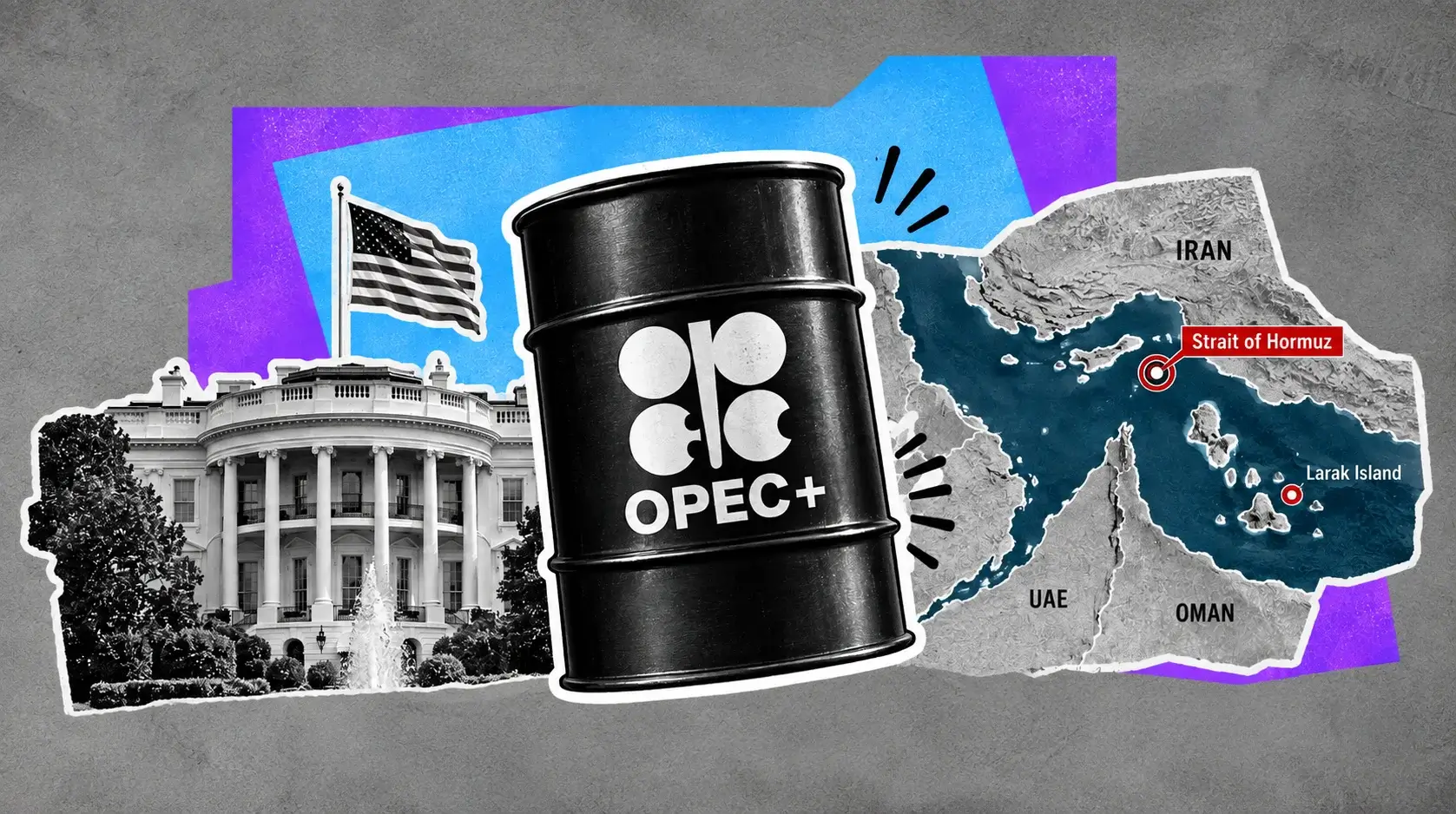
The strategic geography of the current crisis needs to be understood precisely because it is the physical mechanism through which the war translates into oil prices. The Strait of Hormuz is a narrow waterway — approximately 21 miles wide at its narrowest navigable point — through which approximately 20% of the world's oil and liquefied natural gas passes every single day. Before February 28, that 20% moved freely. After the U.S. and Israeli strikes on Iran, Tehran effectively began blocking the strait — not through a complete physical closure, which would require direct military confrontation with the U.S. Navy, but through a combination of threats, harassment of vessels, and the creation of uncertainty severe enough to deter most commercial shipping from transiting. The result was the largest single disruption to global oil supply in decades, measured as a share of global supply — Goldman Sachs's own framing. The fertilizer trade is also affected — approximately one-third of all global fertilizer passed through the Strait of Hormuz before the effective closure, meaning the food production implications of a prolonged blockade extend far beyond energy markets. Iran's UN mission post on Tuesday — offering safe passage to "non-hostile vessels" that coordinate with "competent Iranian authorities" and neither participate in nor support acts of aggression against Iran — represents the first concrete signal of a selective re-opening. China, India, and Pakistan appear to have negotiated their own passage protocols directly with Tehran, with ships from those countries transiting while vessels from nations more closely aligned with the U.S.-Israel coalition face continued restrictions. This selective passage regime is the geopolitical mechanism that makes oil pricing so difficult right now: the market cannot model a strait that is simultaneously open and closed to different participants based on their countries' relationships with Tehran.
Trump's 15-Point Plan and the Market's Conditional Response
The specific catalyst for Wednesday's oil price decline is the 15-point peace proposal the U.S. delivered to Iran through Pakistan — reported by the New York Times, Reuters, and Israel's Channel 12 on Tuesday, and confirmed through unnamed sources across multiple outlets. The plan's contents are significant: on the U.S. side, the demands include the Strait of Hormuz being opened and recognized as a free maritime zone, and the dismantlement of Iran's main nuclear infrastructure. On Iran's side of the negotiated exchange, Channel 12 reported that acceptance of the plan would include the removal of sanctions — a potentially transformative economic development for Iran. Trump added at the Oval Office on Tuesday that Vice President JD Vance and Secretary of State Marco Rubio are personally involved in the discussions, elevating the diplomatic seriousness of the effort. Trump also claimed that U.S.-Israeli strikes on Tehran have led to "regime change" — a statement that, if accurate, would fundamentally alter the negotiating dynamic. The market took the plan's existence as a bullish signal for oil — lower prices reflecting reduced probability of sustained supply disruption. But the response from Tehran was immediate and categorical. Foreign Ministry spokesman Esmail Baghaei told India Today: "Can anyone believe their claims of diplomacy or mediation are credible when they started this war and continue attacking us?" Iran's military spokesperson warned explicitly that oil market prices won't normalize "until regional stability is secured under its military control." Iranian officials have consistently described U.S. peace claims as an attempt to "manipulate markets" — and that framing is not without analytical merit. The $580 million in suspicious oil futures traded minutes before Trump's Iran reversal post — flagged by Nobel laureate Paul Krugman as potential market manipulation — is the kind of detail that raises questions about whether diplomatic signals and market-moving statements are being coordinated for purposes beyond pure geopolitics.
Goldman Sachs: Crude Trades on Geopolitical Risk Premium, Base Case Is Strait Normalization in April
Goldman Sachs provided the most analytically complete framework for understanding current oil pricing dynamics on Wednesday. The bank's co-head of global commodities research, Daan Struyven, stated that the current oil disruption marks "the largest shock in decades when measured as a share of global supply" — context that makes the magnitude of price moves more understandable. More importantly, Goldman distinguished between two drivers of current oil prices. First, base case supply expectations — the market's central scenario for how much oil flows through the Strait of Hormuz over the next 30–60 days. Second, the perceived probability of worst-case scenarios — the tail-risk premium that the market adds to the base case price to compensate for the possibility of a complete, sustained blockade combined with critically low inventories. Goldman noted that "near-term price movements are being driven less by changes in the base case outlook and more by shifts in the perceived probability of worst-case scenarios." That distinction is crucial for trading oil right now. When Trump posts about negotiations, the worst-case probability drops and prices fall sharply — not because the base case has changed but because the tail risk has momentarily compressed. When Iran denies talks and military exchanges continue, the worst-case probability rises and prices spike — not because supply has actually been cut further but because the probability distribution has shifted. Goldman's own base case is that Strait of Hormuz flows normalize in April over a four-week period — an assumption that prices in a gradual diplomatic resolution and is responsible for their year-end oil price target being significantly below current spot prices. If that April normalization assumption proves correct, Brent likely trades back toward $75–$80 by mid-year. If it proves incorrect — if the conflict extends into Q2 and Q3 — the $150 per barrel scenario that BlackRock's Fink flagged as a recession trigger becomes the conversation.
Year-Over-Year Price Context: From $73 to $99 — The Full Scale of the Shock
The year-over-year oil price data provides the clearest single-number summary of what the war has done to global energy costs. Brent crude one year ago: $73.11 per barrel. Brent crude today: approximately $99.75–$101.28. That is a 36.4%–38.5% annual increase — the kind of energy cost shock that rewrites corporate earnings models, consumer spending forecasts, and central bank inflation projections simultaneously. One month ago, before the conflict intensified, Brent was at $71.49 — meaning the war has added approximately $28–$30 per barrel in price in roughly four weeks. The day-over-day move from $102.47 to $99.75 on Brent is a $2.72 decline — significant in isolation but a small fraction of the $28–$30 that has been added by the conflict. Even if Wednesday's peace optimism holds through Thursday's proposed U.S.-Iran meeting, getting from $99 on Brent back to $71 — the pre-war level — requires not just a ceasefire announcement but an actual, physical reopening of the Strait of Hormuz, a reduction in geopolitical risk premium, a rebuilding of inventories that have been drawn down, and several weeks of confirmation that supply flows have genuinely normalized. The Shell CEO's warning on Tuesday that oil shortages could hit Europe next month — with South Asia hit first, then Southeast Asia, then Northeast Asia, with Europe next in April — is the supply chain sequencing that explains why the price remains elevated even on ceasefire optimism days. The physical shortages being created by the disruption have their own timeline that is independent of diplomatic headlines.
Shell CEO Wael Sawan, BlackRock's Larry Fink, and the Corporate World's Oil Warning
Two of the most powerful corporate voices in global energy and finance delivered stark warnings this week that frame the stakes of the current oil price environment. Wael Sawan, CEO of Shell, speaking at the S&P Global CERAWeek conference in Houston, provided the most specific geographic sequencing of the shortage impact: "South Asia was first to get that brunt. That's moved to South East Asia, North East Asia and then more so into Europe as we get into April." This is not a theoretical projection — it is Shell's operational visibility into the physical supply chain disruption propagating geographically as stockpiles in progressively more distant regions run down. South Asia — India, Pakistan, Bangladesh — received the initial shortage shock because their proximity to the Persian Gulf meant their supply disruption was most immediate. The shortage is now moving through Southeast and Northeast Asia, with Japan and South Korea — both heavily reliant on oil passing through the Strait of Hormuz — among the most exposed in the current phase. Europe is the next wave in April. For European motorists, manufacturers, and energy utilities, that timeline is concrete and imminent. Larry Fink's $150 recession trigger threshold is the most important specific price level cited by any market participant this week. At $150 Brent, the economic calculus changes entirely — consumer purchasing power destruction accelerates, airline operations become financially unsustainable at current fares, trucking and logistics costs inflate to levels that trigger broad-based price increases across every supply chain. Fink's framing is not a forecast — it is a conditional: if the conflict escalates and oil reaches $150, recession follows. The distance from $99 to $150 is 51% — achievable if Iran completely and physically closes the strait and if diplomatic efforts collapse. It is not the base case. It is the tail risk that Goldman describes as the primary driver of the current geopolitical risk premium embedded in prices.
The $580 Million Suspicious Trade: Market Manipulation or Coincidence?
The most explosive single piece of data surrounding oil market dynamics this week is the report that $580 million in oil futures were traded in the minutes immediately before Trump's post on Truth Social about Iran talks — the post that subsequently triggered a sharp oil price decline. Nobel Prize laureate Paul Krugman has called this "treason" — an extraordinarily strong word from an economist of his stature that signals the seriousness with which the potential market manipulation is being viewed. The mechanics of the trade are straightforward to understand: if you have advance knowledge that a major peace signal is about to be posted publicly — knowledge that will cause oil prices to drop sharply — taking a short position in oil futures immediately before that post is made generates enormous profits from the predictable price movement that follows. At $580 million in notional value, the trade was large enough to be visible in market data and to attract regulatory attention. Whether this represents actual insider knowledge of Trump's communication timing or a sophisticated algorithmic front-run of anticipated diplomatic developments is a question that regulators will ultimately need to answer. What it confirms beyond any doubt is that oil futures markets are the primary transmission mechanism for geopolitical information right now — every statement, every post, every negotiation leak moves hundreds of millions of dollars in seconds. The market structure reality is that oil is the single variable through which the entire geopolitical situation is being priced in real time across every asset class.
Global Pump Prices: $3.983 U.S. Average, £74.62 UK Brent Equivalent, Poland's Orlen Cutting Margins to Zero
The consumer-level impact of the oil price shock is landing differently across economies depending on tax structures, subsidy policies, and the specific exchange rate exposures of each country. In the United States, the national average for regular unleaded gasoline sits at $3.983 per gallon — up approximately one-third from just under $3.00 when the war started. Diesel nationally is at $5.366 per gallon. California diesel has reached over $7.00 per gallon, an all-time record for the state. These are real purchasing power reductions hitting consumers who spend significant portions of their income on transportation fuel — particularly lower-income households and workers in industries with high vehicle usage. In the United Kingdom, with Brent at £74.62 per barrel equivalent, drivers are facing fuel price pressure through a different tax and distribution structure. For every $10 rise in oil prices, British motorists face paying roughly 7 pence per litre more — meaning the $26–$28 per barrel increase from pre-war levels translates to approximately 18–19 pence per litre in additional pump costs. In Poland, energy giant Orlen has responded to the crisis by slashing its diesel margin to nearly zero and introducing consumer discounts — a corporate subsidy of the price shock that analysts warn is unsustainable if global prices continue rising. Polish analysts are calling for government-level targeted measures to ease consumer burden, particularly for transport-dependent households. The Philippines declared an energy emergency, with President Marcos promising the procurement of one million additional barrels to supplement existing stocks. These policy responses across multiple countries confirm that the oil price shock has reached the level where governments must intervene — a threshold that historically precedes either price normalization through diplomatic resolution or price acceleration through escalation.
Agricultural Fertilizer: The Hidden Supply Chain Shock That Gets Less Attention
The Strait of Hormuz's role in the global fertilizer supply chain is one of the least-discussed but most structurally significant dimensions of the current crisis. Approximately one-third of all global fertilizer passed through the strait before its effective closure. Fertilizer is the primary input cost for industrial-scale agriculture — wheat, corn, soybeans, rice. When fertilizer prices rise sharply and supply becomes uncertain, farmers face a binary choice: pay dramatically higher input costs and pass them through to food prices, or reduce planted acreage and accept lower yields. Either outcome produces higher food prices. The question from Northern Ireland's Ulster Farmers Union — "could war in the Middle East lead to rising food costs?" — is answered in the affirmative by the supply chain math. The fertilizer shock is a 60–90 day lagged signal on food prices: what is happening in the Strait of Hormuz today affects fertilizer availability for the current planting season, which affects harvest quantities in summer and fall, which affects food prices in Q3–Q4 2026. This timeline means the food inflation impact of the current disruption is not fully visible in current CPI data but is already locked in at the supply chain level. The geopolitical risk premium in oil prices therefore understates the full economic impact of the strait disruption by ignoring the downstream food price effects. If the February import price surge of 1.3% — the largest monthly gain in nearly four years — already partially reflects these dynamics, the Q2 2026 inflation data could be substantially worse than current consensus expectations, particularly if the conflict extends.
Global Markets Response: FTSE +1.4%, DAX +1.6%, CAC +1.3%, Nikkei +2.8%
Wednesday's oil price decline produced an immediate and broad-based global equity rally that quantifies the inverse relationship between oil and stocks in the current environment with unusual clarity. In Europe, the FTSE 100 traded 1.4% higher, Germany's DAX was up 1.6%, and France's CAC gained 1.3%. The European response is particularly meaningful because European economies face the most immediate supply shortage risk — Shell's CEO explicitly flagged April as the month Europe gets "the brunt" of the shortage progression. European equities rallying 1.3%–1.6% on a 5% oil price decline reflects just how thoroughly oil has become the single driver of European market direction. In Asia, the overnight session had already embedded the peace optimism: Japan's Nikkei 225 closed 2.8% higher, South Korea's Kospi rose 1.5%, and Australia's ASX 200 gained more than 1.8%. Both Japan and South Korea are described explicitly as "heavily reliant on oil that passes through the Strait of Hormuz" — their equity markets are functioning as leveraged plays on the strait's status. Hong Kong's Hang Seng and Shanghai's composite each gained approximately 1%, with China's separate passage protocol with Iran providing partial insulation from the worst supply disruption scenarios. In the United States, the Dow Jones Industrial Average surged 401 points, or 0.9%, to 46,527. The S&P 500 advanced 0.9% to 6,615. The Nasdaq Composite led at +1.4% to 22,056. The Russell 2000 rose 1.58%. The breadth and simultaneity of the global rally confirms that oil at $99–$101 versus oil at $107–$110 is the difference between equity markets at stress levels and equity markets in genuine recovery mode.
Gold at $4,500, Silver and Platinum Following — The Precious Metals Correlation With Oil
Gold's price behavior during the oil shock has been counterintuitive and instructive. Gold peaked at approximately $5,600 in late January — before the war started — and then dropped more than 15% as the conflict escalated, reaching lows near $4,100 on Monday before rebounding to approximately $4,500 on Wednesday. The standard narrative about gold as a safe haven during conflict breaks down when the mechanism is examined carefully. Oil-driven inflation expectations pushed Treasury yields higher, which raised the opportunity cost of holding non-yielding gold, which pressured the price lower even as geopolitical risk rose. The paradox — a war that should be bullish for gold being bearish for gold through the rate channel — resolved partially on Wednesday as oil's 5% decline reduced inflation expectations, lowered yields marginally, and gave gold room to recover. Silver and platinum followed the same pattern, rising alongside gold as oil fell. The correlation between oil prices and precious metals — running through the inflation expectations and yield channel rather than the direct safe-haven channel — is the market telling you that the primary risk being priced right now is stagflation, not traditional geopolitical danger. Gold at $4,500 is approximately 20% below its January peak and approximately 19% below where it was trading in the days immediately after U.S.-Israeli strikes began on February 28 and it briefly reclaimed $5,400. The gold price trajectory over the past four weeks is essentially a chart of the oil-to-inflation-expectations-to-yield transmission, with the price falling as oil rises and yields follow, and recovering as oil retreats and yield pressure eases.
Read More
-
Yen Stalls at 160 Despite a 3% JGB and Tokyo Core CPI at 2.0% — Intervention Sits at 164, Friday's Payrolls Decide
02.09.2026 · TradingNEWS ArchiveEnergy
-
QQQ ETF ($739) Fades From an Early Tech Rally as a 77.9 ISM Prices Index Meets Micron's $61.5B Guide — $760 Record Test Ahead
01.10.2026 · TradingNEWS ArchiveStocks
-
XRPR and XRPI Follow XRP's $1.49 Test as Spot Funds Hold 1.16B XRP and a 1 Billion Token Escrow Release Lands — $1.70 in Play
01.10.2026 · TradingNEWS ArchiveCrypto
-
November NG Slips Below $3 as Decade-High Storage Meets Capped LNG Exports — $2.75 in Sight
01.10.2026 · TradingNEWS ArchiveCommodities
-
Dollar-Yen at 158 Presses Toward 160 as a 363 bp Carry Gap Meets Katayama-Bessent Intervention Risk — 159 in Sight
01.10.2026 · TradingNEWS ArchiveForex
The $150 Recession Trigger and the Full Scenario Spectrum
The complete oil price scenario spectrum for the next 60–90 days runs from approximately $40 per barrel to $150 per barrel — a range that encompasses outcomes from "war ends in abundance and peace" to "complete blockade triggers global recession." Fortune captured this spectrum in a headline: "Iran war ends in abundance, growth, and oil at $40 a barrel — or global recession and years of oil at $150." Those are the bookend scenarios. The Goldman Sachs base case of Strait normalization in April implies Brent trading back toward $70–$80 by mid-year if that scenario materializes. The BlackRock recession trigger at $150 requires Iran to escalate substantially from current levels — potentially a complete physical closure of the strait with naval confrontation, combined with a collapse of all diplomatic channels. The current price at $99–$101 on Brent sits in the middle of this spectrum — pricing in significant but not catastrophic supply disruption, with a geopolitical risk premium that reflects the elevated probability of worse outcomes without treating them as certainties. The $150 recession scenario also requires a specific transmission mechanism: oil at $150 doesn't simply slow growth — it triggers a price level shock that forces the Federal Reserve to choose between fighting inflation and supporting growth, with no good option available. At $150, import prices would be running at rates not seen since the 1970s oil shock, consumer purchasing power destruction would be severe, airline and logistics industries would face existential financial pressure, and the probability estimates from Moody's Analytics at 48.6%, Goldman Sachs at 30%, and Wilmington Trust at 45% for a U.S. recession would move substantially higher. The critical variable is whether Thursday's proposed U.S.-Iran meeting materializes and shows any substantive progress. A meeting that produces even a framework agreement would take Brent back toward $85–$90 rapidly. A meeting that fails publicly — or doesn't happen at all — returns oil toward $107–$110 within 24–48 hours.
Poland, Philippines, and the Global Cascade of Energy Emergency Declarations
The governmental responses to the oil price shock are propagating globally in ways that reflect each country's specific energy vulnerability and policy toolkit. In Poland, Orlen — the national energy giant — has slashed its diesel margin to nearly zero and introduced consumer discount programs in an attempt to shield motorists from the full global price. Polish analysts are calling this insufficient if global prices continue rising and are pushing for government-level targeted consumer measures. The economic vulnerability is structural: Poland is a transit country for energy and a manufacturing hub with significant transportation infrastructure exposure to diesel prices. In the Philippines, President Ferdinand Marcos declared a national energy emergency and committed to procuring one million additional barrels of oil to supplement existing strategic stockpiles. The Philippines' geographic position — entirely dependent on imported oil and heavily exposed to the Asia-Pacific supply chain disruption sequence that Shell outlined — makes the energy emergency declaration a rational policy response to a genuine supply risk. These governmental emergency responses across two continents on a single day confirm that the oil price shock has moved from a financial market phenomenon to a real-economy policy crisis. When governments begin emergency procurement and margin subsidy programs, the economic impact has moved beyond the realm of trading desk analysis and into the domain of political economy. The secondary effects — on food prices through fertilizer, on manufacturing through energy input costs, on consumer spending through fuel bills — are the slow-burn consequences of an oil shock that are already locked into the data pipeline but not yet fully visible in headline economic indicators.
The Verdict on Oil: Tactical Short Opportunity at $99–$101, But the $75 Target Requires a Ceasefire
Brent crude at $99–$101 is tactically overbought relative to the Goldman Sachs April normalization base case and technically oversold relative to the conflict-continuation scenario. The short-term trade is a cautious sell on any bounce back toward $105–$107 if Iran rejects Thursday's proposed meeting — that bounce would represent the geopolitical risk premium re-expanding toward the conflict-continuation scenario pricing. The medium-term trade is a buy of oil-sensitive equities on any sustained break below $90 on Brent, with the understanding that $90 prices in more diplomatic progress than currently exists. The base case — Goldman's April normalization — puts Brent back toward $75–$80 by mid-Q2 if the ceasefire framework advances. That scenario requires the 15-point proposal to produce a framework agreement rather than a final settlement — Iran and the U.S. are too far apart on specifics for a comprehensive deal in days, but a framework that includes a temporary ceasefire and partial strait reopening is a plausible near-term outcome that would be sufficient to deflate the geopolitical risk premium substantially. The tail risk scenario — $150 and recession — requires Iran to escalate both militarily and diplomatically, rejecting any framework and potentially targeting additional energy infrastructure. Iran's military spokesperson's warning that prices "won't normalize until regional stability is secured under its military control" is the sentence that captures the entire tail risk scenario in one sentence. That statement is bearish for everything except oil, gold, and the U.S. dollar. The market is trading between these two sentences — Trump's "they're talking sense" and Iran's "won't normalize until military control is secured" — and until one of them proves definitively more accurate, oil between $88 and $107 is the range that contains the entire probability distribution of near-term outcomes.